India’s plug-in hybrid vehicle market is finally taking shape, but its evolution is being driven as much by tax policy as by consumer demand. On August 26, 2026, JSW MG Motor India launched the Hector Tomahawk PHEV, the country’s first mass-market plug-in hybrid SUV, at an introductory price of ₹25.69 lakh (ex-showroom). The company simultaneously launched the all-electric Tomahawk EV starting at ₹19.49 lakh.
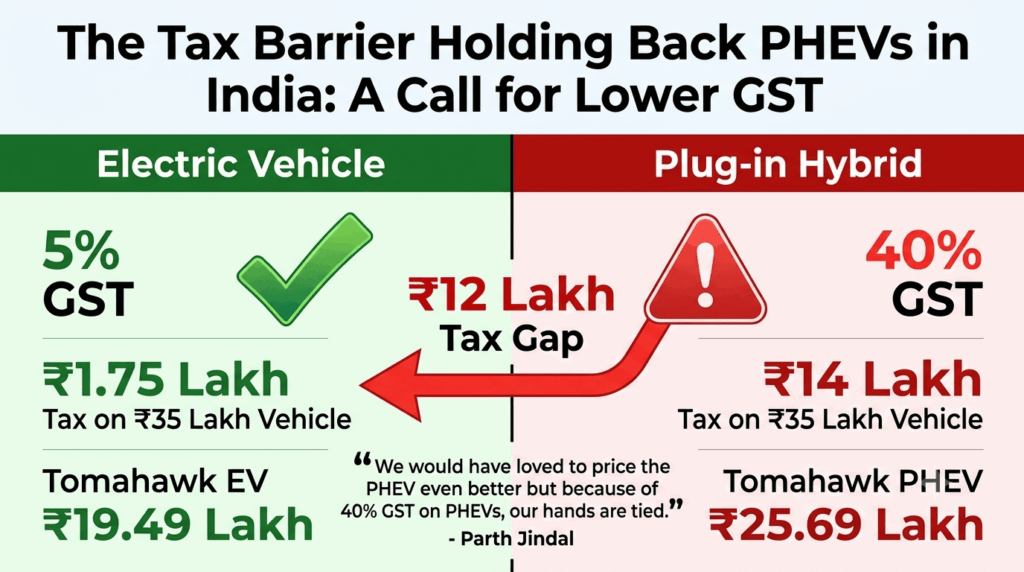
The ₹6.20 lakh gap between the two versions is not a reflection of manufacturing costs. It is a reflection of tax policy. While battery electric vehicles attract 5% GST, most plug-in hybrids are taxed at 40%, creating an effective tax gap of nearly ₹12 lakh on a ₹35-lakh vehicle.
This guide on the tax barrier holding back PHEVs in India: a call for lower GST provides the complete, honest analysis. It covers the 40% tax on PHEVs versus 5% on EVs, the ₹12 lakh tax gap, why JSW MG is lobbying for PHEV tax relief, the company’s 70% localisation target, and what a GST reduction could mean for India’s electrified vehicle market.
The Tax Arithmetic: 40% vs 5%
How India’s GST Structure Creates a Steep Toll for Plug-In Hybrids
The current rates:
Battery electric vehicles attract 5% GST, a concessional rate retained after the September 2025 GST 2.0 overhaul. In contrast, plug-in hybrids above the small-car category are taxed at 40%. This creates a 35-percentage-point differential with pure EVs.
The ₹12 lakh gap:
On a ₹35-lakh ex-factory vehicle, the arithmetic is stark. GST for a PHEV is approximately ₹14 lakh versus about ₹1.75 lakh for a BEV — an effective tax differential of nearly ₹12 lakh. This pushes PHEVs out of the ₹25-30 lakh mass-premium band and into the ₹40-50 lakh bracket.
The Hector Tomahawk example:
The Tomahawk PHEV is priced at ₹25.69 lakh, while the Tomahawk EV starts at ₹19.49 lakh. MG says the PHEV attracts 40% GST, limiting how aggressively it can price the vehicle. The two versions are not directly comparable variant for variant, but the gap shows the difficulty MG faces in making a PHEV attractive when battery-electric cars receive much more favourable taxation.
Jindal stated: “We would have loved to price the PHEV even better but because of 40% GST on PHEVs, our hands are tied”. Its pricing is shaped by the significantly higher GST applicable to hybrids. He said its PHEV version could effectively have been priced alongside the battery-electric Tomahawk but for the difference in taxation.
The structural divide:
The GST 2.0 reform removed the compensation cess that was previously layered on top of the base tax rate, simplifying calculations and trimming the overall burden on larger vehicles by a few percentage points. But the structural divide remains intact: 5% GST for BEVs and 40% for most PHEVs.
Why PHEVs Face 40% GST While EVs Pay Just 5%
The Government’s Classification Framework
The definitional distinction:
The government currently distinguishes between internal combustion engine vehicles, strong hybrids, PHEVs, range-extended electric vehicles (EREVs) and battery EVs based on what actually drives the drivetrain.
Jindal explained the government’s reasoning: “First of all there is ICE, then there is strong hybrid which is nothing but an improved ICE in terms of fuel efficiency. It’s taking your mileage up from 12-13 kmpl to 22-24 kmpl with improved efficiency, but the drivetrain is being operated by the engine, so it is an ICE. Third is PHEV where the drivetrain can drive with the battery separate and the engine separate, but the engine can still drive the drivetrain, so in the definition of the government, and this is what we have understood after studying CAFE 3 norms as well, it is still classified as an ICE”.
The EREV exception:
Jindal argued that an EREV, where the engine essentially acts as a generator for the battery, should receive EV-like treatment. “In my view and in the government’s view and NITI Aayog’s recommendation to the government, EREV should be considered as an EV,” he said. He pointed to the CAFE 3 framework, where EVs and EREVs have the same multiplier effect for CAFE credits, as a possible indication of the policy direction.
The counterargument:
The government’s counter-question will be whether a vehicle that can continue running on petrol deserves incentives close to those offered to a zero-tailpipe-emission EV. Any tax concession would also reduce government revenue and could encourage other manufacturers to seek similar treatment for different hybrid technologies.
JSW MG’s Lobbying Push: A Call for Lower GST
What the Company Is Asking For
The official position:
JSW MG Motor India is pushing for lower, differential taxation for plug-in hybrid electric vehicles and extended-range electric vehicles, arguing that lower taxes can accelerate new-energy vehicle adoption and help India move faster towards energy security. The company is not seeking a tax concession for itself, but wants the benefit passed on to consumers. “We don’t want any discount. We want the consumer to get a discount,” Jindal said.
The middle ground:
Jindal stopped short of seeking the same tax treatment as a pure EV, instead floating a middle ground. “Don’t make it 12%, make it 18%… But consumer should get it cheaper,” Jindal said.
The China comparison:
“In China, EVs, PHEVs and Range Extended EV (EREV) are all taxed at a similar rate, which has spurred adoption of such vehicles,” Jindal noted.
The industry engagement:
The industry is engaging with the government through the Society of Indian Automobile Manufacturers (SIAM). Jindal believes there is scope for a differentiated tax treatment for technologies based on how they power the vehicle. Jindal said MG would work with the government as these products enter the market to determine the appropriate GST treatment.
The adoption argument:
“If you make it less, the adoption will be faster,” Jindal said. The objective is to help India reach higher new-energy vehicle penetration. “It is not driven by profiteering. It is driven by the need that if we want to get to 30% or more, all these technologies that are available should be treated in a manner”.
Lower taxation would make these technologies more accessible and accelerate adoption. “That will allow for faster adoption of these technologies and we get to energy security faster than originally planned. That’s the idea,” Jindal said.
The Localisation Strategy: Reducing Costs Through Domestic Production
70% Localisation by 2027
The target:
JSW MG is targeting 70% localisation across its Windsor and Hector Tomahawk models by the end of 2027, adding roughly 2 to 3 percentage points every month. Battery cells, rare-earth magnets and some electronics are expected to remain imported. Cells alone account for around 20 to 23% of a vehicle’s content.
The investment:
JSW MG has invested approximately ₹3,500 crore in its India operations. Its plant in Halol, Gujarat, currently has annual capacity of 110,000 units, which will rise to 160,000 by March and 220,000 by January 2028. Vendors are investing another ₹2,500 crore. The company expects to cross sales of 95,000 vehicles this calendar year and is targeting 100,000 units, with managing director and CEO Anurag Mehrotra saying it aims to sustain annual volume growth of 35-40%.
The shareholder structure:
JSW owns 35% of the venture and SAIC 49%, with the balance held by Indian institutional investors, employees and dealers.
The Market Opportunity: What Lower GST Could Unlock
The Addressable Market
The diesel SUV opportunity:
The Tomahawk PHEV has no direct mass-market PHEV rival in India and will instead compete directly with diesel SUVs. JSW MG Managing Director Anurag Mehrotra explained the strategy: “If you look at the diesel C-sized market, it is about 40,000 units. The C-sized EV market is about 10,000. So, the total potential is 50,000”.
The running cost advantage:
MG estimates that covering 1,000 kilometres in the PHEV could cost ₹3,000-4,000 compared with ₹10,000-12,000 in a diesel SUV. “The plug-in hybrid will be close to a third of the cost of running a diesel,” Mehrotra remarked. Over the typical 18,000-20,000 kilometres annual driving, this translates to annual savings of approximately ₹1.26 lakh to ₹1.8 lakh. The payback period for the ₹1.5-2 lakh price premium is approximately one year.
The BaaS option:
MG’s Battery-as-a-Service offering for the PHEV brings the starting price down to ₹21.79 lakh ex-showroom, with a battery rental charge of ₹3.20 per kilometre. This significantly lowers the upfront cost of the vehicle, partially neutralising the tax disadvantage.
The sales target:
MG is targeting combined sales of 5,000-6,000 units a month for the Tomahawk PHEV and EV. The company has set an overall target of crossing 100,000 annual sales, with a balanced 50:50 production strategy across the 6,000-unit monthly capacity for EV and PHEV models. The roadmap includes achieving 70% localisation by the end of CY2027.
The Broader Context: PHEVs in India’s Electrification Journey
Bridge or Competitor?
The three-powertrain strategy:
MG’s argument is part of its broader three-powertrain strategy under its ADAPT platform, spanning battery EVs, plug-in hybrids and, eventually, extended-range EVs. A battery EV runs entirely on electricity and depends on external charging. A PHEV combines a rechargeable battery and electric motor with a petrol engine that can also drive the wheels. An EREV, by contrast, always uses its electric motor for propulsion; its petrol engine acts as an onboard generator, producing electricity when battery charge runs low.
The transition spectrum:
MG bets that India’s transition will be a spectrum: BEVs for buyers ready to depend entirely on charging infrastructure, PHEVs for those who want electric driving for daily commutes with the security of a petrol engine for long trips, and EREVs for those who want an EV driving experience without range anxiety.
The practical case:
The practical case for PHEVs is simple. An owner with home charging can complete many urban journeys using electricity. On a long trip, the petrol engine removes the need to plan every stop around a fast charger. That makes the technology useful during the transition to a larger public charging network.
The tax policy challenge:
But the benefit depends heavily on owner behaviour. A PHEV that is regularly charged can use its electric capability. One that is rarely plugged in carries a battery and electric motor while relying heavily on petrol, reducing the advantage. Tax policy therefore has to distinguish between the potential of the technology and how it is actually used.
The honest verdict:
Jindal acknowledged the government’s rationale: because a PHEV’s petrol engine can directly drive the wheels, it is treated as an internal-combustion vehicle rather than an EV. But he argued that the current tax structure puts PHEVs at a disadvantage to battery electric vehicles despite their ability to run predominantly in electric mode. The company is hopeful that the taxation framework could evolve as electrified technologies become more widespread.
What This Means for Today’s Buyers
The Practical Implications
If you are considering a PHEV:
The Tomahawk PHEV offers 115km of electric-only range and a combined range of over 1,100km. For daily commutes, it can operate as a pure EV. For long trips, the petrol engine eliminates range anxiety. The running costs are approximately one-third of a diesel SUV.
But the 40% GST means you are paying a significant tax premium. The full-vehicle price is ₹25.69 lakh, compared with ₹19.49 lakh for the EV. The BaaS option lowers the upfront price to ₹21.79 lakh with a battery rental of ₹3.20 per kilometre.
If you are a policy observer:
The PHEV tax debate is a test case for India’s electrification strategy. Should the government maintain the tax differential to prioritise pure EVs? Or should it rationalise PHEV taxation to accelerate the broader transition to new-energy vehicles? The outcome will shape the trajectory of India’s electrified vehicle market for years to come.
If you are waiting for lower PHEV prices:
JSW MG is actively lobbying for a GST reduction. If the government responds, PHEV prices could come down significantly. Jindal has suggested a middle ground of 18% GST, which would make PHEVs substantially more affordable.
Internal Links: Further Reading on Clean Energy Bazaar
The tax barrier holding back PHEVs in India: a call for lower GST guide connects to the EV market and policy guides on cleanenergybazaar.com.
For the MG Hector Tomahawk launch guide covering the full specifications and pricing, our MG Hector Tomahawk EV and PHEV launch: India’s first mainstream plug-in hybrid SUV guide covers the dual launch in detail. For the PHEV vs EV analysis covering whether plug-in hybrids are a bridge or a competitor, our PHEV vs EV: why India’s first mass-market plug-in hybrid could reshape the market guide covers the broader market implications. For the nation-by-nation BEV penetration ranking covering where India stands globally, our nation-by-nation BEV penetration ranking: Norway at 97.9%, Denmark at 80%, US at 5.9% guide covers the global EV adoption landscape.
Final Thoughts
The tax barrier holding back PHEVs in India: a call for lower GST — and the honest answer is that India’s tax policy is shaping the electrified vehicle market as much as consumer demand.
The numbers are stark. BEVs attract 5% GST. PHEVs face 40% GST. On a ₹35-lakh vehicle, that is approximately ₹14 lakh in GST for a PHEV versus about ₹1.75 lakh for a BEV — a gap of nearly ₹12 lakh. The Hector Tomahawk PHEV costs ₹6.20 lakh more than the EV version, not because of manufacturing costs but because of tax policy.
JSW MG is lobbying for a change. The company is not seeking the same tax treatment as pure EVs, but a middle ground — perhaps 18% GST. It argues that lower taxes would accelerate new-energy vehicle adoption and help India reach energy security faster.
The government’s counterargument is equally valid. A PHEV’s petrol engine can directly drive the wheels, so it is classified as an ICE vehicle. And any tax concession would reduce government revenue and could encourage other manufacturers to seek similar treatment.
The honest verdict: the PHEV tax debate is not about MG versus the government. It is about the shape of India’s electrification journey. Should the transition be EV-only, or should it embrace a spectrum of new-energy technologies? The answer will determine whether PHEVs remain a niche product or become a mainstream bridge to full electrification.