One of the quieter but commercially significant provisions of the European Commission’s December 2025 Automotive Package — overshadowed in most media coverage by the more politically dramatic 90% revision of the 2035 ICE ban — is the introduction of an entirely new vehicle category specifically designed to make small electric cars cheaper, simpler, and more commercially viable to produce and sell in Europe.
This new category, technically designated M1E in the EU’s vehicle type-approval framework, covers electric vehicles up to 4.2 metres in length and creates a specific regulatory environment for compact EVs that reduces the certification burden these vehicles carry relative to their size and market position. It is simultaneously a response to the competitive pressure of Chinese small EVs entering European markets, a recognition that the EU’s existing vehicle regulatory framework was inadvertently making small affordable EVs more expensive to produce than is justified by their actual risk profile, and a targeted industrial policy tool designed to stimulate demand for small EVs manufactured in Europe.
This guide on the EU’s Omnibus automotive proposal a new small and affordable EV category is coming provides the complete, honest analysis — what the M1E category specifically involves, why it was created, what it means for European consumers who want affordable small EVs, what it means for manufacturers who produce them, and the honest assessment of whether this regulatory innovation is sufficient to address the structural challenge of delivering genuinely affordable small EVs in the European market.
The Context — Why Small Affordable EVs Are a Problem in Europe
The Market Reality That Made the M1E Category Necessary
The shrinking small car segment:
The A and B segment small car sales volume in 2024 compared to 2019 declined by 1.6 million vehicles — a dramatic contraction in precisely the vehicle segment that has historically served as the entry point for car ownership for younger buyers, lower-income households, and urban drivers for whom a large vehicle is neither practical nor affordable. europa
This decline is not primarily a consumer preference shift away from small cars. It reflects the economic reality that small cars have become increasingly difficult to manufacture profitably under the EU’s regulatory framework — safety requirements, emissions testing costs, and type-approval expenses that were developed for the full vehicle fleet are disproportionately burdensome for small, low-cost vehicles where the regulatory compliance cost represents a higher percentage of total vehicle cost than for larger, more expensive vehicles.
The electrification problem for small cars:
The EV transition has amplified this challenge. An EV drivetrain — battery pack, motor, power electronics, thermal management — adds cost that can be absorbed proportionally more easily in a €40,000 vehicle than in a €15,000 vehicle. The result: the goal for manufacturers is to bring new small vehicles priced between €15,000 and €20,000 to the market, and since regulatory constraints also factor into the price, the EU is creating this new regulatory category. aol
The Chinese competition dimension:
Several carmakers have been pushing for regulatory change to support sales of small electric vehicles made in Europe, at a time when Chinese brands are starting to gain market share on their turf. The specific competitive threat from Chinese manufacturers — who have demonstrated the ability to produce small, affordable EVs at price points that European manufacturers struggle to match under current regulatory conditions — provides additional urgency to the M1E category’s development. aol
What the M1E Category Actually Is
The Specific Technical and Regulatory Content
The formal definition:
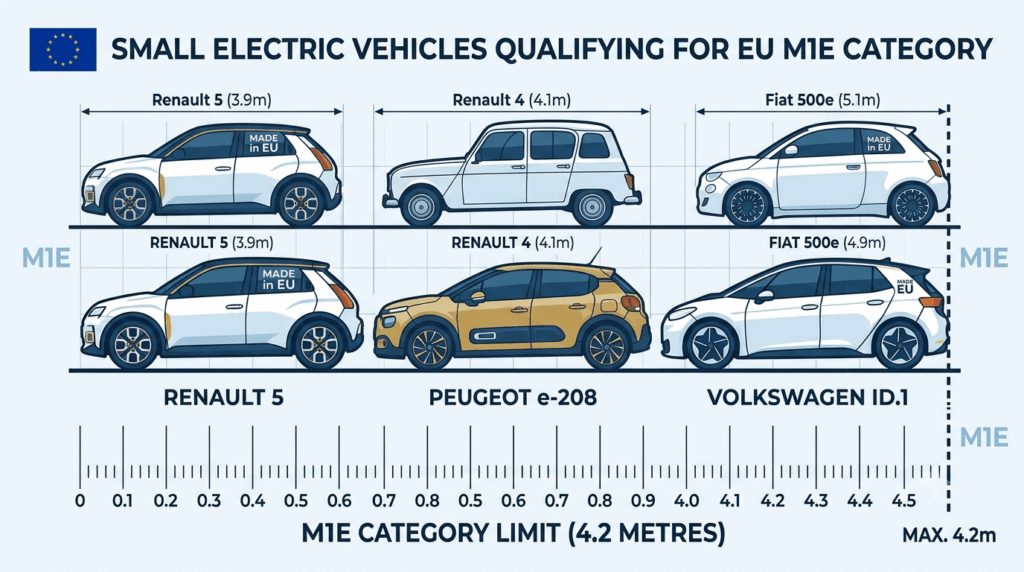
The Automotive Package introduces a new M1 sub-category (“M1E”) for small electric vehicles, defined by a maximum length of 4.2 metres. This length threshold encompasses what the automotive industry designates as A-segment (minicars) and B-segment (small cars) — the Renault Zoe, Fiat 500e, Peugeot e-208, Volkswagen e-up!, and equivalents all fall within this size envelope. Leaseurope
The four objectives the Automotive Omnibus addresses:
The four objectives of the Automotive Omnibus are: removing regulatory obstacles for electric light commercial vehicles (e-vans); reducing costs for Euro 7 emission tests; improving coherence and avoiding market fragmentation; and accelerating the uptake of small affordable electric vehicles. europa
The regulatory simplification the M1E category provides:
The Automotive Omnibus proposal aims to reduce administrative and testing burdens by consolidating and simplifying sector-specific rules, while simultaneously opening a new segment for compact electric vehicles. It introduces a new subcategory of small affordable cars, corresponding to compact electric vehicles (often referenced as an M1E-type concept), with a maximum length of around 4.2 meters and stable technical requirements for ten years. Electric Motor Engineering
This ten-year regulatory stability provision is particularly significant for manufacturers. Renault Group CEO François Provost recommended that automotive regulations in Europe be frozen for 10 to 15 years to encourage the emergence of this category. The Automotive Package’s specific commitment to stable technical requirements for a decade responds directly to this industry demand — manufacturers need regulatory predictability to amortise the development costs of platforms and components across a sufficient production volume to achieve price competitiveness. aol
The EV interoperability requirements:
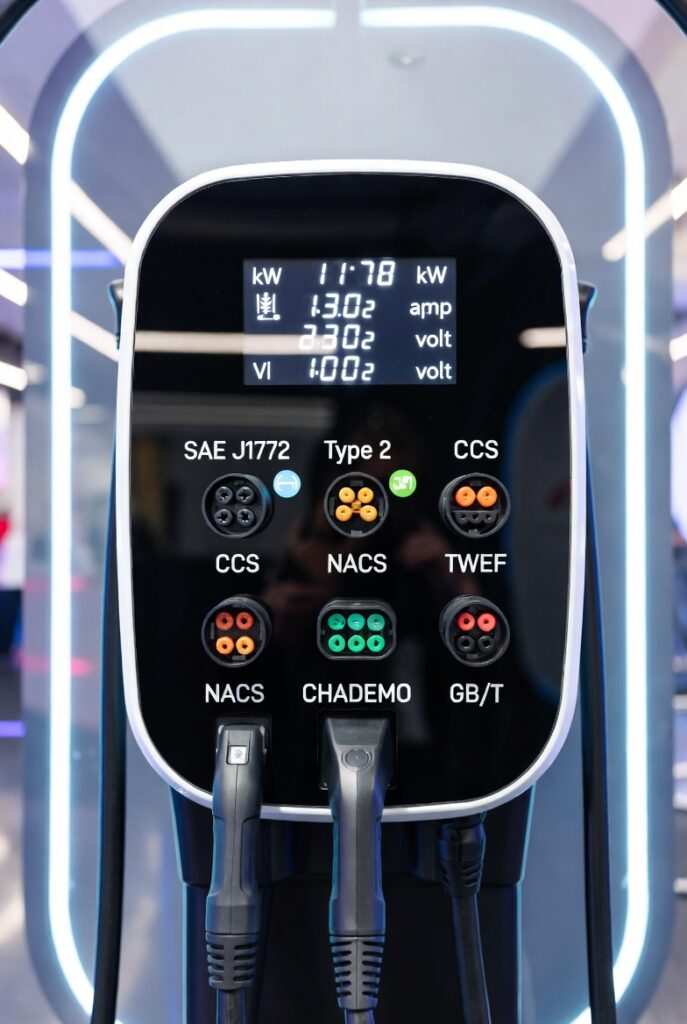
The Automotive Package includes new requirements to ensure interoperability between vehicles, charging infrastructure, and the electricity grid. This provision addresses one of the practical barriers to small EV adoption — the variability in charging compatibility that creates user experience friction, particularly for owners who rely on public charging infrastructure rather than home charging. Leaseurope
The van-specific provisions:
The proposed Directive amends existing EU rules on speed-limitation devices to exempt certain electric light commercial vehicles. Specifically, batteries for EVs classified as N2 solely due to battery weight, and with a maximum permissible mass between 3.5 and 4.25 metric tons, would no longer be required to install or use speed-limitation devices. This exemption is intended to place electric vans on an equal footing with their ICE equivalents. Global Policy Watch
This provision addresses a specific regulatory perversity: electric vans that exceed the 3.5-tonne N1 weight threshold solely because of battery weight were previously subject to N2-category speed limitation requirements that their ICE equivalents don’t face — effectively penalising EV vans for the weight of their electrification.
The Super-Credits for Small Affordable EVs
The CO₂ Compliance Incentive That Makes M1E Commercially Attractive
The manufacturer incentive structure:
The Automotive Package adds incentives for electrification by introducing “super-credits” for small affordable EVs built in Europe, setting EV mandates for corporate fleets with only EU-made cars eligible for public incentives, and earmarking EUR 1.8 billion to boost domestic battery production. CMS
The super-credits mechanism — allowing manufacturers to count small affordable EVs produced in Europe at more than 1:1 weight in their CO₂ fleet average calculations — creates a specific financial incentive for manufacturers to produce M1E-category vehicles domestically rather than importing them. A manufacturer who produces a qualifying small European EV receives enhanced credit toward their CO₂ compliance target, directly improving the economics of producing small EVs in European factories.
The Made-in-EU conditionality:
Zero- or low-emissions vehicles must be “Made in the EU” to benefit from public financial support. This conditionality is the explicit industrial policy dimension of the Automotive Package — the preferential regulatory and financial treatment is structured specifically to benefit European manufacturing rather than providing equivalent benefits to imported vehicles including Chinese-manufactured EVs. CMS
This Made-in-EU conditionality is controversial. Consumer advocates argue it restricts buyer choice and potentially maintains higher prices by limiting competition from imported alternatives. Domestic industry advocates argue it is essential for maintaining European automotive manufacturing employment through the transition and for ensuring that European public support builds European industrial capacity rather than subsidising foreign manufacturing.
What the M1E Category Means for Different Stakeholders
The Manufacturer, Consumer, and Policy Impact Assessment
For European automotive manufacturers:
The M1E category provides the regulatory framework that manufacturers have specifically been requesting to make small EV production economically viable. A predictable regulatory envelope for small EV platforms allows OEMs and Tier-1s to amortise the development of compact e-drives, motors and gearboxes across a decade without frequent homologation changes. Electric Motor Engineering
Renault’s specific position: Renault has been among the most vocal advocates for this regulatory change, with the Renault 5 E-Tech — priced from approximately €25,000 and targeting the affordable small EV segment — directly benefiting from the M1E framework. Renault’s Ampere EV division has built its product strategy around exactly this size and price point.
Stellantis’s position: Stellantis’s European small car brands — Fiat (500e, the forthcoming Pandina EV), Peugeot (e-208, forthcoming e-106), Citroën (ë-C3, ë-Berlingo) — represent the largest portfolio of small EVs that the M1E framework directly supports. The reduced certification cost per vehicle across this portfolio could meaningfully improve small EV economics.
Volkswagen Group’s position: VW’s e-up! and the forthcoming ID.1/ID.2 small EV platform — designed specifically for the affordable small EV segment at a target price of under €25,000 — benefit from the M1E framework’s simplified certification approach.
For European EV buyers:
The honest assessment of what the M1E category means for consumers requires distinguishing between what it enables in principle and what it delivers in practice over what timeline:
In principle: Simplified certification reduces per-vehicle regulatory compliance costs, which in competitive markets should translate into lower vehicle prices. If regulatory compliance cost reduction is €1,000-€2,000 per vehicle for small EVs (a reasonable estimate for the administrative simplification involved), this could bring genuinely affordable small EVs to the €15,000-€18,000 price point that the Commission’s target references.
In practice: Manufacturer pricing decisions are driven by multiple factors beyond regulatory compliance costs. Battery costs, labour costs, supply chain economics, and competitive positioning all influence final vehicle pricing. There is no guarantee that regulatory compliance cost reductions pass through fully to consumer prices rather than being absorbed as margin improvement.
The timeline reality: The M1E framework is a December 2025 proposal that must pass through the European Parliament and Council before becoming law — a process that typically takes 12-24 months for automotive-specific regulations. The first M1E-category vehicles designed specifically around the new framework’s reduced requirements are therefore unlikely to reach consumers before 2028-2029 at the earliest.
For charging infrastructure:
The EV interoperability requirements within the Automotive Package address a specific consumer pain point — the experience of arriving at a public charging station and encountering compatibility issues that shouldn’t exist given the AFIR’s standardisation requirements. By extending interoperability requirements at the vehicle-infrastructure interface, the Package reduces one of the practical barriers to small EV adoption that affects buyers who rely on public charging.
The Chinese Competition Response
How the M1E Category Fits Into Europe’s China EV Strategy
The competitive context the M1E category is designed for:
Chinese EV manufacturers have demonstrated the ability to produce small, affordable EVs at price points that European manufacturers have found difficult to match. The BYD Seagull (available internationally at approximately €12,000-€15,000), the Wuling Air EV, and various Chery and SAIC small EVs have established proof of concept for the price point that the EU’s M1E category is trying to make accessible for European-manufactured vehicles.
The tariff-plus-regulation strategy:
The EU’s approach to Chinese EV competition involves two parallel instruments: the 25-35% additional tariffs on Chinese EV imports imposed in 2024, and the M1E regulatory framework that reduces the cost disadvantage European manufacturers face in producing small affordable EVs domestically. The tariffs protect market access; the M1E framework improves the economics of the European manufacturing that should fill the protected market access.
The honest assessment of whether this is sufficient:
The tariff plus M1E framework may narrow but is unlikely to fully close the cost gap between Chinese-manufactured small EVs and European-manufactured equivalents. Battery supply chain advantages, labour cost differentials, and manufacturing scale differences between Chinese and European automotive sectors represent structural cost differences that regulatory simplification alone cannot overcome.
The M1E framework’s most important contribution may be less about price competitiveness and more about enabling a viable small EV category to exist in European manufacturing at all — creating the industrial base and platform investment that could, over time and at scale, approach the cost efficiency that Chinese manufacturers currently demonstrate.
The Battery Booster — The Supply Chain Dimension
The €1.8 billion battery investment:
The Automotive Package earmarks EUR 1.8 billion to boost domestic battery production. The Battery Booster strategy — the non-legislative component of the December 2025 Automotive Package — addresses the supply chain prerequisite for M1E category vehicles: affordable small EVs require affordable batteries, and affordable European batteries require a European battery manufacturing ecosystem that can compete with the Asian supply chains that currently dominate. CMS
The €1.8 billion earmarking is a meaningful signal but insufficient at the scale required for European battery supply chain development at the level China has achieved. The European gigafactory investments covered in our EU 2035 mandate guide — Northvolt, ACC, CATL’s European facilities — represent the industrial base the Battery Booster strategy supports, and their success is a prerequisite for the M1E category’s long-term commercial viability.
The Regulatory Timeline
When M1E Becomes Operational
The legislative process ahead:
The December 2025 Automotive Package is a Commission proposal requiring:
European Parliament consideration and vote — typically 12-18 months for automotive-specific regulations with significant industrial employment implications
Council of the EU consideration — running in parallel with Parliament but requiring coordination between member states with varying interests (automotive manufacturing-heavy Germany, France, and Italy versus less manufacturing-intensive Nordic and Eastern European states)
Trilogue negotiation between Commission, Parliament, and Council — typically 6-12 months to resolve differences
Realistic M1E implementation timeline:
Commission proposal: December 2025
Parliament/Council adoption: 2027 (realistic estimate)
Transitional period for manufacturer adaptation: 12-24 months
First M1E-category vehicles reaching consumers: 2028-2029
This timeline means the M1E category’s consumer impact is a medium-term development rather than an immediate one. European EV buyers in 2026 will not yet benefit from M1E-category vehicles — the framework is being built for a product generation that is still being designed.
Internal Links — Further Reading on Clean Energy Bazaar
The EU’s Omnibus automotive proposal a new small and affordable EV category is coming guide connects to the European EV policy and global market guides on cleanenergybazaar.com.
For the EU 2035 ICE ban softening guide that covers the broader Automotive Package context within which the M1E category sits, our EU 2035 ICE ban softened to 90 percent guide covers the complete Package analysis. For the US state EV policy scorecard that provides the American policy contrast to Europe’s regulatory approach, our US state EV policy scorecard guide covers American state-level EV policy. For the NACS vs ChaoJi standards guide covering the connector interoperability standards that the Automotive Package’s EV interoperability provisions relate to, our Tesla NACS vs ChaoJi super-standard battle guide covers the global standards landscape. For the Chinese EV market guides covering the BYD and SAIC small affordable EVs that the M1E category is designed to compete with, our Chinese market content cluster covers the competitive reference products in detail.