You connect your vehicle as usual, expect charging to begin, and instead your charger’s display or app shows E-07 — or E-03, or CP Fault, or 漏电保护, or any of the dozens of specific error codes that Chinese GB/T-compliant home EV chargers produce when something interrupts the standard charging sequence.
What does E-07 actually mean? Is it serious? Can you reset it yourself? Does it indicate a hardware fault that requires professional service? Could the same code on a StarCharge S1 mean something different from E-07 on an Autel MaxiCharger? And why does the same vehicle produce one error code at home but charge fine at a public station?
This guide on error code E-07 what Chinese GB/T charger faults mean and how to reset provides the complete diagnostic framework — the GB/T standard’s underlying fault architecture that determines what all these codes represent at a technical level, the specific error code presentations and their meanings across China’s major home charger brands, the systematic reset procedure that resolves the majority of fault conditions without professional service, and the honest diagnostic assessment of which fault codes indicate genuine hardware problems requiring professional attention versus which are transient conditions that resolve through simple steps.
Understanding E-07 Specifically — And Why the Number Matters Less Than the Category
The Critical First Point About Chinese EV Charger Error Codes
The honest framing that prevents the most common diagnostic mistake:
Before building a comprehensive error code reference, the most important single point about Chinese GB/T home charger error codes must be stated clearly: the specific number in any error code (E-07, E-03, E-12, etc.) does not have a standardised meaning across different charger brands.
Unlike the OBD-II diagnostic codes used in vehicle engine management (where P0301 means cylinder 1 misfire on any OBD-II vehicle regardless of manufacturer), Chinese home EV charger error codes are brand-specific implementations. A StarCharge S1 showing E-07 indicates a different specific fault condition from an Autel MaxiCharger showing E-07, which indicates a different condition from a Xiaomi EV Charger showing E-07.
What is standardised — through the GB/T 20234.2 and GB/T 20234.3 standards and through the broader IEC 61851 framework that Chinese charging standards incorporate — is the underlying fault category structure that all compliant chargers must implement. The specific number assigned to each fault category is a manufacturer choice; the fault category itself is standardised.
The practical implication:
This guide provides:
- The standardised fault category framework that allows you to understand any Chinese charger’s error codes conceptually, regardless of specific brand
- Brand-specific error code tables for major Chinese home charger brands with the specific numbers assigned to each fault category
- A universal reset procedure that addresses the most common fault conditions regardless of which specific code they produce
- The diagnostic decision tree that determines whether any specific fault condition warrants self-reset, investigation, or professional service
The GB/T Standard Fault Category Architecture
The Seven Fundamental Fault Categories Every Compliant Chinese Charger Implements
Understanding these categories is the key to interpreting any Chinese home charger error code:
Fault Category 1: Control Pilot Signal Faults (CP故障)
What this covers: The control pilot signal is the fundamental communication mechanism between a GB/T 20234.2-compliant AC charger and the vehicle — a specific voltage and PWM signal that the charger uses to communicate available charging current to the vehicle, and that the vehicle uses to signal its readiness to charge.
What causes CP faults:
Connection faults — the most common cause: the GB/T connector is not fully inserted and mechanically locked into the vehicle’s charging port. The control pilot circuit requires physical contact across all relevant pins, and any partial engagement breaks the CP signal continuity.
Cable damage — physical damage anywhere along the charging cable can interrupt the CP signal wire within the cable bundle, producing CP fault indication even when the power conductors are intact.
Vehicle-side OBC fault — if the vehicle’s onboard charger is experiencing its own fault condition, it may not respond correctly to the CP signal, producing what appears to be a CP signal fault from the charger’s perspective when the underlying cause is vehicle-side.
Charger control pilot circuit fault — less commonly, the charger’s own CP signal generation circuit develops a fault, producing CP error even with a known-good cable and vehicle.
Typical error code representations across brands:
StarCharge S1: E01, 连接故障
Autel MaxiCharger: CP Error, E-01
Xiaomi EV Charger: 连接异常 E1
Huawei FusionCharge: CP Signal Fault, typically E001
TELD residential: E1, 通信故障
Fault Category 2: Ground Fault / RCCB Trip (漏电保护/接地故障)
What this covers: Detection of current leakage to earth beyond the RCCB’s trip threshold — the safety mechanism our fire safety guide and professional installation guide identified as the most important protective function in EV charging equipment.
What causes RCCB trip faults:
Genuine moisture ingress — the most common cause in Chinese underground car parks, particularly in South China humid climate conditions documented in our weatherproof guide and furnace city guide
Vehicle-side ground fault — originating from the vehicle’s own electrical system rather than the charger or cable
Cable insulation damage — physical damage creating a ground fault path at any point in the cable run
Charger internal fault — moisture or component failure within the charger itself creating internal ground fault
Typical error code representations:
StarCharge S1: E05, 漏电保护
Autel MaxiCharger: RCD Trip, GFCI Fault, E-05
Xiaomi EV Charger: 漏电故障 E5
Huawei FusionCharge: RCD Trip, E005
TELD residential: E5, 漏电保护动作
Fault Category 3: Overcurrent / Overload Fault (过流/过载保护)
What this covers: Detection of current draw exceeding the charger’s or circuit’s rated capacity — the load management condition covered extensively in our load balancing guide.
What causes overcurrent faults:
Combined household and EV load exceeding panel capacity — the specific dual-load scenario our load balancing and case study guides documented
Vehicle OBC drawing more current than the charger’s rated output — rare with compliant vehicles but possible if vehicle-side OBC communication errors cause incorrect current negotiation
Charger internal component fault — internal short circuit or component failure producing overcurrent
Typical error code representations:
StarCharge S1: E08, 过流保护
Autel MaxiCharger: Overcurrent, E-08
Xiaomi EV Charger: 过载保护 E8
Huawei FusionCharge: Overcurrent E008
TELD residential: E8, 过流
Fault Category 4: Overvoltage / Undervoltage Fault (过压/欠压保护)
What this covers: Detection of grid voltage outside the charger’s specified acceptable input range — the rural grid voltage fluctuation condition documented in our user stories guide (Teacher Zhao’s Yunnan experience) and our tier 1 vs tier 2 city guide.
What causes voltage faults:
Rural grid instability — voltage fluctuations from agricultural equipment, irrigation pumps, or other rural electrical loads creating voltage excursions outside the charger’s acceptance window
Urban grid events — lightning-related voltage transients, grid switching events, or shared transformer loading causing temporary voltage excursions
Charger internal voltage sensing fault — the charger’s own voltage measurement circuit developing inaccuracy, causing false voltage fault reporting
Typical error code representations:
StarCharge S1: E09, 过/欠压保护
Autel MaxiCharger: Overvoltage/Undervoltage, E-09
Xiaomi EV Charger: 电压异常 E9
Huawei FusionCharge: Voltage Fault E009
TELD residential: E9, 电压异常
Fault Category 5: Temperature Fault (温度保护)
What this covers: Detection of charger internal temperature outside the safe operating range — both the extreme cold scenario documented in our winter charging guide and the extreme heat scenario documented in our furnace city guide.
What causes temperature faults:
Extreme cold (below rated operating temperature) — the Harbin and northeast China scenario requiring -30°C rated equipment
Extreme heat (above rated operating temperature) — the Wuhan and Chongqing furnace city scenario where charger enclosure temperature exceeds the electronics’ rated range
Ventilation blockage — accumulated dust or debris blocking the charger’s thermal management provisions, causing internal temperature rise at ambient temperatures within normal range
Charger internal component fault — component failure causing abnormal heat generation within the charger independent of ambient temperature
Typical error code representations:
StarCharge S1: E10, 温度保护
Autel MaxiCharger: High/Low Temp, E-10
Xiaomi EV Charger: 温度异常 E10
Huawei FusionCharge: Temperature Fault E010
TELD residential: E10, 温度保护
Fault Category 6: Communication / Network Fault (通信故障)
What this covers: Failure of the charger’s smart connectivity — WiFi disconnection, cloud service unavailability, OCPP communication failure — that affects app-controlled features while potentially leaving basic charging function intact.
What causes communication faults:
WiFi signal loss — the underground car park WiFi range limitation that our case study guide documented as the specific problem requiring the WiFi extender solution
Cloud service unavailability — the charger manufacturer’s cloud backend experiencing downtime, maintenance, or (in the zombie pile scenario) permanent cessation
OCPP server disconnection — for chargers enrolled in demand response programmes, the OCPP platform experiencing connectivity issues
Router or ISP issues — home internet service disruption affecting the charger’s WiFi connection
Typical error code representations:
StarCharge S1: E02, 通信异常 (often specifically flagged in app rather than on physical unit)
Autel MaxiCharger: Network Error, E-02, WiFi fault
Xiaomi EV Charger: 网络连接失败 E2
Huawei FusionCharge: Communication Fault E002
TELD residential: E2, 通信故障
Fault Category 7: E-07 and Vehicle-Side Reported Faults (车辆侧故障)
What E-07 specifically represents across the major Chinese charger brands:
E-07 occupies a specific position in the fault category architecture that this guide has been building toward — it is the error code that multiple major Chinese charger brands assign to vehicle-side reported faults: fault conditions where the charger’s own hardware is functioning correctly, but the vehicle’s battery management system is reporting a fault condition through the GB/T communication protocol that causes the charger to halt the charging session.
StarCharge S1 E-07:
StarCharge’s E-07 specifically indicates a vehicle-side BMS fault — a condition where the vehicle’s battery management system has reported a specific fault code through the CAN bus communication of the GB/T 20234.3 DC session (or, in some StarCharge models, an OBC communication fault in the GB/T 20234.2 AC session) that has caused the charger to halt the charging session in response to the vehicle’s reported condition.
Autel MaxiCharger E-07:
Autel’s E-07 (or equivalent code in their numbering) similarly indicates a vehicle-communication-related fault — specifically in some Autel firmware versions, E-07 represents a charging pilot state transition error where the vehicle has not progressed through the expected GB/T charging state machine sequence within the expected timeframe.
Xiaomi EV Charger E-07:
Xiaomi’s implementation assigns E-07 to a similar vehicle-communication category, with the specific nuance that Xiaomi’s HyperOS integration sometimes provides additional diagnostic detail through the Mi Home app about whether the fault originated from the vehicle’s battery state, the OBC communication, or the charging protocol state machine.
The important general point about E-07:
Regardless of which specific aspect of vehicle-side communication E-07 represents in your specific brand’s implementation, the diagnostic implication is consistent: the fault’s origin is likely vehicle-side rather than charger-side, and the primary diagnostic questions are:
Does the vehicle show its own error state in the vehicle app or dashboard display?
Does the same vehicle charge successfully at public charging stations or with a different charger?
Has the vehicle recently experienced any unusual operating conditions (impact, extreme temperature exposure, deep discharge) that might have caused a BMS fault?
The E-07 Specific Diagnostic Protocol
Step-by-Step Diagnosis for the Most Common Presented Fault
Why E-07 specifically deserves dedicated diagnostic attention:
E-07 is disproportionately represented in Chinese EV owner forum discussions of home charger problems, for a specific reason: it is the error code that most commonly presents when the fault is actually vehicle-side rather than charger-side. Owners who correctly troubleshoot Fault Categories 1-6 (connection check, RCCB reset, load assessment, voltage check, temperature check, WiFi check) but find none of these resolves their fault are often experiencing E-07 — the category where the charger itself is reporting a problem that originates elsewhere.
The E-07 diagnostic sequence:
Step 1: Check the vehicle’s own display and app
Before any charger intervention, check:
Vehicle’s dashboard display for any warning lights or error messages related to the battery or charging system
Vehicle manufacturer app (BYD app, NIO Life, Xpeng app, Mi Car, etc.) for any active alerts or fault conditions
Vehicle’s recent charging history in the app — has the vehicle charged successfully at other locations recently?
If the vehicle shows its own active fault condition: the E-07 is a secondary effect of a vehicle-primary fault. Address the vehicle fault (potentially through vehicle manufacturer service) rather than focusing on the charger.
If the vehicle shows no fault condition: proceed to Step 2.
Step 2: Try charging at a different location
If available, attempt to charge the same vehicle at a different charger — either a public AC charging station or a different home charger — and note whether the same E-07 condition occurs.
If E-07 occurs at a different charger also: the fault is almost certainly vehicle-side. The vehicle requires assessment by an authorised service centre.
If charging succeeds at the different location: the fault may be an interaction between the specific charger and the specific vehicle rather than a unilateral fault in either, and the charger’s compatibility with the vehicle’s OBC communication should be assessed.
Step 3: Try charging a different vehicle at the same charger
If a different EV is available (household with two vehicles as covered in our dual-EV case study, or a neighbour’s vehicle with agreement), attempt to charge it at the same charger that is showing E-07.
If the second vehicle charges successfully: the fault interaction is specific to the original vehicle with this specific charger — see Step 4.
If the second vehicle also shows a fault: the charger’s own communication circuitry may have developed a fault that produces incorrect signals to any vehicle — warranting professional charger assessment.
Step 4: Check for vehicle-charger compatibility issues
For specific vehicle and charger combinations where E-07 appears consistently with one vehicle but not another, the potential causes include:
Firmware version mismatch — the charger’s GB/T communication protocol implementation may have a compatibility issue with a specific vehicle model’s OBC firmware version that didn’t exist when both products were first released but has emerged through subsequent firmware updates on either side
Charging cable quality — for portable EVSE scenarios, cable quality affecting communication signal integrity
Physical connector condition — connector pin condition at either the charger or vehicle end affecting communication signal quality
Step 5: Firmware update check
For both the charger and the vehicle:
Check whether the charger has a pending firmware update available through its app — firmware updates sometimes address specific vehicle compatibility issues that manifest as communication faults
Check whether the vehicle has a pending OTA update that addresses charging communication issues — vehicle OTA updates that specifically mention charging improvements sometimes address E-07-type communication fault conditions
The Universal Reset Procedure
The Systematic Reset Sequence That Resolves Most Fault Conditions
Why the reset sequence matters:
A simple “turn it off and turn it back on” approach to EV charger fault reset — disconnecting the vehicle and restarting the charger — resolves many transient fault conditions but misses the diagnostic value that the systematic sequence provides. The systematic sequence uses each reset step as a diagnostic test, narrowing the fault category.
The five-step universal reset sequence:
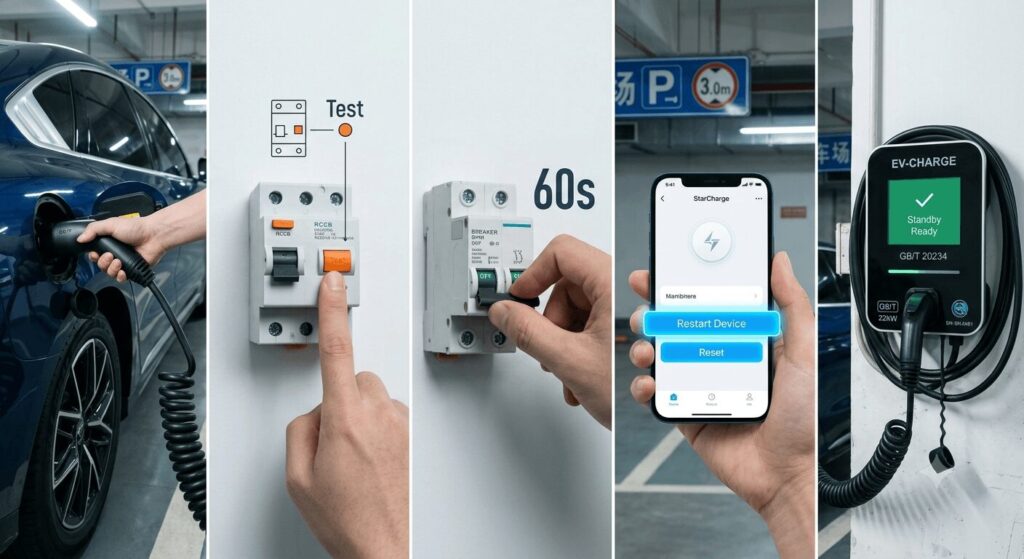
Reset Step 1: Vehicle connector disconnect and reconnect
Disconnect the charging connector from the vehicle’s charging port. Wait 30 seconds. Reconnect the connector, ensuring full mechanical engagement with audible/tactile confirmation of the locking mechanism.
What this tests: Fault Category 1 (CP signal fault from incomplete engagement). If the fault clears with this step, the fault was connection-related.
If fault clears: No further steps required. Monitor for recurrence — frequent recurrence suggests connector wear on either the charger or vehicle end requiring inspection.
If fault persists: Proceed to Step 2.
Reset Step 2: RCCB check and reset
Locate the RCCB in the charging circuit (either integrated into the charger body — visible as a test button — or in the dedicated circuit breaker box). Press the test button to deliberately trip the RCCB, then reset it (switch from OFF back to ON position).
What this tests: Confirms the RCCB is functional and resets any latched ground fault condition. Note whether the RCCB trips again immediately upon reset — immediate retrip indicates an ongoing ground fault condition that warrants investigation before continued use.
If RCCB resets and holds: Attempt to reconnect the vehicle and initiate charging. If fault clears, the RCCB may have tripped from a transient condition.
If RCCB immediately retrips: Stop the charging attempt. This indicates an active ground fault condition that requires investigation per the Fault Category 2 diagnostic guidance above. Do not continue using the charger until the fault is investigated.
If fault persists without RCCB issue: Proceed to Step 3.
Reset Step 3: Main circuit breaker power cycle
Locate the circuit breaker for the dedicated EV charging circuit (separate from the RCCB — the MCB or RCBO that protects the circuit). Switch to OFF position. Wait 60 seconds. Switch back to ON position.
What this tests: Full power cycle of the charger’s electronics, clearing any transient fault latch in the charger’s control system that the charger-level reset in Step 1 didn’t clear.
Note: Some charger brands specify this as the official “reset” procedure and describe it in their documentation as “circuit breaker power cycle reset.” The 60-second wait is important — capacitors within the charger’s electronics need time to discharge before power is restored for a complete electronics reset.
If fault clears after power cycle: The fault was a transient condition latched in the charger’s control electronics. Monitor for recurrence — a single occurrence without recurrence is not a concern; repeated recurrence warrants further investigation.
If fault persists: Proceed to Step 4.
Reset Step 4: Brand-specific software reset
Each major charger brand’s app includes a specific software reset function — separate from the hardware power cycle:
StarCharge (星星充电 app): Settings → Device Management → [charger name] → Reset Device
Autel (Autel Charge app): Charger Settings → Diagnostics → Restart Charger
Xiaomi (Mi Home app): Device → [charger name] → Settings → Restart
Huawei (FusionCharge app): Charger Management → Advanced Settings → System Restart
TELD app: 我的设备 → [设备名] → 重启设备
What this tests: Cloud-side session state reset — clearing any session state maintained in the charger’s cloud backend that may be producing incorrect fault indication for a session that has already ended physically but hasn’t been correctly terminated in the cloud record.
If fault clears after software reset: The fault was a cloud-side session state issue. This may occur after WiFi disconnection during a charging session — the cloud backend may have an “active session” record for a session that the hardware terminated locally, which then blocks new session initiation.
If fault persists: Proceed to Step 5.
Reset Step 5: Charger factory reset (last resort)
Factory reset procedures — which clear all configuration including WiFi credentials, OCPP settings, and TOU schedules — should only be applied after the first four steps have failed to resolve the fault. The procedure varies by brand:
StarCharge: Hold the physical button on the charger unit for 10+ seconds until indicator flashes in reset pattern
Autel: In app: Settings → Factory Reset, or on unit: specific button combination documented in the product manual
Xiaomi: Mi Home → Device → Delete Device (then re-add)
Huawei: FusionCharge app → Factory Reset (requires re-enrollment in FusionSolar ecosystem after)
TELD: Contact TELD customer service — factory reset on TELD residential chargers requires customer service authorisation in most cases
If fault persists after all five reset steps:
The fault indicates either a genuine hardware fault in the charger requiring professional assessment, or a vehicle-side fault that the charger cannot resolve through any reset procedure. At this point, professional assessment is the appropriate next step.
The Brand-Specific Error Code Quick Reference
The Consolidated Code Table for Major Chinese Charger Brands
StarCharge S1 Error Code Reference:
| Code | Category | Common Cause | First Response |
|---|---|---|---|
| E01 | CP / Connection fault | Incomplete connector engagement | Reconnect fully |
| E02 | Communication fault | WiFi disconnection | Check router, WiFi extender |
| E03 | OBC communication | Vehicle-side communication | Check vehicle app |
| E04 | Charging protocol | State machine fault | Power cycle reset |
| E05 | Ground fault / RCCB | Moisture, cable damage | RCCB check, stop if retrips |
| E06 | Short circuit | Cable or connector damage | Professional assessment |
| E07 | Vehicle BMS fault | Vehicle-reported fault | Check vehicle app first |
| E08 | Overcurrent | Circuit overload | Check household load |
| E09 | Voltage fault | Grid voltage issue | Check voltage, rural grid |
| E10 | Temperature | Extreme heat or cold | Allow normalisation |
| E11 | Meter communication | Smart meter comm failure | Contact SGCC if persistent |
| E12 | Hardware fault | Internal component failure | Professional service |
Autel MaxiCharger Error Code Reference:
| Code | Display Text | Category | Common Cause | First Response |
|---|---|---|---|---|
| E-01 | CP Error | CP / Connection | Connector, cable | Reconnect, inspect cable |
| E-02 | Network Error | Communication | WiFi, cloud | Router check |
| E-03 | Comm Error | Protocol | State machine | Power cycle |
| E-04 | Auth Error | OCPP authentication | OCPP config | Check OCPP settings |
| E-05 | RCD Trip | Ground fault | Moisture, damage | Stop if retrips |
| E-06 | Short Circuit | Short | Cable damage | Professional |
| E-07 | BMS Error | Vehicle fault | Vehicle-side | Vehicle app check |
| E-08 | Overcurrent | Overload | Circuit load | Load assessment |
| E-09 | Voltage Error | Voltage | Grid stability | Check voltage |
| E-10 | Temp Error | Temperature | Environment | Normalise temp |
| E-11 | Meter Fault | Metering | Meter comm | Contact installer |
| E-FF | Unknown Fault | Unclassified | Various | Power cycle, then service |
Xiaomi EV Charger Error Code Reference:
| Code | Chinese Display | Category | Common Cause | App Guidance |
|---|---|---|---|---|
| E1 | 连接异常 | Connection | Incomplete connection | Reconnect |
| E2 | 网络故障 | Communication | WiFi | Mi Home network check |
| E3 | 充电通信 | Protocol | OBC comm | Vehicle check |
| E4 | 认证失败 | Authentication | App/cloud auth | Re-login Mi Home |
| E5 | 漏电故障 | Ground fault | Moisture | Stop immediately |
| E6 | 短路保护 | Short circuit | Cable | Professional |
| E7 | 车辆故障 | Vehicle fault | BMS fault | Vehicle app |
| E8 | 过载保护 | Overcurrent | Panel load | Reduce household load |
| E9 | 电压异常 | Voltage | Grid | Check voltage |
| E10 | 温度异常 | Temperature | Environment | Ventilation check |
Huawei FusionCharge Error Code Reference:
| Code | Display | Category | Additional Huawei Context |
|---|---|---|---|
| E001 | CP Fault | Connection | AI may diagnose specific sub-cause |
| E002 | Comm Fault | Communication | AI network diagnostic available |
| E003 | Protocol Fault | State machine | AI provides session log |
| E005 | RCD Trip | Ground fault | AI humidity correlation check |
| E007 | BMS Fault | Vehicle fault | AI provides battery state analysis |
| E008 | Overcurrent | Overload | AI load history analysis |
| E009 | Voltage Fault | Grid voltage | AI voltage history chart |
| E010 | Temp Fault | Temperature | AI climate correlation |
| E012 | Hardware | Internal fault | AI escalates to Huawei service |
When Error Codes Mean Professional Service Is Required
The Specific Code Patterns That Indicate Hardware Faults Beyond Reset
Codes that should trigger immediate cessation and professional assessment:
Ground fault (Category 2 / E-05 series) that retrips immediately after RCCB reset:
As documented in our installation horror stories guide and fire safety guide, an RCCB that retrips immediately after reset indicates an active, ongoing ground fault condition that is not a transient event. Using the charger with a persistent ground fault is a genuine safety risk that neither DIY reset nor continued monitoring resolves — it requires professional assessment to identify and address the fault source.
Short circuit codes (Category approximately E-06):
Short circuit detection indicates a direct conductor-to-conductor or conductor-to-earth fault of sufficient magnitude that it triggered the circuit protection beyond the RCCB. This level of fault typically indicates cable damage (physical insulation failure allowing conductors to contact each other or earth) that requires cable replacement and assessment of how the damage occurred.
Hardware fault codes (E-12 or brand equivalent):
Internal hardware fault codes — where the charger’s own diagnostics have identified a fault within its own electronics rather than an external condition — generally require professional assessment or warranty claim processing. These codes are not resolvable through reset procedures because the fault is within the charger’s own components.
Recurring faults on the same code:
A fault code that resolves through reset but recurs within a few days is a more significant concern than a single isolated occurrence. Recurring patterns on the same code indicate either a developing hardware fault or an ongoing environmental condition (recurring humidity ingress, recurring voltage fluctuation, recurring temperature exceedance) that requires systematic rather than symptomatic response.
When E-07 persists despite vehicle being fault-free:
If the E-07 diagnostic sequence above confirms that the vehicle has no active fault conditions and charges successfully at other locations, but consistently shows E-07 at the specific home charger, this combination suggests a charger-specific communication fault — the charger’s own GB/T communication implementation has developed a fault condition. Professional assessment of the charger is appropriate.
The App Diagnostics That Supplement Error Codes
Using Smart Charger Monitoring for Better Fault Understanding
Huawei FusionCharge AI diagnostic advantage:
As covered throughout our smart charger and maintenance guides, Huawei’s AI-enhanced monitoring specifically applies to fault diagnosis — the FusionCharge system’s AI can provide contextual analysis beyond the error code number:
For E005 (ground fault): The AI system checks whether the fault correlates with weather data (high humidity days, rainfall events) — correlation suggesting moisture-related fault versus non-correlation suggesting equipment fault
For E007 (vehicle BMS fault): The AI system provides battery state history analysis that can help determine whether the BMS fault is a transient software issue or a pattern suggesting developing battery health concern
For E009 (voltage fault): The AI provides a voltage history chart that reveals whether the fault occurred during a specific voltage excursion event or reflects ongoing voltage instability
Xiaomi and Autel app diagnostic features:
Both Xiaomi’s Mi Home integration and Autel’s dedicated Charge app provide session history logs that show fault occurrence patterns — particularly useful for recurring fault analysis where a single fault event provides limited diagnostic information but a pattern of fault occurrence times and conditions provides significant diagnostic value.
The specific data to capture when a fault occurs:
For any fault code encounter, capturing the following information before performing any reset steps creates a diagnostic record that has value if professional service is subsequently needed:
Photograph of the error code display on the physical unit
Screenshot of the app’s fault notification with timestamp
Note of weather conditions (particularly humidity and temperature) at the time of fault
Note of what was happening immediately before fault (vehicle just connected, mid-charge, attempting to resume after previous session)
Note of any recent changes (new appliance added to household circuit, recent rainfall, recent temperature extremes)
Internal Links — Further Reading on Clean Energy Bazaar
The error code E-07 what Chinese GB/T charger faults mean and how to reset guide is the detailed fault diagnostic companion to the troubleshooting and maintenance guides throughout this content cluster.
For the general troubleshooting guide that established the broader fault category framework this E-07-specific guide extends, our troubleshooting home EV chargers common error codes for GB/T standards guide covers every fault category in the original framework. For the maintenance guide covering the inspection practices that prevent many fault conditions before they produce error codes, our EV charger maintenance 2026 dust protection vs humidity resistance brand comparison guide covers every brand’s maintenance requirements. For the fire safety guide contextualising the ground fault codes that require the most urgent response documented in this guide, our fire safety and EV charging what Chinese homeowners need to know about indoor parking risks guide covers the complete safety framework. For the winter charging guide covering the temperature fault conditions that specifically affect northeast China EV owners as documented in this guide, our winter EV charging guide 2026 cold weather performance for Harbin -30C vs wet Shanghai guide covers every cold-climate consideration. For the furnace city guide covering the heat-related temperature faults documented in the Fault Category 5 section, our hot weather EV charger tips thermal management for furnace cities like Wuhan and Chongqing guide covers every heat-related consideration. And for the smart charger guide covering the AI diagnostic advantage that distinguishes Huawei’s fault analysis from simpler brand implementations, our best smart EV chargers China 2026 Huawei Digital Power vs Xiaomi vs local innovators guide covers every AI monitoring platform.
Final Thoughts
The error code E-07 what Chinese GB/T charger faults mean and how to reset diagnostic framework reveals that understanding Chinese EV charger error codes requires two layers of knowledge: the brand-specific numbers that identify specific fault codes on your specific charger, and the underlying GB/T fault category architecture that gives those numbers technical meaning regardless of which brand’s implementation you’re working with.
E-07 specifically — the focus of this guide’s title — represents the vehicle-side fault category that is most commonly misdiagnosed as a charger problem when the investigation should actually begin with the vehicle app, a charging test at a different location, and assessment of whether the vehicle itself has an active fault condition that the charger is correctly detecting and reporting.
The universal five-step reset sequence — connector reconnect, RCCB check, circuit breaker power cycle, app software reset, factory reset as last resort — addresses the majority of transient fault conditions across all major Chinese charger brands, with each step serving as a diagnostic test that narrows the fault category while simultaneously attempting resolution.
The specific codes that require professional assessment rather than self-reset — ground faults that retrip immediately, short circuit detection, hardware fault codes, and recurring patterns on any category — are clearly identified in this guide’s diagnostic framework, providing the safety-critical boundary between appropriate self-help and appropriate professional escalation.
Your charger is communicating something specific through every error code it displays. This guide gives you the vocabulary to understand that communication, the procedure to respond appropriately to it, and the boundary knowledge to know when the conversation requires a professional who can look inside the hardware rather than just the display.