Every guide in this content cluster has provided the correct approach to Chinese home EV charger installation — the proper equipment, the correct specifications, the licensed electrician process, the 物业 permission pathway, the State Grid dedicated circuit application. This guide documents what happens when those correct approaches are not followed.
The installation horror stories collected here are real — drawn from Chinese EV owner communities, electrician professional forums, fire safety incident reports, and the documented experience of licensed electricians who have been called in to fix dangerous DIY installations. The specific details have been generalised to protect individuals and specific compounds, but the technical realities, the failure modes, and the consequences are documented accurately.
This guide on installation horror stories what Chinese DIYers did wrong and how to fix it serves a dual purpose: it provides the cautionary documentation that helps prospective DIY installers understand why the correct approach matters, and it provides the specific diagnostic and remediation guidance that helps owners who already have DIY installations assess whether their specific installation is dangerous and what to do about it.
Why Chinese EV Charger DIY Installations Happen
Understanding the Motivations Before Judging the Outcomes
The legitimate pressures that drive DIY installation:
Before cataloguing the failures, honest acknowledgment of why Chinese EV owners attempt DIY installation is necessary — because the motivations are often legitimate even when the outcomes are dangerous.
Cost pressure: Professional installation costs of ¥3,000-¥8,000 after State Grid fees represent a meaningful additional expense beyond the vehicle purchase. For EV owners who stretched their budget to afford the vehicle, the installation cost is genuinely challenging.
物业 obstruction: When 物业 refuses installation permission, some owners conclude that self-installation is the only practical option — a conclusion that, while legally and technically incorrect, reflects genuine institutional frustration.
Urgency: A new EV owner who arrives home the day of delivery with no ability to charge faces immediate practical pressure that professional installation’s multi-week timeline doesn’t address.
Overconfidence in existing electrical skills: Chinese housing generally exposes residents to more hands-on maintenance than Western housing norms — some owners with basic electrical knowledge reasonably believe that “connecting a charger” is within their existing capability, not realising the specific technical requirements that EV charging imposes beyond general household electrical work.
Understanding these motivations doesn’t justify dangerous installations — but it does explain why the guidance in this guide needs to address the specific failure modes that these motivated, often capable, and genuine DIY installers produce, rather than simply repeating “don’t do it yourself.”
Horror Story 1: The Garden Hose Extension Cord
What Happened
The situation:
A Beijing apartment owner in a 1990s compound received his BYD Han EV in late November 2023. His 物业 application was pending with no clear timeline. His parking space was 18 metres from the nearest utility socket he could access — a socket in the car park maintenance room that the 物业 manager informally told him he could use “for now.”
What he did:
He purchased what he believed was a heavy-duty outdoor extension cord from a hardware market in Dongzhimen — a 15-metre cord with a 三插 (three-pin) connector that looked appropriately heavy-gauge for EV charging. He connected his vehicle’s included Mode 2 cable (the cable that came with the vehicle) to this extension cord and used it for overnight charging.
What he didn’t know:
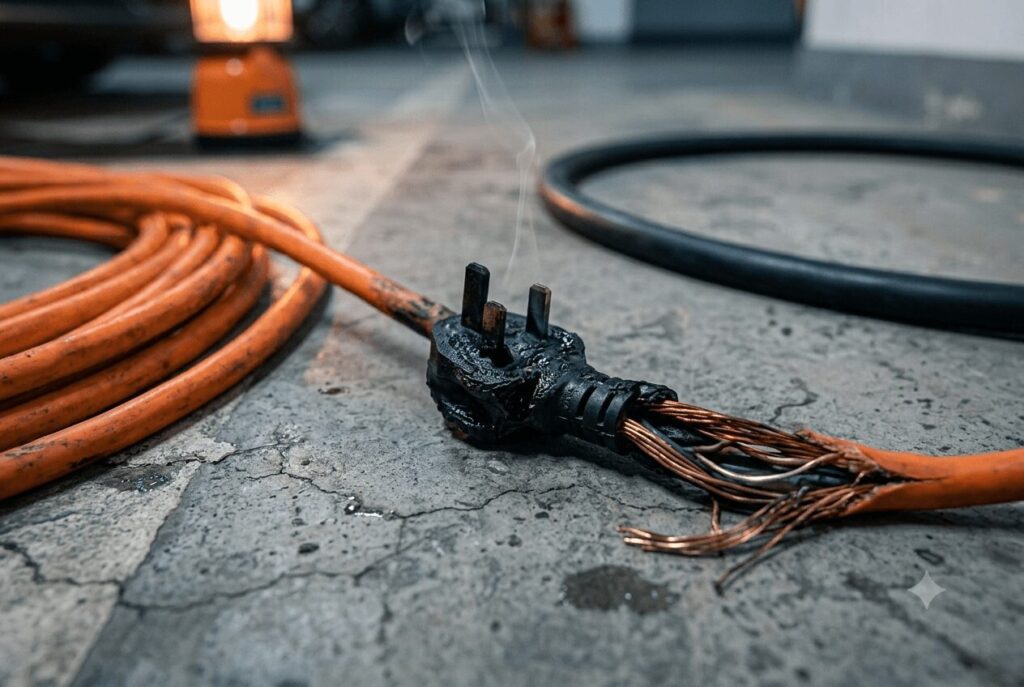
The extension cord he purchased was rated for 10A intermittent use — appropriate for garden power tools used in short bursts. The conductor cross-section was 0.75mm². EV charging through his Mode 2 cable was drawing approximately 8A continuous current for 6-8 hours overnight.
At 8A continuous through 0.75mm² conductor over 8 hours, the cable’s conductor temperature reached levels well above the PVC jacket’s rated continuous temperature. The cable routing — partially coiled where it crossed the car park floor — prevented heat dissipation that the cable depended on for its nominal rating.
What happened:
Three weeks into this arrangement, the car park security guard discovered smoke coming from the coiled section of the extension cord at approximately 2am. The outer jacket had melted through in a section approximately 30cm long. No fire resulted — the guard noticed and disconnected the power before ignition occurred — but the exposed conductors and melted plastic represented a fire that was minutes or hours from starting.
The specific technical failure:
The thermal rating exceedance (conductor temperature well above PVC jacket maximum continuous operating temperature) in a coiled section (preventing convective heat dissipation) with the sustained current of overnight EV charging produced the predictable outcome that this guide series’ coverage of the flywire phenomenon and the Pinduoduo scams guide documents in technical detail.
The fix:
The owner stopped the extension cord arrangement immediately. He purchased a purpose-built BESEN portable EVSE with built-in RCCB protection rated for 32A continuous use with appropriate 2.5mm² conductors — the legitimate portable EVSE option covered in our DIY charging guide. He used this through a properly rated weatherproof socket that the car park maintenance room provided, at a single uncoiled cable run, while his formal dedicated circuit application processed.
The lesson:
Extension cords are not EV charging cables. The gauge that looks appropriate for general electrical use is not adequate for sustained EV charging current. No extension cord purchased at a hardware market for general purposes should be used for overnight EV charging regardless of how heavy-duty it appears.
Horror Story 2: The Unlicensed Neighbour Electrician
What Happened
The situation:
A Shenzhen apartment owner in a 2010 development wanted to install a StarCharge S1 home charger in her underground parking space. Her compound’s licensed installer quotes were ¥2,800 for the complete installation. Her neighbour — who she knew had done electrical work professionally “many years ago” and was now retired — offered to do the installation for ¥500.
What he did:
The neighbour’s installation appeared, to a non-expert eye, professional: the charger was level on the wall, the cable ran tidily in surface conduit from the charger to the car park distribution board area, and the connections looked neat.
What he didn’t do:
He connected the charger’s circuit directly to the car park general lighting circuit rather than applying for and installing a dedicated meter — not because he didn’t know this was wrong, but because he didn’t know how to navigate the State Grid dedicated meter application process and didn’t want to admit this to the owner.
He specified a 20A circuit breaker for the connection, which he had in his toolbox, rather than the 32A breaker appropriate for 7 kW charging.
He used Type AC (AC-only) RCCB protection — available cheaply from his existing stock — rather than the appropriate Type A/AC device capable of detecting the specific residual current patterns that EV charging systems can produce.
He did not earth-bond the charger’s protective earth to the car park earthing system.
What happened over the following months:
The 20A circuit breaker tripped regularly when the charger’s demand peaked — approximately once a week, requiring the owner to go to the distribution board area and reset the breaker manually before charging could resume. She assumed this was normal.
The lack of dedicated metering meant the owner was inadvertently consuming car park common-area electricity — the car park’s landlord electricity account was being charged for her EV charging. After three months, the car park electricity bill showed an unexplained increase that triggered investigation by the compound’s management.
The Type AC RCCB failed to detect a partial ground fault condition that developed when the connector housing suffered minor damage from being dropped — the vehicle continued charging with an active ground fault condition present.
How it was discovered:
The compound’s maintenance electrician, investigating the electricity bill anomaly, discovered the unauthorised connection to the common area circuit. He identified the missing dedicated meter, the wrong protection specification, and the earthing deficiency in a single inspection. He disconnected the charger circuit.
The fix:
The owner engaged a licensed electrician to properly apply for a State Grid dedicated meter, install appropriate 32A protection devices with correct RCCB type, properly earth-bond the charger, and complete the installation to applicable standards. Total cost: ¥3,200 — slightly more than the original legitimate quotes she had received.
The informal ¥500 “saving” had produced:
- 4 months of electricity theft from common area circuits
- A ground fault condition operating without protection for an unknown period
- Disconnection and reinstallation cost that exceeded the original legitimate installer quotes
The lesson:
“Used to do electrical work” is not the same as current knowledge of EV charging-specific requirements, State Grid dedicated meter processes, and the applicable protection specifications. The combination of outdated electrical knowledge and incomplete process understanding that informal “helped out by a neighbour” installations produce is more dangerous than no installation because it creates an installation that appears to function while concealing specific safety deficiencies that correct installation would address.
Horror Story 3: The Wrong RCCB Type That Failed to Protect
What Happened
The situation:
A licensed electrician — genuinely licensed, genuinely experienced in general residential wiring — installed a home EV charger in a Guangzhou underground car park in 2022. He was a competent electrician who had never previously installed an EV charger and who didn’t specifically research the RCCB requirements for EV charging.
What he did:
The installation was technically correct in most respects: proper cable specification, appropriate circuit breaker, correct earthing, charger correctly mounted and wired. For ground fault protection, he installed a standard Type AC RCCB — the type used in standard Chinese residential circuits and the type he had always specified for circuit protection in residential work.
What was wrong:
As covered in our professional installation costs guide’s discussion of RCCB types, EV charging systems can produce DC residual current components through the vehicle’s onboard charging system (OBC) that Type AC RCCBs specifically cannot detect. Type AC RCCBs detect only AC residual current — the standard alternating current leakage that occurs with most household appliance faults.
EV charger-specific fault conditions can produce a combination of AC and DC leakage current that causes the AC component to be below the RCCB trip threshold even when the total leakage (AC + DC combined) significantly exceeds a safe level. This is not a theoretical concern — it is a documented failure mode that IEC standards have specifically addressed by recommending Type B or Type A/AC RCCBs for EV charging circuits.
What happened:
Approximately 14 months after installation, during a period of humid Guangzhou monsoon weather, the EV cable developed a minor insulation compromise where it passed over a sharp edge of the conduit entry point — a small but progressive damage that the monsoon humidity exacerbated.
The developing fault produced a mixed AC/DC residual current that did not trip the Type AC RCCB despite reaching levels that would have tripped a Type A or Type B device. The fault continued, and the cable heating at the fault point continued.
The owner noticed that the connector felt warmer than usual after charging sessions — but having no reference point for what “normal” connector temperature felt like, she assumed this was typical.
The fault was discovered when a licensed electrician conducting a property inspection for an unrelated purpose tested the RCCB with a proper RCD tester rather than just the built-in test button and identified that the device failed to trip at the required current level due to the DC component blinding the Type AC device.
No fire resulted — the fault was caught before reaching ignition temperature. But the absence of fire was luck in combination with early discovery, not a reflection of adequate protection.
The fix:
Replacing the Type AC RCCB with a Type A (AC+DC pulse) RCCB — a direct component swap in the existing circuit — cost approximately ¥180 for the component plus ¥200 for the electrician’s service visit. The cable insulation damage point was identified and remediated in the same visit.
The lesson:
Even a licensed, competent electrician who has not specifically researched EV charging circuit requirements can install a technically incorrect protection device — not from incompetence but from applying general residential wiring knowledge to a specific application where additional requirements apply. For EV charging circuits, the RCCB type specification is not a general residential electrical knowledge item but a specific EV charging requirement that must be explicitly researched or explicitly specified to the installer.
For Chinese EV owners who had their charger installed before 2022-2023 (when awareness of EV-specific RCCB requirements became more widespread in Chinese electrical installation practice), verifying that the protection device is Type A or Type B rather than Type AC is a specific post-installation check worth performing.
How to check your existing RCCB type:
The RCCB housing typically shows the type designation — look for the symbol on the device’s front face. Type AC devices show a sine wave symbol. Type A devices show a sine wave plus a dashed line symbol. Type B devices show additional symbols indicating DC detection capability. If the device shows only the sine wave (Type AC), this warrants replacement for an EV charging circuit.
Horror Story 4: The Overloaded Apartment Panel
What Happened
The situation:
A Wuhan apartment owner installed a 7 kW home charger in 2023 through a licensed electrician who correctly installed the dedicated EV charging circuit. The installation was technically correct in isolation — proper cable, correct protection devices, appropriate circuit from the dedicated EV charging meter to the charger.
What was wrong:
The apartment’s main electrical panel — the panel serving the apartment’s household loads — was a 1990s installation in a building built during that period, with a 25A main breaker and multiple circuits already operating the household’s air conditioning, induction cooking, water heater, and other loads.
The dedicated EV charging circuit was connected at the apartment’s main panel rather than from a separate meter served from the building’s distribution infrastructure — a technical shortcut that avoided the State Grid dedicated meter application process but connected the EV charging current to the apartment’s already-loaded main panel.
At peak household load (summer evening: two air conditioners running, induction cooking, water heater, evening lighting) plus EV charging (7 kW), the combined load substantially exceeded the 25A main breaker’s capacity.
What happened:
The apartment’s main breaker tripped repeatedly on evenings when EV charging coincided with peak household electrical demand. Each trip cut power to the entire apartment, requiring a trip to the distribution cupboard to reset the breaker.
After approximately 20 tripping events over three months, the breaker developed a fault — a consequence of repeated thermal stress from overload conditions — and began tripping at loads well below its rated 25A capacity, eventually failing to maintain power even for normal household loads without EV charging.
The fix:
The underlying fix was to properly apply for a State Grid dedicated EV charging meter — creating a separate, properly-metered circuit for EV charging that drew from the building’s distribution infrastructure rather than from the apartment’s main panel. This is the standard installation process that the initial installation had incorrectly bypassed.
Additionally, the apartment’s main panel required replacement — the thermally-stressed breaker had degraded the panel component beyond safe reliable operation.
Total remediation cost: ¥3,800 for proper State Grid dedicated meter installation plus ¥1,500 for the main panel replacement that the repeated tripping incidents had necessitated.
The lesson:
The State Grid dedicated meter process exists specifically to create a separate electrical supply for EV charging that doesn’t impose on the apartment’s existing electrical infrastructure. Bypassing this process — even through technically competent installation work that correctly handles all other aspects of the installation — imposes EV charging load on electrical infrastructure not designed for it, with the predictable consequences that load analysis would have predicted in advance.
Horror Story 5: The Missing Earth Bond in a Wet Car Park
What Happened
The situation:
A Chengdu apartment owner installed a charger in his compound’s underground car park. The charger was a legitimate certified product. The installation was performed by a person who was competent but who had learned electrical installation from practical experience rather than formal electrical trade training — a common profile in China’s informal electrical labour market.
What was missed:
The charger’s protective earth terminal was connected to the earth wire in the cable running back to the circuit breaker. However, the installation did not include a local earth bond connecting the charger’s metal housing to the car park’s earthing system through a separate dedicated earth conductor directly to the car park earth point.
In a dry environment, this omission would likely never cause a problem — the earth continuity through the cable was adequate for most fault scenarios. But the Chengdu underground car park experienced regular minor water ingress during Chengdu basin’s significant rainfall periods, creating a damp concrete floor and occasional puddles.
What happened:
Approximately eight months after installation, during a period of sustained Chengdu rainfall that had created pooled water in parts of the underground car park, a vehicle driver parked their EV and walked through a shallow puddle while simultaneously touching the charger housing.
They received an electrical shock — not a lethal one, as the protective earth maintained some continuity — but a distinctly felt shock that caused involuntary muscle contraction and significant distress.
Investigation revealed that water contact with the charger’s mounting surface had created a leakage path from the charger housing to the puddle on the floor, and the earth bonding’s reliance on cable continuity rather than direct local earth bond meant the earth fault path had higher impedance than a proper local earth bond would have provided — allowing a non-zero voltage to appear on the charger housing under fault conditions.
The fix:
Installation of a dedicated local earth bonding conductor from the charger housing directly to the car park’s earthing system — a relatively simple addition that cost approximately ¥400 for the conductor and installation. The water ingress issue in the specific mounting location was also addressed by repositioning the charger to a higher wall location less exposed to water contact.
The lesson:
Earth bonding requirements for EV charger installations in wet or potentially wet environments are more demanding than those for dry indoor electrical installations. A car park — even one that appears relatively dry — is a wet location by electrical installation standards, and the earth bonding provision appropriate for wet location installations (local earth bond directly to the building’s earthing system, not only reliance on cable earth continuity) is specifically required.
Horror Story 6: The Self-Installed Charger That Voided Insurance
What Happened
The situation:
A Shanghai apartment owner self-installed a home EV charger in 2023, competently by most measures — correct cable specification, correct protection devices, correct charger mounting. He had genuine electrical knowledge from professional training in a related field and the installation was functionally adequate.
What happened 14 months later:
An electrical fault in the building’s common infrastructure — unrelated to the owner’s charger installation — caused a brief high-voltage transient that damaged multiple electrical devices in the building including the owner’s EV charger. The charger’s control board was permanently damaged.
The insurance claim that failed:
The owner filed a home contents insurance claim for the damaged charger — a legitimate claim for equipment damaged by an external electrical fault. The insurance company’s assessment included an inspection of the charger installation that identified the absence of State Grid dedicated meter certification, the absence of a licensed electrician installation certificate, and the absence of 物业 approval documentation.
The insurer denied the claim citing the policy’s exclusion for damage to equipment installed in violation of applicable regulatory requirements — the self-installation without proper permits, licensed electrician certification, and utility company meter installation fell within this exclusion.
The further consequence:
When the owner subsequently arranged proper professional installation with State Grid dedicated meter and licensed electrician certification, the installation record confirmed the previous self-installation — creating documentation of the regulatory violation that the insurer’s denial had already established.
The fix:
The owner’s only remediation option was to properly install from scratch — proper State Grid meter, proper licensed electrician installation, proper 物业 approval — at full cost, while bearing the charger replacement cost himself following the denied insurance claim.
The lesson:
As covered in our flywire charging safety guide’s insurance implications section, the insurance exclusion for damage arising from non-compliant installations is real, consistently enforced when insurers investigate claims, and applies to self-installations that bypass the regulatory requirements regardless of how technically competent the actual installation work was.
The proper installation documentation — State Grid dedicated meter certificate, licensed electrician installation certificate, 物业 approval letter — is not bureaucratic formality. It is the documentation that confirms the installation’s compliance with regulatory requirements that insurance policies depend on for coverage validity.
The Common Thread — What All These Failures Share
The Pattern Analysis That Informs Prevention
The specific failure categories that recur:
Examining the six horror stories reveals specific failure categories that appear with disproportionate frequency:
Category 1: Undersized conductors (Stories 1, from various sources)
The single most common Chinese DIY installation failure. The correct conductor specification — 2.5mm² minimum for 32A continuous EV charging — is not intuitive from general electrical experience where 1.5mm² or 2.5mm² are both acceptable for lighting and socket circuits. The specific 32A sustained demand of EV charging imposes conductor requirements that general-purpose electrical intuition underestimates.
Category 2: Wrong or absent RCCB specification (Stories 3, from various sources)
Even trained electricians who install the correct RCCB type for general residential work install the wrong type for EV charging — the EV-specific requirement for Type A or Type B rather than Type AC is a specific technical knowledge item that must be researched explicitly.
Category 3: Bypassing the dedicated meter process (Story 4)
The State Grid dedicated meter application is perceived as bureaucratic overhead rather than the essential electrical infrastructure separation it actually provides. Bypassing it imposes EV charging load on apartment electrical infrastructure designed for lower loads.
Category 4: Earthing deficiencies in wet environments (Story 5)
Earth bonding requirements for wet-location EV charger installations exceed those for dry indoor electrical work — a specific requirement that general residential electrical training doesn’t necessarily cover.
Category 5: Documentation and regulatory compliance gaps (Story 6)
The insurance, 物业, and regulatory consequences of non-compliant installations are real and costly when they materialise — often in circumstances (insurance claims, incident investigations) where the documentation absence has the most significant financial consequences.
The Self-Assessment Checklist for Existing Installations
If You Already Have a DIY Installation — What to Check Immediately
For owners who already have self-installed or informally-installed chargers:
Apply the following checklist to assess whether your installation has any of the specific failure modes documented in this guide’s horror stories:
Check 1: Cable specification
Locate any visible section of the cable used for your charging circuit. The cable jacket should print the conductor cross-section specification along its length. Confirm the specification is 2.5mm² or larger. If it shows 0.75mm², 1.0mm², or 1.5mm² — or if there is no specification printing (indicating potentially non-specification cable) — the cable requires replacement.
Check 2: RCCB type
Locate the RCCB (residual current circuit breaker) in your EV charging circuit. Examine the symbol on the front face of the device. If the symbol shows only a sine wave without any additional symbols, this is a Type AC device inappropriate for EV charging circuits. Engage a licensed electrician for Type A/AC or Type B replacement.
Check 3: Dedicated meter presence
Confirm whether your EV charging circuit has a separate dedicated electricity meter — separate from the apartment’s household meter. A dedicated meter is physically a separate meter unit (either adjacent to the apartment meter or near the charger installation) that records only EV charging electricity consumption. If your EV charging is recorded on your standard household meter rather than a dedicated meter, your installation bypasses the State Grid dedicated meter requirement.
Check 4: Circuit overload assessment
Review whether your apartment’s main circuit breaker has ever tripped in connection with EV charging. Any tripping incident suggests the EV charging load is being imposed on circuit infrastructure not rated for it — the dedicated meter absence is the likely underlying cause.
Check 5: Earth bonding in wet locations
If your charger is installed in an underground car park or any location that experiences any moisture exposure (dampness, water pooling, condensation on concrete), confirm that the charger housing has a local earth bond — a separate earth conductor running directly from the charger housing to a local earth point, not only reliance on the earth wire in the charging circuit cable.
Check 6: Warm-hand test
After 30 minutes of charging, carefully touch (don’t grip — a closed-hand grip can cause muscle lock if current is present) the connector body, the cable at various points along its length, and any visible junction points. Any section that is more than comfortably warm represents either a connection quality problem or a conductor undersizing problem. Anything that is genuinely hot represents an immediate safety concern requiring cessation of use and professional inspection.
The Professional Remediation Path
When to Stop Using Your Charger and When Immediate Action Is Required
Immediate cessation of use:
Stop using the charger immediately and engage a licensed electrician for inspection if:
- Cable feels warm or hot during charging at any point along its length
- RCCB is Type AC (highest priority for replacement in wet-location installations)
- Any visible cable damage, melting, or discolouration
- Any earth continuity concerns in a wet-location installation
- Any smell of electrical burning during or after charging
Priority remediation (within 2 weeks):
Engage a licensed electrician for assessment and remediation if:
- Cable specification is below 2.5mm²
- No dedicated meter is present
- Circuit breaker trips have occurred related to EV charging
- Earth bonding is absent in underground car park installation
- Installation was not documented with licensed electrician certificate
Regulatory remediation:
Even if the physical installation is technically adequate, if the installation lacks proper State Grid dedicated meter and licensed electrician documentation, engaging the formal remediation process — State Grid meter application, licensed electrician inspection and certification — addresses the insurance and regulatory documentation gaps even if no physical installation changes are required.
Internal Links — Further Reading on Clean Energy Bazaar
The installation horror stories what Chinese DIYers did wrong and how to fix it guide connects directly to the safety, installation, and compliance guides throughout this content cluster.
For the DIY charging guide covering the limited scenarios where self-installation is genuinely appropriate, our DIY EV charger installation 2026 easiest plug and play models for Chinese apartments 220V guide covers every safe self-install option with proper boundaries. For the professional installation costs guide covering the correct professional installation process that these horror stories deviated from, our professional EV charger installation costs 2026 what State Grid chargers vs private companies charge guide covers every cost component. For the fire safety guide that contextualises the fire risks documented in these stories, our fire safety and EV charging what Chinese homeowners need to know about indoor parking risks guide covers the complete fire safety framework. For the flywire safety guide covering the systematic approach to dangerous cable arrangements documented in Story 1, our China apartment flywire charging is it safe legal solutions for lower ground parking guide covers every safety consideration. For the troubleshooting guide that helps identify specific error conditions that developing installation faults produce, our troubleshooting home EV chargers common error codes for GB/T standards guide covers every fault category. And for the maintenance guide covering the ongoing inspection practices that would catch many of the developing faults documented in these stories, our EV charger maintenance 2026 dust protection vs humidity resistance brand comparison guide covers every maintenance consideration.
Final Thoughts
The installation horror stories what Chinese DIYers did wrong and how to fix it documentation serves one primary purpose: to convert abstract safety guidance into concrete, visceral understanding of what specific installation errors produce in specific real-world conditions.
The six stories documented here — the extension cord that nearly caught fire, the unlicensed neighbour whose hidden errors cost more to fix than the installation saved, the wrong RCCB that allowed a fault to develop undetected, the overloaded apartment panel that degraded through repeated tripping, the missing earth bond in a wet car park that caused a shock, the self-installed charger whose documentation absence voided insurance — are not worst-case hypotheticals constructed to frighten readers. They are representative examples of documented Chinese EV charger installation failure patterns drawn from real owner communities and real electrician experience.
The technical errors these stories document are specific and preventable:
Use proper EV charging cable (2.5mm² minimum), not general-purpose extension cords.
Specify Type A or Type B RCCB, not the Type AC device used for general residential circuits.
Apply for the State Grid dedicated meter, not a shortcut that connects EV charging to apartment main panels.
Include proper earth bonding for wet-location installations, not only cable-continuity earth protection.
Obtain proper documentation — licensed electrician certificate, State Grid meter certificate, 物业 approval — not just a physical installation without paper trail.
The correct approach to Chinese home EV charger installation is not complex, but it is specific. It requires specific knowledge, specific equipment, specific process, and specific documentation. Every element of that specificity exists because the consequences of the specific errors that these horror stories document are real — fires, shocks, denied insurance claims, expensive remediation — and preventable through the correct approach that this entire guide series has described.
Learn from these stories. Check your installation against the self-assessment checklist. Fix what needs fixing. The ¥3,000-¥5,000 cost of proper professional installation is not overhead — it is the cost of the specific knowledge, specific equipment, and specific documentation that prevents the outcomes these stories describe.