There is a specific category of product listing that appears on Pinduoduo, on certain Taobao third-party stores, and on multiple e-commerce aggregator platforms that has become increasingly prevalent as China’s EV market has grown and as the great shakeout described in our dedicated guide has driven desperate liquidation pricing from failing manufacturers: the suspiciously cheap, lavishly-specified, urgently-discount-framed home EV charger listing that promises 7 kW smart charging capability, 3C certification, WiFi connectivity, TOU scheduling, and a five-year warranty at a price point of ¥199-¥389.
“Lader” — derived from the English word “charger” through phonetic approximation that circulates in Chinese online communities — has become a slang term in Chinese EV owner communities for this specific category of product: the fake, dangerous, or catastrophically under-specification home EV charger sold through low-oversight e-commerce channels to price-sensitive buyers who don’t know how to distinguish a dangerous product from a legitimate one.
These products have caused fires. They have caused electrical injuries. They have caused vehicles to fail to charge on critical mornings. They have caused apartment building electrical panels to trip repeatedly. And they continue to be sold at scale through platforms whose verification processes, despite significant criticism and some improvement, remain inadequate to prevent these products from reaching consumers who deserve better information.
This guide on the Lader scams why cheap chargers on Pinduoduo are burning out provides the complete, honest safety assessment — what these dangerous products actually are at a technical level, the specific failure modes that cause fires and injuries, how to identify them before purchase through the specific signals they display, the platform-specific dynamics of Pinduoduo that make it the primary distribution channel for dangerous EV charger products, and the practical guidance for Chinese EV owners who may already own one of these products and need to assess their risk.
What “Lader” Products Actually Are — The Technical Reality
The Spectrum of Dangerous Cheap Charger Products
“Lader” is not a single product type but a category spanning several distinct fraud and quality failure patterns:
Pattern 1: Complete fabrications with zero legitimate manufacturing
The most dangerous category: products assembled from the cheapest possible electronic components with no engineering safety design, no quality testing, no legitimate 3C certification, and no functional safety protection. These are typically assembled in small workshops using whatever components are cheapest at the time of assembly — the specific component used for RCCB protection may change between production batches, the cable may be whatever gauge the assembler can source most cheaply regardless of whether it meets the current rating, and the entire assembly may have never been connected to any testing equipment.
Specific characteristics:
The RCCB protection circuit — the critical safety component covered throughout our fire safety and troubleshooting guides — is typically either absent entirely or implemented with components so far below specification that it provides no meaningful protection. In documented inspection reports of seized dangerous chargers, “RCCB” components have been found to be non-functional light bulb components serving as visual fakes for the RCCB that should be present.
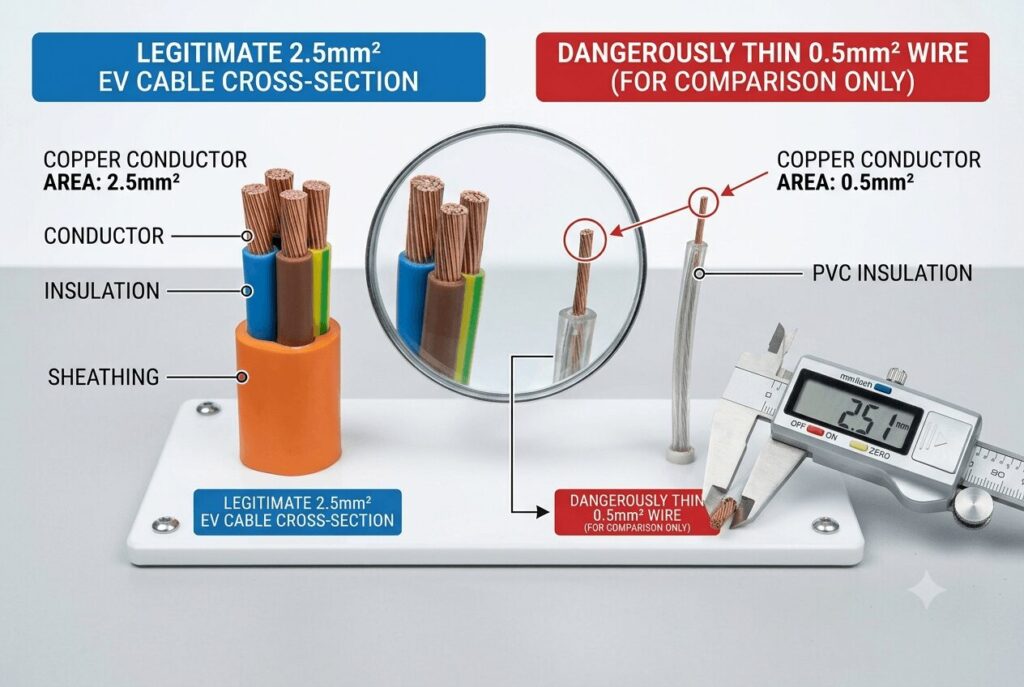
Cable conductor cross-section: consistently undersized. Legitimate 7 kW charger cables require 2.5mm² minimum conductor cross-section for sustained 32A current. Seized dangerous products have been documented with 0.5mm²-0.75mm² conductors — the same gauge used in household lamp cords — running sustained EV charging current that will cause dangerous heating within minutes.
Pattern 2: Legitimate brand counterfeits
Products that physically copy the appearance of legitimate certified chargers — StarCharge S1 appearance, Autel MaxiCharger appearance, or similar established brand appearances — using copied logos, copied serial number formats, and in some cases copied certification mark appearances, while containing completely different and uncertified internal components.
These are particularly dangerous because consumers who correctly understand that they should buy StarCharge or Autel can be deceived by a product that appears, in e-commerce listing images and on the physical unit, to be the legitimate product they correctly selected.
Pattern 3: Former legitimate products from failed manufacturers, sold without disclosure
Products from the zombie pile category covered in our zombie pile crisis guide — legitimate products manufactured by now-defunct companies, sold through liquidation channels without disclosure of the manufacturer’s failure. These products may have been legitimate at manufacture but now have no warranty support, no firmware updates, and potentially lapsed 3C certification.
Less immediately dangerous than Pattern 1 or 2 but carrying the specific zombie pile risks covered in that guide — primarily functional failure of cloud-dependent features rather than immediate physical safety hazard.
Pattern 4: Specification misrepresentation without outright counterfeiting
Products from small manufacturers that are loosely certified under technically-compliant-but-barely-so circumstances — where the specific unit submitted for certification testing was assembled to a higher standard than the production units sold to consumers, or where the certification covers a nominally similar but actually different product configuration.
This pattern exploits the gap between what certification tests verify and what production quality control maintains — a real gap in China’s certification system that the August 2026 deadline compliance guide addressed at regulatory level but that consumer-facing purchasing decisions must also navigate.
The Pinduoduo Platform Dynamic — Why This Platform Specifically
What Makes Pinduoduo the Primary Distribution Channel for Dangerous Chargers
Pinduoduo’s specific platform characteristics that create elevated risk:
Pinduoduo (拼多多, PDD) has built China’s third-largest e-commerce platform through a specific strategy: extreme price competition, group buying mechanics that create price discovery at the absolute minimum viable market price, and a seller model that allows significantly lower barriers to entry than Tmall or JD.com’s more curated approaches.
These characteristics that made Pinduoduo successful in consumer goods categories where quality variation is less dangerous — fresh produce, daily necessities, apparel — create specific safety risks when applied to electrical safety equipment like EV chargers:
The price discovery mechanism favours danger:
Pinduoduo’s group buying and price comparison mechanics create relentless downward price pressure that rewards the seller who can offer the lowest price. In categories where quality and price correlate positively (as they do in EV charger safety equipment), the extreme price pressure mechanism rewards the seller who cuts safety-critical cost corners most aggressively.
A legitimate certified 7 kW smart EV charger has a manufacturing cost floor — the cost of certified safety components, compliant cable specification, and quality manufacturing that cannot be reduced below approximately ¥400-¥500 per unit while maintaining genuine certification compliance. Any charger listed below this floor is either being sold at a loss (unsustainable) or has achieved the price through component quality reduction that compromises safety.
Pre-publication verification is limited:
Unlike JD.com’s 自营 (self-operated) channel where JD procurement verifies product quality before listing, or Tmall’s brand-store model where brand accountability provides some quality assurance, Pinduoduo’s third-party seller model allows listing without pre-publication technical verification. A seller can list a product claiming 3C certification without providing any verification of that claim before the listing goes live.
Group buying mechanics create time pressure:
The “group buying” mechanisms that Pinduoduo built its initial success on — limited-time prices that increase if you don’t buy within a deadline — create purchasing urgency that reduces the time buyers spend on due diligence. The specific verifications recommended in our fake certification detection guide (CQC database lookup, manufacturer verification) require time and deliberate effort that time-pressured buying mechanics actively discourage.
The review system’s limitations for safety assessment:
Pinduoduo’s review system — like all e-commerce review systems — captures the immediate purchase experience (delivery speed, packaging, initial appearance) rather than the safety performance that only becomes apparent over sustained use. A charger that appears functional during the first week of use will accumulate positive reviews even if it is electrically unsafe under sustained charging load — the safety failure may take weeks or months to manifest, well after the review window when most users submit feedback.
Seller anonymity and accountability gaps:
Pinduoduo’s third-party seller model allows greater seller anonymity than platforms with more rigorous seller onboarding. Sellers of dangerous products can establish a store, accumulate a transaction history using lower-risk products to build initial ratings, introduce the dangerous products once a sufficient rating baseline exists, and exit before enforcement catches up — then repeat the cycle with a new store.
The Specific Failure Modes — Why These Chargers Burn
The Technical Chain From Component Failure to Fire
Failure chain 1: Undersized cable ignition
The most directly dangerous failure mode:
Undersized conductor cross-section (0.5-0.75mm²) connected to 7 kW sustained charging current (32A):
The resistance of the undersized conductor: significantly higher than the 0.2 Ω/metre of legitimate 2.5mm² copper
Heat generated in the cable: P = I²R = 32² × higher resistance = substantially more than the cable’s thermal rating can dissipate
Cable jacket material: typically the cheapest available PVC compound, with lower thermal rating than cable specification standards require
The progression: Heat builds in the cable over the first 20-30 minutes of a charging session. If the cable is coiled (as it often is in storage or when the full cable length isn’t needed), heat accumulates rather than dissipating. The PVC jacket begins softening above approximately 70°C. Sustained current continues raising temperature. At 130-160°C, PVC begins producing toxic breakdown products. At higher temperatures, ignition of surrounding combustible materials becomes possible — particularly in the presence of any petroleum-based cleaning products, cardboard packaging, or wood that typically surrounds where cars are parked.
Failure chain 2: Absent or fake RCCB failure
A charging cable that develops any insulation damage — from mechanical abrasion, vehicle contact, water ingress — creates a ground fault condition that a genuine RCCB detects and trips within 30 milliseconds, as covered in our fire safety guide.
A non-functional RCCB — the fake component documented in seized products — allows the ground fault current to flow continuously. Depending on the fault magnitude and location, this can:
Create sustained heating at the fault point leading to ignition
Create electrocution hazard for anyone who contacts the cable or vehicle while the fault is present
Create sustained arcing that produces much faster and more intense heating than the gradual cable heating in Failure Chain 1
Failure chain 3: Connector overheating from substandard contact materials
Legitimate GB/T connectors use contact materials specified to maintain low contact resistance over 10,000+ connect-disconnect cycles. Fake connectors use cheaper plated steel or inadequately plated copper contacts that develop higher contact resistance within weeks or months of use.
Higher connector contact resistance generates heat at the connector body with each charging session. The connector’s housing material — typically ABS plastic — has limited thermal resistance. Progressive heating of the connector eventually produces melting, arcing, or fire at the connector body itself.
Why this specific failure is particularly insidious:
The connector heating failure develops gradually over months. Early sessions may produce slightly warm connectors that an owner notices but dismisses as normal. The warmth gradually increases as contact resistance grows. By the time the connector is dangerously hot, the owner has months of “it always gets a bit warm” experience that has normalised a progressively dangerous condition.
The warm-hand connector test covered in our DIY charging guide exists specifically to detect this failure mode — but many owners don’t perform it because they’ve been conditioned by months of warm-but-not-alarming connector temperatures.
The Specific “Lader” Warning Signs — Before Purchase
The Pre-Purchase Detection Checklist
Warning sign 1: Price below ¥450 for a claimed 7 kW smart charger
As established in our fake certification detection guide and the manufacturing cost floor analysis in our great shakeout guide, legitimate 7 kW smart chargers cannot be manufactured to certification standard below approximately ¥400-¥500 manufacturing cost. Any listing below ¥450 retail price — regardless of claimed specifications — is either being sold at a loss (unsustainable, signals liquidation of problematic stock) or has achieved the price through safety-compromising quality reduction.
Warning sign 2: Specification claims inconsistent with price
Legitimate certified chargers priced at ¥450-¥700 (the value tier) offer 7 kW, basic TOU scheduling, standard IP54 protection, and three-year warranty. A listing at ¥299 claiming:
- 7 kW output
- IP65 protection
- -30°C cold weather rating
- Five-year warranty
- AI energy management
- OCPP 2.0 compliance
- 5G connectivity
- Free installation included
…is not a market bargain — it is a spec sheet generated without any relationship to what the actual product contains. The specification claims are often copied from legitimate product listings and pasted wholesale onto counterfeit product pages, producing a specification profile that is internally inconsistent with the price point.
Warning sign 3: Brand name not resolvable to a real company
“Lader” products typically use brand names that are:
Phonetically similar to established brands without being identical: “StarChanger” instead of “StarCharge,” “TELD+” instead of “TELD,” “MaxiCharge” instead of “MaxiCharger”
Completely invented brand names with no Chinese company registry presence: searching for the brand name in the National Enterprise Credit Information Publicity System (国家企业信用信息公示系统) returns no company registration
English-language brand names that sound professional but correspond to no traceable company: “PowerStar EV,” “UltraCharge Pro,” “GreenWave Energy”
The verification step: Before any purchase, search the brand name in the National Enterprise Credit Information Publicity System. A legitimate charger brand must correspond to a registered Chinese company with EV charging in its registered business scope. No company registration = no legitimate manufacturer = certain dangerous product.
Warning sign 4: Listing photos that show certification marks only in graphics, not products
As covered in our fake certification detection guide’s Pattern 6 (image manipulation), Pinduoduo listing photos for dangerous products typically show the 3C certification mark in the designed graphic banner images (详情页) rather than visible on the physical product in product photographs.
A legitimate certified product has the 3C mark physically present on the product’s rating label. If the product photographs don’t show the rating label with the certification mark, and the mark appears only in designed advertising images, this is a specific red flag.
Warning sign 5: Seller store age under 6 months with sudden EV charger listings
As noted in our Taobao and JD certification guide, sellers of dangerous products exploit the review system by establishing stores with initial clean product histories. On Pinduoduo specifically, checking the seller store establishment date (accessible through the store profile page) before any purchase is a basic filtering step — stores under 6 months old listing EV charging equipment warrant specific additional verification.
Warning sign 6: Urgency framing and countdown timers
“Last 3 hours at this price,” “only 7 units remaining,” “group buying price ends tonight” — these urgency mechanics are not unique to dangerous products, but they specifically interfere with the deliberate verification process that safe charger purchasing requires. Any EV charger listing using strong urgency mechanics should trigger additional scrutiny rather than faster purchasing.
The Post-Purchase Assessment — If You May Have Already Bought One
The Immediate Risk Assessment for Suspected Dangerous Products
If you have purchased a home EV charger from Pinduoduo or similar low-oversight channels in the past 12 months and have not yet verified its certification status:
Step 1: Stop using it until verified
Unplug the charger from both the vehicle and the electrical supply. Do not use it overnight until the verification steps below are completed. This is not alarmist — it is the appropriate precautionary response when safety equipment’s certification status is unknown.
Step 2: Locate the rating label
The rating label is typically on the rear or underside of the main charger body. It should contain:
- Manufacturer name and address (verifiable as a real company)
- Model number (searchable in CQC database)
- 3C certification mark (physically printed on the label, not a separate sticker)
- Rated voltage and current (should specify 220V and 32A maximum for 7 kW)
- IP rating
- Operating temperature range
- A certification reference number
If the rating label is absent, obviously applied as a separate sticker over the main label, or contains inconsistent information (rated at 32A but the cable is visibly thinner than a household extension cord), these are immediate red flags requiring discontinuation of use.
Step 3: CQC database verification
Using the model number and manufacturer name from the rating label, conduct the CQC database verification described in our fake certification detection guide. A legitimate product returns a valid, current certification record. No result, or a result showing the manufacturer name doesn’t match, confirms the product is uncertified and should not be used.
Step 4: Physical safety inspection
If verification is inconclusive but you need to make an immediate safety assessment:
Cable inspection: Examine the full cable length. Gently bend a section — certified cables using proper conductor gauge have a specific stiffness from the copper conductor mass that visibly undersized cables lack. Undersized cables feel flimsy, lightweight, and flexible in a way that proper charging cables don’t.
Connector inspection: The GB/T connector should feel substantial and well-constructed. Contacts should be gold or silver coloured, bright, and uniform. Any visible corrosion, rough surfaces, or non-metallic appearance of contact surfaces indicates substandard materials.
Housing inspection: The charger housing should have no visible seam gaps, should feel solid and not hollow when gently tapped, and should show no signs of cost-cutting in the housing material (very thin walls visible at any ventilation openings, brittle-feeling plastic, painted-over surfaces rather than integrated colour).
Step 5: If the product fails verification
Stop using the product. Return it through the platform’s return process, specifically citing safety certification concerns in the return reason — this creates a record that may contribute to the platform’s enforcement attention on the specific seller. Consider filing a complaint with SAMR’s 12315 system (covered in our fake certification detection guide) to contribute to regulatory enforcement.
Do not discard the product without photographing the rating label and any visible safety-relevant details first — this documentation may be relevant to insurance claims if any damage has already occurred, and may be relevant to any reporting process.
The Regulatory Enforcement Reality — What Is and Isn’t Being Done
The Honest Assessment of Platform and Regulatory Response
What Pinduoduo has done:
Pinduoduo has implemented some safety category requirements for EV charging product listings — sellers are required to upload certification documentation as part of the listing process, and Pinduoduo’s systems perform some automated verification against listing claims.
Why this has not solved the problem:
The documentation upload requirement can be satisfied with fabricated documents — uploaded images of certification certificates that can be created in basic graphic editing software. The automated verification checks that Pinduoduo’s systems perform are pattern-matching against document format rather than real-time CQC database verification of certificate numbers, meaning convincingly-formatted fake documents may pass automated screening.
The scale problem: Pinduoduo’s marketplace has millions of active sellers listing hundreds of millions of products. Even with good-faith enforcement intent, the resource requirements for human review of a meaningful proportion of electrical safety product listings are enormous relative to what any marketplace can practically allocate.
What SAMR has done:
State Administration for Market Regulation (SAMR) has conducted periodic market surveillance sweeps of EV charging products, including published inspection reports of dangerous products seized from various distribution channels. These sweeps have produced formal enforcement actions against specific manufacturers and sellers, with published results that create some deterrence.
Why this has not solved the problem either:
The enforcement action cycle — surveillance sweep, inspection, enforcement action, published result — operates on a timescale of months to years, while dangerous products can be listed, sold at scale, and the seller entity dissolved and reconstituted in weeks. The regulatory enforcement tempo is fundamentally mismatched to the e-commerce seller cycle tempo.
The honest conclusion:
Regulatory and platform enforcement has not been, and cannot in the near term realistically be, sufficient to prevent dangerous EV charger products from reaching Chinese consumers through low-oversight e-commerce channels. The consumer’s own due diligence — the verification steps in our fake certification detection guide and the pre-purchase warning signs in this guide — remains the primary protective mechanism for individual purchasing decisions.
The Safer Alternatives — Where to Actually Buy
Platform and Channel Guidance for Safe EV Charger Purchasing
The highest-safety purchasing channels:
JD.com 自营 (self-operated) listings: As established in our fake certification detection guide, JD’s self-operated channel provides the strongest platform-side product verification among major Chinese e-commerce options. JD’s procurement process for 自营 products includes certification verification before listing.
Manufacturer direct: Purchasing directly from manufacturers’ official flagship stores on Tmall or JD, or through manufacturers’ own websites and WeChat mini-programs, provides the closest possible connection to the legitimate product and eliminates the third-party seller intermediary layer where most fraud occurs.
Professional installation companies: For EV charger purchases bundled with installation services (the approach covered in our professional installation costs guide), the installation company’s liability for their installation work creates a meaningful incentive to use legitimate products — an installer whose installation causes a fire faces significant liability exposure, making installers who work from legitimate certified products specifically preferable.
Vehicle manufacturer programmes: As covered in our BYD vs NIO vs Xpeng manufacturer bundle guide, EV manufacturer-bundled charger programmes — where the charger is recommended, coordinated, or supplied through the vehicle manufacturer’s official programme — use manufacturer-audited products that provide strong certification assurance.
The legitimate price range reference:
As covered in our fake certification detection guide and the great shakeout guide, the minimum price for a legitimate certified 7 kW smart charger from established brands in 2026 is approximately ¥699-¥899 for the value tier (StarCharge S1, basic Autel options). Any purchase below this range requires specific CQC verification before use — not as an optional step, but as a mandatory safety prerequisite.
Internal Links — Further Reading on Clean Energy Bazaar
The Lader scams why cheap chargers on Pinduoduo are burning out guide is the consumer safety companion to the certification, compliance, and brand survival guides throughout this content cluster.
For our foundational fake certification detection guide that provides the CQC database verification process referenced throughout this guide, our spotting fake 3C logos how Chinese buyers can verify certification on Taobao JD chargers guide covers the complete verification process. For the 3C certification guide that establishes why certification matters for the specific safety failures this guide documents, our 3C certification and EV chargers 2026 why buying non-certified chargers is dangerous in China guide covers every safety requirement. For the fire safety guide that covers the fire and electrical hazard consequences of the dangerous product failure modes documented in this guide, our fire safety and EV charging what Chinese homeowners need to know about indoor parking risks guide covers the complete fire safety framework. For the August 2026 compliance deadline guide that covers the regulatory framework under which dangerous products violate Chinese law, our China’s 3C deadline August 2026 is your current EV charger now illegal the 20 point checklist guide covers every compliance consideration. For the zombie pile crisis guide that covers the third pattern of dangerous cheap charger (failed manufacturer liquidation) documented in this guide, our zombie pile crisis 2026 how to avoid dead chargers from liquidated Chinese brands guide covers the complete brand survival framework. And for the great shakeout guide that contextualises the market conditions driving the desperate pricing that characterises dangerous cheap charger listings, our great shakeout why 80 percent of Chinese EV charger manufacturers face elimination in 2026 guide covers the complete industry analysis.
Final Thoughts
The Lader scams why cheap chargers on Pinduoduo are burning out phenomenon is not primarily a story about platform failure or regulatory inadequacy, though both are genuine contributing factors. It is primarily a story about what happens when price-sensitive purchasing decisions in a safety-critical product category are not accompanied by the technical knowledge that enables consumers to distinguish genuinely good value from dangerous false economy.
The ¥299 “7 kW smart charger” that looks identical in listing images to a ¥899 legitimate product is not offering the same product at better pricing. It is offering a physically dangerous object at a price that reflects the cost of manufacturing a physically dangerous object — far below the manufacturing cost of the legitimate product because the legitimate product’s cost includes components that protect human life and property that the ¥299 product has deliberately excluded.
The specific technical failures this guide has documented — undersized cable ignition, absent RCCB failure, connector overheating — are not abstract or theoretical risks. They are documented failure modes from documented products that have caused documented fires, documented electrical injuries, and documented vehicle charging failures across China in 2023-2026.
The protection available to Chinese EV owners is not complex, but it requires deliberate application:
Never purchase a claimed 7 kW smart charger below ¥450 without specific CQC certification verification. Verify certification before first use of any charger purchased from Pinduoduo or third-party sellers on any platform. Perform the warm-hand connector test after 30 minutes of every first charging session with new equipment. Use the pre-purchase warning signs in this guide as a systematic filter before any purchase decision.
These steps are not burdensome. They take minutes. They are the difference between a home charging setup that provides years of safe, economical EV charging and one that poses a fire risk to your vehicle, your parking space, and potentially your home and family.
The ¥600 price difference between the dangerous product and the legitimate one is not a saving. It is a risk premium you are paying to expose yourself to losses that could be orders of magnitude larger. Buy the legitimate product. Verify the certification. Use the safe channels.
That is the complete answer to why cheap chargers on Pinduoduo are burning out: they were built to burn, and the only protection is not buying them.