China’s EV charging equipment market has a specific competitive dynamic that distinguishes it from most other consumer hardware categories: the companies that matter most are not the foreign industrial brands that feature prominently in premium purchasing discussions, nor the Huawei and Xiaomi technology giants that command the ecosystem integration premium — they are the four Chinese companies that have built their primary businesses around EV charging itself, that have invested most heavily in the specific manufacturing, distribution, and service infrastructure that China’s EV charging market requires, and that collectively account for the largest share of installed residential and commercial EV charging equipment in China’s domestic market.
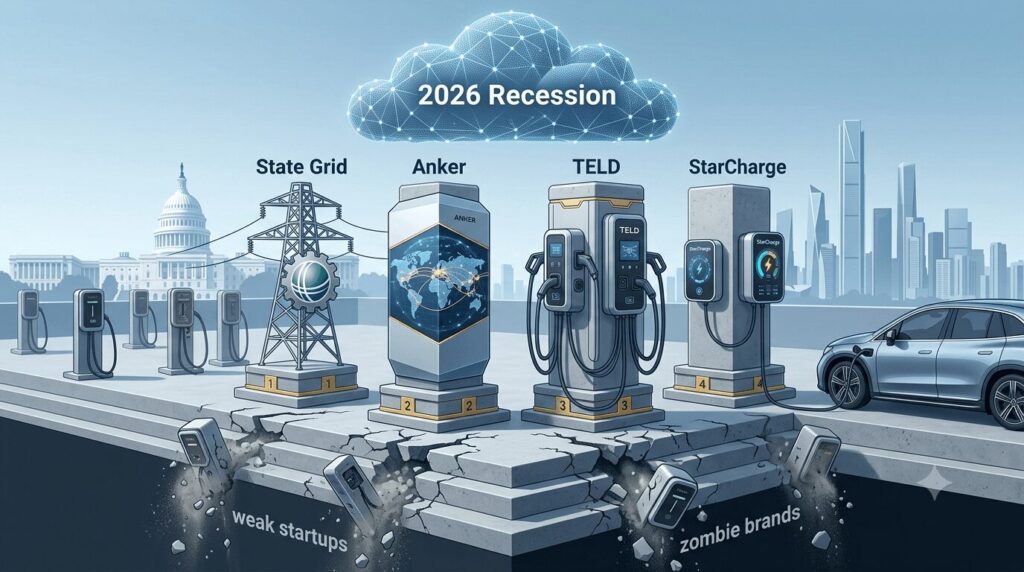
These four companies — StarCharge (星星充电), TELD (特来电), State Grid-affiliated charging entities, and Anker’s charging division (安克 EV charging, a newer entrant that has complicated the traditional “big four” narrative) — form the core of China’s domestic EV charging industry in a way that neither pure technology companies like Huawei nor industrial conglomerates like ABB quite do. They are EV charging specialists, and their fate in the 2026 economic environment is both commercially significant and directly relevant to the Chinese EV owners who have purchased or are considering purchasing their products.
The 2026 economic context requires specific acknowledgment: China’s economic environment in 2026 is characterised by specific challenges — ongoing property sector weakness, consumer confidence constraints, export pressure from global trade tensions, and the deflationary pressure that has affected multiple consumer goods categories — that create a more challenging operating environment for EV charging companies than the venture-capital-fuelled growth period of 2020-2023 produced. This guide on big four Chinese charger manufacturers who will survive the 2026 recession assesses each company’s specific resilience to these conditions.
Defining the “Big Four” — Why These Companies Matter Most
The Specific Competitive Significance of China’s Domestic EV Charging Specialists
What distinguishes the “big four” from other market participants:
As established in our great shakeout guide, China’s EV charging manufacturer landscape has undergone dramatic consolidation from 300+ companies to a smaller group of survivors. Within this surviving group, a specific tier of companies has built primary businesses around EV charging — not as a product line within a broader electronics or technology company, but as the core of their commercial identity.
This specialisation creates both competitive advantage and specific vulnerability: these companies know EV charging better than anyone but lack the diversification cushion that Huawei, Xiaomi, ABB, or Schneider bring to their EV charger product lines.
The “big four” as used in this guide:
The framing “big four” in China’s EV charging market does not have a universally agreed definition — different industry analysts use different groupings. For this guide’s purposes, the four companies warranting specific analysis are:
- StarCharge (星星充电) — Wanbang Digital Energy’s charging subsidiary, the largest domestic residential charger brand by installed base
- TELD (特来电) — State Grid affiliated major charging network operator with both equipment manufacturing and network operation
- Xingxing Charging (星星充电 parent Wanbang) and NARI Group — the State Grid technology group’s charging-focused subsidiary
- Anker (安克新能源/EV charging division) — the newer entrant whose consumer electronics brand identity and global distribution have complicated the established competitive dynamic
The definition caveat:
This guide uses “big four” as an analytical convenience rather than a formal industry designation. The honest assessment will note where the fourth position is genuinely contested — between Anker’s newer-but-differently-structured entry and other established mid-tier companies like Shenzhen Kstar or UUGreenPower whose claims to “big four” status are arguable.
Company 1: StarCharge (星星充电 / Wanbang Digital Energy)
The Market Leader’s 2026 Position
Background and market position:
StarCharge, operating as the EV charging division of Wanbang Digital Energy (万帮数字能源), has established itself as the company with the largest domestic residential EV charger installed base in China — a position built through:
- Early market entry (StarCharge’s charging business dates to 2014)
- Aggressive residential channel development through EV manufacturer partnerships and installer networks
- Public charging network development that complements residential hardware sales with recurring transaction revenue
- Competitive pricing that made StarCharge products the default choice across a wide range of installation scenarios
Revenue diversification within EV charging:
Unlike pure residential hardware manufacturers whose entire revenue depends on new equipment sales, StarCharge’s business model combines:
- Residential hardware sales (the StarCharge S1 and related products covered throughout this guide series)
- Commercial DC fast charging equipment sales
- Public charging network operation (StarCharge operates one of China’s largest third-party public charging networks, generating per-session transaction revenue)
- Software and energy management services (increasingly important as OCPP platform and demand response management services develop)
The public charging network component is particularly significant for recession resilience: transaction revenue from existing installed charging points continues flowing regardless of whether new equipment is being sold — providing a recurring revenue base that pure hardware manufacturers lack.
The 2026 recession exposure:
The specific 2026 economic challenges create differential exposure for StarCharge’s different revenue streams:
Residential hardware sales: Most exposed to consumer confidence constraints — EV owners who might have purchased a home charger in 2023 may defer the purchase in 2026’s more cautious consumer environment
Public charging transaction revenue: Less exposed to economic conditions — EV owners who already own EVs need to charge them regardless of economic environment, and public charging demand tracks EV fleet utilisation rather than consumer goods purchase decisions
Commercial equipment sales: Moderately exposed — commercial operators may delay charging infrastructure investment in challenging economic conditions, but government mandates (the fleet charging mandate covered in our government fleet guide) provide a demand floor that pure consumer discretionary spending doesn’t
The honest financial assessment:
StarCharge/Wanbang Digital Energy is privately held, limiting the financial transparency available for direct assessment. Industry reports have cited significant revenue growth through 2022-2023 and substantial venture capital backing. The 2026 environment’s impact on StarCharge’s financial position requires monitoring through the indirect indicators our zombie pile guide specifies — customer service responsiveness, product development activity, pricing behaviour.
Specific concern requiring monitoring: Industry reports in 2024-2025 suggested StarCharge/Wanbang Digital Energy was navigating challenging capital market conditions as VC funding for Chinese clean energy companies tightened. The company’s public charging network operation requires ongoing capital to maintain and expand, and the charging network sector’s economics have been more challenging than the early optimistic projections — high capital intensity, lower-than-projected utilisation rates at some locations, and competitive pressure from State Grid-affiliated charging operators.
Survival assessment: StarCharge’s installed base, revenue diversification across residential, commercial, and network operation, and market position as China’s largest domestic residential charger brand make it significantly more resilient than the Category 1 and 2 companies eliminated in the great shakeout. However, its private company status limits financial visibility, and the specific 2026 economic environment warrants ongoing monitoring of the operational signals covered in our zombie pile guide.
Risk tier: Moderate-low — meaningfully above the average Chinese charger startup but carrying more uncertainty than HKEX-listed or parent-company-backed competitors.
Company 2: TELD (特来电 / State Grid EV Charging Affiliate)
The Network Operator’s Structural Advantages
Background and corporate structure:
TELD (特来电, Qingdao TELD New Energy Co., Ltd.) operates differently from most EV charging companies in a specific and commercially significant way: it is not primarily a hardware manufacturer that also operates charging networks — it is primarily a charging network operator that also manufactures hardware to serve its own network.
TELD’s corporate structure involves State Grid Corporation of China as a strategic investor, giving TELD a specific institutional relationship with China’s largest electricity utility that provides both commercial advantages (network partnership access, grid connection prioritisation) and implicit institutional support that distinguishes it from purely private EV charging companies.
The network-first business model:
TELD’s primary revenue model is charging network transaction revenue — the per-kWh and per-session fees from public and semi-public charging stations that TELD operates across China. This model has specific characteristics:
- Highly capital-intensive upfront (building and equipping charging stations)
- Recurring revenue once installed (transaction revenue from existing stations continues regardless of new hardware sales)
- Asset-heavy balance sheet that in normal capital markets conditions supports debt financing of expansion
The 2026 recession exposure for TELD:
TELD’s network-first model creates specific recession dynamics:
Transaction revenue from existing network: Resilient — EV fleet utilisation (and therefore public charging demand) is driven by transportation demand, not consumer goods purchasing decisions. Economic slowdown reduces traffic volumes modestly but does not dramatically reduce EV charging demand from the existing fleet.
New network expansion capital: Vulnerable — in challenging capital markets, the debt financing that network expansion requires becomes more expensive and less available. TELD’s expansion pace depends on capital availability that 2026’s financial environment constrains more than 2021’s did.
Hardware sales to third-party operators: Moderately resilient — commercial operators who need to serve EVs must charge them somewhere, creating ongoing equipment replacement and upgrade demand even in economic downturns.
The State Grid relationship advantage:
TELD’s State Grid investor relationship is the company’s most significant structural advantage in the 2026 environment. State Grid’s strategic investment in TELD reflects a policy alignment — the Chinese government’s EV charging infrastructure development objectives align with TELD’s business — that provides institutional support through conditions where purely private companies would face more severe capital constraints.
This institutional relationship doesn’t make TELD risk-free, but it provides a specific resilience that no purely private competitor can replicate.
Honest financial assessment:
TELD has pursued various capital market activities including reported preparations for stock market listing through multiple periods. As a company with State Grid investment and significant public infrastructure assets, TELD’s financial position is likely stronger than similarly-sized private charging companies — but without full public financial disclosure, direct comparison is limited.
Survival assessment: TELD’s network-first model, State Grid relationship, and established public charging network position make it among the most structurally resilient of the domestic EV charging specialists in the 2026 environment. The primary risk is capital market constraints affecting expansion rather than core business viability.
Risk tier: Low-moderate — the State Grid relationship and recurring network revenue provide structural advantages that purely private residential hardware-focused companies lack.
Company 3: The State Grid-Affiliated Charging Entities (国家电网充电桩)
Understanding the State Grid Charging Ecosystem
The corporate complexity that requires explanation:
“State Grid’s charging business” is not a single company but a collection of related entities that operate through State Grid’s corporate structure:
SGCC EV Service (国网电动汽车服务有限公司): State Grid Corporation of China’s dedicated EV charging subsidiary, which operates State Grid’s own public charging network, develops charging standards, and manages the State Grid’s direct charging infrastructure investments.
Provincial Grid Company Charging Operations: Each of SGCC’s provincial grid companies (国网北京市电力公司, 国网上海市电力公司, etc.) operates EV charging infrastructure within its service territory, creating a distributed charging network that is administratively part of the provincial grid company rather than the parent SGCC subsidiary.
NARI Group (南瑞集团): State Grid’s technology and automation subsidiary, which has developed EV charging technology and equipment through its subsidiaries.
Why the State Grid entities occupy a unique position:
For a recession survival analysis, State Grid entities are in a fundamentally different category from any private EV charging company: they are state-owned enterprise subsidiaries whose financial health is ultimately backed by one of the world’s largest corporations (SGCC had revenues of approximately ¥800 billion in recent years) operating under explicit government mandate to develop EV charging infrastructure.
This does not mean State Grid charging entities are commercially optimal or operationally excellent — SOE subsidiaries have their own management challenges and may operate with different efficiency incentives than private companies. But the specific zombie pile risk — companies failing and leaving customers with non-functional chargers — applies minimally to State Grid charging entities, because the institutional framework that would allow such failure is essentially non-existent.
The specific advantage for Chinese EV owners:
A home charger installed through State Grid’s dedicated circuit process — the standard process covered in our professional installation costs guide — is already connected to State Grid infrastructure at the meter level. The charger hardware itself may be from any certified manufacturer, but the electrical service contract is with State Grid directly.
For EV owners whose primary concern is the long-term reliability of their electricity supply and meter infrastructure (as distinct from the charger hardware itself), the State Grid relationship built into every standard dedicated circuit installation provides institutional backing that no private charger manufacturer can match.
2026 recession exposure:
State Grid charging entities’ recession exposure is primarily operational rather than financial — the concern is not whether State Grid charging subsidiaries will fail financially, but whether the 2026 economic environment reduces their capital allocation for charging infrastructure expansion, reduces their service quality standards, or produces management decisions that affect customer experience.
The government fleet mandate covered in our government fleet charging guide provides specific policy-backed demand for State Grid charging infrastructure that insulates expansion from pure market conditions — government agencies required to meet fleet electrification targets represent a captive customer base for State Grid charging deployment.
Survival assessment: The categorically lowest zombie pile risk of any entity in China’s EV charging market. State Grid charging entities will outlast any private competitor by virtue of institutional structure.
Risk tier: Very low (as close to zero existential risk as any entity in the market).
Company 4: Anker’s EV Charging Division (安克新能源)
The Consumer Electronics Giant’s Late Entry
Background and corporate context:
Anker Innovations (安克创新, SZSE: 300866) is one of China’s most successful consumer electronics companies — best known globally for its phone chargers, power banks, and USB accessories that have achieved dominant positions on Amazon and in Western consumer electronics retail. Anker’s entry into EV charging through its Anker Energy (安克新能源) division represents a strategic extension into the EV charging market from a company with:
- ¥20+ billion annual revenue (primarily from consumer electronics)
- Established global distribution in 100+ countries
- Strong brand recognition in both Chinese and Western consumer markets
- Shenzhen Stock Exchange listing (SZSE: 300866) with full public financial disclosure
- Proven design and manufacturing excellence in power electronics
What distinguishes Anker’s EV charging market entry:
Anker’s approach to EV charging differs from established specialists like StarCharge and TELD in ways that create both competitive advantages and specific limitations:
Competitive advantages:
Brand recognition and consumer trust in consumer electronics translates meaningfully to home EV charger purchasing decisions — Chinese consumers who trust Anker’s phone chargers are receptive to Anker’s EV chargers in ways that create lower customer acquisition costs than pure-play EV charging companies face.
Global distribution infrastructure that StarCharge and TELD have not developed — Anker’s existing Amazon and international retail distribution can serve export market EV charger sales without the infrastructure investment that Chinese EV charging specialists would need to build from scratch.
Financial strength and transparency — Anker’s SZSE listing provides the highest level of financial transparency among the “big four” candidates discussed in this guide, with quarterly financial disclosures that allow specific recession exposure assessment against actual revenue and profitability data.
Product design capability — Anker’s consumer electronics design heritage produces charger products that are aesthetically superior and user-experience-optimised compared to many industrial-heritage competitors.
Specific limitations:
Market entry timing — Anker entered the EV charging market after StarCharge and TELD had established significant installed base advantages and after the great shakeout had eliminated the weaker competitors, meaning Anker is competing in a more consolidated market than early entrants faced.
Limited commercial DC fast charging presence — Anker’s primary EV charging focus is residential and light commercial AC charging; the commercial DC fast charging segment where TELD is particularly strong is less developed in Anker’s portfolio.
Network operation — Anker does not operate public charging networks in the way TELD and StarCharge do, limiting its recurring transaction revenue exposure and making it more dependent on new equipment sales revenue than network operators.
The 2026 recession exposure for Anker:
Anker’s diversified consumer electronics revenue base — the ¥20+ billion parent company revenue that dwarfs the EV charging division’s contribution — provides the most explicit financial cushion among the “big four” candidates. In a challenging 2026 economic environment:
EV charging sales softness would be a minor revenue headwind for Anker overall, not an existential threat
Anker’s strong global distribution actually provides countercyclical resilience — Western markets’ EV charging demand, while exposed to their own economic conditions, is not perfectly correlated with Chinese economic conditions
The SZSE listing allows real-time financial health monitoring that the private company candidates cannot provide
Survival assessment: Anker’s consumer electronics parent company diversification and SZSE-listed financial transparency make its EV charging division among the most financially robust of any domestic EV charging market participant. The specific zombie pile risk that concerns owners of products from pure-play charger startups is minimal for Anker — the parent company’s continued financial health means the EV charging product line is sustained even if EV charging revenue itself is challenging.
Risk tier: Low — the consumer electronics diversification and public listing provide exceptional resilience relative to pure-play EV charging specialists.
The 2026 Recession Context — What Specifically Creates Risk
The Economic Conditions Each Company Faces
The specific 2026 economic challenge:
China’s 2026 economic environment involves specific challenges that create differentiated impacts across EV charging companies:
Consumer confidence constraints:
Chinese consumer spending has been constrained by ongoing property sector uncertainty, employment market softness in some sectors, and the general caution that follows an extended period of economic adjustment. Home EV charger installation — a discretionary capital expenditure of ¥2,000-¥5,000 — is susceptible to deferral in this environment.
Impact distribution: Most severe for pure residential hardware companies whose revenue depends entirely on new installation decisions. Less severe for network operators whose transaction revenue continues from existing installations. Less severe for diversified companies (Anker) where EV charging represents a small portion of total revenue.
Capital market tightening:
Private equity and venture capital funding for clean energy companies has tightened significantly from the peak 2021-2022 period. Companies that built business models predicated on continued growth capital access face specific challenges when that capital becomes more expensive or unavailable.
Impact distribution: Most severe for capital-intensive network operators (TELD, to some extent StarCharge) that require ongoing capital for network expansion. Less severe for asset-light or publicly-listed companies with access to public capital markets.
Government mandate floor:
The fleet electrification mandates covered in our government fleet guide and the rural pilot county programme covered in our rural charging guide provide policy-backed demand floors that partially insulate the market from pure consumer demand cyclicality.
Impact distribution: Primarily benefits network operators and commercial equipment manufacturers who serve government and institutional customers. Less directly relevant for purely residential hardware-focused revenue.
The Survival Ranking and Honest Assessment
The Consolidated View
| Company | Recession Resilience | Zombie Risk | Financial Transparency | Revenue Diversification |
|---|---|---|---|---|
| State Grid entities | Very high | Essentially zero | SOE (indirect) | Institutional backing |
| Anker EV division | High | Very low | SZSE public | Consumer electronics parent |
| TELD | Moderate-high | Low | Limited (private) | Network + hardware |
| StarCharge | Moderate | Moderate-low | Limited (private) | Network + residential + commercial |
The honest ranking for Chinese EV owner purchase decisions in 2026:
For owners whose primary concern is long-term product support and zombie pile avoidance in the 2026 recession environment:
First choice among domestic specialists: Products from the State Grid-affiliated entities for the State Grid’s institutional permanence — though the specific residential charger products available through this channel are primarily targeted at State Grid’s own network deployment rather than individual consumer retail.
Strong second choice: Anker’s EV charging products — the SZSE-listed parent company transparency and consumer electronics diversification provide the clearest financial health visibility and most robust financial cushion of any pure consumer-market-facing EV charging brand.
Established choices with monitoring: StarCharge and TELD — both warrant the ongoing monitoring recommended in our zombie pile guide, not because they are at acute risk but because their private company status limits direct financial health assessment. The monitoring approach (app updates, customer service responsiveness, new product releases) should be applied actively for recent purchasers and prospective buyers.
What This Means for Owners Who Already Have StarCharge or TELD Products
The Practical Guidance for Existing Customers
For existing StarCharge S1 owners:
The StarCharge S1’s cloud-optional architecture — basic charging function continues without cloud connectivity — provides meaningful protection even if StarCharge’s cloud services were disrupted. Configure your vehicle’s built-in timer as a backup TOU scheduling mechanism (covered in our TOU savings guide) to maintain valley-rate charging independent of the StarCharge app.
Monitor the five-factor indicators from our zombie pile guide specifically for StarCharge: app update dates, customer service response quality, new product announcements. Any deterioration in these signals warrants the contingency planning covered in our zombie pile guide.
For existing TELD charger owners:
TELD’s State Grid investment relationship and public charging network operation provide structural resilience that pure residential charger companies lack. The specific monitoring priority for TELD is the company’s capital market situation — if press reports indicate TELD is facing capital constraints that affect network operations, this would be an early warning signal for the same contingency planning.
For owners of products from either company:
The upgrade decision framework covered in our upgrade guide applies — the specific triggers for replacement (TOU scheduling failure, safety deterioration, etc.) are more important than preemptive replacement based on recession anxiety alone. Functioning chargers from established companies do not require replacement merely because the economic environment is challenging.
Internal Links — Further Reading on Clean Energy Bazaar
The big four Chinese charger manufacturers who will survive the 2026 recession guide is the competitive landscape companion to the brand survival and industry analysis guides throughout this content cluster.
For the zombie pile crisis guide that established the five-factor framework applied throughout this competitive assessment, our zombie pile crisis 2026 how to avoid dead chargers from liquidated Chinese brands guide covers the complete survival framework. For the great shakeout guide that established the broader market consolidation context this guide’s “big four” analysis builds upon, our great shakeout why 80 percent of Chinese EV charger manufacturers face elimination in 2026 guide covers the complete industry analysis. For the Autel safety guide that covers the international brand risk assessment complementing this domestic brand analysis, our is Autel safe to buy the fate of US brands operating in China amidst trade tensions guide covers the international brand perspective. For the best home EV charger comparison guide where StarCharge and TELD products are evaluated against specifications, our best home EV chargers 2026 top 7 comparison for Chinese homeowners guide covers every product specification. For the government fleet charging guide that covers the policy-backed demand floor that protects commercial segments of the big four’s businesses, our public sector opportunity guide to China’s 25 percent government fleet charging mandate guide covers institutional demand. And for the warranty comparison guide covering the warranty terms and service coverage of the big four’s products, our EV charger warranty comparison 2026 best coverage from local brands vs US importers guide covers every warranty structure.
Final Thoughts
The big four Chinese charger manufacturers who will survive the 2026 recession analysis produces a clear hierarchy of resilience that Chinese EV owners can use to calibrate their purchasing decisions and their monitoring priorities for existing equipment.
State Grid entities are effectively recession-proof by institutional design — the Chinese government’s commitment to EV charging infrastructure development provides backing that no economic cycle can overcome in the medium term.
Anker’s EV charging division is the most financially transparent and most explicitly financially cushioned of the consumer-market-facing options — the SZSE-listed parent company’s continued success in consumer electronics provides a survival guarantee for the EV charging division that pure-play charger companies cannot credibly claim.
TELD’s State Grid investment relationship and network operation model provide structural resilience that differentiates it meaningfully from purely private competitors — the recurring transaction revenue from existing network operations and the institutional support from State Grid investment create recession resistance that residential hardware-only companies lack.
StarCharge’s established installed base and multi-channel revenue structure (residential, commercial, network operations) provide meaningful resilience, but the private company status and the specific capital market challenges that the 2026 environment creates for network-building businesses warrant active monitoring rather than complacent assumption of continued operational stability.
The honest overall conclusion: Chinese EV owners who have purchased from StarCharge or TELD are not in immediate jeopardy — these are not the pure-play startups that the zombie pile crisis and great shakeout guides primarily warned about. But the 2026 recession environment does create specific pressures that warrant the active monitoring approach those guides recommend, and the upgrade decision framework from our upgrade guide should be applied to any emerging functionality issues rather than deferring investigation.
For new purchases: Anker’s growing EV charging lineup, backed by its SZSE-listed parent company’s financial strength and consumer electronics distribution, deserves consideration alongside established StarCharge and TELD products — the newer entrant’s financial transparency and recession resilience are genuinely competitive advantages that the purchasing decision should weigh alongside the established competitors’ installed base advantages.