Chinese EV owners who research European home charging sometimes encounter a feature that doesn’t exist in their own market: 11 kW home AC charging. European EVs — including vehicles sold in Europe by Chinese manufacturers — routinely specify 11 kW as the standard home charging rate, delivered through three-phase AC power that most European homes receive as standard. The same BYD Atto 3, specified at 11 kW for the European market, charges at 6.6 kW maximum in the Chinese domestic market. The same Xpeng P7, 11 kW in Europe, 6.6 kW in China.
Why this difference? And more specifically: why doesn’t China provide three-phase power to residential properties, which is what enables 11 kW home charging in Europe? Is it a technical limitation? An infrastructure choice? A regulatory decision? And what does it mean practically for Chinese EV owners who want the fastest possible home charging?
This guide on three-phase power for homes Europe has it why doesn’t China use it for home charging provides the complete, honest technical explanation — what three-phase power actually is and why it allows faster charging, why China’s residential electricity infrastructure uses single-phase rather than three-phase distribution to homes, whether Chinese homes can access three-phase power and under what circumstances, and what this means practically for EV charging speed and equipment choices across different Chinese property types.
The Technical Foundation — What Three-Phase Power Actually Is
Understanding Three-Phase Electricity
The physics of AC power delivery:
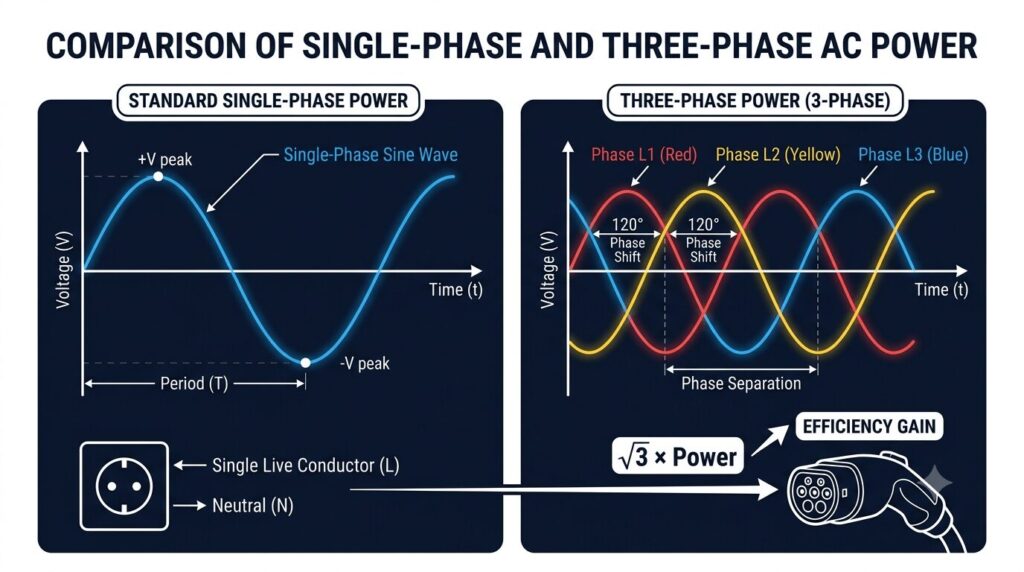
Alternating current (AC) electricity reverses direction at the grid frequency — 50 Hz in China and Europe, meaning current reverses direction 50 times per second. In a single-phase system, there is one live conductor and one neutral conductor, with the voltage oscillating between positive and negative peaks at the 50 Hz frequency.
What three-phase means:
A three-phase system has three separate live conductors, each carrying an AC current at the same frequency but offset by 120 degrees from each other — meaning the three phases reach their peak voltages at different points in each cycle, 1/3 of a cycle apart.
The three-phase system was the solution 19th century electrical engineers developed to transmit large amounts of electrical power efficiently over long distances — three conductors carrying offset AC currents produce a smoother aggregate power delivery than single-phase, allow motors to self-start and run more efficiently, and transmit more power per conductor than single-phase at the same voltage.
The power calculation difference:
Single-phase AC power: P = V × I × power factor
Three-phase AC power: P = √3 × V × I × power factor
The √3 (square root of 3, approximately 1.732) multiplier means three-phase delivers 1.732 times more power than single-phase at the same voltage and current — this is the fundamental physics reason why three-phase enables faster AC charging.
How Three-Phase Enables 11 kW Home EV Charging in Europe
European three-phase specification:
European residential electrical supply: 230V phase-to-neutral (same as China’s 220V), 400V phase-to-phase (three-phase line voltage)
Maximum residential circuit current: typically 32A per phase
Three-phase power at maximum: √3 × 230V × 32A = approximately 12.8 kW (derated to 11 kW for sustained charging)
Why European EV chargers specify 11 kW:
The 11 kW (or more precisely, 16A × 3 phases × 230V × √3 × power factor) represents the maximum continuous charging load appropriate for typical European residential three-phase electrical supply.
The European charging equipment:
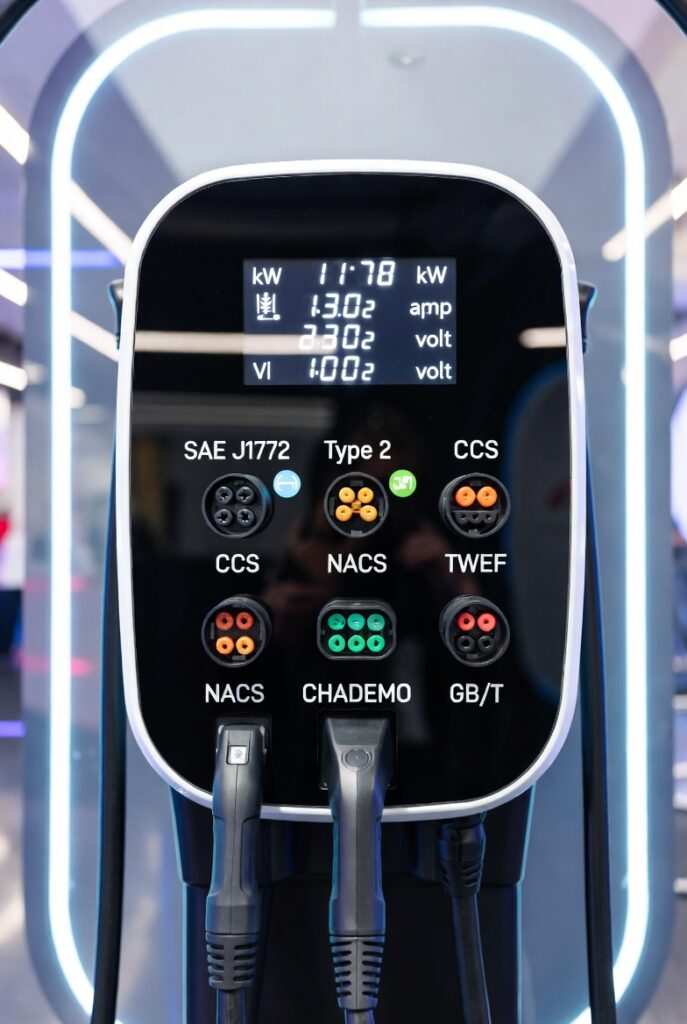
Type 2 chargers (IEC 62196-2 — the European standard connector), which connect to European EV home chargers and public AC charging stations, physically support three-phase connection with seven pins: three live conductors (L1, L2, L3), neutral, earth, and two communication pins. A three-phase-capable vehicle connects through this connector to a three-phase power supply and charges at up to 11 kW or, for some vehicles, up to 22 kW.
China’s Residential Electricity Infrastructure — Why Single-Phase Dominates
The Historical and Technical Reasons for Single-Phase Residential Distribution
How China’s electricity grid is structured:
China’s electricity grid, like all modern electricity grids, uses three-phase power for transmission and distribution at high and medium voltage — the same fundamental physics apply globally, and three-phase is the only practical approach for bulk electricity transmission.
The three-phase transmission and distribution infrastructure delivers electricity to residential neighbourhoods through distribution transformers that step voltage down from medium voltage (typically 10 kV in China) to low voltage (0.4 kV / 400V three-phase at the distribution transformer secondary).
The key decision point — how electricity is distributed from the distribution transformer to individual homes:
At the distribution transformer, the three-phase 400V supply is available. The question is how this supply is then connected to individual residential customers. There are two approaches:
Approach A (European): Three-phase to each home
Each residential unit receives a connection to all three phases — giving every home access to 400V three-phase power at the property level. The home’s electrical panel distributes loads across the three phases internally.
Approach B (Chinese and most Asian): Single-phase per home, three-phase distributed across homes
Each residential unit receives a connection to one of the three phases (phase L1, L2, or L3) plus neutral. Different homes in the same building or neighbourhood are connected to different phases, distributing the aggregate residential load across all three phases at the distribution transformer level — but individual homes access only one phase.
China’s choice of Approach B:
China’s residential electricity distribution has historically used Approach B — single-phase per household — for reasons that combine engineering tradition, infrastructure economics, safety philosophy, and historical development trajectory:
Reason 1: Safety philosophy
Single-phase household supply limits the maximum voltage present in a home to 220V (phase-to-neutral). Three-phase supply brings 380V phase-to-phase voltages into the home — higher voltages that increase electrocution risk if live conductors are contacted.
Chinese residential electrical standards, developed during the mass urbanisation and electrification of the 1980s-2000s, prioritised minimising residential electrical safety risk — a 220V maximum in-home voltage was considered safer than exposing residential users to 380V phase-to-phase voltages.
Reason 2: Infrastructure economics
Three-phase supply to individual residences requires more complex in-home wiring — a three-phase distribution panel with phase balancing, three-phase wiring for major appliances, and more sophisticated electrical installation. In the context of China’s rapid mass housing development from the 1980s onward, single-phase wiring was simpler, cheaper per unit to install, and required less electrician skill to implement correctly.
Reason 3: Residential load characteristics
China’s historically dominant residential loads — lighting, refrigeration, small appliances, cooking (increasingly induction), and space conditioning — are all single-phase loads that work perfectly well with single-phase supply. The perceived benefit of three-phase at the residential level was minimal when the primary use cases were single-phase loads.
Reason 4: Historical development trajectory
China’s residential electrification occurred primarily in the 1970s-2000s, when the dominant electrical design precedent from Soviet technical assistance (which influenced early PRC electrical engineering education and practice) favoured single-phase residential distribution. By the time EV charging created a genuine need for higher residential AC power delivery, the single-phase residential infrastructure was already installed at enormous scale — the path dependency of existing infrastructure made transitioning to three-phase residential supply prohibitively expensive.
The comparison with European infrastructure:
Europe’s residential three-phase supply reflects a different historical development trajectory — many European countries developed residential three-phase supply during earlier electrification periods when industrial and residential electrical infrastructure developed simultaneously, with three-phase supply seen as standard for any electrified building rather than a special commercial requirement. Germany, France, Netherlands, and Nordic countries established three-phase residential supply as normal infrastructure, creating the foundation that now enables 11 kW home EV charging.
The Practical Consequence for Chinese EV Charging
The 7 kW Home Charging Ceiling in China
Why Chinese home EV charging is capped at 7 kW:
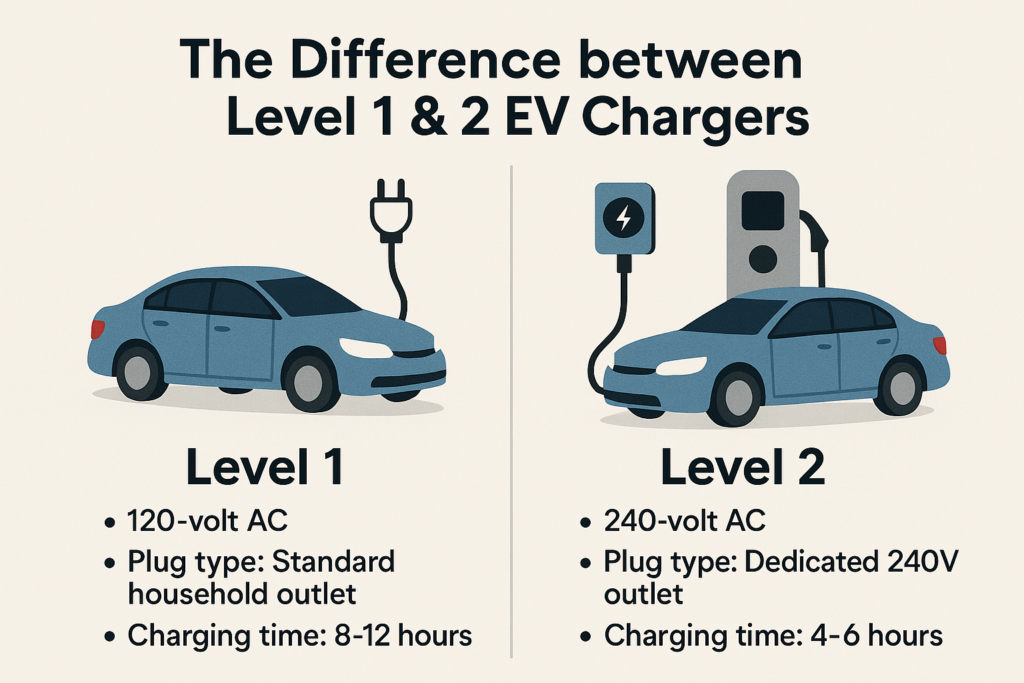
With single-phase 220V supply and a maximum residential circuit current of 32A (the typical Chinese residential EV charging circuit):
Maximum single-phase power: 220V × 32A × power factor ≈ 7 kW (the standard Chinese home charging maximum)
This 7 kW ceiling is not a charger specification limitation, not an EV design limitation, and not a regulatory restriction on charging — it is a fundamental consequence of single-phase electrical supply architecture. No certified home charger in China’s residential market provides more than 7 kW because no Chinese residential property has the three-phase supply required to deliver more power through a single residential circuit.
The GB/T standard reflects this reality:
GB/T 20234.2 (China’s AC charging standard) specifies single-phase 7 kW as the standard home charging power level, with three-phase 22 kW available for commercial and industrial three-phase supply locations. The standard’s structure acknowledges the residential single-phase constraint while providing for three-phase commercial charging where that supply exists.
The Charging Speed Comparison — China vs Europe
For the same vehicle, the home charging speed difference:
BYD Atto 3, 60 kWh battery, 20-80% charge (36 kWh):
China (6.6 kW OBC, single-phase): 36 kWh ÷ 6.6 kW = 5.5 hours
Europe (11 kW OBC, three-phase): 36 kWh ÷ 11 kW = 3.3 hours
NIO ET7, 75 kWh battery, 20-80% charge (45 kWh):
China (6.6 kW OBC single-phase): 45 kWh ÷ 6.6 kW = 6.8 hours
Europe (11 kW OBC three-phase): 45 kWh ÷ 11 kW = 4.1 hours
The practical overnight charging implication:
As covered extensively in our charge time calculator guide, most Chinese EV owners charging overnight have 8-10 hours within the TOU valley window. Both the Chinese 7 kW rate and the European 11 kW rate complete overnight charges for typical daily usage within this window — making the 7 kW vs 11 kW difference academically interesting but practically inconsequential for typical Chinese owners who drive standard daily commuting distances.
The difference becomes practically significant only for:
- Large-battery vehicles (90-100 kWh) needing substantial overnight charge
- High-mileage owners (35,000+ km/year) depleting large batteries regularly
- Owners with limited overnight charging windows due to specific TOU configurations or arrival time constraints
Where Chinese Properties Do Have Three-Phase Access
The Exceptions That Enable Faster AC Charging
Not all Chinese properties have single-phase supply:
While single-phase is the dominant Chinese residential supply architecture, three-phase supply does exist in specific Chinese property categories:
Category 1: Villas and stand-alone houses
Many Chinese villas — particularly higher-specification developments constructed since approximately 2010 — are connected to three-phase supply, reflecting the higher electrical loads of larger properties (multiple HVAC units, more appliances, larger lighting systems) that benefit from load balancing across three phases.
The EV charging implication for villa owners:
Chinese villa owners with three-phase supply can install 11 kW or 22 kW three-phase EV chargers — and the Chinese versions of some EVs (particularly those sold in multiple markets where the OBC supports three-phase) can charge at these higher rates if their onboard charger is specified accordingly.
This is why our tier 1 vs tier 2 city guide discusses three-phase charging in the context of Chengdu villas specifically — the villa property category in China has genuinely different electrical infrastructure from apartment properties, creating different home charging options.
Category 2: Commercial and mixed-use properties
Chinese commercial properties — offices, retail units, restaurants — typically have three-phase supply as standard, reflecting their higher and more variable electrical load requirements. This is why Chinese commercial EV charging installations (the mall charging guide’s reference installations) can and do deploy three-phase chargers at 22 kW.
Category 3: Newer high-density residential developments with enhanced specifications
Some Chinese residential developments constructed since approximately 2018-2020, particularly premium developments targeting buyers who might own EVs and high-end appliances, have been designed with three-phase supply to individual apartments as a specification differentiator. This is not yet mainstream but represents an emerging trend in premium Chinese residential development.
Category 4: Rural properties with agricultural connections
As covered in our rural tier 1 vs tier 2 guide, Chinese rural properties with agricultural electrical connections sometimes have three-phase supply available — intended for irrigation pumps and agricultural equipment — that can be adapted for EV charging at higher power levels than standard residential single-phase allows.
The Three-Phase Upgrade Question
Can Chinese apartment owners upgrade to three-phase supply?
In the vast majority of Chinese apartment situations, the answer is no — at least not practically:
The single-phase connection from the distribution transformer to the apartment building is a building-level infrastructure decision, not an individual apartment choice. Upgrading a single apartment to three-phase would require:
Running new three-phase supply cables from the distribution transformer (or from the building’s common three-phase supply in the distribution room) to the individual apartment — a significant infrastructure modification requiring building-level approval, professional installation, and SGCC coordination
Installing a three-phase electrical panel within the apartment — replacing the standard single-phase consumer unit
Coordinating with 物业 for the installation work in shared infrastructure spaces
For most Chinese apartment owners, this upgrade path is practically unavailable — either because the building’s distribution infrastructure doesn’t support three-phase to individual apartments, because 物业 will not approve the modifications required, or because the cost (¥20,000-¥50,000 for the full upgrade) is disproportionate to the benefit.
The practical verdict for apartment owners:
7 kW single-phase home charging is the practical ceiling for Chinese apartment owners, and for the overwhelming majority, this is entirely adequate for daily charging needs given the overnight TOU window. Pursuing three-phase upgrade for apartment properties is not recommended — the cost, complexity, and practical unavailability make it an unrealistic goal for essentially all Chinese apartment EV owners.
The OBC (Onboard Charger) Design Implications
Why Chinese-Market EVs Have Different OBC Specifications From European Versions
The vehicle-side adaptation to supply architecture:
As covered in our understanding EV charger specs guide’s discussion of the OBC, the vehicle’s onboard charger converts AC supply to DC for battery charging. The OBC specification — maximum AC input and corresponding DC output — is designed for the supply architecture of the market where the vehicle will be used.
Chinese-market OBC specifications:
The vast majority of Chinese-market EVs have OBCs specified for single-phase 220V input, with maximum AC acceptance rates of 6.6 kW (most common) or 7 kW (in some models). This specification is appropriate for China’s single-phase residential supply — no faster AC charging is possible at home regardless of OBC specification, so specifying a three-phase OBC adds cost with no practical benefit.
European-market OBC specifications:
European-market versions of the same vehicles have OBCs specified for three-phase 230V input, with maximum AC acceptance rates of 11 kW (standard) or 22 kW (premium specification). This specification is appropriate for Europe’s three-phase residential supply — the faster AC charging is achievable at home because three-phase supply is available.
The same vehicle, different OBC specification:
This explains the specification difference noted at this guide’s opening:
BYD Atto 3 China: 6.6 kW single-phase OBC
BYD Atto 3 Europe: 11 kW three-phase OBC
This is not BYD holding back the Chinese version — it is appropriate engineering for each market’s infrastructure reality. Installing a 11 kW three-phase OBC in a Chinese-market Atto 3 would add cost and complexity without enabling any faster home charging, since Chinese homes don’t have three-phase supply.
The Public Charging and Commercial Charging Context
Where Three-Phase AC Fast Charging Does Exist in China
Chinese public AC charging:
China’s public AC charging infrastructure does include three-phase charging points at commercial and public locations that have three-phase supply — typically at:
- Office building car parks with commercial three-phase supply
- Shopping mall car parks (as covered in our mall charging guide)
- Hotel car parks with commercial electrical connections
- Some purpose-built public charging facilities
At these locations, three-phase 22 kW AC charging points using GB/T 20234.2 (which specifies three-phase capability) can serve vehicles with three-phase-capable OBCs if those vehicles’ China-market variants include three-phase OBCs.
The current Chinese vehicle fleet limitation:
Here is the irony: even where Chinese commercial locations have three-phase AC charging infrastructure, most Chinese-market EVs cannot use it at full 22 kW because their China-market OBCs are specified for single-phase only. The commercial three-phase AC charging infrastructure primarily benefits imported vehicles with three-phase OBCs (European-specification imports) and a small number of vehicles whose China-market variants include three-phase OBC capability.
The commercial charging landscape implication:
Chinese commercial EV charging strategy has logically bypassed the three-phase AC charging tier and moved directly to DC fast charging for high-power needs — rather than building 22 kW AC commercial charging infrastructure that most Chinese-market vehicles can’t use, Chinese charging networks have invested in DC fast charging (from 30 kW to 250 kW) that provides genuinely fast charging for any DC-capable vehicle regardless of their AC OBC specification.
This is actually a strategically elegant response to the single-phase home charging constraint: Chinese EV owners who need faster charging than 7 kW home AC charging provides use DC fast charging (readily available at commercial locations, covered in our commercial charger guide) rather than pursuing the intermediate tier of 11-22 kW three-phase AC charging that European infrastructure emphasises.
The V2G and Future Infrastructure Implications
How Single-Phase vs Three-Phase Affects Bidirectional Charging
V2H and V2G are primarily DC functions:
As covered in our V2H/V2G guide, residential V2H and V2G systems in China use bidirectional DC charging equipment rather than AC bidirectional systems. This means the single-phase vs three-phase distinction is less critical for V2H capability than it might initially appear — the bidirectional DC system operates independently of the residential AC supply architecture in terms of power delivery mechanism.
The practical V2G power level implication:
V2H systems in China (the BYD Han EV system covered in our V2G guide) are currently rated at 6 kW bidirectional — consistent with single-phase residential supply architecture. Three-phase residential supply would enable higher-power V2H systems (11 kW+ bidirectional) that could serve larger home loads more effectively.
Whether China will transition toward three-phase residential supply:
The question of whether China’s residential electrical infrastructure will evolve toward three-phase supply — driven by the combination of EV charging, V2H/V2G requirements, and the general increase in residential electrical load — is genuinely open. Some indicators suggest gradual movement in this direction:
Premium residential developments already specifying three-phase supply as noted above
SGCC’s awareness of the EV charging speed benefit that three-phase residential would enable, documented in various SGCC research publications
The long-term logic of V2H systems operating at higher power levels pushing residential supply requirements toward three-phase capability
The realistic timeline:
Any significant transition toward three-phase residential supply in China’s existing housing stock would require replacement of distribution transformer secondary wiring throughout existing residential compounds — an enormous infrastructure undertaking with cost implications that make it a 20-30 year transition at the earliest, not a near-term development that EV owners should plan around.
For new residential construction, three-phase supply specification in premium developments may gradually normalise over 10-15 years. For existing residential stock, single-phase remains the practical ceiling indefinitely for all but a small minority of exceptional properties.
The Practical Guide — What Chinese EV Owners Should Know and Do
The Clear Guidance for Different Chinese Property Situations
For apartment owners (the vast majority of Chinese EV owners):
Accept 7 kW as the home charging maximum — this is not a problem to be solved but a reality to be accommodated. As our charge time calculator guide demonstrates, 7 kW with TOU scheduling delivers adequate overnight charging for the vast majority of Chinese driving patterns. The appropriate response is:
- Install the best 7 kW charger appropriate for your climate and installation environment (per the specific recommendations throughout this guide series)
- Configure TOU scheduling to maximise the valley rate saving from overnight charging
- Use DC fast charging for the rare occasions when faster charging is needed mid-trip
For villa owners with three-phase supply:
Verify three-phase supply availability before charger purchase — confirm with the property developer or with an electrician who can inspect your main distribution panel. If three-phase supply is confirmed:
- Select a charger specified for three-phase 22 kW (Autel MaxiCharger 22 kW three-phase, Ginlong Solis three-phase, Huawei FusionCharge three-phase variant)
- Verify your specific vehicle’s China-market OBC specification supports three-phase AC input — many Chinese-market vehicles don’t, in which case a 7 kW single-phase charger is equally adequate despite the three-phase supply availability
The specific vehicle OBC verification step:
Before purchasing a three-phase charger on the assumption it will charge your vehicle faster, confirm your specific vehicle model’s China-market OBC specification. If the OBC is single-phase only (6.6 kW maximum), a three-phase 22 kW charger will not charge faster — the OBC limits charging speed regardless of supply availability.
Internal Links — Further Reading on Clean Energy Bazaar
The three-phase power for homes Europe has it why doesn’t China use it for home charging guide is the electrical infrastructure companion to the product specification and installation guides throughout this content cluster.
For the understanding EV charger specs guide that covers OBC specifications and their relationship to charging speed, our understanding EV charger specs 2026 kW amps 800V architecture new GB standards guide covers every technical specification including the OBC’s role. For the charge time calculator that demonstrates the practical overnight charging implications of 7 kW vs 11 kW for specific Chinese vehicles, our EV charge time calculator 2026 how long to full for your Chinese EV BYD to NIO guide covers every major Chinese model. For the tier 1 vs tier 2 city guide that covers villa three-phase supply availability in the Chengdu villa context specifically referenced in this guide, our tier 1 vs tier 2 city charging solutions for Beijing high-rises vs Chengdu villas vs rural villages guide covers every property type. For the professional installation costs guide covering what three-phase installation work actually costs in Chinese commercial contexts, our professional EV charger installation costs 2026 what State Grid chargers vs private companies charge guide covers every installation scenario. For the luxury EV charging guide that specifically addresses the imported three-phase-capable European vehicles whose OBC specifications interact with Chinese supply architecture, our luxury EV charging 2026 Porsche Taycan BMW i5 Mercedes EQE best home solutions for China’s 1 percent guide covers every premium vehicle specification. And for the V2G guide that contextualises how single-phase vs three-phase supply affects bidirectional charging capability, our V2G in China 2026 can your BYD Atto 3 power your home during a blackout guide covers the complete bidirectional charging landscape.
Final Thoughts
The three-phase power for homes Europe has it why doesn’t China use it for home charging question has a layered answer that goes beyond a simple “China chose differently” — it reflects the combination of engineering tradition, safety philosophy, infrastructure economics at mass scale, historical development trajectory, and path dependency that produced genuinely different residential electrical infrastructure in China and Europe despite both being sophisticated, modern electrical systems.
The single-phase residential electrical infrastructure that limits Chinese home EV charging to 7 kW is not a failure of foresight or a problem that will be quickly fixed — it is a deeply embedded characteristic of China’s residential building stock that was reasonable given the historical context in which it was established and that will take decades to meaningfully change. The practical response to this reality is not frustration but adaptation: understanding that 7 kW overnight TOU charging serves the overwhelming majority of Chinese EV owners’ actual needs adequately, that DC fast charging provides the high-power capability when genuinely needed, and that the specific exceptions (villa owners with three-phase supply, commercial properties) provide the higher-power AC charging access where the infrastructure genuinely exists.
European three-phase residential charging’s 11 kW capability is genuinely better than Chinese single-phase 7 kW for users who can access it and whose vehicles have three-phase OBCs. But “better” in a context where the supply infrastructure doesn’t exist at the residential level doesn’t produce better outcomes — it produces expensive equipment with no additional capability. Chinese EV owners are not missing out on faster home charging because of a specification choice that could be changed without changing the infrastructure — they are experiencing the engineering consequence of an infrastructure architecture decision made decades ago that is not reversible at the individual property level.
Know your supply. Verify your OBC. Install appropriately. Charge effectively within the infrastructure you actually have. That is the practical wisdom this guide delivers.