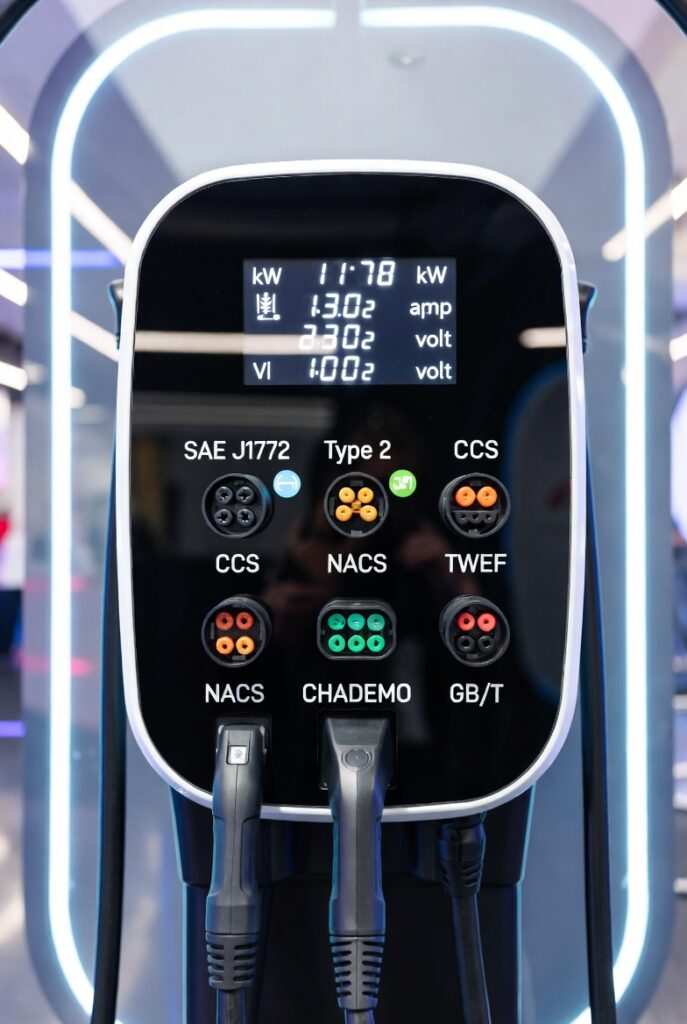
The North American Charging Standard (NACS) — Tesla’s proprietary connector that became an industry standard when Ford, GM, Rivian, and eventually virtually every North American EV manufacturer adopted it, and that the Society of Automotive Engineers subsequently standardised as SAE J3400 — has completed one of the most dramatic standards consolidation stories in automotive history. By 2026, NACS is the de facto standard for new EV charging infrastructure deployment across the United States and Canada, displacing CCS1 (the previous North American standard) with remarkable speed.
This creates a specific question for Chinese EV industry participants that is worth examining honestly rather than dismissively: does NACS’s North American dominance have any practical implication for Chinese EV owners using Chinese GB/T infrastructure, for imported vehicles being brought to China, for Chinese EVs being exported to North America, or for Chinese charging hardware manufacturers competing in North American export markets?
This guide on NACS invasion are US Tesla chargers compatible with Chinese GB/T standards in 2026 provides the complete, technically honest assessment — what NACS actually is at the connector and protocol level, how it compares with GB/T at each technical layer, whether physical adapters can bridge the standards, what the Chinese domestic market implications are (essentially none for most owners), and where genuine cross-standard compatibility questions arise in specific, identifiable scenarios involving cross-border vehicle ownership or export market participation.
The conclusion, which honest technical analysis requires stating clearly at the outset: for Chinese EV owners using Chinese-market vehicles at Chinese charging infrastructure, NACS is irrelevant in 2026. GB/T remains China’s domestic connector standard with no prospect of displacement by NACS, and Chinese-market Tesla vehicles use GB/T connectors, not NACS. The “NACS invasion” of China’s EV charging market is not happening and is not projected to happen. This guide explains why in technical detail — and then addresses the specific, narrower scenarios where NACS does create genuine practical questions for specific readers.
Understanding NACS — What It Actually Is
The Technical Architecture of NACS
The connector’s physical design:
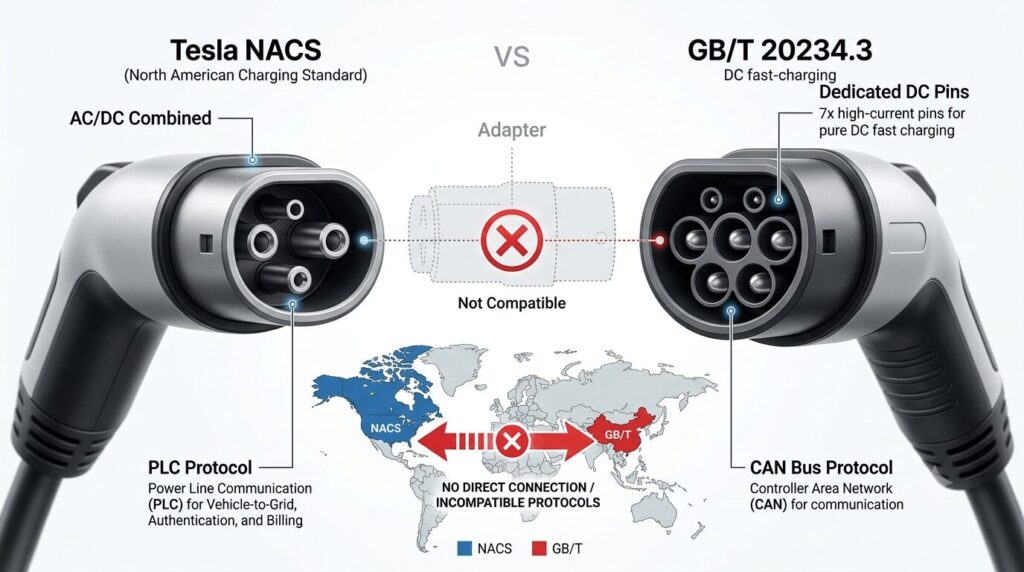
NACS (North American Charging Standard, SAE J3400) uses a significantly smaller physical connector than either CCS1 (the previous North American standard) or CCS2 (the European standard). Tesla’s original design goal — a single connector capable of both AC and DC charging — produced a compact, oval connector with 3 pins:
- Two large DC power pins for DC fast charging
- One pilot/signal pin for both AC charging control pilot and DC communication
- Ground connection integrated into the connector body
The single connector for both AC and DC is NACS’s most distinctive feature compared to European CCS2 (which requires a separate DC inlet with additional pins below the standard AC connector) and compared to Japanese CHAdeMO (which used an entirely separate DC connector from the AC inlet).
The electrical specifications:
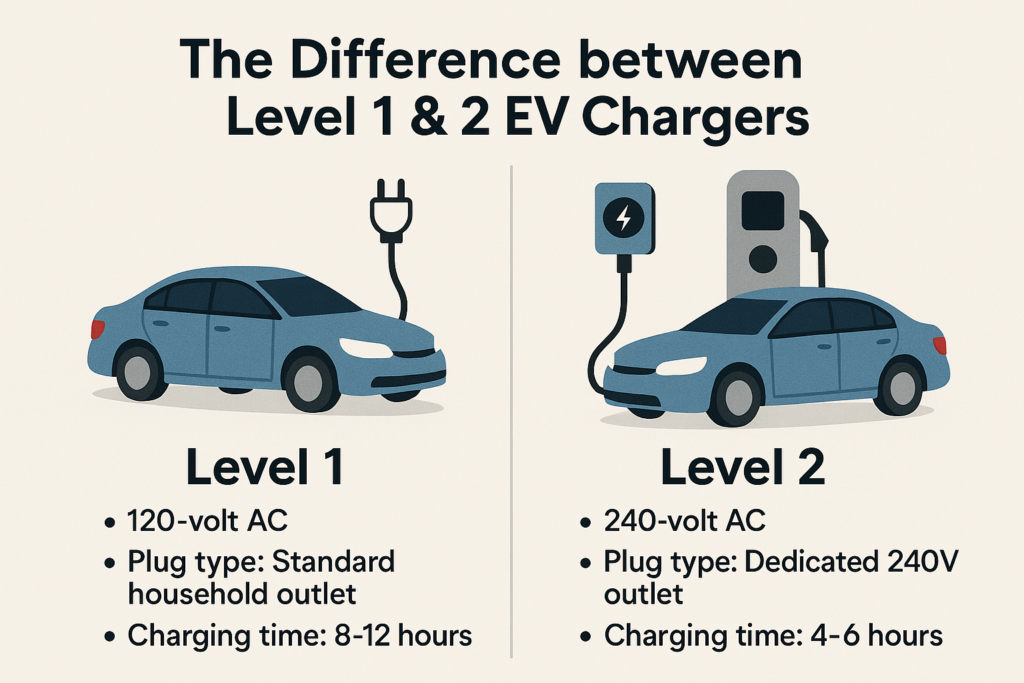
AC charging through NACS: Up to 19.2 kW in North American context (240V × 80A)
DC fast charging through NACS: Up to 350 kW (current practical deployment) with architecture supporting higher future ratings
The communication protocol:
AC communication: Standard pilot signal (same underlying principle as J1772 that NACS replaced)
DC communication: PLC (Power Line Communication) over the pilot pin — a specific difference from CCS that uses PLC over the DC power conductors
Understanding GB/T — China’s Domestic Standard
GB/T 20234 at the Technical Level
The GB/T connector family:
As covered extensively in our GB/T vs NACS vs CCS guide, China’s GB/T charging standard comprises multiple parts:
GB/T 20234.2 (AC charging, 交流充电):
The AC charging connector used for home and workplace AC charging — the connector on every home charger covered throughout this guide series. Seven-pin design accommodating three-phase AC power (up to 22 kW) with dedicated control pilot, proximity detection, and protective earth connections.
GB/T 20234.3 (DC fast charging, 直流充电):
The DC fast charging connector used for public DC fast charging infrastructure. Nine-pin design for DC power delivery with CAN bus communication protocol — a key technical difference from NACS’s PLC communication.
The communication architecture:
AC control pilot: Similar in principle to J1772/NACS AC charging control
DC communication: CAN bus (Controller Area Network, the same communication bus used within vehicles) — fundamentally different from NACS’s PLC communication and from CCS’s PLC implementation
The Technical Compatibility Assessment — Layer by Layer
Layer 1: Physical Connector Compatibility
NACS and GB/T physical incompatibility:
NACS and GB/T (both AC and DC variants) have entirely different physical geometries — different pin count, different pin arrangement, different connector body shape. A NACS connector physically cannot insert into a GB/T inlet, and a GB/T connector physically cannot insert into a NACS inlet. There is zero physical interoperability without an adapter.
This is not a controversial or uncertain finding — it is an observable, objective physical characteristic. The connectors are designed independently by different standards bodies for different electrical specifications, and they have different shapes.
Layer 2: Electrical Specification Compatibility
Voltage and current compatibility:
Both NACS and GB/T handle similar voltage and current ranges for DC fast charging — the DC power delivery parameters are physically compatible in principle (both handle 400-800V DC at high current).
AC charging is where electrical specifications differ most significantly:
NACS AC: 120V/240V single-phase (North American electrical infrastructure)
GB/T AC: 220V single-phase or 380V three-phase (Chinese electrical infrastructure)
The North American 120V/240V split-phase system is fundamentally different from China’s 220V/380V single-phase/three-phase system, meaning a NACS charger designed for North American electrical infrastructure cannot simply be plugged into Chinese grid supply — the input voltage specifications are different at the grid connection level, independent of the connector compatibility question.
Layer 3: Communication Protocol Compatibility
The most technically significant incompatibility:
DC fast charging communication represents the most substantive technical incompatibility between NACS and GB/T that makes simple physical adapters inadequate for DC fast charging interoperability:
NACS DC communication: PLC over pilot pin (a specific implementation)
GB/T 20234.3 DC communication: CAN bus over dedicated communication pins
These are genuinely different communication protocols that cannot be bridged by a simple physical adapter — bridging them at the DC fast charging level would require active electronics that translate between the two protocols, not merely a passive mechanical adapter.
AC charging is more bridgeable:
AC charging communication — the control pilot signal that governs the charging session initiation and current level negotiation — is more similar between the standards in principle, though the specific pin assignment and connector geometry differences still prevent simple passive adaptation.
Layer 4: Standards Authority and Certification
Why even a technically functional adapter has market implications:
In China’s regulatory context, as covered extensively in our 3C certification guides and August 2026 compliance guide, EV charging equipment requires 3C certification against applicable GB/T standards to be legally used in China. An adapter bridging NACS to GB/T — even if technically functional — would itself require certification as EV charging equipment under Chinese regulations before it could be legally used.
The Chinese Tesla Situation — The Most Common Practical Question
Why Chinese-Market Tesla Vehicles Use GB/T, Not NACS
The definitive answer to the most common practical question:
Tesla manufactures China-market vehicles at its Shanghai Gigafactory (Giga Shanghai) specifically for the Chinese domestic market. These vehicles — including the China-market Model 3, Model Y, Model S, and Model X sold in China — are equipped with GB/T connectors, not NACS connectors.
This is not a software configuration or a removable adapter situation — it is a hardware design choice that Tesla made specifically for Chinese market compliance, consistent with China’s requirements that EVs sold domestically use GB/T charging interfaces.
The practical implication:
A Chinese Tesla Model Y purchased from Tesla’s Chinese retail network charges from any GB/T home charger, any GB/T AC charging point, and any GB/T DC fast charging station in China — exactly as a BYD Han or NIO ET5 does, with no NACS involvement. The owner can also use Tesla’s own Supercharger network in China, which uses GB/T connectors at Chinese Supercharger stations.
Tesla Supercharger network in China uses GB/T:
Tesla’s Chinese Supercharger network uses GB/T 20234.3 DC connectors — not NACS. Tesla began opening its Chinese Supercharger network to non-Tesla vehicles in China (using GB/T compatibility) consistent with broader Supercharger network opening in China that occurred over 2023-2024.
The Scenarios Where Cross-Standard Compatibility Actually Matters
Scenario 1: Bringing a North American NACS Vehicle to China
Who this affects:
Chinese nationals returning from the United States with a NACS-equipped EV (a US-market Tesla, Ford Mustang Mach-E, Chevrolet Equinox EV, or other NACS vehicle)
Expatriates who owned a NACS vehicle in North America and are relocating to China
The practical situation:
A US-market Tesla Model Y equipped with NACS connectors cannot charge at any standard Chinese GB/T charging point without an adapter. And as established above, a simple passive NACS-to-GB/T adapter is not technically adequate for DC fast charging due to the communication protocol difference.
The current resolution:
As of mid-2026, the practical solution for NACS vehicles being used in China is limited:
For AC charging: NACS-to-GB/T-AC adapters exist in the grey market (accessories market, not officially certified) that allow NACS vehicles to use Chinese GB/T AC charging infrastructure. These adapters bridge the AC control pilot in a way that can functionally work for slow AC charging, though they lack 3C certification and their use is not technically compliant with Chinese charging standards.
For DC fast charging: No publicly available, technically complete, and certified adapter solution exists that bridges NACS DC and GB/T DC communication protocols for fast charging. This means a NACS vehicle in China has no access to standard Chinese DC fast charging infrastructure.
The honest assessment: Bringing a NACS-equipped EV to China for sustained use is genuinely impractical in 2026. The charging infrastructure gap is not addressable through simple accessories. This is a niche scenario but one worth honest documentation.
Scenario 2: Chinese EVs Exported to North America
The commercially significant direction:
Multiple Chinese EV manufacturers have announced or are actively pursuing North American market entry — a strategic direction that has been significantly complicated by US tariff policy but that remains a commercial objective for brands including BYD, NIO (through potentially unbranded entry), CATL (through licensing partnerships), and others.
The connector implication for Chinese EVs in North America:
Chinese EVs designed for the domestic market use GB/T connectors. North American charging infrastructure in 2026 is transitioning to NACS as the dominant standard. Chinese EVs entering the North American market cannot use GB/T connectors for that market — they must either:
Be re-engineered with NACS connectors for North American market variants (the same localisation that Tesla performs in reverse for its Chinese market vehicles)
Include NACS adapters as part of the market entry specification
The commercial implication:
For Chinese EV manufacturers seriously pursuing North American export, NACS adoption for the North American variant of their vehicles is a market requirement — the same market requirement that drove every North American EV manufacturer to adopt NACS. This is a product development and manufacturing localisation challenge, not a standards competition question.
Scenario 3: Chinese Charging Hardware Manufacturers Exporting to North America
The commercially relevant scenario for this guide series’ business-oriented content:
Chinese charging hardware manufacturers — several of whom are covered throughout this guide series — have significant North American export ambitions. Autel, for example, has established meaningful commercial presence in the North American charging market as well as its home Chinese market.
The NACS implication for Chinese charging hardware exports:
Chinese charging hardware manufacturers who want to sell AC home chargers in the North American market in 2026 must produce NACS-compatible products for that market. Several already do — Autel’s North American product range includes NACS connectors, entirely distinct from their GB/T Chinese domestic market products.
This represents standard product market localisation — the same approach Chinese automakers must take for vehicle exports — rather than a standards conflict that undermines either market’s domestic standard.
Scenario 4: CCS2 Vehicles in China — A More Relevant Current Scenario
A more immediately practical cross-standard scenario:
While NACS vehicles in China are a rare edge case, a more common scenario involves pre-2023 imported European EVs equipped with CCS2 connectors — BMW i3, earlier Mercedes EQC, older Volkswagen ID.4 import variants, and similar vehicles imported before Chinese-market localised versions with GB/T connectors became standard.
The CCS2 in China situation:
Some Chinese public DC fast charging stations, particularly at higher-traffic commercial and highway locations operated by major networks, provide CCS2 connectors alongside GB/T to serve this specific imported vehicle population. The availability is not universal but is sufficient at major locations.
CCS2-to-GB/T adapters for AC charging exist in China’s accessories market for imported European vehicles, similar to the NACS adapter situation above but with somewhat better established third-party support given the larger number of CCS2 vehicles in China versus NACS vehicles.
The ChaoJi Factor — China’s Next-Generation Standard and Global Aspirations
How ChaoJi Positions China’s Standard in Global Context
ChaoJi (超级充) — the next-generation Chinese standard:
As covered in our GB/T vs NACS vs CCS guide and our technology trends guide, ChaoJi is China’s next-generation ultra-fast charging connector standard, developed jointly by Chinese and Japanese standards bodies (JARI/CHAdeMO cooperation), with backward compatibility with existing GB/T vehicles through adapter provisions.
ChaoJi’s global positioning aspirations:
The ChaoJi standard development included explicit ambitions for international adoption beyond China and Japan — positioning it as a potential global standard that could bridge the NACS/CCS2 fragmentations in international markets. These ambitions have not materialised into widespread adoption outside China and Japan as of 2026.
The technical capability that ChaoJi offers:
ChaoJi supports up to 900 kW charging at maximum specification — substantially exceeding current NACS and CCS2 maximum deployments — and uses liquid-cooled cable technology that enables the high-current delivery at reduced cable weight and temperature. These technical capabilities are genuinely superior to current NACS and CCS2 specifications, but technical superiority has historically proven insufficient to drive cross-market standard adoption when network effects favour established standards.
The honest global standards outlook:
Three regional standards are consolidating their respective markets: NACS in North America, CCS2 in Europe (with NACS gaining some traction), and GB/T/ChaoJi in China and parts of Asia. The prospect of a single global charging standard has receded rather than advanced as each region has made definitive infrastructure investment decisions in their respective standards. This regional fragmentation creates the cross-border compatibility scenarios this guide has documented, and creates the localisation requirement for vehicles and hardware exported between regions.
What the “NACS Invasion” Framing Gets Wrong
The Specific Misunderstanding This Guide Addresses
Why the “NACS invasion” framing misleads Chinese EV owners:
The question framed as “NACS invasion: will NACS replace GB/T in China?” or “are US Tesla chargers compatible with China?” conflates several distinct questions that have very different answers:
Question 1: Is NACS physically compatible with GB/T? Answer: No.
Addressed above — different connectors, different communication protocols, no passive adapter compatibility for DC fast charging.
Question 2: Do Chinese-market Tesla vehicles use NACS? Answer: No.
Chinese-market Teslas use GB/T. NACS is a North American standard for Tesla’s North American market vehicles.
Question 3: Will NACS replace GB/T in China? Answer: No credible basis for this.
China’s GB/T standard is a sovereign industrial standard with billions of yuan of installed infrastructure, regulatory mandate, and no political or commercial incentive for China to adopt a North American standard. The direction of any long-term standards influence is as likely to flow from China (through ChaoJi) to other markets as from North America to China.
Question 4: Does NACS affect the Chinese EV market? Answer: Indirectly, for exports.
Chinese EV and hardware manufacturers targeting North American export must accommodate NACS — this is a product localisation requirement that affects manufacturers’ export strategies without affecting China’s domestic charging standard.
The appropriate framing:
NACS’s North American consolidation is an important development for the global EV industry. For Chinese EV owners using Chinese-market vehicles at Chinese charging infrastructure, it is irrelevant to their daily charging experience. For Chinese EV manufacturers pursuing export strategies, it is one of several market localisation requirements alongside steering wheel position, safety certification, and emissions compliance.
The Practical Guidance for Specific Chinese Readers
For Chinese EV Owners Using Chinese-Market Vehicles
You need no information about NACS. Your vehicle uses GB/T connectors. Chinese charging infrastructure uses GB/T connectors. Every home charger covered throughout this guide series uses GB/T. NACS does not exist in your charging ecosystem.
The GB/T vs NACS question is entirely irrelevant to your charger selection, your installation process, your TOU optimisation, your demand response participation, your maintenance schedule, or any other practical aspect of home EV charging that this guide series has addressed.
For Chinese Nationals Planning North America Travel or Relocation
If you are planning to use an EV in North America: You need a NACS-compatible vehicle or a CCS1-to-NACS adapter (for vehicles that supported CCS1 — many early North American EVs). Chinese-market GB/T vehicles are not designed for North American grid infrastructure or North American connector compatibility, and should not be imported to North America for use without major modification.
If you are relocating from North America to China with a NACS vehicle: The charging compatibility situation is as documented above — AC charging may be addressable with third-party adapters, DC fast charging is practically unavailable. Serious consideration should be given to selling the North American vehicle and purchasing a Chinese-market vehicle on arrival rather than attempting to use a NACS vehicle with Chinese infrastructure.
For Chinese EV Industry Participants Targeting North American Export
NACS (SAE J3400) is the required connector standard for the North American market. North American variants of Chinese EVs must include NACS inlet capability. North American variants of Chinese charging hardware (home chargers, commercial chargers) must include NACS connector output. This is a product engineering and certification requirement, not a standards debate.
The 3C certification and GB/T standards that govern Chinese domestic market products have no applicability in North America. North American products require UL, ETL, or equivalent North American safety certification alongside SAE J3400 connector compliance.
Internal Links — Further Reading on Clean Energy Bazaar
The NACS invasion are US Tesla chargers compatible with Chinese GB/T standards in 2026 guide is the standards compatibility companion to the connector and product guidance throughout this content cluster.
For our comprehensive GB/T vs NACS vs CCS connector standard guide that established the technical foundation this guide builds upon, our GB/T vs NACS vs CCS which EV charger plug do you need in China 2026 guide covers every connector standard in detail. For the understanding EV charger specs guide that covers GB/T standard specifications including the 800V architecture considerations that interact with connector standard questions, our understanding EV charger specs 2026 kW amps 800V architecture new GB standards guide covers every technical specification. For the Tesla comparison guide that specifically establishes how Tesla’s Chinese market products differ from North American products in connector specification, our Tesla universal wall connector vs StarCharge vs Autel 2026 China market comparison guide covers Tesla’s China market specification. For the technology trends guide covering ChaoJi’s development as China’s next-generation standard with global aspirations, our upcoming EV charger trends 2026-2027 V2G solid-state batteries and what to buy now in China guide covers every emerging standard development. For the luxury EV charging guide covering the imported European CCS2 vehicles that represent the more practically relevant cross-standard scenario for Chinese EV owners, our luxury EV charging 2026 Porsche Taycan BMW i5 Mercedes EQE best home solutions for China’s 1 percent guide covers every imported EV connector consideration. And for the 3C certification guide covering the certification requirements that any cross-standard adapter would need to meet for legal Chinese market use, our 3C certification and EV chargers 2026 why buying non-certified chargers is dangerous in China guide covers every safety certification standard.
Final Thoughts
The NACS invasion are US Tesla chargers compatible with Chinese GB/T standards in 2026 question has a clear, technically honest answer: NACS and GB/T are incompatible connector standards with different physical designs, different electrical specifications in the AC context, and — most significantly — different DC fast charging communication protocols that prevent simple passive adapter bridging. Chinese-market Tesla vehicles use GB/T connectors because Tesla localises its vehicles for each market’s connector standard, meaning the premise of a “NACS invasion” of China’s charging infrastructure is based on a misunderstanding of how Tesla markets its vehicles in China.
For the vast majority of Chinese EV owners reading this guide — those who own Chinese-market vehicles and use Chinese charging infrastructure — the NACS question is entirely irrelevant to any practical charging decision they face. GB/T is China’s domestic standard, it will remain China’s domestic standard, and the home chargers, public charging infrastructure, and commercial charging equipment covered throughout this guide series will continue to use GB/T connectors for the foreseeable future.
The genuine cross-standard scenarios that do create practical challenges — NACS vehicles being brought to China, Chinese vehicles or hardware being exported to North America — are niche in the context of China’s domestic EV market but real and deserving of the honest technical documentation this guide has provided. For participants in these specific cross-border scenarios, the technical incompatibility is real, the solutions are limited and imperfect, and the practical implication is that regional market participation genuinely requires regional market product specifications rather than cross-standard adaptation.
NACS has transformed North American EV charging. GB/T defines Chinese EV charging. ChaoJi is developing China’s next-generation standard. These are the three realities of 2026’s global EV connector landscape — regionally defined, mutually incompatible without product localisation, and each appropriate to the specific market it serves.