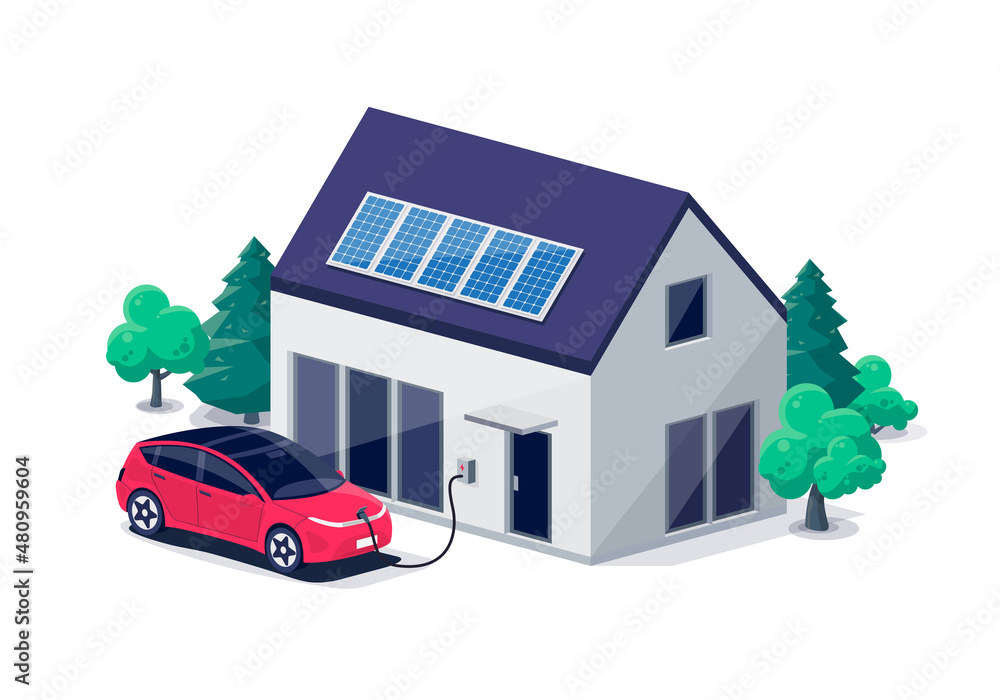
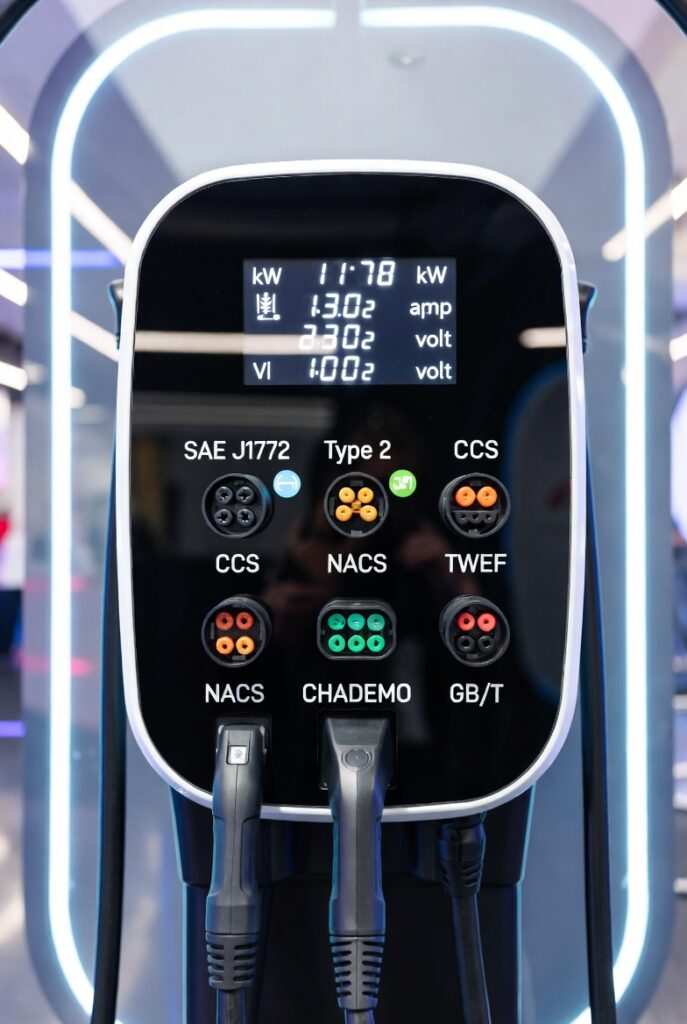
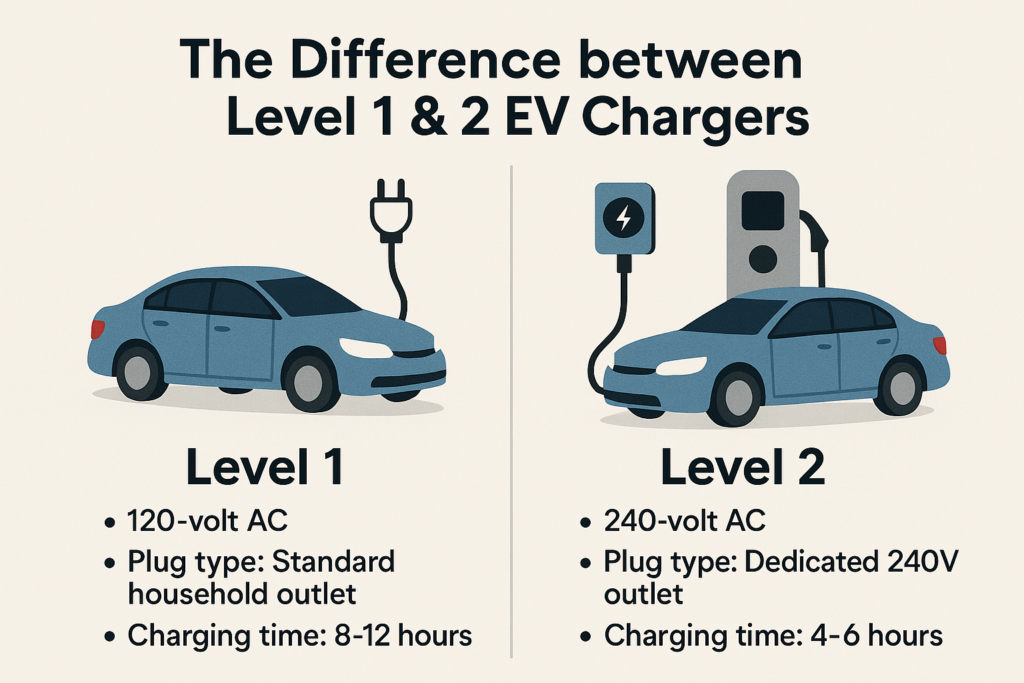
China’s residential energy landscape in 2026 has produced a genuinely new type of household energy consumer that didn’t meaningfully exist five years ago: the homeowner who combines rooftop or balcony solar generation with a home battery energy storage system (BESS) and an EV home charger into a coordinated energy management system that simultaneously minimises electricity costs, maximises renewable energy self-consumption, and provides energy resilience during grid disruptions.
This combination — which the Chinese solar and energy storage industry has branded 光储充一体化 (solar-storage-charging integration) — has moved from a luxury proposition for technically sophisticated early adopters to an increasingly accessible system that mainstream Chinese villa and house owners are actively considering and implementing.
This guide on battery energy storage systems BESS combining solar storage EV charging in China provides the complete, honest assessment of this integrated approach — the specific products available in China’s residential market, the genuine financial case across different Chinese cities and household profiles, the technical integration requirements, the honest limitations and complications that marketing materials underemphasise, and the buying decisions that maximise value within this integrated system for Chinese homeowners who are genuinely considering this approach.
Understanding the 光储充 System — What Integration Actually Means
The Three Components and How They Work Together
Without integration — three separate systems:
A Chinese homeowner with rooftop solar, a home BESS, and an EV home charger operating as three independent, uncoordinated systems would experience:
The solar inverter converting solar DC to AC and exporting surplus to the grid or consuming within the home — independently, without knowledge of the BESS’s state or the EV’s charging needs
The BESS charging from the grid at valley rates and discharging to the home at peak rates — independently, without solar visibility and without EV demand coordination
The EV charger executing its TOU schedule, charging the vehicle from grid electricity during valley hours — independently, without using available solar surplus or BESS stored energy optimally
The inefficiencies of uncoordinated operation:
Uncoordinated operation produces suboptimal outcomes at every interaction point between the three systems — solar surplus exported to grid at ¥0.35-¥0.42/kWh feed-in rate while the EV simultaneously charges from grid electricity at ¥0.34/kWh (no net saving from solar self-consumption), BESS charging from grid at valley rates while solar surplus is simultaneously exported (duplicate storage of the same grid electricity instead of directly using solar surplus), and the EV charging from grid at valley rates on clear days when solar surplus was available but not coordinated to serve EV charging.
With genuine integration — coordinated energy management:
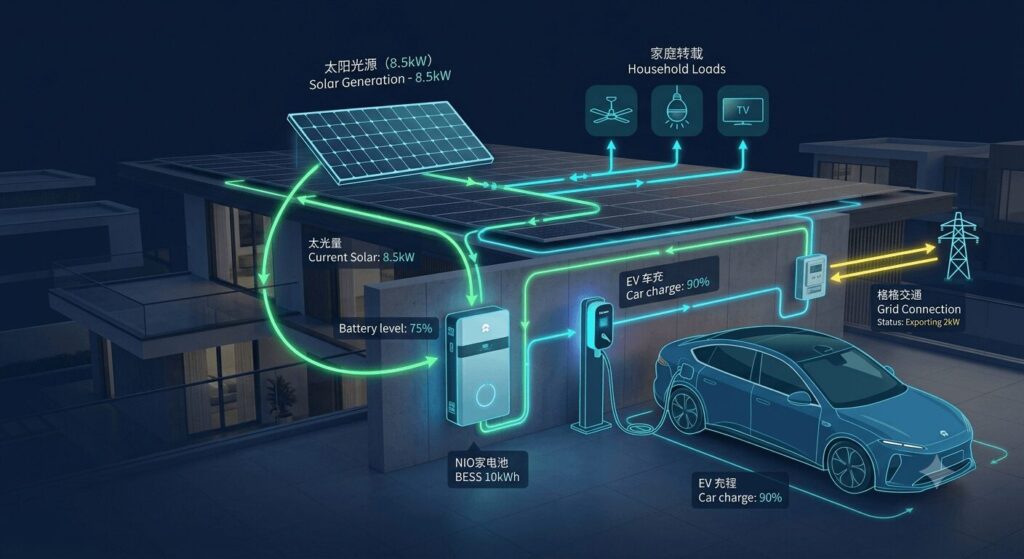
A properly integrated 光储充 system uses a unified energy management platform (EMS, 能源管理系统) that monitors all three subsystems simultaneously and coordinates energy flows to maximise overall financial benefit:
When solar is generating surplus above household loads: preferentially direct surplus to EV charging (highest self-consumption value), then to BESS charging, then to grid export — in that priority order based on the financial value of each use
When solar is not generating (night) and BESS is charged: direct BESS energy to household loads during peak rate periods, reserving valley rate window for grid-supplied EV charging (cheaper than BESS-supplied)
When grid outage occurs: seamlessly transition to island mode, powering household loads from BESS and solar generation while managing EV charging to avoid depleting essential backup capacity
The Chinese BESS Product Landscape
The Major BESS Brands in China’s Residential Market
CATL Ningle Home Energy Storage (宁德时代小水滴):
As covered in our NIO/Xpeng charging guide’s discussion of CATL Ningle for EV charging, CATL’s residential energy storage product line extends beyond its EV charging hardware to include the “小水滴” (Small Water Drop) home BESS unit that integrates with CATL’s broader energy ecosystem.
Specifications:
- Battery chemistry: LFP (Lithium Iron Phosphate) — the same Blade Battery technology in BYD vehicles, appropriately adapted for stationary storage
- Capacity options: 5 kWh, 10 kWh, 15 kWh modules (stackable)
- Round-trip efficiency: approximately 92-95%
- Warranty: 10 years or 6,000 cycles (whichever comes first)
- EV integration: Native integration with CATL Ningle EV charger for coordinated energy management
- Price: approximately ¥3,500-¥4,500/kWh installed
Huawei LUNA2000 Home Battery (华为智能储能系统):
Huawei’s LUNA2000, discussed in the context of the FusionCharge ecosystem throughout multiple guides in this series, is the most sophisticated residential BESS product available in China’s market from the perspective of integrated energy management — specifically because of Huawei’s AI-enhanced energy management system that coordinates FusionSolar inverter, LUNA2000 storage, FusionCharge EV charger, and household loads as a genuinely unified system.
Specifications:
- Battery chemistry: LFP, with modular design
- Capacity options: 5 kWh modules, typically installed in 5-30 kWh configurations
- Round-trip efficiency: 96.4% (best-in-class in Chinese market)
- Warranty: 10 years with Huawei service
- EV integration: Full FusionCharge integration through FusionSolar platform
- AI optimisation: Level 4 AI energy management as covered in our smart charger guides
- Price: approximately ¥4,000-¥5,000/kWh installed
BYD Battery-Box Premium (比亚迪Battery-Box Premium):
BYD’s stationary storage product line includes residential BESS systems that leverage the same LFP chemistry as BYD’s vehicle batteries. The company’s scale in battery manufacturing provides cost advantages that partially explain BYD’s competitive positioning in this market.
Specifications:
- Battery chemistry: LFP (BYD Blade Battery technology adapted for stationary use)
- Capacity: 5.1 kWh modules, configurable to 10.2 kWh, 15.3 kWh etc.
- Round-trip efficiency: approximately 94%
- Warranty: 10 years
- EV integration: BYD ecosystem — most naturally paired with BYD vehicle and BYD charging equipment
- Price: approximately ¥3,200-¥4,200/kWh installed
Growatt ARK BESS (古瑞瓦特储能):
Growatt, as a major Chinese solar inverter manufacturer (their EV charger is covered in our product comparisons), has expanded into integrated solar-storage-EV systems that leverage their existing inverter manufacturing capability.
Specifications:
- Battery chemistry: LFP
- Capacity: 2.56-15 kWh configurations
- Round-trip efficiency: approximately 92-95%
- Warranty: 10 years
- EV integration: Growatt EV charger integration through Growatt SMART Energy platform
- Price: approximately ¥2,800-¥3,800/kWh installed (most accessible entry price in this comparison)
Sungrow SBR Home BESS (阳光电源家储):
Sungrow, another major Chinese solar inverter manufacturer whose EV charger products appear throughout this guide series, offers the SBR series home BESS as part of their integrated solar-storage-EV ecosystem.
Specifications:
- Battery chemistry: LFP
- Capacity: 3.2-25.6 kWh configurable
- Round-trip efficiency: approximately 95%
- Warranty: 10 years
- EV integration: Sungrow EV charger through iSolarCloud platform
- Price: approximately ¥3,000-¥4,000/kWh installed
The Complete System Configuration — What a Chinese 光储充 Installation Actually Looks Like
The Reference System for Financial Analysis
For the financial calculations throughout this guide, the reference system:
- Location: Chengdu, Sichuan (chosen because Chengdu’s low electricity rates make the financial case more challenging — if it works in Chengdu, it works in higher-rate cities)
- Property: Villa compound, rooftop solar access
- Solar array: 5 kWp rooftop solar (typical for Chinese residential villa)
- BESS: 10 kWh (Huawei LUNA2000 reference, 2 × 5 kWh modules)
- EV: BYD Han EV Long Range (76.9 kWh, 18 kWh/100km real-world)
- Annual EV mileage: 20,000 km
- Household electricity consumption: 5,000 kWh/year (without EV)
Solar Generation Profile
Chengdu solar generation:
As covered in our Chengdu villa charging guide, Chengdu’s basin geography and famous overcast conditions produce lower solar generation than coastal or northern Chinese cities:
5 kWp system in Chengdu: approximately 5,000-5,500 kWh/year
(Compared to: Shanghai 5,500-6,000 kWh/year, Beijing 5,800-6,500 kWh/year, Shenzhen 6,000-6,500 kWh/year)
Monthly generation distribution:
Chengdu solar generation concentrates in the clearer spring and autumn months, with summer monsoon cloud cover reducing summer generation despite the season’s longer days, and winter fog and overcast reducing winter generation further.
Energy Flow Analysis — Where Each kWh Actually Goes
Annual energy production and consumption:
Solar generation: 5,250 kWh/year
Household consumption (non-EV): 5,000 kWh/year
EV consumption: 4,074 kWh/year (20,000 km × 18 kWh/100km × 1.12 efficiency factor)
Total consumption: 9,074 kWh/year
Without BESS (solar only, no storage):
Without a BESS, solar surplus above household instantaneous loads exports to the grid at feed-in rate:
- Estimated self-consumption of solar without BESS: approximately 45-55% (based on typical Chinese residential profile with daytime cooking and appliance use during solar generation hours)
- Solar self-consumed: approximately 2,363-2,888 kWh/year
- Solar exported: approximately 2,362-2,887 kWh/year at ¥0.35-¥0.39/kWh feed-in
With 10 kWh BESS:
BESS captures surplus solar not immediately consumable, storing it for use during evening peak hours or EV charging:
- Estimated self-consumption with BESS: approximately 70-80% of solar generation
- Solar self-consumed: approximately 3,675-4,200 kWh/year
- Solar exported: approximately 1,050-1,575 kWh/year
- EV charging from solar (direct and via BESS): approximately 1,200-1,800 kWh/year
- EV charging from grid TOU valley: approximately 2,274-2,874 kWh/year
The Financial Analysis — The Honest Numbers
Revenue and Saving Streams for the Reference System
Stream 1: Solar self-consumption saving
kWh consumed from solar instead of grid at standard rate:
(3,675 kWh average solar self-consumption) × ¥0.55/kWh (Chengdu flat rate avoided) = ¥2,021/year
Stream 2: Solar feed-in tariff revenue
kWh exported to grid:
(1,313 kWh average export) × ¥0.37/kWh (Sichuan average feed-in) = ¥486/year
Stream 3: BESS arbitrage (peak-valley charging)
The BESS can also charge from grid at valley rates and discharge during peak rates:
Available daily BESS capacity for grid arbitrage (after solar priority): approximately 5 kWh/day in winter months when solar is limited
Annual arbitrage kWh: approximately 600-900 kWh
At Chengdu peak-valley differential (¥0.70 – ¥0.25 = ¥0.45/kWh): 750 × ¥0.45 = ¥338/year
Stream 4: EV TOU charging saving
As covered throughout our TOU guides, EV charging at Chengdu valley rate versus blended rate:
2,574 kWh from grid × (¥0.60 blended – ¥0.25 valley) = ¥901/year
Stream 5: EV charging from solar surplus (self-consumption to EV)
EV charged from solar (avoiding both grid electricity and vehicle charging at standard rates):
1,500 kWh EV from solar × ¥0.55/kWh (grid rate avoided) = ¥825/year
Total annual financial benefit: ¥4,571/year
Capital Cost
Reference system total installed cost:
5 kWp solar array (panels, mounting, inverter): ¥18,000-¥25,000
10 kWh Huawei LUNA2000 BESS: ¥45,000-¥55,000
Huawei FusionCharge EV charger (11 kW three-phase for villa): ¥3,000-¥5,000
System integration and installation: ¥5,000-¥10,000
Total system cost: ¥71,000-¥95,000
Government subsidies available:
Rooftop solar installation subsidy (varies by province): ¥0.05-¥0.15/kWh generation subsidy in some provinces, or ¥1,000-¥5,000 installation grant in others
BESS subsidies (selected cities in pilot programmes): ¥0.20-¥0.60/kWh installed capacity in most advanced cities
EV charger installation subsidy (Chengdu): ¥500-¥1,000
Representative subsidies for Chengdu reference system:
Solar generation subsidy: ¥0.08/kWh × 5,250 kWh/year = ¥420/year
BESS installation grant (limited availability): ¥2,000-¥6,000 one-time
EV charger: ¥750
Total representative subsidies: ¥2,750-¥6,750 (one-time) + ¥420/year ongoing solar generation subsidy
Net system cost after subsidies:
¥71,000-¥95,000 gross − ¥2,750-¥6,750 subsidies = ¥64,250-¥92,250 net
The Payback Calculation
Payback period:
Net system cost: ¥78,250 (midpoint)
Annual financial benefit: ¥4,571
Simple payback: 17.1 years
With 5% annual electricity rate increase assumption:
Net present value calculation with electricity rate escalation:
Year 1 benefit: ¥4,571
Year 5 benefit: ¥5,573
Year 10 benefit: ¥7,447
Year 20 benefit: ¥12,124
Cumulative 20-year benefit: approximately ¥145,000
Net 20-year return: ¥145,000 − ¥78,250 = ¥66,750 net benefit over 20 years
The Honest Financial Assessment
The Chengdu calculation produces the most conservative case:
Chengdu’s low electricity rates (¥0.25/kWh valley, ¥0.70/kWh peak) produce lower absolute financial benefit per kWh than higher-rate coastal cities — the same system in Shanghai or Beijing produces meaningfully better financial returns.
The Shanghai equivalent:
Using Shanghai rates (¥0.34 valley, ¥0.87 peak, ¥0.38 average feed-in):
Revised annual benefit: approximately ¥6,800-¥7,500/year
Simple payback: 10.4-11.5 years
20-year net benefit with 3% electricity escalation: approximately ¥95,000-¥110,000
The honest conclusion:
For Chinese villa owners with adequate solar access:
The system makes financial sense over a 15-20 year horizon in most Chinese cities, but requires patience and a long investment horizon that not all buyers should assume. It is not a 5-7 year payback investment at current system costs and electricity rates.
The non-financial value adds meaningfully: Energy resilience (blackout backup capability), carbon reduction alignment with personal values, energy independence from grid price volatility, and the modernisation and perceived value addition to the property are genuine non-financial values that many buyers appropriately weight alongside the financial calculation.
The system does NOT make financial sense as a purely financial investment for apartment owners without rooftop solar access, for rental tenants, or for any owner whose primary motivation is financial return rather than the combination of financial return plus non-financial values.
The Technical Integration Challenges — What Marketing Doesn’t Tell You
Challenge 1: Phase Balance and Load Management Complexity
Why multi-phase electrical systems complicate 光储充 integration:
Chinese villa electrical systems are often three-phase, while residential solar inverters, BESS inverters, and EV chargers may each operate on single phase or three phase — creating load balancing requirements between phases that an inadequately designed system fails to manage correctly.
The specific problem:
If the solar inverter is on Phase 1, the BESS is on Phase 2, and the EV charger is on Phase 3, the energy management system must account for the inability to directly transfer energy between phases without going through the grid, even when the overall system has generation surplus. Poorly integrated systems that ignore phase balance produce situations where the system appears to have surplus energy that cannot actually be used as expected.
The solution: Commission a qualified installer who specifically designs the single-phase and three-phase balance for the combined system, not just each component in isolation.
Challenge 2: Grid Export Limitations in Certain Chinese Provinces
The provincial restriction that affects system financial models:
Several Chinese provinces and some local grid companies have implemented restrictions on residential solar grid export, either capping export quantity (allowing generation but limiting how much can be exported) or in some cases effectively zero-export requirements (all generation must be self-consumed or stored).
How this affects the financial model:
The financial analysis above includes solar feed-in revenue as a positive cash flow. In zero-export or export-limited zones, this revenue is reduced or eliminated, and the financial model must be recalculated based on self-consumption only — potentially materially changing the payback calculation depending on how much of the system’s solar generation would have been exported.
Verification required before system design:
Confirm the specific export policy with the local SGCC or Southern Grid branch before designing the system, as this fundamentally affects both system sizing and financial projections.
Challenge 3: Battery Warranty and Cycling Conditions
The warranty condition that many buyers don’t read carefully:
BESS warranties — including Huawei LUNA2000’s 10-year warranty — specify both a time period and a cycle count limit. For a 10-year, 6,000-cycle warranty:
6,000 cycles ÷ 10 years ÷ 365 days = 1.64 cycles per day
Daily cycling (once per day) stays safely within the warranty. But systems where the BESS is cycled multiple times daily — once for solar surplus storage and a separate cycle for grid arbitrage — can approach or exceed the warranty cycle limit before the time warranty expires.
The practical implication: Design the energy management system’s cycling schedule explicitly against the warranty’s cycle count limit, not just the time period.
Challenge 4: Huawei Ecosystem Lock-In
The integration advantage and constraint:
As covered throughout our Huawei FusionCharge guides, the Huawei ecosystem (FusionSolar inverter + LUNA2000 storage + FusionCharge EV charger) provides the most genuinely integrated 光储充 management available in China’s residential market — but with strong ecosystem lock-in that limits component substitution.
If the Huawei FusionSolar inverter fails and is discontinued before replacement, the LUNA2000 and FusionCharge may lose coordinated management capability. The ecosystem integration that creates the AI optimisation value also creates dependency on Huawei’s continued product support across all three components simultaneously.
The risk mitigation: Huawei’s Tier 1 zombie risk assessment (per our zombie pile crisis guide) makes this lock-in risk meaningfully lower than it would be for a smaller brand — but it remains a genuine consideration for a 20-year investment horizon.
The Buying Decision Framework — Who Should Actually Consider This System
Profile 1: The Chengdu Villa Owner With Long Investment Horizon
Strong case for integrated 光储充:
Rooftop solar access, three-phase electrical supply, BYD or NIO vehicle, 15+ year ownership horizon, values energy independence alongside financial return, has the capital for a ¥70,000-¥95,000 system investment.
Recommended system: Huawei FusionSolar + LUNA2000 + FusionCharge if Huawei ecosystem user; Sungrow inverter + SBR BESS + Sungrow EV charger for best value non-Huawei configuration.
Profile 2: The Shanghai Villa Owner Optimising Financial Return
Strongest financial case:
Higher electricity rates in Shanghai produce the best financial returns in the comparison. TOU arbitrage with Shanghai’s ¥0.53/kWh peak-valley differential across both BESS and EV charging produces meaningfully better returns than Chengdu.
Recommended system: Full Huawei ecosystem for maximum AI optimisation of the larger peak-valley differential, or Growatt for value-priced entry into the system with shorter payback.
Profile 3: The Apartment Owner
No case for BESS currently:
Without rooftop solar access, apartment owners cannot achieve the solar self-consumption that makes BESS financially viable in residential settings. The BESS-only arbitrage case (charging at valley rates, discharging at peak) works at ¥338/year for a ¥45,000-¥55,000 system — a 133-year payback that no rational financial analysis supports.
The correct path for apartment owners: Standard smart EV charger for TOU savings, without BESS. If V2H capability eventually becomes available for their EV, reassess at that point.
Profile 4: The Rural Yunnan or Hainan Owner With High Solar Resource
Enhanced financial case due to solar:
High-solar-resource provinces (Yunnan, Hainan, Qinghai, Inner Mongolia’s southern belt) produce significantly more than Chengdu’s 5,250 kWh/year from a 5 kWp system — potentially 7,000-9,000 kWh/year in the best-resourced locations. This fundamentally improves the financial case by increasing the solar contribution to both household consumption and EV charging.
The Comparison With Simpler Alternatives
Simple Smart Charger vs Full 光储充 System
| Approach | Capital Cost | Annual Financial Benefit | Simple Payback | 10yr Net |
|---|---|---|---|---|
| Smart EV charger only (TOU) | ¥2,699-¥4,000 | ¥1,260-¥1,670 | 1.6-3 years | ¥10,000-¥13,000 |
| Solar + EV charger (no BESS) | ¥21,699-¥29,000 | ¥2,500-¥3,200 | 7-9 years | ¥3,000-¥11,000 |
| Full 光储充 (solar + BESS + EV) | ¥73,699-¥99,000 | ¥4,571-¥7,500 | 10-17 years | ¥-30,000-¥+5,000 |
The table’s honest message:
The simple smart EV charger alone delivers the fastest payback and highest 10-year net return of any approach — not because it’s the most sophisticated, but because it captures the dominant financial value (TOU savings) at minimum capital cost.
The full 光储充 system makes sense when the combination of solar resource, electricity rates, ownership horizon, and non-financial values (energy independence, carbon reduction, resilience) combine to justify a 10-17 year financial payback, understanding that the 20-year return is genuinely positive and meaningful in higher-rate cities.
Internal Links — Further Reading on Clean Energy Bazaar
The battery energy storage systems BESS combining solar storage EV charging in China guide is the integrated energy system companion to the individual component guides throughout this content cluster.
For the smart charger AI optimisation guide covering the Huawei FusionCharge ecosystem central to the most integrated 光储充 systems, our best smart EV chargers China 2026 Huawei Digital Power vs Xiaomi vs local innovators guide covers every AI platform in detail. For the TOU savings guide establishing the EV charging financial foundation that the 光储充 system builds upon, our time-of-use EV charging savings smart chargers that exploit cheaper night rates in China guide covers every tariff structure. For the V2G guide that contextualises V2H capability within the broader bidirectional charging landscape relevant to 光储充 evolution, our V2G in China 2026 can your BYD Atto 3 power your home during a blackout guide covers every bidirectional consideration. For the Chengdu villa guide that established the villa solar installation context referenced throughout this guide’s financial analysis, our tier 1 vs tier 2 city charging solutions for Beijing high-rises vs Chengdu villas vs rural villages guide covers every geographic scenario. For the ROI calculator methodology that underpins the financial analysis in this guide, our EV home charger ROI calculator 2026 when it pays off with local rebates included guide covers the complete financial framework. And for the zombie pile crisis guide assessing the long-term brand survival risk relevant to a 20-year integrated system investment, our zombie pile crisis 2026 how to avoid dead chargers from liquidated Chinese brands guide covers every brand survival assessment.
Final Thoughts
The battery energy storage systems BESS combining solar storage EV charging in China integrated approach represents the most sophisticated and potentially most financially rewarding residential energy configuration available to Chinese villa and house owners in 2026 — while also representing the highest capital commitment, the longest payback horizon, and the most complex installation and operational requirements of any approach covered in this guide series.
The honest financial assessment produces a specific and nuanced conclusion: the 光储充 integrated system makes genuine long-term financial sense for Chinese villa owners with good solar resource, higher electricity rates (Shanghai, Beijing, Shenzhen more than Chengdu), sufficient capital, and 15+ year ownership horizons — delivering 20-year net returns of ¥66,750-¥110,000 above initial investment depending on city and system size. It does not make sense as a financial investment for apartment owners without solar access, for owners prioritising 5-7 year payback, or for anyone whose primary motivation is financial return rather than the combination of financial return, energy independence, and values alignment that the complete system delivers.
The technology pathway is clear: Huawei’s FusionSolar + LUNA2000 + FusionCharge ecosystem provides the most genuinely integrated coordination available in China’s market today, with AI energy management that extracts meaningfully more value from the combined system than uncoordinated component operation would produce. Growatt and Sungrow provide more accessible entry pricing with somewhat less sophisticated integration. CATL and BYD provide strong battery fundamentals with brand-specific vehicle ecosystem alignment.
The starting point for any Chinese homeowner genuinely considering this system is not which product to buy — it is whether the combination of your specific solar resource, your specific electricity rates, your specific ownership horizon, and your specific balance between financial and non-financial values creates the case for the investment. This guide’s financial framework allows that assessment to be made with specific numbers rather than marketing enthusiasm or vague sustainability aspiration.
For those for whom the case is made: it is a genuinely worthwhile, technically achievable, and increasingly accessible integrated energy system that represents the leading edge of Chinese residential energy management in 2026. For those for whom the case isn’t yet made: a ¥999 StarCharge S1 with TOU scheduling still captures ¥1,670/year and pays back in 16 months. Start there, and reassess as solar costs fall, BESS costs fall, and V2H capability expands within your specific vehicle ecosystem.