Shenzhen is China’s most ambitious laboratory for new financial technology, and digital yuan (e-CNY, 数字人民币) adoption has progressed further in Shenzhen than in almost any other Chinese city. As the world’s first major central bank digital currency deployed at meaningful scale, China’s digital yuan has generated enormous international interest — and within China’s EV charging community specifically, has generated a specific strand of discussion about whether programmable digital currency fundamentally changes the economics and automation of EV charging payments.
This guide on digital yuan and smart charging how CBDC is automating EV payments in Shenzhen provides what this community discussion has largely lacked: a technically honest, practically grounded assessment of what digital yuan integration with EV charging actually does in 2026, what it doesn’t do, where it genuinely adds value beyond what Alipay and WeChat Pay already provide, and — most importantly for home charging users — the honest answer to whether digital yuan has any practical significance for the residential home EV charging setup that the vast majority of this guide series has addressed.
The conclusion, which this guide reaches after examining the evidence thoroughly, is nuanced: digital yuan has genuine and interesting applications in specific public and commercial EV charging contexts in Shenzhen, and its programmable money capabilities create genuinely novel possibilities for automated charging payments that standard payment systems cannot replicate. But for the home EV charging user whose primary financial interest is TOU rate optimisation and whose charger is connected to their own dedicated meter — the topic that has occupied the majority of this guide series — digital yuan’s practical significance in 2026 is minimal to zero, and claiming otherwise misrepresents the technology’s current state.
Understanding Digital Yuan — What Makes It Different From Alipay and WeChat Pay
The Technical Distinction That Matters for EV Charging
Why most e-CNY vs Alipay comparisons miss the point:
Popular comparisons of digital yuan with existing mobile payment systems focus on user experience — both let you pay with your phone, both are widely accepted, both show a balance and transaction history. At this surface level, the difference seems minimal, which has led many commentators to question why digital yuan exists at all.
The genuinely significant technical difference — and the one most relevant to EV charging automation — is programmability:
Standard payment systems (Alipay, WeChat Pay):
These are payment rails — infrastructure that moves money from one account to another when instructed by the account holder. They are conditionally automated only in the sense that the account holder can pre-authorise specific recurring payments (subscriptions, scheduled transfers) but cannot directly attach conditions to the money itself. The money, once transferred, can be used for anything by the recipient.
Digital yuan (e-CNY):
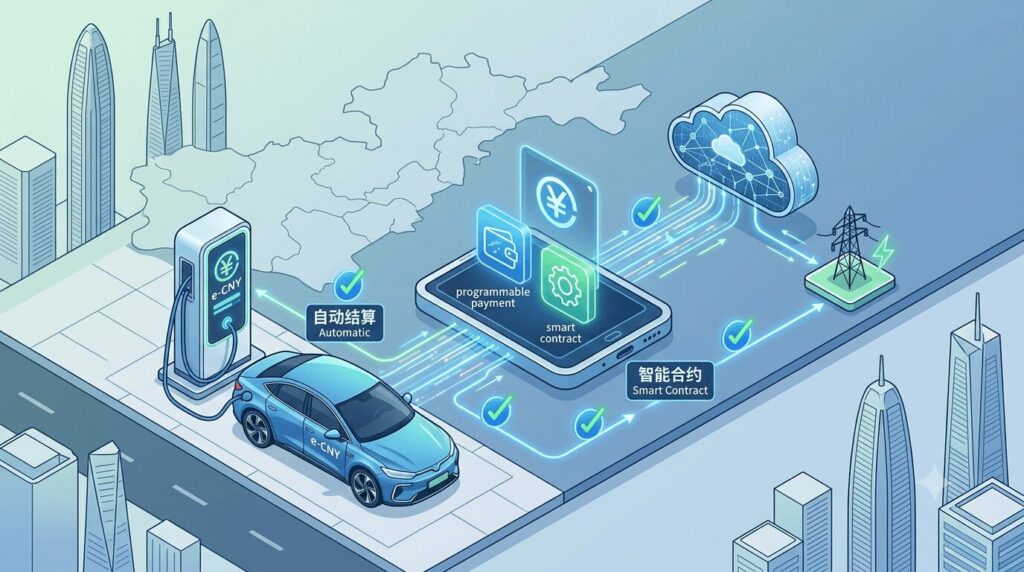
As a central bank digital currency with programmable smart contract capability, e-CNY allows conditions to be encoded directly into specific units of currency — creating “smart money” that can only be spent in specific ways, can trigger specific actions when specific conditions are met, or can automatically execute payment flows based on real-world events detected by connected systems.
The specific EV charging relevance:
A programmable e-CNY payment for EV charging can be designed to:
- Automatically execute only when the electricity price falls below a specified threshold (direct TOU automation through currency programming rather than charger software)
- Trigger automatically when the vehicle’s battery SOC drops below a specified level detected by the charging infrastructure
- Split automatically between the electricity cost component (forwarded directly to the utility) and the service fee component (retained by the charging station operator) without manual reconciliation
- Expire or redirect if unused within a specified period (relevant for pre-authorised charging credits on commercial networks)
None of these capabilities are available through Alipay or WeChat Pay without complex intermediate software layers — they emerge naturally from e-CNY’s programmable money architecture.
The Three Layers of Digital Yuan EV Charging Application
Layer 1: Basic digital yuan payment acceptance at charging stations
The most widely deployed digital yuan EV charging application in Shenzhen in 2026: charging stations that accept e-CNY payment alongside Alipay, WeChat Pay, and bank card — a payment method addition that doesn’t fundamentally change the charging experience but expands payment options.
Practical significance for users: Minimal — equivalent to a charging station accepting one additional credit card brand. Convenient for the minority of users who actively use e-CNY as their primary payment method, irrelevant for others.
Layer 2: Automated payment execution through programmable e-CNY
More advanced deployments where the payment for a charging session is pre-authorised as programmable e-CNY that executes automatically when charging completes, with the amount calculated based on actual kWh delivered at the applicable rate — no user action required at the end of the session.
Practical significance for users: Meaningful convenience improvement for public charging users — eliminates the requirement to scan a QR code or tap a payment device at session completion, allowing the user to unplug and leave while payment processes automatically.
Layer 3: Smart contract-based charging automation
Pilot deployments — primarily in Shenzhen’s Futian and Nanshan district pilot zones — where programmable e-CNY smart contracts connect directly with the charging infrastructure’s management system to create genuinely automated, condition-triggered charging and payment:
The charging session initiates automatically when the vehicle is connected and a pre-registered smart contract detects the connection
The payment executes at the contractually specified rate
If the contract includes time-of-use conditions, charging begins automatically when the contracted rate window opens without any user action
Settlement between the charging network operator and the utility occurs automatically without manual reconciliation
Practical significance for users: Genuine operational convenience, particularly for fleet operators and commercial users who benefit most from automated reconciliation and condition-triggered execution.
Shenzhen’s Specific Digital Yuan EV Charging Deployment
The Shenzhen Context — Why This City Leads
Why Shenzhen is the reference city for digital yuan EV charging:
Shenzhen’s combination of China’s highest EV penetration rate, China’s most advanced digital yuan pilot programme (having received significantly more e-CNY distribution through government subsidies, salary programmes, and consumer incentives than most Chinese cities), and Shenzhen’s general status as China’s innovation showcase city makes it the natural location where digital yuan and EV charging intersect most meaningfully.
The specific Shenzhen programmes:
Shenzhen’s 数字人民币绿色出行 (Digital Yuan Green Mobility) Programme:
This Shenzhen municipal programme, operated in coordination with the People’s Bank of China’s digital yuan deployment team and the Shenzhen Municipal Transportation Bureau, provides specific incentives for EV owners who use digital yuan for charging payments — including e-CNY bonus credits distributed to registered programme participants when they pay for public EV charging using digital yuan at enrolled charging stations.
The programme has enrolled several major charging networks operating in Shenzhen, including State Grid’s Shenzhen operations, TELD’s Shenzhen public network, and StarCharge’s Shenzhen commercial installations.
The specific incentive structure (as of mid-2026):
Enrolled programme participants receive e-CNY bonus credits equal to approximately 5-10% of charging payments made in e-CNY at enrolled stations, distributed monthly to registered digital wallets. These credits can be used for subsequent charging payments or for other e-CNY-accepting merchants.
The practical financial value:
At 5-10% bonus on public charging payments, the annual financial benefit for an EV owner using Shenzhen public charging for, say, ¥3,000/year in total charging payments: ¥150-¥300/year in e-CNY bonus credits.
The honest significance: Genuinely useful but modest — comparable in scale to minor credit card reward programmes, not a fundamental economic transformation.
The SGCC Shenzhen Smart Grid + Digital Yuan Integration:
State Grid’s Shenzhen operations have been piloting direct integration between e-CNY programmable payments and the grid’s demand response system — specifically using programmable e-CNY smart contracts to automate demand response participation for public charging stations.
In this pilot, participating charging stations execute a smart contract that:
- Automatically reduces charging power delivery when State Grid’s demand response signal indicates grid stress
- Automatically receives grid service compensation in e-CNY when the curtailment event completes
- Settles this compensation directly to the charging station operator without manual claims processing
What this demonstrates technically: That programmable e-CNY can serve as an automated settlement mechanism for grid services — a genuinely novel application of digital currency to energy infrastructure. What it means practically for EV owners: Minimal direct impact; this is primarily an operator and utility-level efficiency improvement rather than a consumer-facing change.
What Digital Yuan Does and Doesn’t Do for Home EV Charging
The Home Charging Reality Check
The fundamental structural point that most digital yuan EV charging discussion misses:
The vast majority of this guide series has addressed home EV charging — the dedicated circuit, dedicated meter, SGCC-supplied electricity, TOU-scheduled overnight charging that represents the primary charging method for the majority of Chinese EV owners.
For home charging specifically: The electricity payment for home EV charging is not a transaction-based payment that occurs at the charging station — it is a utility bill payment that occurs monthly through the standard residential electricity billing process. The dedicated EV meter accumulates consumption, State Grid bills the account holder monthly at the applicable TOU rates, and payment occurs through bank transfer, Alipay, WeChat Pay, or any other standard payment method.
Digital yuan’s role in this process: Zero current practical difference. The monthly electricity bill can be paid in e-CNY if the user chooses, but this is equivalent to paying the water bill in e-CNY — a payment method choice that has no effect on the TOU rate, the charging schedule, the charger’s function, or any other aspect of the home charging economics that this guide series has addressed.
The specific smart features that actually drive home charging financial optimisation:
As established throughout our TOU savings guide, smart charger connectivity guide, and EV charger ROI calculator — the home charging financial optimisation that matters is TOU scheduling, which is implemented through the charger’s own app, the vehicle’s built-in timer, or OCPP-based demand response programme participation. None of these require or benefit from digital yuan integration in any technically meaningful way.
The bottom line for home charging users: Digital yuan’s practical relevance to your home EV charging setup in 2026 is negligible. The statement sometimes encountered in Chinese EV owner forums that “you need e-CNY for the latest smart charging features” reflects either a misunderstanding of the technology or marketing from digital yuan promotion programmes that overstates the home charging relevance.
Where Digital Yuan Genuinely Adds Value in the EV Charging Context
The Contexts Where e-CNY Creates Real Improvement Over Existing Systems
Context 1: Fleet charging automated reconciliation
As covered in our government fleet charging guide, commercial fleet operators managing dozens or hundreds of vehicles across multiple charging locations face significant administrative burden in reconciling charging costs — which driver, which vehicle, which station, which time, at what rate, for what amount.
Digital yuan’s programmable payment capability allows fleet charging payments to be pre-encoded with vehicle ID, driver ID, and cost-centre allocation — creating automatic reconciliation records that eliminate the manual process currently required. For a fleet of 50 vehicles with 2 charging sessions per day, this eliminates approximately 3,000 manual reconciliation records per month.
The genuine financial value for fleet operators: Meaningful administrative cost reduction, potentially ¥5,000-¥20,000/year in staff time for larger fleets.
Context 2: Cross-operator roaming payments
A persistent friction point in China’s public EV charging market is the requirement to maintain accounts and pre-loaded balances across multiple charging network operators — a user travelling a route that passes through StarCharge, TELD, and State Grid stations needs separate accounts and balances for each.
Digital yuan’s universal acceptance across operators (all operators accepting e-CNY can receive payment from any user’s e-CNY wallet without operator-specific account setup) simplifies this specific friction — effectively functioning as a universal charging payment method that works seamlessly across networks that otherwise require separate account management.
The genuine user value: Convenience improvement for frequent long-distance drivers who regularly use multiple charging networks — most directly relevant to the road trip scenarios covered in our portable charger and Spring Festival guides.
Context 3: Programmable subsidy distribution and compliance
As covered throughout our local rebates guide, EV charging subsidies in China require verification that charging occurred at eligible stations using eligible equipment before subsidy disbursement. The current process involves documentation submission, review, and eventual payment through standard channels — a process that takes weeks and creates administrative burden for both applicants and administrators.
Programmable e-CNY allows subsidy conditions to be encoded directly into the subsidy payment — funds that automatically unlock for the recipient when the eligible charging event is verified through connected charging infrastructure data, without requiring manual documentation submission or review.
The genuine systemic value: Significant administrative efficiency improvement for both government subsidy programmes and for recipients who currently experience delays and paperwork burden. The most advanced Shenzhen pilot programmes have demonstrated subsidy settlement times reduced from weeks to minutes.
Context 4: Demand response automated settlement for commercial operators
As noted in the SGCC Shenzhen pilot discussion above, automated demand response settlement through programmable e-CNY genuinely streamlines what is currently a manually-intensive settlement process between grid operators and charging station operators participating in demand response programmes.
The genuine operator value: Meaningful operational efficiency improvement that could accelerate charging operator participation in demand response programmes — indirectly benefiting grid stability and potentially expanding the demand response income opportunities for residential OCPP users as programme participation becomes more widespread.
The Honest Assessment of Digital Yuan’s 5G Parallel
Why Digital Yuan for Home Charging Resembles 5G Connectivity
The parallel that clarifies the appropriate level of interest:
As established in our connectivity guide’s clear-eyed assessment of 5G connectivity for home EV chargers, the pattern of technology capability versus practical home charging relevance follows a consistent structure: a genuinely capable and interesting technology that delivers real value in specific commercial and infrastructure contexts, but whose practical relevance to residential home EV charging is minimal despite enthusiastic marketing claims to the contrary.
5G for home EV chargers: Provides faster data transfer and lower latency for the charger’s connectivity. In practice, home EV charging commands require data transfer rates that 4G or even WiFi handle adequately — 5G’s additional capability goes entirely unused in residential charging, making 5G connectivity in a home charger a cost-adding feature with no functional benefit.
Digital yuan for home EV charging: Provides programmable payment and automated settlement capabilities that create genuine value for fleet operators, demand response automation, and cross-network public charging. In practice, home EV charging payment occurs through monthly utility billing that digital yuan doesn’t currently interface with in any functionally meaningful way — e-CNY capability in a home charger’s feature list is a cost-adding claim with no practical home charging benefit.
The implication for home charger purchasing decisions:
Exactly as our connectivity guide establishes that “5G connectivity” should not be a premium you pay for in a home EV charger — because you don’t benefit from it — “digital yuan payment integration” should similarly not be a premium that influences home charger purchase decisions. If two chargers are otherwise equivalent and one costs ¥300 more because of digital yuan payment integration, the ¥300 premium delivers zero practical home charging benefit.
The Future Trajectory — Where Digital Yuan EV Charging Integration Is Going
The Developments That Could Change This Assessment
Development 1: Direct utility billing integration with e-CNY
The most significant change that would make digital yuan genuinely relevant to home charging would be direct integration between the dedicated EV meter’s utility billing and programmable e-CNY — allowing, for example, the monthly electricity bill to be pre-funded as programmable e-CNY that automatically settles to State Grid as consumption is recorded.
Current status: Not deployed for residential electricity billing as of mid-2026. SGCC’s digital yuan exploration has focused on commercial and industrial applications. Residential utility billing integration is a noted future development area but without specific deployment timeline.
Development 2: V2G settlement automation through e-CNY
As V2G programmes scale from pilot to mainstream (the trajectory our technology trends guide established), the settlement of grid service income from residential V2G participation represents a genuinely useful e-CNY application — programmable e-CNY could automate the settlement of demand response income to participating residential users without manual claims processes.
Current status: Limited to the commercial operator-level pilots described above. Residential V2G settlement automation through e-CNY is a logical extension of current pilots, relevant as V2G residential deployment scales.
Development 3: Cross-province charging subsidy automation
As EV charging subsidy programmes potentially develop toward national-level coordination (currently primarily municipal and provincial), programmable e-CNY could serve as the settlement mechanism for nationally-standardised subsidy distribution — a significant systemic improvement if subsidy programmes scale to the level of complexity where manual settlement becomes unmanageable.
Current status: Early pilot-stage in selected cities. National-scale implementation is a multi-year development rather than a near-term deployment.
The Practical Guide for Shenzhen EV Owners
What Shenzhen EV Owners Should Actually Do About Digital Yuan
For home charging users (the majority):
Register for the 数字人民币绿色出行 programme if you use public charging in Shenzhen — the 5-10% bonus on public charging payments is real and available with minimal friction. This registration has no bearing on your home charging setup, costs nothing, and provides modest financial benefit on your public charging spend.
For your home charging setup — dedicated meter, SGCC connection, TOU-scheduled smart charger — continue the guidance established throughout this guide series. Digital yuan adds nothing to this setup’s optimisation.
For public charging users:
Enable e-CNY in your digital wallet (the PBOC e-CNY app is available in Shenzhen with straightforward setup) and register it at enrolled Shenzhen charging networks for the bonus programme. The automated payment functionality at enrolled stations genuinely reduces payment friction for public charging.
For fleet operators:
Investigate the specific digital yuan fleet charging reconciliation pilots being run through Shenzhen’s commercial charging networks — the administrative cost reduction for fleet reconciliation is genuine and likely scales meaningfully with fleet size.
For anyone who has heard that digital yuan smart charging delivers unique financial benefits for home charging:
It doesn’t, in 2026, in any technically meaningful way. The TOU savings, demand response income, and smart charging optimisation covered throughout this guide series are delivered through charger software, OCPP connectivity, and vehicle battery management — all independent of payment method. Digital yuan is a payment method, not a charging optimisation technology.
Internal Links — Further Reading on Clean Energy Bazaar
The digital yuan and smart charging how CBDC is automating EV payments in Shenzhen guide is the payment technology companion to the connectivity and smart features guidance throughout this content cluster.
For the connectivity guide that established the honest assessment of 5G and digital yuan as home charging features, our best smart connectivity WiFi 5G digital yuan payments in Chinese smart chargers guide covers every connectivity specification with the same honest analysis framework. For the TOU savings guide that establishes what actually drives home charging financial optimisation — independent of payment method, our time-of-use EV charging savings smart chargers that exploit cheaper night rates in China guide covers every tariff structure. For the local rebates guide covering the Shenzhen subsidy programmes that digital yuan’s programmable settlement capability could eventually streamline, our local utility rebates for EV charging 2026 Shenzhen Shanghai Beijing guide covers every available programme. For the government fleet charging guide covering the fleet reconciliation context where digital yuan delivers genuine operational value, our public sector opportunity guide to China’s 25 percent government fleet charging mandate guide covers every fleet management consideration. For the technology trends guide that contextualises digital yuan within the broader EV charging technology landscape, our upcoming EV charger trends 2026-2027 V2G solid-state batteries and what to buy now in China guide covers every emerging technology. And for the V2G guide covering demand response settlement automation that digital yuan could eventually streamline, our V2G in China 2026 can your BYD Atto 3 power your home during a blackout guide covers every bidirectional charging consideration.
Final Thoughts
The digital yuan and smart charging how CBDC is automating EV payments in Shenzhen story is genuinely interesting — but its interest lies in what it reveals about the future trajectory of automated energy payments and programmable money infrastructure, rather than in any current practical significance for the residential home EV charging setup that this guide series has primarily addressed.
Digital yuan’s programmable capabilities create genuine value in specific EV charging contexts: fleet reconciliation automation, cross-operator payment friction reduction, subsidy distribution efficiency, and demand response settlement automation. These are real improvements over existing systems, and Shenzhen’s deployment is demonstrating them at meaningful scale. The technology works, the applications are sensible, and the trajectory toward broader deployment is clear.
What digital yuan does not do in 2026 — and what this guide’s honest assessment has specifically established — is fundamentally change the home EV charging economics that this guide series has documented. TOU scheduling, OCPP demand response participation, and smart charger optimisation remain the mechanisms that drive residential charging financial benefit, operating entirely independently of payment method. The dedicated meter that records your home charging consumption, the SGCC that bills you monthly, and the Alipay payment you use to settle that bill are not going to be replaced by a digital yuan smart contract in any practically significant way on any near-term timeline.
For Shenzhen EV owners: register for the green mobility bonus programme, it’s free money. For home charging users everywhere: invest your attention in TOU optimisation and OCPP compliance, which deliver ¥1,670/year in documented savings. For anyone evaluating a charger specifically for its digital yuan integration: the feature adds zero home charging benefit today and should add zero premium to your purchase decision.
The programmable money future for energy is real and approaching. In 2026, it hasn’t yet arrived at your home charging socket.