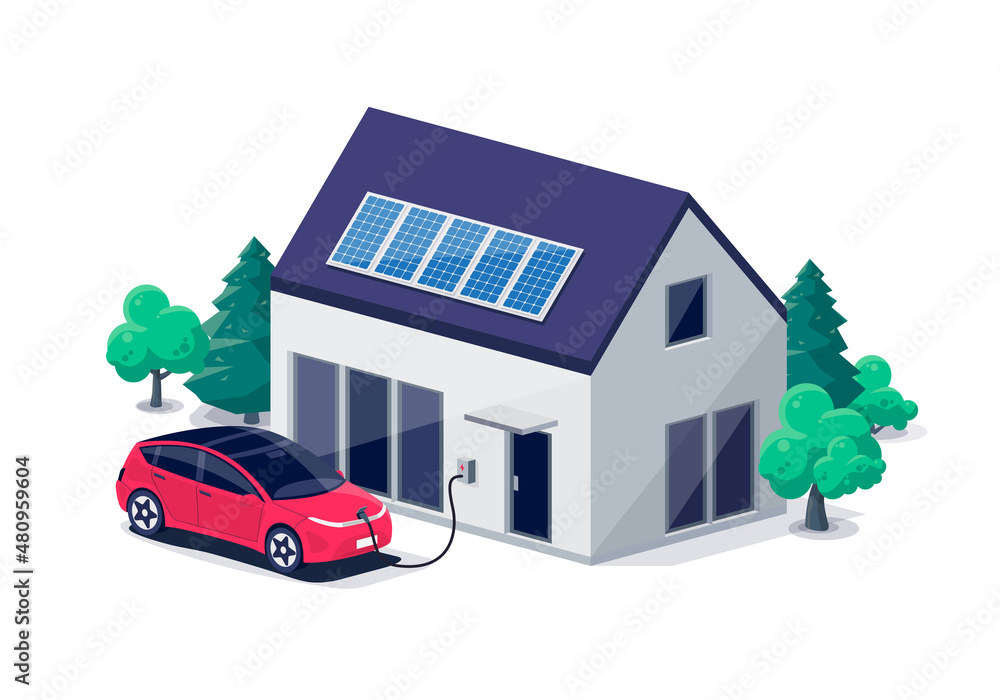
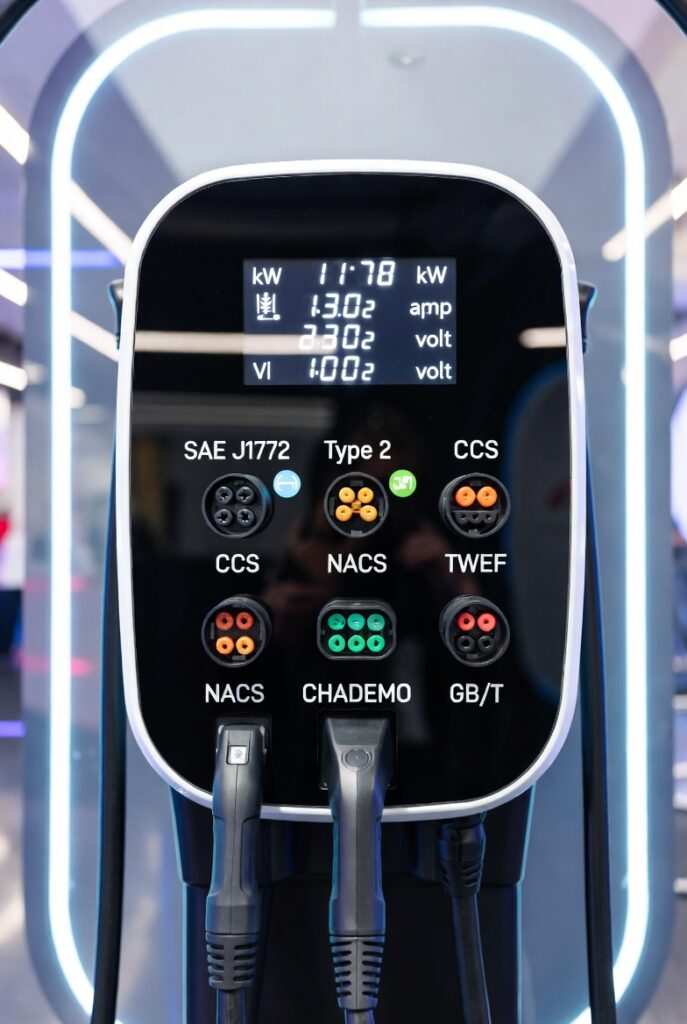
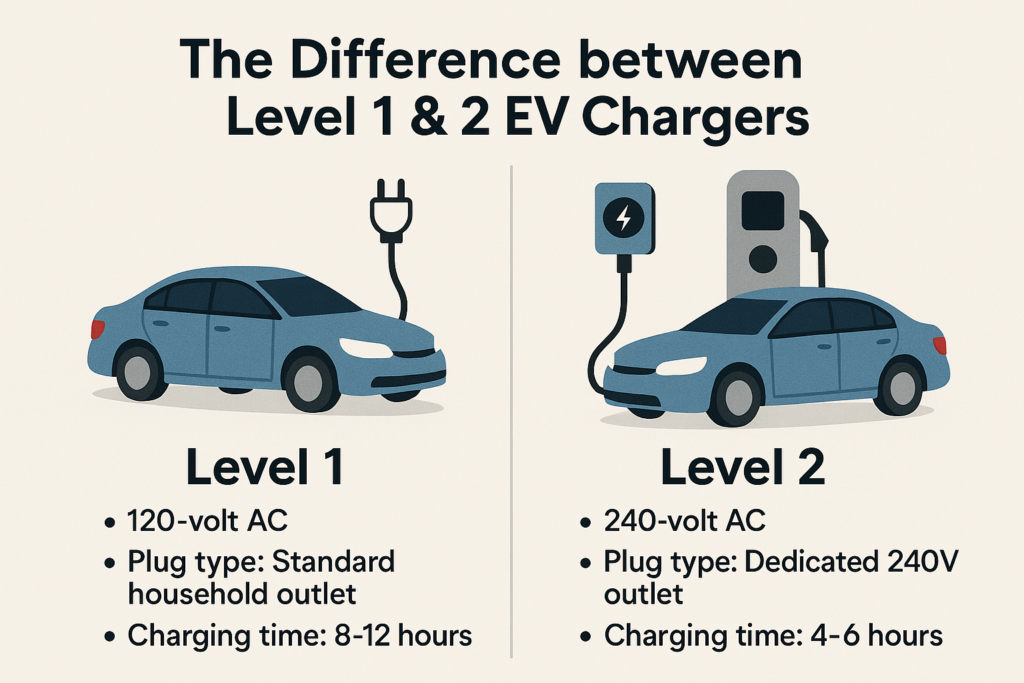
There are two EV chargers listed side by side on a Taobao search results page. Both show the 3C certification mark in their product images. Both claim GB/T 20234.2 compliance. Both list similar technical specifications. One costs ¥899. The other costs ¥399.
The ¥399 charger has a fake 3C logo. It has never been through a CNCA-accredited testing laboratory. Its RCCB protection may not function correctly. Its cable may be undersized for sustained charging current. Its connector may not meet the mechanical engagement specification required for daily connect-disconnect cycling. If it causes a fire or electrical injury, no insurance coverage applies.
The buyer who purchased it cannot tell the difference from the product listing alone — which is precisely what the seller is relying on.
This is not a marginal or rare problem in China’s e-commerce EV charger market. As established in our dedicated 3C certification guide, our zombie pile crisis analysis, and our August 2026 deadline compliance guide, the proliferation of uncertified or fraudulently-certified EV charging products through Chinese e-commerce platforms represents one of the most significant practical safety risks that Chinese EV buyers face when navigating the home charging hardware market — particularly when purchasing through platforms where third-party sellers can list products with minimal pre-publication verification.
This guide on spotting fake 3C logos how Chinese buyers can verify certification on Taobao JD chargers provides the complete, practical verification toolkit — what genuine 3C certification looks like, how to identify the specific visual and documentary tells of fake or fraudulent certification claims, the specific database verification steps that provide definitive confirmation, and the platform-specific navigation strategies for Taobao and JD.com that reduce exposure to uncertified products before even reaching the verification stage.
Understanding What Genuine 3C Certification Actually Looks Like
The Physical 3C Mark — What Authentic Looks Like
The genuine 3C mark’s visual characteristics:
The authentic China Compulsory Certification mark (中国强制认证 / CCC) has a specific, standardised visual design established by CNCA:
- The letters “CCC” in a specific stylised font with consistent proportions, surrounded by a circular or oval boundary line
- Typically appears in black on a white or silver background, or as a silver/metallic impression on the product housing
- Accompanied by the category identifier letter(s) indicating which specific certification category covers the product — for EV chargers, this typically includes “S” (safety) and often “EMC” (electromagnetic compatibility)
- The mark size is standardised relative to the product’s overall dimensions, with minimum size requirements that prevent marks being placed at sizes too small to be clearly readable
What the mark appears on:
On legitimate certified products, the 3C mark appears on:
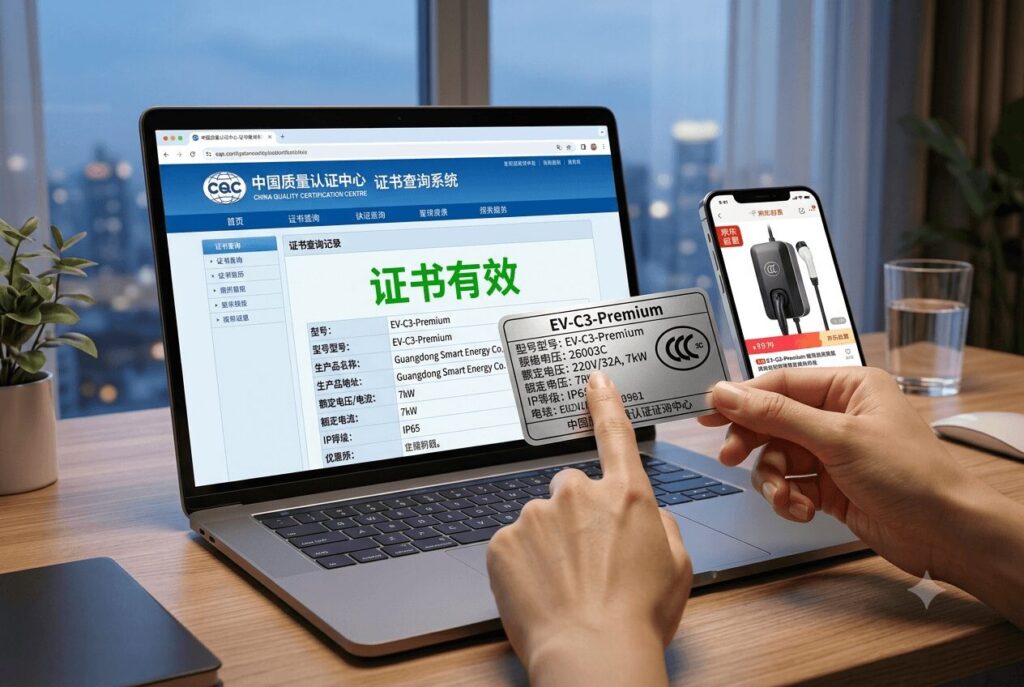
- A permanent label affixed to the product itself (the rating label, typically located on the rear or underside of the charger unit)
- The product’s packaging
- The product’s documentation (manual, warranty card)
The critical point about the rating label specifically:
The rating label is not just where the 3C mark appears — it also contains the specific technical information (model number, rated input/output voltage and current, operating temperature range, IP rating, manufacturer name and address) that enables the database verification covered later in this guide. A product whose 3C mark appears only in marketing materials and product images but whose physical rating label either doesn’t exist, doesn’t match the marketing, or carries a different model number than what’s being sold, is a significant red flag regardless of what the listing claims.
The Certificate Documentation — What Legitimate Certification Produces
Beyond the physical mark, what legitimate 3C certification produces:
A legitimate 3C certification process results in a specific certificate document issued by the certifying body (typically CQC, China Quality Certification Centre, or one of the other CNCA-designated certification bodies), containing:
- A unique certificate number in a standardised format
- The specific product name, model number(s), and variant specifications covered
- The manufacturer’s name and registered address
- The applicable standard(s) against which the product was tested
- The certification body’s name, seal, and the names of the certifying personnel
- The certification validity period and any conditions of continued validity
- A specific marking approval specifying exactly how and where the 3C mark may appear on the certified product
Why the certificate number is the most important verification element:
The certificate number is the specific database key that allows independent, third-party verification through CNCA’s public database — the definitive verification method covered in detail later in this guide. Every legitimate certificate has one, and no fraudulent product can obtain one through any means other than actually completing the certification process.
The Six Categories of Fake or Fraudulent Certification
Category 1: Complete Fabrication — No Certification Ever Existed
The most common category among the cheapest listings:
Some sellers list products with a 3C mark in product images, in listing descriptions, and even on product packaging, where no certification of any kind has ever been obtained for the product. The mark is simply copied from a legitimate product’s marketing materials and applied to the new listing — a straightforward visual theft that requires no knowledge of certification processes.
How to detect: Database verification (Point 4 of our 20-point checklist from the August 2026 guide) reveals no record of any certification for the claimed model number. The manufacturer name combined with the model number produces no search results in the CNCA database.
Risk level: Maximum — this product has never had any independent safety verification whatsoever.
Category 2: Certificate Transfer — Real Certificate, Wrong Product
A more sophisticated fraud:
A seller obtains access to a genuine 3C certificate — either by legitimately certifying one product model and then applying that certificate reference to a different, uncertified product, or by using a certificate issued to a related company that doesn’t actually cover their specific product — and references the genuine certificate number in listings for a non-certified product.
How to detect: Database verification shows the certificate reference number is genuine, but the specific model number, manufacturer details, or product description in the database doesn’t match the product being sold. This requires comparing the database record against the specific product in the listing rather than simply confirming the certificate number is real.
Risk level: High — the specific product sold has not been tested, even though a related certificate exists.
Category 3: Superseded or Lapsed Certificate — Was Certified, No Longer Valid
A subtler category particularly relevant to the August 2026 context:
A product that genuinely was certified at some point but whose certification has since lapsed (through non-renewal, manufacturer failure, or the manufacturer ceasing to maintain the conditions of certification) or been superseded (because the product was modified without recertification) may continue to be sold with the original certification mark and reference number long after the certification is no longer valid.
How to detect: Database verification shows the certificate number exists but with a status of “cancelled,” “suspended,” or “expired” rather than “valid.” This category is particularly relevant for the zombie pile crisis scenario — manufacturers who have ceased operations typically haven’t formally surrendered their certifications, which may show as technically still registered but without an operational company maintaining the conditions.
Risk level: Moderate to high — the product may have been genuinely certified at some point, but current production may not meet the original certified specification if manufacturing has continued without oversight.
Category 4: Variant Non-Coverage — Certified Model ≠ Sold Variant
A frequently encountered category in e-commerce specifically:
As established in our August 2026 deadline guide’s Point 12, 3C certification is specific to the exact product variant submitted for testing — a 5-metre cable variant and a 7-metre cable variant of otherwise identical chargers require separate certification if the cable is considered part of the certified configuration. Sellers who have certified one variant and then list other variants with the same certification reference are misrepresenting the scope of the certification.
How to detect: Database verification shows a valid certificate, but comparison of the database record’s specific model coverage against the exact variant being purchased reveals the sold variant isn’t listed. This requires reading the certificate’s scope carefully rather than simply confirming the certificate is valid.
Risk level: Low to moderate — the product design may be certified, but the specific variant’s safety has not been independently verified.
Category 5: Manufacturer Name Substitution — Certificate for Different Company
A category particularly relevant to OEM and white-label products:
China’s EV charger manufacturing includes extensive OEM and white-label arrangements — the same underlying hardware sold under multiple brand names. In legitimate arrangements, each selling entity obtains its own certification or is listed as a legitimate secondary seller under the original manufacturer’s certificate. In fraudulent arrangements, a reseller or white-label buyer references the original manufacturer’s certificate number without being listed as a legitimate holder of that certification, creating a reference to a valid certificate that doesn’t actually cover their specific selling entity’s products.
How to detect: Database verification shows a valid certificate, but the manufacturer name on the certificate doesn’t match the seller or brand name in the listing.
Risk level: Moderate — the underlying hardware may genuinely be certified under the original manufacturer’s name, but the reseller’s operation is outside the certification framework.
Category 6: Image Manipulation — Real Product Image, Fake Certification Mark
A category particularly relevant to Taobao’s listing practices:
Some listings show real product photographs of the physical product alongside separately-manipulated images showing certification marks, or use product description images (the 详情页 banner images rather than the product photos themselves) to display certification marks in ways that don’t correspond to actual physical marks on the product.
How to detect: Distinguishing between product photographs and designed marketing images in listings, and specifically checking whether the 3C mark appears on the physical rating label visible in authentic product photographs rather than only in graphic design images.
The Database Verification Process — The Definitive Check
Step 1: Identify the Certificate Number or Manufacturer/Model Information
Before verification, collect the following from the listing:
- Manufacturer name (品牌/制造商) — be alert to the difference between the brand name (sometimes a marketing name) and the actual manufacturer entity (sometimes different for OEM/white-label products)
- Product model number (型号) — the specific alphanumeric model identifier, not the marketing name
- Any certification reference number shown in the listing
Where to find this information in Taobao and JD listings:
On JD.com: The product specification table (商品规格) typically accessible through the product details section often lists certification information including certificate numbers for compliant products. If this information is absent from the specification table for an EV charger listing, this is itself a warning signal.
On Taobao: The product description images (详情页) sometimes include certification documentation images. The product attribute section (宝贝属性) should ideally list the certificate number, though its absence is more common on Taobao than on JD due to the platform’s different seller verification standards.
Step 2: Access the CQC Certification Database
The primary verification resource:
The China Quality Certification Centre (中国质量认证中心, CQC) maintains the most comprehensive public-facing database for 3C certification verification, accessible at:
cqc.com.cn — navigate to the certificate inquiry function (证书查询 or 产品认证证书查询)
The CNCA’s own database:
The CNCA (China National Certification and Accreditation Administration, 中国合格评定国家认可委员会 / 国家认证认可监督管理委员会) maintains the overarching regulatory database, accessible through:
cnca.gov.cn — the certification and accreditation information section
For EV charger-specific verification, CQC’s database is generally more useful because CQC is the primary body that certifies residential EV charging equipment and its database interface is more granular and specific than the broader CNCA database for this product category.
Step 3: Conduct the Search
Search approaches (in order of specificity and reliability):
Most reliable: Certificate number search
If the listing provides a specific certificate number (in the format typically beginning with CQC or CNCA followed by alphanumeric identifiers), enter this directly. A genuine certificate will return specific results showing the certificate holder, covered product models, validity status, and applicable standards.
Alternative: Manufacturer + model search
If no certificate number is provided, search by manufacturer company name (the registered Chinese legal entity name rather than the marketing brand name) combined with the product model number. This approach requires accurate knowledge of the manufacturer entity’s registered name, which may differ from the brand name in the listing.
Broad: Manufacturer search
Searching solely by manufacturer company name returns all certifications held by that entity — useful for confirming whether the manufacturer has any active certifications at all, though requiring subsequent review to confirm the specific product and variant are covered.
Step 4: Interpret the Results
For a result returning a valid certificate:
Confirm each of the following against the listing:
- Certificate status: “有效” (valid) rather than “注销” (cancelled), “暂停” (suspended), or “过期” (expired)
- Certificate holder: Matches the manufacturer entity claimed in the listing
- Covered product models: Includes the specific model number and variant you’re purchasing
- Applicable standards: Includes GB/T 20234.2 (for AC EV chargers) and GB 4943 or GB 17625 (safety and EMC respectively) as appropriate
- Certification body: A recognised CNCA-designated certification body
For a result returning no record:
No result found for the claimed certificate number or manufacturer/model combination is definitive evidence that the claimed certification either doesn’t exist, has been fabricated, or uses incorrect identifying information — in any case, a clear warning not to purchase.
Platform-Specific Strategies for Taobao and JD.com
JD.com — The More Verifiable Platform
JD.com’s seller verification standards:
JD.com operates a somewhat more rigorous seller qualification process than Taobao for certain product categories, with EV charging products in particular having been subject to increased platform oversight in the context of the August 2026 certification deadline and broader product safety enforcement.
JD.com-specific verification advantages:
JD’s “自营” (JD self-operated) listings — products sold directly by JD.com rather than by third-party marketplace sellers — carry substantially lower fraudulent certification risk because JD’s procurement process includes its own certification verification for self-operated products. Looking for the “自营” tag on JD.com listings provides a meaningful additional layer of confidence before even conducting your own verification.
JD’s “品质保障” (quality assurance) programme for certain product categories includes additional certification verification as part of programme participation criteria — products displaying this programme badge have undergone additional JD-side verification.
JD-specific warning signals:
Third-party sellers on JD’s marketplace (identified by seller names other than “京东自营” in the listing) carry more variable certification reliability, requiring the same verification diligence as Taobao third-party sellers.
Listings that don’t include any certification reference in the product specification table should be treated with scepticism on JD, where compliant products from legitimate sellers generally do include this information.
Taobao — The Higher-Risk Platform
Why Taobao presents higher certification fraud risk:
Taobao’s marketplace model allows individual sellers and small businesses to list products with minimal pre-publication verification of product safety certifications — a structural feature of the platform’s design that has made it the primary distribution channel for uncertified EV charging products in China’s e-commerce market.
Taobao-specific warning signals requiring increased scrutiny:
Price significantly below market: As established in both our zombie pile guide and our great shakeout guide, uncertified products typically achieve their price advantage specifically by avoiding certification costs — any charger listed at significantly below the ¥699-¥899 floor for certified 7 kW smart chargers from legitimate manufacturers warrants specific certification verification before purchase.
Seller operating time less than 12 months: Very recently-established Taobao stores listing EV chargers are disproportionately represented among uncertified product sellers — checking the store’s establishment date through the seller information section before purchase provides a basic screening filter.
No product-level ratings or reviews mentioning specific technical performance: Genuine buyers of certified EV chargers tend to leave reviews mentioning specific performance characteristics (charging speed, app functionality, installation experience). Reviews that are exclusively generic (“great product, fast delivery, recommended”) without any product-specific content may reflect review farming rather than genuine buyers.
Product images showing certification marks only in designed marketing graphics rather than in product photographs: As discussed in Category 6 of our fake certification categories, the 3C mark should appear on the physical product visible in authentic product photographs, not only in the listing’s 详情页 design graphics.
Taobao-specific verification resources:
Taobao’s “消保” (consumer protection) programme and its “正品保障” (genuine product guarantee) programme both involve additional seller and product verification — listings displaying these badges carry lower (though not zero) fraudulent certification risk than unverified listings.
Checking the seller’s other product listings: a legitimate EV charger manufacturer or authorised reseller typically sells a coherent product range; a seller who lists EV chargers alongside completely unrelated product categories with no apparent specialisation is a higher-risk seller profile.
The Visual Inspection Guide — What To Check On Arrival
Before First Use — Physical Verification Steps
Even after purchasing what appears to be a legitimate certified product, these physical checks on arrival provide a final verification layer before first use:
Check 1: Rating label presence and completeness
The rating label (rated on the rear or underside of the unit) should be permanently affixed (not a paper sticker that can be easily removed and reaffixed) and should contain: manufacturer name and address, model number matching what was purchased, rated voltage and current, IP rating, operating temperature range, 3C mark with applicable category letters, and ideally the certificate number.
If the rating label is absent, easily removable, or contains incomplete information, do not use the charger before further investigation.
Check 2: 3C mark physical characteristics on the rating label
The physical 3C mark on a genuine certified product is typically:
- Printed directly on the rating label as part of the label’s permanent printing, not a separate sticker applied over the label
- Clear and legible with consistent proportions matching the CNCA’s standardised design
- Accompanied by category identification letters appropriate to the product
If the mark appears to be a separate adhesive sticker applied over the rating label, or if its proportions or letterforms don’t match the standardised design, this is a warning signal.
Check 3: Cable specification verification
As covered throughout our safety guides, the cable’s conductor cross-section rating matters for safe sustained EV charging current. A legitimate certified product will have a cable with conductor cross-section clearly marked — typically 2.5mm² minimum for 32A continuous use.
Examine the cable jacket: legitimate cables have conductor specification printed on the outer jacket along its length. If no specification printing is visible, or if the specification printed is below minimum for the rated current, this indicates non-certified or non-compliant cable.
Check 4: RCCB presence and function
As covered in our DIY charging guide and our error code troubleshooting guide, RCCB protection is a fundamental requirement for certified EV charging equipment. The RCCB may be integrated into the charger unit itself (visible as a test button on the main unit) or may be specified as a requirement for installation in the consumer unit’s dedicated circuit — confirm which approach your specific product uses and verify the RCCB function by pressing the test button before first use.
Check 5: Connector mechanical quality
The GB/T connector should engage and disengage with consistent, controlled resistance — too loose suggests worn or undersized spring mechanisms, too stiff suggests assembly quality issues. The locking mechanism should engage audibly/tactilely when fully inserted and should require deliberate, specific action to release (not simply pulling the connector body).
What to Do If You’ve Already Purchased a Potentially Uncertified Charger
The Honest Assessment Sequence
Step 1: Stop using the charger immediately while you verify
This is the appropriate precautionary response when certification status is uncertain — not alarmist given that most genuinely-concerning uncertified products do function in normal use, but genuinely prudent given that the specific failure modes covered in our flywire safety guide and our safety content throughout this guide series are not predictably detectable in normal operation.
Step 2: Conduct the database verification through CQC’s system
Using the certificate number from the rating label (if present) or the manufacturer name and model number, conduct the database verification described above. A confirmed genuine, valid certification substantially reduces (though doesn’t eliminate) safety concerns. A failed verification result should be treated as a strong indicator of non-certification.
Step 3: If verification fails or is impossible:
Contact the seller with a specific request for the official certificate number and documentation — not a listing image or marketing material, but the actual certificate reference. Legitimate sellers of certified products can and should be able to provide this. A seller who cannot or will not provide a verifiable certificate reference is itself definitive evidence of a certification problem.
Step 4: Platform complaint and return processes:
Both Taobao and JD.com have formal complaint channels for fraudulent certification claims — filing a complaint with the specific documentation of failed certification verification (screenshots of the database showing no result for the claimed certificate number, alongside screenshots of the listing’s certification claims) initiates a refund and seller accountability process that is more effective with specific documentary evidence than with general complaints about product quality.
Step 5: Report to SAMR if the product is clearly fraudulent:
Formal reporting to SAMR (State Administration for Market Regulation, 国家市场监督管理总局) through their 12315 consumer complaint platform provides regulatory enforcement input that contributes to broader market enforcement action beyond the individual transaction — a small action with a modestly positive collective externality.
The Price Guide — What Certified Products Actually Cost
The Minimum Price Floor for Genuinely Certified 7 kW Smart Chargers
Using price as a primary screening filter:
As established throughout this guide series’ product comparisons and our great shakeout guide’s price compression analysis, the economics of genuinely certified EV charger manufacturing establish a price floor below which legitimate certification cannot be maintained while covering production costs — a number that, while not fixed, provides a useful screening reference.
Current certified product price floors (mid-2026 estimates):
- Basic certified 7 kW smart charger (TOU scheduling, app, GB/T certified): approximately ¥699 minimum from recognised manufacturers at volume pricing
- Standard certified 7 kW smart charger with stronger specification: approximately ¥899-¥1,099
- IP65 certified unit with OCPP: approximately ¥1,299 minimum
The danger zone:
Any 7 kW EV charger listed below approximately ¥500 claiming full 3C certification and comprehensive smart features should be treated as highly likely to be either uncertified or to be certified for a different product than what’s being sold, per the variant non-coverage category above.
The important caveat:
Price alone is not a verification method — a ¥900 product can be uncertified, and certification verification through the database method above is always required regardless of price. But price well below the plausible floor for certified manufacturing is a strong enough signal to prioritise verification before any purchase, and to approach the product with heightened scepticism throughout the verification process.
Internal Links — Further Reading on Clean Energy Bazaar
The spotting fake 3C logos how Chinese buyers can verify certification on Taobao JD chargers guide is the purchasing verification companion to the certification and compliance guides throughout this content cluster.
For our foundational 3C certification guide covering what certification is and why uncertified chargers are dangerous, our 3C certification and EV chargers 2026 why buying non-certified chargers is dangerous in China guide covers the complete safety foundation. For the August 2026 compliance deadline guide with the 20-point checklist that complements this verification guide, our China’s 3C deadline August 2026 is your current EV charger now illegal the 20 point checklist guide covers the complete compliance assessment. For the great shakeout guide explaining why uncertified products have proliferated through the specific market dynamics covered here, our great shakeout why 80 percent of Chinese EV charger manufacturers face elimination in 2026 guide covers the complete industry analysis. For the zombie pile crisis guide covering the brand survival framework that complements the certification verification approach, our zombie pile crisis 2026 how to avoid dead chargers from liquidated Chinese brands guide covers the complete survival assessment. For the flywire charging safety guide that establishes the insurance and legal implications of uncertified equipment relevant to this guide’s risk assessment, our China apartment flywire charging is it safe legal solutions for lower ground parking guide covers every safety and legal consideration. And for the DIY charging guide covering the specific safety features whose absence in uncertified products creates the risks this guide addresses, our DIY EV charger installation 2026 easiest plug and play models for Chinese apartments 220V guide covers every safe self-install option.
Final Thoughts
The spotting fake 3C logos how Chinese buyers can verify certification on Taobao JD chargers challenge exists because the visual similarity between a genuine 3C mark and a fabricated one is close enough that no amount of careful looking at a product image — on Taobao, on JD, or anywhere else — provides reliable discrimination without database verification. The mark is not the certification. The database record is the certification.
Every step in this guide ultimately points toward a single core verification action: taking the manufacturer name and model number, or the certificate number if available, and confirming through CQC’s public database that a valid, current, scope-appropriate certificate exists for the specific product you’re buying. This takes approximately five minutes. It provides the only reliable answer to the question this guide addresses. No amount of visual inspection, price analysis, seller rating review, or platform badge checking substitutes for it.
The specific failure categories this guide has identified — complete fabrication, certificate transfer, lapsed certification, variant non-coverage, manufacturer name substitution, image manipulation — are not hypothetical; they are documented patterns from China’s e-commerce consumer product market that apply with specific relevance to the EV charger category given its combination of high purchase volume, safety-critical function, and the authentication difficulty that e-commerce creates when buyers cannot physically inspect products before purchase.
The consequence of purchasing an uncertified charger isn’t primarily financial — though the ¥399 “saving” relative to a certified product looks considerably less attractive when viewed against the cost of a replacement charger, the potential insurance claim denial, or the potential property damage from an electrical incident involving an uncertified product. The consequence is specifically the elimination of the independent safety verification that the 3C certification process exists to provide — the verified confirmation that the specific product has been tested against the specific safety requirements that protect you, your vehicle, and your home from the specific failure modes that inadequate EV charging equipment creates.
Verify. Every time. It takes five minutes.