The Chinese national highway network — 国道 and the expressway system (高速公路) that now spans well over 180,000 kilometres — has transformed long-distance EV road tripping from a logistical anxiety exercise into something genuinely close to routine for most popular routes. But “genuinely close to routine” is not the same as “never requires backup planning,” and the gap between those two states is exactly where the right portable charging equipment makes the difference between a minor inconvenience and a stranded, stressful evening at a service area with no working charger and no Plan B.
This guide on best portable EV chargers for travel 2026 China national highway road trip essentials covers the complete portable charging toolkit for Chinese EV road trips — which products genuinely earn a place in your boot, the specific national highway and expressway charging infrastructure realities that make portable backup equipment worthwhile even on well-served routes, and the road trip-specific scenarios where portable charging capability has saved Chinese drivers from situations that public infrastructure alone didn’t solve.
Why Portable Charging Equipment Still Matters in 2026’s China
The Public Infrastructure Reality Check
China’s public DC fast charging network has expanded dramatically — State Grid, TELD, StarCharge, and the vehicle manufacturer-specific networks like Xpeng’s S4 and NIO’s Power Swap system collectively provide charging coverage along virtually every major expressway corridor connecting China’s tier-1 and tier-2 cities. For the most popular long-distance routes — Beijing-Shanghai, Shanghai-Guangzhou, Chengdu-Chongqing — charging infrastructure density genuinely rivals or exceeds many international markets.
Where the gaps remain:
Despite this genuine infrastructure achievement, gaps persist in specific, predictable categories that every experienced Chinese EV road tripper eventually encounters:
Gap 1: Service area charger availability during peak travel periods
China’s national holiday travel periods — particularly 国庆节 (National Day, early October) and 春节 (Spring Festival) — create charging station queuing that has become almost as notorious as the legendary holiday traffic congestion itself. Photos and videos of dozens of EVs queuing at popular expressway service area charging stations during these peak periods circulate widely on Chinese social media every year, and the experience is genuinely common enough that any serious road tripper should plan around it rather than assume it as a remote possibility.
Gap 2: Charger malfunction at the specific station you’re relying on
Even in areas with nominally adequate charger density, individual charging points fail, undergo maintenance, or are temporarily offline with enough frequency that arriving at a specific planned charging stop only to find it non-functional remains a real, if not constant, occurrence.
Gap 3: Rural and less-travelled route gaps
For routes connecting smaller cities, rural tourist destinations, or any path that deviates from the most heavily travelled expressway corridors, charging infrastructure density drops meaningfully — sometimes to the point where the nearest functioning public charger is a genuinely inconvenient detour from your planned route.
Gap 4: Destination charging at accommodation without dedicated EV infrastructure
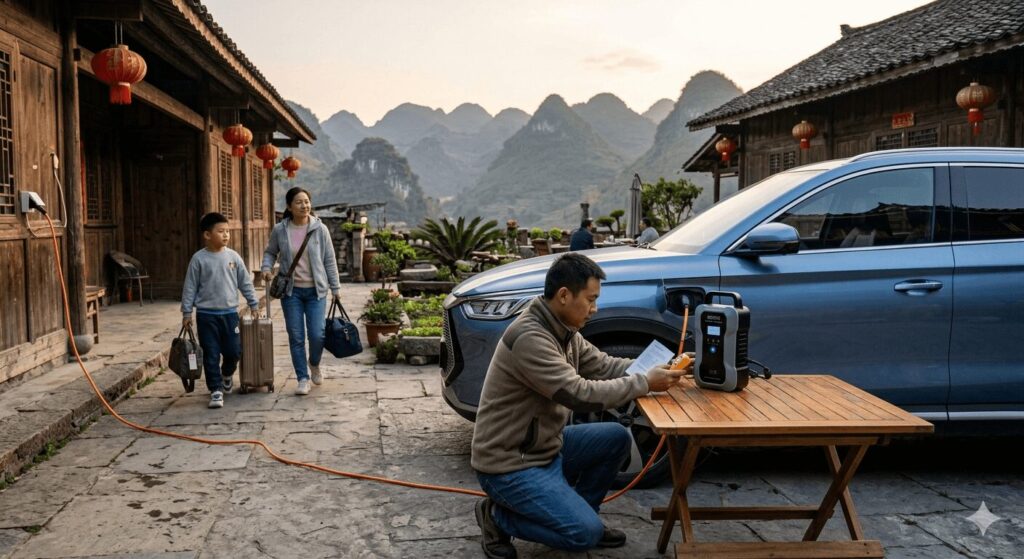
Many Chinese hotels, particularly outside major cities and particularly in smaller tourist destinations, have not yet installed dedicated EV charging infrastructure, leaving road trippers needing to charge overnight with whatever standard electrical access the accommodation can provide.
The Portable Charging Solution Philosophy
The right portable charging kit for Chinese road trips isn’t about replacing public DC fast charging as your primary long-distance charging method — public DC fast charging remains dramatically faster and should be your default plan. The portable kit exists specifically to solve the gaps above: providing a functional backup when your planned charging stop fails you, enabling overnight charging at accommodation without dedicated infrastructure, and providing genuine peace of mind that transforms road trip planning from anxious contingency-obsession into confident, flexible travel.
The Core Portable Charging Kit — What Belongs in Every Chinese EV Road Tripper’s Boot
Component 1: A Quality Mode 3 Portable EVSE With Interchangeable Plugs
As covered extensively in our DIY charging guide’s discussion of portable EVSE options, the foundation of any serious road trip charging kit is a genuinely good-quality portable EVSE — not the basic Mode 2 cable that came with your vehicle, but an upgraded unit with proper safety protection and plug versatility.
Why the included Mode 2 cable alone is insufficient for road trip use:
Most included Mode 2 cables charge at only 2.2 kW (10A) from a standard socket, lack built-in RCCB protection in many cases, and offer no plug flexibility — meaning they only work with whatever standard socket happens to be available, with no option to take advantage of higher-current sockets that might be available at a specific location.
The recommended product: BESEN Smart Portable EVSE with interchangeable plugs
As detailed in our DIY charging guide, this product (or functionally equivalent alternatives from Pilot-EV or similar manufacturers) provides the genuine versatility that road trip use specifically demands:
- Base unit with GB/T connector for the vehicle end
- Interchangeable plug heads: 10A standard socket (2.2 kW), 16A standard socket (3.5 kW), 32A commando socket (7 kW)
- Built-in RCCB ground fault protection — non-negotiable for any equipment you’ll be using in unfamiliar electrical environments away from home
- IP55 weather protection for outdoor use in varied conditions across different regions
- Reasonable weight and size for boot storage without being a major packing consideration
Why interchangeable plugs specifically matter for road trips:
Unlike home charging, where you know exactly what socket type you’ll be using every single time, road trip charging means encountering an unpredictable variety of electrical access points — a standard socket at one hotel, a 16A socket in a relative’s rural courtyard, perhaps an industrial 32A commando socket at a friend’s workplace if you’re staying with contacts along your route. The interchangeable plug system means a single piece of equipment adapts to whatever you encounter, rather than needing multiple separate cables for different scenarios.
Component 2: A Genuine EV-Rated Extension Cable (Not a Standard Extension Cord)
The critical distinction from our safety guidance:
As emphasised throughout this guide series, particularly in our flywire charging safety guide, a standard domestic extension cord is never appropriate for sustained EV charging current, regardless of road trip convenience pressures. The solution for road trip scenarios where your portable EVSE needs more reach than its standard cable provides is a purpose-built EV charging extension cable.
Specification for road trip use:
Minimum 2.5mm² conductor cross-section rated for 32A continuous current, with IP55 weather protection, in a single continuous length without joins (joins are exactly the failure point described in our flywire safety guide, and road trip use in unfamiliar environments is precisely when you most want to avoid introducing additional risk points).
Recommended length for road trip versatility:
A 5-metre extension, in addition to whatever cable length your primary portable EVSE already includes, provides meaningful additional reach for situations where the available socket is further from your parking position than ideal — common at unfamiliar accommodation where you don’t have the luxury of choosing your exact parking spot relative to available power.
Component 3: A Socket Tester
Why this small, inexpensive item matters disproportionately for road trips:
As covered in our DIY charging guide, confirming a socket is properly earthed and electrically sound before connecting your vehicle is good practice at home, where you presumably know your own electrical infrastructure’s history and condition. On the road, connecting to entirely unfamiliar sockets — at a roadside guesthouse, a relative’s rural property, or any accommodation without dedicated EV infrastructure — this basic verification step becomes considerably more important, given you have zero prior knowledge of the specific socket’s condition or wiring quality.
Cost and practicality: At roughly ¥30-¥50, a basic socket tester is genuinely one of the cheapest and most valuable items in any road trip charging kit, taking up minimal space while providing a meaningful safety check before connecting potentially expensive vehicle charging equipment to an unknown electrical circuit.
Component 4: A 32A Commando Plug Adapter Set
Why this specific adapter matters for Chinese road trip scenarios:
As covered in our DIY charging guide’s discussion of 32A commando socket solutions, some road trip scenarios — particularly staying with contacts who have access to commercial or industrial premises, or finding accommodation that happens to have appropriate higher-current sockets installed for other purposes (workshop equipment, certain agricultural settings) — present opportunities for genuinely fast 7 kW charging if you have the right adapter to access a 32A commando socket when one happens to be available.
The practical value: This is a lower-priority item than the core EVSE and extension cable, more of a “nice to have for the right circumstance” than an essential, but for road trippers who frequently visit rural relatives or who travel routes where they know specific commando socket access points exist (a friend’s workshop, a relative’s small business premises), the adapter set takes up minimal space for the genuine charging speed upgrade it occasionally enables.
The Highway Service Area Charging Reality — What to Actually Expect in 2026
Understanding China’s Expressway Service Area Charging Infrastructure
The general infrastructure pattern:
Chinese expressway service areas (服务区), spaced at roughly 50-80 kilometre intervals along most major expressway routes, increasingly include EV charging infrastructure as a now-standard amenity alongside the traditional petrol stations, restaurants, and rest facilities. State Grid, in particular, has invested heavily in expressway service area charging as part of its broader charging infrastructure mandate.
The realistic charging speed expectation:
While some flagship service area installations on the most heavily travelled corridors (particularly connecting major tier-1 cities) feature genuinely fast 250 kW+ ultra-fast charging stations, the more typical expressway service area installation, particularly on less heavily travelled routes or in less economically developed provinces, more commonly features 60-120 kW charging capability — meaningfully slower than the flagship installations but still providing reasonable charging speed for a typical 20-30 minute rest stop.
The queuing reality during peak travel periods:
As mentioned above, China’s national holiday travel periods create documented, sometimes severe charging queue situations at popular service areas. This is the single most important practical reality for road trip planning: if you are travelling during 国庆节, 春节, or other major holiday periods, build meaningfully more charging buffer time into your planning than you would for off-peak travel, and treat your portable charging kit’s backup capability as genuinely more likely to be needed during these specific periods.
The Apps That Matter for Real-Time Service Area Charging Status
Checking availability before committing to a specific stop:
Most experienced Chinese EV road trippers use a combination of apps — 高德地图 (Amap) with its EV charging layer showing real-time charger availability status, alongside network-specific apps like 国家电网 for State Grid stations or 特来电/星星充电 for those respective networks — to check actual current availability at upcoming service areas before committing to a specific stop, rather than simply driving to the nearest service area and hoping for an available, functional charger.
The practical road trip habit this enables:
Checking real-time availability at your next two or three potential charging stops, rather than just the immediate next one, allows you to make an informed decision about which specific stop to target if your first choice shows queuing or unavailability — a habit that meaningfully reduces the frustration of arriving at a congested station with no advance warning.
Regional Road Trip Considerations — Building on This Content Cluster’s Climate Guidance
Northern Route Road Trips and Cold Weather Portable Charging
Connecting to our winter charging guidance:
For road trips through northern China during colder months — whether a deliberate winter road trip or simply travel during the shoulder seasons when northern routes can experience unexpectedly cold conditions — the portable charging equipment specification considerations covered in our winter EV charging guide apply directly to your travel kit choices.
The practical road trip adaptation:
If your route takes you through genuinely cold conditions, prioritise a portable EVSE with cold-rated cable specification (remaining flexible rather than becoming brittle at low temperature) over a budget option that might perform adequately in milder conditions but risk hardware failure if your road trip encounters an unexpected cold snap, particularly relevant for road trips with any northeastern or high-altitude northwestern routing.
Southern and Furnace City Route Considerations
Connecting to our hot weather guidance:
For road trips through Wuhan, Chongqing, or other furnace city regions during summer months, the same IP65 humidity protection and adequate upper temperature rating principles covered in our furnace city thermal management guide apply to your portable equipment choices — a portable EVSE that’s adequate for milder climate home use may experience more thermal stress than ideal if your road trip itinerary includes extended time in these specific high-heat, high-humidity regions during peak summer.
South China Coastal and Monsoon Route Considerations
Connecting to our weatherproof charger guidance:
Road trips along China’s southern coastal regions, particularly during the April-September monsoon and typhoon season discussed in our weatherproof charger guide, warrant the same IP65-or-better weather protection specification for portable equipment that this guide series recommends for permanent installations in these regions — a portable EVSE that will be used outdoors in genuinely heavy rainfall conditions along a coastal road trip route needs the same water protection consideration as fixed home installations in the same climate.
The Hotel and Accommodation Charging Strategy
What to Expect From Chinese Accommodation in 2026
The improving but uneven landscape:
Major hotel chains in larger Chinese cities increasingly include dedicated EV charging as a guest amenity, often through partnership arrangements with charging network operators like StarCharge or TELD providing charging points in hotel car parks. However, this remains genuinely uneven outside major cities — smaller hotels, guesthouses, and rural accommodation frequently lack any dedicated EV infrastructure.
The pre-trip verification habit:
Before booking accommodation for any multi-stop road trip, checking specifically for EV charging availability — through the booking platform’s amenity listings, direct enquiry with the property, or checking whether the accommodation appears on charging network apps’ location maps — prevents the unwelcome discovery of inadequate charging access only after arrival.
The Portable Kit’s Role at Accommodation Without Dedicated Charging
Using your portable EVSE for overnight accommodation charging:
When your accommodation lacks dedicated EV infrastructure, your portable EVSE kit becomes genuinely essential rather than just a backup — most properties, even without dedicated EV charging, can typically provide access to a standard socket (often through prior arrangement with hotel staff, sometimes through accessing an exterior socket near the parking area with permission) sufficient for overnight charging at the 2.2-3.5 kW rates your portable kit’s standard plug configurations provide.
The overnight charging math for road trip accommodation:
At 3.5 kW overnight charging (using your portable EVSE’s 16A plug configuration) across a typical 8-10 hour overnight stay, you can reasonably expect to add 28-35 kWh to your battery — sufficient to meaningfully extend your range for the next day’s driving even without fast DC charging, effectively using overnight accommodation charging as a substantial top-up that reduces your dependence on finding fast charging during the following day’s travel.
The etiquette and arrangement consideration:
For accommodation without formal EV charging arrangements, always explicitly request permission and discuss appropriate compensation for electricity usage with hotel or guesthouse staff before connecting — this is both the legally and ethically appropriate approach, and practically, establishes a positive relationship that makes the specific property more likely to accommodate EV charging requests from other travellers in the future, contributing in a small way to the broader infrastructure development this guide series’ content cluster has tracked throughout China’s various regions.
The Brand Survival Consideration for Road Trip Equipment Specifically
Why Our Zombie Pile Guidance Applies Doubly to Travel Equipment
The connection to our brand survival guide:
As covered extensively in our zombie pile crisis guide, Chinese EV charging hardware companies have experienced significant market consolidation, with smaller manufacturers failing or quietly ceasing support at a documented rate. For road trip equipment specifically, this consideration carries additional weight beyond the home charging context that guide primarily addressed.
Why portability amplifies the brand risk concern:
A home charger from a failed manufacturer that loses smart features but retains basic local charging function (the cloud-optional architecture distinction covered in our zombie pile guide) remains a manageable situation at home, where you have time, internet research capability, and no urgency pressure to figure out workarounds. A portable EVSE that fails or behaves unpredictably while you’re genuinely stranded at an unfamiliar location during a road trip — without the convenience of researching solutions at leisure — represents a meaningfully worse practical consequence of the same underlying brand risk.
The practical road trip equipment recommendation:
Apply the five-factor due diligence framework from our zombie pile guide with particular attention to the “cloud-optional architecture” factor specifically for any portable EVSE intended for road trip use — confirming your portable unit functions via simple physical button operation without requiring active internet connectivity, given that road trip scenarios may include locations with poor or no mobile data signal where cloud-dependent equipment could become genuinely non-functional precisely when you need it most.
The Complete Road Trip Charging Kit Checklist
Pre-Trip Preparation Checklist
Equipment to pack:
- Quality Mode 3 portable EVSE with interchangeable plugs (BESEN, Pilot-EV, or equivalent)
- Purpose-built EV charging extension cable (5m, 32A rated, IP55, no joins)
- Socket tester
- 32A commando adapter (optional, for travellers with known access to such sockets along their route)
- Your vehicle’s original Mode 2 cable as a genuine backup-to-the-backup
Apps to install and configure before departure:
- 高德地图 with EV charging layer enabled
- Your vehicle manufacturer’s app with route planning/charging stop features configured
- 国家电网 app
- TELD and/or StarCharge apps depending on your planned route’s likely network coverage
- Your vehicle’s specific manufacturer charging network app if applicable (Xpeng S4, NIO Power, etc.)
Pre-trip research:
- Identify primary and backup charging stops for each major leg of your route
- Check real-time charger availability and any reported issues for your planned stops
- Verify accommodation EV charging availability or confirm a standard socket access arrangement
- If travelling during a major holiday period, build additional time buffer into your schedule specifically anticipating potential charging queues
During-Trip Habits
At each charging stop:
- Check real-time availability at your next 2-3 potential stops before committing, particularly during peak holiday travel
- If using your portable EVSE at any unfamiliar location, perform the socket tester check and the warm-hand test after 30 minutes of use, exactly as recommended in our DIY charging guide for home use
At accommodation:
- Confirm charging arrangement and compensation with staff explicitly before connecting
- Use your portable EVSE’s appropriate plug configuration for whatever socket is made available
- Configure overnight charging timing if the accommodation happens to have any TOU-relevant electricity arrangement, though this is less commonly relevant for short-stay accommodation than for home charging
Internal Links — Further Reading on Clean Energy Bazaar
The best portable EV chargers for travel 2026 China national highway road trip essentials guide is the travel-specific companion to the portable charging and safety guidance covered throughout this content cluster.
For the DIY charging guide that establishes the core portable EVSE product recommendations adapted for road trip use throughout this guide, our DIY EV charger installation 2026 easiest plug and play models for Chinese apartments 220V guide covers every certified portable option in full technical detail. For the flywire charging safety guide that establishes why proper extension cable specification matters even more critically away from home, our China apartment flywire charging is it safe legal solutions for lower ground parking guide covers every safety consideration. For the zombie pile crisis guide that informs the brand selection considerations specifically relevant to road trip equipment reliability, our zombie pile crisis 2026 how to avoid dead chargers from liquidated Chinese brands guide covers the complete due diligence framework. For the winter charging guide relevant to any road trip routing through China’s colder northern regions, our winter EV charging guide 2026 cold weather performance for Harbin -30C vs wet Shanghai guide covers every cold-weather consideration. For the furnace city thermal management guide relevant to any road trip through Wuhan, Chongqing, or similar summer-heat regions, our hot weather EV charger tips thermal management for furnace cities like Wuhan and Chongqing guide covers every heat-related consideration. And for the real user stories guide featuring genuine Chinese EV owner experiences across diverse travel and usage scenarios, our user stories real EV charger setups from Chinese drivers from Shenzhen taxis to Hainan tourists guide covers eight genuine first-person accounts including travel-relevant experiences.
Final Thoughts
The best portable EV chargers for travel 2026 China national highway road trip essentials reflect a simple underlying philosophy: China’s public charging infrastructure has genuinely matured to the point where it should be your primary long-distance charging strategy for the vast majority of road trip scenarios, but the gaps that remain — holiday queuing, individual station malfunctions, rural route coverage, and accommodation without dedicated infrastructure — are real enough and predictable enough that travelling without a proper portable backup kit represents an unnecessary and avoidable risk.
The core kit is neither expensive nor complicated: a quality Mode 3 portable EVSE with interchangeable plugs, a properly rated extension cable for the occasions when reach matters more than speed, a simple socket tester, and the habit of checking real-time charging availability through apps like 高德地图 before committing to any specific stop. Together, these cost a few hundred yuan and take up modest boot space, in exchange for genuine peace of mind and, on the inevitable occasion when your primary charging plan doesn’t work out exactly as expected, an actual working solution rather than a stressful improvisation.
China’s expressway network connects an extraordinary range of destinations, and its charging infrastructure increasingly makes EV road tripping a genuinely viable, often pleasant way to experience that connectivity. The right portable charging kit doesn’t replace that infrastructure achievement — it simply ensures that the inevitable, predictable gaps in any infrastructure system, however well-developed, don’t turn your road trip into the stranded-at-a-service-area story that nobody wants to tell.
Pack the kit. Check the apps. Build in buffer time during holiday periods. The rest of China’s road trip charging story, in 2026, genuinely works.