Here is the practical question that Chinese EV owners ask more often than almost any other — and that existing guides answer less usefully than they should.
“How long will it take to charge my car?”
Most answers to this question are either too simple (“approximately 8 hours on a 7 kW home charger”) or buried in technical specifications that require cross-referencing between the vehicle’s OBC rating, the charger’s maximum output, the supply voltage and current, the battery’s current state of charge, and the charging efficiency factor.
The honest answer is that charge time depends on five variables simultaneously: the vehicle’s battery capacity, the vehicle’s maximum AC or DC charging rate, the charger or station’s output power, the starting state of charge, and the target state of charge. Change any one of these variables and the charge time changes.
This guide on the EV charge time calculator 2026 how long to full for your Chinese EV BYD to NIO provides both an interactive calculator that handles all five variables instantly and a comprehensive reference covering every major Chinese EV model’s charging time across every realistic scenario — home AC charging at 3.3 kW, 7 kW, and 11 kW; and public DC fast charging at 50 kW, 120 kW, 150 kW, 250 kW, and 400 kW.
The calculator covers BYD’s complete lineup, NIO’s range, Xpeng, Zeekr, Xiaomi SU7, Li Auto, and the major international EVs sold in China’s domestic market.
The Five Variables That Determine Charge Time
Before the calculator, understanding what drives charge time prevents the most common charging planning mistakes.
Variable 1: Usable Battery Capacity (kWh)
The usable battery capacity — not the gross capacity — determines how much energy must be delivered to move from current SOC to target SOC.
Usable vs gross capacity:
Most EV manufacturers quote gross battery capacity in marketing materials. Usable capacity — the portion of the battery that can actually be used for driving — is typically 90-95% of gross capacity.
The charge time implication:
Charging from 20% to 80% of a 76.9 kWh usable battery requires:
76.9 kWh × (0.80 – 0.20) = 46.1 kWh of energy delivery
Variable 2: Vehicle’s Maximum Charging Rate (kW)
For AC home charging:
The vehicle’s Onboard Battery Charger (OBC) AC input rating determines maximum home charging speed — regardless of the charger’s output capability. As established throughout this guide series, a vehicle with a 6.6 kW OBC charges at 6.6 kW from any AC charger rated 7 kW or higher.
For DC fast charging:
The vehicle’s maximum DC input rating determines public fast charging speed up to the station’s output ceiling.
The critical rule: Charge time is always governed by the lower of (a) the vehicle’s maximum rate and (b) the charger/station’s output rate.
Variable 3: Charger or Station Output Power (kW)
Home AC chargers:
- Standard socket (10A): 2.2 kW
- Standard socket (16A): 3.5 kW
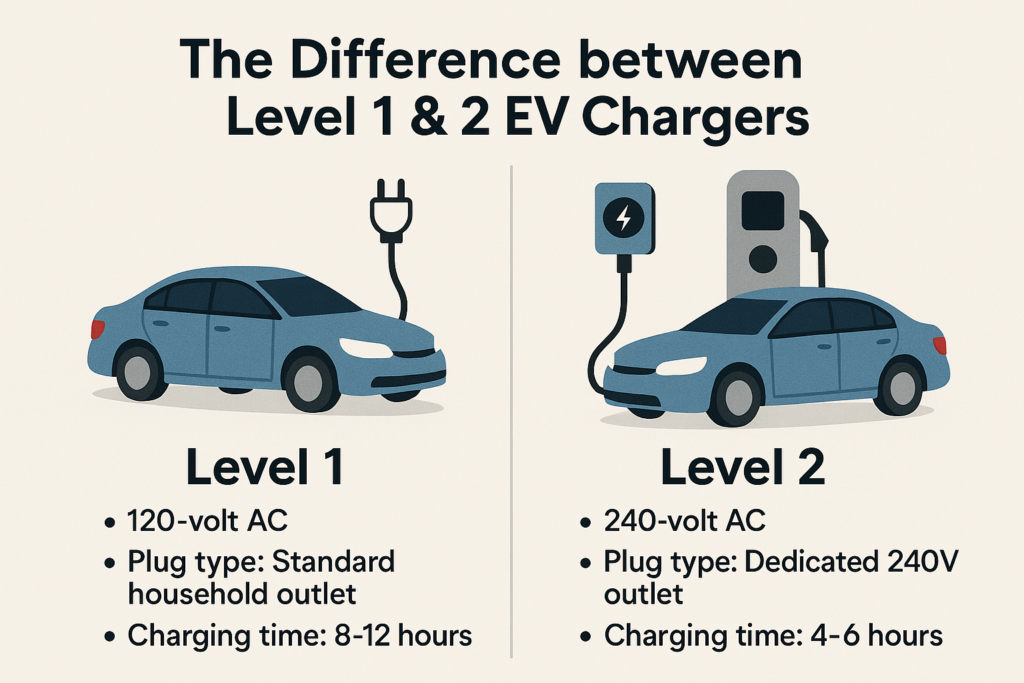
- Dedicated 7 kW home charger: 6.6-7 kW (delivers vehicle’s OBC maximum up to 7 kW)
- Three-phase 11 kW home charger: 11 kW (for vehicles with 11 kW OBC)
Public DC stations:
- Standard DC: 30-50 kW
- Fast DC: 90-150 kW
- Ultra-fast DC: 180-250 kW
- Premium ultra-fast: 300-500 kW (ChaoJi and 800V compatible stations)
Variable 4: Starting State of Charge (SOC)
The starting SOC determines how much energy is needed. Arriving home at 40% SOC and charging to 80% requires half the energy — and half the time — of arriving at 10% SOC.
Variable 5: Target State of Charge (SOC)
For daily use, most EV manufacturers recommend charging to 80% rather than 100% for battery longevity. At high SOC (above 80-85%), charging slows significantly as the BMS implements taper charging to protect cells. The 0-100% time includes this slow final phase — the 80-100% portion often takes as long as the 0-80% portion on many EVs.
The Charging Efficiency Factor
AC home chargers are not 100% efficient — some electricity is lost as heat in the charger and cables. Typical charging efficiency: 88-93%.
The practical implication:
If a vehicle needs 46.1 kWh of battery energy, the charger must deliver approximately 46.1 ÷ 0.90 = 51.2 kWh from the grid.
For charge time calculation:
Charge time = Energy needed (battery) ÷ (Charger output × Charging efficiency)
= 46.1 ÷ (7 kW × 0.90)
= 46.1 ÷ 6.3
= 7.3 hours
The Interactive EV Charge Time Calculator
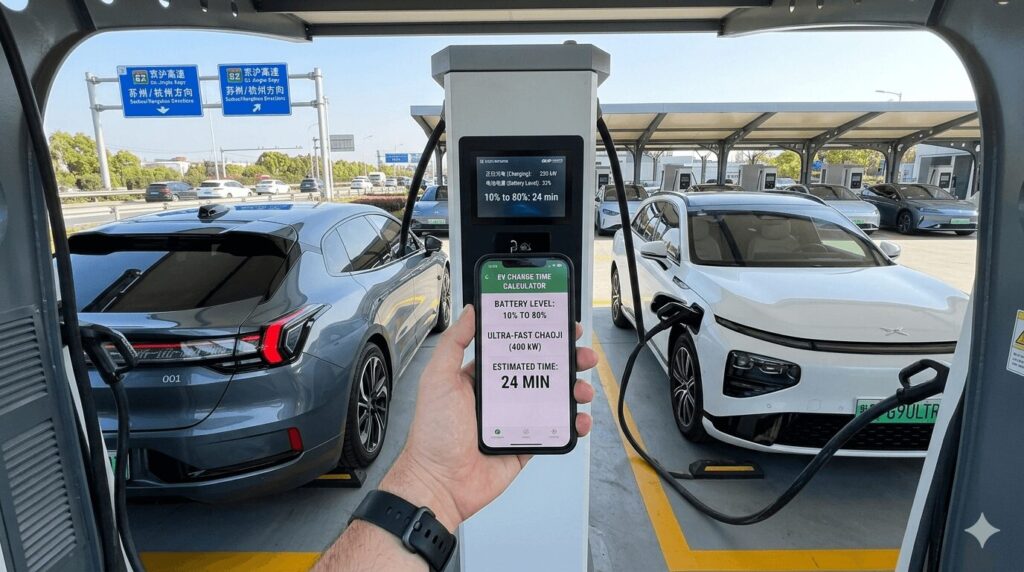
The calculator below allows you to select your specific Chinese EV model, enter your current and target SOC, select your charging method, and receive instant accurate charge time for your specific scenario.
V
visualize
V
visualize show_widget
https://709f1212927e72444047651aa2caf82e.claudemcpcontent.com/mcp_apps?connect-src=https%3A%2F%2Fesm.sh+https%3A%2F%2Fcdnjs.cloudflare.com+https%3A%2F%2Fcdn.jsdelivr.net+https%3A%2F%2Funpkg.com&resource-src=https%3A%2F%2Fesm.sh+https%3A%2F%2Fcdnjs.cloudflare.com+https%3A%2F%2Fcdn.jsdelivr.net+https%3A%2F%2Funpkg.com+https%3A%2F%2Ffonts.googleapis.com+https%3A%2F%2Ffonts.gstatic.com+https%3A%2F%2Fassets.claude.ai&dev=true
Now here is the complete article content to accompany the calculator in WordPress. Paste the calculator embed before the reference tables below.
Focus Keyword: EV charge time calculator 2026 how long to full for your Chinese EV BYD to NIO
How to Use the Calculator
Select your vehicle from the dropdown — covering every major Chinese EV brand from BYD’s complete lineup through NIO, Xpeng, Li Auto, Zeekr, Xiaomi SU7, Tesla China domestic-spec, and the major European luxury EVs sold in China.
Set your starting SOC (the battery level when you plug in) and target SOC (how charged you want to get). The 20% to 80% default reflects the recommended daily charging range for lithium battery longevity — but adjust freely for your actual scenario.
Select your home supply: standard socket at 2.2 kW, upgraded 16A socket at 3.5 kW, dedicated 7 kW home charger, or three-phase 11 kW charger.
The results show home AC charge time, fastest possible DC time, a visual comparison bar chart across five DC power levels, and a TOU window assessment confirming whether your charge fits within the overnight valley rate window.
The Reference Charging Tables — Every Major Chinese EV at a Glance
The calculator handles individual scenarios. These reference tables give the complete picture for every vehicle at the most common charging configurations — useful for comparing vehicles before purchase or planning charging for a long journey.
Home AC Charging Times — 20% to 80%
All times use 90% charging efficiency factor. Times shown for each home supply configuration.
| Vehicle | Battery | AC Max | 2.2 kW socket | 7 kW charger | 11 kW charger |
|---|---|---|---|---|---|
| Wuling Mini EV | 9.2 kWh | 2.2 kW | 2.5 hr | 2.5 hr | 2.5 hr |
| Wuling Mini EV LR | 13.8 kWh | 2.2 kW | 3.7 hr | 3.7 hr | 3.7 hr |
| BYD Dolphin | 44.9 kWh | 6.6 kW | 13.6 hr | 4.3 hr | 4.3 hr |
| BYD Han EV Standard | 64.8 kWh | 6.6 kW | 19.6 hr | 6.2 hr | 6.2 hr |
| BYD Han EV Long Range | 76.9 kWh | 6.6 kW | 23.3 hr | 7.3 hr | 7.3 hr |
| BYD Seal Long Range 800V | 82.56 kWh | 6.6 kW | 25 hr | 7.9 hr | 7.9 hr |
| Li Auto L9 EREV | 42.8 kWh | 6.6 kW | 13 hr | 4.1 hr | 4.1 hr |
| NIO ET5 75 kWh | 75 kWh | 6.6 kW | 22.7 hr | 7.1 hr | 7.1 hr |
| NIO ET5 100 kWh | 100 kWh | 6.6 kW | 30.3 hr | 9.5 hr | 9.5 hr |
| NIO ET5 150 kWh | 150 kWh | 6.6 kW | 45.5 hr | 14.3 hr | 14.3 hr |
| NIO ET7 100 kWh | 100 kWh | 11 kW | 30.3 hr | 9.5 hr | 6.1 hr |
| Xpeng P7 80.9 kWh | 80.9 kWh | 6.6 kW | 24.5 hr | 7.7 hr | 7.7 hr |
| Xpeng G9 Ultra | 98 kWh | 11 kW | 29.7 hr | 9.3 hr | 5.9 hr |
| Zeekr 001 Performance | 100 kWh | 11 kW | 30.3 hr | 9.5 hr | 6.1 hr |
| Zeekr 001 Privilege | 140 kWh | 11 kW | 42.4 hr | 13.3 hr | 8.5 hr |
| Xiaomi SU7 Standard | 73.6 kWh | 6.1 kW | 23.4 hr | 7.1 hr | 7.1 hr |
| Xiaomi SU7 Max | 101 kWh | 11 kW | 30.6 hr | 9.6 hr | 6.2 hr |
| Xiaomi SU7 Ultra | 150 kWh | 11 kW | 45.5 hr | 14.3 hr | 9.1 hr |
| Porsche Taycan 4S | 79.2 kWh | 11 kW | 24 hr | 7.5 hr | 4.8 hr |
| BMW i5 eDrive40 | 81.2 kWh | 11 kW | 24.6 hr | 7.7 hr | 4.9 hr |
| Mercedes EQE 350+ | 90.6 kWh | 11 kW | 27.5 hr | 8.6 hr | 5.5 hr |
| Tesla Model 3 LR | 75 kWh | 11 kW | 22.7 hr | 7.1 hr | 4.5 hr |
| Li Auto MEGA | 100 kWh | 11 kW | 30.3 hr | 9.5 hr | 6.1 hr |
Bold indicates the fastest available option for each vehicle.
Critical insight from this table:
For vehicles with 6.6 kW or lower AC maximum (all BYD models, Xpeng P7, Li Auto L-series, Xiaomi SU7 Standard/Pro, NIO ET5), a 7 kW home charger and an 11 kW three-phase charger deliver identical charge times. Paying for three-phase installation provides zero speed benefit for these vehicles.
For vehicles with 11 kW AC maximum (NIO ET7, Xpeng G9, Zeekr 001, Xiaomi SU7 Max/Ultra, Porsche Taycan, BMW i5, Mercedes EQE), three-phase installation reduces charge time by 35-40% — a meaningful and genuine benefit.
TOU Valley Window Fit Analysis
This is the most practically important table in the guide. It answers: “If I plug in at 11pm (when Shanghai’s valley rate starts), will my car be charged to 80% before 8am?”
Valley window: 9 hours (23:00-08:00 Shanghai). Pass = charge completes within window. Fail = charge extends past window end.
| Vehicle | At 7 kW (from 20%) | Valley fit? | At 11 kW (if applicable) | Valley fit? |
|---|---|---|---|---|
| Wuling Mini EV | 2.5 hr | ✅ Easily | — | — |
| BYD Dolphin | 4.3 hr | ✅ | — | — |
| BYD Han EV Standard | 6.2 hr | ✅ | — | — |
| BYD Han EV Long Range | 7.3 hr | ✅ | — | — |
| BYD Seal Long Range | 7.9 hr | ✅ (1.1hr margin) | — | — |
| Li Auto L9 EREV | 4.1 hr | ✅ | — | — |
| NIO ET5 75 kWh | 7.1 hr | ✅ | — | — |
| NIO ET5 100 kWh | 9.5 hr | ⚠️ Tight | — | — |
| NIO ET5 150 kWh | 14.3 hr | ❌ Fails | — | — |
| NIO ET7 100 kWh | 9.5 hr | ⚠️ Tight | 6.1 hr | ✅ |
| Xpeng P7 Long Range | 7.7 hr | ✅ (1.3hr margin) | — | — |
| Xpeng G9 Ultra | 9.3 hr | ⚠️ Tight | 5.9 hr | ✅ |
| Zeekr 001 LR AWD | 9.5 hr | ⚠️ Tight | 6.1 hr | ✅ |
| Zeekr 001 Privilege | 13.3 hr | ❌ Fails | 8.5 hr | ✅ |
| Xiaomi SU7 Standard | 7.1 hr | ✅ | — | — |
| Xiaomi SU7 Max | 9.6 hr | ⚠️ Overrun | 6.2 hr | ✅ |
| Xiaomi SU7 Ultra | 14.3 hr | ❌ Fails | 9.1 hr | ⚠️ Tight |
| Porsche Taycan 4S | 7.5 hr | ✅ | 4.8 hr | ✅ |
| BMW i5 eDrive40 | 7.7 hr | ✅ | 4.9 hr | ✅ |
| Mercedes EQE 350+ | 8.6 hr | ✅ (30min margin) | 5.5 hr | ✅ |
| Tesla Model 3 LR | 7.1 hr | ✅ | 4.5 hr | ✅ |
The ❌ Fail vehicles and what to do:
NIO ET5 150 kWh: Home charging requires NIO programme 11 kW three-phase or NIO swap supplementation. At 7 kW single-phase, 20-80% takes 14.3 hours — requires starting at 5:42pm to complete by 8am, which means charging partly at flat rate (17:00-23:00) and partly at valley rate. Use NIO’s swap network for long-range replenishment; home 7 kW charging for daily top-ups of 40-60 km.
Zeekr 001 Privilege: Three-phase 11 kW required — the only way to fit the 140 kWh battery within the valley window. As covered in our Zeekr charging guide, three-phase supply investigation is a prerequisite for Privilege ownership.
Xiaomi SU7 Ultra: Even at 11 kW, the 9.1-hour charge time is tight within the 9-hour valley window. SU7 Ultra owners should investigate three-phase supply and consider starting charging before 11pm at flat rate on high-usage days.
Public DC Fast Charging Times — 10% to 80%
All times shown for 10-80% DC fast charging (the standard fast charge range avoiding taper charging above 80%).
| Vehicle | DC Max | At 50 kW | At 120 kW | At 150 kW | At 250 kW | At 400 kW |
|---|---|---|---|---|---|---|
| Wuling Mini EV | No DC | — | — | — | — | — |
| BYD Dolphin | 60 kW | 50 min | 34 min | 34 min | 34 min | 34 min |
| BYD Han EV LR | 120 kW | 77 min | 54 min | 54 min | 54 min | 54 min |
| BYD Seal Long Range | 150 kW | 83 min | 55 min | 47 min | 47 min | 47 min |
| Li Auto L9 EREV | 100 kW | 43 min | 31 min | 31 min | 31 min | 31 min |
| NIO ET5 75 kWh | 126 kW | 75 min | 55 min | 51 min | 51 min | 51 min |
| NIO ET5 100 kWh | 126 kW | 100 min | 74 min | 68 min | 68 min | 68 min |
| Xpeng G9 Ultra | 480 kW | 131 min | 55 min | 44 min | 26 min | 14 min |
| Zeekr 001 Performance | 400 kW | 120 min | 50 min | 40 min | 24 min | 15 min |
| Zeekr 001 Privilege | 360 kW | 168 min | 70 min | 56 min | 34 min | 34 min |
| Xiaomi SU7 Max | 400 kW | 121 min | 51 min | 40 min | 24 min | 15 min |
| Xiaomi SU7 Ultra | 500 kW | 180 min | 75 min | 60 min | 36 min | 23 min |
| Li Auto MEGA | 520 kW | 120 min | 50 min | 40 min | 24 min | 15 min |
| Porsche Taycan 4S | 270 kW | 95 min | 40 min | 32 min | 19 min | 19 min |
| BMW i5 eDrive40 | 205 kW | 98 min | 41 min | 33 min | 20 min | 20 min |
| Mercedes EQE 350+ | 170 kW | 109 min | 45 min | 37 min | 37 min | 37 min |
| Tesla Model 3 LR | 250 kW | 90 min | 38 min | 30 min | 18 min | 18 min |
Bold indicates the fastest achievable time for each vehicle (limited by vehicle DC maximum).
The key DC charging planning insights from this table:
For standard 50-120 kW public charging stations — which represent the majority of China’s public DC infrastructure — vehicles with DC maximums above 120 kW (Zeekr 001 Performance, Xpeng G9 Ultra, Xiaomi SU7 Max) charge at the same speed as a BYD Han EV. The ultra-fast charging advantage only appears at stations delivering 250 kW or more.
When planning long-distance routes, use the ChaoJi-enabled and 800V-compatible State Grid ultra-fast hubs and StarCharge premium stations for vehicles with 250 kW+ DC capability — these represent 15-25% of China’s total DC fast charging locations in 2026.
The Charging Planning Guide — Real Scenarios
Scenario 1: The Daily Commuter (50 km each way, BYD Han EV)
Situation: 100 km daily commute, arriving home at 7pm with approximately 35% battery, departing at 7am.
With 7 kW home charger, TOU from 11pm:
Energy needed: 76.9 kWh × (0.80 – 0.35) = 34.6 kWh
At 6.6 kW effective: 34.6 ÷ (6.6 × 0.90) = 5.8 hours
Starting at 11pm, completing at 4:48am — well within valley window.
Result: Full daily replenishment completed by 4:48am at ¥0.34/kWh. Comfortable margin before 7am departure. Perfect scenario.
Scenario 2: The Weekend Road Tripper (NIO ET5 75 kWh, Long Journey)
Situation: 600 km round trip on Saturday. Leaves with 90% battery, needs to use public charging twice en route.
Route charging with 126 kW NIO DC maximum:
10-80% at 126 kW: 70 × 0.75 ÷ 126 = 42 minutes per stop
Two stops × 42 minutes = 84 minutes total public charging for 600 km journey
Monday morning home recovery:
Returns home with 15% battery, needs to be at 80% by 8am Monday.
Energy needed: 75 kWh × 0.65 = 48.75 kWh
At 7 kW home charger: 48.75 ÷ (6.6 × 0.90) = 8.2 hours
Starting at 11pm Sunday: completes at 7:12am — within valley window by 48 minutes.
Result: Tight but achievable. Setting minimum SOC override at 25% ensures the charger starts immediately if the battery is lower than expected.
Scenario 3: The Zeekr 001 Privilege Owner’s Dilemma
Situation: 140 kWh battery, single-phase 7 kW home supply only, arrives home at 9pm with 20% battery.
At 7 kW home charger:
Energy needed: 140 kWh × 0.60 = 84 kWh
At 6.6 kW OBC (Zeekr 001 accepts 11 kW but supply is 7 kW): 84 ÷ (7 × 0.90) = 13.3 hours
Starting at 11pm: completing at 12:18pm next day — well past valley window end.
Valley rate electricity consumed (11pm-8am, 9 hours): 7 × 0.90 × 9 = 56.7 kWh
Remaining at flat rate (8am-12:18pm): 84 – 56.7 = 27.3 kWh at ¥0.67/kWh
Additional electricity cost from missing valley window: 27.3 × (¥0.67 – ¥0.34) = ¥9.01 per session
The three-phase solution:
At 11 kW three-phase: 84 ÷ (11 × 0.90) = 8.5 hours
Starting at 11pm: completing at 7:30am — within valley window.
Annual saving from three-phase installation vs single-phase for Privilege owner (charging from 20% daily):
Single-phase valley overrun: ¥9.01/session × 300 sessions/year = ¥2,703/year additional electricity cost
Three-phase additional installation cost: ¥400-¥800 one-time
Payback on three-phase upgrade for Privilege owner: under 4 months.
The SOC Management Guide — Optimising Battery Longevity
Why Daily Charging to 80% Matters
The charge time calculator uses 80% as the default target SOC — not as an arbitrary conservative choice but because the 80% limit is the most financially and technically optimal daily charging target for most Chinese EV owners.
The electrochemistry of high SOC:
Lithium-ion cells (including BYD Blade Battery LFP and CATL Shenxing NMC) experience increased stress when held at high state of charge for extended periods. At 95-100% SOC, side reactions at the battery anode proceed at higher rates than at 80% SOC — gradually degrading capacity over thousands of charge cycles.
The practical impact:
A BYD Han EV charged to 80% daily versus 100% daily over 10 years retains approximately 3-5% more usable capacity at year 10. On a 76.9 kWh battery, 3-5% is 2.3-3.8 kWh — approximately 12-21 km of retained range at year 10.
When 100% charging is appropriate:
Before long journeys where maximum range is needed, the BYD app and most Chinese EV apps allow temporary 100% charging while keeping the daily default at 80%.
The Complete SOC Management Reference
| SOC Strategy | Appropriate Scenario | Battery Impact |
|---|---|---|
| 20-80% daily | Standard daily commuter use | Best long-term health |
| 30-80% daily | Short commute (under 60 km) | Excellent |
| 10-80% before long trip | Weekend road trip preparation | Acceptable occasionally |
| 80-100% top-up | Long journey day only | Acceptable occasionally |
| 100% daily | Never recommended for long-term | Accelerated degradation |
| Below 10% regularly | Avoid — deep discharge stress | Harmful |
The Public Charging Station Guide for Chinese EV Owners
Matching Your Vehicle to the Right Chinese Station Type
Not all public DC fast charging stations deliver what their rated power suggests. Understanding which stations genuinely benefit your specific vehicle prevents wasted time at underperforming infrastructure.
For vehicles with up to 120 kW DC maximum (BYD Han EV, BYD Seal Standard, NIO ET5):
Standard State Grid and TELD 120 kW dual-gun stations provide full speed. Single-gun 120 kW stations are preferred — dual-gun stations split power between simultaneously charging vehicles.
For vehicles with 120-200 kW DC maximum (BYD Seal Long Range, NIO ET5 Long, NIO ES8):
Seek dedicated 150-180 kW single-gun stations. State Grid’s enhanced fast charging hubs in premium locations. Avoid dual-gun stations unless both guns are available to your vehicle.
For vehicles with 200-400 kW DC maximum (Zeekr 001, Xpeng G9, Xiaomi SU7 Max):
Target ChaoJi-compatible ultra-fast hubs and 800V-capable stations. State Grid’s 480 kW flagship stations (selected motorway service areas and urban premium hubs). BYD Diamond Level stations.
For vehicles with 400+ kW DC maximum (Xiaomi SU7 Ultra, Li Auto MEGA, Xpeng G9 Ultra):
The full speed benefit requires the most advanced stations currently in deployment — expanding but not yet ubiquitous. Xpeng S4 network for G9 Ultra. State Grid flagship ultra-fast for others.
The Cold Weather Charging Time Adjustment
One variable the calculator handles in its standard form but that deserves specific attention for northern Chinese EV owners: cold weather significantly affects charge times.
How Cold Reduces Effective Charging Rate
Battery chemical kinetics slow in cold:
Below approximately 15°C, lithium-ion cell kinetics slow — reducing the rate at which lithium ions can safely intercalate into the anode. The BMS reduces charging current to protect the cells.
Practical charging rate reduction by temperature:
| Temperature | AC Charging Rate (% of rated) | DC Charging Rate (% of rated) |
|---|---|---|
| 25°C (optimal) | 100% | 100% |
| 15°C | 95% | 90% |
| 5°C | 85% | 70% |
| -5°C | 70% | 50% |
| -15°C | 55% | 30% |
| -25°C | 40% | 15-20% |
Cold weather adjustment for charge times:
Multiply the calculator’s output time by the inverse of the rate reduction factor.
Example: BYD Han EV at -10°C, home AC charging:
Calculator shows 7.3 hours for 20-80% at 7 kW.
At -10°C, AC rate approximately 65%: 7.3 ÷ 0.65 = 11.2 hours
For Beijing and northern China EV owners: add 30-60% to calculator times for winter charging, and start the TOU schedule earlier to ensure completion before departure.
The battery pre-conditioning solution:
Most Chinese EV apps support battery pre-conditioning — warming the battery using grid electricity before a planned charging session or departure. Pre-conditioning at -15°C for 30-45 minutes before connecting to a DC fast charger can restore 80-90% of rated DC charging speed.
For home AC charging in cold weather: the vehicle naturally warms the battery during the long AC charging session — by the time significant charging has occurred, the battery temperature has risen to a more efficient range.
Internal Links — Further Reading on Clean Energy Bazaar
The EV charge time calculator 2026 how long to full for your Chinese EV BYD to NIO is the practical planning tool companion to every vehicle-specific and installation guide in the Chinese market content cluster.
For the TOU savings guide covering how charge times relate to valley window fit and annual electricity savings, our time-of-use EV charging savings smart chargers that exploit cheaper night rates in China guide covers every tariff. For the BYD Seal and Han specific charging guide covering OBC ratings and why 800V architecture doesn’t change AC times, our best home chargers for BYD Seal and Han owners 2026 compatibility with 800V systems guide covers every specification. For the NIO, Xpeng, and Li Auto charging guide covering battery swap versus home charging time planning, our best EV charger for NIO Xpeng and Li Auto home solutions for battery swap vs charging guide covers the full picture. For the Zeekr 001 and Xiaomi SU7 charging guide covering three-phase requirements for vehicles where the calculator shows valley window failure, our charging guide for Xiaomi SU7 Zeekr and Wuling Mini EV compact vs performance charging guide covers every specification. For the ROI calculator that converts these charge times into annual savings and payback periods, our EV home charger ROI calculator 2026 when it pays off with local rebates included guide covers the complete financial picture. And for the weatherproof charger guide ensuring the home charger that delivers these charge times is specified correctly for cold weather and humid environments, our weatherproof EV chargers 2026 IP ratings for humid southern China vs dusty northern China guide covers every climate specification.
Final Thoughts
The EV charge time calculator 2026 how long to full for your Chinese EV BYD to NIO produces numbers that are both more reassuring and more important than most EV buyers expect before using a calculator like this.
More reassuring: for the majority of Chinese EV owners driving under 120 km daily in vehicles with 6.6 kW AC maximums (BYD Han EV, BYD Seal Standard, NIO ET5 standard battery, Li Auto EREV, Xiaomi SU7 Standard), a 7 kW home charger and the 9-hour Shanghai valley window are a comfortable match. The charge completes well before departure. The TOU saving is fully captured. There is no urgency to upgrade supply or hardware.
More important: for the minority of Chinese EV owners with very large batteries (NIO ET5 150 kWh, Zeekr 001 Privilege, Xiaomi SU7 Ultra) or with 11 kW AC vehicles and single-phase supply, the calculator reveals a genuine constraint — the charge either doesn’t complete within the valley window or takes impractically long at available supply levels. For these owners, three-phase supply investigation is not optional, it is functionally necessary.
The five numbers that determine your home charging outcome — battery capacity, vehicle AC maximum, charger output, starting SOC, target SOC — are all in the calculator. Use it every time your charging scenario changes: new vehicle, new charger, new home, different season.
The most important thing the calculator confirms for every Chinese EV owner: configure TOU scheduling. Whether your charge takes 2.5 hours (Wuling Mini EV) or 14 hours (NIO ET5 150 kWh at 7 kW), the electricity for every kWh delivered during the overnight valley window costs ¥0.30-¥0.34 rather than ¥0.65-¥0.87. The timing of charging matters as much as the hardware delivering it.