Here is the home charging problem that affects more Chinese EV owners than any guide on clean energy or EV charging websites acknowledges.
Every guide on Chinese home EV charging — including the guides on this website — assumes the existence of a designated parking space. Apply to your 物业. Install your charger. Capture your TOU savings.
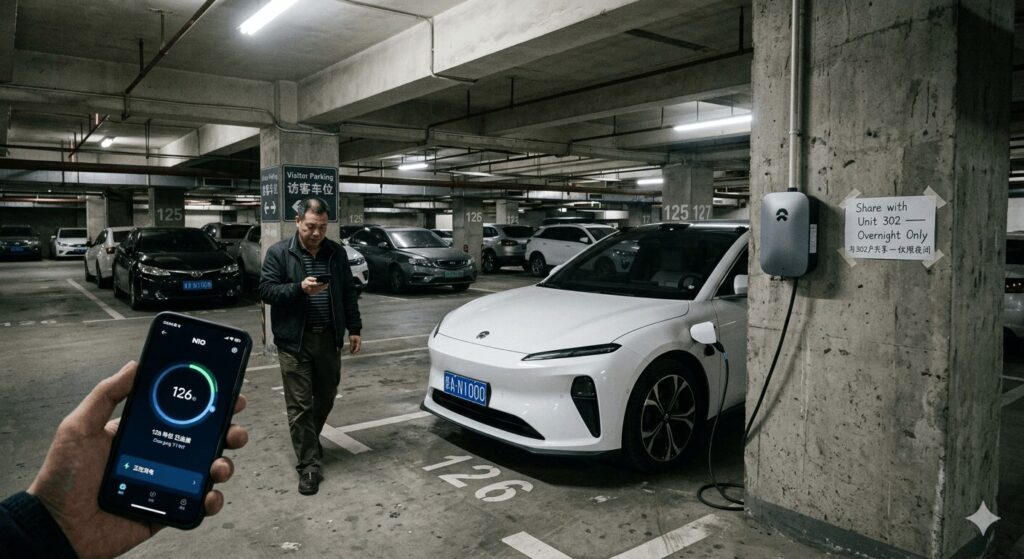
But a significant proportion of Chinese EV owners do not have a designated parking space. They park on the street outside their 老破小 apartment in an inner-city hutong area. They rotate through shared visitor spaces in their compound. They park in a public car park 200 metres from their building that they pay for monthly. They live in a rural township where their property has space for a car but no dedicated electrical supply to that space. They rent a shared underground space from a neighbour who won’t allow permanent installation.
The standard home EV charging guide does not serve these owners. And they are not a small minority — in China’s oldest urban residential areas, in rural townships, and in the significant proportion of residential developments where parking is shared rather than individually assigned, the “designated parking space” assumption fails completely.
This guide on urban parking vs rural garages how Chinese homeowners install EV chargers without a fixed spot addresses the complete landscape of alternative Chinese home EV charging solutions — every creative, practical, legally compliant approach available to Chinese EV owners who cannot follow the standard installation path. Some of these solutions are good. Some are better than the standard installation path in specific scenarios. Some are pragmatic compromises. All are honest.
Understanding the No-Fixed-Spot Problem in China’s Urban Landscape
Before covering solutions, understanding why the no-fixed-spot problem is so prevalent in China’s urban residential environment prevents false assumptions about who this guide serves.
The Chinese Urban Parking Deficit
China’s urban housing stock contains two distinct generations of residential development:
Pre-2000 residential stock (老旧小区 — old residential compounds): The majority of Beijing, Shanghai, and other major city housing built before 2000 was constructed without sufficient parking provision for the vehicle ownership rates that followed China’s economic growth. A residential compound built in 1985 for 200 households may have parking for 30-40 vehicles — leaving 160 households with no designated parking. These residents park on streets, in adjacent public car parks, or in time-sharing arrangements with the limited designated space owners.
The scale of this problem in Beijing alone: Beijing’s housing authority estimates approximately 40% of households in inner-city districts lack designated parking. These are overwhelmingly the older hutong-adjacent and ring-road apartment districts where EV adoption rates are also increasing as younger professional residents purchase vehicles.
Post-2000 residential stock: Modern Chinese residential developments include parking ratios of 1:1 or higher (one space per household as a minimum). These residents have designated parking and the standard home charging path applies. Most EV charging guides assume this majority scenario.
The growing middle scenario: A significant cohort of Chinese EV owners purchased parking spaces after building construction — some purchased spaces in their own compound, some in adjacent car parks, some arranged long-term leases in nearby public facilities. These arrangements create variable charging rights depending on the specific legal nature of the parking arrangement.
The Rural Non-Fixed-Spot Reality
Rural China’s no-fixed-spot problem is different from urban China’s but equally real:
Self-built rural housing (自建房): Rural residents who own their land and home typically park wherever is convenient on their property — in the yard, beside the house, under a simple roof structure. There is no “designated parking space” because there is no parking management infrastructure. The home charger installation has no space-based permission requirement — but the electrical supply to the parking position may not exist and must be created.
Township rental housing: Township residents who rent rather than own their accommodation face the same charging access issues as urban renters — potentially more acute because township property management is even less structured than urban 物业.
Solution Category 1: Shared Parking and Time-Share Arrangements
What It Is
For urban residents without designated parking, shared parking arrangements with designated space owners in their compound or building represent the most proximate solution — physically close to the resident’s home, potentially connectable to building electrical infrastructure.
The Time-Share Charging Arrangement
How it works: A resident without a designated parking space negotiates with a space owner who has both a parking space and is willing to allow installation of a shared home charger. The arrangement typically involves:
- The EV owner funds the charger installation and pays for ongoing electricity
- The space owner allows use of their space for overnight parking and charging (typically 10pm-8am when they don’t need the space)
- The space owner receives either reduced parking fees or a fixed monthly payment in exchange for the arrangement
The legal structure: This arrangement has no formal legal recognition in Chinese property law — it is a private commercial agreement between two residents. The risks:
- Space owner can terminate the arrangement with limited notice
- 物业 may question a charger installation on a space owned by someone else but used by another resident
- If the space owner sells their space, the arrangement may not survive the ownership transfer
The practical reality: These arrangements are common in Chinese residential compounds — particularly in compounds where EV adoption is high among residents and parking is constrained. They are informal, relationship-dependent, and fragile. But they work for the time they work.
Structuring for maximum stability:
- Sign a written agreement (even a simple WeChat message confirmation creates a record)
- Register the charger in the space owner’s name with 物业 (easier 物业 approval as it looks like a standard installation)
- Agree on a minimum notice period for termination (6-12 months is reasonable)
- Include provisions for charger removal and cost reimbursement if arrangement ends
The Collective Parking Charging Application
A stronger alternative to individual time-share:
In compounds where multiple residents without designated parking face the same challenge, a collective application to the 物业 for shared EV charging points in visitor or unallocated parking areas creates a more stable solution:
How to propose this to 物业:
- Survey other EV-owning residents without designated parking in the compound — identify 5-10 interested parties
- Draft a collective application to 物业 proposing shared AC charging points (7 kW each) in the compound’s visitor parking or unallocated ground-level areas
- Reference local government guidance on residential compound collective charging infrastructure
- Propose a cost-sharing arrangement — each resident contributes to installation costs
Why 物业 may accept this: Collective charging infrastructure managed through third-party operators (TELD, StarCharge) generates revenue for the operator and potentially for the compound through revenue-sharing. This financial incentive — the compound earns money from charging fees — is a powerful motivation for 物业 cooperation that individual installation requests lack.
Solution Category 2: Public Car Park Monthly Subscription Charging
What It Is
Chinese public car parks — particularly those operated by professional operators like 中汽协 (CAAM) affiliated companies, CBRE-managed commercial parking, and municipal parking authorities — increasingly offer monthly subscription EV charging arrangements.
How Monthly Subscription Charging Works
The subscription structure: Monthly parking subscription + EV charging add-on. Typical offerings:
- Monthly parking fee: ¥300-¥800/month (urban tier-1 city rates)
- EV charging add-on: ¥100-¥200/month for unlimited overnight AC charging (typically 7pm-7am charging access)
- Or: ¥0 charging add-on with per-kWh billing (¥0.80-¥1.20/kWh)
The financial comparison with home TOU installation:
Home TOU installation (if available): Annual electricity: 4,073 kWh × ¥0.34 = ¥1,385/year
Public car park monthly subscription charging (¥150/month unlimited): Annual cost: ¥150 × 12 = ¥1,800/year
Public car park per-kWh (¥1.00/kWh): Annual cost: 4,073 kWh × ¥1.00 = ¥4,073/year
The monthly subscription unlimited plan is 30% more expensive than home TOU annually — but avoids the ¥3,000-¥5,000 installation investment. For residents in temporary accommodation or with uncertain tenure, the subscription model may be financially optimal despite the higher annual cost.
For long-term residents who cannot install home charging: The cumulative cost difference over 5 years:
- Home TOU installation: ¥2,699 (initial) + ¥6,925 (5yr electricity) = ¥9,624
- Monthly subscription unlimited: ¥1,800/year × 5 = ¥9,000
The subscription is actually cheaper than home installation over 5 years for residents who cannot access TOU valley rates. This is a genuinely important finding that contradicts the reflex recommendation of “always install home charging.”
Finding Monthly EV Charging Subscriptions in Chinese Cities
In Beijing: Look for car parks operated by:
- 首都停车 (Capital Parking) — Beijing’s largest public parking operator, offers EV monthly plans
- 北京停车场 (Beijing Parking) municipal facilities
- Commercial property car parks adjacent to residential areas
Search: “月租充电 [your district]” (monthly charging [your district]) on 大众点评 or 高德地图
In Shanghai:
- 上海城投停车 (Shanghai Urban Investment Parking)
- CBRE-managed commercial car parks
- 宜停车 (Easy Parking) app — aggregates monthly EV charging subscriptions across Shanghai
In Chengdu, Wuhan, and other tier-2 cities: Public car park operators increasingly offer monthly EV charging plans as EV adoption increases. Search the 高德地图 charging station layer filtered by “月租” or ask directly at nearby car parks.
Solution Category 3: Employer Workplace Charging
What It Is
For EV owners without home charging access, employer workplace charging is the closest functional equivalent — charging the vehicle during working hours at the employer’s premises.
How Workplace Charging Works in China
The growing Chinese workplace charging landscape:
China’s major technology and finance employers in tier-1 cities have installed workplace EV charging facilities at scale:
- Alibaba (Hangzhou): 2,000+ workplace charging points across campus
- Tencent (Shenzhen): extensive workplace charging at headquarters and secondary offices
- Huawei (Shenzhen): significant workplace charging infrastructure
- Government office parks: increasingly mandated to provide staff EV charging
For employees at these organisations: Workplace charging at standard AC rates (often subsidised or free as employee benefit) provides daily energy replenishment equivalent to home charging — particularly for employees who work regular hours and can leave the vehicle plugged in during the working day.
For employees at smaller organisations: Smaller employers may not have dedicated charging infrastructure. In this case, employees can:
- Propose a charging installation to their employer — framing as a staff benefit that reduces operating costs for company vehicles and improves employee retention
- Apply for use of any existing socket access at the workplace for temporary vehicle charging (with employer permission)
- Investigate whether the employer’s building management has collective charging infrastructure available to staff
The Workplace Charging Financial Model
Cost to employee: Many large Chinese employers offer free workplace EV charging as a staff benefit — particularly technology companies competing for talent. For employees with access to free workplace charging, daily commuting energy costs approach zero.
Cost comparison:
- Free workplace charging: ¥0/year for daily commuting energy
- Home TOU charging equivalent: ¥890-¥1,700/year depending on mileage
Free workplace charging is unambiguously superior to home charging if available. It should be the first investigation for any Chinese EV owner without home charging access.
Solution Category 4: Destination Charging Strategy
What It Is
For Chinese EV owners without any home or workplace charging, a destination charging strategy — charging at supermarkets, shopping centres, restaurants, and other destinations visited during daily routines — substitutes for dedicated home charging.
How Destination Charging Works
China’s retail and commercial charging infrastructure:
Major Chinese retail chains and commercial operators have installed significant EV charging infrastructure as customer amenity:
- 盒马鲜生 (Hema Supermarket): Alibaba’s fresh food chain — most locations have 7 kW AC charging bays
- 大润发 (RT-Mart): Hypermarket chain with AC charging at major locations
- 宜家 (IKEA China): All major Chinese IKEA stores have EV charging
- 万达广场 (Wanda Plaza): Commercial property with EV charging across 300+ malls
- 龙湖天街 (Longfor Tianjie): Premium mall operator with charging at most locations
The destination charging calculation: Shopping session duration: 1-3 hours At 7 kW AC: 7-21 kWh added per shopping session Typical weekly shopping session: 1-2 times per week
For a driver consuming 300 kWh/month:
- Weekly 2-session destination charging: 2 × 14 kWh = 28 kWh/week = 112 kWh/month
- Remaining energy need: 300 – 112 = 188 kWh from other sources
Destination charging covers approximately 37% of typical monthly energy needs — not complete, but a meaningful contribution that reduces reliance on public DC fast charging at premium rates.
Cost of destination charging: Most Chinese retail destination charging is at AC rates:
- Free (customer amenity at some retailers): ¥0
- Service fee only: ¥0.30-¥0.50/kWh service fee (no electricity charge at some locations)
- Standard rate: ¥0.60-¥1.00/kWh
Even at ¥1.00/kWh, destination AC charging costs significantly less than public DC fast charging at ¥1.40-¥2.50/kWh.
Solution Category 5: Street-Level Community Charging
What It Is
In Chinese hutong areas, old residential compounds, and rural township streets, community-level EV charging poles (路边充电桩) are being deployed by municipal governments, state-owned enterprises, and community organisations.
Beijing’s Street Charging Initiative (路侧充电)
Beijing municipal government has deployed street-level charging poles (路侧充电桩) along residential streets in inner-city districts where parking is on-street and home installation is impossible. These poles serve residents who park on the street adjacent to their homes.
How they work:
- AC charging poles at 3.5-7 kW installed at street-level intervals
- Accessible via StarCharge, TELD, or municipal app
- Charging started and paid via QR code scan
- Typical rate: ¥0.60-¥0.90/kWh
- Overnight parking + charging available
Availability: Currently deployed in:
- Beijing’s Dongcheng, Xicheng, and Chaoyang hutong areas
- Shanghai’s former French Concession and Jing’an residential streets (pilot)
- Expanding to other major city districts as part of urban EV charging densification plans
The street charging limitation: Street-level charging poles are not guaranteed to be available when you arrive — other vehicles may be using them. The space may be occupied by non-EV vehicles (a persistent problem in Chinese street charging that municipal authorities address with parking enforcement but cannot eliminate). For urban residents who depend on street charging, having a backup public DC fast charging station identified is essential.
Solution Category 6: The Rural Property Solution — Creating Charging Infrastructure Where None Exists
What It Is
For rural Chinese EV owners whose property has space for a vehicle but no electrical supply to that space, the solution is creating new electrical infrastructure — running supply from the existing household meter to the vehicle’s parking position.
The Rural Extension Solution
The typical rural charging scenario without existing supply:
A village household has mains electricity connected to the house — 220V single-phase entering through a meter on the wall. The vehicle parks 15 metres away in a yard or beside an outbuilding. No electrical supply exists in the yard.
The solution: simple cable extension from household supply to yard position
Step 1: Assess load capacity of existing household circuit Chinese rural residential meters are typically rated 40A-60A. At 40A with typical household loads of 10-15A during charging hours (evening), available capacity for EV charging is 25-30A — sufficient for 7 kW charging at 32A (tight) or safer at 16A (3.5 kW).
Step 2: Dedicated circuit or extension? The ideal approach — a dedicated circuit from the meter to the charging position with its own circuit breaker — requires a licensed electrician and potentially a meter upgrade. Cost: ¥500-¥1,500 for a simple 15-metre run.
The pragmatic approach — a properly rated heavy-duty extension from an existing outdoor socket to the vehicle position — is technically simpler but carries the sustained-load safety concerns discussed in our safety guide. A 2.5mm² cable rated for 16A continuous use, properly secured and protected, is safer than a standard domestic extension cord but below the standard of a dedicated circuit.
Recommendation for rural extension installations: Invest in the dedicated circuit. The ¥500-¥1,500 cost for a proper dedicated circuit installation is the correct decision — the safety margin over a heavy-duty extension is significant for 6-8 hour overnight charging.
Step 3: Voltage tolerance charger selection Rural grid voltage fluctuation means charger voltage input tolerance is important. Specify a charger with 180V-264V input range rather than standard 220V ±10% for rural installations where voltage may dip during peak agricultural demand periods.
Step 4: TOU scheduling consideration Rural TOU availability varies by province. If TOU pricing is not available at the rural supply bureau level, use the vehicle’s built-in timer to delay charging to lower-demand overnight periods — rural grids experience lower overall load overnight even if formal TOU pricing is not implemented.
Rural Outbuilding Conversion
For rural households with existing outbuildings (农用仓库, 杂货间) near the vehicle’s parking position, converting an outbuilding into a combined storage and EV charging space provides:
- Weatherproof protection for the charger (eliminates need for IP65 outdoor rating — IP54 adequate in enclosed outbuilding)
- Cable security and theft protection
- Vehicle protection from weather during charging
- Simplified electrical installation (running supply into an enclosed building is simpler and lower cost than outdoor conduit installation)
The outbuilding conversion cost:
- Electrical supply to outbuilding (if not existing): ¥300-¥800
- Charger installation inside outbuilding: ¥500-¥1,000
- Total: ¥800-¥1,800 — significantly lower than urban standard installations
Solution Category 7: Mobile/Portable EV Charging Solutions for the No-Fixed-Spot Owner
What It Is
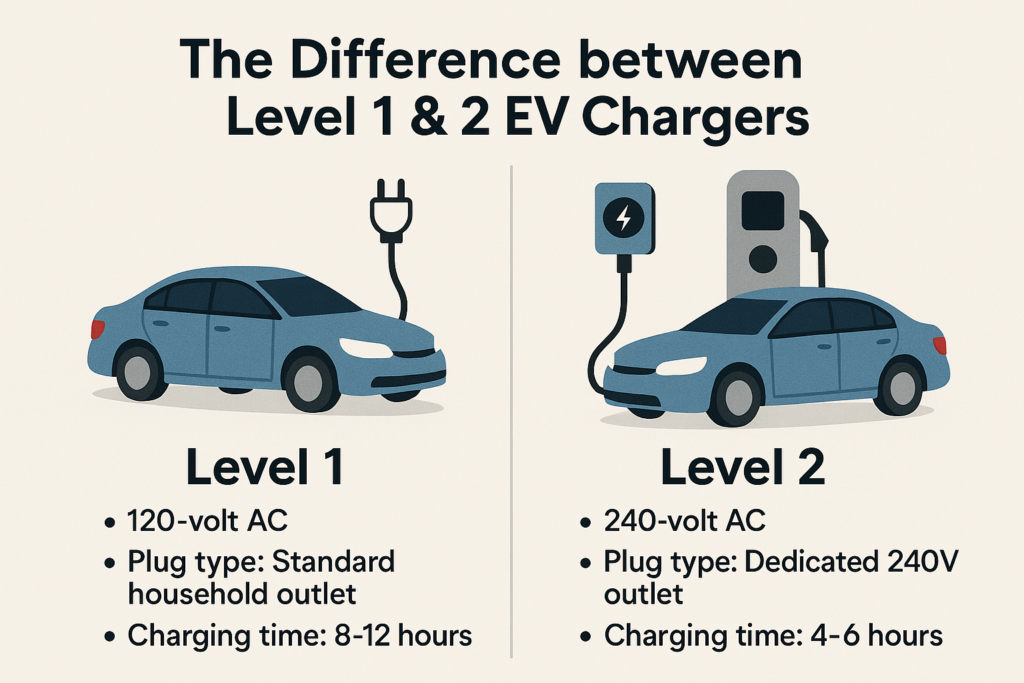
For Chinese EV owners who move between multiple parking locations — street parking, employer car park, friend/family property — a high-quality portable EVSE that connects to whatever electrical socket is available at each location provides maximum flexibility.
The Complete Portable Charging Kit
The four-socket portable kit:
A serious portable charging kit for Chinese EV owners without fixed parking consists of:
Component 1: High-quality Mode 3 portable EVSE with multiple socket options
- Base unit with GB/T Type 2 cable
- Interchangeable plug heads: 10A standard (2.2 kW), 16A standard (3.5 kW), 32A commando (7 kW)
- Built-in RCCB protection
- IP55 weather protection
- Product: BESEN Smart Portable EVSE with interchangeable plugs (¥600-¥900)
Component 2: Commando socket adapters
- 32A commando to standard 220V socket (for slower charging when only standard socket available)
- 32A commando to 16A socket adapter
- Carried in vehicle — enables charging from the widest range of available sockets
Component 3: Cable storage solution A properly designed cable reel or storage bag for the portable EVSE — loose cable in the boot degrades faster than properly stored cable and creates connection issues.
Component 4: Socket assessment tool A simple socket tester (¥30-¥50) that confirms a socket is properly earthed and safe before connecting the vehicle. Critical for rural or unfamiliar socket use.
Total kit cost: ¥700-¥1,000
Portable Charging Speed Comparison
| Socket Type | Current | Speed | 50 km replacement |
|---|---|---|---|
| Standard 10A socket | 10A | 2.2 kW | 4.1 hours |
| Standard 16A socket | 16A | 3.5 kW | 2.6 hours |
| 32A commando | 32A | 7 kW | 1.3 hours |
| 3-phase commando | 32A/phase | 11 kW | 0.8 hours |
The versatility advantage of the portable kit: At the employer’s premises with a 32A industrial socket: 7 kW charging. At a friend’s house with a standard socket: 2.2 kW charging. At a rural relative’s property with a 16A cooker socket: 3.5 kW charging. The portable kit with interchangeable plugs extracts maximum charging speed from whatever electrical supply is available.
Solution Category 8: The Creative Chinese EV Owner — Real-World Solutions
This section documents real-world solutions that Chinese EV owners without fixed parking have developed and shared in owner communities — practical, creative approaches that stretch beyond the standard guide.
Solution A: The Landlord Partnership Deal
The situation: Urban renter in a Chinese 老旧小区 with no designated parking and a landlord who owns a street-level parking space in the compound’s car park.
The solution: The tenant proposes to the landlord: “I’ll pay for and install a smart charger on your parking space. I’ll pay for all electricity separately with a sub-meter. When I move out, the charger stays — adding value to your property. In exchange, I want to park in your space overnight at a reduced monthly fee.”
Why this works: The landlord gets a free property improvement (charger installation adds ¥3,000-¥5,000 in property value to the parking space), reduced installation cost, and a reliable tenant who is financially invested in the space. The tenant gets overnight home charging equivalent at below-market parking rates.
The tenant protection: A written agreement specifying minimum notice period (12 months recommended) before the arrangement can be terminated.
Solution B: The Split-Use Space
The situation: An urban owner who has a designated parking space in their compound but shares it with a family member’s vehicle — two cars, one space.
The creative approach: Install the charger on the designated space. Both vehicles use the space on a time-share basis — the EV occupies the space overnight for charging, the other vehicle occupies it during the day.
This requires: Coordination between household members, a scheduled sharing arrangement, and a charger installation that the space genuinely supports.
The benefit: Both vehicles share the charger infrastructure costs while the EV gets overnight charging access.
Solution C: The Neighbour Network
The situation: An urban resident in a compound where 3-4 neighbours have designated parking spaces but none of the spaces has yet had a charger installed.
The creative approach: Organise a collective installation — one electrician visit installs chargers on 3-4 spaces simultaneously, reducing per-charger installation cost through shared mobilisation and shared conduit routing.
The collective installation saving: Individual installation: ¥1,700 per charger Collective installation (4 chargers, shared conduit): approximately ¥1,200 per charger Saving: ¥500 per charger × 4 = ¥2,000 total saving for the group
This approach also typically simplifies 物业 approval — a single application for 4 chargers on known space owners is processed more efficiently than 4 separate applications.
Solution D: The Pre-Purchase Charging Audit
The situation: A Chinese consumer evaluating which new EV to purchase, aware that home charging access is uncertain.
The creative approach: Conduct a charging audit before purchasing the vehicle rather than after:
- Investigate workplace charging availability — is it free, available at what speed, is a space reservation system needed?
- Map destination charging on typical weekly routes — are there AC charging points within walking distance of regularly visited locations?
- Assess public DC fast charging proximity — how far is the nearest 120 kW+ station from home?
- Evaluate vehicle-specific charging dependency — does the target vehicle have sufficient DC fast charging speed to make public charging practical if home charging isn’t available?
The vehicle choice implication: For a Chinese EV owner with no home charging access, a vehicle with fast DC charging capability — BYD Seal (150 kW), Xpeng G9 (300 kW+), Zeekr 001 (400 kW) — is significantly more practical than a vehicle with slow DC charging (BYD Han EV standard: 80 kW, Wuling Mini EV: no DC). A 10-minute DC fast charge that replaces 100 km of range changes the public charging dependence calculation completely.
Solution E: The Rural Cooperative Charging Point
The situation: A rural village where 5-8 households have purchased EVs within the past 2 years, all without home charging. The village has limited electrical infrastructure.
The creative approach: Propose a village cooperative charging point to the village committee (村委会):
- 2-4 AC charging points installed at a central village location (near the village committee building, community centre, or main gathering area)
- Funded through a combination of household contributions (¥200-¥500/household) and village collective funds
- Managed through a simple QR code payment system (星星充电 or 特来电 small-operator programme)
Why this works at the village level: The village committee has authority to add electrical load to the village distribution transformer more straightforwardly than individual household additions. A cooperative installation serves multiple households without requiring individual meter applications from each. And the shared infrastructure creates community goodwill that individual charging solutions do not.
Finding operator support for rural cooperative charging: Both TELD (特来电) and StarCharge (星星充电) have small-community operator programmes that provide equipment, installation support, and payment infrastructure for rural collective charging installations. Contact their business development departments for rural cooperative charging enquiries.
The Financial Comparison of All Solutions
| Solution | Upfront Cost | Annual Operating Cost | 5yr Total | TOU Access | Reliability |
|---|---|---|---|---|---|
| Home installation (if available) | ¥2,699 | ¥1,385 | ¥9,624 | ✅ Full | Excellent |
| Monthly subscription (unlimited) | ¥0 | ¥1,800 | ¥9,000 | ⚠️ Partial | Good |
| Time-share with neighbour | ¥1,500-¥2,500 | ¥1,385 | ¥8,310-9,310 | ✅ Full | Variable |
| Public DC fast charging | ¥0 | ¥7,000+ | ¥35,000+ | ❌ No | Good |
| Workplace charging (free) | ¥0 | ¥0 | ¥0 | N/A | Good |
| Destination AC charging | ¥0 | ¥2,000-¥3,000 | ¥10,000-15,000 | ❌ No | Variable |
| Street charging (Beijing) | ¥0 | ¥2,500-¥3,500 | ¥12,500-17,500 | ❌ No | Variable |
| Portable kit (versatile) | ¥800 | ¥2,000-¥4,000 | ¥10,800-20,800 | Via car timer | Good |
| Rural extension installation | ¥800-¥1,800 | ¥1,385 | ¥7,725-8,725 | Via car timer | Good |
| Cooperative village charging | ¥200-¥500 | ¥2,000-¥3,000 | ¥10,200-15,500 | ❌ No | Moderate |
The critical financial finding: The two most expensive long-term approaches — public DC fast charging only (¥35,000+ over 5 years) and destination AC charging without home supplement (¥10,000-¥15,000 over 5 years) — are significantly more expensive than every home-based alternative. This reinforces the importance of securing some form of home-equivalent charging even when the standard installation path is unavailable.
Free workplace charging eliminates EV charging cost entirely — worth significant effort to secure.
The Decision Framework — Which Solution for Your Situation
Step 1: Is Free or Heavily Subsidised Workplace Charging Available?
Yes: This is your primary charging solution. Supplement with destination AC charging for non-working days. No home installation required.
No: Proceed to Step 2.
Step 2: Do You Have Any Fixed or Semi-Fixed Parking Access?
Yes — designated space, owned or long-term lease: Standard home installation path — see our find the right EV charger for your home China edition guide.
Yes — but rented from someone else: Negotiate a charger installation arrangement with the space owner. Written agreement, minimum 12 months’ notice, charger remains on termination.
Yes — shared space with other vehicles: Explore collective installation for shared cost. Charger on a timer to prevent blocking shared space access during peak hours.
No fixed parking: Proceed to Step 3.
Step 3: Are You in an Urban or Rural Setting?
Urban (tier-1 or tier-2 city): Priority sequence:
- Apply for community/collective charging in compound visitor parking
- Investigate monthly subscription AC charging at nearby public car park
- Map destination AC charging points on regular routes
- Supplement with public DC fast charging for convenience
Rural or township: Priority sequence:
- Create dedicated circuit from household supply to parking position
- Rural cooperative charging through village committee if individual supply is inadequate
- Use portable EVSE with interchangeable plugs for maximum charging flexibility
- Identify nearest public DC fast charging and plan routes accordingly
Step 4: What Vehicle Type Do You Drive?
Pure BEV with fast DC charging (BYD Seal 150 kW, Zeekr 001 400 kW, Xpeng G9 300 kW+): Public DC fast charging as a supplement to destination AC charging is more viable — a 15-minute charge replaces meaningful range.
Pure BEV with slow DC charging (Han EV Standard 80 kW, older BEV models): Home-equivalent charging is more important — a 45-60 minute DC fast charging stop is more disruptive than a 15-minute stop. Prioritise monthly subscription or time-share solutions.
EREV or PHEV (Li Auto, BYD DM-i series): Petrol backup eliminates range anxiety. Lower home charging urgency — destination charging and public AC charging adequately supplement petrol operation without requiring home-equivalent installation.
Micro EV (Wuling Mini EV): Standard socket at home, workplace, or friend/family property is adequate — the 2.2 kW charging speed that limits large-battery vehicles is proportionate to the Mini EV’s 9.2-13.8 kWh battery.
What Not to Do — The Common Mistakes
Mistake 1: Buying a Vehicle Before Auditing Charging Access
The most expensive mistake. Purchasing a large-battery pure BEV with slow DC charging speed (Han EV Standard: 80 kW) without confirming home charging access, then discovering that every public charging session is 45-60 minutes at ¥1.40/kWh.
Prevention: Complete the charging audit (Solution D above) before signing the vehicle purchase contract. If home charging is not accessible, consider EREV or vehicles with fast DC charging rates.
Mistake 2: Using a Standard Extension Cord for Sustained EV Charging
Covered in our safety guide and worth repeating here: standard domestic extension cords are not rated for 6-8 hours of sustained 10A+ current draw. Rural owners without fixed electrical supply are specifically at risk of this mistake.
Prevention: If temporary socket-based charging is unavoidable, use a proper Mode 3 EVSE with built-in RCCB protection. Never use a standard domestic extension cord or power strip.
Mistake 3: Assuming Monthly Car Park Subscription Includes Overnight Charging Access
Some monthly subscription car park arrangements restrict charging to business hours — the subscription is for daytime vehicle storage with daytime charging access. Overnight parking with overnight charging is a separate and more expensive arrangement.
Prevention: Confirm specifically that overnight parking with overnight charging (11pm-7am TOU window access) is included in the subscription package before signing.
Mistake 4: Neglecting the Vehicle’s Built-In Timer
For any owner using socket-based charging — whether standard 220V or 32A commando — the vehicle’s built-in charging timer is the TOU scheduling substitute that requires no charger investment. Most Chinese EVs (BYD, NIO, Xpeng, Tesla China, Li Auto) have built-in timers accessible through the vehicle app. Setting the timer for 11pm start captures full valley rate savings without a smart charger.
Annual TOU saving available through car timer: ¥1,200-¥1,700/year — identical to using a dedicated smart charger’s TOU scheduling for the same charging speed.
Internal Links — Further Reading on Clean Energy Bazaar
The urban parking vs rural garages how Chinese homeowners install EV chargers without a fixed spot guide is the creative solutions companion to the standard installation guides in the Chinese market content cluster.
For the standard home charger installation guide that applies when a designated parking space is available, our find the right EV charger for your home China edition guide covers the complete standard installation path. For the apartment EV charging rights guide covering how to advocate for designated space or collective charging in your compound, our apartment EV charging solutions 2026 China HOA rules property manager permissions and fixed parking rights guide covers every regulatory right. For the portable vs hardwired comparison covering portable EVSE options for the versatile charging kit, our portable vs hardwired home EV chargers best options for Chinese apartment dwellers guide covers every portable solution. For the tier 1 vs tier 2 vs rural geographic context that shapes which solutions apply to different Chinese locations, our tier 1 vs tier 2 city charging solutions for Beijing high-rises vs Chengdu villas vs rural villages guide covers every location. For the budget charger options relevant to rural extension and cooperative installations, our best budget EV chargers under ¥2,000 2026 Chinese options that actually work guide covers affordable certified options. And for the safety certification guide ensuring all solutions use certified hardware regardless of the creative installation approach, our 3C certification and EV chargers 2026 why buying non-certified chargers is dangerous in China guide covers non-negotiable safety requirements.
Final Thoughts
The urban parking vs rural garages how Chinese homeowners install EV chargers without a fixed spot landscape in China in 2026 is more creative and more viable than most standard charging guides suggest.
The no-fixed-spot problem is real and affects a significant proportion of Chinese EV owners. But it is not the dead end that “get a designated space first” advice implies. The solutions available cover a wide range of scenarios, cost levels, and technical requirements.
The hierarchy of solutions for Chinese EV owners without fixed parking:
- Free workplace charging — where available, the financial and practical optimum. Zero annual cost.
- Time-share with space owner / landlord partnership — creates home-equivalent charging at near-home-installation cost with appropriate written agreements.
- Monthly subscription car park charging — competitive with home installation over 5 years for residents without TOU access. Particularly appropriate for uncertain tenure situations.
- Rural extension installation — creates home-equivalent charging at lowest total installation cost for rural self-built housing owners. Simpler than urban apartment installation.
- Destination AC charging + public DC supplement — viable for high-DC-speed vehicles where a 15-minute public charge is genuinely quick.
- Collective compound or village cooperative — creates community charging infrastructure that serves multiple owners simultaneously.
- Portable versatile EVSE kit — maximum flexibility for mobile lifestyles, multiple parking locations, and uncertain living situations.
The financial analysis consistently shows that public DC-only charging is the most expensive long-term approach — ¥35,000 over 5 years versus ¥9,000-¥10,000 for monthly subscription or time-share solutions. Any solution that creates home-equivalent or destination-level charging access is financially superior to DC-only dependence.
The vehicle choice matters too. An EV owner without home charging should prioritise vehicles with fast DC charging capability — a 15-minute charge replaces meaningful range and makes public charging less disruptive than a 45-minute charge on a vehicle with slow DC capability.
Most importantly: use the vehicle’s built-in charging timer. Whether charging from a standard socket at a time-share space, a monthly subscription car park, or a rural extension installation — the timer that delays charging until 11pm is available on almost every modern Chinese EV and captures the same TOU savings as a smart charger’s automatic scheduling. It costs nothing and saves ¥1,200-¥1,700/year.
The no-fixed-spot situation is a constraint, not an obstacle. Work the creative solutions. Use the timer. The EV ownership economics work even without the standard installation.