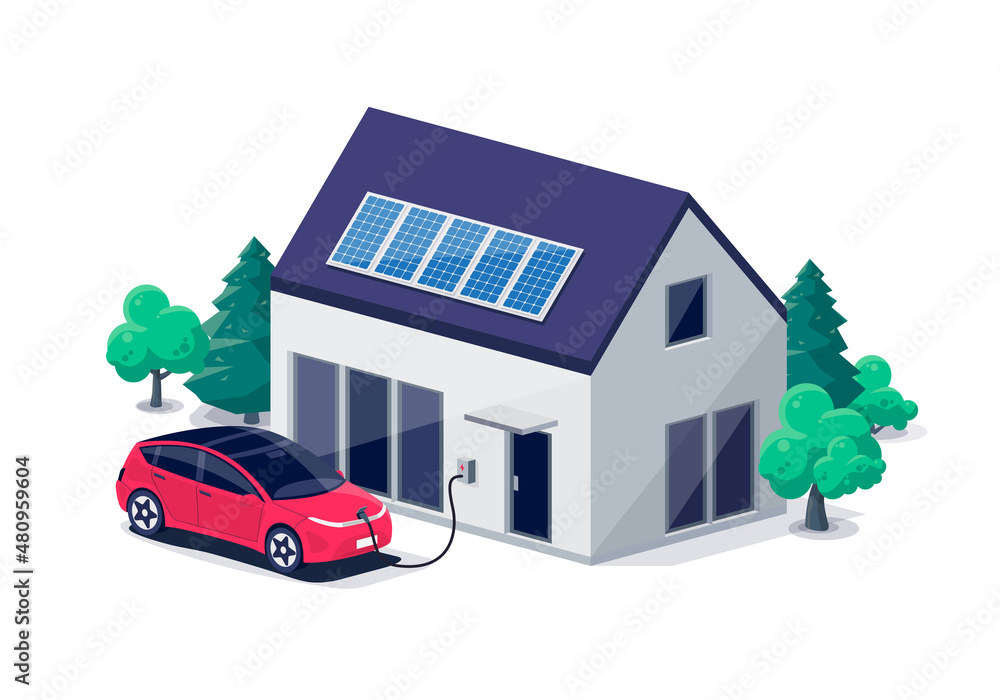
Here is the situation that awaits a significant proportion of Porsche Taycan, BMW i5, and Mercedes EQE buyers in China after taking delivery.
The vehicle cost ¥600,000 to ¥1,500,000. It was delivered to a villa compound in Pudong, a high-end apartment in Beijing’s Chaoyang district, or a private residence in Shenzhen’s Nanshan. The owner has a designated parking space — almost certainly owned rather than leased, in a premium compound with well-managed 物业, and with above-average electrical infrastructure.
They go to configure their home charging setup. And they discover that the home charging question for a Porsche Taycan China-spec is not straightforward in the way that a BYD Han EV’s home charging question is straightforward.
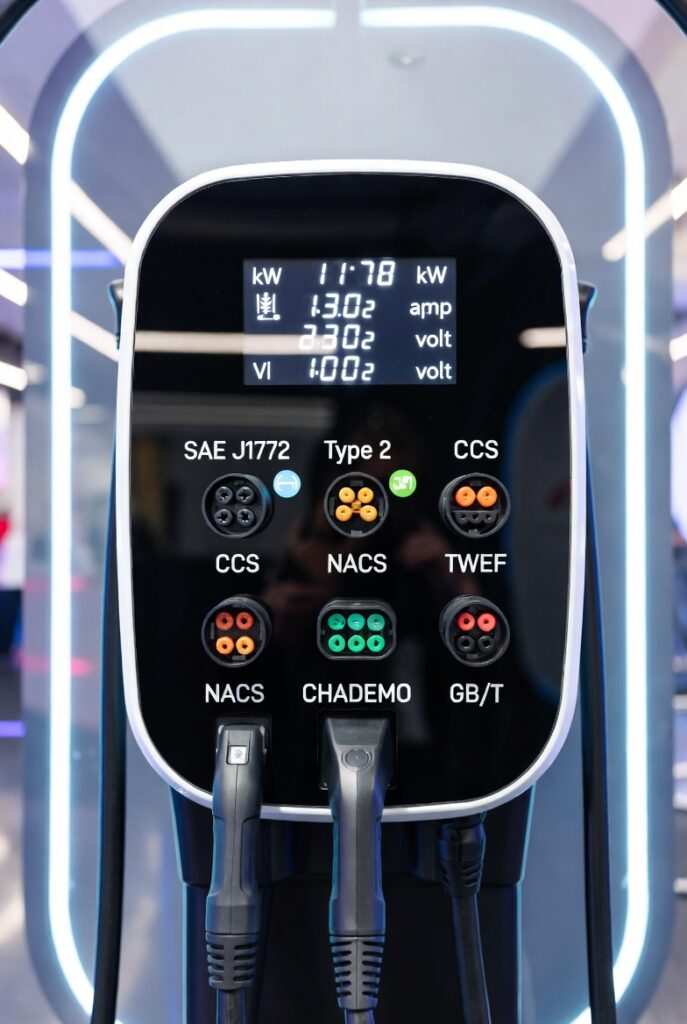
The Taycan’s China-spec GB/T connector is compatible with all Chinese charging infrastructure — but the vehicle’s 11 kW AC maximum means three-phase supply determines whether home charging reaches the vehicle’s full AC capability. The BMW i5’s 11 kW three-phase capability and the Mercedes EQE’s 11 kW three-phase specification create the same question. And beneath the technical question is a taste and positioning question that applies specifically to this market segment: for owners who have invested ¥600,000-¥1,500,000 in a vehicle, what does the home charging setup look like? A ¥1,299 Autel box on the villa wall? Or something that matches the vehicle’s positioning?
This guide on luxury EV charging 2026 Porsche Taycan BMW i5 Mercedes EQE best home solutions for China’s 1 percent covers the complete picture — the specific charging specifications of China’s three most significant luxury EVs, the correct technical home charging setup for each, the premium charger options that match the ownership experience, and the honest analysis of whether luxury home charging hardware is worth the investment beyond its technical function.
Understanding China’s Luxury EV Market — Who These Owners Are
Before recommending specific chargers, understanding the specific characteristics of China’s luxury EV ownership context shapes every recommendation in this guide.
The Chinese Luxury EV Owner Profile
Residential context: The majority of Porsche Taycan, BMW i5, and Mercedes EQE buyers in China live in one of three residential contexts:
Villa compound (别墅小区): Detached or semi-detached properties in premium gated compounds. Typically three-phase electrical supply available. Private garage or dedicated covered parking. Premium 物业 management. This is the most common residential context for Porsche Taycan buyers specifically.
Premium high-rise apartment (高端住宅): Luxury apartment buildings with above-average electrical infrastructure. More likely than standard residential buildings to have three-phase supply to parking spaces. Premium 物业 with experience handling complex resident requests. Common for BMW i5 and Mercedes EQE buyers in tier-1 cities.
Private residence or courtyard house (独栋住宅/四合院): Individual private properties with direct utility connection — typically the most flexible electrical infrastructure of any residential type.
The electrical infrastructure advantage: China’s premium residential compounds have significantly better electrical infrastructure than standard residential developments. Three-phase supply to individual parking spaces — rare in standard Chinese apartment compounds — is more commonly available in villa compounds and premium high-rise developments. This changes the charging speed calculation materially compared to standard residential contexts.
The Positioning Reality — What Home Charging Looks Like at This Ownership Level
In the European and US luxury EV market, premium home charging hardware is an established product category. A Porsche Taycan delivered to a German buyer’s home typically comes with a Porsche-branded home charger as part of the delivery package. ABB, Wallbox Commander, and similar premium products have established visual identities in the European garage context.
China’s premium home EV charging market is developing but less visually established. The default options — StarCharge S1 in a plastic box, even the Autel MaxiCharger — are functional products designed for the mass residential market. They serve their purpose but do not communicate premium positioning.
For Chinese luxury EV owners who care about the aesthetic and experiential coherence of their home charging setup, this creates a genuine gap — and a market that is beginning to be filled by premium international charger brands entering China and by domestic brands developing aesthetically positioned products.
This guide addresses both the technical specifications and the positioning dimension of luxury home EV charging in China.
Vehicle Technical Specifications — China-Spec Details
Porsche Taycan (China-Spec)
The critical China-spec distinction: Porsche Taycan vehicles sold in China are manufactured with GB/T connectors rather than the CCS2 connectors on European and US models. This is mandatory for all EVs sold in China’s domestic market — Porsche’s decision to conform to Chinese standards rather than seeking an exemption means China-spec Taycans integrate fully with Chinese charging infrastructure.
Porsche Taycan 4S (China-spec):
- Battery: 79.2 kWh (Performance Battery Plus)
- Architecture: 800V
- AC charging: 11 kW (three-phase, GB/T)
- DC fast charging: 270 kW (GB/T DC)
- CLTC range: 598 km
Porsche Taycan Turbo (China-spec):
- Battery: 93.4 kWh
- Architecture: 800V
- AC charging: 11 kW (three-phase, GB/T)
- DC fast charging: 320 kW (GB/T DC)
- CLTC range: 630 km
Porsche Taycan Turbo S (China-spec):
- Battery: 93.4 kWh
- Architecture: 800V
- AC charging: 11 kW (three-phase, GB/T)
- DC fast charging: 320 kW (GB/T DC)
- CLTC range: 598 km
Key home charging insight: All Porsche Taycan China-spec variants share 11 kW maximum AC charging — identical to the Zeekr 001 and Xiaomi SU7 Max in this specification. The 800V architecture, as with all Chinese EVs, has no effect on AC home charging speed.
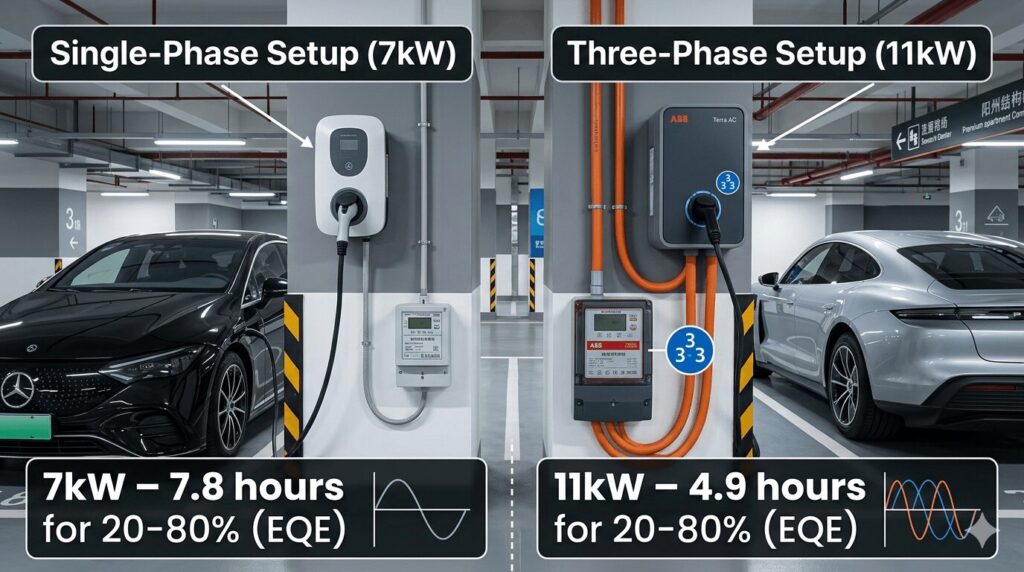
The three-phase requirement for Taycan: At 11 kW three-phase, 20-80% for the Taycan 4S (79.2 kWh):
- Energy needed: 79.2 × 0.60 = 47.5 kWh
- At 11 kW: 47.5 ÷ 11 = 4.3 hours
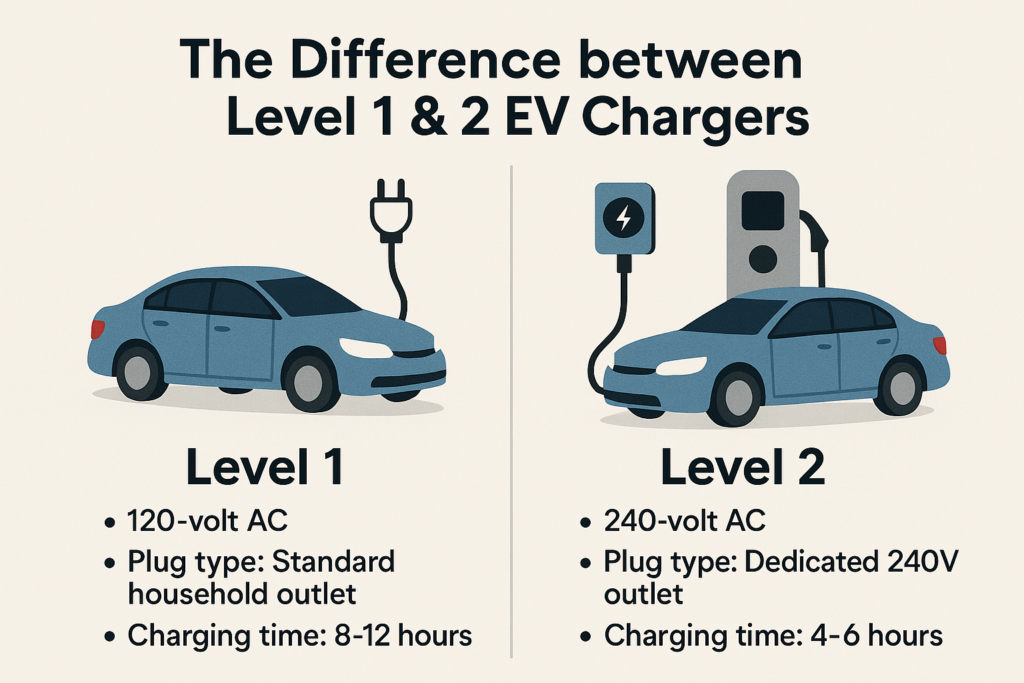
At 7 kW single-phase:
- 47.5 ÷ 7 = 6.8 hours
The 2.5-hour difference for a Taycan 4S is meaningful for regular overnight charging cycles. For the Taycan Turbo with 93.4 kWh battery:
- Three-phase (11 kW): 5.1 hours for 20-80%
- Single-phase (7 kW): 8.0 hours for 20-80%
Taycan 800V DC fast charging in China: Taycan’s 270-320 kW DC charging capability is among the highest of any EV sold in China. Compatible stations:
- State Grid ultra-fast hubs (250 kW): achieves close to maximum speed
- Premium TELD and StarCharge 250 kW+ hubs: compatible
- Porsche’s own charging service: Porsche China provides access to a curated fast-charging network through the Porsche Connect app
BMW i5 (China-Spec)
BMW i5 eDrive40 (China-spec):
- Battery: 81.2 kWh
- Architecture: 400V
- AC charging: 11 kW (three-phase, GB/T)
- DC fast charging: 205 kW (GB/T DC)
- CLTC range: 582 km
BMW i5 M60 xDrive (China-spec):
- Battery: 81.2 kWh
- Architecture: 400V
- AC charging: 11 kW (three-phase, GB/T)
- DC fast charging: 205 kW
- CLTC range: 516 km
Key home charging insight: The BMW i5’s 400V architecture means its DC fast charging maximum (205 kW) is lower than the Taycan’s 270-320 kW — despite both being premium luxury EVs. At home, both charge identically: 11 kW maximum AC with three-phase supply.
BMW i5 charging time with three-phase:
- 81.2 kWh, 20-80% at 11 kW: 81.2 × 0.60 ÷ 11 = 4.4 hours
- 81.2 kWh, 20-80% at 7 kW: 81.2 × 0.60 ÷ 7 = 7.0 hours
BMW HomeCharge (China): BMW China offers a home charging service for i5 buyers — the BMW Wallbox (China-spec, GB/T, 11 kW) with BMW-managed installation. BMW’s home charging programme is less comprehensive than NIO’s managed service but includes BMW-certified installation and BMW brand charger hardware.
Mercedes EQE (China-Spec)
Mercedes EQE 350+ (China-spec):
- Battery: 90.6 kWh
- Architecture: 400V
- AC charging: 11 kW (three-phase, GB/T)
- DC fast charging: 170 kW (GB/T DC)
- CLTC range: 734 km
Mercedes EQE 500 4MATIC (China-spec):
- Battery: 90.6 kWh
- Architecture: 400V
- AC charging: 11 kW (three-phase, GB/T)
- DC fast charging: 170 kW
- CLTC range: 670 km
Mercedes EQE AMG 53 4MATIC+ (China-spec):
- Battery: 90.6 kWh
- Architecture: 400V
- AC charging: 11 kW (three-phase, GB/T)
- DC fast charging: 170 kW
- CLTC range: 570 km
Key home charging insight: The Mercedes EQE’s 170 kW DC fast charging maximum is the lowest of the three luxury vehicles in this comparison — but the 90.6 kWh battery and 11 kW AC maximum create the same three-phase home charging consideration as Taycan and i5.
EQE charging time with three-phase:
- 90.6 kWh, 20-80% at 11 kW: 90.6 × 0.60 ÷ 11 = 4.9 hours
- 90.6 kWh, 20-80% at 7 kW: 90.6 × 0.60 ÷ 7 = 7.8 hours
Mercedes Wallbox (China): Mercedes China offers a Wallbox home charger product for EQE buyers — GB/T certified, 11 kW three-phase. Mercedes’ home charging programme includes certified installation through Mercedes-authorised service partners.
The Three-Vehicle Charging Specification Comparison
| Specification | Porsche Taycan 4S | BMW i5 eDrive40 | Mercedes EQE 350+ |
|---|---|---|---|
| Battery | 79.2 kWh | 81.2 kWh | 90.6 kWh |
| Architecture | 800V | 400V | 400V |
| Max AC (home) | 11 kW | 11 kW | 11 kW |
| Max DC (public) | 270 kW | 205 kW | 170 kW |
| Three-phase 20-80% | 4.3 hours | 4.4 hours | 4.9 hours |
| Single-phase 20-80% | 6.8 hours | 7.0 hours | 7.8 hours |
| Connector (China) | GB/T | GB/T | GB/T |
| Time saving (3ph vs 1ph) | 2.5 hours | 2.6 hours | 2.9 hours |
The universal luxury vehicle finding: All three vehicles have 11 kW maximum AC and GB/T connectors. Three-phase supply is the dominant specification question for home charging. The vehicles’ different DC charging speeds (270 kW vs 205 kW vs 170 kW) are irrelevant to home AC charging but matter for public fast charging optimisation.
The Three-Phase Home Charging Reality for Luxury Vehicle Owners
Why Three-Phase Is More Attainable for Luxury EV Owners
As established in our Zeekr 001 and Xiaomi SU7 Max guide, three-phase supply to residential parking spaces is uncommon in standard Chinese apartment compounds but significantly more common in the premium residential contexts where luxury EV buyers typically live.
Premium villa compound electrical infrastructure: New-build villa compounds in China’s tier-1 cities increasingly provide three-phase supply to individual garages as standard — the electrical infrastructure for these developments is designed for higher consumption loads including EV charging, air source heat pumps, and home automation. A Porsche Taycan buyer in a 2020+ Pudong villa compound has a reasonable probability of three-phase supply availability at their garage.
Premium high-rise electrical infrastructure: High-end apartment buildings (¥50,000+ per square metre) in Shanghai, Beijing, and Shenzhen often have above-average electrical infrastructure with three-phase supply potential to parking spaces. The 物业 in these buildings — typically professional operators like Vanke Service or Greenland Property Management — have established processes for EV charging installations including three-phase circuit requests.
The investigation process for luxury residential EV owners:
- Contact 物业 directly — request confirmation of electrical infrastructure specifications for your specific parking space
- If three-phase is not currently available at your space but available at the building’s distribution boards, request a quotation for three-phase circuit extension to your space
- For villa owners with direct utility connection, contact the local electricity supply bureau about three-phase meter upgrade (if currently on single-phase residential supply)
Expected cost of three-phase circuit installation to parking space:
- Simple routing (under 10 metres): ¥2,000-¥4,000
- Standard routing (10-30 metres): ¥4,000-¥8,000
- Complex routing (30+ metres, through building structure): ¥8,000-¥15,000
For a Porsche Taycan buyer, ¥4,000-¥8,000 for three-phase circuit installation is a reasonable investment — the 2.5-hour daily charging time saving compounds over a 5-7 year ownership period.
The Premium Charger Market in China — What Actually Exists
This is where honest analysis becomes most important. Chinese luxury EV owners want home charging hardware that matches their vehicle’s positioning — but the luxury home EV charger market in China in 2026 is still developing.
International Premium Charger Brands Available in China with GB/T
ABB Terra AC W7 (中国版 — GB/T):
ABB — one of the world’s leading industrial electrical companies — manufactures a China-market version of their Terra AC W7 with GB/T connector. This is the most established premium international home EV charger brand with a genuine Chinese market presence.
| Specification | Detail |
|---|---|
| Price | ¥2,500-¥5,000 (depending on variant and installation package) |
| Power | 7 kW (single-phase) / 11 kW (three-phase) / 22 kW (three-phase premium) |
| Connector | GB/T 20234.2-2015 ✅ |
| IP Rating | IP65 |
| Operating Temp | -30°C to +50°C |
| Enclosure | Premium UV-stabilised polycarbonate |
| Warranty | 2 years standard / 5 years extended |
| OCPP | 1.6 ✅ |
| Smart Features | Remote monitoring, scheduled charging, energy reporting |
| Design | Industrial-premium aesthetic — restrained, professional |
| Service | ABB’s industrial service network — certified engineers |
The ABB case for Porsche Taycan owners:
ABB is Porsche’s technology partner globally — ABB supplies Porsche’s home charging hardware in European markets and is the official Porsche charging partner for Formula E. While the China-spec ABB Terra AC W7 is not Porsche-branded in the Chinese market, the brand association and technical heritage are genuine.
For a Porsche Taycan owner who wants a charger from a manufacturer operating at the same technical tier as Porsche’s own standards — ABB is the only option in China that meets this criterion.
The 5-year extended warranty: ABB’s 5-year extended warranty (available at additional cost of approximately ¥500-¥1,000) is the longest available for any home EV charger in the Chinese market. For a Taycan owner planning 7-10 year ownership, 5 years of warranty coverage through ABB’s professional service network is genuinely valuable.
The 22 kW capability: The ABB Terra AC W7’s 22 kW three-phase variant delivers faster than 11 kW charging — but note that none of the vehicles in this guide accept more than 11 kW AC. The 22 kW charger delivers 11 kW to Taycan, i5, and EQE — the extra capability is unused. This is relevant only if a future vehicle in the household accepts 22 kW AC charging.
Schneider Electric EVLink Home (施耐德 GB/T 版):
Schneider Electric — French industrial electrical giant — manufactures a China-market GB/T version of their EVLink Home.
| Specification | Detail |
|---|---|
| Price | ¥2,000-¥4,500 |
| Power | 7 kW / 11 kW / 22 kW three-phase |
| Connector | GB/T 20234.2-2015 ✅ |
| IP Rating | IP65 |
| Operating Temp | -30°C to +50°C |
| OCPP | 1.6 ✅ |
| Warranty | 3 years standard / extended available |
| Design | European industrial aesthetic — clean rectangular form factor |
Schneider for BMW i5 owners: Schneider Electric and BMW have technology partnership relationships in building automation — Schneider’s EcoStruxure platform integrates with BMW’s connected home systems in BMW-branded premium apartment developments in China. For BMW i5 owners in BMW-partnered residential developments, Schneider represents a natural brand alignment that ABB does not provide.
Siemens VersiCharge (西门子 GB/T 版):
Siemens manufactures a China-market GB/T version of their VersiCharge home EV charger.
| Specification | Detail |
|---|---|
| Price | ¥2,000-¥4,000 |
| Power | 7 kW / 11 kW |
| Connector | GB/T 20234.2-2015 ✅ |
| IP Rating | IP55 (standard) / IP65 (premium variant) |
| Operating Temp | -25°C to +50°C |
| OCPP | 1.6 ✅ |
| Warranty | 3 years |
Siemens for Mercedes EQE owners: Siemens and Mercedes have extensive industrial and automotive technology partnerships. The Siemens brand carries German engineering credibility that resonates with Mercedes EQE buyers who selected a German luxury EV brand specifically for its engineering heritage. For Mercedes owners who value brand consistency, Siemens is the natural charger brand association.
Domestic Premium Options for Luxury EV Owners
Huawei Digital Power FusionCharge (华为数字能源充电桩):
As covered extensively in our smart EV charger comparison guide, the Huawei FusionCharge represents Chinese premium — AI-driven energy management, HarmonyOS integration, and industrial quality from Huawei’s power infrastructure division.
For luxury EV owners who are Huawei ecosystem users: A Porsche Taycan owner with Huawei Mate 60 Pro and a HarmonyOS smart home — an entirely plausible profile for China’s premium EV buyer — gets more from the Huawei FusionCharge than from any ABB or Schneider alternative. The AI energy management, voice control, and smart home coordination add genuine daily value that the international industrial brands cannot match.
For luxury EV owners who are NOT Huawei ecosystem users: The Huawei FusionCharge’s premium justification depends on ecosystem participation. Without HarmonyOS, the product is an excellent IP65 charger with good TOU scheduling — but at ¥2,500-¥4,500, no more compelling than ABB or Schneider.
Delta Electronics EV Charger (台达电动车充电桩):
Delta Electronics — Taiwanese industrial electronics manufacturer — produces premium GB/T home chargers for the Chinese market.
| Specification | Detail |
|---|---|
| Price | ¥2,500-¥5,000 |
| Power | 7 kW / 11 kW / 22 kW |
| Connector | GB/T 20234.2-2015 ✅ |
| IP Rating | IP65 |
| Operating Temp | -30°C to +55°C |
| OCPP | 2.0 ✅ |
| Warranty | 3 years |
Delta’s industrial electronics heritage (power supplies, UPS systems, industrial automation) translates to genuine component quality in their EV charger products. The OCPP 2.0 compliance positions the Delta charger for China’s emerging smart grid demand response programmes — relevant for premium property owners in Shenzhen and Shanghai’s most advanced electricity market areas.
The Manufacturer Home Charging Programmes — What Porsche, BMW, and Mercedes Offer in China
Each of the three vehicle manufacturers offers a home charging service in China — understanding what these programmes include determines whether they represent genuine value for luxury buyers.
Porsche Home Charging Service (保时捷家充服务)
What Porsche China offers:
Porsche Mobile Charger Connect (保时捷移动充电宝): A portable Mode 3 EVSE — the charging cable that comes with the Taycan for use at Type 2 sockets. In China, this is configured for GB/T AC charging.
Porsche Home Energy Management System (PHEMS — 保时捷家庭能源管理系统): Porsche’s home energy management platform — connecting the Taycan, the home charging unit, solar generation (if present), and home electrical loads for coordinated energy management. This is more sophisticated than a simple home charger — it is an energy management platform.
Porsche HomeCharge (中国版): Porsche China does not sell a branded home charging unit in the same way that Porsche Germany sells the branded AC charger. Instead, Porsche China provides a curated list of approved home charger products — primarily ABB, Schneider, and Huawei — and offers installation coordination through Porsche-authorised service centres.
What this means for Taycan buyers: Unlike NIO’s integrated home charging programme with dedicated service engineers, Porsche’s Chinese home charging service is more a coordination and approval function than a managed end-to-end service. The actual charger product comes from ABB, Schneider, or Huawei — not from Porsche directly.
Recommendation: For Porsche Taycan buyers, using Porsche’s approved channel to select and install an ABB Terra AC W7 or Huawei FusionCharge provides the brand-sanctioned path to home charging setup with Porsche’s quality assurance applied to the installation.
BMW HomeCharge (宝马家充服务)
BMW China’s home charging service:
BMW Wallbox (宝马壁挂式充电站): BMW offers a branded Wallbox for Chinese buyers — GB/T certified, 11 kW three-phase, BMW design language.
Specifications:
- Power: 7 kW or 11 kW
- Connector: GB/T 20234.2-2015
- IP Rating: IP55
- BMW ConnectedDrive integration
- Installation: Through BMW-authorised dealer service partners
BMW Home Charging subscription: BMW China offers a home energy management subscription service — monitoring charging costs, optimising TOU scheduling, and integrating with the i5’s vehicle energy management through the BMW ConnectedDrive platform.
The BMW Wallbox positioning: The BMW Wallbox is a legitimate premium product — BMW’s industrial design team applied the brand’s design language to the charger, creating a product that visually matches the vehicle’s premium positioning better than generic alternatives.
Price: ¥1,800-¥3,500 (charger only) plus installation
Recommendation: For BMW i5 buyers who value brand visual consistency and want a charger with BMW’s quality assurance directly applied — the BMW Wallbox is the natural choice. The ConnectedDrive integration adds genuine convenience for daily charging management.
Mercedes Wallbox (梅赛德斯-奔驰 家充设备)
Mercedes China’s home charging service:
Mercedes Wallbox (奔驰壁挂充电桩): Mercedes offers a branded Wallbox for Chinese buyers — GB/T certified, 11 kW three-phase, Mercedes design aesthetic.
Specifications:
- Power: 7 kW or 11 kW
- Connector: GB/T 20234.2-2015
- IP Rating: IP55
- Mercedes me integration
- Installation: Through Mercedes-authorised service partners
Mercedes me integration: The Mercedes Wallbox connects to the Mercedes me app — the EQE’s connected services platform. Integration includes:
- Charging status visible in the Mercedes me app
- TOU scheduling coordinated with vehicle departure schedule
- Charging history and cost tracking
- Remote start/stop
Price: ¥1,800-¥3,500 (charger only) plus installation
The Premium Charger Comparison for Luxury EV Owners
| Charger | Price | IP | Temp | Warranty | OCPP | Design | Ecosystem |
|---|---|---|---|---|---|---|---|
| ABB Terra AC W7 | ¥2,500-5,000 | IP65 | -30°C | 3-5yr | 1.6 | Industrial premium | Any |
| Schneider EVLink | ¥2,000-4,500 | IP65 | -30°C | 3yr | 1.6 | European clean | BMW partnership |
| Siemens VersiCharge | ¥2,000-4,000 | IP55-65 | -25°C | 3yr | 1.6 | German industrial | Mercedes |
| BMW Wallbox | ¥1,800-3,500 | IP55 | -20°C | 3yr | Standard | BMW design | BMW i5 |
| Mercedes Wallbox | ¥1,800-3,500 | IP55 | -20°C | 3yr | Standard | Mercedes design | EQE |
| Huawei FusionCharge | ¥1,800-4,500 | IP65 | -30°C | 3-5yr | 2.0 | Tech premium | Huawei |
| Delta Electronics | ¥2,500-5,000 | IP65 | -30°C | 3yr | 2.0 | Industrial | Any |
| Ginlong Solis | ¥1,500-3,200 | IP66 | -30°C | 5yr | 2.0 | Technical | Any |
The Recommendation Matrix for Each Vehicle
For Porsche Taycan Owners
The premium choice: ABB Terra AC W7 (11 kW three-phase, 5-year extended warranty)
Price: ¥3,500-¥5,000 (with installation and extended warranty) Why: ABB’s Porsche technology partnership, 5-year warranty, IP65, -30°C, 11 kW three-phase delivery. The only charger that matches Taycan’s specification credentials and brand tier simultaneously.
The ecosystem choice: Huawei Digital Power FusionCharge For Taycan owners who are Huawei ecosystem users — AI energy management, HarmonyOS smart home, FusionSolar integration for villa solar.
The villa outdoor choice: Ginlong Solis Smart (IP66, OCPP 2.0, 5yr) For Taycan owners in coastal villa compounds with direct outdoor exposure where IP66 provides maximum protection. OCPP 2.0 for Shenzhen electricity market advanced programme participation.
What to avoid:
- Manufacturer home charger programmes — Porsche does not offer a direct-to-owner premium Chinese home charger equivalent to NIO’s programme
- Budget domestic chargers (StarCharge S1, TELD) — adequate technically but represent a visible positioning mismatch for a ¥1,000,000+ vehicle’s home charging setup
- IP54 chargers in any outdoor or semi-outdoor installation context
For BMW i5 Owners
The premium choice: BMW Wallbox or Schneider EVLink (11 kW three-phase)
BMW Wallbox: For i5 owners who want brand visual consistency and ConnectedDrive integration. The BMW design language applied to the charger creates a coherent premium ownership experience.
Schneider EVLink: For i5 owners who prioritise technical specification (IP65 vs BMW Wallbox’s IP55, -30°C vs -20°C) over brand visual alignment. The BMW-Schneider commercial partnership provides implicit brand alignment.
The ecosystem choice: Huawei FusionCharge For Huawei ecosystem BMW i5 owners — same reasoning as Taycan.
The technical premium: ABB Terra AC W7 For i5 owners who prioritise 5-year warranty and industrial heritage over BMW brand alignment.
What to avoid:
- BMW Wallbox in harsh outdoor northern China installations — IP55 is below IP65 for outdoor exposure. Specify Schneider or ABB if outdoor installation.
For Mercedes EQE Owners
The premium choice: Mercedes Wallbox or Siemens VersiCharge (11 kW three-phase)
Mercedes Wallbox: For EQE owners who want brand visual consistency and Mercedes me integration. The Mercedes design applied to the charger is the cleanest aesthetic match with the EQE’s design language.
Siemens VersiCharge: For EQE owners who prioritise technical specification and value the Siemens-Mercedes brand association. German engineering from both vehicle and charger manufacturer.
The long-range EQE overnight charging note: The EQE 350+’s 90.6 kWh battery at single-phase 7 kW requires 7.8 hours for 20-80%. Starting at 11pm: completes at 6:48am — within the valley rate window but with no margin. Three-phase delivery (11 kW, 4.9 hours) provides comfortable valley window completion with significant margin for late arrivals.
For EQE owners with available three-phase supply: specify the 11 kW variant of both the Mercedes Wallbox and Schneider EVLink. The charging time improvement and valley window margin improvement are both meaningful.
The “Is Premium Hardware Worth It?” Honest Analysis
This section addresses the question that sophisticated luxury EV buyers ask: does the premium charger hardware actually deliver value proportionate to its premium over budget alternatives?
The Technical Value Analysis
Does an ABB Terra AC W7 charge an EQE faster than a StarCharge S1? No — both deliver 11 kW when connected to three-phase supply. Charging speed is determined by the vehicle’s AC acceptance rate and the supply voltage/current — not by charger brand.
Does an ABB Terra AC W7 charge more efficiently? Marginally — industrial-grade power electronics typically achieve 97-98% efficiency versus the 92-95% efficiency of consumer-grade alternatives. Annual energy saving from higher efficiency: approximately ¥30-¥80/year. Financial return from premium efficiency: negligible.
Does an ABB Terra AC W7 last longer? This is where the premium hardware case is strongest. Industrial components — contactors, connector assemblies, cable materials — from ABB, Schneider, and Siemens are rated for operating environments and cycle counts that exceed consumer specifications. An ABB charger with genuinely industrial contactor and connector quality has a longer expected hardware lifespan than consumer-grade equivalents.
The hardware longevity financial case: Premium charger (ABB, ¥4,500) versus budget charger (StarCharge S1, ¥999) price difference: ¥3,501. Premium charger expected hardware lifespan: 12-15 years (industrial grade) Budget charger expected hardware lifespan: 7-10 years (consumer grade)
Over a 15-year ownership period:
- Budget approach: 1.5 charger replacements × (¥999 charger + ¥1,700 installation each replacement) = ¥4,048.50 in replacement costs
- Premium approach: 0 replacements
- Premium approach total: ¥4,500 (charger) + ¥1,700 (installation) = ¥6,200
- Budget approach total: ¥999 + ¥1,700 + ¥4,048 = ¥6,747
Over 15 years, the premium charger is approximately ¥547 more expensive than the budget approach — not ¥3,501 more expensive. The replacement cost calculation closes most of the gap.
The Non-Financial Value Analysis
The coherence argument: A Porsche Taycan in a villa garage. The wall behind the vehicle has a ¥999 consumer plastic box with LEDs. This is a visual incoherence that the owner will see every day for 7-10 years.
For owners who care about the visual environment of their spaces — a characteristic that correlates strongly with premium luxury vehicle purchase — the charger’s aesthetic presence has genuine value that financial analysis cannot capture.
The ABB Terra AC W7, Schneider EVLink, or BMW Wallbox’s industrial design quality is specifically not this: these are professional aesthetic expressions of electrical hardware that are appropriate in premium residential contexts.
The service experience argument: When a ¥999 StarCharge charger fails on a Tuesday morning, the owner calls a generic service number and waits for a callback. When an ABB charger under the 5-year extended warranty develops an issue, ABB’s industrial service team — the same team that maintains charging infrastructure for Porsche dealerships — responds with the urgency and professionalism appropriate to a premium service relationship.
For owners who value service experience as part of premium ownership — and this is a distinguishing characteristic of China’s luxury EV buyer — the premium service that comes with ABB and Schneider’s industrial warranty and service infrastructure is genuine value.
The verdict on premium vs budget for luxury EV owners:
The technical charging performance is identical. The financial analysis over 15 years shows a ¥500-¥600 cost premium for premium hardware — not the ¥3,500 apparent premium at purchase.
The non-financial value — aesthetic coherence with the vehicle and residential context, premium service experience, ownership experience consistency — is real for the specific buyer profile that purchases a ¥600,000-¥1,500,000 EV.
Recommendation: For luxury EV owners who care about the visual environment of their home and value premium service experience, the ABB Terra AC W7, BMW Wallbox (for i5), Mercedes Wallbox (for EQE), or Huawei FusionCharge (for Huawei ecosystem users) are the correct choices. The financial premium over a 15-year horizon is modest and the non-financial value is genuine.
For luxury EV owners who are indifferent to the charger’s appearance and focused purely on financial optimisation, the Autel MaxiCharger (IP65, -30°C, OCPP) at ¥1,299-¥2,499 delivers 95% of the technical specification at 60% of the price.
The Home Charging Cost Analysis for Luxury EVs
Annual TOU Charging Cost (Shanghai, 20,000 km/year)
| Vehicle | Efficiency | Annual kWh | At TOU ¥0.34 | At standard ¥0.75 | Annual TOU saving |
|---|---|---|---|---|---|
| Porsche Taycan 4S | 22 kWh/100km | 4,889 kWh | ¥1,662/yr | ¥3,667/yr | ¥2,005/yr |
| BMW i5 eDrive40 | 18 kWh/100km | 4,000 kWh | ¥1,360/yr | ¥3,000/yr | ¥1,640/yr |
| Mercedes EQE 350+ | 17 kWh/100km | 3,778 kWh | ¥1,285/yr | ¥2,833/yr | ¥1,548/yr |
The Taycan annual charging cost insight: A Porsche Taycan at TOU rates costs ¥1,662/year in electricity for 20,000 km — approximately ¥0.083/km. At the Taycan 4S’s purchase price of approximately ¥900,000, the annual fuel saving versus a comparable Porsche 911 (petrol, approximately ¥15,000-¥20,000/year in fuel) is ¥13,338-¥18,338/year. The home charger installation cost (¥6,000-¥8,000 for premium ABB with three-phase circuit) pays back in approximately 4-6 months of fuel savings.
The 5-Year Total Cost Comparison
| Setup | Hardware + Install | 5yr Electricity | 5yr Total |
|---|---|---|---|
| ABB Terra AC W7 (11kW, 3-phase, 5yr warranty) | ¥7,000 | ¥8,310 | ¥15,310 |
| BMW Wallbox (11kW, 3-phase) + installation | ¥5,500 | ¥6,800 | ¥12,300 |
| Autel MaxiCharger (11kW, 3-phase) | ¥4,199 | ¥6,800 | ¥11,000 |
| StarCharge (7kW, single-phase — if no 3-phase) | ¥2,699 | ¥7,780* | ¥10,479 |
*Single-phase means more flat-rate exposure as charging extends past valley window — higher effective electricity cost
The total cost insight: The ABB Terra AC W7 with premium installation costs ¥15,310 over 5 years — ¥4,310 more than the Autel MaxiCharger approach. For a Porsche Taycan buyer who saves ¥15,000-¥20,000/year in fuel versus a petrol equivalent, ¥4,310 additional over 5 years represents 0.005% of the fuel saving benefit. The premium is negligible relative to the overall financial picture of luxury EV ownership.
The Installation Excellence Standard — What Premium Charging Setup Requires
For luxury EV owners, the installation quality deserves as much attention as the charger hardware. A premium charger installed by an unqualified contractor with poor cable management and exposed conduit is worse than a budget charger installed with precision and care.
What a Premium Installation Includes
Cable management: In premium villa installations, surface-mounted conduit is replaced by in-wall cable routing — the cable runs invisibly from the electrical panel to the charger mounting point with no exposed trunking. This requires advance planning during building construction or renovation.
Charger mounting: The charger should be mounted level, at the correct ergonomic height (typically 1.0-1.4 metres to the cable outlet), with appropriate clearance for the vehicle’s charging port geometry. For the Taycan — which has a rear charging port on the left side — charger placement matters specifically.
Cable length specification: The Porsche Taycan’s charging port is at the rear left. In a standard parallel garage parking position, the charger mounted on the left wall at the rear of the vehicle provides the cleanest cable routing. Specify cable length (5m standard, 7m for longer vehicles or diagonal parking positions) accordingly.
Earthing and protection: Premium installations use Type B RCD protection (detecting both AC and DC fault currents) rather than the Type A/AC RCCB standard in many budget installations. For high-value vehicles with sophisticated charging electronics, Type B protection is the correct specification.
Electrician certification: Use an ABB-certified, Schneider-certified, or BMW/Mercedes service-certified installation partner rather than a generic licensed electrician for premium hardware installation. The charger manufacturer’s warranty may specify certified installation as a condition.
Public DC Fast Charging for Luxury EVs in China
Porsche Taycan DC Charging Network Access
Porsche Connect China: Porsche’s connected services platform provides curated charging network access through the Taycan’s infotainment. Compatible with TELD, StarCharge, and State Grid through unified billing.
The 270-320 kW DC capability in China: Porsche Taycan’s DC charging is the fastest of the three luxury vehicles but finding 270+ kW capable stations in China requires specific station identification:
- State Grid ultra-fast hubs: 250 kW (approaching Taycan’s maximum — 93% utilisation)
- Premium TELD hubs: 180-250 kW
- BYD Diamond: 480 kW (Taycan capped at 320 kW)
Taycan 10-80% DC fast charging time:
- At 270 kW: approximately 18 minutes (4S, 79.2 kWh)
- At 150 kW: approximately 30 minutes
- At 50 kW: approximately 90 minutes
BMW i5 and Mercedes EQE DC Charging
BMW i5 205 kW DC: Most Chinese DC fast charging infrastructure at 150-250 kW serves the i5 well — 150 kW station delivers 10-80% in approximately 32 minutes, 205 kW in approximately 24 minutes.
Mercedes EQE 170 kW DC: The EQE’s 170 kW DC maximum means any 150+ kW station delivers close to full speed — broadly available across China’s major DC fast charging infrastructure. 10-80% at 170 kW: approximately 32 minutes.
Internal Links — Further Reading on Clean Energy Bazaar
The luxury EV charging 2026 Porsche Taycan BMW i5 Mercedes EQE best home solutions for China’s 1 percent guide is the premium segment complement to the Chinese domestic brand vehicle charging guides.
For the Zeekr 001 charging guide covering another 800V high-performance vehicle’s three-phase home charging requirements, our charging guide for Xiaomi SU7 Zeekr and Wuling Mini EV compact vs performance charging guide covers the domestic premium comparison. For the ABB Terra AC W7 and Schneider EVLink full specification review in the broader home charger comparison, our best home EV chargers 2026 top 7 comparison for Chinese homeowners Star Charge Autel guide covers every major brand. For the weatherproof specification guide confirming IP65 requirements for villa outdoor installations, our weatherproof EV chargers 2026 IP ratings for humid southern China vs dusty northern China guide covers every climate zone. For the Huawei Digital Power FusionCharge AI smart charger comparison for luxury EV owners with Huawei ecosystems, our best smart EV chargers China 2026 Huawei Digital Power vs Xiaomi vs local innovators guide covers the premium smart market. For the understanding EV charger specs guide confirming why 800V architecture is irrelevant to AC home charging for the Porsche Taycan, our understanding EV charger specs 2026 kW amps 800V architecture and the new GB standards guide covers every technical specification. And for the rebates guide covering installation subsidies available for premium vehicle owners in Shanghai, Beijing, and Shenzhen, our local utility rebates for EV charging 2026 Shenzhen Shanghai Beijing guide covers every available programme.
Final Thoughts
The luxury EV charging 2026 Porsche Taycan BMW i5 Mercedes EQE best home solutions for China’s 1 percent analysis produces recommendations that reflect the specific technical requirements and ownership context of China’s premium EV segment.
The technical findings:
All three vehicles share the same 11 kW maximum AC charging rate and GB/T connector. Three-phase supply is the dominant technical decision — delivering 4.3-4.9 hour 20-80% charging versus 6.8-7.8 hours on single-phase. Premium residential contexts make three-phase supply more attainable for luxury EV buyers than for standard residential owners. Three-phase circuit installation at ¥4,000-¥8,000 pays back in the first year of improved valley-rate charging efficiency.
The charger recommendations:
Porsche Taycan: ABB Terra AC W7 (5-year extended warranty, Porsche technology partner heritage) as primary. Huawei FusionCharge for Huawei ecosystem owners.
BMW i5: BMW Wallbox (brand consistency, ConnectedDrive integration) or Schneider EVLink (IP65, BMW commercial partner). ABB for owners prioritising warranty and industrial specification.
Mercedes EQE: Mercedes Wallbox (brand consistency, Mercedes me integration) or Siemens VersiCharge (German engineering, Mercedes commercial partner). ABB for owners prioritising warranty.
The honest premium hardware verdict:
The ¥3,500 apparent premium of ABB over StarCharge reduces to ¥500-¥600 over 15 years when replacement cost is factored in. The non-financial value — aesthetic coherence, premium service experience — is genuine for buyers who care about ownership experience consistency. The ¥500-¥600 15-year financial premium is negligible relative to the overall economics of luxury EV ownership for vehicles costing ¥600,000-¥1,500,000.
For China’s luxury EV owners: invest in the correct three-phase supply first. Then select the charger that matches your residential context, your aesthetic preferences, and your smart home ecosystem. Configure TOU scheduling on day one.
The ¥2,005/year TOU saving for a Porsche Taycan owner is available through every charger recommendation in this guide. Capture it regardless of which hardware you choose.