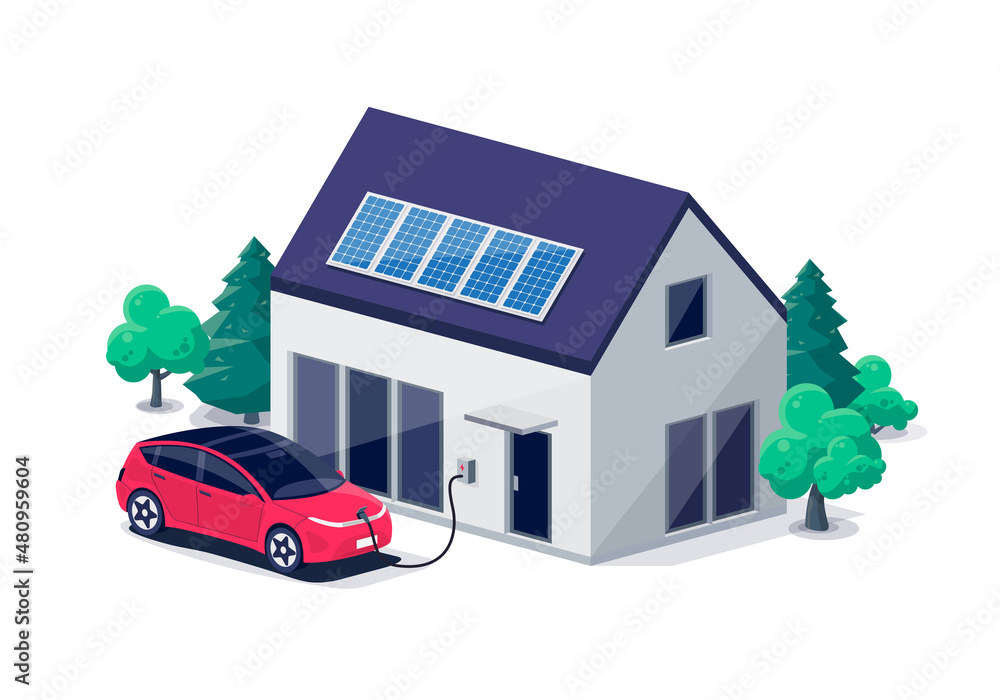
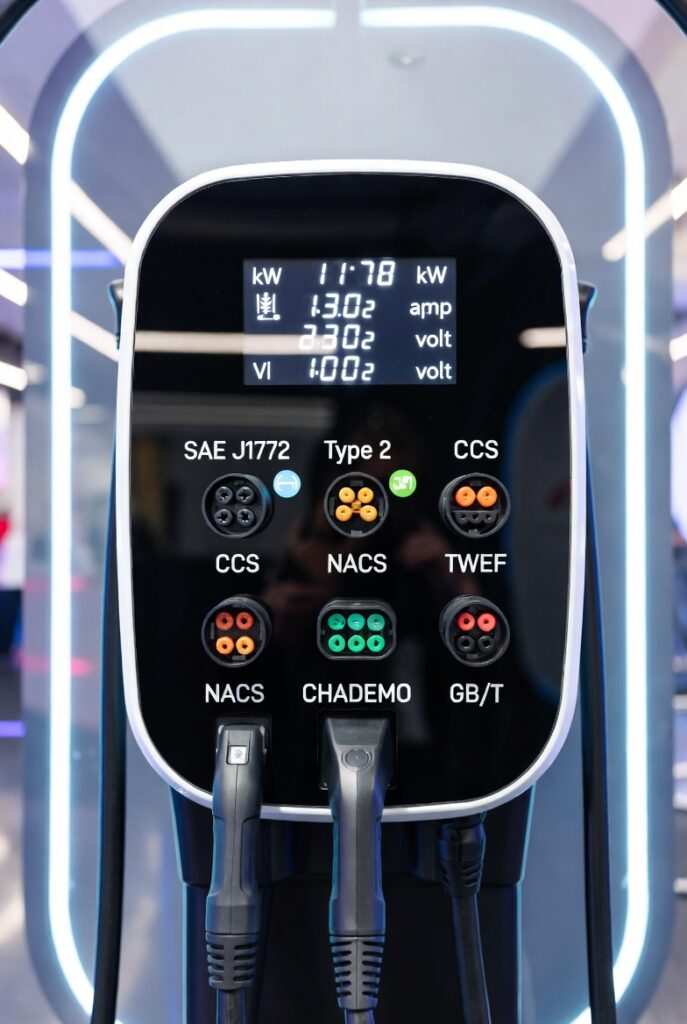
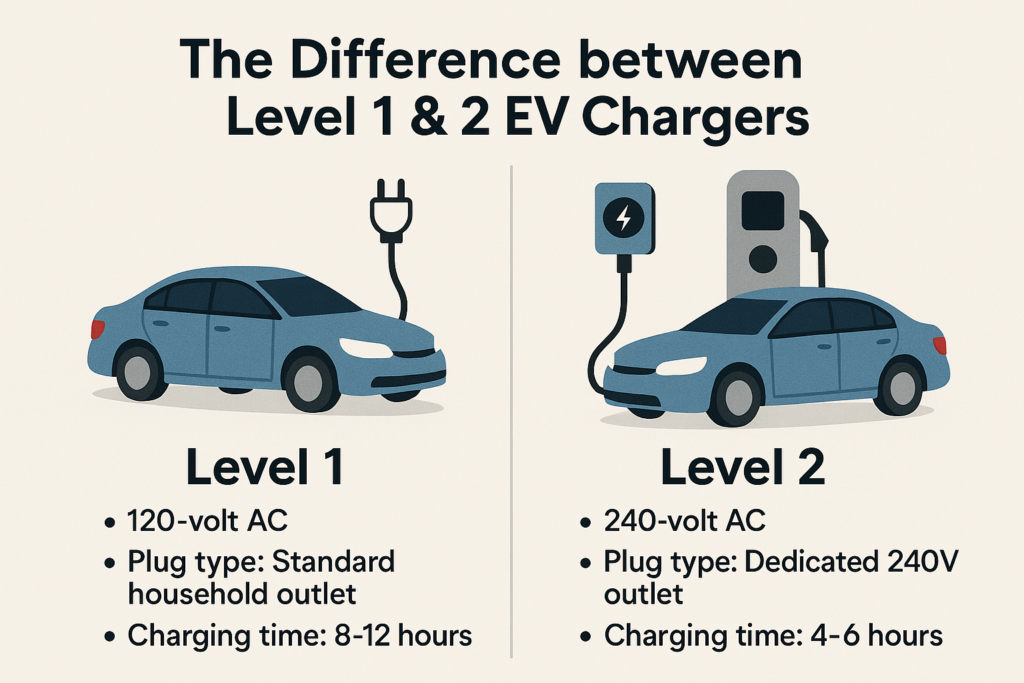
Here is the most interesting charging spectrum in China’s EV market in 2026.
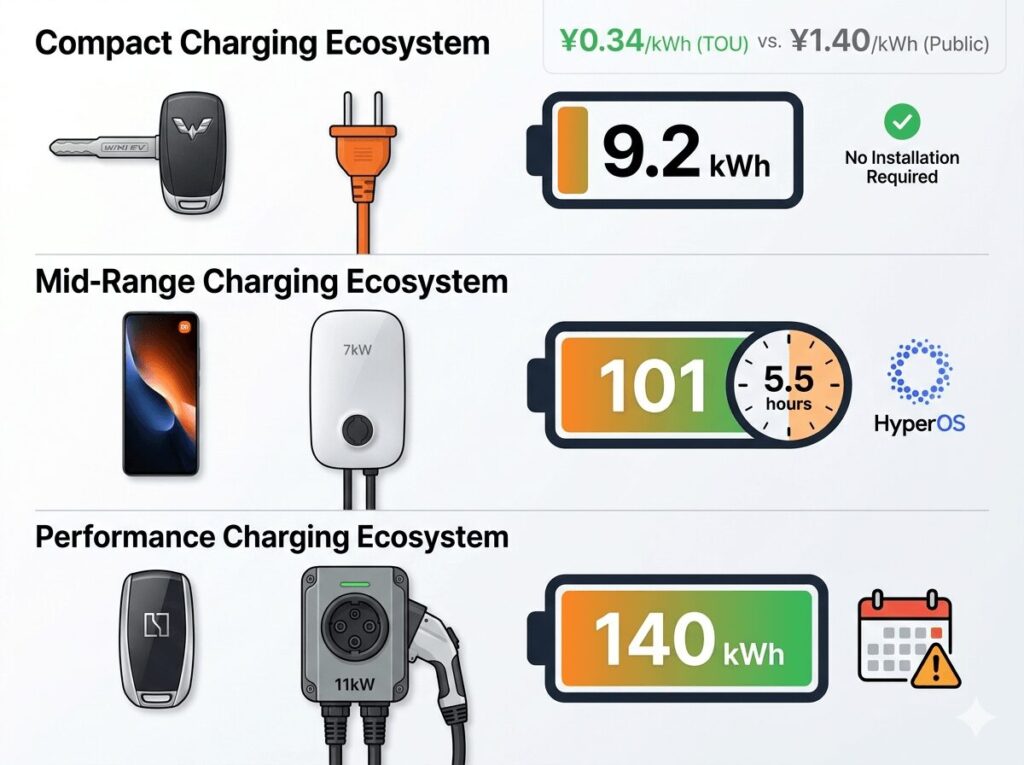
At one end: the Wuling Mini EV. A ¥30,000-¥60,000 two-seat city car with a 9.2 kWh battery, 170 km range, and a charging socket that plugs into the same socket as your rice cooker.
At the other end: the Zeekr 001 Performance AWD. A ¥280,000+ sports shooting brake with a 100 kWh battery, 800V architecture, 400 kW DC fast charging capability, and a home charger requirement that involves three-phase electrical supply and significant technical specification consideration.
In the middle: the Xiaomi SU7 — the vehicle that generated more pre-order excitement than any Chinese EV launch in history, combining a 73.6 kWh or 101 kWh battery with HyperOS smart car technology, 220 kW-400 kW DC fast charging, and a home charging ecosystem that integrates with Xiaomi’s entire smart device universe.
The charging requirements of these three vehicles could not be more different. The Wuling Mini EV’s owner doesn’t need an electrician, a 物业 application, or a dedicated circuit. They need a functioning wall socket and four to eight hours of patience. The Zeekr 001 Performance owner needs to evaluate whether their parking space has three-phase supply, whether their building’s electrical infrastructure supports 11 kW or higher AC charging, and which charger specification delivers the full benefit of their vehicle’s AC charging capability.
This charging guide for Xiaomi SU7 Zeekr and Wuling Mini EV compact vs performance charging covers the complete charging picture for each vehicle — home charging setup, public charging optimisation, and the specific decisions that differentiate these three vehicles’ charging strategies from each other and from the broader market.
Why These Three Vehicles Create China’s Most Interesting Charging Comparison
Before diving into specific charging guidance, understanding why this comparison is genuinely instructive — not just a list of different specifications — frames the value of the analysis.
The Spectrum These Three Vehicles Represent
Wuling Mini EV — the charging simplicity champion: The Wuling Mini EV (五菱宏光MINI EV) is China’s best-selling EV by cumulative units — millions of units sold across its production history. It represents a specific Chinese EV market segment that most English-language EV content ignores: the urban micro-mobility replacement vehicle where home charging means “plug into the wall” and total ownership cost is the dominant buying criterion.
The Mini EV’s charging is simple to the point of being irreducible. Understanding this simplicity — and why it is the correct solution for the vehicle’s use case — is as instructive as understanding the Zeekr’s complexity.
Zeekr 001 — the home charging complexity champion: The Zeekr 001 is Geely’s premium electric sports shooting brake — competing with European performance EVs on specification and price while being manufactured in China. Its 800V battery architecture, 400 kW DC fast charging capability, and 11 kW AC maximum create home charging decisions that parallel those of a Porsche Taycan or Lucid Air in the international context.
Xiaomi SU7 — the ecosystem integration champion: The Xiaomi SU7 represents something neither Wuling nor Zeekr attempts — a complete HyperOS-integrated smart vehicle where the car, the home charger, the smartphone, the smart home, and the user’s digital life are designed as a single coordinated system.
The SU7’s charging specification is neither the simplicity of the Mini EV nor the raw performance of the Zeekr — it is a thoughtfully designed middle ground that maximises the value of Xiaomi’s technology ecosystem for EV charging.
The “Compact vs Performance” Charging Framework
The compact vs performance framing in this guide’s title describes a genuine spectrum that determines every charging decision:
Compact charging priorities: Minimum cost, simplicity, adequate daily replenishment, no installation required if possible
Performance charging priorities: Maximum AC speed for efficient overnight recovery, 800V DC compatibility for ultra-fast public charging, ecosystem integration for departure pre-conditioning, long-term battery health optimisation for high-value battery packs
Understanding where each vehicle sits on this spectrum — and where you as an owner sit — determines every recommendation in this guide.
Section 1: Wuling Mini EV — The Simplest Charging Story in China
Vehicle Technical Specifications
Wuling Mini EV (宏光MINI EV) — 2026 variants:
| Variant | Battery | Range (NEDC) | AC Charging | DC Fast |
|---|---|---|---|---|
| Mini EV Standard | 9.2 kWh | 120 km | 2.2 kW (10A, 220V) | None |
| Mini EV Long Range | 13.8 kWh | 170 km | 2.2 kW (10A, 220V) | None |
| Mini EV Plus | 17.3 kWh | 200 km | 2.2 kW or 3.3 kW | None (some variants) |
Key charging characteristics:
- No DC fast charging: The Mini EV has no DC fast charging capability on standard variants — AC slow charging only
- 2.2 kW maximum: The most common Mini EV variant accepts only 10A at 220V = 2.2 kW — slower than any dedicated home EVSE
- No GB/T DC port: Standard Mini EV uses only the GB/T AC connector — the same single port for all charging
Why the Mini EV’s Charging Is Exactly Right for Its Purpose
The Mini EV’s 2.2 kW charging rate appears limited when compared to other EVs in this guide — and by any absolute measure, it is. But evaluated against the Mini EV’s actual use case, it is precisely calibrated:
The Mini EV daily driving reality:
Most Mini EV owners drive under 50 km daily — using the vehicle as a last-mile commuter, urban errand runner, or second household vehicle for city driving. At 50 km daily:
- Energy consumption: approximately 9-10 kWh (at 18-20 kWh/100km urban)
- Charging time to replace: 9 kWh ÷ 2.2 kW = 4.1 hours
A Mini EV owner who arrives home at 7pm and plugs into a standard 220V socket will have fully replaced their daily consumption by 11:10pm — well before TOU valley rates even start.
The Mini EV doesn’t need 7 kW home charging. Its battery is small enough that 2.2 kW is entirely adequate for daily replenishment.
Mini EV Home Charging Options
Option 1: Standard 220V socket (standard household plug) — The Free Option
The Mini EV comes with a Mode 2 cable — plug one end into any standard 220V socket, the other into the car. This is the charging solution for the majority of Mini EV owners.
Cost: ¥0 (included with vehicle) Speed: 2.2 kW → 4.1 hours to replace 50 km daily consumption Installation required: None 物业 approval required: None
For Mini EV owners: this is genuinely adequate for 90% of daily scenarios. The vehicle’s small battery means standard socket charging is not a compromise — it is the correct solution.
The safety note for sustained Mini EV socket charging: As covered in our safety guide, sustained 10A charging from a standard socket requires that the socket be in good condition. For Mini EV owners who charge nightly for years on the same socket:
- Inspect the socket annually for discolouration or heat damage
- If any warming is detected during charging, replace the socket
- Consider an upgraded 16A socket installation (simple, cheap, requires basic electrician) for higher reliability
Option 2: Upgraded 16A Socket — For Better Safety and Modest Speed Improvement
A 16A socket installation near the Mini EV’s parking space:
- Cost: ¥300-¥600 (simple socket installation by licensed electrician)
- Speed: 3.3 kW (if the Mini EV Plus variant with 3.3 kW maximum) or 2.2 kW (standard variants limited by vehicle)
- 物业 approval: Typically straightforward — a single 16A socket is a minor electrical addition
For Mini EV Standard and Long Range variants (2.2 kW maximum AC): the 16A socket delivers no charging speed improvement — the vehicle limits at 2.2 kW regardless of socket current capacity. The 16A socket upgrade provides safety and circuit reliability improvements.
For Mini EV Plus variants (3.3 kW maximum): the 16A socket allows full 3.3 kW charging, reducing 50 km replacement time from 4.1 hours to 2.7 hours.
Option 3: Dedicated GB/T 7 kW Home Charger — Overkill for Most Mini EV Owners
A full 7 kW GB/T home charger installation for a Mini EV is technically possible — the vehicle has a GB/T AC port compatible with any certified GB/T home charger. But the Mini EV’s 2.2 kW AC acceptance rate means the 7 kW charger delivers exactly 2.2 kW — identical speed to a standard socket charge.
The 7 kW charger for a Mini EV delivers zero charging speed benefit.
The financial case:
- 7 kW charger + installation: ¥2,699-¥3,200
- Annual TOU saving (9 kWh/day, 50 km/day, 18,250 km/year): approximately
- Annual kWh: 3,285 kWh
- TOU saving: 3,285 × (¥0.75-¥0.34) = ¥1,347/year
- Payback: ¥2,699 ÷ ¥1,347 = 2.0 years
The TOU saving is achievable — by using the car’s built-in timer (if available) to delay standard socket charging until 11pm, the same TOU saving is captured without a dedicated charger installation.
Recommendation for Mini EV owners:
- Standard socket with included Mode 2 cable: adequate for all driving under 50 km/day
- 16A socket upgrade (¥300-¥600): worthwhile for better safety and marginal speed improvement on Plus variants
- Full 7 kW home charger: generally not justified — use car’s built-in timer with standard socket for TOU savings
Mini EV Public Charging
The Mini EV’s absence of DC fast charging means public charging is AC only — at 2.2-3.3 kW, the same speed as home charging.
For Mini EV owners who occasionally need public charging:
- AC public charging stations (Type 2 / GB/T AC): charge at 2.2 kW regardless of station output
- Charging time from empty: Standard 9.2 kWh = 4.2 hours; Long Range 13.8 kWh = 6.3 hours
The public charging implication: Mini EV owners cannot rapidly charge at public stations the way BYD Seal or Zeekr owners can. If a Mini EV owner runs low on a day out, they need 3-6 hours of AC public charging — not a 20-minute DC fast charge. Trip planning for Mini EV owners means ensuring adequate home charging overnight, not planning public charging stops.
Mini EV Charging Cost Analysis
The Mini EV’s low energy consumption makes it one of the cheapest vehicles to operate in China regardless of charging method:
| Charging Method | Rate | Cost/100km |
|---|---|---|
| Standard socket (11pm, TOU) | ¥0.34/kWh | ¥6.12/100km |
| Standard socket (7pm, flat rate) | ¥0.67/kWh | ¥12.06/100km |
| AC public charging | ¥1.00-¥1.50/kWh | ¥18-27/100km |
| Petrol equivalent (Toyota Corolla) | — | ¥60-80/100km |
The Mini EV operating cost is approximately 10× cheaper than petrol per kilometre — even at standard rates, let alone TOU rates. This cost advantage is the Mini EV’s primary ownership value proposition, and it is preserved by any charging approach.
Section 2: Xiaomi SU7 — The Ecosystem Integration Story
Vehicle Technical Specifications
Xiaomi SU7 (小米SU7) — 2026 variants:
| Variant | Battery | Range (CLTC) | AC Charging | DC Fast |
|---|---|---|---|---|
| SU7 Standard | 73.6 kWh | 668 km | 6.1 kW (single-phase) | 220 kW |
| SU7 Pro | 94.3 kWh | 830 km | 6.1 kW (single-phase) | 220 kW |
| SU7 Max | 101 kWh | 800 km | 11 kW (three-phase) | 400 kW |
| SU7 Ultra | 150 kWh | 800+ km | 11 kW (three-phase) | 500+ kW |
Key charging characteristics:
- SU7 Standard and Pro: 6.1 kW maximum AC (single-phase residential supply delivers full speed)
- SU7 Max and Ultra: 11 kW maximum AC (three-phase supply required for full speed — single-phase delivers 6-7 kW)
- SU7 Max DC: 400 kW — one of the fastest home EV charging-to-fast-charging transitions available
- SU7 Ultra: 500+ kW DC — the fastest DC charging of any production sedan in China
Understanding the SU7’s HyperOS Charging Ecosystem
The Xiaomi SU7 is not just a car with a charger — it is a node in Xiaomi’s HyperOS ecosystem where the vehicle, the home charger, the phone, and smart home devices share a coordinated intelligence layer.
What HyperOS charging coordination actually does:
Vehicle-charger state sharing: The SU7 continuously shares its battery state, temperature, and charging requirements with the Xiaomi home charger through HyperOS. The charger knows not just the SOC percentage (as standard GB/T protocol provides) but the specific cell temperature distribution, the BMS’s recommended charge rate for current conditions, and the vehicle’s planned departure schedule.
Smart home energy coordination: When the SU7’s home charger is active, Mi Home can coordinate household energy usage to prevent total consumption from exceeding safe limits — automatically adjusting smart air conditioning load, delaying dishwasher cycles, and managing water heater scheduling to prevent the EV charging circuit from causing panel issues.
This is the smart home energy coordination that the Emporia Pro + Vue delivers in the US market — but implemented through Xiaomi’s consumer device ecosystem rather than a dedicated energy monitoring device.
Departure scene integration: Setting a departure time in the SU7’s interface updates:
- The home charger’s TOU-optimised charging schedule to complete at departure time
- The vehicle’s cabin pre-conditioning schedule
- The home’s smart devices to “leaving soon” mode (adjusting climate, preparing lighting)
- The SU7’s navigation to load any planned journey
All triggered by a single departure time setting.
小爱同学 voice control: From anywhere in the home — not just at the charger or in the car — voice commands manage charging:
- “小爱,帮我把车充到80%” (charge car to 80%)
- “小爱,明天早上7点把车充好” (have car charged by 7am tomorrow)
- “小爱,车现在充了多少” (how much is the car charged now)
The natural language understanding handles context — “charge the car” is understood as the SU7, not other home devices.
SU7 Home Charging Time Reference
| Variant | Battery | At 6.1 kW | At 11 kW (3-phase) | Valley window (11pm-8am) |
|---|---|---|---|---|
| Standard (73.6 kWh, 20-80%) | 73.6 kWh | 7.2 hours | N/A | ✅ Completes 6:12am |
| Pro (94.3 kWh, 20-80%) | 94.3 kWh | 9.3 hours | N/A | ⚠️ Completes 8:18am |
| Max (101 kWh, 20-80%) | 101 kWh | 9.9 hours | 5.5 hours | ⚠️ 6.1kW: 8:54am; 11kW: ✅ 4:30am |
| Ultra (150 kWh, 20-80%) | 150 kWh | 14.7 hours | 8.2 hours | ❌ 6.1kW needs 14+hr; 11kW: ✅ 7:12am |
Critical insight for SU7 Pro and Max/Ultra owners:
SU7 Pro at 6.1 kW single-phase: A 20-80% charge started at 11pm completes at 8:18am — 18 minutes past Shanghai’s valley rate end (8am). The final 18 minutes of charging costs flat-rate electricity (¥0.67/kWh) rather than valley rate (¥0.34/kWh). Cost difference: approximately ¥0.12. Negligible.
SU7 Max at 6.1 kW single-phase: Completes at 8:54am — 54 minutes into flat-rate period if started at 11pm. More meaningful flat-rate exposure. Configure smart charger to start at 10pm to ensure completion within valley window.
SU7 Max and Ultra with 11 kW three-phase: Three-phase supply transforms the charging window from “tight” to “comfortable” — completing well within the valley rate window regardless of starting SOC.
For SU7 Max and Ultra owners: Three-phase home supply investigation is worthwhile. The 4-5 hour time saving with 11 kW versus 6.1 kW, combined with the valley window fit improvement, makes three-phase supply genuinely valuable rather than merely technically interesting.
SU7-Specific Charger Recommendations
Primary recommendation: Xiaomi EV Charger (小米充电桩)
Price: ¥1,099-¥1,999 (basic to standard) Power: 7 kW (single-phase) or 11 kW (three-phase) IP Rating: IP55 Temperature: -20°C to +55°C Warranty: 3 years HyperOS Integration: ✅ Full SU7 ecosystem
The Xiaomi EV Charger is the natural choice for SU7 owners — the HyperOS integration is deep enough that the vehicle and charger genuinely function as a coordinated system rather than two separate products communicating through standard protocol.
For SU7 Standard and Pro owners (6.1 kW single-phase): Xiaomi EV Charger 7 kW — delivers full 6.1 kW charging speed with complete HyperOS integration.
For SU7 Max and Ultra owners (11 kW maximum):
If three-phase supply is available: Xiaomi EV Charger 11 kW three-phase — full 11 kW charging with HyperOS integration. This is the optimal setup for SU7 Max and Ultra owners.
If only single-phase supply available: Xiaomi EV Charger 7 kW — delivers 6.1 kW (limited by vehicle’s single-phase acceptance, not by charger). HyperOS integration is fully present regardless of charging speed. For SU7 Ultra owners needing to charge the full 150 kWh battery, investigate three-phase supply availability — 14.7 hours for a 20-80% charge at single-phase speed is genuinely constraining for large-battery overnight charging.
Secondary recommendation: Autel MaxiCharger
For SU7 owners with outdoor parking, South China humid exposure, or northern China cold conditions — Autel’s IP65 and -30°C specifications override the Xiaomi charger’s HyperOS integration advantage when environment demands it.
For outdoor parking: Autel MaxiCharger (IP65). HyperOS integration is available through the vehicle’s own intelligence even without the Xiaomi-branded charger — the SU7 can coordinate charging schedules through its own departure time settings even with a third-party charger.
For SU7 owners without Xiaomi smart home: The Xiaomi EV Charger’s primary differentiating feature for SU7 owners — beyond the standard TOU scheduling any charger provides — is the HyperOS ecosystem integration. For SU7 owners who don’t use Mi Home, don’t have other Xiaomi smart devices, and don’t use 小爱同学 voice control: the ¥200-¥400 premium of the Xiaomi charger over StarCharge S1 is not justified by the integration benefit they won’t use. StarCharge S1 at ¥899 delivers identical TOU savings.
SU7 Public DC Fast Charging Guide
SU7 Standard and Pro (220 kW maximum):
- Compatible with any 120 kW+ DC fast charging station
- 10-80% at 220 kW: approximately 20 minutes
- Optimal stations: State Grid 250 kW hubs, TELD 180 kW+ stations, StarCharge 150 kW+
SU7 Max (400 kW maximum):
- Full speed requires 800V-compatible ultra-high-power stations
- At 400 kW: 10-80% approximately 12-13 minutes
- Compatible stations: Premium State Grid ultra-fast hubs, BYD Diamond Level stations
- At standard 120-150 kW stations: charges at station’s maximum output (120-150 kW) rather than vehicle maximum
SU7 Ultra (500+ kW):
- The fastest DC charging of any production sedan in China
- Requires ChaoJi-compatible or 800V ultra-high-power stations for maximum speed
- At 500 kW: 10-80% approximately 13-15 minutes (for 150 kWh battery)
- Ultra-fast station availability is currently limited — expanding through 2026-2027
The SU7 public charging cost:
| Station type | Rate | SU7 Standard 10-80% cost |
|---|---|---|
| Home TOU valley | ¥0.34/kWh | ¥14.97 (44.16 kWh) |
| State Grid DC fast | ¥1.40/kWh | ¥61.82 |
| TELD premium | ¥2.00/kWh | ¥88.32 |
The home TOU vs public DC fast charging cost difference for SU7 Standard: approximately ¥47/session. For 52 sessions per year (one per week), home TOU vs public DC saves ¥2,444/year — reinforcing the financial dominance of home charging for SU7 owners.
SU7 Charging Summary
The SU7’s home charging setup is the most straightforward decision of the three vehicles in this guide (excluding the Mini EV):
- SU7 Standard/Pro: 7 kW Xiaomi EV Charger if Xiaomi ecosystem user; StarCharge S1 if not
- SU7 Max/Ultra: Investigate three-phase supply; 11 kW Xiaomi EV Charger if three-phase available
- Any outdoor installation: Autel MaxiCharger regardless of Xiaomi ecosystem preference
- Configure TOU scheduling immediately — ¥1,500-¥2,000+/year savings available
Section 3: Zeekr 001 — The Performance Charging Story
Vehicle Technical Specifications
Zeekr 001 (极氪001) — 2026 variants:
| Variant | Battery | Range (CLTC) | AC Charging | DC Fast | Architecture |
|---|---|---|---|---|---|
| 001 Long Range RWD | 86 kWh | 732 km | 11 kW (three-phase) | 200 kW | 800V |
| 001 Long Range AWD | 100 kWh | 660 km | 11 kW (three-phase) | 200 kW | 800V |
| 001 Performance AWD | 100 kWh | 620 km | 11 kW (three-phase) | 400 kW | 800V |
| 001 Privilege | 140 kWh | 870 km | 11 kW (three-phase) | 360 kW | 800V |
Key charging characteristics:
- All variants: 11 kW maximum AC — three-phase supply required for full AC speed
- 800V battery architecture across entire range — like BYD Seal but applied to all variants
- 400 kW DC fast charging (Performance AWD) — same tier as Xpeng G9 Ultra
- The 140 kWh Privilege battery: One of the largest production EV batteries in China — the home charging time implications are significant
The Critical Zeekr 001 Three-Phase Decision
Unlike the BYD Seal and Han — where 800V architecture was irrelevant to home charging speed because the AC maximum was 6.6 kW single-phase — the Zeekr 001’s 11 kW AC maximum creates a genuine three-phase decision with meaningful charging time implications.
Zeekr 001 charging time comparison:
| Variant | Battery | 20-80% at 7 kW (single-phase) | 20-80% at 11 kW (three-phase) | Time saving |
|---|---|---|---|---|
| Long Range RWD (86 kWh) | 86 kWh | 7.4 hours | 4.7 hours | 2.7 hours |
| Long Range AWD (100 kWh) | 100 kWh | 8.6 hours | 5.5 hours | 3.1 hours |
| Performance AWD (100 kWh) | 100 kWh | 8.6 hours | 5.5 hours | 3.1 hours |
| Privilege (140 kWh) | 140 kWh | 12.0 hours | 7.6 hours | 4.4 hours |
The Privilege battery home charging reality: The Zeekr 001 Privilege’s 140 kWh battery at 7 kW single-phase requires 12.0 hours for a 20-80% charge. Starting at 11pm, completion at 11am — entirely outside the valley rate window. At 11 kW three-phase, completion at 6:36am — within the valley window.
For Zeekr 001 Privilege owners: three-phase home charging is not optional — it is practically required for valley rate charging. An owner with single-phase supply and a 140 kWh battery will consistently fail to complete overnight TOU-scheduled charging.
For Zeekr 001 Long Range and Performance owners: At 7 kW single-phase, 20-80% completes in 8.6 hours — starting at 11pm, completion at 7:36am. This is within the valley window for most Chinese cities (valley ends at 7am-8am) but tight. Three-phase provides comfortable margin with 5.5-hour completion time.
Investigating Three-Phase Supply for Zeekr 001 Owners
How to determine if three-phase supply is available at your parking space:
Step 1: Check your electricity meter A three-phase supply will have three live conductors plus neutral — your electricity meter will typically show three separate phase inputs. A single-phase supply has one live conductor.
Step 2: Ask your 物业 or electrician The simplest approach: ask the 物业 whether the underground car park’s electrical distribution supports three-phase supply to individual parking spaces. In commercial buildings and newer premium residential developments, three-phase is common. In standard residential buildings, single-phase is more typical.
Step 3: Consider a three-phase circuit installation if only single-phase currently available at parking space but three-phase at building: If the building has three-phase supply but only single-phase is currently run to your parking space, installing a three-phase circuit from the distribution board is possible — but more complex and expensive than single-phase circuit installation. Costs: ¥2,000-¥5,000 additional versus single-phase circuit, depending on distance and complexity.
The financial case for three-phase supply investigation for Zeekr 001 Privilege owners: Three-phase circuit installation cost: ¥2,000-¥5,000 Annual TOU saving improvement from three-phase (avoiding 4 hours daily of flat-rate charging): approximately ¥300-¥500/year Payback: 4-16 years — marginal financial case.
However: The Privilege’s 140 kWh battery fundamentally cannot complete overnight TOU charging on single-phase supply at typical arrival SOCs. Three-phase is a functional requirement for this vehicle, not just an optimisation. The financial analysis of payback is secondary to the functional necessity.
Zeekr 001 Battery Architecture and CATL Shenxing
The Zeekr 001 Performance AWD and Privilege variants use CATL Shenxing battery cells — the 4C ultra-fast charging cells that enable 400 kW DC charging. As discussed in our broader Chinese EV charger guides, CATL cells are relevant to the CATL Ningle home charger consideration.
CATL Ningle for Zeekr 001 owners: The CATL Ningle’s cell-level recovery charging optimisation is applicable to Zeekr 001 Performance and Privilege owners who frequently use 400 kW+ DC fast charging — subjecting the Shenxing cells to sustained extreme charge rates. The Ningle’s home charging health recovery mode implements conservative slow charging parameters after high-rate DC sessions — supporting cell longevity for owners who push the charging speed advantage of their vehicle regularly.
The Zeekr 001 Performance owner CATL Ningle argument:
- 400 kW DC fast charging generates significant thermal stress on battery cells
- Home AC charging is the recovery period — the 5.5-hour overnight charge at 11 kW
- CATL Ningle’s cell-aware recovery charging optimises this period for battery longevity
- For high-mileage Zeekr 001 Performance owners (25,000+ km/year, frequent DC fast charging), this optimisation has meaningful long-term battery value
Zeekr 001 Home Charger Recommendations
The three-phase requirement changes the charger recommendation for Zeekr 001 owners compared to most Chinese EVs.
For Zeekr 001 owners with three-phase supply (commercial building, premium residential, villa):
Primary recommendation: Autel MaxiCharger 11 kW Three-Phase (IP65, -30°C)
The Autel MaxiCharger’s 11 kW three-phase capability combined with IP65 weather protection and -30°C cold temperature rating makes it the most specification-complete three-phase home charger for Zeekr 001 owners.
Price: ¥1,799-¥2,499 (11 kW three-phase variant) Why Autel over branded alternatives:
- Zeekr does not have a proprietary home charging programme at NIO’s service level
- IP65 for three-phase installation provides better long-term protection
- OCPP 1.6 for future smart grid participation
- Solar integration if villa installation with solar panels
Alternative: Ginlong Solis Smart 11 kW Three-Phase (IP66, OCPP 2.0) For Zeekr 001 Privilege owners in South China outdoor or coastal installations where IP66 provides additional margin over IP65, the Ginlong Solis with OCPP 2.0 is the specification leader.
For Zeekr 001 owners without three-phase supply:
Install a single-phase 7 kW home charger while investigating three-phase circuit installation:
Interim recommendation: StarCharge S Series Smart 7 kW
- Delivers TOU scheduling immediately
- 7 kW provides approximately 80% of the AC charging time benefit of 11 kW three-phase for Long Range variants
- Cost-effective interim solution while three-phase investigation proceeds
For Zeekr 001 Performance owners prioritising battery health:
CATL Ningle (11 kW three-phase variant if available) Cell-level recovery optimisation for Shenxing-equipped high-mileage owners. Requires three-phase supply for full benefit.
Zeekr 001 Public DC Fast Charging Guide
400 kW DC fast charging optimisation (Performance AWD and Privilege):
Thermal pre-conditioning for maximum DC rate: The Zeekr 001’s CATL Shenxing cells achieve maximum charge rate (400 kW) when pre-conditioned to 25-35°C. The Zeekr app’s pre-conditioning function — activated before departure for a planned fast charging stop — warms the battery to optimal temperature through the home charger (or while driving) before the DC session begins.
The 400 kW station finding challenge: 400 kW-rated DC stations are less common than 120-150 kW stations in China’s 2026 charging network. The Zeekr app identifies compatible ultra-high-power stations along routes — key networks with 400 kW+ capability:
- Premium State Grid ultra-fast hubs (250-350 kW, approaching 400 kW at newest installations)
- BYD Diamond Level stations (480 kW)
- StarCharge premium urban hubs (300 kW+)
Charging time at various DC power levels:
| Power Level | Zeekr 001 Performance (100 kWh, 10-80%) |
|---|---|
| 50 kW | 84 minutes |
| 120 kW | 35 minutes |
| 200 kW | 21 minutes |
| 400 kW | 10.5 minutes |
The 400 kW vs 200 kW time difference: 10.5 minutes vs 21 minutes — a 10.5-minute saving per DC fast charging session. For a Zeekr owner making 50 long-distance stops per year, the 400 kW station versus 200 kW station saves approximately 8.75 hours annually in charging time. Meaningful for frequent long-distance drivers.
The Compact vs Performance Charging Comparison — Every Dimension
Charging Speed Spectrum
| Vehicle | Home AC | Public DC | Home-to-80% |
|---|---|---|---|
| Wuling Mini EV | 2.2 kW | None | 4.1-6.3 hours |
| Xiaomi SU7 Standard | 6.1 kW | 220 kW | 7.2 hours |
| Xiaomi SU7 Max | 11 kW (3-phase) | 400 kW | 5.5 hours |
| Zeekr 001 LR AWD | 11 kW (3-phase) | 200 kW | 5.5 hours |
| Zeekr 001 Performance | 11 kW (3-phase) | 400 kW | 5.5 hours |
Installation Complexity Spectrum
| Vehicle | Charger Needed | 物业 Required | Electrician | Complexity |
|---|---|---|---|---|
| Wuling Mini EV | Standard socket | ❌ No | ❌ No | Minimal |
| Xiaomi SU7 Standard | 7 kW GB/T | ✅ Yes | ✅ Yes | Standard |
| Xiaomi SU7 Max | 11 kW 3-phase | ✅ Yes | ✅ Yes | Moderate |
| Zeekr 001 LR | 11 kW 3-phase | ✅ Yes | ✅ Yes | Moderate |
| Zeekr 001 Privilege | 11 kW 3-phase | ✅ Yes | ✅ Yes | Required (functional) |
Annual Home Charging Cost (Shanghai TOU, 15,000 km/year)
| Vehicle | Annual kWh | Annual cost (TOU ¥0.34) | Annual cost (no TOU) | TOU saving |
|---|---|---|---|---|
| Wuling Mini EV | 2,700 kWh | ¥918/yr | ¥2,025/yr | ¥1,107/yr |
| Xiaomi SU7 Standard | 2,618 kWh | ¥890/yr | ¥1,964/yr | ¥1,074/yr |
| Zeekr 001 LR AWD | 3,214 kWh | ¥1,093/yr | ¥2,411/yr | ¥1,318/yr |
| Zeekr 001 Privilege | 3,428 kWh | ¥1,166/yr | ¥2,571/yr | ¥1,405/yr |
5-Year Total Cost Comparison
| Vehicle | Charger + Install | 5yr Electricity (TOU) | 5yr Total |
|---|---|---|---|
| Mini EV (socket only) | ¥0 | ¥4,590 | ¥4,590 |
| Mini EV (16A socket) | ¥450 | ¥4,590 | ¥5,040 |
| SU7 Standard (Xiaomi charger) | ¥2,849 | ¥4,450 | ¥7,299 |
| SU7 Max (11kW, 3-phase) | ¥3,399 | ¥4,800 | ¥8,199 |
| Zeekr 001 LR (Autel 11kW) | ¥3,999 | ¥5,465 | ¥9,464 |
| Zeekr 001 Privilege (11kW+3ph) | ¥5,999 | ¥5,830 | ¥11,829 |
The Smart Feature Comparison — Which Vehicle Benefits Most
HyperOS Integration Value (Xiaomi SU7)
The HyperOS integration is the SU7’s unique differentiating value — the only vehicle in this comparison whose charger functions as part of a broader smart home ecosystem rather than just a charging device. For SU7 owners who actively use Mi Home:
- Voice command charging management: daily convenience value
- Smart home energy coordination: prevents panel overload without dedicated hardware
- Departure scene automation: reduces morning routine friction
- Unified energy monitoring: all home + vehicle energy in one view
Value: High for active Xiaomi ecosystem users. Zero for non-users.
CATL Ningle Value (Zeekr 001 Performance/Privilege, SU7 Max/Ultra)
All three performance vehicles use CATL batteries. The CATL Ningle’s cell-level optimisation applies to all — but is most valuable for:
- Vehicles with large batteries (Zeekr Privilege 140 kWh, SU7 Ultra 150 kWh)
- Owners who frequently use ultra-fast DC charging (400 kW+)
- Long-term ownership plans (7-10 years)
Value: High for frequent ultra-fast DC charging users. Moderate for standard users.
Simple Socket Value (Wuling Mini EV)
The Mini EV’s “smart feature” is the absence of complexity — no app, no scheduling configuration, no WiFi setup, no annual firmware update concerns. Plug in, charge, unplug. For Mini EV owners:
- No software dependency risk (charger works indefinitely without manufacturer support)
- No connectivity failure mode
- No scheduled charging misconfiguration risk
Value: The highest reliability of any charging approach — through radical simplicity.
The Universal Recommendations Summary
For Wuling Mini EV Owners
The charging setup: Standard 220V socket + included Mode 2 cable. No additional hardware investment needed for charging adequacy.
Upgrade if:
- Socket shows any heat damage (16A socket replacement: ¥300-¥600)
- Mini EV Plus variant: 16A socket for 3.3 kW charging (¥300-¥600)
- Frequent 100+ km daily driving: consider TOU timing via car timer
Do not buy: A 7 kW home charger for a standard Mini EV — zero speed benefit, ¥2,699+ unnecessary expenditure.
For Xiaomi SU7 Standard/Pro Owners
The charging setup: Xiaomi EV Charger 7 kW (¥1,099-¥1,999) for Xiaomi ecosystem users. StarCharge S1 (¥899-¥1,099) for non-Xiaomi users. Autel MaxiCharger for outdoor/northern China installations.
The priority: TOU scheduling configuration on installation day — ¥1,074-¥1,500+/year saving.
The three-phase question: Not applicable for SU7 Standard and Pro — 6.1 kW single-phase is the maximum regardless.
For Xiaomi SU7 Max/Ultra Owners
The charging setup: Investigate three-phase supply availability first. If three-phase available: Xiaomi EV Charger 11 kW three-phase. If single-phase only: Xiaomi 7 kW (for ecosystem) with three-phase investigation ongoing.
The three-phase priority: SU7 Ultra owners particularly need three-phase — 14.7-hour single-phase 20-80% charge is genuinely constraining for a 150 kWh battery.
For Zeekr 001 Long Range and AWD Owners
The charging setup: Autel MaxiCharger 11 kW three-phase (IP65, -30°C, ¥1,799-¥2,499) as the primary recommendation. Three-phase supply investigation required before charger purchase.
Battery health consideration: CATL Ningle 11 kW three-phase for high-mileage Performance owners who regularly use 400 kW DC fast charging.
For Zeekr 001 Privilege Owners
The charging setup: 11 kW three-phase charging is functionally required — single-phase cannot complete overnight TOU charging of the 140 kWh battery. Autel MaxiCharger 11 kW three-phase or Ginlong Solis 11 kW.
Three-phase circuit installation investigation is a prerequisite to any charger purchase for Privilege owners in standard residential buildings.
Internal Links — Further Reading on Clean Energy Bazaar
The charging guide for Xiaomi SU7 Zeekr and Wuling Mini EV compact vs performance charging is the vehicle-specific guide for China’s most distinctive charging spectrum within the Chinese market content cluster.
For the BYD Seal and Han charging guide that covers 800V architecture for another major Chinese brand, our best home chargers for BYD Seal and Han owners 2026 compatibility with 800V systems guide covers every BYD specification. For the NIO, Xpeng, and Li Auto guide covering battery swap vs charging decisions, our best EV charger for NIO Xpeng and Li Auto home solutions for battery swap vs charging guide covers those three brands. For the Autel MaxiCharger three-phase full specification review, our best home EV chargers 2026 top 7 comparison for Chinese homeowners Star Charge Autel guide covers every major brand. For the Xiaomi smart charger comparison that explains the HyperOS integration in full detail, our best smart EV chargers China 2026 Huawei Digital Power vs Xiaomi vs local innovators guide covers the AI platform comparison. For the weatherproof guide determining whether IP65 is required for outdoor Zeekr and SU7 installations, our weatherproof EV chargers 2026 IP ratings for humid southern China vs dusty northern China guide covers every climate. For the 800V architecture explanation confirming why home charging is single-phase limited, our understanding EV charger specs 2026 kW amps 800V architecture and the new GB standards guide covers every technical specification.
Final Thoughts
The charging guide for Xiaomi SU7 Zeekr and Wuling Mini EV compact vs performance charging reveals how dramatically different home charging requirements can be across vehicles sold in the same market at the same time.
The spectrum conclusion:
Wuling Mini EV: The standard socket is not a compromise — it is the correct and complete solution. The Mini EV’s design is precisely calibrated for the charging infrastructure it uses. Respecting this simplicity rather than over-engineering the solution is the right approach.
Xiaomi SU7: The most sophisticated charging ecosystem of any Chinese EV in 2026. HyperOS integration turns home charging from an isolated function into part of a coordinated smart home system. For SU7 Standard and Pro owners, a 7 kW Xiaomi charger captures full daily value. For Max and Ultra owners, three-phase investigation is worth the time and potential investment.
Zeekr 001: The most technically demanding home charging setup of the three — particularly for Privilege owners where three-phase is functionally necessary rather than merely advantageous. The 400 kW DC fast charging capability is exceptional but irrelevant to home charging setup decisions. What matters at home is ensuring adequate 11 kW three-phase infrastructure for the vehicle’s AC charging capability.
The universal principle across the entire compact-to-performance spectrum: Configure TOU valley rate charging on the first night of ownership. Whether you are a Mini EV owner timing your standard socket charge with your car’s timer, or a Zeekr 001 Privilege owner configuring an 11 kW three-phase smart charger — the TOU saving is available to everyone and costs nothing beyond the five minutes required to configure it.