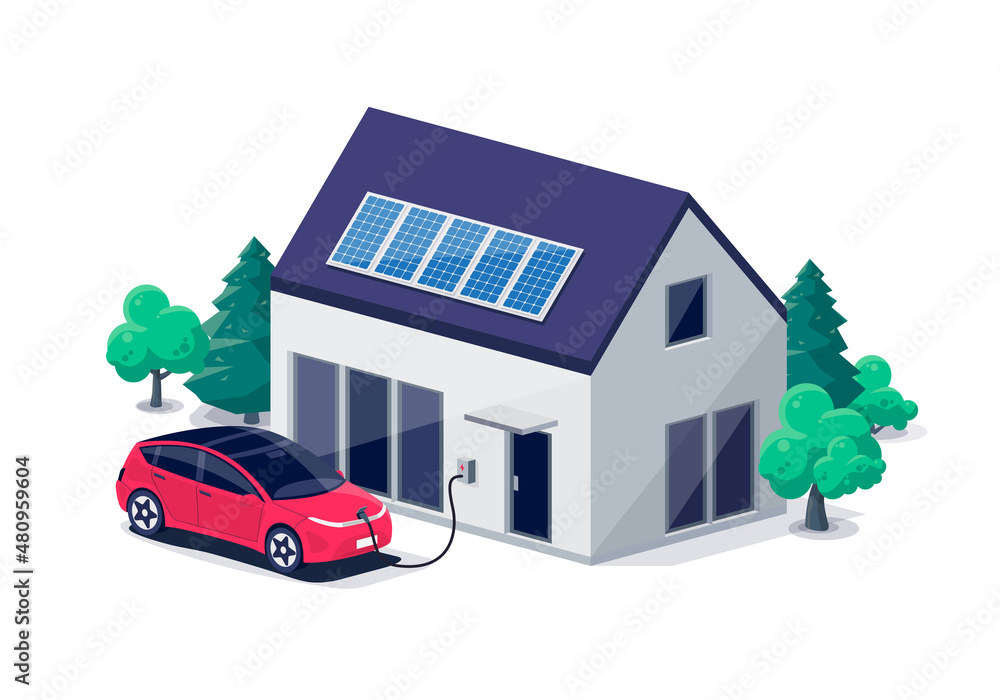
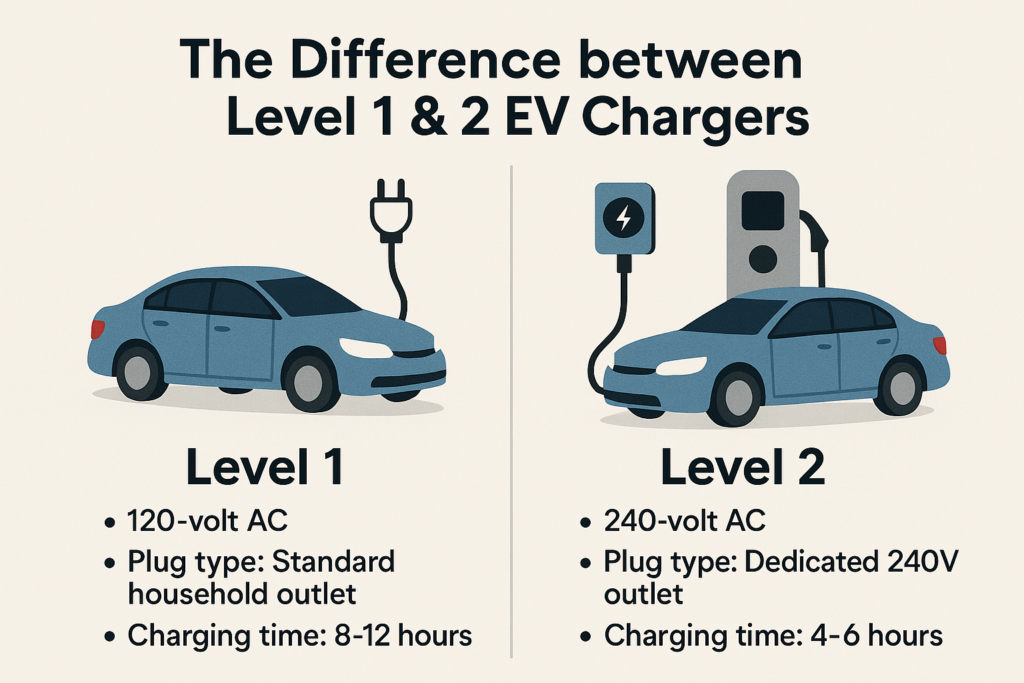
Here is something that happens in China every week in 2026 that almost nobody talks about publicly.
A Chinese EV owner buys a home charger from a Taobao or Pinduoduo listing. The price is ¥380 — significantly less than the ¥899-¥1,499 that established brands charge. The product page shows a GB/T certification marking. The reviews are positive. It arrives, it installs, it appears to work.
For three months, everything is fine.
Then one night, at 2am, while the charger is doing what it does every night — drawing 32 amps continuously for six hours to charge the family BYD — something in the charger’s undersized internal wiring reaches a temperature its cheap insulation cannot handle. The temperature sensor that should detect this and cut power either doesn’t exist or has already failed. The charger begins to smoulder.
Whether the outcome is a destroyed charger, a damaged vehicle, a car park fire, or something worse depends on factors outside the owner’s control — proximity of combustibles, whether anyone wakes up, whether the building’s fire suppression works.
This scenario is not hypothetical. Chinese fire safety authorities report EV charging-related fires as a significant and growing incident category — and investigations consistently identify non-certified or counterfeit-certified charging equipment as a primary contributing factor.
This guide on 3C certification and EV chargers 2026 why buying non-certified chargers is dangerous in China explains the complete certification framework that separates safe Chinese home EV chargers from dangerous ones, the specific failure modes that non-certified chargers introduce, how to verify that a charger you’re considering is genuinely certified, and why the ¥400-¥600 saving from buying uncertified is one of the worst financial decisions available in home EV ownership.
The Chinese EV Charger Certification Framework — What Exists and What It Covers
The terminology around Chinese EV charger certification is genuinely confusing — because multiple certification schemes apply to different aspects of a home EV charger, and manufacturers sometimes use these terms interchangeably or misleadingly. Understanding the full framework prevents both the mistake of assuming any “certified” claim is meaningful and the opposite mistake of assuming no certification can be trusted.
What 3C Certification Is
3C stands for China Compulsory Certification (中国强制认证 — CCC). The “3C” abbreviation comes from the three C’s in the English name.
3C certification is China’s mandatory product safety certification system — equivalent in concept to CE marking in Europe or UL listing in the United States. Products on the mandatory 3C catalogue must be 3C certified before they can legally be sold, imported, or used in China.
The administering body: The 3C certification system is administered by the Certification and Accreditation Administration of China (CNCA — 国家认证认可监督管理委员会) and implemented through accredited certification bodies, most prominently the China Quality Certification Centre (CQC — 中国质量认证中心).
The certification mark: A product with genuine 3C certification carries the 3C mark — a circular design with three Cs — along with a unique certification number that can be verified in the official 3C certification database.
Is 3C Certification Mandatory for Home EV Chargers in China?
This is where Chinese EV charging certification gets specific — and where many buyers are confused by incomplete information.
The direct answer: As of 2026, AC home EV chargers (交流充电桩) used for residential installation in China are subject to 3C certification requirements under the electrical equipment mandatory certification catalogue.
The technical details: Home EV chargers fall under the electrical safety certification requirements applicable to:
- 低压电器 (low-voltage electrical equipment) certification categories
- Consumer electrical equipment safety standards
- Specifically, GB/T 20234.2-2015 compliance which is assessed as part of certification
What 3C certification for a home EV charger covers:
- Electrical insulation quality and breakdown resistance
- Overcurrent protection adequacy
- Thermal performance under sustained load
- Enclosure safety and IP rating verification
- Connector safety and contact quality
- Communication protocol compliance (EVSE handshake)
- EMC (electromagnetic compatibility) — preventing interference with other devices
What 3C certification does NOT cover:
- The long-term reliability of smart features (WiFi, app, scheduling)
- The quality of the charger’s software
- Whether the charger will still function in 5 years
- The manufacturer’s warranty service quality
The GB/T 20234.2-2015 Standard and Its Relationship to 3C
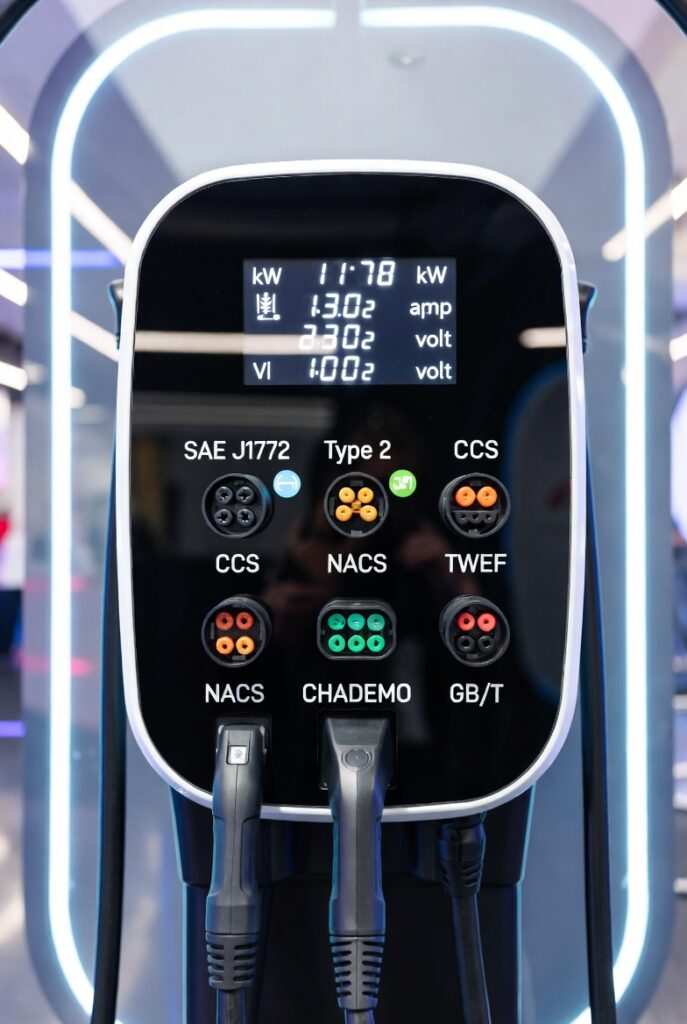
GB/T 20234.2-2015 is the Chinese national standard defining the technical requirements for AC EV charging connectors and vehicle inlets. It is a GB/T standard — a recommended national standard that becomes mandatory when referenced in legal or certification requirements.
The relationship between 3C and GB/T 20234.2: 3C certification for AC home EV chargers requires compliance with the relevant safety standards including GB/T 20234.2-2015. A charger with genuine 3C certification has been tested against these standards by an accredited testing laboratory.
A charger claiming “GB/T 20234.2-2015 compliance” without 3C certification may or may not actually comply — the claim is self-declared without independent testing verification.
The critical distinction:
- “GB/T compliant” (self-claimed, no independent testing): Meaningless without certification
- “3C certified” (independently tested and certified): Meaningful — tested by accredited laboratory
- “GB/T 20234.2-2015 certified with traceable 3C certificate number”: Genuine safety verification
CQC Certification — The Specific Certification Body
The China Quality Certification Centre (CQC — 中国质量认证中心) is the most prominent accredited certification body for EV charger 3C certification in China. When a Chinese EV charger manufacturer goes through proper certification, CQC is the most commonly used certification body.
CQC certification process:
- Manufacturer submits product for testing
- CQC-accredited laboratory tests the product against relevant standards
- CQC reviews test results and factory inspection
- If compliant, CQC issues a certificate with a unique certificate number
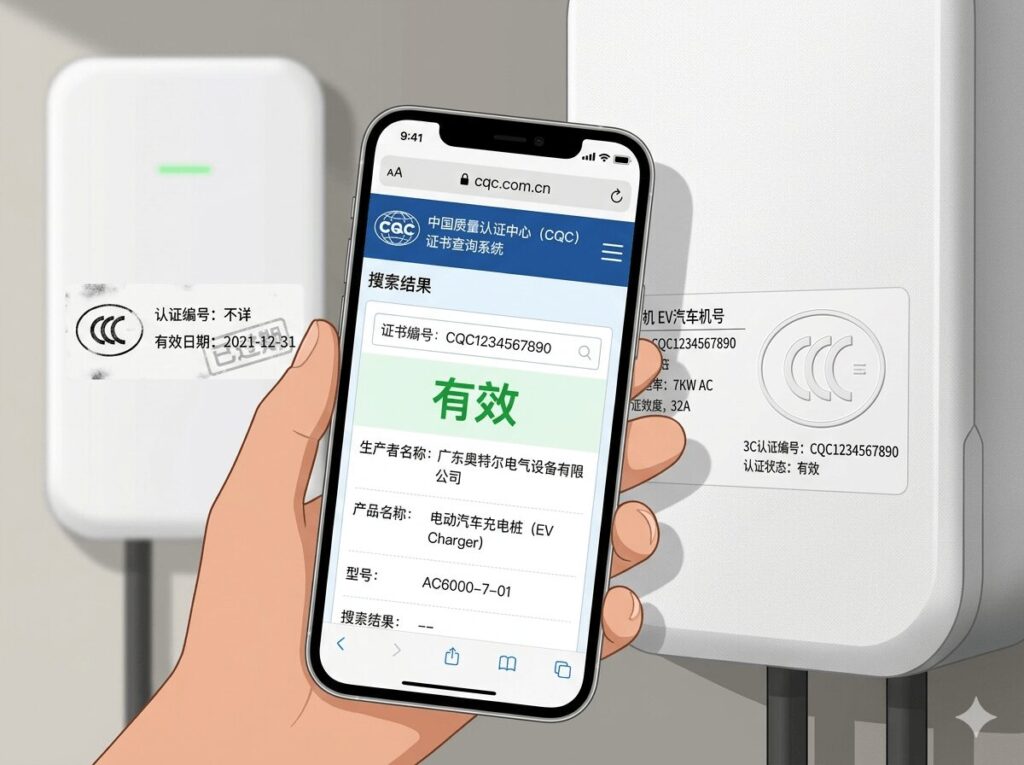
- The certificate appears in CQC’s public database (accessible at cqc.com.cn)
Why CQC certification matters for Chinese EV charger buyers: A CQC certificate number on a charger allows you to verify — in under 2 minutes using the CQC website — whether the certification is genuine, for which specific product, and whether it is currently valid.
This verification capability is the most powerful tool available for Chinese EV charger buyers assessing product safety.
The Specific Dangers of Non-Certified EV Chargers
Understanding what certification testing actually prevents — in specific technical terms — transforms the abstract “buy certified” advice into concrete understanding of what you’re accepting when you don’t.
Danger 1: Undersized Internal Wiring
What certification tests: The internal wiring of a home EV charger must be rated for the continuous current it carries. A 32A charger (7 kW at 220V) draws 32 amps continuously for potentially 8-10 hours per night. Internal wiring must be appropriately sized for this sustained load.
What uncertified manufacturers cut: Using 20A-rated wire in a 32A circuit saves approximately ¥15-¥30 per unit in manufacturing cost. The wire handles 32A initially — it may take months or years for the degradation to become dangerous, during which time the charger appears to work normally.
The failure mode: Undersized wiring operates at elevated temperature during every charging session. Over time, the insulation degrades, the resistance increases (increasing heat further), and eventually thermal runaway occurs. The failure happens during a charging session — typically at night.
Certification protection: IEC and GB/T standards specify minimum conductor sizes for rated currents. 3C testing verifies that the actual conductors in the product meet these specifications — not just that the manufacturer claims they do.
Danger 2: Inadequate Contactor Rating
What a contactor is: The contactor is the internal switching device that opens and closes the charging circuit when a vehicle connects and disconnects. It must reliably switch on and off thousands of times over the charger’s lifespan while carrying the full charging current.
What uncertified manufacturers cut: Using contactors rated for 16A in a 32A circuit, or using contactors with lower rated cycle counts. Cost saving: approximately ¥20-¥50 per unit.
The failure mode: Undersized contactors arc excessively when switching, degrading faster than rated. Eventually the contactor welding — becoming stuck closed (allowing charging to continue when it should stop) or stuck open (preventing charging). Stuck-closed failure is the more dangerous — the charger cannot stop charging on command, including in fault conditions.
Certification protection: Testing verifies contactor ratings against the charger’s specified operating parameters.
Danger 3: Missing or Non-Functional Ground Fault Protection
What certification tests: Ground fault protection (RCCB/RCD functionality) — the charger’s ability to detect and disconnect within milliseconds when current flows through an unintended path (e.g., through a person, through water, through a short circuit to the vehicle chassis).
What uncertified manufacturers cut: Ground fault protection components cost ¥80-¥150 per unit. The cheapest approach is to include a non-functional protection circuit — one that passes visual inspection but doesn’t actually trip on a ground fault.
The failure mode: Ground faults are among the most dangerous electrical failures — they can result in fatal electric shock or fire. Without functional ground fault protection, a ground fault in the charger or vehicle charging system during an overnight session may not be detected until structural damage or injury occurs.
Certification protection: 3C testing includes functional testing of protective devices — they must actually trip under fault conditions, not just be present.
Danger 4: IP Rating Fraud
What certification tests: The stated IP (Ingress Protection) rating — verified through standardised water and dust exposure tests.
What uncertified manufacturers claim: IP55 or IP65 ratings based on no testing whatsoever — or based on testing the enclosure without cable entry points and connector openings that are actually present on the finished product.
The failure mode: A charger claiming IP55 but actually providing IP20-equivalent protection allows moisture ingress during rain, condensation accumulation, or cleaning. Water and electricity produce a predictable outcome.
Certification protection: IP rating testing is performed on the complete product as it would be installed — including cable entries, connector housing, and mounting configuration.
Danger 5: Thermal Protection Absence or Failure
What certification tests: The charger’s thermal protection system — specifically that it activates at specified temperatures and disconnects charging before temperatures reach dangerous levels.
What uncertified manufacturers cut: The temperature sensor and shutdown circuit can be omitted entirely (cost saving: ¥20-¥40) or replaced with a non-functional component that passes visual inspection.
The failure mode: Without thermal protection, a charger in a hot environment (summer underground car parks in southern China can reach 45°C), with a ventilation obstruction, or with an internal fault that increases heat generation, continues operating past safe temperature limits. The progression from overheating to fire can take minutes.
Certification protection: Testing verifies that thermal protection activates within specified temperature limits under controlled test conditions.
Danger 6: Connector Contact Quality Failure
What certification tests: Connector contact resistance, plating quality, and sustained performance under the rated number of insertion cycles.
What uncertified manufacturers cut: Connector contacts with thin plating, lower-grade base metal, or inadequate spring tension. Cost saving: ¥30-¥80 per connector.
The failure mode: Low-quality connector contacts develop increased contact resistance through corrosion, mechanical wear, or oxidation faster than certified equivalents. Increased contact resistance generates heat at the connection point — concentrated in the connector housing, which is directly adjacent to the vehicle’s charging inlet. Connector fires from degraded contacts are a documented failure mode in non-certified charging equipment.
Certification protection: Contact resistance testing and accelerated lifecycle testing verify contact quality.
Danger 7: EMC (Electromagnetic Compatibility) Failure
What certification tests: The charger’s electromagnetic emissions — ensuring it doesn’t interfere with other electronic devices in the vicinity.
What uncertified manufacturers skip: EMC testing is expensive (¥5,000-¥20,000 for a complete EMC test campaign) and requires engineering investment in suppression components. Non-certified chargers typically skip EMC compliance entirely.
The failure mode: Non-compliant EMC emissions from a 7 kW charger operating for 8 hours per night can interfere with WiFi routers, smart home devices, vehicle electronics, and in worst cases, implanted medical devices. The health and safety implications of persistent EMC interference from overnight charging are difficult to trace but real.
Certification protection: EMC testing verifies that emissions are within legal limits.
The Counterfeit Certification Problem — How It Works and How to Spot It
The most dangerous category of non-certified charger is not the product that makes no certification claims — it is the product that displays a fake or misappropriated 3C or GB/T certification mark that it did not earn through independent testing.
How Fake Certification Works
Method 1: Copied certification numbers A manufacturer takes the genuine 3C certificate number from a different, certified product — sometimes from a completely different product category — and prints it on their product. The number appears genuine because it exists in the 3C database, but it was issued for a different product by a different manufacturer.
Method 2: Expired certificate reuse A manufacturer whose product was genuinely certified at one point — but whose certificate has since expired due to product changes or failure to maintain certification — continues printing the old certificate number on new products.
Method 3: Fabricated certificate numbers Certificate numbers that follow the correct format but were never issued — designed to look authentic to buyers who don’t verify them.
Method 4: Genuine mark, different model A manufacturer certifies one version of their product (with proper components) and then produces a lower-cost version for sale (with substandard components) using the certified model’s certificate number.
How to Verify a Certification Certificate Number — Step by Step
The 2-minute verification process:
Step 1: Obtain the certificate number from the product — it should appear on the product label, in the packaging documentation, or on the manufacturer’s product specification sheet.
Step 2: Visit the CQC certificate verification website: www.cqc.com.cn
Step 3: Navigate to the certificate query function (证书查询)
Step 4: Enter the certificate number in the search field
Step 5: Verify:
- Does the certificate exist?
- Is it currently valid (有效) or has it expired (撤销/暂停)?
- Does the certificate holder (证书持有人) match the product’s stated manufacturer?
- Does the product description on the certificate match the product you’re evaluating?
- Does the model number on the certificate match the product’s stated model number?
A genuine 3C certification for a home EV charger will show:
- Certificate status: 有效 (valid)
- Certificate holder: The manufacturer’s registered company name
- Product category: Related to EV charging or low-voltage electrical equipment
- Model number(s): Matching the specific model you’re purchasing
A failed verification (any of the following) indicates a non-certified product:
- Certificate number not found
- Certificate is expired or suspended
- Certificate holder doesn’t match the manufacturer
- Product description doesn’t match an EV charger
- Model number on certificate doesn’t match the product
The Real Cost of Non-Certified Chargers — Beyond the Fire Risk
The safety risks of non-certified chargers are the primary argument against them — but the financial risks are also significant and worth understanding explicitly.
The Insurance Void
Chinese household insurance and EV charger claims: Standard Chinese household insurance policies (家庭财产保险) typically exclude damage caused by electrical equipment that is not certified to applicable Chinese standards. A fire caused by a non-certified home EV charger may void your household insurance policy entirely — not just for the charger itself but for the entire fire-related claim.
In 2026 Chinese insurance practice, fire investigations from EV charging incidents routinely examine the certification status of the charging equipment. An insurer who discovers a non-certified charger was involved in a fire has grounds to deny the claim under policy exclusions for non-compliant electrical equipment.
The financial exposure: A fire in an underground car park in a Chinese residential compound can cause:
- Direct damage to your vehicle: ¥100,000-¥500,000
- Damage to adjacent vehicles: ¥50,000-¥1,000,000+
- Structural damage to the car park: ¥100,000-¥2,000,000+
- Legal liability to neighbours and the compound
The insurance void from a non-certified charger transforms a ¥300-¥600 saving into potential personal liability of ¥500,000-¥3,000,000+.
The 物业 Installation Refusal
Chinese 物业 companies that process EV charging applications review the charger’s certification status as part of their safety assessment. A non-certified charger will be — and legally must be — rejected by any properly functioning 物业 approval process.
An owner who has already purchased a non-certified charger faces the choice of starting the purchase process over (with a genuine certified product) or attempting to install without 物业 approval — the latter creating additional legal exposure.
The Utility Meter Rejection
The electricity supply bureau (国家电网/南方电网) meter installation process also involves review of the connected equipment’s certification status. A non-certified charger may cause the utility to refuse the dedicated meter application — delaying or preventing the entire home charging setup.
The Resale Value Impact
A home with an installed non-certified EV charger is a liability rather than an asset. Any property purchaser or rental tenant who discovers the charger is non-certified inherits the safety and legal risks — creating a negotiation issue and potential deal-breaker in property transactions.
The Chinese Online Marketplace Problem — Why Non-Certified Chargers Are Everywhere
Understanding why non-certified chargers are so common in Chinese online marketplaces prevents the assumption that a product listed on Tmall, JD.com, or Taobao must be safe.
The Economics of Cheap Charger Manufacturing
A certified 7 kW home EV charger from an established manufacturer (StarCharge, TELD, Autel) costs ¥899-¥1,599 retail. The manufacturing cost breakdown is approximately:
| Component | Cost (certified) | Cost (non-certified) |
|---|---|---|
| Enclosure and hardware | ¥150-200 | ¥80-120 |
| Internal wiring (full rating) | ¥60-80 | ¥20-30 |
| Contactor (full rating) | ¥80-120 | ¥30-50 |
| Connector (certified) | ¥80-120 | ¥30-60 |
| Control board | ¥80-100 | ¥40-60 |
| Thermal protection | ¥25-40 | ¥0-10 |
| RCCB/protection | ¥80-120 | ¥0-20 |
| Certification costs (amortised) | ¥30-60 | ¥0 |
| Testing and QC | ¥30-50 | ¥5-15 |
| Total manufacturing | ¥615-890 | ¥205-365 |
The margin structure: A non-certified manufacturer selling a charger at ¥380 on Pinduoduo makes approximately ¥15-¥175 margin per unit on a volume basis — viable as a business while eliminating every safety-critical component that certification requires.
The Review Manipulation Problem
The 4.9-star reviews on cheap uncertified chargers on Chinese e-commerce platforms reflect the reality that most non-certified chargers work adequately for months or years before failing — and many fail in ways that are inconvenient rather than catastrophic. The buyer whose cheap charger stopped working after 14 months leaves a negative review; the buyer whose charger is still working at 8 months leaves a positive one. The buyer whose charger caused a fire is not posting reviews.
This survivorship bias in reviews creates a false positive picture that misleads buyers evaluating non-certified products.
Platform Responsibility and Its Limits
Tmall, JD.com, Taobao, and Pinduoduo all have policies requiring certified products in safety-critical categories. In practice, enforcement is imperfect — particularly on Taobao and Pinduoduo where third-party sellers can list products without the same verification scrutiny as established brand stores.
The safest purchasing channels for Chinese EV chargers:
- Official brand flagship stores on Tmall (官方旗舰店) — StarCharge, TELD, Autel, Xiaomi, Huawei official stores
- JD.com自营 (JD.com self-operated) — products sold and fulfilled by JD directly rather than third-party sellers
- Manufacturer direct (brand official website or WeChat mini programme)
- Authorised dealers — electrician companies and EV charging installation services with established brand relationships
Higher risk channels:
- Individual Taobao stores with no established brand history
- Pinduoduo group-buying listings for electrical equipment
- WeChat private group purchasing for “wholesale” chargers
- Any listing where the seller is identified as “个人” (individual) rather than a registered company
The Certification Verification Checklist — Before You Buy Any Chinese EV Charger
Use this checklist before purchasing any home EV charger for use in China:
Step 1: Identify the Certification Claims
Look for:
- 3C certification mark (三C认证标志) on the product or packaging
- Specific certificate number — a formatted alphanumeric code, not just “GB/T certified”
- CQC certification documentation in the product listing or available on request
Red flag: Any of the following without a traceable certificate number:
- “GB/T认证” without a certificate number
- “国家认证” without specifying which certification
- “符合GB/T 20234.2标准” (complies with standard) — self-declared compliance without independent certification
Step 2: Verify the Certificate Number
- Visit www.cqc.com.cn
- Enter the certificate number in 证书查询
- Confirm: certificate exists, is valid, holder matches manufacturer, product matches charger
Time required: Under 2 minutes What to do if verification fails: Do not purchase the product. Find an alternative with verifiable certification.
Step 3: Verify the Manufacturer
- Is the manufacturer a registered Chinese company? (Check on 国家企业信用信息公示系统 — gsxt.gov.cn)
- Does the company have a verifiable business address and contact information?
- Does the company appear in established Chinese EV charging industry directories?
Red flag: Manufacturers with names like “深圳市新能源科技有限公司” (generic names) and no verifiable business history — these can be shell companies for counterfeit product distribution.
Step 4: Check the Price Sanity
- Does the price seem realistic for a genuinely certified product?
Reference prices (2026):
- Basic certified 7 kW charger (no smart features): ¥580-¥780 minimum
- Smart certified 7 kW charger: ¥899-¥1,499 minimum
Any 7 kW charger priced below ¥500 should be treated with strong scepticism. At below ¥400, genuine 3C certification is economically implausible given manufacturing cost realities.
Step 5: Verify the Purchase Channel
- Is this an official brand store (官方旗舰店) or established authorised seller?
- Is the product sold and fulfilled by JD (京东自营) if purchasing on JD?
- Can you trace the seller to a registered business entity?
The Certification Comparison — Genuine vs Fake at a Glance
| Feature | Genuinely Certified Charger | Fake-Certified / Non-Certified Charger |
|---|---|---|
| 3C mark present | ✅ Yes | ⚠️ Sometimes (fake) / ❌ No |
| Certificate number | ✅ Specific, traceable | ⚠️ Copied/fabricated / ❌ Absent |
| CQC database verification | ✅ Passes | ❌ Fails |
| Manufacturer match | ✅ Verified | ❌ Mismatch |
| Internal wiring gauge | ✅ Full rating | ❌ Undersized |
| Contactor rating | ✅ Full rating | ❌ Undersized |
| RCCB protection | ✅ Functional | ❌ Absent or non-functional |
| Thermal protection | ✅ Functional | ❌ Absent or non-functional |
| IP rating | ✅ Tested | ❌ Self-declared |
| EMC compliance | ✅ Tested | ❌ Untested |
| Insurance coverage | ✅ Maintained | ❌ Potentially voided |
| 物业 acceptance | ✅ Required | ❌ Grounds for rejection |
| Price range | ¥580+ | ¥200-¥500 |
The Affordable Certified Options — You Don’t Have to Choose Between Safe and Cheap
The most important practical message of this guide: you do not have to pay ¥2,000+ for a safe, certified home EV charger in China.
As covered in our best budget EV chargers under ¥2,000 2026 Chinese options that actually work guide, genuinely certified options start at:
¥580-¥780: ChargeWay CW-J7032
- Genuine GB/T 20234.2-2015 certification with traceable certificate
- 7 kW hardwired charging
- Full safety protection suite
- 2-year warranty
- No smart features — use car timer for TOU scheduling
¥899-¥1,099: StarCharge S1
- Genuine 3C/CQC certification
- 7 kW smart charging with TOU scheduling
- 3-year warranty
- Full safety protection
- Nationwide service network
These products are the bottom of the genuine certified market — not bargain-basement safety compromises. The ¥200-¥400 premium over the cheapest uncertified Taobao listings is the price of knowing your charger won’t burn down your car park.
What Chinese Fire Investigations Tell Us — The Real-World Data
Chinese fire investigation authorities have published findings from EV-charging-related fire incidents that directly address the certification question. Key findings from publicly available incident investigation summaries:
Common factors in EV charging fire incidents:
- Non-certified or counterfeit-certified charging equipment is identified as a contributing factor in the majority of equipment-originated charging fires
- The most common specific failure modes are thermal protection absence/failure and undersized internal wiring — exactly the components that certification testing verifies
- Incidents disproportionately occur during overnight charging sessions when the charger is operating at sustained maximum load for extended periods
The investigator’s conclusion (paraphrased from multiple published findings): Purchasing price is not a reliable indicator of safety in China’s home EV charger market. The only reliable indicator of a charger’s safety compliance is independent third-party certification with a verifiable certificate number.
For EV Owners Who Have Already Installed a Non-Certified Charger
This section addresses a practical reality: some readers of this guide will have already installed a non-certified charger, purchased in good faith based on apparent certification marks or product descriptions.
The Honest Assessment
If you have an installed charger and are uncertain about its certification status:
Step 1: Check the certificate number now Locate the certificate number on the charger unit or its documentation. Run the CQC verification as described above. If the verification passes — the charger is genuine, proceed normally.
Step 2: If verification fails or no certificate number exists
This is a serious finding requiring action. The charger may be operating safely today — but it lacks the independent testing verification that confirms it will continue to do so under sustained load conditions over time.
Immediate risk reduction measures:
- Reduce charging to daytime hours when someone is present and can respond to a fault
- Avoid charging at maximum rate (if the charger has adjustable amperage, reduce from 32A to 16A — halving the thermal stress)
- Never leave charging unattended for extended periods
- Check the charger enclosure temperature during a charging session — it should be warm but not hot. Hot to touch is a warning sign.
The replacement decision: A non-certified charger that has been identified as such should be replaced. The timeline depends on your assessment of the risk — but a ¥899 StarCharge S1 replacement is the appropriate action. The cost is under 1 month of TOU savings from the new charger.
Do not leave a non-certified charger in operation indefinitely after identifying it as non-certified. The information has value only if acted upon.
Internal Links — Further Reading on Clean Energy Bazaar
The 3C certification and EV chargers 2026 why buying non-certified chargers is dangerous in China guide is the safety foundation for the entire Chinese market content cluster.
For the budget charger guide that identifies the lowest-price genuinely certified options available in China, our best budget EV chargers under ¥2,000 2026 Chinese options that actually work guide covers affordable certified options. For the full charger comparison covering the certified brands that represent the safe choice across all price tiers, our best home EV chargers 2026 top 7 comparison for Chinese homeowners Star Charge Autel guide covers the complete certified market. For the technical specifications guide that explains what GB/T 20234.2-2015 requires in plain language, our understanding EV charger specs 2026 kW amps 800V architecture and the new GB standards guide covers every standard. For the troubleshooting guide that helps identify the warning signs of non-certified charger failure before it becomes dangerous, our troubleshooting home EV chargers common fixes for US and European models guide covers fault diagnosis relevant to Chinese and international chargers. For the warranty comparison that covers how certification status affects warranty validity and insurance coverage, our EV charger warranty comparison 2026 best coverage from top brands guide covers every warranty dimension. And for the complete buying process from 物业 approval through to installation that ensures certified equipment is specified throughout, our find the right EV charger for your home China edition guide covers every step.
Final Thoughts
The 3C certification and EV chargers 2026 why buying non-certified chargers is dangerous in China argument comes down to a single calculation that every Chinese EV buyer should make once and then never revisit.
The financial saving from buying a non-certified ¥380 charger versus a certified ¥899 StarCharge S1 is ¥519.
The potential financial exposure from a non-certified charger fire — insurance void, vehicle damage, adjacent vehicle damage, structural damage, legal liability — ranges from ¥200,000 to ¥3,000,000+.
The probability of a non-certified charger causing a fire is difficult to quantify precisely — but Chinese fire investigation data consistently identifies non-certified equipment as a primary contributing factor in charging-related fires.
The expected value calculation — probability of fire × financial exposure — exceeds ¥519 at any probability above approximately 0.02%. Given that non-certified chargers eliminate every safety system that certification testing verifies, 0.02% is a significant underestimate of the actual risk.
This is not a close call. The ¥519 saving is not worth it.
Buy certified. Verify the certificate number. Use this guide to confirm you have a genuine product. Then charge safely.
The StarCharge S1 at ¥899 with a verified CQC certificate number will charge your EV every night for the next five years without requiring you to think about fire risk. That peace of mind is worth every yuan of the ¥519 difference — and the annual ¥1,670 TOU saving will pay for the entire charger in under 8 months anyway.
There is no financial, practical, or rational argument for buying a non-certified home EV charger in China in 2026. There is only the seductive but misleading appeal of a lower number on a product page.