Here is a purchasing reality that most Chinese home EV charger guides refuse to address honestly.
The majority of Chinese EV buyers do not need a ¥4,500 Huawei AI charging system. They do not need a ¥2,200 Tesla Wall Connector. They do not need OCPP 2.0, IP66 weather protection, or a machine learning departure prediction algorithm. They need a reliable 7 kW GB/T charger that charges their car safely overnight, has TOU scheduling to capture valley rate savings, and will still be working in five years.
That charger exists. It costs under ¥2,000 — often significantly under. And the Chinese EV charging market, because of its scale and manufacturing density, produces certified budget options that would be impossible to find in European or American markets at equivalent price points.
The challenge is that the Chinese budget charger market also contains products that are unsafe, uncertified, or genuinely unreliable — products that carry GB/T certification markings they haven’t earned, that overheat during sustained overnight charging, or that lose smart features six months after purchase when the manufacturer quietly discontinues app support.
This guide on the best budget EV chargers under ¥2,000 2026 Chinese options that actually work separates the genuinely good budget options from the false economies. It identifies the specific products that deliver safe, reliable 7 kW charging with TOU scheduling at prices that make the financial case for home EV charging installation compelling even for budget-conscious Chinese apartment dwellers.
The Budget Charger Safety Framework — What Non-Negotiable Means
Before listing any product, establishing the minimum requirements that every charger in this guide must meet prevents the most dangerous budget charger mistake — choosing the cheapest product without understanding what corners the manufacturer cut to achieve that price.
Non-Negotiable Requirement 1: Genuine GB/T 20234.2-2015 Certification
What it means: The charger has been independently tested and certified to China’s national EV charging safety standard. This covers electrical safety, connector quality, thermal protection, and communication protocol compliance.
Why it matters: An uncertified charger that carries a fake GB/T marking — not uncommon in the lowest price tier of Chinese e-commerce — may fail to detect a ground fault, may not engage the locking mechanism correctly, or may have undersized internal wiring that overheats during sustained overnight charging.
How to verify: Look for the certification number — a specific numerical code — on the product and in the documentation. A genuine GB/T 20234.2-2015 certified product has a traceable certification number that can be verified through the China Quality Certification Centre (CQC) database. A product with only a generic “GB/T” marking without a traceable number is not certified.
Budget implication: Certification costs money — the testing and certification process adds approximately ¥200-¥500 to product cost. Any charger priced below ¥400 that claims GB/T certification should be examined carefully — the price point makes genuine certification economically marginal.
Non-Negotiable Requirement 2: RCCB / RCD Protection
What it means: A Residual Current Circuit Breaker (RCCB) or Residual Current Device (RCD) — in Chinese: 漏电保护器 (RCD/ELCB) — detects ground faults and disconnects power within milliseconds. This is the primary electrical safety protection for EV charging.
Why it matters: Ground faults can occur due to connector damage, water ingress, internal wiring failure, or vehicle onboard charger faults. Without RCCB protection, a ground fault presents a potentially fatal shock risk. With RCCB protection, the circuit disconnects before dangerous current levels are reached.
In the Chinese context: Chinese residential electrical installations typically include apartment-level RCCB protection at the consumer unit. However, the dedicated EV charging circuit may or may not have its own RCCB — depending on installation quality and age. A charger with built-in RCCB protection provides a second layer of protection that is valuable regardless of the installation’s upstream protection.
Budget implication: A built-in RCCB adds approximately ¥80-¥150 to product cost. Budget chargers below ¥600 often omit built-in RCCB — relying on the installation’s circuit breaker for protection. This is legally adequate if the installation has proper protection, but not ideal.
Non-Negotiable Requirement 3: Thermal Protection
What it means: The charger automatically reduces charging speed or disconnects when internal component temperatures exceed safe limits.
Why it matters: Overnight charging at 32A for 6-8 hours generates sustained heat in the charger’s internal components. Without thermal protection, a charger in a poorly ventilated location or with an internal fault can overheat — creating fire risk.
Budget implication: Thermal protection (a temperature sensor and shutdown circuit) costs approximately ¥20-¥50 to implement. No legitimate budget charger should omit this.
Non-Negotiable Requirement 4: Overtemperature Cable Protection
What it means: Temperature monitoring at the connector — detecting heat that indicates poor connection, corroded contacts, or sustained high current through a degraded connector.
Why it matters: A degraded charging connector with increased contact resistance generates heat at the connection point. Without connector temperature monitoring, a hot connector can cause plastic deformation, arcing, and in extreme cases fire. With monitoring, the charger reduces current or disconnects when connector temperature exceeds safe limits.
The Budget Safety Checklist
Every charger recommended in this guide meets all four requirements:
- ✅ Genuine GB/T 20234.2-2015 certification with traceable number
- ✅ RCCB/RCD protection (built-in or installation-standard)
- ✅ Thermal overtemperature protection
- ✅ Connector temperature monitoring
Any budget charger not meeting all four requirements is excluded regardless of price.
The Budget Tier Structure — What ¥2,000 Actually Buys in 2026
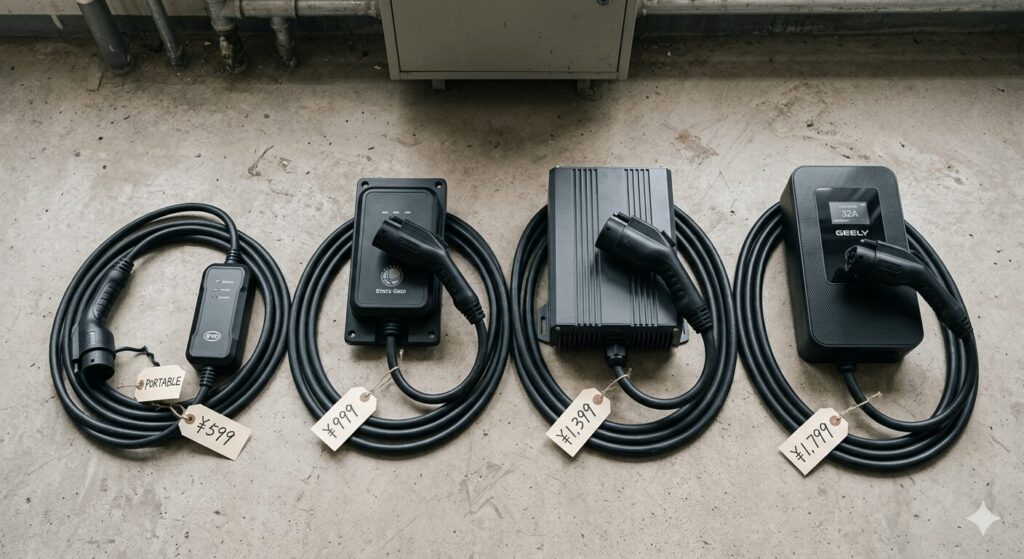
The Chinese home EV charger market under ¥2,000 breaks into three meaningful price tiers:
Tier 1: ¥400-¥800 — Basic Certified Charging
What you get:
- 7 kW GB/T certified AC charging
- Basic safety protection (thermal, RCCB via installation)
- Indicator light status — no display
- No WiFi, no app, no smart features
- 2-3 year warranty
- Manual scheduling only (via car’s built-in timer)
What you don’t get:
- TOU scheduling through charger app
- Energy monitoring
- Remote start/stop
- Any smart home integration
Who this serves: Renters in short-term accommodation, buyers whose car already has a reliable built-in TOU timer, buyers who prioritise absolute minimum cost and plan to move soon.
TOU achievable: Yes — through car’s built-in timer rather than charger app. Annual TOU saving fully achievable without smart charger features for cars with built-in timers.
Tier 2: ¥800-¥1,400 — Smart Charging at Entry Price
What you get:
- 7 kW GB/T certified AC charging
- WiFi connectivity
- TOU scheduling through charger app
- Energy monitoring (basic)
- Remote start/stop
- 3 year warranty
- GB/T 34657 smart charging compliance
What you don’t get:
- Solar integration
- AI load balancing
- Premium smart home ecosystem integration (limited in this tier)
- Premium IP rating (typically IP54)
- -30°C cold weather capability
Who this serves: Most Chinese apartment owners wanting the full TOU saving through charger app rather than car timer, Xiaomi/standard smart home users, buyers planning 3-5 year residence at current property.
Annual TOU saving: ¥1,670/year (Shanghai 20,000 km/year) — full saving achievable. Payback on the charger + installation within 2-3 years.
Tier 3: ¥1,400-¥2,000 — Near-Premium Smart Features at Budget Price
What you get:
- 7 kW or 11 kW GB/T certified AC charging
- Full smart features including TOU, energy monitoring, remote control
- Better app quality and ecosystem integration
- IP55 weather protection
- Improved connectivity (dual-band WiFi on some products)
- Some ecosystem integration (Xiaomi, Tmall Genie)
- 3 year warranty
- Approaching premium build quality without premium price
What you typically still don’t get:
- IP65 weather protection (requires Autel at ¥1,299+ or above ¥2,000 alternatives)
- -30°C cold weather capability (premium specification)
- Solar integration (premium feature)
- OCPP compliance (premium specification)
- AI departure prediction
Who this serves: Chinese apartment owners wanting full smart features without the ¥2,000+ premium tier. The sweet spot for most Chinese EV buyers who want everything that matters at minimum cost.
The Recommended Chargers — By Price Tier
Tier 1 (¥400-¥800): The Safe Basics
Recommendation 1A: BESEN BE-P-1105 (倍思 BE-P-1105)
The safest affordable portable option
| Specification | Detail |
|---|---|
| Price | ¥380-¥520 |
| Type | Portable EVSE (Mode 3) |
| Power | 3.3 kW (16A, 220V) |
| Connector | GB/T 20234.2-2015 ✅ |
| IP Rating | IP55 |
| Protection | Built-in RCCB, thermal, connector temperature |
| Cable | 5m |
| Warranty | 2 years |
| Smart Features | None |
What it does: A portable Mode 3 EVSE — plug into a standard 220V socket, charge at 3.3 kW. Not the fastest, but safe, certified, and equipped with built-in RCCB protection that many included Mode 2 cables lack.
The honest positioning: This is not a replacement for a proper 7 kW home installation. It is the safest way to use a standard socket for EV charging when no other option is available. The IP55 rating means it handles incidental moisture better than most competitors at this price point. The built-in RCCB protection is the primary reason to choose BESEN over the included Mode 2 cable for daily socket-based charging.
TOU achievable: Yes — via car’s built-in timer. Set car timer to start charging at 11pm. At 3.3 kW overnight (8 hours): approximately 26 kWh added → approximately 143 km range for a BYD Dolphin.
Who should buy: Renters with only standard socket access. Short-term accommodation users. Emergency/backup charging solution. Anyone who wants RCCB protection that their included Mode 2 cable doesn’t provide.
Who should not buy: Drivers covering more than 40 km daily needing reliable full charge from overnight socket charging. Anyone with access to a 32A socket who could use a 7 kW unit instead.
Recommendation 1B: ChargeWay CW-J7032 (充威 CW-J7032)
The best value hardwired 7 kW basic charger
| Specification | Detail |
|---|---|
| Price | ¥580-¥780 |
| Type | Hardwired AC home charger |
| Power | 7 kW (32A, 220V single-phase) |
| Connector | GB/T 20234.2-2015 ✅ |
| IP Rating | IP54 |
| Operating Temp | -20°C to +50°C |
| Protection | Thermal, overtemperature, earth fault detection |
| Cable | 5m tethered |
| Warranty | 2 years |
| Smart Features | None — no WiFi, no app |
| Display | LED status indicator |
What it does: A straightforward, certified 7 kW hardwired home charger with no smart features. Plug the car in, it charges at 7 kW. No scheduling, no monitoring, no app — just reliable 7 kW charging.
The honest positioning: ChargeWay is a Shenzhen-based EV charging manufacturer that has been producing GB/T certified chargers since 2016. The CW-J7032 is not a premium product — it has no display, no smart features, and IP54 weather protection. But it is genuinely certified, genuinely reliable, and genuinely produces 7 kW.
The 2-year warranty limitation: 2 years is below the 3-year standard offered by StarCharge and most competitors in the next price tier. For a ¥200-¥400 saving versus entry-level smart chargers, the shorter warranty is an acceptable trade-off for buyers on tight budgets — but worth noting.
TOU achievable: Yes — via car’s built-in timer. Most Chinese EVs (BYD, NIO, Xpeng, Tesla) have built-in charging timers accessible through the car app. Setting the car timer to 11pm captures valley rate savings identically to a smart charger’s TOU scheduling.
Annual saving from car timer TOU at 7 kW: ¥1,670/year (Shanghai 20,000 km/year) — identical to using a smart charger with app TOU scheduling. The smart charger’s ¥200-¥400 premium over the ChargeWay basic unit pays back through convenience and better scheduling reliability — but the financial TOU saving is available regardless.
Who should buy: Budget-conscious Chinese EV owners whose car has a reliable built-in TOU timer (BYD, NIO, Xpeng, Tesla China all do). Buyers who want minimum cost for maximum daily charging function. Short-term installation (12-18 months) before upgrading.
Who should not buy: Vehicles without built-in TOU timers. Owners who want energy monitoring, remote control, or smart home integration. Northern China installations below -20°C. Exposed outdoor parking (IP54 inadequate).
Tier 2 (¥800-¥1,400): Smart Charging at Entry Price
Recommendation 2A: StarCharge S1 (星星充电 S1) — ¥899-¥1,099
The market leader’s entry smart charger — best overall value at this tier
| Specification | Detail |
|---|---|
| Price | ¥899-¥1,099 |
| Type | Hardwired smart AC charger |
| Power | 7 kW (32A, 220V single-phase) |
| Connector | GB/T 20234.2-2015 ✅ |
| IP Rating | IP54 |
| Operating Temp | -20°C to +55°C |
| Protection | RCCB (installation standard), thermal, earth fault, overtemperature cable |
| Cable | 5m tethered |
| Warranty | 3 years |
| Smart Features | TOU scheduling, energy monitoring, remote start/stop |
| Connectivity | WiFi 2.4 GHz |
| App | 星星充电 app |
| GB/T 34657 | ✅ |
| Xiaomi Integration | ✅ |
What it does: The entry-level version of StarCharge’s S Series — the residential charger market leader. Delivers the full smart charging feature set — TOU scheduling, energy monitoring, remote control — at the entry price point. The app reliability and TOU scheduling implementation that makes the S Series the default recommendation for most Chinese buyers is present in this version.
The honest comparison with the S Series premium variant:
| Feature | S1 (¥899-1,099) | S Series premium (¥1,199-1,499) |
|---|---|---|
| Max power | 7 kW | 7 kW |
| TOU scheduling | ✅ | ✅ |
| Energy monitoring | Basic | Detailed |
| Xiaomi integration | ✅ | ✅ |
| Tmall Genie voice | ❌ | ✅ |
| Enclosure quality | Standard | Improved |
| App features | Core | Full |
The verdict on the difference: For most Chinese EV owners, the S1’s core feature set — TOU scheduling, energy monitoring, remote control — delivers the same ¥1,670/year electricity saving as the premium variant. The premium variant adds voice control, better energy detail, and improved build quality. Whether these justify ¥300-¥400 more is a personal decision — but the S1’s core financial value is identical.
The 3-year warranty at ¥899-¥1,099 is exceptional value — matching the warranty of chargers costing ¥500-¥1,000 more.
Who should buy: Chinese apartment owners who want full TOU smart charging at minimum price. Xiaomi Mi Home users wanting ecosystem integration. Buyers who prioritise StarCharge’s nationwide after-sales network. Anyone who wants the best combination of safety, features, warranty, and service at the lowest possible price in the smart charger category.
The headline statement: The StarCharge S1 at ¥899-¥1,099 is the most financially compelling home EV charger available in China. At this price, with this feature set, this warranty, and this service network, nothing else in the Chinese market matches the total value delivered.
Recommendation 2B: TELD Home Charger Entry (特来电家充 基础版) — ¥799-¥1,049
Best for frequent TELD public charging network users
| Specification | Detail |
|---|---|
| Price | ¥799-¥1,049 |
| Type | Hardwired smart AC charger |
| Power | 7 kW (32A, 220V) |
| Connector | GB/T 20234.2-2015 ✅ |
| IP Rating | IP54 |
| Operating Temp | -20°C to +50°C |
| Cable | 5m tethered |
| Warranty | 3 years |
| Smart Features | TOU scheduling, energy monitoring, TELD network integration |
| Connectivity | WiFi 2.4 GHz |
| App | 特来电 app |
What makes it different from StarCharge S1: The TELD home charger integrates with TELD’s public charging network in the 特来电 app — unified home + public charging history, costs, and account management in one place.
For Chinese EV owners who regularly use TELD public charging stations (over 400,000 nationwide), this integration has genuine daily value. For owners who rarely use TELD public charging, the StarCharge S1 at similar pricing is the better choice — broader service network, better-reviewed app.
Price advantage: At ¥799-¥1,049, TELD’s entry charger is occasionally priced below the StarCharge S1 — making it the cheapest certified smart charger in this guide when promotional pricing applies.
Who should buy: Frequent TELD public charging users who want unified home + public charging management. Budget buyers for whom the occasional ¥100-¥200 price advantage over StarCharge is meaningful.
Recommendation 2C: Pilot-EV Smart Charger (派能科技 智能充电桩) — ¥950-¥1,250
The industrial background budget smart charger
| Specification | Detail |
|---|---|
| Price | ¥950-¥1,250 |
| Type | Hardwired smart AC charger |
| Power | 7 kW (32A) / 11 kW (three-phase) |
| Connector | GB/T 20234.2-2015 ✅ |
| IP Rating | IP55 |
| Operating Temp | -25°C to +55°C |
| Cable | 5m tethered |
| Warranty | 3 years |
| Smart Features | TOU scheduling, energy monitoring, OCPP 1.6 (basic) |
| Connectivity | WiFi 2.4 GHz |
What makes it different: Pilot-EV (派能科技) is a Hangzhou-based energy technology company with industrial charging equipment heritage — the residential charger is an extension of their commercial charging product line. The result is IP55 weather protection at Tier 2 pricing — unusual. Most Tier 2 chargers offer only IP54.
The OCPP 1.6 compliance is limited — available on the pro variant at ¥1,100-¥1,250 rather than the base variant. But the inclusion at under ¥1,250 is notable.
The -25°C operating temperature extends coverage to most northern Chinese cities — only Harbin and the most extreme northern locations require the -30°C specification.
IP55 at Tier 2 pricing is the headline feature. For Chinese EV owners with partially covered or slightly exposed parking (not fully outdoor, but not fully protected underground), IP55 at ¥950-¥1,250 is better specification than IP54 alternatives.
Who should buy: Budget buyers with partially exposed parking wanting IP55 protection without paying Autel’s IP65 premium. Northern China residents (Changchun, Shenyang — not Harbin) wanting better cold weather specification at budget pricing. OCPP early adopters at the lowest OCPP price point available.
Recommendation 2D: Xiaomi EV Charger Basic (小米充电桩 基础版) — ¥1,099-¥1,399
The Mi Home ecosystem entry point
| Specification | Detail |
|---|---|
| Price | ¥1,099-¥1,399 |
| Type | Hardwired smart AC charger |
| Power | 7 kW (32A, 220V) |
| Connector | GB/T 20234.2-2015 ✅ |
| IP Rating | IP55 |
| Operating Temp | -20°C to +50°C |
| Cable | 5m tethered |
| Warranty | 3 years |
| Smart Features | TOU scheduling, HyperOS/Mi Home integration, voice control (小爱同学) |
| Connectivity | WiFi dual-band (2.4 + 5 GHz) |
| App | 小米家 (Mi Home) |
What makes it different: The Xiaomi EV Charger’s basic variant brings full HyperOS/Mi Home integration at ¥1,099-¥1,399 — the entry point for genuine Xiaomi ecosystem smart charging. The dual-band WiFi is the most notable specification at this price tier — providing 5 GHz connectivity that reduces congestion issues in dense Chinese urban apartment buildings.
For Xiaomi SU7 owners on a budget: this is the charger. Even at the basic tier, the SU7 vehicle integration is present — charging status in the car’s HyperOS interface, 小爱同学 voice commands, and Mi Home scene automation.
For non-Xiaomi users: the ecosystem integration value disappears and the ¥200-¥400 premium over StarCharge S1 is harder to justify.
Dual-band WiFi justification at this price: In Chinese tier-1 city apartment buildings with potentially 50+ WiFi networks visible, 2.4 GHz congestion is a real connectivity issue. The dual-band WiFi’s 5 GHz option reduces connection failures that could interrupt TOU scheduling. For the dense WiFi environments of Shanghai, Beijing, and Shenzhen high-rises, this is a meaningful practical advantage.
Who should buy: Xiaomi SU7 owners on a budget. Xiaomi Mi Home smart home users wanting EV charging integrated at minimum cost. Dense urban apartment dwellers wanting dual-band WiFi reliability.
Tier 3 (¥1,400-¥2,000): Near-Premium Features at Budget Price
Recommendation 3A: StarCharge S Series Pro (星星充电 S系列 Pro) — ¥1,199-¥1,499
The complete smart charger at the budget ceiling
| Specification | Detail |
|---|---|
| Price | ¥1,199-¥1,499 |
| Type | Hardwired smart AC charger |
| Power | 7 kW (32A) / 11 kW three-phase option |
| Connector | GB/T 20234.2-2015 ✅ |
| IP Rating | IP54 |
| Operating Temp | -20°C to +55°C |
| Cable | 5m tethered |
| Warranty | 3 years |
| Smart Features | Full TOU, energy monitoring, voice control, Xiaomi + Tmall integration |
| Connectivity | WiFi 2.4 GHz |
| App | 星星充电 app — full feature |
| GB/T 34657 | ✅ |
What it adds over the S1:
- Tmall Genie voice control (天猫精灵 integration)
- More detailed energy monitoring with monthly trend analysis
- Improved enclosure finish and build quality
- Full app feature set including session comparison and cost analysis
Is the ¥300-¥400 upgrade from S1 worth it? For Tmall Genie users: Yes — voice control adds convenience that daily users appreciate For energy monitoring enthusiasts: Yes — detailed monthly analysis improves charging behaviour For pure charging function: No — TOU savings are identical between S1 and S Series Pro
Who should buy: StarCharge S1 buyers who want the full app feature set and Tmall voice control at ¥300-¥400 more. The natural upgrade path from S1 without leaving the StarCharge ecosystem.
Recommendation 3B: Autel MaxiCharger AC Basic (奥创充电桩 基础版) — ¥1,299-¥1,599
The IP65 entry point — best budget choice for outdoor installation
| Specification | Detail |
|---|---|
| Price | ¥1,299-¥1,599 |
| Type | Hardwired smart AC charger |
| Power | 7 kW (32A, 220V) |
| Connector | GB/T 20234.2-2015 ✅ |
| IP Rating | IP65 |
| Operating Temp | -30°C to +55°C |
| Cable | 5m tethered |
| Warranty | 3 years |
| Smart Features | TOU scheduling, energy monitoring, basic load management |
| Connectivity | WiFi dual-band |
| OCPP | 1.6 (basic variant) |
| App | Autel Charge app |
The IP65 budget entry point: The Autel MaxiCharger’s basic variant at ¥1,299-¥1,599 brings IP65 weather protection — the specification that outdoor installations require — to the budget ceiling price range.
At this price, the comparison is:
- StarCharge S Series Pro (¥1,199-1,499): IP54, full smart features, StarCharge ecosystem
- Autel MaxiCharger Basic (¥1,299-1,599): IP65, -30°C, basic smart features, less ecosystem
The decision: Do you have outdoor parking? If yes, Autel at ¥1,299-1,599. If no (covered underground parking), StarCharge S Series Pro at ¥1,199-1,499.
For outdoor parking owners, paying ¥100-¥400 more for IP65 is one of the most financially rational decisions in this guide — preventing the moisture-related electronics failure that makes a ¥1,000 charger a ¥1,000 replacement every 3-4 years instead of a ¥1,000 charger that lasts 10 years.
Who should buy: Budget buyers with outdoor or exposed parking for whom IP65 is necessary. Northern China residents needing -30°C capability at minimum cost. Buyers who want OCPP future-proofing at the lowest available OCPP price point.
Recommendation 3C: CATL Ningle Home Charger (宁德时代 宁的家充) — ¥1,200-¥1,800
The battery specialist’s home charging product for CATL-cell vehicle owners
| Specification | Detail |
|---|---|
| Price | ¥1,200-¥1,800 |
| Type | Hardwired smart AC charger |
| Power | 7 kW (32A) / 11 kW (three-phase) |
| Connector | GB/T 20234.2-2015 ✅ |
| IP Rating | IP55 |
| Operating Temp | -20°C to +50°C |
| Cable | 5m tethered |
| Warranty | 3 years |
| Smart Features | TOU scheduling, battery health optimisation, CATL cell communication |
| Connectivity | WiFi |
| App | Ningle app |
The cell-level optimisation at budget price: CATL’s Ningle home charger brings cell-level battery health optimisation to the ¥1,200-¥1,800 price range — territory where no other charger offers this capability. For NIO, Xpeng, Zeekr, and other CATL-cell vehicle owners, the battery health optimisation is a genuine differentiation that standard chargers at the same price cannot offer.
The battery longevity value calculation at budget pricing:
Cell-level optimisation reduces degradation from unnecessary high-SOC time:
- Annual indirect battery health saving: approximately ¥50-¥200 (degradation reduction)
- Deferred battery replacement value over ownership: ¥300-¥600 present value
For a ¥100-¥500 premium over basic smart chargers at the same tier, the CATL Ningle’s battery health benefit has a reasonable payback for owners planning 7+ year vehicle ownership.
Who should buy: CATL-cell vehicle owners (NIO, Xpeng, Zeekr, Voyah, Deepal) who want battery health optimisation at budget pricing. NIO ET5 and Xpeng G9 owners who didn’t take the manufacturer bundle and want cell-level charging optimisation at minimum cost.
Recommendation 3D: Growatt EV Charger Basic (古瑞瓦特充电桩 基础版) — ¥1,200-¥1,800
The solar integration entry point for Growatt solar owners
| Specification | Detail |
|---|---|
| Price | ¥1,200-¥1,800 |
| Type | Hardwired smart AC charger |
| Power | 7 kW (32A) / 11 kW (three-phase) |
| Connector | GB/T 20234.2-2015 ✅ |
| IP Rating | IP65 |
| Operating Temp | -25°C to +55°C |
| Cable | 5m tethered |
| Warranty | 3 years (5 years with Growatt inverter) |
| Smart Features | TOU scheduling, solar divert (Growatt ecosystem), energy monitoring |
| Connectivity | WiFi, Ethernet |
| App | ShinePhone (Growatt) |
Why this appears at budget pricing: Growatt’s basic EV charger variant sits at the bottom of their product range at ¥1,200-¥1,800 — reaching into the budget ceiling tier. For Growatt solar owners who specifically want solar divert, this is the lowest-cost entry point for native solar integration in the Chinese market.
For non-Growatt solar owners: the ShinePhone app is solar-management-focused and IP65 at this price is matched by Autel. Without the Growatt solar ecosystem, the Autel MaxiCharger Basic is a better-rounded budget choice.
The 5-year warranty with Growatt inverter: For Growatt solar owners already in the ecosystem, the 5-year warranty uplift is a valuable addition — matching ABB’s extended warranty offer at a fraction of ABB’s price.
Who should buy: Growatt solar panel owners wanting solar divert at minimum cost. Villa owners in the Growatt solar ecosystem who want IP65, -25°C, and solar integration within the budget ceiling.
The Budget Charger Comparison Table
| Charger | Price | Power | IP | Temp | Warranty | TOU | Smart | Best For |
|---|---|---|---|---|---|---|---|---|
| BESEN BE-P-1105 | ¥380-520 | 3.3 kW | IP55 | -20°C | 2yr | Via car | ❌ | Portable socket charging |
| ChargeWay CW-J7032 | ¥580-780 | 7 kW | IP54 | -20°C | 2yr | Via car | ❌ | Basic hardwired, car timer |
| StarCharge S1 | ¥899-1,099 | 7 kW | IP54 | -20°C | 3yr | ✅ App | ✅ | Most buyers |
| TELD Entry | ¥799-1,049 | 7 kW | IP54 | -20°C | 3yr | ✅ App | ✅ | TELD network users |
| Pilot-EV Smart | ¥950-1,250 | 7/11 kW | IP55 | -25°C | 3yr | ✅ App | ✅ | Partial exposure |
| Xiaomi Basic | ¥1,099-1,399 | 7 kW | IP55 | -20°C | 3yr | ✅ App | ✅ | Mi Home/SU7 owners |
| StarCharge S Pro | ¥1,199-1,499 | 7/11 kW | IP54 | -20°C | 3yr | ✅ Full | ✅ Full | Full smart features |
| Autel Basic | ¥1,299-1,599 | 7 kW | IP65 | -30°C | 3yr | ✅ App | ✅ | Outdoor/north China |
| CATL Ningle | ¥1,200-1,800 | 7/11 kW | IP55 | -20°C | 3yr | ✅ App | ✅ | CATL-cell vehicles |
| Growatt Basic | ¥1,200-1,800 | 7/11 kW | IP65 | -25°C | 3-5yr | ✅ App | Solar | Growatt solar owners |
The Budget Charger Financial Case — How Fast Does Each Pay Back?
For a Shanghai Resident, BYD Han EV, 20,000 km/year, Without Any Home Charger
Current situation (no home charger): Relies on collective compound charging at ¥1.00/kWh Annual electricity cost: 4,073 kWh × ¥1.00 = ¥4,073/year
With StarCharge S1 at valley rate (¥0.34/kWh): Annual electricity cost: 4,073 × ¥0.34 = ¥1,385/year Annual saving: ¥4,073 – ¥1,385 = ¥2,688/year
Payback calculations:
| Charger | Hardware | Installation | Total Cost | Annual Saving | Payback |
|---|---|---|---|---|---|
| ChargeWay Basic (no smart, car timer) | ¥680 | ¥1,700 | ¥2,380 | ¥2,688 | 10.6 months |
| StarCharge S1 (smart TOU) | ¥999 | ¥1,700 | ¥2,699 | ¥2,688 | 12.1 months |
| Pilot-EV Smart (IP55) | ¥1,100 | ¥1,700 | ¥2,800 | ¥2,688 | 12.5 months |
| Autel Basic (IP65, outdoor) | ¥1,450 | ¥1,700 | ¥3,150 | ¥2,688 | 14.1 months |
The universal insight: Every charger in this guide pays back its complete installation cost within 12-14 months for a 20,000 km/year driver currently paying public charging rates. The difference between the cheapest and most expensive option in this guide (¥770 hardware difference) extends payback by approximately 3 months — not a meaningful financial distinction given the multi-year ownership horizon.
The action that matters most: Installing any certified home charger at all. The choice between budget options matters far less than the decision to install.
The Budget Charger Red Flags — What to Avoid
Red Flag 1: Sub-¥400 “7 kW” Chargers on Taobao/PDD
Chargers priced below ¥400 claiming 7 kW output on Taobao, Pinduoduo, or unverified Tmall stores typically cut corners in ways that matter:
- Undersized internal wiring rated for lower continuous current than claimed
- Contactors rated for fewer switching cycles
- Connector contacts with inadequate plating thickness (faster corrosion)
- Fake or unverifiable GB/T certification markings
- No traceable manufacturer responsible for safety claims
The cost of buying the wrong cheap charger: If a sub-¥400 charger fails after 18 months, you’ve spent ¥400 on the charger + ¥1,700 on installation + ¥400 on the replacement charger = ¥2,500 for what could have been ¥999 + ¥1,700 = ¥2,699 for a 3-year warranted StarCharge. The false economy is real.
Red Flag 2: Chargers Without Traceable Certification Numbers
Any seller who cannot provide a specific, traceable GB/T 20234.2-2015 certification number from the China Quality Certification Centre (CQC) should not be trusted for safety certification claims.
How to check: Visit cqc.com.cn and use the certificate verification function with the number provided. If the number doesn’t appear, or appears for a different product, the certification claim is false.
Red Flag 3: “Smart” Chargers Without Established App Support
Several budget smart chargers from small manufacturers have appeared in the Chinese market with WiFi connectivity and apps — but the apps are discontinued within 12-18 months as the company either exits the market or deprioritises maintenance. The WiFi module continues to flash trying to connect to a cloud service that no longer exists.
Protection: Stick to brands with established market presence (StarCharge, TELD, Xiaomi, Autel, CATL, Growatt) or brands with long enough track record to assess app support continuity. A 2-year-old startup selling a “smart” charger at ¥700 is a higher app discontinuation risk than StarCharge selling the same specification at ¥899.
Red Flag 4: Extension Cord Installations
No budget charger — or any charger — should ever be connected to an extension cord for installation. An extension cord introduces contact resistance, heat build-up points, and reduced current capacity compared to the direct dedicated circuit that every home charger installation requires.
Any installer who proposes connecting your home charger via an extension cord should be rejected immediately and the installation planned correctly with a dedicated circuit.
Red Flag 5: Unverified Parallel Imports
Some online sellers offer chargers claiming to be “import” versions of international brands at low prices. In the Chinese market, a charger claiming to be a “European import” at ¥800 is almost certainly not certified for Chinese 220V single-phase supply, not GB/T compliant, and potentially dangerous.
Buy from established Chinese retail channels — official brand stores on Tmall, JD.com (京东), or through established distributors — not from individual resellers claiming import products.
The Budget Charger Decision Guide — 5 Questions
Question 1: Do you have a car with a built-in TOU charging timer?
- BYD: Yes (via BYD app)
- NIO: Yes (via NIO app)
- Xpeng: Yes (via Xpeng app)
- Tesla China: Yes (via Tesla app departure time)
- Most Chinese EVs 2022+: Yes
If yes and budget is the priority → ChargeWay CW-J7032 (¥580-780) + car timer captures full TOU saving at minimum cost.
If no or want charger-level TOU scheduling → Tier 2 minimum.
Question 2: What is your parking situation?
- Covered underground parking → IP54 adequate → StarCharge S1 (¥899-1,099) is optimal
- Partially exposed parking → IP55 minimum → Pilot-EV Smart (¥950-1,250) or Xiaomi Basic (¥1,099-1,399)
- Outdoor exposed parking → IP65 required → Autel Basic (¥1,299-1,599) even at budget
Question 3: What city are you in?
- Shanghai, Beijing, Shenzhen, Guangzhou, Chengdu, Wuhan, most Chinese cities → -20°C adequate → any charger in this guide
- Changchun, Shenyang, Hohhot → -25°C recommended → Pilot-EV Smart (-25°C) or Autel Basic (-30°C)
- Harbin, extreme northern Inner Mongolia, Xinjiang north → -30°C required → Autel Basic (¥1,299-1,599) is the budget -30°C option
Question 4: What is your smart home ecosystem?
- Xiaomi Mi Home / HyperOS / Xiaomi SU7 → Xiaomi Basic (¥1,099-1,399)
- Tmall Genie / Alibaba ecosystem → StarCharge S Series Pro (¥1,199-1,499)
- No specific smart home ecosystem → StarCharge S1 (¥899-1,099) — best value baseline
Question 5: Do you have specific battery or solar requirements?
- CATL-cell vehicle (NIO, Xpeng, Zeekr) wanting battery health optimisation → CATL Ningle (¥1,200-1,800)
- Growatt solar installation → Growatt Basic (¥1,200-1,800)
- All others → Standard charger recommendation based on Questions 1-4
The Total Installation Budget — Hardware + Installation Reality
Budget charger buyers sometimes underestimate total installation cost by focusing only on hardware. The total installation budget for a Chinese apartment installation:
Typical Total Installation Cost by Scenario
Simple installation (supply already at space, under 5m routing):
- Hardware (StarCharge S1): ¥999
- Electrician labour: ¥400-¥600
- Materials (cable, conduit, circuit breaker): ¥200-¥400
- Electricity meter (utility): ¥0-¥300
- Total: ¥1,599-¥2,299
Standard installation (cable run 5-15m):
- Hardware (StarCharge S1): ¥999
- Electrician labour: ¥700-¥1,200
- Materials: ¥400-¥700
- Electricity meter: ¥0-¥300
- Total: ¥2,099-¥3,199
Complex installation (cable run 15-30m, difficult routing):
- Hardware (StarCharge S1): ¥999
- Electrician labour: ¥1,200-¥2,500
- Materials: ¥700-¥1,200
- Electricity meter: ¥0-¥500
- Total: ¥2,899-¥5,199
The honest budget message: The hardware cost (¥580-¥2,000 in this guide) is typically 25-45% of total installation cost. Installation labour and materials often cost more than the hardware itself. Budget charger buyers who focus exclusively on hardware price can be surprised by total installation cost.
The implication: Choosing hardware that is ¥400 cheaper than alternatives saves ¥400 on a ¥2,500-¥4,000 total installation project — a 10-16% total saving. Meaningful, but not so significant that safety corners should be cut to achieve it.
Internal Links — Further Reading on Clean Energy Bazaar
The best budget EV chargers under ¥2,000 2026 Chinese options that actually work guide is the value-focused companion to the full product comparison guides in the Chinese market content cluster.
For the full seven-charger comparison covering StarCharge, Autel, TELD, NIO, BYD, Sungrow, and Schneider across all price ranges, our best home EV chargers 2026 top 7 comparison for Chinese homeowners Star Charge Autel guide covers the complete market. For the smart charger AI value analysis that determines when premium features above ¥2,000 are worth buying, our smart EV chargers 2026 AI load balancing vs standard features worth the extra cost in China guide provides the financial framework. For the complete buying process including 物业 approval that determines total installation cost, our find the right EV charger for your home China edition guide covers every pre-purchase decision. For the portable vs hardwired comparison relevant to budget buyers evaluating whether to install at all, our portable vs hardwired home EV chargers best options for Chinese apartment dwellers guide covers every scenario. For the head-to-head comparison between Tesla Wall Connector, StarCharge and Autel at various price points, our Tesla Universal Wall Connector vs Star Charge vs Autel 2026 China market comparison guide covers every specification dimension. And for the technical specifications guide explaining every number referenced in this comparison, our understanding EV charger specs 2026 kW amps 800V architecture and the new GB standards guide translates everything into plain language.
Final Thoughts
The best budget EV chargers under ¥2,000 2026 Chinese options that actually work guide produces a clear hierarchy for every buyer type.
The definitive budget recommendations:
For most Chinese apartment owners wanting maximum value: StarCharge S1 (¥899-¥1,099) — the best combination of safety, smart features, warranty, and after-sales service at the lowest price that delivers all of these meaningfully. Nothing else in the Chinese market matches this combination at this price.
For buyers whose car has a reliable TOU timer and want minimum hardware cost: ChargeWay CW-J7032 (¥580-¥780) — certified 7 kW charging at minimum cost when the car timer handles TOU scheduling.
For outdoor parking buyers on a budget: Autel MaxiCharger Basic (¥1,299-¥1,599) — IP65 at the budget ceiling is the only rational choice for exposed outdoor parking. No other budget charger provides this.
For northern China buyers on a budget: Autel MaxiCharger Basic (¥1,299-¥1,599) — -30°C capability at the budget ceiling for Changchun, Harbin, and northern China locations.
For Xiaomi SU7 owners or Mi Home users: Xiaomi Basic (¥1,099-¥1,399) — full HyperOS integration and dual-band WiFi at the budget tier.
For CATL-cell vehicle owners: CATL Ningle (¥1,200-¥1,800) — cell-level battery optimisation at budget pricing that no other charger in this price range delivers.
The most important financial decision in home EV charging remains constant regardless of which budget charger you choose: configure TOU valley rate scheduling on installation day. The ¥1,670/year saving from valley rate charging is available through every charger in this guide — and it is worth more annually than the entire hardware cost of most chargers here.
Buy the cheapest certified charger that meets your specific installation requirements. Configure TOU scheduling immediately. The rest is refinement.