Here is what happens to most Chinese EV buyers within forty-eight hours of taking delivery.
The dealership hands over the keys. The sales consultant mentions something about home charging. A Mode 2 cable — the portable charging cable that plugs into a standard household socket — is in the boot. The consultant says installing a home charger is easy and hands over a leaflet with three brand names on it.
The buyer goes home. They look at the leaflet. They search online. They find that StarCharge, TELD, and a dozen other brands all make 7 kW home chargers at broadly similar prices with broadly similar feature lists. They read one review that recommends Brand A. They read another that recommends Brand B. A forum thread suggests the brand that came with their car manufacturer’s recommendation is overpriced. A friend says just get the cheapest one that has GB/T certification.
None of this is wrong exactly. But none of it answers the specific questions that determine which charger is actually right for their specific situation — their vehicle, their parking space, their electrical supply, their usage pattern, and the 物业 (property management company) permission process that stands between them and a working home charger.
This guide on finding the right EV charger for your home China edition answers all of those questions in one place. It is written specifically for Chinese EV owners in mainland China — not adapted from a European or American guide with the charger brand names changed. The electrical standards, the property management reality, the installation process, the network operator landscape, and the specific vehicles this guide references are all Chinese market.
If you have recently bought or are about to buy an EV in China and want to understand home charging properly before making any hardware purchase, this is the guide to read first.
Before You Buy Anything — The Three Questions That Determine Everything
Most home EV charger buying mistakes in China happen because buyers choose hardware before answering three foundational questions. These questions determine the correct charger specification, the correct installation approach, and whether a home charger installation is even possible at your specific property.
Question 1: Do You Have a Designated Parking Space?
Home EV charging in China requires a designated parking space — either owned, long-term leased, or assigned to your residence under the property management rules. This is not a recommendation — it is a physical requirement of the installation.
If you own your parking space: You have the strongest position for installation approval. The space is yours, the electrical connection from the space’s supply point to a charger on the wall is entirely within your control (subject to 物业 approval for any work in building common areas). Proceed to Question 2.
If you have a long-term leased parking space: Most leased spaces in Chinese residential compounds can support home charger installation, but you need the space owner’s written permission for permanent installation in addition to 物业 approval. Some space owners are cooperative — particularly as EV adoption normalises charging as a standard amenity. Others are not. Discuss with your space owner before investing time in the 物业 process.
If you use a shared or visitor parking space: A permanent home charger installation is not possible on shared parking. Your options are:
- Portable EVSE from a standard socket if accessible
- Using the compound’s shared charging infrastructure if available
- Applying to the compound for a designated space assignment
- Relying primarily on public charging infrastructure
If you have no parking access: Home charging is not currently possible. Review our guidance on public charging strategy in the EV charging guide 2026 slow vs fast vs ultra-fast differences in the Chinese market.
Question 2: Is There Electrical Supply Available at Your Parking Space?
Having a parking space does not automatically mean there is electrical supply available at that space. Chinese residential car parks have varying levels of electrical infrastructure:
Scenario A — Electrical supply already at your space: Some residential compounds in China — particularly newer developments built after approximately 2018 — have pre-installed electrical infrastructure at every parking space. A cable trunking system or conduit runs from a distribution board to each space, with either a socket or a prepared connection point already in place.
If your parking space already has an electrical supply point, charger installation is straightforward. The electrician connects your chosen charger unit to the existing supply point. Cost and complexity are minimal.
How to check: Look at adjacent parking spaces in your compound. If other spaces have chargers installed, your space likely has or can easily get supply. Ask your 物业 directly.
Scenario B — No supply at your space but available at distribution board: The underground car park has electrical distribution boards serving groups of spaces, but no supply is run to individual spaces. This is the most common scenario in developments built between 2010 and 2018.
Installation requires running cable from the distribution board to your space — typically through cable trunking, conduit, or cable trays already present in the car park structure. This is feasible but requires 物业 approval for the cable routing work.
Scenario C — Limited or no electrical infrastructure in the car park: Older residential compounds — particularly those built before 2010 — sometimes have minimal electrical infrastructure in underground car parks. Adding EV charging capacity may require significant electrical work including upgrading the car park’s supply capacity.
In this scenario, individual home charger installation may be less practical than a compound-wide collective charging solution. Speak with your 物业 about collective charging infrastructure options — many local governments provide subsidies for collective residential charging installation programmes.
Question 3: What Is Your Vehicle’s Maximum AC Charging Rate?
Your vehicle’s maximum AC charging rate is the single most important specification for choosing a home charger — because no home charger can charge your vehicle faster than this rate, regardless of the charger’s own power rating.
How to find your vehicle’s maximum AC charging rate:
Check your vehicle’s owner’s manual under charging specifications (充电规格 or 充电参数). Look for “交流充电功率” (AC charging power) or “慢充功率” (slow charging power).
Common Chinese EV AC charging rates (2026):
| Vehicle | Max AC Rate | Home Charger You Need |
|---|---|---|
| BYD Seagull | 6.6 kW | 7 kW single-phase |
| BYD Dolphin | 6.6 kW | 7 kW single-phase |
| BYD Atto 3 | 6.6 kW or 11 kW (variant dependent) | 7 kW or 11 kW |
| BYD Han EV | 6.6 kW or 11 kW (variant dependent) | 7 kW or 11 kW |
| BYD Seal | 6.6 kW or 11 kW (variant dependent) | 7 kW or 11 kW |
| NIO ET5 | 11 kW (three-phase) | 11 kW three-phase if available |
| NIO ET7 | 11 kW (three-phase) | 11 kW three-phase if available |
| Xpeng G9 | 11 kW (three-phase) | 11 kW three-phase if available |
| Xpeng P7 | 6.6 kW | 7 kW single-phase |
| Li Auto L9 | 6.6 kW | 7 kW single-phase |
| Tesla Model 3 (China) | 11 kW | 11 kW if three-phase available |
| Tesla Model Y (China) | 11 kW | 11 kW if three-phase available |
| Huawei Aito M9 | 11 kW | 11 kW three-phase |
| ZEEKR 001 | 11 kW | 11 kW three-phase |
The key insight: Most Chinese residential buildings have single-phase 220V supply to parking spaces — limiting home charging to 7 kW regardless of your vehicle’s AC capability. Only commercial buildings, newer premium residential developments, and some villa-style properties with three-phase supply can deliver 11 kW home charging.
For most Chinese apartment dwellers: A 7 kW single-phase home charger is the correct and complete specification. Buying an 11 kW or 22 kW charger delivers no additional speed on a single-phase supply.
The 物业 Permission Process — What You Actually Need to Do
The 物业 permission process is the step that most home charger guides in China underexplain — and the step that most buyers underestimate.
Why 物业 Approval Is Required
Under Chinese residential property management regulations (物业管理条例), any modification to building common areas — including running electrical cables through car park structures — requires 物业 approval. The electrical installation itself requires a licensed electrician (持证电工) and must comply with Chinese national electrical codes.
Beyond the legal requirement, 物业 approval is practically necessary because:
- The cable route to your parking space typically passes through building common areas
- The electrical supply to your parking space typically connects to building infrastructure
- The 物业 needs to know what loads are connected to building electrical systems for safety management
What the 物业 Process Typically Involves
Step 1: Initial enquiry (首次询问) Contact your 物业 management office — either in person at their office in the compound or through the compound’s app (many Chinese residential compounds use apps like 万物云, 彩生活, or building-specific apps for resident services). Explain that you have purchased an EV and want to install a home charging unit at your parking space.
Ask specifically:
- Is EV charging installation permitted in this compound?
- What is the application process?
- Are there pre-approved charger brands or models?
- Is there electrical supply already available at your specific space?
- What are the costs involved (if any)?
Step 2: Formal application (正式申请) Most 物业 that permit EV charging installation require a written application. Typical required documents:
- Copy of your vehicle registration certificate (行驶证)
- Copy of your property ownership certificate (房产证) or lease agreement
- Floor plan showing your parking space location
- Proposed charger model specification sheet (产品规格书)
- Electrician’s credentials (持证电工证书)
- Installation plan showing proposed cable route
Step 3: 物业 assessment and approval (评估与审批) The 物业 assesses the application — typically checking:
- Whether the car park’s electrical supply can support the additional load
- Whether the proposed cable route is acceptable
- Whether the proposed charger model meets safety requirements
Approval typically takes 1-4 weeks. If the compound’s electrical capacity is a concern, the 物业 may require coordination with the electricity supply bureau (供电局) for a capacity assessment.
Step 4: Electricity meter application (电表申请) In most Chinese compounds, home EV charging requires a separate electricity meter for the charging circuit — separate from your apartment’s household electricity meter. This prevents the EV charging electricity consumption from being counted as communal electricity and ensures you pay for your own charging.
Apply to your local electricity supply bureau (国家电网 or 南方电网 depending on your region) for a dedicated EV charging meter. This process typically takes 2-6 weeks and the meter installation is done by the utility company at no or nominal cost.
Step 5: Installation (安装) With 物业 approval and electricity meter in place, a licensed electrician (持证电工) installs the charger. The installation typically takes 2-4 hours for a straightforward setup.
The 物业 process timeline: Allow 4-12 weeks from initial enquiry to operational home charger in a typical Chinese residential compound. This is significantly longer than many buyers expect — plan accordingly and don’t wait until your EV is delivered to start the process.
What to Do If 物业 Refuses
If your 物业 initially refuses EV charging installation, several escalation paths exist:
National Policy Support: China’s national government has issued multiple policy documents encouraging residential EV charging installation and discouraging unreasonable 物业 refusals. The National Development and Reform Commission (NDRC) and Ministry of Housing and Urban-Rural Development (住建部) have issued guidance that 物业 should facilitate EV charging installation for residents who own or lease parking spaces.
Local Government Support: Many local governments — particularly in tier-1 cities — have implemented specific policies requiring 物业 to facilitate EV charging installation. Shanghai’s local regulations, Beijing’s relevant policies, and Shenzhen’s guidelines all support resident EV charging rights. Research your city’s specific policies as leverage in discussions with resistant 物业.
Collective Application: A group application from multiple EV-owning residents in the compound typically receives better treatment than individual applications. It signals that EV charging is a compound-wide need and makes the case for collective infrastructure investment more compelling.
New Energy Vehicle Coordination Platform: Some cities have established government-run coordination platforms specifically for resolving EV charging installation disputes. Search for your city’s “新能源汽车充电安装协调” mechanism.
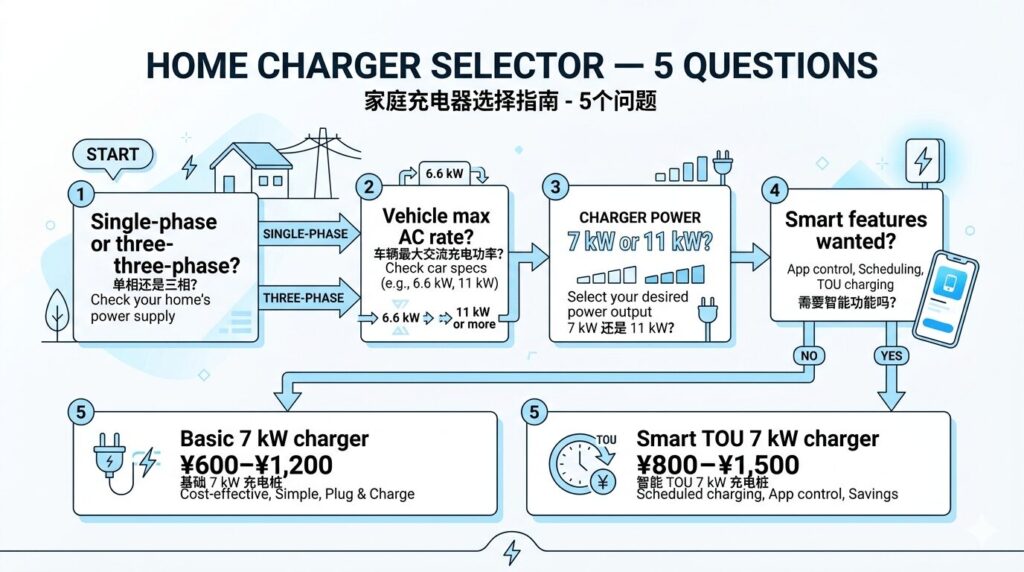
The Home Charger Selector — Find Your Right Charger in 5 Questions
Work through these five questions in order. Stop when you reach a recommendation.
Question 1: Do you have single-phase or three-phase electrical supply at your parking space?
How to tell:
- If your parking space has a single socket or supply point and your compound is a standard apartment building: almost certainly single-phase
- If your parking space is in a commercial building, villa compound, or premium development: may be three-phase
- Ask your 物业 or electrician to confirm
If single-phase (most Chinese apartment owners): → Go to Question 2 (Single-Phase Path)
If three-phase: → Go to Question 2 (Three-Phase Path)
Question 2 (Single-Phase Path): What is your vehicle’s maximum AC charging rate?
If 6.6 kW or 7 kW (most current Chinese EVs): → Go to Question 3 (7 kW)
If 11 kW: → A 7 kW single-phase charger is still the correct choice — single-phase supply cannot deliver 11 kW. Your vehicle charges at 7 kW regardless. Go to Question 3 (7 kW).
Question 2 (Three-Phase Path): What is your vehicle’s maximum AC charging rate?
If 6.6 kW or 7 kW: → A 7 kW single-phase charger is still correct — your vehicle accepts only 7 kW regardless of supply capability. Three-phase capability in the supply is unused. Go to Question 3 (7 kW).
If 11 kW: → An 11 kW three-phase charger unlocks your vehicle’s full AC capability. Go to Question 3 (11 kW Three-Phase).
If 22 kW (rare, some premium vehicles): → A 22 kW three-phase charger fully utilises your vehicle’s maximum AC capability. Go to Question 3 (22 kW Three-Phase).
Question 3 (7 kW Path): Do you want smart charging features (TOU scheduling, energy monitoring, app control)?
If yes — smart charger: → Go to Question 4 (Smart 7 kW)
If no — reliable basic charging at lowest cost: → Recommendation: Basic 7 kW GB/T Home Charger (¥600-¥1,200)
For drivers who want reliable overnight charging without app features, a basic certified 7 kW GB/T home charger from StarCharge, TELD, or BYD/NIO manufacturer-supplied unit delivers everything needed. No smart features, no app, no WiFi — just plug in and charge. The correct choice for drivers on flat-rate electricity tariffs who gain nothing from TOU scheduling.
Question 4 (Smart 7 kW): Do you have solar panels installed or plan to install them within 2 years?
If yes — solar integration: → Recommendation: Smart 7 kW GB/T Charger with Solar Divert Capability (¥1,500-¥3,000)
Chinese solar-integrated home chargers — particularly from brands like Sungrow (阳光电源), Growatt (古瑞瓦特), or their EV charger partnerships — offer solar divert functionality similar to the Myenergi Zappi in the UK/European market. The charger monitors solar generation and prioritises surplus solar for EV charging rather than exporting to the grid.
Best options:
- Sungrow Smart Charger + Sungrow solar system integration
- Growatt EV Charger + Growatt inverter integration
- NIO/BYD vehicle-specific smart chargers with solar monitoring capability
If no — smart scheduling without solar: → Recommendation: Smart 7 kW GB/T Charger with TOU Scheduling (¥800-¥2,000)
Go to Question 5.
Question 5 (Smart 7 kW, No Solar): What is your primary smart feature priority?
A) Lowest electricity cost — TOU/谷电 scheduling to charge overnight at cheap rates: → Recommendation: StarCharge 7 kW Smart Charger or TELD Smart Unit (¥800-¥1,500)
These units support GB/T 34657 smart charging protocol — scheduling overnight 谷电 (valley electricity) charging automatically. At the difference between peak rates (¥0.85-1.00/kWh in some Chinese cities) and valley rates (¥0.35-0.45/kWh), annual savings from TOU scheduling are ¥200-¥500 for typical Chinese EV owners.
B) Full ecosystem integration with your EV brand: → Recommendation: Manufacturer-supplied or brand-recommended smart charger
- BYD vehicles: BYD Smart Charger integrates with DiLink app
- NIO vehicles: NIO Home Charger (蔚来家充桩) integrates with NIO app — NIO provides subsidised or free installation for new owners
- Xpeng vehicles: Xpeng Home Charger integrates with Xpeng app
- Tesla (China): Tesla Wall Connector (China-spec, GB/T) integrates with Tesla app
- Li Auto: Li Auto Home Charger integrates with Li Auto app
C) Most reliable hardware at any price: → Recommendation: ABB, Schneider Electric, or Siemens GB/T home charger (¥2,000-¥5,000)
International industrial brands manufacturing GB/T certified home chargers for China bring their global quality standards to the domestic market. More expensive than Chinese domestic brands but with arguably superior long-term reliability.
D) Best value — smart features without premium price: → Recommendation: StarCharge Smart 7 kW or TELD Smart 7 kW (¥800-¥1,500)
The best-value smart charging option for most Chinese EV owners without specific brand ecosystem requirements.
Question 3 (11 kW Three-Phase Path): Same priority questions apply
Basic (no smart features): → Basic 11 kW three-phase GB/T charger: ¥1,200-¥2,500
Smart with TOU: → StarCharge 11 kW three-phase smart or equivalent: ¥1,500-¥3,000
Brand ecosystem: → Manufacturer-supplied 11 kW unit (NIO, Tesla, Xpeng)
The Major Chinese Home EV Charger Brands — Compared
StarCharge (星星充电)
Background: Subsidiary of Wanbang Digital Energy, one of China’s largest EV charging operators. Manufactures both commercial and residential charging equipment.
Product range:
- 7 kW single-phase smart home charger: ¥800-¥1,500
- 11 kW three-phase smart home charger: ¥1,500-¥2,500
- Smart versions with WiFi, app control, TOU scheduling
Strengths:
- Most widely installed residential brand in China
- Good after-sales service network nationally
- GB/T 34657 smart charging compliance
- Integration with StarCharge’s broader charging ecosystem (useful for monitoring home + public charging in one app)
Weaknesses:
- App interface reviewed as functional but not particularly intuitive
- Hardware quality is adequate rather than premium
Best for: Chinese EV owners who want a widely supported, well-serviced, competitively priced smart home charger without specific brand ecosystem requirements.
TELD (特来电)
Background: China’s largest private EV charging network operator, with a significant residential charger manufacturing arm alongside their commercial business.
Product range:
- 7 kW smart home charger: ¥800-¥1,500
- Smart charging with TELD network integration
Strengths:
- Strong brand recognition and service network
- Home charger integrates with TELD’s app — useful for users who also charge at TELD public stations
- Good value pricing
Weaknesses:
- Residential product range less developed than StarCharge
- App reviews more mixed than StarCharge
Best for: EV owners who frequently use TELD public charging and want a unified app experience across home and public charging.
NIO Home Charger (蔚来家充桩)
Background: NIO’s own home charging product, designed specifically for NIO vehicle owners and sold through the NIO service ecosystem.
Product range:
- NIO Home Charger 7 kW: provided to NIO owners at subsidised or zero cost under NIO’s service programmes
- NIO Home Charger 11 kW (three-phase): for NIO owners with three-phase supply
NIO’s home charging programme: NIO provides home charging installation support as part of the vehicle purchase — including subsidised installation and dedicated NIO service engineers for the installation process. For NIO owners, this programme is a compelling reason to use the NIO Home Charger rather than a third-party unit.
Strengths:
- Deep integration with NIO app — charging status, session history, remote start/stop
- NIO-managed installation service reduces 物业 friction
- Subsidised pricing for NIO owners
Weaknesses:
- Only appropriate for NIO vehicle owners — no benefit for non-NIO vehicles
- Less relevant if you change vehicle brand
Best for: NIO vehicle owners — full stop.
BYD Smart Charger (比亚迪充电桩)
Background: BYD’s own home charging product sold through BYD dealerships and the BYD service network.
Product range:
- BYD 7 kW Home Charger: ¥800-¥1,500 at dealership
- Smart version with BYD DiLink integration
Strengths:
- Integration with BYD DiLink app for BYD vehicle owners
- BYD dealership service network for installation and after-sales
- BYD owner familiarity
Weaknesses:
- Pricing sometimes higher than equivalent third-party options
- Integration benefit specific to BYD vehicles
Best for: BYD vehicle owners who want the convenience of dealership-managed installation and brand app integration.
Tesla Wall Connector (China-spec)
Background: Tesla’s home charging unit manufactured for the Chinese market — uses GB/T connectors rather than NACS. Sold through Tesla’s Chinese retail channel.
Product range:
- Tesla Wall Connector (China GB/T): 7 kW or 11 kW (depending on supply)
- Integrates with Tesla app
Strengths:
- Seamless Tesla app integration for Chinese-spec Tesla owners
- Tesla’s software update track record applies to Chinese-spec Wall Connectors
- Premium build quality
Weaknesses:
- Specific to Tesla vehicles in practical terms (though the GB/T connector is compatible with all Chinese EVs)
- Higher price than domestic equivalents at similar specifications
Best for: Chinese-spec Tesla owners who want full Tesla app integration.
ABB, Schneider Electric, Siemens (International Brands)
Background: Global industrial electrical equipment manufacturers with GB/T certified Chinese market home EV charger products.
Product range: 7 kW and 11 kW GB/T home chargers at ¥2,000-¥5,000+
Strengths:
- Industrial engineering quality — longer expected hardware lifespan
- Established global brand with long-term business continuity confidence
- Strong safety certifications
Weaknesses:
- Significantly more expensive than domestic equivalents
- Less integration with Chinese EV brand ecosystems
- Less localised app experience
Best for: EV owners who prioritise hardware longevity and brand reliability over price, and who don’t need specific Chinese EV brand app integration.
Huawei FusionCharge (华为充电)
Background: Huawei’s EV charging product line, integrated with the Huawei intelligent connectivity ecosystem and specifically designed for Aito vehicles.
Product range:
- Huawei FusionCharge 7 kW: smart, Huawei ecosystem integration
- 11 kW three-phase version
Strengths:
- Deep Huawei/HarmonyOS ecosystem integration for Aito vehicle owners
- Smart home integration through Huawei’s smart home platform
- Premium build quality consistent with Huawei’s product line
Weaknesses:
- Most valuable for Aito vehicle owners specifically
- Premium pricing
Best for: Huawei Aito vehicle owners and Huawei smart home ecosystem users.
The Installation Cost Guide — What You’ll Actually Pay in China
Understanding installation costs before starting the 物业 process prevents budget surprises.
Component 1: Home Charger Unit Cost
| Charger Type | Price Range | Notes |
|---|---|---|
| Basic 7 kW GB/T (no smart features) | ¥600-¥1,200 | Adequate for flat-rate tariff users |
| Smart 7 kW GB/T (TOU, WiFi, app) | ¥800-¥2,000 | Most popular price point |
| Premium smart 7 kW (international brand) | ¥2,000-¥5,000 | ABB, Schneider, Siemens |
| Manufacturer-supplied (NIO, BYD, etc.) | ¥0-¥1,500 | Often subsidised or free for new owners |
| 11 kW three-phase smart | ¥1,500-¥3,500 | For three-phase supply only |
Component 2: Electricity Meter Installation
State Grid or Southern Grid meter installation:
- Meter hardware: Typically provided by the utility at no cost
- Installation fee: ¥0-¥500 depending on region and complexity
- Connection fee (if supply upgrade required): ¥500-¥2,000
Component 3: Electrical Installation Labour and Materials
This is the most variable cost component — dependent on cable run distance, cable routing complexity, and local labour rates.
Simple installation (supply already at space, under 5 metres from supply point to charger):
- Labour: ¥300-¥600
- Materials (cable, conduit, circuit breaker): ¥200-¥400
- Total: ¥500-¥1,000
Standard installation (cable run 5-20 metres, standard routing):
- Labour: ¥600-¥1,500
- Materials: ¥400-¥800
- Total: ¥1,000-¥2,300
Complex installation (long cable run 20-50 metres, complex routing, conduit through walls):
- Labour: ¥1,500-¥4,000
- Materials: ¥800-¥2,000
- Total: ¥2,300-¥6,000
Component 4: Any 物业 or Building Management Fees
Some 物业 charge administrative fees for processing EV charging applications:
- Processing fee: ¥0-¥500 (varies by compound — many charge nothing)
- Electrical infrastructure access fee (some compounds): ¥0-¥1,000
Total Installation Cost Summary
| Scenario | Total Cost Range |
|---|---|
| Manufacturer-subsidised (NIO/BYD programme) + simple installation | ¥500-¥1,500 |
| Smart 7 kW charger + standard installation | ¥1,800-¥4,300 |
| Premium charger + complex installation | ¥4,000-¥10,000+ |
| Typical median scenario (smart 7 kW, standard installation) | ¥2,500-¥3,500 |
Smart Charging and TOU Electricity in China — Financial Value
Smart home charging in China delivers financial value through the 谷电 (valley electricity / off-peak rate) pricing structure available in Chinese cities with time-differentiated electricity tariffs.
Which Chinese Cities Have TOU Residential Electricity Pricing
As of 2026, residential TOU electricity pricing (居民分时电价) has been implemented in most major Chinese cities as part of China’s grid modernisation programme. Key markets:
Shanghai: Three pricing tiers — peak (峰电), flat (平电), valley (谷电)
- Peak (typically 8am-11am, 6pm-11pm): approximately ¥0.87/kWh
- Flat (typically 11am-6pm): approximately ¥0.67/kWh
- Valley (typically 11pm-8am): approximately ¥0.34/kWh
Beijing: Similar three-tier structure
- Peak: approximately ¥0.85/kWh
- Flat: approximately ¥0.65/kWh
- Valley: approximately ¥0.30/kWh
Shenzhen / Guangdong: Similar structure
- Peak: approximately ¥0.75-0.85/kWh
- Valley: approximately ¥0.30-0.38/kWh
Chengdu / Sichuan: Lower electricity rates generally due to hydropower abundance
- Peak: approximately ¥0.70/kWh
- Valley: approximately ¥0.28/kWh
The Annual TOU Saving Calculation
For a Shanghai resident driving a BYD Han EV, 20,000 km annually:
- Annual kWh from home charger: 20,000 ÷ 5.5 km/kWh × 1.12 (efficiency) = approximately 4,073 kWh
Charging at peak rate (¥0.87/kWh): 4,073 × ¥0.87 = ¥3,543/year
Charging at valley rate (¥0.34/kWh): 4,073 × ¥0.34 = ¥1,385/year
Annual saving from TOU scheduling: ¥3,543 – ¥1,385 = ¥2,158/year
A smart charger with TOU scheduling capability that costs ¥500-¥800 more than a basic unit pays back its premium in approximately 3 months through electricity savings.
This is the most important financial calculation in this entire guide. A smart charger with TOU scheduling is not a luxury feature for Chinese EV owners in cities with residential TOU pricing — it is the most financially impactful home charging decision available, with a payback measured in months rather than years.
Charging Time Reference — How Long Will It Take?
At 7 kW Home Charger (Most Chinese Apartment Owners)
| Vehicle | Battery (usable) | 20-80% Time | Full Charge Time |
|---|---|---|---|
| BYD Seagull | 30.1 kWh | 3.9 hours | 4.9 hours |
| BYD Dolphin | 44.9 kWh | 5.8 hours | 7.3 hours |
| BYD Atto 3 | 60.5 kWh | 7.8 hours | 9.9 hours |
| BYD Han EV | 76.9 kWh | 9.9 hours | 12.6 hours |
| BYD Seal LR | 82.5 kWh | 10.7 hours | 13.5 hours |
| NIO ET5 (75 kWh) | 75 kWh | 9.7 hours | 12.2 hours |
| Tesla Model 3 (China) | 60 kWh | 7.8 hours | 9.8 hours |
| Li Auto L9 (PHEV) | 42.8 kWh | 5.5 hours | 7.0 hours |
| Xpeng P7 | 70.8 kWh | 9.1 hours | 11.6 hours |
The overnight charging insight for Chinese EV owners:
Most Chinese EV owners plug in when they arrive home in the evening (7pm-10pm) and depart in the morning (7am-8am). This provides 9-13 hours of potential charging time.
For a BYD Han EV needing 9.9 hours for 20-80% — plugging in at 10pm provides exactly enough time for the charge to complete by 7:58am. This is tight. For reliable full charging, plug in as early as possible after arriving home.
The TOU scheduling interaction: If you’re on Shanghai TOU pricing with a valley rate window of 11pm-8am, and you arrive home at 8pm:
- Without smart scheduling: charge from 8pm at peak/flat rates for 3 hours, then valley rates for the remaining 7 hours
- With smart scheduling: charger waits until 11pm, then charges at valley rate for the entire 9.9-hour session
The smart charger saves money AND the charge completes by 8:58am — after the valley window ends at 8am, the car needs only the final hour of standard-rate charging to complete.
At 11 kW Home Charger (Three-Phase Supply Users)
| Vehicle | Battery (usable) | 20-80% Time | Full Charge Time |
|---|---|---|---|
| NIO ET5 (75 kWh) | 75 kWh | 5.0 hours | 7.8 hours |
| Tesla Model 3 (China) | 60 kWh | 4.0 hours | 6.3 hours |
| Xpeng G9 | 98 kWh | 6.5 hours | 10.2 hours |
| BYD Han EV (11kW variant) | 76.9 kWh | 5.1 hours | 8.0 hours |
Common Home Charging Mistakes Chinese EV Owners Make
Mistake 1: Starting the Hardware Purchase Before 物业 Approval
Buying a charger before confirming 物业 approval, only to discover the compound prohibits private installations or requires a specific approved brand list.
Prevention: Complete the 物业 enquiry process and understand the requirements before ordering any hardware.
Mistake 2: Buying a Charger Rated Higher Than Your Vehicle’s AC Ceiling
Buying an 11 kW charger for a BYD Han EV that accepts only 6.6 kW maximum AC. The charger delivers 6.6 kW regardless.
Prevention: Find your vehicle’s maximum AC charging rate first. Buy the charger that matches it — not one rated higher.
Mistake 3: Installing Without a Dedicated Electricity Meter
Installing without a separate EV charging meter, then discovering charging electricity is counted as shared building electricity — creating billing disputes with other residents.
Prevention: Apply for a dedicated EV charging meter from the utility as part of the installation process. This is required in most Chinese compounds.
Mistake 4: Not Using TOU Scheduling After Installing a Smart Charger
Buying a smart charger for its TOU scheduling capability but never configuring the schedule. This is the equivalent of buying a car with advanced driver assistance systems and never turning them on.
Prevention: Configure TOU scheduling on the day of installation. Set the charging window to your local valley electricity period (check your electricity bill or utility app for your specific times). The annual saving is ¥1,000-¥2,500 — too significant to leave unconfigured.
Mistake 5: Using the Mode 2 Cable as a Long-Term Charging Solution
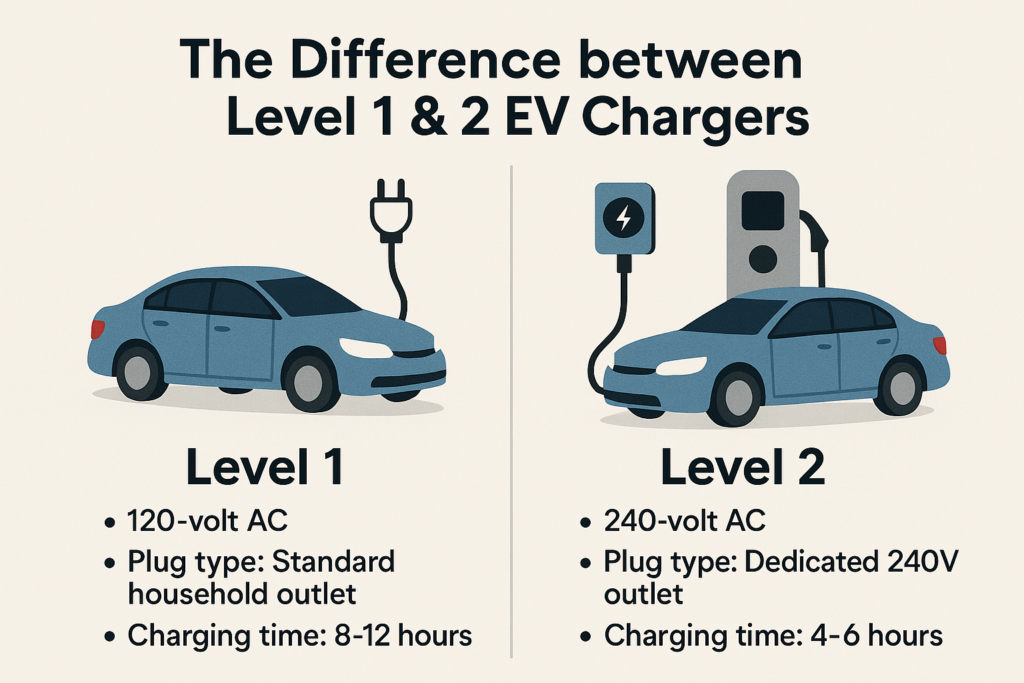
The Mode 2 cable included with the vehicle — designed for emergency and temporary use — is acceptable for occasional use but not optimal for daily charging. Standard sockets in Chinese residential buildings are not designed for sustained high-current draw over 8-10 hour periods.
Prevention: Install a dedicated 7 kW home charging unit for daily charging. The Mode 2 cable is a useful backup, not a permanent solution.
Mistake 6: Ignoring the Annual Maintenance of the Charging Connector
The charging connector is the highest-wear component of the home charger. After 12-18 months of daily use, connector contacts can develop oxidation that increases resistance and reduces charging efficiency.
Prevention: Annual connector inspection and cleaning with a dry brush and light application of dielectric grease. This costs nothing and maintains charging efficiency throughout the charger’s lifespan.
The Five-Minute Pre-Purchase Checklist
Before ordering any home EV charger in China, confirm these five items:
- Parking space confirmed: Designated, owned or leased, suitable for permanent installation
- 物业 approval confirmed: Application submitted and approved, not just informally agreed
- Vehicle’s maximum AC rate confirmed: From owner’s manual — 6.6 kW, 7 kW, or 11 kW?
- Supply type confirmed: Single-phase 220V or three-phase 380V at parking space?
- TOU tariff confirmed: Is residential time-differentiated pricing (居民分时电价) available in your city? If yes, is a smart charger with TOU scheduling specified?
If all five are confirmed, you have everything needed to specify the correct charger and proceed with confidence.
Internal Links — Further Reading on Clean Energy Bazaar
Find the right EV charger for your home China edition is the buying guide within the Chinese market content cluster.
For the complete Chinese market charging speed guide covering slow vs fast vs ultra-fast in depth, our EV charging guide 2026 slow vs fast vs ultra-fast differences in the Chinese market covers every scenario. For the connector compatibility guide covering GB/T, NACS, and CCS across Chinese and international infrastructure, our GB/T vs NACS vs CCS which EV charger plug do you actually need in China in 2026 guide covers every scenario. For the technical specifications guide that explains every kW, amp, and GB standard referenced in this buying guide, our understanding EV charger specs 2026 kW amps 800V architecture and the new GB standards guide translates everything into plain language. For the charge time calculator covering Chinese EVs including BYD, NIO, and Xpeng, our EV charge time calculator 2026 provides calculations for every major model. And for the broader EV charger troubleshooting guide applicable to home charger faults in China and internationally, our troubleshooting home EV chargers common fixes for US and European models guide covers the most common fault diagnosis and resolution scenarios.
Final Thoughts
Finding the right EV charger for your home China edition comes down to five decisions made in the right order:
Decision 1: Confirm your parking and 物业 situation first. No charger is the right charger if you can’t get it installed. Start here before everything else.
Decision 2: Match the charger power to your vehicle’s AC ceiling. For most Chinese EV owners in apartment buildings: 7 kW. Buying higher is wasted money on a single-phase 220V supply.
Decision 3: Specify a smart charger with TOU scheduling. In Chinese cities with residential time-differentiated electricity pricing, the annual saving (¥1,000-¥2,500) pays back the smart charger premium within 3-6 months. This is the most financially impactful single decision in home EV charging setup.
Decision 4: Consider brand ecosystem integration. NIO, BYD, Tesla, Xpeng, and Huawei all offer chargers that integrate with their vehicle apps. If deep app integration matters to you, buy the manufacturer’s charger. If not, StarCharge or TELD smart units deliver equivalent charging function at competitive prices.
Decision 5: Allow 4-12 weeks for the complete process. 物业 approval, electricity meter application, and installation scheduling take time. Start the process before your EV arrives — not after.
The right home charger for your specific situation is the one that matches your vehicle’s ceiling, works within your supply capability, includes smart scheduling if TOU pricing is available in your city, and is installed correctly through the appropriate approval processes.
Everything beyond these five criteria is refinement rather than necessity.