Introduction: When the Mercury Rises, Your EV Needs a Strategy
India is no stranger to extreme heat. Temperatures in Rajasthan routinely breach 48°C in May. Tamil Nadu summers push past 42°C. Delhi’s heat index in June can feel like standing inside a tandoor. For EV owners across the country, one question becomes increasingly urgent every summer: “Is my car — and my charger — ready for this?”
The good news is that EV owners in some of the world’s hottest EV markets — Texas, USA, and Southern Europe (Spain, Italy, Greece, and southern France) — have been navigating extreme-heat charging challenges for years. Their hard-won experience is a playbook that Indian EV owners can learn from right now, before the next heat wave arrives.
This guide covers hot weather EV charger tips: thermal management for Texas summers or Southern Europe — and translates every lesson directly into advice for Indian EV buyers driving in high-heat climates.
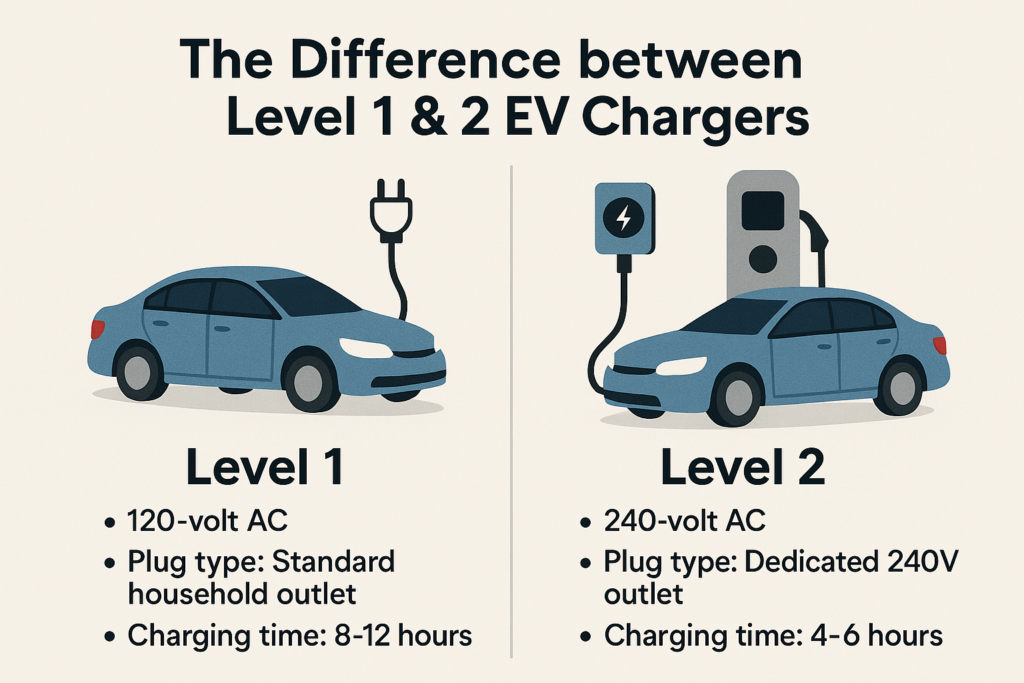
New to EV charging basics? Start with our foundational guide: EV Charger Types Explained: AC vs DC, Level 1 vs Level 2 vs Level 3 before diving in.
Why Heat Is the Number One Enemy of EV Batteries
Before getting into the tips, it’s worth understanding why heat is so damaging — and why charging in high temperatures compounds the risk.
EV batteries operate optimally within a temperature window of roughly 15°C to 35°C. The moment temperatures climb above 35–40°C — which happens routinely in a parked car in Texas, Seville, or Jaipur — the chemistry changes in four important ways.
Electrolyte breakdown accelerates. The liquid electrolyte inside lithium-ion cells degrades faster at high temperatures, permanently reducing capacity over time.
Internal resistance increases. A hot battery resists incoming charge more, which slows charging speed and generates even more heat — a compounding problem during fast charging.
The battery management system (BMS) works overtime. In heat, the BMS diverts energy to run the thermal management system and keep cells within a safe range — drawing power directly from the battery, meaning your car may lose charge even while sitting parked in the sun.
Long-term degradation risk rises. Repeated heat-related stress meaningfully accelerates the rate of capacity loss over a battery’s lifetime.
The practical result: EV owners in hot climates who don’t adapt their charging habits see faster battery degradation than those who do — regardless of whether they’re in Houston, Seville, or Hyderabad.
📌 Want to understand how battery degradation works in Indian conditions? EV Battery Health in India: How Heat, Charging Habits and Climate Affect Longevity
Section 1: Lessons from Texas — America’s Toughest EV Heat Market
Texas routinely records summer temperatures between 38°C and 46°C, with humidity levels that make the heat index even more punishing. It has one of the highest EV adoption rates in the US, making it the world’s most demanding real-world EV heat test.
Tip 1: Never Fast-Charge a Hot Battery
In Texas, afternoon DC fast charging during summer is considered poor practice among experienced EV owners. When a battery that has been sitting in a 42°C parking lot gets plugged into a 150 kW fast charger, two heat sources combine: ambient temperature plus the internal heat generated by rapid charging.
The result is automatic thermal throttling — the vehicle’s BMS detects that the battery is approaching unsafe temperatures and reduces the maximum charge rate, sometimes dramatically. A car rated for 150 kW DC fast charging may deliver only 60–80 kW under these conditions. You wait longer, and the battery still takes on thermal stress.
The Texas rule: Fast charge in the early morning before 9 AM or after 8 PM when ambient temperatures are lower. This one habit alone can cut your DC fast charging session time by 30–40% during summer months.
For India: Directly applicable in cities like Hyderabad, Chennai, and Ahmedabad, where afternoon temperatures between April and June regularly exceed 40°C. If you use public DC fast chargers for top-ups, plan sessions for morning or evening — not midday.
Tip 2: Use Pre-Conditioning Before Charging
Many Texas Tesla and Ford Mustang Mach-E owners swear by battery pre-conditioning — activating the car’s thermal management system to cool the battery before arriving at a fast charger.
On vehicles that support it, navigating to a DC fast charger using the car’s built-in navigation (not a phone app) triggers automatic pre-conditioning. The car begins cooling the battery pack during the drive, so it arrives at the charger already within its optimal temperature window — resulting in dramatically faster charging from the first minute.
On vehicles without automatic pre-conditioning, many Texas owners manually pre-cool their cabin using remote start while the car is still plugged into a home charger, pulling grid power to cool both cabin and battery before unplugging.
For India: Popular EVs including the Tata Nexon EV, MG ZS EV, and Hyundai Ioniq 5 include pre-conditioning features accessible via their companion apps. Activating cabin pre-cooling while still plugged into your home charger before a morning drive is not a luxury — it is a meaningful battery health strategy in Indian summer conditions.
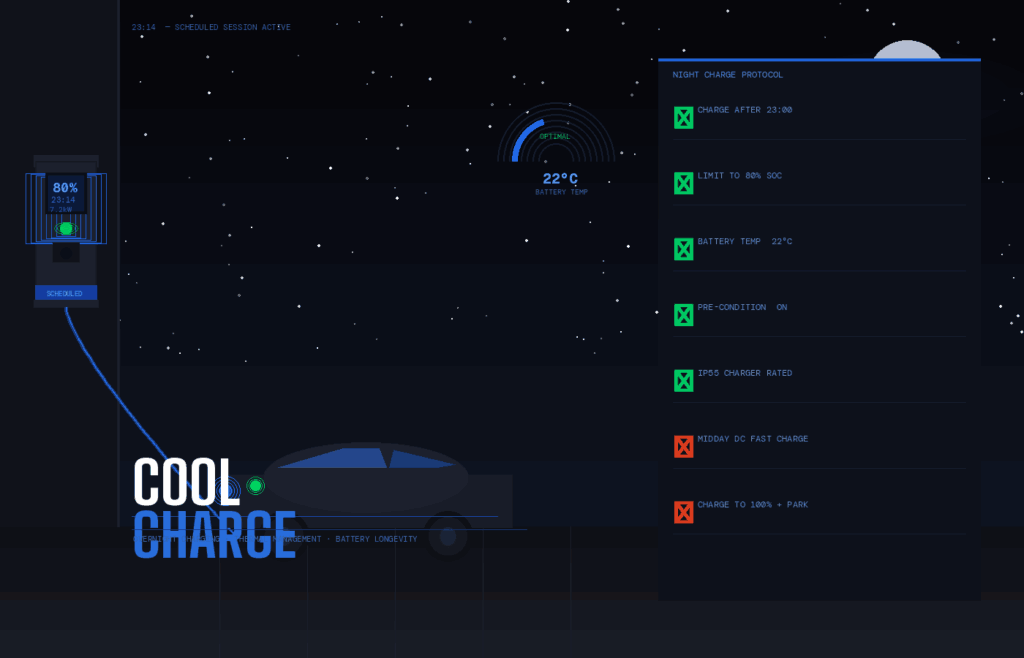
Tip 3: Schedule Home Charging After Midnight
The thermal logic of overnight home charging is straightforward: the ambient temperature at 2 AM is typically 10–15°C cooler than at 3 PM, meaning the home charger delivers current to a battery that is already cooler and more receptive. This reduces the thermal management system’s workload, meaning less battery energy is consumed by cooling — and more goes into actual usable charge.
For India: Several Indian DISCOMs are introducing off-peak EV tariffs for overnight charging. But even without a differential tariff, scheduling your home AC charger to run between 11 PM and 5 AM reduces battery heat stress significantly — particularly relevant for EV owners in Rajasthan, Gujarat, and Maharashtra where nights cool meaningfully after 10 PM.
📌 Check if your state DISCOM offers off-peak EV charging rates: EV Home Charging Cost Calculator India: Per-Unit Rates by State 2025
Tip 4: Keep State of Charge Between 20% and 80% in Summer
Texas EV communities consistently advise against two habits in summer: letting the battery drop below 20% before charging, and charging to 100% and leaving the car parked in the heat.
A battery at very low charge in extreme heat has less thermal buffer — the BMS has fewer tools to manage temperature. A battery charged to 100% and left in direct sun has elevated internal voltage combined with heat, which accelerates electrolyte oxidation.
The practical sweet spot for summer parking: keep the battery between 50% and 80% when the car will sit in the heat for several hours. Most smart home chargers allow you to set a charge limit — a feature that pays dividends in summer.
For India: Especially relevant for Indian EV owners who charge to 100% overnight and leave their cars in uncovered parking lots throughout a hot workday. Setting a charge limit of 80% on your home charger is a simple, one-time setting that meaningfully protects battery longevity over years of use.
Section 2: Lessons from Southern Europe — Charging Under the Mediterranean Sun
Southern Europe — Spain, Italy, Greece, and the south of France — presents a different heat challenge. Temperatures are similarly extreme (Spain’s Andalusia regularly hits 44–46°C in July and August), but EV infrastructure is less mature than in the US, meaning drivers have fewer options about when and where they charge.
Tip 5: Park in Shade or Underground — Always
In cities like Seville, Valencia, and Athens, a car parked in direct July sun can reach internal cabin temperatures of 70–80°C within an hour. The battery pack, while insulated from cabin heat, still absorbs radiant heat through the floor and body panels — raising pack temperature meaningfully even before any driving or charging occurs.
The rule among experienced Southern European EV owners: underground parking is always preferred, not just for comfort but for battery thermal management. An underground garage that maintains 22–26°C throughout the day gives the BMS a dramatically easier job than an asphalt lot in full sun.
Keeping EVs plugged in with the thermal management system active whenever parked for extended periods is equally important — many EVs draw a small amount of grid power to maintain optimal battery temperature while connected, which is far more efficient than battery-powered cooling.
For India: This translates directly to Mumbai’s open-air housing society parking, Delhi’s uncovered street parking, and Bengaluru’s sun-exposed IT park lots — all thermal stress environments for parked EVs. Wherever possible, seek covered or basement parking during extreme heat months.
Tip 6: Avoid DC Fast Charging During Peak Heat Hours on Road Trips
EV road trip guides for Southern Europe explicitly advise planning shorter charging legs in summer and expecting slower charging speeds during peak heat hours. A practical strategy used by experienced drivers on the Madrid–Barcelona highway in July: charge at 7–8 AM before departing, drive 200–250 km, arrive at a fast charger by 10–10:30 AM before peak heat, charge to 75–80%, then complete the journey — avoiding the 12 PM–5 PM window when charger output throttling is most likely.
For India: As India’s national highway charging network expands on the Delhi–Jaipur, Mumbai–Pune, and Bengaluru–Chennai corridors, this tip is immediately actionable. Plan intercity EV journeys to arrive at charging stops before 11 AM or after 6 PM during April–June. The difference in charging speed and battery stress is substantial.
Tip 7: Know Your EV’s Cooling System Type Before Summer
Southern European EV communities have become sharp at distinguishing between air-cooled and liquid-cooled battery thermal management systems — because the difference is significant in hot climates.
Older EVs and some budget models use passive air cooling — airflow from driving moves heat away from the battery. This works reasonably well at highway speeds but fails when the car is stationary in traffic or parked in heat. Modern EVs use active liquid cooling, where a coolant pump circulates fluid through channels in the battery pack, maintaining temperature even when stationary.
Automotive experts consistently recommend that drivers who fast-charge often in hot weather prioritise cars with robust liquid-cooled packs — an EV designed around air-only cooling may perform well in a mild coastal city but struggle in extreme heat.
For India: When comparing EVs at a dealership, ask specifically: “Does this model use liquid-cooled or air-cooled battery thermal management?” This single question is one of the most important you can ask as an Indian buyer in a high-heat state.
📌 Compare thermal management specs across popular Indian EVs: Best Home EV Chargers in India 2025: Tata, Exicom, and More Compared
Tip 8: The 80% Rule for Summer Road Trips
Experienced EV road trippers in Europe have broadly adopted what’s known as the 80% Rule for summer: charge to 80%, drive to the next charger, charge to 80% again. Never chase 100% when it’s 40°C outside. The last 20% of charge takes disproportionately long as the BMS slows charging to manage heat, and the additional range is rarely needed when chargers are reasonably spaced.
For India: On well-served routes like Delhi–Agra, Pune–Mumbai, and Bengaluru–Mysuru, the 80% Rule applies and saves meaningful time and battery stress in summer months. On less-served routes, adjust to 90% as needed for range confidence — but avoid chasing 100% in peak heat.
Section 3: How This Applies to India’s Specific Heat Zones
Zone A: Rajasthan and Gujarat — Desert Heat
With summer temperatures regularly exceeding 45°C and most parking exposed to direct sun, EV owners in Jodhpur, Jaisalmer, Jaipur, Ahmedabad, and Surat face some of the most demanding thermal conditions for EVs anywhere in the world.
Priority actions: Overnight home charging only (never midday). Covered or basement parking wherever available. Charge limit set to 80%. Battery pre-conditioning activated every morning. DC fast charging strictly before 9 AM or after 7 PM.
Zone B: Tamil Nadu and Andhra Pradesh — Coastal Heat and Humidity
Chennai, Vijayawada, and Visakhapatnam combine high temperatures with high humidity — a combination that reduces heat dissipation efficiency, meaning BMS cooling systems work harder to shed the same amount of heat.
Priority actions: Keep the car plugged in with the thermal management system active whenever parked for extended periods. Many EVs use a small trickle of grid power to keep the battery cool while plugged in — far more efficient than battery-powered cooling in a hot lot.
Zone C: Delhi NCR — Extreme Summer and Grid Variability
Delhi summers combine intense heat with periodic voltage fluctuations that can affect smart charger behaviour. A charger that faults during a voltage sag and restarts at 2 AM when the battery is already warm creates unnecessary thermal cycling.
Priority actions: Invest in a home charger with built-in surge protection and voltage regulation. Look for automatic restart after power interruption. Schedule charging for late night when the grid is most stable.
📌 Planning to install a home charger in Delhi or NCR? EV Charger Installation Cost in India: What to Expect in 2025
Section 4: Smart Charger Features That Matter Most in Hot Weather
If you are buying or upgrading a home charger for Indian conditions, these features deliver the most value in hot climates.
Scheduled charging with a fixed time window. Set yours to 11 PM–5 AM and never think about it again. This single setting protects both your battery and your electricity bill.
Charge limit setting. Any smart home charger worth buying in India should allow you to cap the maximum state of charge — 80% for daily use, adjustable to 100% for long trips only.
Remote monitoring via app. Being able to check battery temperature and charging status remotely is useful in hot weather. If you return to your car after 6 hours in a hot parking lot and see the battery at 44°C, you know to pre-cool before driving.
IP55 or higher housing rating. For Indian installations in open-air parking or balcony-adjacent locations, IP55 or higher means the charger is protected against dust and water. In Indian summer conditions, this also means the charger handles direct sun without internal component degradation.
📌 See which home EV chargers in India meet these criteria: Compare All Home EV Chargers Available in India — Side-by-Side
LFP vs NMC: Why Battery Chemistry Matters in Indian Heat
One of the most important and least-discussed specifications for Indian EV buyers is battery chemistry.
LFP (lithium iron phosphate) batteries — used in certain Tata Nexon EV variants, BYD models, and several Chinese-origin EVs available in India — have higher thermal stability and degrade more slowly when routinely exposed to high temperatures or charged to higher states of charge in hot conditions.
NMC (nickel manganese cobalt) batteries — used in most Hyundai, Kia, MG, and European EVs — offer higher energy density and better cold-weather performance, but require more careful thermal management in sustained heat.
Research consistently shows that LFP batteries hold up better in hot climates, degrading less than NMC batteries when frequently left in the sun or routinely fast-charged in high temperatures.
For Indian buyers: If you live in a high-heat region and your daily use involves exposed parking and occasional DC fast charging, an EV with an LFP battery may offer meaningfully better long-term battery health than an equivalent NMC vehicle — even if the NMC car offers slightly more range on paper.
Quick Reference: Hot Weather EV Charging Do’s and Don’ts
DO:
- Charge at home overnight, between 11 PM and 5 AM
- Set your charge limit to 80% for daily use in summer
- Use battery pre-conditioning before fast charging and before long drives
- Park in shade, basement, or covered parking whenever possible
- Keep battery above 20% charge during hot weather
- Use built-in car navigation (not phone maps) to trigger automatic pre-conditioning when routing to a fast charger
- Choose a home charger with IP55+ rating for Indian outdoor conditions
DON’T:
- DC fast charge a battery that’s been sitting in direct sun at midday
- Leave the car at 100% charge in hot, uncovered parking for hours
- Let the battery drop below 20% in extreme heat before charging
- Rely on a portable Mode 2 charger as your primary solution in summer — the slower charge rate keeps the battery at elevated temperature for longer
- Ignore charger ambient temperature ratings — a unit rated for 40°C ambient may fault in a 48°C Rajasthan summer
Frequently Asked Questions (FAQ)
Q: Does hot weather reduce EV range in India? Yes. Temperatures above 35°C reduce EV range by roughly 10–20% in most vehicles because the thermal management system draws battery power to cool the pack, and cabin air conditioning further depletes usable range. This is most pronounced in air-cooled battery systems.
Q: Is it safe to charge an EV during a heatwave? Yes, with the right precautions. Use your home AC charger rather than a DC fast charger during daytime heat. Schedule overnight charging when possible. If the car has been running hard in midday heat, allow 30–60 minutes of cooling before plugging in.
Q: Does charging to 100% damage the battery in summer? Routinely charging to 100% in high-heat conditions does accelerate degradation, because elevated state-of-charge combined with heat increases internal cell stress. For daily use, an 80% charge limit is a best practice endorsed by most EV manufacturers for hot-climate operation.
Q: Which Indian EVs have the best thermal management for hot climates? EVs with active liquid cooling — including the Hyundai Ioniq 5, Kia EV6, and BYD Atto 3 — handle heat better than those with passive cooling. Among more affordable options, Tata vehicles with LFP batteries offer good thermal stability. Always verify the specific variant’s cooling system type before purchasing.
Q: Can a home EV charger overheat in Indian summer conditions? A charger installed in direct sun in a 48°C environment can approach its thermal limit if it carries a low ambient temperature rating. Always check your charger’s maximum operating temperature specification — look for 50°C or higher — and mount it in a shaded or covered location wherever possible.
Conclusion: India’s Summers Demand Smart EV Charging Habits
Texas summers and Southern European heat waves have been stress-testing EV owners and their charging setups for years — and those experiences have produced a clear, evidence-backed playbook. Charge at night. Pre-condition your battery. Keep state of charge moderate. Seek shade. Avoid midday fast charging. Choose the right battery chemistry for your climate.
For Indian EV owners navigating conditions that are, in many regions, even more extreme than Texas or Seville, these are not optional best practices — they are the difference between a battery that performs well for 8–10 years and one that visibly degrades within 3–4.
At Clean Energy Bazaar, we help Indian EV buyers make smarter decisions — from choosing the right charger for their climate zone to understanding which EV specifications matter most for Indian conditions.
📌 Ready to choose the right home EV charger for Indian heat conditions? Compare All Home EV Chargers Available in India — Side-by-Side
Found this guide useful? Share it with your EV-owning friends before the next heat wave — and drop your questions about charging in your specific city or climate zone in the comments below.