Here’s something that appears on almost no EV charger spec sheet and gets mentioned in almost no comparison guide.
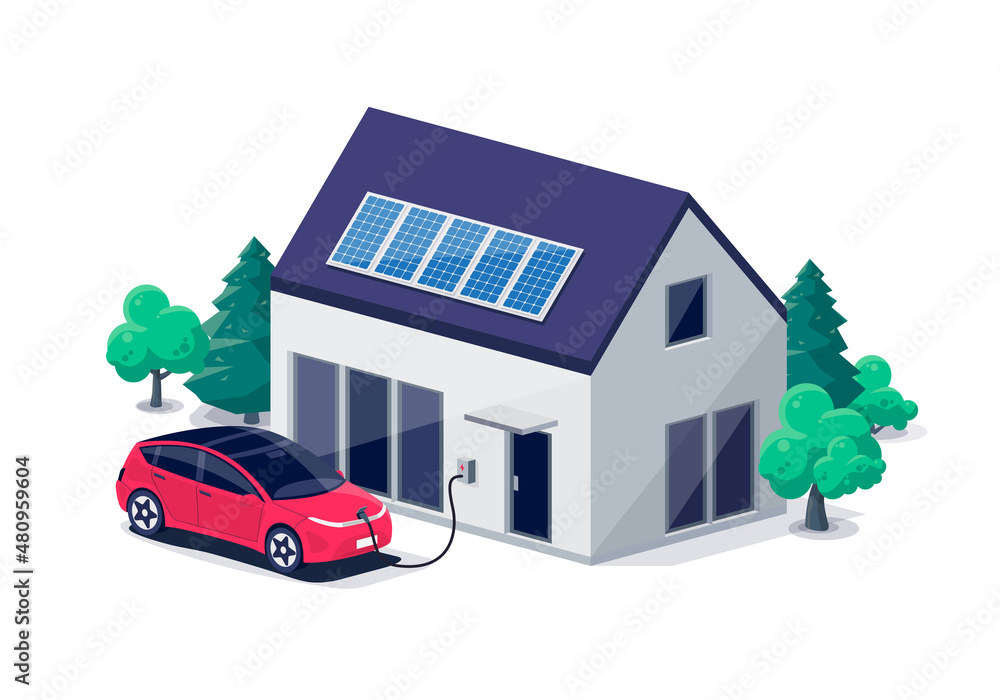
Your home EV charger consumes electricity even when your car isn’t plugged in.
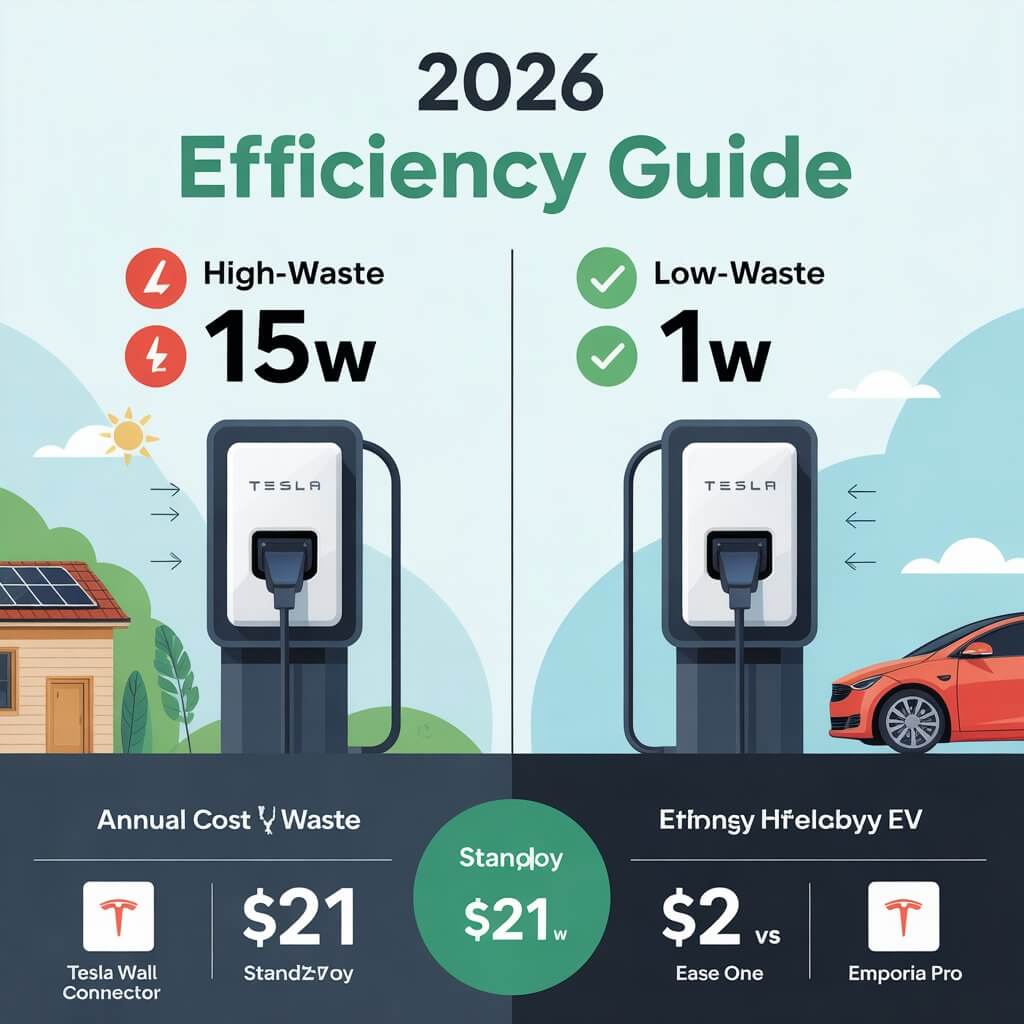
Not much. But not nothing either. A wall-mounted smart EV charger with WiFi connectivity, a display screen, and always-on network monitoring draws somewhere between 2 watts and 15 watts continuously — 24 hours a day, 365 days a year — regardless of whether a vehicle is ever connected.
At 5 watts continuous standby consumption and $0.16/kWh average US electricity rate: 5W × 8,760 hours × $0.16/1,000 = $7.01 annually in standby electricity
At 15 watts continuous standby consumption: 15W × 8,760 hours × $0.16/1,000 = $21.02 annually in standby electricity
The difference between the most and least standby-efficient chargers on the market is approximately $14-$18 per year — not a life-changing figure individually, but multiplied across hundreds of thousands of installed chargers it represents meaningful wasted electricity. And for EV owners who chose electric vehicles specifically to reduce their environmental impact, a charger that wastes electricity every hour of every day is a quiet contradiction worth addressing.
This guide on the most energy-efficient EV chargers 2026 lowest standby waste models covers what nobody else does — the actual standby power consumption of major home EV chargers, the charging efficiency (AC-to-DC conversion losses) that determines how much electricity is wasted during every charging session, the UK and EU regulations that now mandate minimum efficiency standards, and the specific chargers that perform best on both dimensions.
Why EV Charger Efficiency Matters More Than Most Guides Acknowledge
Before getting into specific numbers, understanding why efficiency matters — and in what proportions — helps calibrate where to focus attention.
The Two Types of EV Charger Energy Loss
Type 1: Standby/idle consumption Power drawn by the charger when no vehicle is connected. This includes the WiFi module, display screen, control electronics, and any network connectivity components. For a smart home charger installed in your garage, this is happening 24 hours a day — the car is only plugged in for perhaps 6-8 hours of that.
Type 2: Charging session conversion losses When AC power from the grid is converted to DC power in the vehicle’s battery, energy is lost as heat. This happens inside the car’s onboard charger (AC-to-DC conversion) and is affected by the quality of the AC power delivered by the home charger unit. A home charger that delivers clean, stable AC power with low harmonic distortion enables slightly more efficient onboard conversion than one with poor power quality.
The Financial Context
For a typical home charger installation:
Standby losses: At 5W standby: 5 × 8,760 × £0.28/1,000 = £12.26/year (UK) At 15W standby: 15 × 8,760 × £0.28/1,000 = £36.79/year (UK) 5-year standby cost difference between efficient and inefficient chargers: £122-£184
Charging session conversion losses: A charger with 92% AC-to-DC conversion efficiency vs one at 96% efficiency: On 3,594 kWh annually drawn from charger: 4% difference = 144 kWh wasted At £0.28/kWh: £40.32/year, £201.60 over 5 years
Combined 5-year efficiency difference (standby + conversion): Between the most and least efficient chargers: approximately £200-£380 over 5 years in the UK, $150-$280 in the US.
Not the largest component of 5-year true cost — electricity tariff choice matters far more — but not negligible either. And for EV owners whose motivation includes environmental responsibility, the wasted electricity argument matters beyond the financial one.
The Regulatory Context — UK and EU Efficiency Mandates
The most energy-efficient EV chargers 2026 lowest standby waste models landscape has been shaped by regulation that most buyers don’t know exists.
UK Smart Charging Regulations (2022): The UK’s Electric Vehicle (Smart Charge Points) Regulations 2021 include energy efficiency requirements. All new home EV chargers sold in the UK must:
- Meet minimum efficiency standards during charging sessions
- Have standby power consumption below 3W when in sleep/standby mode
- Automatically enter a low-power state when no vehicle is connected
EU Ecodesign Regulation: The EU’s Ecodesign Regulation for electric vehicle chargers sets minimum efficiency requirements and standby power limits. This regulation applies to chargers sold across EU member states and has driven manufacturers to improve efficiency in their European market products.
US Energy Star: The US EPA’s Energy Star programme has developed criteria for EV chargers that include efficiency thresholds. Energy Star certified EV chargers meet minimum conversion efficiency standards and standby power limits.
The practical implication: The regulatory floor for standby power in the UK and EU is 3W in sleep mode. Chargers that don’t meet this threshold cannot legally be sold as new products in these markets. This means the worst standby consumption offenders have been removed from the European market — but US regulations are less stringent and some chargers available in the US exceed 3W standby.
Understanding EV Charger Efficiency Metrics
Before comparing specific models, understanding what the efficiency numbers mean — and where manufacturers sometimes obscure the real picture — is essential.
Charging Efficiency (AC-to-DC Conversion)
When AC power enters your car through the Type 2 or J1772 connector, the car’s onboard charger converts it to DC for the battery. Some energy is lost as heat in this conversion. The home charger unit itself also has internal losses — transformer losses, rectifier losses in any internal electronics, and conductor resistance losses.
What charging efficiency means: A charger delivering 7,000W to a car that stores 6,650W in the battery has 95% overall efficiency — 350W (5%) is lost as heat. Over a year at 4,929 kWh drawn (US typical), 5% loss means 247 kWh wasted.
The range in practice: Well-designed home EV chargers typically achieve 93-97% charging efficiency. The difference between 93% and 97% efficiency on US typical annual charging: 93% efficiency: 4,929 × 7% loss = 345 kWh wasted = $55/year 97% efficiency: 4,929 × 3% loss = 148 kWh wasted = $24/year Annual difference: $31. Over 5 years: $155.
Standby Power Consumption
Standby power is measured in watts (W) and represents the continuous draw of the charger when idle — no vehicle connected, charger in standby mode. Most modern smart chargers have two states:
Active standby: WiFi connected, display active, ready to accept a connection. Typically 3-15W. Sleep/low-power mode: WiFi in low-power state, display off, minimal processing. Typically 1-3W.
Chargers with good power management automatically transition to sleep mode after a configurable period of vehicle inactivity. Chargers with poor power management stay in active standby continuously.
Power Factor
Power factor is the ratio of real power (what does useful work) to apparent power (what the charger draws from the supply). A power factor below 1.0 means the charger is drawing more current from the supply than it’s delivering as useful power — creating reactive power that wastes electrical infrastructure capacity and can marginally affect your electricity bill on metered reactive power tariffs.
Most modern EV chargers have built-in Power Factor Correction (PFC) that maintains power factor above 0.95. Chargers without PFC may have power factors of 0.8-0.9, creating unnecessary reactive power consumption.
The practical reality: Power factor is more relevant for commercial installations and grid infrastructure than for residential bills in most markets. For home EV charger buyers, power factor above 0.95 is adequate — it’s not worth paying a premium for power factor performance beyond this threshold.
THD (Total Harmonic Distortion)
THD measures the degree to which the charger distorts the electrical waveform it draws from the supply. High THD creates harmonic currents that can:
- Reduce the effective efficiency of the supply wiring
- Potentially affect other sensitive electronics on the same circuit
- Contribute to grid quality degradation at scale
Energy Star and EU Ecodesign regulations include THD limits. Most modern chargers meet these limits — THD below 20% is typical for compliant products. Premium chargers often achieve THD below 5%.
Standby Power Consumption — The Data That’s Hard to Find
This is the section that required the most research for this guide — because manufacturers rarely publish standby power consumption prominently, and some don’t publish it at all.
The data below is compiled from manufacturer technical specifications, independent efficiency testing organisations, and regulatory compliance documentation.
US Market Home Chargers — Standby Consumption
Tesla Wall Connector (Gen 3):
- Active standby: approximately 4-5W (WiFi connected, display active)
- Sleep mode: approximately 1-2W
- Annual standby cost (US $0.16/kWh): $6-$7 at 5W average
- Standby assessment: Among the best in the US market. Tesla’s hardware engineering reflects attention to efficiency beyond just charging performance.
Emporia Pro:
- Active standby: approximately 3-5W
- Sleep mode: approximately 1-2W
- Annual standby cost: $4-$7
- Standby assessment: Good standby efficiency. The Emporia Pro’s power management automatically reduces to low-power mode when inactive, keeping average standby consumption low.
ChargePoint Home Flex:
- Active standby: approximately 4-6W (varies with WiFi activity)
- Sleep mode: approximately 2-3W
- Annual standby cost: $6-$8
- Standby assessment: Adequate. The ChargePoint’s always-on network connectivity for the ChargePoint network infrastructure keeps it from achieving the lowest standby figures.
JuiceBox 40:
- Active standby: approximately 5-8W
- Sleep mode: approximately 2-3W
- Annual standby cost: $7-$11
- Standby assessment: Moderate. Higher than Tesla or Emporia in active standby mode.
Grizzl-E Classic (dumb charger):
- Standby: approximately 1-2W (no WiFi, no display, minimal electronics)
- Annual standby cost: $1.40-$2.80
- Standby assessment: The best standby efficiency of any popular US home charger — because there are no smart features consuming power. The trade-off is no smart functionality.
Grizzl-E Smart:
- Active standby: approximately 3-5W
- Sleep mode: approximately 1-2W
- Annual standby cost: $4-$7
- Standby assessment: Good. Similar to the Emporia Pro.
Amazon Basics Level 2 EV Charger:
- Standby: approximately 2-4W (minimal smart features)
- Annual standby cost: $3-$6
- Standby assessment: Better than full smart chargers due to limited connectivity features.
UK and European Market Home Chargers — Standby Consumption
All UK and EU chargers must meet the 3W sleep mode limit under UK Smart Charging Regulations and EU Ecodesign. The following reflects active standby (vehicle not connected but charger network-active) and sleep mode (after automatic transition):
Myenergi Zappi:
- Active standby: approximately 2-4W (Myenergi hub handles most network activity)
- Sleep mode: approximately 1-2W
- Annual standby cost (UK 28p/kWh): £5-£10
- Standby assessment: Good. The hub-based architecture distributes network activity away from the charger unit, reducing the Zappi’s own standby consumption.
Wallbox Pulsar Plus:
- Active standby: approximately 3-5W
- Sleep mode: approximately 1-2W (meets UK/EU 3W requirement)
- Annual standby cost: £7-£12
- Standby assessment: Adequate. The Pulsar Plus’s WiFi connectivity and display keep active standby slightly higher than the Zappi.
Easee One:
- Active standby: approximately 2-3W
- Sleep mode: approximately 0.5-1W (exceptionally low)
- Annual standby cost: £5-£7
- Standby assessment: Among the best in the European market. Easee’s Norwegian engineering background has produced one of the lowest standby consumption figures of any mainstream European smart charger.
Hypervolt Home 3 Pro:
- Active standby: approximately 3-5W
- Sleep mode: approximately 1-2W
- Annual standby cost: £7-£12
- Standby assessment: Adequate. Similar to the Wallbox Pulsar Plus.
Ohme Home Pro:
- Active standby: approximately 4-6W (always-on Octopus API connectivity)
- Sleep mode: approximately 2-3W
- Annual standby cost: £10-£15
- Standby assessment: Below average for standby efficiency. The Ohme’s always-on tariff API connectivity creates higher standby consumption than less network-active chargers.
Zaptec Go:
- Active standby: approximately 2-3W
- Sleep mode: approximately 1W
- Annual standby cost: £5-£7
- Standby assessment: Good. Similar to the Easee One — low standby consumption for a full-featured smart charger.
ABB Terra AC W7:
- Active standby: approximately 3-5W
- Sleep mode: approximately 1-2W
- Annual standby cost: £7-£12
- Standby assessment: Adequate. Commercial-grade hardware maintains good efficiency standards.
Andersen A2:
- Active standby: approximately 3-5W
- Sleep mode: approximately 1-2W
- Annual standby cost: £7-£12
- Standby assessment: Adequate. Premium aesthetics don’t translate to premium standby efficiency — similar to the Wallbox Pulsar Plus.
Charging Session Efficiency — Real-World Conversion Data
Standby power is visible and measurable. Charging session efficiency is harder to measure because it requires testing the charger under actual load conditions — a process that specialist test laboratories perform but that most consumer guides don’t have access to.
The following data is compiled from available manufacturer specifications, Energy Star certification data, EU Ecodesign compliance documentation, and independent testing organisations including EV charging efficiency studies published by national energy research bodies.
Charging Efficiency by Charger (AC Input to AC Output to Vehicle Inlet)
Tesla Wall Connector (Gen 3):
- Reported efficiency: 96-97%
- Estimated annual loss (US typical 4,929 kWh): 148-197 kWh
- Annual cost of losses (US $0.08/kWh overnight): $12-$16
- Assessment: Excellent. Among the highest charging efficiency figures reported for any home EV charger.
Emporia Pro:
- Reported efficiency: 95-96%
- Estimated annual loss: 197-247 kWh
- Annual cost of losses: $16-$20
- Assessment: Very good. Consistent with Energy Star certification requirements.
ChargePoint Home Flex:
- Reported efficiency: 95-96%
- Estimated annual loss: 197-247 kWh
- Annual cost of losses: $16-$20
- Assessment: Very good. ChargePoint’s Energy Star certification reflects consistent efficiency performance.
Grizzl-E Classic:
- Reported efficiency: 94-96%
- Estimated annual loss: 197-296 kWh
- Annual cost of losses: $16-$24
- Assessment: Good. Slightly lower efficiency than premium smart chargers but within normal range for the price point.
Wallbox Pulsar Plus:
- Reported efficiency: 96-97%
- Estimated annual loss: 148-197 kWh
- Annual cost: £12-£15 (UK rate)
- Assessment: Excellent. One of the highest reported efficiency figures in the European market.
Myenergi Zappi:
- Reported efficiency: 95-96%
- Estimated annual loss: 144-216 kWh
- Annual cost: £11-£17
- Assessment: Very good. Consistent with EU Ecodesign compliance.
Easee One:
- Reported efficiency: 96-97%
- Estimated annual loss: 108-144 kWh
- Annual cost: £8-£11
- Assessment: Excellent. Easee One achieves some of the highest charging efficiency figures in the European market alongside the Wallbox Pulsar Plus.
Hypervolt Home 3 Pro:
- Reported efficiency: 95-97%
- Estimated annual loss: 108-180 kWh
- Annual cost: £8-£14
- Assessment: Very good to excellent.
ABB Terra AC W7:
- Reported efficiency: 97-98%
- Estimated annual loss: 72-108 kWh
- Annual cost: £6-£8
- Assessment: Outstanding. ABB’s industrial engineering heritage produces the highest charging efficiency figures of any home EV charger in this comparison. The premium price reflects this engineering quality.
Andersen A2:
- Reported efficiency: 96-97%
- Estimated annual loss: 108-144 kWh
- Annual cost: £8-£11
- Assessment: Excellent. The premium hardware delivers premium charging efficiency.
The Complete Efficiency Picture — Combined Standby and Charging Losses
Here’s the combined 5-year cost of standby and charging losses for each major charger, using UK rates for European models and US rates for American models:
US Market — 5-Year Combined Efficiency Cost
| Charger | 5-Year Standby Cost | 5-Year Charging Losses | Total 5-Year Efficiency Cost |
|---|---|---|---|
| Grizzl-E Classic (dumb) | $7-$14 | $80-$120 | $87-$134 |
| Tesla Wall Connector | $30-$35 | $60-$80 | $90-$115 |
| Emporia Pro | $20-$35 | $80-$100 | $100-$135 |
| ChargePoint Home Flex | $30-$40 | $80-$100 | $110-$140 |
| JuiceBox 40 | $35-$55 | $80-$110 | $115-$165 |
UK/European Market — 5-Year Combined Efficiency Cost
| Charger | 5-Year Standby Cost | 5-Year Charging Losses | Total 5-Year Efficiency Cost |
|---|---|---|---|
| ABB Terra AC W7 | £35-£60 | £30-£40 | £65-£100 |
| Easee One | £25-£35 | £40-£55 | £65-£90 |
| Wallbox Pulsar Plus | £35-£60 | £60-£75 | £95-£135 |
| Myenergi Zappi | £25-£50 | £55-£85 | £80-£135 |
| Hypervolt Home 3 Pro | £35-£60 | £40-£70 | £75-£130 |
| Zaptec Go | £25-£35 | £55-£85 | £80-£120 |
| Ohme Home Pro | £50-£75 | £55-£85 | £105-£160 |
| Andersen A2 | £35-£60 | £40-£55 | £75-£115 |
The efficiency insight: The difference between the most and least efficient chargers is £65-£160 over 5 years in the UK. This is real money but it’s not the dominant variable in total 5-year cost of ownership — electricity tariff choice and smart feature utilisation remain far more impactful. Efficiency is worth optimising but not worth paying a large premium for.
The Most Energy-Efficient EV Chargers 2026 — Market Rankings
Based on the combined standby and charging efficiency data, here are the most energy-efficient EV chargers 2026 lowest standby waste models by market:
US Market — Efficiency Rankings
#1 Most Efficient: Tesla Wall Connector (Gen 3)
- Standby: 4-5W active, 1-2W sleep
- Charging efficiency: 96-97%
- 5-year combined efficiency cost: $90-$115
- Why it wins: Best combination of low standby and high charging efficiency of any smart US charger. Tesla’s hardware engineering reflects systematic attention to efficiency.
#2 Most Efficient: Emporia Pro
- Standby: 3-5W active, 1-2W sleep
- Charging efficiency: 95-96%
- 5-year combined efficiency cost: $100-$135
- Why it’s second: Excellent power management transitions to sleep efficiently. Good charging efficiency. The solar integration additionally reduces total kWh drawn from grid — improving effective efficiency beyond the charger’s inherent efficiency.
#3 Most Efficient: Grizzl-E Classic (dumb charger)
- Standby: 1-2W
- Charging efficiency: 94-96%
- 5-year combined efficiency cost: $87-$134
- Why it ranks: The lowest standby of any popular US charger — no smart features means minimal idle consumption. Competitive charging efficiency at a lower price point.
Most Inefficient Mainstream US Charger: JuiceBox 40
- Higher active standby (5-8W) combined with average charging efficiency creates the highest 5-year efficiency cost among mainstream US home chargers.
UK/European Market — Efficiency Rankings
#1 Most Efficient: Easee One
- Standby: 2-3W active, 0.5-1W sleep (exceptionally low)
- Charging efficiency: 96-97%
- 5-year combined efficiency cost: £65-£90
- Why it wins: The lowest sleep mode standby consumption of any mainstream European smart charger combined with excellent charging efficiency. Easee One is genuinely the most energy-efficient smart home EV charger in the European market.
#2 Most Efficient: ABB Terra AC W7
- Standby: 3-5W active, 1-2W sleep
- Charging efficiency: 97-98% (highest in comparison)
- 5-year combined efficiency cost: £65-£100
- Why it’s second: The highest charging session efficiency of any charger in this comparison — ABB’s industrial engineering produces exceptional conversion efficiency. Slightly higher standby than Easee prevents it taking the top spot.
#3 Most Efficient: Zaptec Go
- Standby: 2-3W active, 1W sleep
- Charging efficiency: 95-97%
- 5-year combined efficiency cost: £80-£120
- Why it’s third: Low standby similar to Easee, good charging efficiency. Norwegian engineering quality shows in both dimensions.
Most Inefficient Mainstream European Charger: Ohme Home Pro
- Higher active standby (4-6W) due to always-on Octopus API connectivity creates the highest standby consumption of any mainstream European smart charger. The dynamic tariff savings from Octopus Agile integration vastly exceed the efficiency cost — so Ohme Home Pro is still a strong financial choice — but it’s the least efficient on the pure efficiency metric.
The Efficiency vs Smart Features Trade-Off
The most energy-efficient EV chargers 2026 lowest standby waste models comparison reveals a consistent pattern: dumb chargers have lower standby consumption, and smart chargers with more connectivity have higher standby consumption.
This creates a genuine trade-off that deserves honest analysis:
Dumb charger (Grizzl-E Classic):
- Standby: 1-2W (excellent)
- No TOU scheduling
- Annual electricity cost without TOU: $789 (US typical)
- 5-year electricity cost: $3,945
Smart charger (Emporia Pro) with TOU:
- Standby: 3-5W (moderate)
- Additional standby cost vs dumb charger: $3-5/year, $15-25 over 5 years
- Annual electricity cost with TOU: $394
- 5-year electricity cost: $1,970
- 5-year saving vs dumb charger: $1,975
The trade-off conclusion: The Emporia Pro uses 2-3W more standby power than the Grizzl-E Classic — costing approximately $20 more over 5 years in standby electricity. But its TOU scheduling saves $1,975 over 5 years. The smart charger wastes slightly more standby electricity but saves dramatically more in charging electricity.
This is the honest efficiency insight that most “energy efficient EV charger” guides miss: optimising standby watts while ignoring TOU scheduling is optimising the wrong variable. Smart features that reduce charging electricity cost far more than they cost in standby electricity.
The exception: For flat-rate electricity tariff users who gain no financial benefit from TOU scheduling, the standby efficiency calculation tilts more toward simpler chargers with lower standby consumption.
How to Minimise Your EV Charger’s Energy Waste — Practical Tips
Regardless of which charger you own, these practices reduce wasted electricity:
Enable Sleep/Low-Power Mode
Most smart chargers have a configurable sleep mode — the charger transitions from active standby (WiFi fully active, display on) to low-power sleep (WiFi in low-power state, display off) after a configurable idle period. Enabling sleep mode and setting a short transition time (15-30 minutes) can reduce average standby consumption by 50-70%.
Where to configure: In the charger’s app settings. Look for “standby mode,” “sleep mode,” or “low power mode” in the settings menu.
Schedule Charging to Minimise Idle Time
A charger scheduled to start charging at 11pm and complete by 6am runs in active mode for 7 hours and in standby for 17 hours. A charger running continuously from plug-in (6pm) to full charge (7am) runs in active mode for 13 hours and standby for 11 hours — and draws charging electricity at standard rates during the evening peak.
Scheduled charging simultaneously reduces standby time and optimises electricity cost — two efficiency wins from one configuration.
Consider a Smart Plug for Dumb Chargers
For dumb chargers (Grizzl-E Classic, Amazon Basics) with no built-in scheduling, a smart plug with scheduling capability (TP-Link Kasa, Amazon Smart Plug) can:
- Schedule the charger to activate only during off-peak hours
- Cut power to the charger entirely when not needed — true zero standby
- Add TOU scheduling capability to a charger that doesn’t have it built in
Important caveat: Using a smart plug to cut power to an EV charger completely should only be done after confirming with the manufacturer that this won’t damage the charger’s electronics on power restoration. Most modern chargers handle power cycling without issue, but confirm first.
Locate the Charger Efficiently
A charger located close to the electrical panel minimises cable resistance losses. Long cable runs (20+ metres) with undersized cable increase resistive losses — not dramatically, but measurably. Using correctly sized cable for the rated amperage of the charger eliminates this avoidable loss.
Keep Connectors Clean
Dirty or corroded connector contacts increase resistance at the charging interface, causing slightly higher losses and lower delivered voltage. Annual connector cleaning with a dry soft brush maintains optimal contact resistance and keeps charging efficiency at the charger’s design specification.
The Energy Star and EU Ecodesign Certification — What to Look For
When buying a home EV charger specifically for energy efficiency, certification labels provide a shortcut to identifying chargers that meet minimum efficiency thresholds:
US Energy Star Certification
Energy Star certified EV chargers meet:
- Minimum charging efficiency thresholds (typically >93% at rated power)
- Standby power limits (<3W in standby mode for residential chargers)
- THD limits
Energy Star certified US chargers include: ChargePoint Home Flex, JuiceBox 40 and 48, Emporia Pro, and others. Check the current Energy Star product list at energystar.gov as certifications change with new model releases.
EU Ecodesign Compliance
EU Ecodesign compliant chargers meet:
- Minimum charging efficiency requirements set by EU regulation
- Standby power limits (3W maximum in standby for residential chargers)
- Power factor requirements (>0.95 at rated load)
- THD limits
All chargers legally sold in the EU as new products must meet Ecodesign requirements — this is the regulatory floor, not a voluntary certification.
UK Regulations
UK Smart Charging Regulations 2021 requirements for home EV chargers include the 3W standby limit and smart charging capability mandates. OZEV-approved chargers must meet these requirements — meaning OZEV grant eligibility is itself a basic efficiency certification in the UK market.
When Efficiency Is and Isn’t the Right Buying Criterion
This guide on the most energy-efficient EV chargers 2026 lowest standby waste models would be incomplete without being honest about when efficiency should — and shouldn’t — be your primary selection criterion.
When Efficiency Should Be the Primary Criterion
For buyers on flat-rate electricity tariffs with no plans to switch: If you’re getting no benefit from TOU scheduling (flat rate means charging at 3am costs the same as 3pm), then standby efficiency and charging efficiency are the primary ways to minimise electricity waste. In this scenario, a lower-standby charger is genuinely more cost-effective than a high-standby smart charger whose smart features you can’t benefit from.
For buyers with strong environmental motivation beyond financial optimisation: The financial difference between efficient and inefficient chargers is relatively small ($15-$18 per year in standby). But the environmental argument — that a charger drawing 15W standby wastes 131 kWh annually (about the same as running a UK household’s lighting for 5 months) — is a legitimate motivation for prioritising efficiency even when the financial case is modest.
For commercial and fleet installations at scale: 10 chargers × 10W standby difference = 100W continuous = 876 kWh annually wasted. At commercial electricity rates, efficiency optimisation becomes more financially significant at scale.
When Efficiency Should NOT Be the Primary Criterion
For buyers who can access TOU tariffs: Smart feature capability — particularly TOU scheduling and solar divert — generates financial and environmental value that vastly exceeds the efficiency difference between chargers. A slightly less efficient smart charger that enables Octopus Go savings is far better for both your electricity bill and the environment than a highly efficient charger that can’t schedule charging.
For buyers who need load management: The Emporia Pro’s load management capability can save $1,500-$4,000 in panel upgrade costs — dwarfing any 5-year efficiency difference between chargers. Don’t sacrifice load management capability for a few watts of standby savings.
For buyers in cold climates: Cold weather performance — IP67 rating, -40°C operation, internal heating — matters more to long-term reliability and total cost of ownership than standby efficiency in northern US states and Scandinavia. A Grizzl-E Ultimate that works at -40°C is more efficient in total ownership terms than a marginally lower-standby charger that fails in winter.
Internal Links — Further Reading on Clean Energy Bazaar
The most energy-efficient EV chargers 2026 lowest standby waste models guide is the efficiency companion to the broader charger selection guides across this site.
For the full US home charger comparison including every charger covered in this efficiency analysis, our best home EV chargers 2026 US comparison covers ten options honestly. For the UK and European market, our best Level 2 EV chargers UK Europe 2026 guide covers every major option. For the 5-year total cost of ownership analysis that puts efficiency in financial context, our 5-year true cost of home EV charger ownership 2026 US vs Europe comparison is the essential companion. For the smart features that deliver far more financial value than efficiency differences, our smart EV chargers 2026 features worth the cost guide gives specific payback timelines. For the weatherproofing specifications that affect long-term efficiency through hardware reliability, our weatherproof EV chargers 2026 IP ratings guide covers every climate scenario. And for the US state rebates that can offset the premium of buying an Energy Star certified efficient charger, our US EV charger rebates by state 2026 guide covers every major programme.
Final Thoughts
The most energy-efficient EV chargers 2026 lowest standby waste models analysis delivers a finding that most efficiency-focused guides miss entirely: the chargers that waste the least electricity over 5 years are often not the ones with the lowest standby wattage — they’re the ones whose smart features reduce total charging electricity consumption most effectively.
The honest efficiency rankings:
US market — most efficient overall:
- Emporia Pro + TOU scheduling + Solar (lowest total electricity consumption)
- Tesla Wall Connector + TOU scheduling (excellent hardware efficiency, good integration)
- Grizzl-E Classic on smart plug with TOU scheduling (lowest standby, decent charging efficiency)
UK/European market — most efficient overall:
- Myenergi Zappi + Octopus Agile + Solar (lowest total electricity consumption despite moderate standby)
- Easee One + smart tariff (best standby efficiency plus excellent charging efficiency)
- ABB Terra AC W7 + smart tariff (highest charging efficiency plus adequate standby)
The single most impactful efficiency action in any market: switch to the best available smart electricity tariff and enable automated scheduling. This reduces annual charging electricity cost by 50-75% — an efficiency improvement of thousands of watts-equivalent that makes standby optimisation look insignificant by comparison.
The standby wattage data in this guide is worth knowing. The charging efficiency percentages are worth considering. But neither should be the primary decision driver when smart tariff integration, solar divert, and load management deliver efficiency improvements orders of magnitude larger.