Here’s the conversation that doesn’t happen enough before people buy a smart EV charger.
Someone in Denver with a 5 kWp solar system asks which smart charger will actually help them charge from their own solar electricity rather than the grid. Someone in Bristol with a Myenergi Zappi asks why their neighbour’s Emporia Pro seems to have more polished app features. Someone buying their first smart charger in either market asks whether the Wi-Fi connectivity, app experience, and solar integration on these chargers is genuinely useful day-to-day or just marketing features that sound impressive and rarely get used.
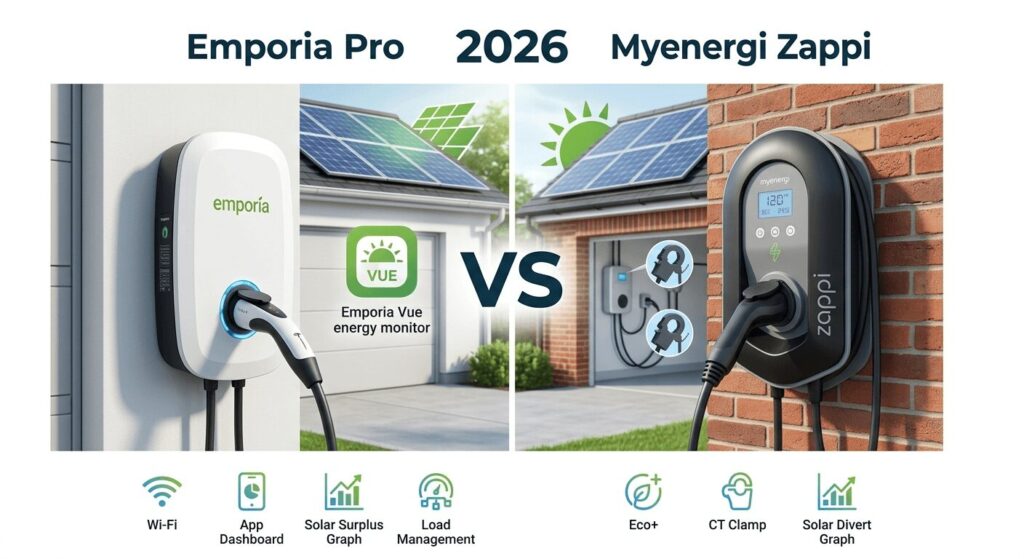
These are the right questions. And the best smart connectivity Wi-Fi app solar integration US Emporia vs Europe Zappi comparison is the right framework for answering them — because the Emporia Pro and Myenergi Zappi represent the two most serious solar-integrated smart charger options in their respective markets, and comparing them honestly reveals what smart connectivity actually delivers in practice versus what it promises on a spec sheet.
This guide covers every dimension of smart connectivity that matters — Wi-Fi reliability, app quality, solar integration depth, TOU scheduling, load management, ecosystem integration, and the honest financial value of each feature — with specific verdicts on which charger wins on each dimension and why.
Why This Comparison Specifically Matters
The best smart connectivity Wi-Fi app solar integration US Emporia vs Europe Zappi comparison matters for three reasons that go beyond typical spec sheet matching.
First, both chargers are specifically built around solar integration in a way that most competing chargers aren’t. The Tesla Wall Connector, ChargePoint Home Flex, and Wallbox Pulsar Plus all have smart features — but solar integration is not their design priority. For the Emporia Pro and Myenergi Zappi, solar integration is the primary differentiating feature around which everything else is built.
Second, both chargers represent genuine value propositions in their respective markets. The Emporia Pro at $399 delivers solar integration that competing US chargers charge $600-$700 for. The Myenergi Zappi at £699-£849 delivers solar divert that no competing European charger matches regardless of price. Understanding the differences between them helps buyers in each market understand what they’re actually getting.
Third, the smart connectivity experience varies significantly between them in ways that matter for daily use. The Wi-Fi reliability, app polish, solar algorithm sophistication, and ecosystem integration are genuinely different — and these differences affect whether the smart features actually get used or sit in a menu nobody opens.
The Emporia Pro — Smart Connectivity Overview
Price: $399 (US) Connector: NACS or J1772 Smart Features: Wi-Fi connectivity, real-time energy monitoring, TOU scheduling, solar integration (with Vue monitor), load management, Alexa/Google Home Solar Integration Method: Whole-home energy monitoring via Emporia Vue companion device App: Emporia app (iOS/Android) OCPP: 1.6 Warranty: 3 years
Wi-Fi Connectivity — Emporia Pro
The Emporia Pro connects to your home network via 2.4 GHz Wi-Fi. The initial setup process is straightforward — download the Emporia app, scan the QR code on the unit, follow the prompts to connect to your network.
Reliability in practice: The Emporia Pro’s Wi-Fi connectivity is generally solid but has a specific weakness that owner reviews flag consistently: Wi-Fi reconnection after router changes or network resets. Several owners report the charger losing connectivity after a router firmware update or home network reconfiguration and requiring a manual reset process to reconnect. This is a firmware-level issue that Emporia has addressed in subsequent updates but hasn’t completely resolved.
For homes with stable, long-established Wi-Fi networks that rarely change, this is a non-issue. For homes with frequent network changes, IoT mesh systems, or router updates, it’s worth knowing.
Signal strength requirement: The Emporia Pro requires a reasonably strong 2.4 GHz signal at the charger location. Garages at the far end of a property from the router can be at the edge of reliable signal range. A Wi-Fi extender near the charger location is a common and straightforward fix.
Offline functionality: The Emporia Pro can charge without Wi-Fi connectivity — the physical charging function doesn’t depend on network connection. Smart scheduling and app monitoring are unavailable offline, but the charger will charge at the last-set amperage even when disconnected from the network. This is important — a charger that stops working when Wi-Fi drops is a significant reliability problem that the Emporia Pro avoids.
App Experience — Emporia Pro
The Emporia app is one of the stronger home EV charger apps in the US market — not because it’s the most polished design, but because it provides genuinely useful data in an accessible format.
What the app shows:
- Real-time charging power (kW) and current session energy (kWh)
- Historical charging data — daily, weekly, monthly energy consumption
- Estimated charging cost based on your entered electricity rate
- Home energy consumption breakdown by circuit (with Vue monitor installed)
- Solar generation and surplus tracking (with Vue monitor)
- Charging schedule management
- Load management settings
What it does well: The energy monitoring integration with the Vue whole-home monitor is genuinely useful. Seeing your EV charging in the context of your total home energy consumption — and specifically seeing solar generation, grid import, and EV charging on the same dashboard — is more actionable than a standalone charger energy monitor.
What it does less well: The app’s design aesthetic is functional rather than polished. It gets the job done but doesn’t have the refined UI of the ChargePoint app or the Tesla app. For technically inclined users this is a minor aesthetic complaint. For less technical users who want an app that feels intuitive immediately, the learning curve is slightly steeper.
Alexa and Google Home integration: Both work reliably. “Alexa, start charging my car” and “Hey Google, what’s my car’s charging status” function as expected. The novelty wears off quickly but the integration works.
Solar Integration — Emporia Pro
This is the Emporia Pro’s standout feature and the primary reason most solar-owning US homeowners should consider it over competing chargers.
How it works: The Emporia Pro’s solar integration requires the Emporia Vue whole-home energy monitor ($150-$200 additional). The Vue monitors every circuit in your home in real time — including your solar inverter’s generation output. When solar generation exceeds home consumption, the Vue detects the surplus and signals the Emporia Pro to increase charging speed to absorb it. When solar generation drops (cloud cover, sunset), the charger throttles back to avoid drawing from the grid.
The sophistication of the algorithm: Emporia’s solar integration adjusts charging speed continuously as solar generation fluctuates. The charger doesn’t just turn on and off based on a threshold — it modulates output in response to changing surplus availability. This continuous adjustment maximises solar self-consumption in a way that simpler threshold-based systems don’t achieve.
What this means financially: For a California homeowner with a 6 kWp solar system generating 25 kWh on a good day, typical home consumption of 12 kWh leaves 13 kWh of daily surplus available for EV charging. At a grid rate of 28-35 cents/kWh, using surplus solar rather than buying from the grid saves $3.64-$4.55 per day — approximately $1,300-$1,660 annually assuming 300 days of meaningful solar generation.
The Emporia Pro at $399 plus Vue at $150 = $549 total investment. At $1,300-$1,660 annual savings from solar divert, payback period is 4-5 months. Over the charger’s 7-year lifespan, this represents $9,100-$11,620 in cumulative electricity savings from the solar integration alone.
The limitation: Solar integration requires the Vue companion device. Without it, the Emporia Pro is a smart charger with TOU scheduling and load management — genuinely useful but not solar-responsive. The $150-$200 additional cost of the Vue is worth factoring into the total price comparison.
TOU Scheduling — Emporia Pro
The Emporia Pro’s TOU scheduling is straightforward and effective. You set charging windows in the app — for example, 11pm to 7am on an Octopus Go-equivalent US overnight tariff — and the charger activates automatically within those windows.
Tariff API integration: The Emporia Pro doesn’t have direct API integration with specific US electricity tariffs in the way that some European chargers integrate with Octopus Agile. You manually configure the schedule based on your tariff’s off-peak windows. For fixed-window TOU tariffs (the majority of US smart tariffs), this works well. For dynamic pricing tariffs (real-time pricing in some US markets), manual scheduling captures most of the savings but misses the optimal dynamic window selection.
Load Management — Emporia Pro
The Emporia Pro’s load management is one of its most practically valuable features for US homeowners — and one of the most financially significant for owners with 100-amp panels.
How it works: With the Vue energy monitor installed, the Emporia Pro monitors your home’s total electrical draw in real time. When other high-draw appliances (HVAC, electric oven, dryer, electric water heater) are running, the charger automatically reduces its output to prevent the combined load from exceeding your panel’s capacity or tripping breakers.
The financial value: For US homeowners with 100-amp panels who want 48A (11.5 kW) charging, the alternative to load management is a panel upgrade costing $1,500-$4,000. The Emporia Pro’s load management — included in the $399 price — makes 48A charging viable on many 100-amp panels without the panel upgrade. The load management feature alone can save thousands compared to the panel upgrade alternative.
The Myenergi Zappi — Smart Connectivity Overview
Price: £699-£849 (UK); €749-€899 (Europe) Connector: Type 2 tethered Smart Features: Wi-Fi connectivity (via Myenergi hub), solar divert (Eco/Eco+ modes), TOU scheduling, energy monitoring, smart tariff compatibility Solar Integration Method: CT clamp on solar inverter/consumer unit App: Myenergi app (iOS/Android) OCPP: 1.6 Warranty: 3 years
Wi-Fi Connectivity — Myenergi Zappi
The Myenergi Zappi’s Wi-Fi connectivity works differently from most home chargers — it connects to your home network through the Myenergi hub (a separate device) rather than directly. The Zappi communicates with the hub via a proprietary Myenergi radio protocol, and the hub connects to your router via Wi-Fi or ethernet.
The hub-based architecture: This design choice has both advantages and disadvantages. The advantage is that the Zappi itself doesn’t need to be within Wi-Fi range of your router — it communicates with the hub via the Myenergi radio protocol which has a longer range. The hub can be positioned anywhere with Wi-Fi access, and multiple Myenergi devices (Zappi, Eddi, Libbi) all connect through the same hub.
The disadvantage is that a hub failure takes down all connected Myenergi devices simultaneously. The hub is an additional component that can fail. And the initial setup involves configuring both the hub’s Wi-Fi connection and the Zappi’s pairing to the hub — slightly more complex than a direct Wi-Fi setup.
Reliability in practice: The Myenergi hub-based architecture is generally reliable once set up correctly. Owner reviews report fewer random disconnection issues than the Emporia Pro’s direct Wi-Fi approach. The ethernet connection option for the hub (connecting via cable rather than Wi-Fi) provides the most stable connectivity for garages near the home’s network core.
Offline functionality: Like the Emporia Pro, the Zappi can charge without hub connectivity. The charging function doesn’t depend on network connection — you lose app monitoring and remote schedule changes but the charger continues operating on its last-set mode. This is the right design choice for any charger that’s a primary daily-use device.
App Experience — Myenergi Zappi
The Myenergi app is the most common point of criticism in Zappi owner reviews — and the gap between the Zappi’s hardware excellence and its app quality is the most honest limitation to acknowledge in this comparison.
What the app shows:
- Real-time charging power and session energy
- Solar generation, home consumption, and grid import (with CT clamp installed)
- Historical energy data
- Charging mode management (Fast/Eco/Eco+)
- Schedule settings
- Myenergi ecosystem device status (Eddi, Libbi if installed)
What it does well: The energy dashboard showing solar generation, home consumption, grid import, and EV charging on a single real-time view is genuinely informative. When the sun is shining and the Zappi is charging from surplus solar in Eco+ mode, seeing the solar generation tracking perfectly with the EV charging output is satisfying and provides clear confirmation the system is working.
What it does less well: The app’s UI design has improved through several iterations but remains behind the polish level of competing apps. The layout is functional but not intuitive — new users consistently report needing time to understand the information hierarchy. Setting schedules is more menu-intensive than it should be. The app performance on older smartphones can be sluggish.
Compared to the Emporia Pro’s app — which isn’t the most polished either — the Zappi’s app is noticeably less consumer-friendly. This is a genuine weakness in a product that is otherwise excellent hardware.
Smart tariff integration: This is where the Zappi’s connectivity strength lies. The Myenergi app integrates with Octopus Energy’s API directly — for Octopus Go, OVO Drive Anytime, and other UK smart EV tariffs, the Zappi can receive pricing signals and automatically schedule charging around the cheapest windows. This goes beyond manual scheduling — the Zappi responds to actual tariff data rather than a pre-set time window.
For UK Zappi owners on Octopus Go, the automatic scheduling is seamless. The charger detects the cheap overnight window, charges during it, and stops. No manual intervention. This level of smart tariff integration is a genuine functional advantage over the Emporia Pro’s manual scheduling approach.
Solar Integration — Myenergi Zappi
This is where the Zappi earns its exceptional reputation — and where the best smart connectivity Wi-Fi app solar integration US Emporia vs Europe Zappi comparison most clearly differentiates the two products.
How it works: The Zappi’s solar integration uses a CT (current transformer) clamp installed on the main consumer unit or solar inverter cable. The CT clamp continuously monitors electrical flow — detecting both solar generation and home consumption in real time. The Zappi uses this data to implement its three charging modes:
Fast Mode: Standard grid-powered charging at maximum speed. Ignores solar generation.
Eco Mode: Charges at the minimum EV charging speed (typically 6A/1.4 kW) plus any available solar surplus. The car always charges — just as fast as solar allows above the minimum threshold. On cloudy days, the car charges slowly from grid + whatever solar is available. On sunny days, charging speed increases as solar surplus increases.
Eco+ Mode: Only charges when there’s net solar surplus — no grid electricity used for EV charging. If solar generation drops below home consumption, charging stops completely until surplus is restored. This is the maximum self-consumption mode — your EV only ever charges from free solar electricity.
The sophistication difference from the Emporia Pro: Both chargers adjust charging speed in response to solar surplus. The Zappi’s advantage is the granularity and stability of the control algorithm — particularly in Eco+ mode.
The Zappi’s CT clamp measures actual electrical flow at the consumer unit, not estimated generation from an inverter API. This means it responds to the actual net position of your home energy balance — including consumption changes from appliances turning on and off, kettle boiling, oven switching elements, etc. — rather than a modelled estimate.
The result is more precise solar matching — the Zappi follows surplus changes more responsively and accurately than systems relying on inverter data estimates.
The three-mode flexibility: The choice between Fast, Eco, and Eco+ gives Zappi owners genuine daily control over the solar-versus-grid tradeoff. On a grey November morning when solar generation is minimal, switch to Fast mode and charge from the grid overnight on your cheap tariff. On a bright July afternoon with the panels generating strongly, switch to Eco+ and charge entirely from the sun.
This mode flexibility makes the Zappi more practically useful than a binary “solar or grid” approach — it adapts to the variable British and Northern European weather in a way that maximises value year-round.
What this means financially: For a UK homeowner with a 4 kWp solar system in southern England generating approximately 3,500 kWh annually, typical EV usage of 3,000-4,000 km per year requires approximately 500-700 kWh of charging electricity. Using Eco+ mode to source this from solar surplus rather than the grid saves approximately:
- Grid electricity cost avoided: 500 kWh × 25p/kWh = £125
- Solar export foregone: 500 kWh × 6p/kWh (SEG rate) = £30
- Net saving from Eco+ vs exporting: £125 – £30 = £95 annually on the EV charging alone
For higher-mileage drivers or those with larger solar systems, this saving increases proportionally. For a driver covering 15,000 km annually on a Wallbox-charged VW ID.4 without solar divert, switching to a Zappi could save £300-£400 annually.
Over a 7-year ownership period, that’s £665-£2,800 depending on mileage and solar system size — from a charger that costs £50-£150 more than alternatives.
TOU and Smart Tariff Scheduling — Myenergi Zappi
The Zappi’s smart tariff integration is a genuine competitive advantage over the Emporia Pro for UK owners on dynamic or smart tariffs.
Octopus Energy API integration: The Myenergi app communicates directly with Octopus Energy’s API to receive real-time pricing data for Octopus Go and Agile tariffs. The Zappi’s scheduling responds to actual tariff data rather than manually-set time windows.
For Octopus Go users: The Zappi automatically charges during the guaranteed cheap overnight window (currently 11:30pm-5:30am) without any manual scheduling required. Change to Go and the Zappi adapts automatically.
For Octopus Agile users: The Zappi can respond to Agile’s 30-minute dynamic pricing, scheduling charging during the cheapest half-hour slots within a user-defined overnight window. This level of dynamic optimisation exceeds what manual scheduling achieves and is one of the clearest functional advantages of smart tariff API integration.
For non-Octopus tariffs: Standard schedule-based charging works reliably. The smart tariff advantage is specific to Octopus integration — for other UK tariffs, the Zappi schedules similarly to the Emporia Pro.
Direct Feature Comparison — Best Smart Connectivity Wi-Fi App Solar Integration US Emporia vs Europe Zappi
| Feature | Emporia Pro (US) | Myenergi Zappi (Europe/UK) |
|---|---|---|
| Wi-Fi connectivity | Direct 2.4 GHz | Hub-based (Myenergi hub) |
| Wi-Fi reliability | Good, occasional reconnection issues | Good, ethernet option adds stability |
| App quality | Functional, moderate polish | Functional, lower polish than Emporia |
| App energy dashboard | Excellent (with Vue) | Good (with CT clamp) |
| Solar integration | Good — continuous modulation | Excellent — CT clamp, three modes |
| Solar algorithm sophistication | Good | Best in class |
| Solar mode flexibility | Binary (solar active/inactive) | Three modes (Fast/Eco/Eco+) |
| Companion device required | Yes (Vue, $150-$200) | Yes (CT clamp, included) |
| TOU scheduling | Manual schedule | Manual + smart tariff API (Octopus) |
| Dynamic tariff integration | No native API | Yes (Octopus Agile/Go) |
| Load management | Yes — excellent | No dedicated load management |
| Ecosystem integration | Emporia Vue/home monitoring | Myenergi Eddi/Libbi/hub |
| Alexa/Google Home | Yes | Limited |
| OCPP | 1.6 | 1.6 |
| Market | US | UK/Europe |
| Price (unit only) | $399 | £699-£849 |
| All-in with companion device | $549-$599 | £699-£849 (CT clamp included) |
Where Each Charger Wins — The Honest Verdicts
Emporia Pro Wins On:
Load management: The Emporia Pro’s real-time load management — monitoring total home draw and throttling EV charging to prevent breaker trips — has no direct equivalent on the Zappi. For US homeowners with 100-amp panels, this single feature can save $1,500-$4,000 in panel upgrade costs. The Zappi has no equivalent.
App energy monitoring breadth: With the Vue monitor, the Emporia Pro’s app shows whole-home energy consumption broken down by circuit. This is more comprehensive than the Zappi’s CT clamp monitoring of net household flow.
Voice assistant integration: Alexa and Google Home integration on the Emporia Pro is more developed than the Zappi’s limited voice control. For smart home enthusiasts who actively use voice control, the Emporia Pro is ahead.
Value per dollar: At $399 (or $549-$599 with Vue), the Emporia Pro delivers solar integration, load management, and whole-home energy monitoring at a price that competing US chargers charge $200-$300 more for — without the solar capability.
NACS native option: Available in NACS natively at the same price — the Zappi is Type 2 only.
Myenergi Zappi Wins On:
Solar algorithm sophistication: The Zappi’s CT clamp-based monitoring, three-mode flexibility (Fast/Eco/Eco+), and the precision of its surplus tracking algorithm represent the most sophisticated residential solar EV charging system currently available at any price. The Emporia Pro’s solar integration is good. The Zappi’s is better.
Smart tariff API integration: Direct Octopus Energy API integration for UK Octopus Go and Agile users is a functional advantage that the Emporia Pro’s manual scheduling doesn’t replicate. For UK Agile users specifically, this is the single most financially valuable smart connectivity feature available.
Eco+ mode: The ability to charge exclusively from solar surplus — zero grid electricity used for EV charging — has no direct equivalent on the Emporia Pro. For UK and European homeowners with solar on the SEG tariff, Eco+ mode is the feature that changes the economic calculation most significantly.
Myenergi ecosystem depth: Combined with Eddi (solar hot water diversion) and Libbi (home battery storage), the Zappi becomes part of a whole-home solar management system that the Emporia Pro — even with the Vue — doesn’t fully match.
Wi-Fi architecture stability: The hub-based architecture, with ethernet connectivity option, provides more stable connectivity in challenging locations than the Emporia Pro’s direct Wi-Fi approach.
The Smart Connectivity Features That Actually Pay For Themselves — By Scenario
The best smart connectivity Wi-Fi app solar integration US Emporia vs Europe Zappi comparison is most useful when it’s applied to specific real-world scenarios:
Scenario 1: US Homeowner, 5 kWp Solar, 100-Amp Panel
Best charger: Emporia Pro Why: Solar divert ($1,300+ annual savings), load management (avoids panel upgrade worth $1,500-$4,000), whole-home monitoring (operational value). The Zappi isn’t available in the US market easily. The Emporia Pro covers both the solar and panel constraints.
Smart features that pay for themselves: Both solar integration AND load management in this scenario. The combined value is exceptional.
Scenario 2: US Homeowner, No Solar, Time-of-Use Tariff
Best charger: Emporia Pro or ChargePoint Home Flex Why: TOU scheduling saves $100-$200 annually on most US TOU tariffs. Solar integration adds no value without solar. Load management is valuable if on a 100-amp panel.
Smart features that pay for themselves: TOU scheduling — pays back smart premium in 2-4 years.
Scenario 3: UK Homeowner, 4 kWp Solar, Octopus Go
Best charger: Myenergi Zappi Why: Eco+ mode solar divert (£95-£300 annual savings depending on mileage), Octopus Go API integration (seamless overnight scheduling), three-mode flexibility for variable British weather.
Smart features that pay for themselves: Both solar divert AND Octopus API integration. Combined, the Zappi’s smart features represent the best financial return of any home EV charger in the UK market for solar owners.
Scenario 4: UK Homeowner, No Solar, Standard TOU Tariff
Best charger: Wallbox Pulsar Plus, Easee One, or Zappi Why: Without solar, the Zappi’s premium over simpler chargers is harder to justify. The Zappi’s TOU scheduling works well but doesn’t require the Zappi specifically — a £549-£649 Easee One does the same job at lower cost.
Smart features that pay for themselves: TOU scheduling — same value as US scenario. Solar-specific features don’t apply.
Scenario 5: UK Homeowner, 4 kWp Solar, Octopus Agile
Best charger: Myenergi Zappi — no other charger comes close Why: Octopus Agile API integration + Eco+ mode + CT clamp precision creates a combination that maximises both solar self-consumption and dynamic tariff savings simultaneously. The Ohme Home Pro is the only serious alternative for Agile integration specifically, but lacks Eco+ mode solar exclusivity.
Smart features that pay for themselves: This is the scenario where the Zappi’s smart connectivity delivers the highest combined financial return of any home EV charger in any market.
Common Questions About Smart Connectivity — Answered Honestly
“Do I need to keep the app open for smart charging to work?”
No — for both the Emporia Pro and the Myenergi Zappi. Smart charging schedules and solar divert operate autonomously once configured. The app is for monitoring and changing settings, not for continuous operation. You can delete the app from your phone and both chargers continue operating on their last-configured settings.
“What happens if my internet goes down?”
Both chargers continue charging on their last-configured schedule or mode. You lose remote monitoring and any dynamic adjustments (like Octopus Agile real-time pricing on the Zappi) but the fundamental charging function continues. Internet dependency is appropriate for optional smart features — not for basic charging operation.
“How often do smart features need manual intervention?”
For the Emporia Pro with TOU scheduling: initial setup only. Set the schedule once, it runs automatically.
For the Myenergi Zappi with Octopus API integration: initial setup only. The API handles scheduling automatically.
For solar divert on both: you choose the mode (Fast/Eco/Eco+ on Zappi, or solar-active/inactive on Emporia) and the algorithm handles the rest. Many owners set Eco+ permanently in summer and Fast overnight in winter — two mode changes per year.
“Can I use the Emporia Pro in Europe or the Zappi in the US?”
The Emporia Pro is designed for the US market (240V, J1772/NACS). Using it in Europe requires a US-spec electrical connection and the Type 2 connector incompatibility makes it impractical for European use.
The Myenergi Zappi is primarily a UK/European product (230V Type 2). US buyers can import it but encounter UK-specific electrical specifications, limited US installer support, and warranty complications. Not a practical recommendation for either direction.
Internal Links — Further Reading on Clean Energy Bazaar
The best smart connectivity Wi-Fi app solar integration US Emporia vs Europe Zappi comparison sits within a broader set of smart charger guides.
For the broader smart EV charger features comparison covering the Emporia Pro, Tesla Universal Wall Connector, and Myenergi Zappi across every feature dimension, our smart EV chargers 2026 features worth the cost guide gives specific financial payback timelines. For the full European smart charger comparison covering Wallbox, Zappi, and Andersen, our Wallbox vs Myenergi Zappi vs Andersen smart charger Europe 2026 guide covers every relevant difference. For the full US three-way comparison, our Tesla Universal Wall Connector vs ChargePoint Home Flex vs Emporia Pro 2026 guide covers the dominant US smart chargers in depth. For the full US home charger market, our best home EV chargers 2026 US comparison covers ten options. For the UK and European market, our best Level 2 EV chargers UK Europe 2026 guide covers every major option. For understanding every spec in plain language, our EV charger specs 2026 guide translates everything. And for European grants that reduce the net cost of either charger, our EV home charging incentives Europe 2026 guide covers every country.
Final Thoughts
The best smart connectivity Wi-Fi app solar integration US Emporia vs Europe Zappi comparison has clear winners by scenario rather than a single overall winner — because these two chargers serve different markets, different electrical systems, and different smart feature priorities.
The Emporia Pro wins for US solar homeowners who need load management alongside solar integration, want whole-home energy monitoring, and are on a 100-amp panel that makes load management a cost-saving rather than a nice-to-have.
The Myenergi Zappi wins for UK and European solar homeowners who want the most sophisticated solar divert available at any price, are on Octopus Go or Agile and want genuine API-level tariff integration, and want mode flexibility (Fast/Eco/Eco+) that lets them optimise for different daily conditions.
For non-solar owners in both markets: the smart connectivity premium these chargers command over simpler alternatives is harder to justify. TOU scheduling alone doesn’t require either charger — a less expensive option delivers the same scheduling function. Solar integration is the feature that makes both the Emporia Pro and the Myenergi Zappi worth their respective prices.
The question to answer before buying either: do you have solar panels? If yes, both are strong recommendations for their respective markets. If no, the smart connectivity premium needs a different justification.