Grizzl-E Ultimate vs Hypervolt Home 3 Pro 2026. Most home EV charger comparisons are written by people who live somewhere temperate.
They compare apps. They compare cable lengths. They compare smart tariff integration. All legitimate considerations — until your charger stops working at minus 20 degrees Celsius on a January morning in Minnesota, Calgary, Oslo, or Edinburgh because nobody thought to ask whether the hardware actually handles sustained cold.
Cold weather EV charging is a real problem that affects a significant portion of EV owners in the US, Canada, the UK, and Northern Europe — and it’s almost entirely ignored in mainstream charger comparisons. This guide fixes that.
The Grizzl-E Ultimate vs Hypervolt Home 3 Pro cold weather US Europe comparison is built around the specific challenges of charging in cold climates — hardware performance at low temperatures, IP ratings that actually matter in winter conditions, cable flexibility in freezing temperatures, and the smart features that have genuine value when your battery is cold and charging is slower than normal. Plus the honest value comparison that tells you whether the price difference between these two chargers is justified.
Why Cold Weather Makes Home EV Charging Harder — and Why Your Charger Choice Matters
Before comparing the two chargers, it’s worth understanding what cold weather actually does to EV charging — because it affects both the car and the charger in ways that most guides don’t explain.
What Cold Does to Your EV Battery
EV batteries are lithium-ion cells that operate most efficiently between 20-35°C. Below 0°C, two things happen simultaneously that reduce charging performance:
Increased internal resistance. Cold lithium-ion cells have higher internal resistance, which means the battery’s BMS (battery management system) limits charging current to prevent damage. A car that accepts 7.2 kW in summer may only accept 3-4 kW at minus 10°C until the battery warms up through its thermal management system.
Reduced capacity. Cold batteries hold less charge than warm ones. A car with a quoted 60 kWh battery may effectively have 45-50 kWh of usable capacity at minus 15°C — meaning it both charges slower and holds less when fully charged.
This is why EV range in winter feels dramatically worse than summer numbers suggest — and why overnight home charging in cold climates sometimes produces a less-full battery in the morning than the same session would in July.
What Cold Does to Your Charger
The charger itself faces different but equally real cold weather challenges:
Electronics performance. Charger control boards, WiFi modules, and display screens all perform less reliably at extreme low temperatures. Budget chargers with minimal thermal protection can fail to initialise or lose connectivity in sustained cold below minus 15°C.
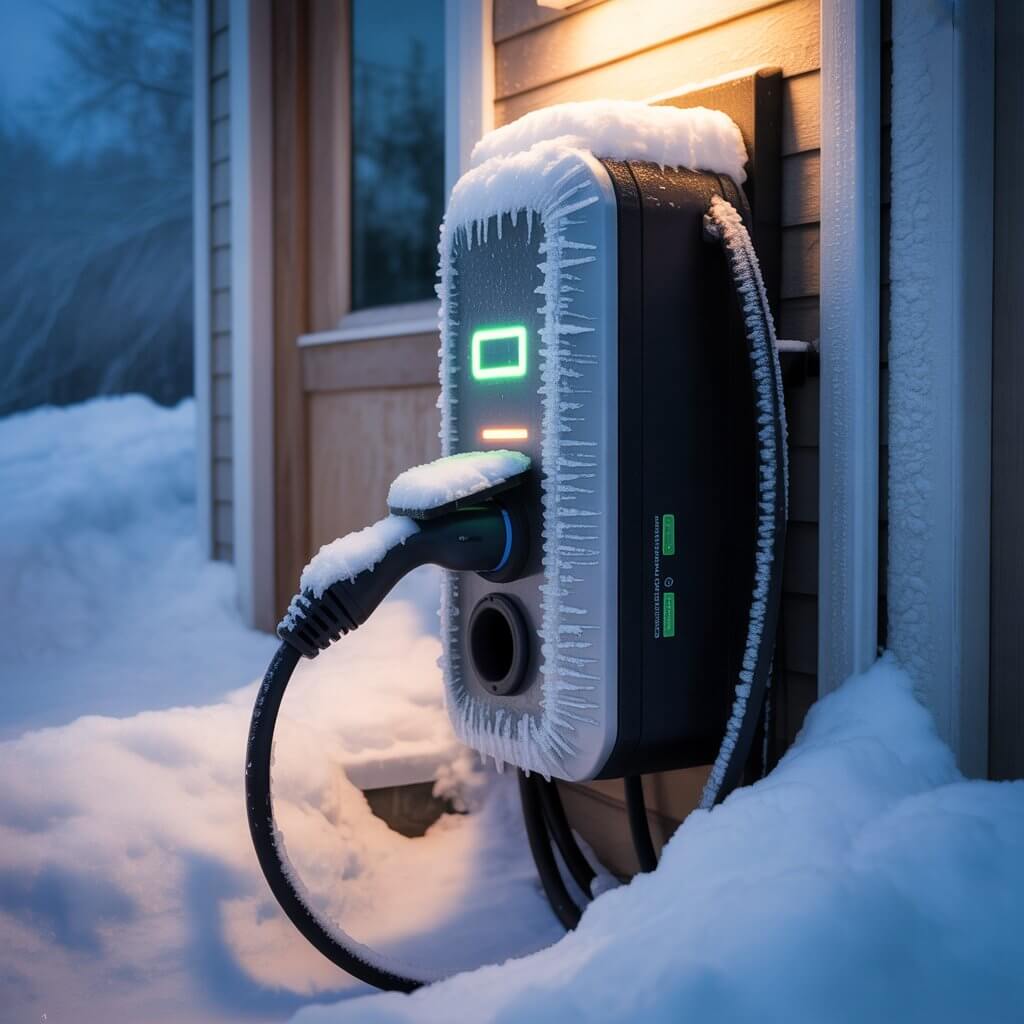
Cable flexibility. EV charging cables contain multiple conductors surrounded by an insulating jacket. In cold temperatures — particularly below minus 10°C — standard cable jackets stiffen significantly. A stiff cable is harder to plug in, puts stress on the connector and charging port, and in extreme cases can crack if bent sharply. The cable compound matters enormously for cold climate use and most spec sheets don’t mention it.
Connector performance. Metal connector pins contract slightly at low temperatures and plastic connector housings can become brittle. High-quality chargers use materials and connector designs that maintain reliable electrical contact and physical integrity across a wide temperature range. Budget chargers often don’t.
IP rating reality. An IP55 rating means the charger is protected against low-pressure water jets. In winter conditions, the relevant threats are snow accumulation, ice formation on connector faces, freezing condensation inside connector housings, and salt spray in coastal areas. IP65 and above — fully dustproof and protected against stronger water jets — provides meaningfully better protection against winter precipitation and condensation than IP55.
With that context, here’s how the Grizzl-E Ultimate and Hypervolt Home 3 Pro handle each of these challenges.
Grizzl-E Ultimate — The Cold Weather Specialist Built for North American Winters
Price: $399-$449 (US/Canada) Connector: J1772 or NACS (both versions available) Max Power: 11.5 kW (48A, 240V) Installation: Hardwired or NEMA 14-50 plug Operating Temperature: -40°C to +50°C Cable Temperature Rating: -40°C rated cable compound IP Rating: IP67 Smart Features: WiFi app control, scheduled charging, energy monitoring, Alexa/Google Home Warranty: 3 years Cable Length: 24 feet
Why the Grizzl-E Ultimate Is Built Differently From Most Home Chargers
The Grizzl-E brand’s entire design philosophy is built around one premise that most home EV charger manufacturers skip: a charging unit installed outdoors in a North American or Northern European climate needs to survive the full range of conditions that climate produces — not just a mild British drizzle.
The minus 40°C operating temperature rating is the headline spec — and it’s not marketing padding. The Grizzl-E Ultimate uses a heating element inside the unit that activates when ambient temperature drops below a threshold, keeping the internal electronics within their operating range even in sustained arctic cold. This is the same approach industrial outdoor electronics use and it’s what separates the Grizzl-E from chargers that technically meet IP67 but use electronics rated to minus 20°C or minus 25°C that quietly fail in Canadian prairie winters.
The minus 40°C rated cable compound is equally important. The Grizzl-E Ultimate’s cable uses a cold-rated thermoplastic elastomer (TPE) jacket that remains flexible at temperatures where standard PVC cable jackets become rigid and brittle. In practical terms this means the cable bends naturally and plugs in smoothly even after an overnight minus 30°C freeze — something most European-market chargers simply cannot claim.
The IP67 rating — fully dustproof and waterproof to 1 metre submersion — exceeds the IP55 or IP65 ratings of most competing premium chargers. For outdoor installations in regions with heavy snowfall, ice formation, or significant rainfall, IP67 provides a meaningful real-world protection advantage.
The metal enclosure — powder-coated aluminium rather than the polycarbonate plastic used by most competing chargers — handles thermal cycling (repeated freeze-thaw cycles) better over a 7-10 year outdoor installation lifespan. Plastic housings can develop microcracks from repeated thermal cycling that allow moisture ingress over time. The Grizzl-E’s aluminium housing doesn’t have this failure mode.
Smart Features on the Grizzl-E Ultimate
The Grizzl-E Ultimate — the smart version of Grizzl-E’s lineup — adds WiFi connectivity, app control, scheduled charging, and energy monitoring to the rugged hardware platform that made the basic Grizzl-E Classic the best-selling budget home charger in North America.
The app is functional and reliable. Scheduled charging works well for TOU tariff optimisation. Energy monitoring provides clear session history. Alexa and Google Home integration is included.
What the Grizzl-E Ultimate doesn’t have: solar integration, load management beyond basic scheduling, or OCPP compliance. For cold climate buyers whose primary concern is reliable charging in winter conditions, these gaps are acceptable trade-offs. For buyers who also want solar divert or sophisticated load management, the Grizzl-E Ultimate’s smart feature set may be insufficient.
Cold Weather Specific Features Worth Noting
Pre-conditioning integration. The Grizzl-E Ultimate’s scheduling feature works effectively with EV pre-conditioning routines — setting the charger to run during pre-conditioning (warming the battery before departure) ensures the car draws pre-conditioning power from the grid rather than the battery, preserving range. This is standard scheduling functionality but its value is amplified in cold climates where pre-conditioning is a daily necessity rather than an occasional convenience.
Connector protection. The Grizzl-E Ultimate’s J1772 and NACS connectors use a hinged dust and moisture cover on the charging end that protects the pins from freezing precipitation when not in use. This is a small but genuinely useful detail for buyers in high-snowfall regions who leave the connector exposed between charging sessions.
Cable storage. The 24-foot cable is long enough to coil loosely rather than being stretched tight between charger and car — important in cold weather where a taut cable puts more stress on connectors and is more likely to develop fatigue cracks at flex points.
Where the Grizzl-E Ultimate Falls Short
The app and smart feature experience is functional but not polished. The UI is clearly designed by engineers rather than product designers — effective for setting schedules and viewing usage history but less intuitive than the Hypervolt Home 3 Pro’s app for less technically confident users.
No solar integration — a meaningful gap for US and European homeowners with rooftop solar who want to maximise self-consumption. The Myenergi Zappi remains the recommendation for solar homeowners in any climate.
No OCPP compliance — limits integration with third-party home energy management systems and utility demand response programs. For buyers whose priority is cold weather reliability rather than smart grid integration, this is acceptable.
NACS adapter rather than native NACS on the J1772 version — if you have a NACS vehicle and buy the J1772 version, you need the adapter. The NACS native version is available at the same price and is the right buy for NACS vehicle owners.
Available primarily in North America — European buyers cannot easily source the Grizzl-E Ultimate through standard UK or European channels, limiting its relevance for that market to import orders with associated warranty complications.
Grizzl-E Ultimate Cold Weather Verdict
The best home EV charger for cold climate US and Canadian homeowners who want hardware built specifically for sustained low-temperature performance. The minus 40°C rating, cold-rated cable, IP67, and aluminium enclosure form a cold weather specification package that no competing home charger at this price point matches.
Hypervolt Home 3 Pro — The Smart Charger That Handles British and Northern European Winter Better Than Most
Price: £899-£1,099 (UK); €949-€1,149 (Europe) Connector: Type 2 tethered Max Power: 7.4 kW (single-phase) or 22 kW (three-phase, Pro version) Installation: Hardwired Operating Temperature: -25°C to +40°C Cable Temperature Rating: -20°C rated (standard); -25°C rated (Pro version) IP Rating: IP65 Smart Features: App control, scheduled charging, energy monitoring, solar divert, smart tariff integration, Hypervolt Connect hub, dynamic load balancing Warranty: 3 years OZEV Approved: Yes Cable Length: 6.5m
Why the Hypervolt Home 3 Pro Is the Smart Cold Climate Choice for UK and European Buyers
The Hypervolt Home 3 Pro is not a cold weather specialist in the same deliberate way the Grizzl-E Ultimate is. Hypervolt is a British brand designed for British conditions — which means it’s engineered for the specific cold climate challenges of the UK and Northern Europe rather than the more extreme temperatures of North American winters.
The minus 25°C operating temperature rating covers the realistic winter temperature range for the vast majority of UK and Northern European EV owners. Edinburgh’s coldest recorded winter temperature is around minus 15°C. Oslo’s is around minus 25°C. Copenhagen’s is minus 20°C. For European buyers, minus 25°C covers everything except the most extreme Nordic events.
What the Hypervolt Home 3 Pro adds to adequate cold weather performance is a sophisticated smart feature set that has genuine financial value in cold climates specifically — and this is where it differentiates from the Grizzl-E Ultimate in ways that matter.
Smart Features That Matter More in Cold Climates
Dynamic load balancing. Cold weather increases home electricity consumption significantly — heating, electric blankets, heated floors, additional lighting. The Hypervolt Home 3 Pro’s dynamic load balancing monitors your home’s total electrical draw and reduces charging speed when heating and other cold-weather loads push your total consumption close to your supply limit. This prevents tripped breakers during the periods of highest home electricity use — which in Northern Europe happen to coincide with the coldest nights.
Solar divert. The Hypervolt Home 3 Pro’s solar integration works on the same principle as the Myenergi Zappi — detecting surplus solar generation and directing it to EV charging. In cold climates, solar generation in winter is reduced but not absent — a sunny January day in the UK or Scandinavia can still produce meaningful surplus if consumption is managed well. The Hypervolt’s solar divert captures this winter solar generation for EV charging rather than exporting it at low SEG rates.
Smart tariff integration. The Hypervolt Home 3 Pro integrates directly with UK smart tariffs including Octopus Go, OVO Drive Anytime, and British Gas EV tariff through their API rather than generic scheduling. In cold climates where overnight charging is non-negotiable — you need a full battery every winter morning — smart tariff integration that maximises off-peak charging within your pre-departure window is more valuable than in mild climates where charging is more flexible.
Pre-departure scheduling. The Hypervolt app’s scheduling interface is designed around departure time rather than just time windows — you tell it when you need to leave and it works backward to ensure the car is fully charged by then, prioritising off-peak hours as much as possible within that constraint. For cold climate drivers who need a full charge and a warm cabin by 7:30am every morning, departure-time scheduling is meaningfully more useful than a simple time-window approach.
Cold Weather Specific Performance
The IP65 rating is fully dustproof and protected against low-pressure water jets — adequate for UK and Northern European winter conditions including rain, sleet, and snow. Not IP67 like the Grizzl-E Ultimate, but the difference matters most in environments with standing water or submersion risk, which UK and European residential installations rarely experience.
The minus 25°C operating temperature covers European winter conditions for all but the most extreme Nordic locations. Buyers in Northern Norway, Northern Sweden, Northern Finland, or Iceland who regularly experience below minus 25°C should consider whether the Grizzl-E Ultimate’s minus 40°C rating (available via import with warranty considerations) is worth pursuing.
The Type 2 cable on the Pro version uses a -25°C rated compound — more flexible in cold than the standard Hypervolt cable’s -20°C rating. For UK buyers, the practical difference between -20°C and -25°C is minimal given UK winter temperatures rarely reach -20°C. For Norwegian or Swedish buyers, the -25°C cable rating is worth specifying.
Where the Hypervolt Home 3 Pro Falls Short
The price — £899-£1,099 before installation — is significantly higher than the Grizzl-E Ultimate’s $399-$449. For UK buyers the OZEV £350 grant brings the effective unit cost to £549-£749 before installation, which narrows the gap but doesn’t close it. The value comparison between these two chargers is not straightforward — you’re comparing cold weather hardware superiority against smart feature sophistication, at different price points and in different markets.
The -25°C operating temperature, while adequate for most European climates, falls short of the Grizzl-E Ultimate’s -40°C rating for buyers in extreme cold climates. If you’re in northern Scandinavia or Canada, the Hypervolt’s temperature floor is a real limitation.
No internal heating element — unlike the Grizzl-E Ultimate, the Hypervolt Home 3 Pro relies on its operating temperature specification rather than active internal heating to maintain performance in cold conditions. Below -25°C, the unit may not initialise reliably.
Cable flexibility below -20°C is reduced on the standard cable — buyers in Northern European climates where winter temperatures regularly reach -15°C to -20°C should specify the Pro version’s -25°C rated cable.
Available in UK and Europe only — US buyers cannot easily access the Hypervolt Home 3 Pro through standard channels.
The Cold Weather Performance Comparison — What Actually Matters
| Cold Weather Spec | Grizzl-E Ultimate | Hypervolt Home 3 Pro |
|---|---|---|
| Min Operating Temp | -40°C | -25°C |
| Cable Temp Rating | -40°C | -25°C (Pro) / -20°C (standard) |
| IP Rating | IP67 | IP65 |
| Internal Heating | Yes | No |
| Enclosure Material | Aluminium | Polycarbonate |
| Thermal Cycling Resistance | Excellent | Good |
| Snow/Ice Protection | IP67 + connector cover | IP65 |
| Available Market | US/Canada | UK/Europe |
The Grizzl-E Ultimate wins the cold weather hardware comparison outright. The minus 40°C rating, internal heating element, IP67, cold-rated cable, and aluminium enclosure form a cold weather specification that the Hypervolt Home 3 Pro doesn’t match. For buyers in extreme cold climates — Northern Canada, Minnesota, Montana, North Dakota — the Grizzl-E Ultimate is the clear hardware choice.
For buyers in UK and Northern European climates where winter temperatures rarely drop below minus 15°C, the Hypervolt Home 3 Pro’s cold weather performance is adequate and its smart feature advantages — dynamic load balancing, solar divert, smart tariff API integration, departure-time scheduling — deliver real financial value that the Grizzl-E Ultimate doesn’t offer at equivalent sophistication.
The Value Comparison — Is the Price Difference Justified?
This is where the Grizzl-E Ultimate vs Hypervolt Home 3 Pro cold weather US Europe comparison gets interesting — because these two chargers don’t compete directly in the same market.
For US and Canadian Buyers
The Grizzl-E Ultimate at $399-$449 is the obvious cold weather choice for North American buyers. The Hypervolt Home 3 Pro isn’t realistically available in the US market through standard channels, which makes the comparison academic for most US readers.
The relevant US comparison for Grizzl-E Ultimate buyers is against the Emporia Pro ($399) or the ChargePoint Home Flex ($699). The Grizzl-E Ultimate’s cold weather hardware advantage over these competitors is real — neither the Emporia Pro nor the ChargePoint Home Flex has a -40°C rating or an internal heating element. The Grizzl-E Ultimate’s smart feature set is slightly less sophisticated than the Emporia Pro’s solar integration but is more than adequate for buyers whose primary concern is reliable winter performance.
Value verdict for US/Canada: The Grizzl-E Ultimate is exceptional value for cold climate North American buyers — industry-leading cold weather hardware at a mid-range price point with adequate smart features. At $399-$449 before the federal tax credit (30% up to $1,000), the effective cost after credit on a typical installation is around $400-$600 all-in. Difficult to beat for the cold weather performance delivered.
For UK and European Buyers
The Hypervolt Home 3 Pro at £899-£1,099 before the £350 OZEV grant is significantly more expensive than equivalent chargers with similar smart features — the Wallbox Pulsar Plus at £649-£799 delivers comparable smart capabilities at lower cost, and the Myenergi Zappi at £699-£849 is better for solar homeowners.
The Hypervolt Home 3 Pro’s premium over the Wallbox Pulsar Plus is justified if:
- You’re on Octopus Go or OVO Drive Anytime and want direct API smart tariff integration
- You have solar panels and want integrated solar divert without buying a Zappi
- You want dynamic load balancing for a home with high cold-weather electrical consumption
- You value British brand customer support that understands UK-specific tariffs and conditions
For UK buyers specifically, the Hypervolt Home 3 Pro’s departure-time scheduling and smart tariff API integration have genuine daily value in cold winters where a full battery every morning is non-negotiable rather than optional.
Value verdict for UK/Europe: The Hypervolt Home 3 Pro is good value for UK buyers who want smart tariff optimisation and solar integration in a cold-weather-adequate package — particularly after the £350 OZEV grant brings the effective cost down to £549-£749 for the unit. Less compelling for continental European buyers where Wallbox delivers similar smart features at lower cost and the Myenergi Zappi delivers better solar integration.
Cold Weather Charging Tips That Apply Regardless of Which Charger You Buy
The charger hardware is only part of the cold weather charging story. These practices make a meaningful difference regardless of which unit you install:
Pre-condition your battery before charging. Most EVs allow you to schedule cabin heating and battery conditioning before departure while still plugged into the charger. Pre-conditioning while plugged in draws power from the charger rather than the battery — preserving range. Set pre-conditioning to run 20-30 minutes before your departure time every morning in winter.
Keep the battery above 20% state of charge. Cold batteries below 20% SOC charge even more slowly than cold batteries at higher charge levels — the BMS becomes increasingly conservative at low temperatures and low charge simultaneously. Plugging in every night regardless of range remaining is more important in winter than summer.
Store your charging cable inside when possible. If your cable is separate from the charger unit — portable EVSE or untethered charger socket — storing it inside overnight keeps it flexible for the morning session. A cable that has been at minus 20°C for 8 hours is significantly stiffer than one that spent the night indoors.
Check connector contacts regularly in winter. Salt spray from road gritting, freezing condensation, and ice formation can contaminate connector contacts over a winter season. A dry soft brush monthly keeps contacts clean and maintains reliable electrical connection. Never use water to clean frozen connectors — use a dedicated electrical contact cleaner.
Set charging to complete 30 minutes before departure rather than at departure time. This gives the BMS time to complete the charge at a slightly higher current than the very end of a charging session, and allows the car’s thermal management to warm the battery slightly before you unplug and drive away.
The Decision — Who Should Buy Which
Buy the Grizzl-E Ultimate if:
- You’re in the US or Canada and experience sustained winter temperatures below -15°C
- You live in Minnesota, Wisconsin, Montana, North Dakota, or any Canadian province
- Cold weather reliability is your absolute primary concern
- You want the best cold weather hardware available at a mid-range price
- You don’t need solar integration as a priority
- You’re a NACS or J1772 vehicle owner looking for the most weather-resistant home charger available
Buy the Hypervolt Home 3 Pro if:
- You’re in the UK or Northern Europe
- You want smart tariff API integration with UK-specific tariffs
- You have solar panels and want integrated solar divert
- You have high cold-weather home electricity consumption that benefits from dynamic load balancing
- You want a British brand with UK-specific support and warranty
- Budget allows for the premium over the Wallbox Pulsar Plus
Consider alternatives if:
- You’re in the UK with solar and budget is tighter — the Myenergi Zappi delivers better solar integration at lower cost
- You’re in the US with solar — the Emporia Pro delivers better solar integration at the same price as the Grizzl-E Ultimate
- You’re in Europe without solar — the Wallbox Pulsar Plus delivers similar smart features to the Hypervolt at lower cost
- You’re in Canada or Northern US and want smart features — consider the Emporia Pro for solar integration alongside the Grizzl-E Classic for weather resistance, depending on which priority wins
Internal Links — Further Reading on Clean Energy Bazaar
The Grizzl-E Ultimate vs Hypervolt Home 3 Pro cold weather US Europe comparison sits within a broader set of guides that cover every dimension of home EV charger selection.
For the full US home charger market including the Grizzl-E Classic, Emporia Pro, and ChargePoint Home Flex, our best home EV chargers 2026 US comparison covers ten options honestly. For the full UK and European market including the Wallbox Pulsar Plus, Myenergi Zappi, and Andersen A2, our best Level 2 EV chargers UK Europe 2026 comparison covers the full picture. For the smart feature value question — which features pay for themselves and which ones are marketing — our smart EV chargers 2026 features worth the cost guide gives specific payback timelines. For the three-way US premium comparison, our Tesla Universal Wall Connector vs ChargePoint Home Flex vs Emporia Pro 2026 guide covers the dominant US smart chargers in depth. For the European premium three-way, our Wallbox vs Myenergi Zappi vs Andersen smart charger Europe 2026 comparison is the right read. And before buying anything, our EV charger warranty comparison covers what warranty terms actually mean in practice.
Final Thoughts
The Grizzl-E Ultimate vs Hypervolt Home 3 Pro cold weather US Europe comparison has a cleaner answer than most three-way comparisons because the two chargers serve genuinely different markets and genuinely different priorities.
The Grizzl-E Ultimate wins the cold weather hardware comparison outright — minus 40°C, internal heating, IP67, cold-rated cable, aluminium enclosure. For North American buyers in genuine cold climates, it’s the most capable cold weather home EV charger at any price below $700.
The Hypervolt Home 3 Pro wins the smart feature comparison for UK and European buyers who want departure-time scheduling, smart tariff API integration, solar divert, and dynamic load balancing in a cold-weather-adequate package. For UK buyers the OZEV grant makes the value case more compelling than the headline price suggests.
The mistake to avoid in this comparison is choosing the wrong charger for the wrong market — buying the Grizzl-E Ultimate in the UK where it’s not easily serviced, or expecting the Hypervolt to perform in Canadian winter conditions where its -25°C temperature floor genuinely matters.
Cold weather EV charging is solved by a combination of the right charger hardware, the right charging habits, and the right smart features — in that order of importance. The Grizzl-E Ultimate gets the hardware right. The Hypervolt Home 3 Pro gets the smart features right. Which one is right for you depends on where you live and which dimension of that combination you need most.