Here’s a situation most new EV owners know well.
You’re looking at two home chargers side by side. One says 7.2 kW. The other says 11 kW. Both list different amps. One mentions single-phase, the other three-phase. The product descriptions mention NACS, CCS, Type 2, and something called an OCPP protocol. The price difference between them is ₹15,000.
You have no idea which one you actually need.
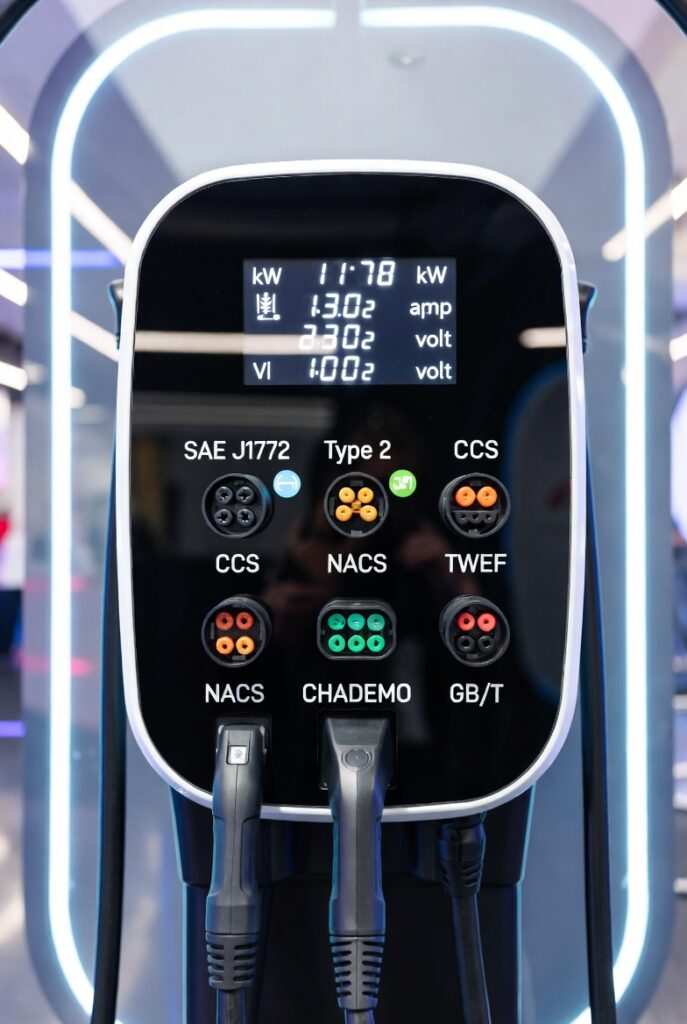
This is understanding EV charger specs 2026 in practice — and the honest truth is that most charger manufacturers and retailers make these specs harder to understand than they need to be. Not necessarily deliberately, but the technical language assumes a baseline knowledge that most first-time EV buyers simply don’t have.
This guide fixes that. Every spec that matters — kW, amps, voltage, NACS, CCS, three-phase, single-phase — explained in plain language with real-world context. By the end, you’ll know exactly what each number means, how it affects your charging experience, and which specs actually matter when you’re choosing a charger.
Why EV Charger Specs Feel So Confusing
Before getting into individual specs, it’s worth understanding why understanding EV charger specs 2026 feels harder than it should.
EV charging sits at the intersection of three different technical worlds — electrical engineering, automotive engineering, and software/networking. Each of those worlds has its own terminology, and EV charger spec sheets tend to throw all three at you simultaneously without context.
A spec sheet that lists “32A, 7.4 kW, 230V, Type 2, OCPP 1.6, IP55” is technically accurate but practically useless to someone who just wants to know how quickly their Tata Nexon EV or Tesla Model 3 will charge. The goal of this guide is to translate all of that into information you can actually use.
kW — The Number That Actually Tells You How Fast You’ll Charge
What Does kW Mean on an EV Charger?
kW stands for kilowatt — a unit of power. In the context of EV charging, the kW rating of a charger tells you how much electrical power it can deliver to your car’s battery per unit of time.
Think of it like water flow. If charging your battery is like filling a tank, kW is the rate at which water flows through the pipe. A higher kW rating means more power delivered per hour, which means faster charging.
How kW Translates to Real Charging Speed
Here’s the practical translation most spec sheets don’t give you:
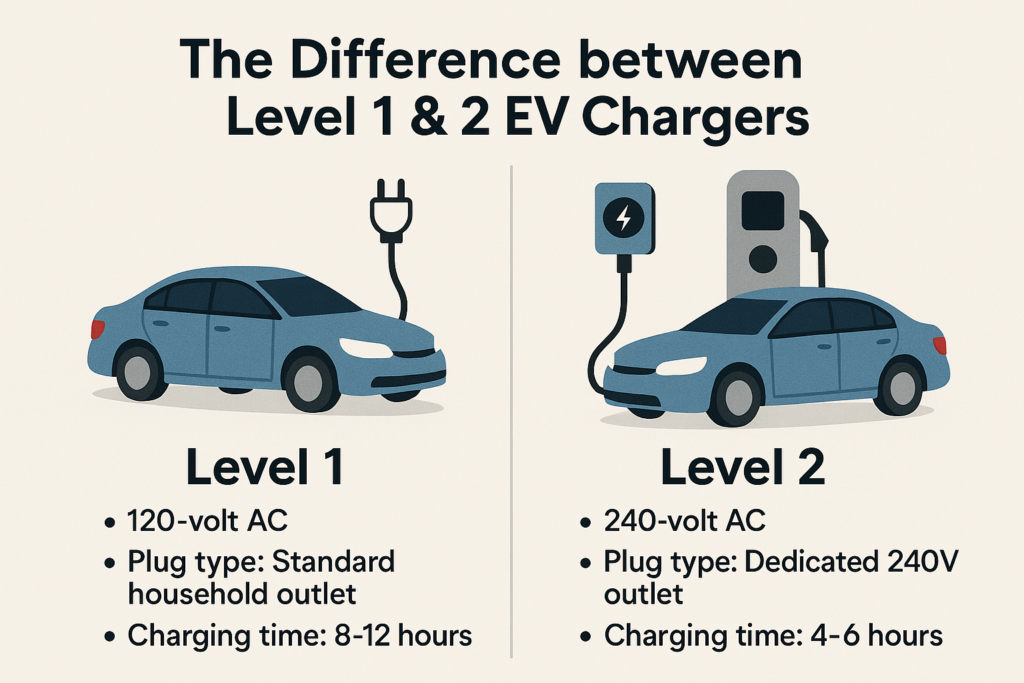
- 1.4 kW (Level 1, US 120V): Adds roughly 8-10 km of range per hour. A full charge from empty takes 40-50 hours on a mid-range EV.
- 3.3 kW (slow AC): Adds roughly 20-25 km of range per hour. Common on older EVs and basic home chargers.
- 7.2-7.4 kW (standard Level 2): Adds roughly 40-50 km of range per hour. The most common home charging speed. A 60 kWh battery charges fully in 8-9 hours.
- 11 kW (faster Level 2): Adds roughly 65-75 km of range per hour. A 60 kWh battery charges fully in about 5-6 hours.
- 22 kW (fast AC, Europe): Adds roughly 120-150 km of range per hour. Only achievable with three-phase power and a car whose onboard charger supports 22 kW AC.
- 50 kW (DC fast charging): Adds roughly 250-300 km of range per hour. Most EVs go from 20% to 80% in 30-45 minutes.
- 150 kW (high-power DC fast): Adds roughly 700-900 km of range per hour on compatible vehicles. 20% to 80% in 15-20 minutes.
- 250-350 kW (ultra-fast DC): Adds 100 km of range in under 5 minutes on vehicles like the Hyundai Ioniq 6 or Porsche Taycan.
The Most Important kW Rule Nobody Tells You
The charger’s kW rating is a ceiling, not a guarantee. Your car’s onboard charger determines the actual charging speed.
If your car has a 7.2 kW onboard AC charger — like the Tata Nexon EV — and you plug into an 11 kW home charger, you’ll charge at 7.2 kW. The extra capacity of the charger does nothing. You’re not getting ripped off — you just can’t use more than your car accepts.
This is one of the most common sources of confusion when understanding EV charger specs 2026 — people buy a faster charger expecting faster charging and get the same speed they had before because their car was the bottleneck all along.
Check your car’s maximum AC charging rate before buying a home charger. If it’s 7.2 kW, an 11 kW charger gives you headroom for a future vehicle upgrade but won’t charge your current car any faster.
Amps — The Spec That Determines Whether Your Electrical System Can Handle the Charger
What Does Amp Rating Mean on an EV Charger?
Amps (A) measure electrical current — the volume of electrons flowing through the circuit at any given moment. In EV charging, the amp rating of a charger determines how much current it draws from your home’s electrical supply.
If kW is the rate of water flow, amps is the diameter of the pipe. A higher amp charger draws more current from your electrical system, which is why higher-powered chargers often require a dedicated circuit and sometimes an electrical panel upgrade.
How Amps, Voltage and kW Relate to Each Other
These three specs are mathematically connected by a simple formula:
Power (kW) = Voltage (V) × Current (A) ÷ 1000
This means:
- A 32A charger on 230V single-phase delivers 7.36 kW — which is why most “7.4 kW” chargers are actually 32A units
- A 48A charger on 240V US single-phase delivers 11.5 kW
- A 32A charger on 400V three-phase delivers 22 kW (32A × 400V × √3 ÷ 1000)
You don’t need to memorise this formula. You just need to know that kW, amps, and voltage are all describing the same thing from different angles — and that changing any one of them changes the others.
What Amp Rating Do You Need for Your Home Charger?
For a 7.2-7.4 kW home charger: You need a 32A dedicated circuit. Most homes in India, the UK, and Europe can accommodate this without electrical panel work if a spare circuit is available.
For an 11 kW home charger: You need a 48A circuit in the US (on 240V) or three-phase supply in Europe. In India, 11 kW home charging requires three-phase supply, which is available in some homes but not standard in all apartments.
For a 22 kW home charger: Three-phase supply is mandatory. In India this typically means a commercial or industrial connection, which most residential properties don’t have. In Europe, three-phase residential supply is more common, particularly in Northern and Central Europe.
Always have a licensed electrician assess your home’s electrical capacity before buying a charger. The charger spec sheet tells you what the unit needs — only an electrician can tell you whether your home can provide it.
Voltage — The Spec That Varies Most Between Countries
What Does Voltage Mean for EV Charging?
Voltage (V) is the electrical pressure that pushes current through a circuit. Different countries have different standard supply voltages, which directly affects EV charging speeds.
- India: 230V single-phase, 400V three-phase
- US and Canada: 120V (standard outlets), 240V (Level 2 charging circuits)
- UK: 230V single-phase, 400V three-phase
- Europe (continental): 230V single-phase, 400V three-phase
- Australia: 230V single-phase, 400V three-phase
This is why US Level 1 charging (120V) is so much slower than European Level 1 (230V) for the same amp rating — the lower US voltage means less power delivered despite identical current.
The 400V vs 800V Battery Architecture Question
You’ll increasingly see EVs advertised with “800V architecture” — like the Hyundai Ioniq 6, Kia EV6 GT, and Porsche Taycan. This is different from the supply voltage and refers to the internal battery voltage of the car.
800V battery architecture allows these vehicles to accept DC fast charging at very high power levels — up to 350 kW on compatible stations — without the thermal management challenges that affect lower-voltage batteries at high charge rates. It’s one of the reasons these vehicles can charge from 10% to 80% in under 20 minutes.
For home charging purposes, 800V vs 400V battery architecture makes no difference — both charge at the same AC rate your onboard charger allows. The 800V advantage only shows up at high-power DC fast chargers.
Single-Phase vs Three-Phase Charging — The Spec That Causes the Most Confusion
What Is Single-Phase Charging?
Single-phase power uses two wires to deliver electricity — one live wire carrying current and one neutral wire completing the circuit. Most residential electrical supply in the US, and standard residential supply in India and the UK, is single-phase.
Single-phase charging is what most home EV chargers use. It’s simpler, cheaper to install, and sufficient for overnight home charging at 7.2-11 kW.
What Is Three-Phase Charging?
Three-phase power uses four wires — three live wires carrying current at different phases of the AC cycle, plus a neutral. Each phase carries power independently and they’re offset by 120 degrees, which is why three-phase power can deliver three times the power of single-phase at the same voltage and current per wire.
Three-phase supply is standard for industrial and commercial buildings in India. It’s also available in many European residential properties, particularly in Northern and Central Europe. In the US, true three-phase residential supply is uncommon — most US homes have split-phase 240V, which is different from three-phase.
Why Three-Phase Matters for EV Charging
The practical difference is straightforward:
- Single-phase, 32A, 230V: 7.4 kW maximum
- Three-phase, 32A, 400V: 22 kW maximum
A car that supports 22 kW AC charging — like the older Renault Zoe or certain variants of the BMW i3 — charges three times faster on three-phase power than on single-phase. At a 22 kW three-phase public station, you’re adding 120-150 km of range during a 45-minute lunch break. On single-phase, that same session adds 40-50 km.
For most Indian home charging setups, single-phase 7.4 kW is the practical ceiling unless you have a three-phase residential connection. This is worth confirming with your electrician before buying anything above 7.4 kW.
NACS — Understanding EV Charger Specs 2026 Means Understanding This Standard
What Is NACS?
NACS stands for North American Charging Standard. It’s the connector and communication standard originally developed by Tesla for their Supercharger network and adopted as an industry-wide standard by SAE International in 2023.
Going into 2026, NACS has become the dominant EV charging standard for new vehicles in the US and Canada. Ford, GM, Rivian, Honda, Nissan, Toyota, and most other major manufacturers have committed to NACS for their 2025 and 2026 model year vehicles.
What Makes NACS Different
NACS handles both AC and DC charging through a single compact connector. This is a genuine improvement over the previous US standard, which required a J1772 connector for AC and a separate CCS1 connector for DC fast charging — meaning older EVs had two separate charging ports.
NACS is also physically smaller and lighter than J1772 or CCS1, which matters for daily use — a smaller, lighter connector is easier to handle, easier to store, and puts less strain on the car’s charging port over time.
NACS in 2026 — Where Things Stand
If you’re buying a new EV in the US in 2026, it almost certainly has a NACS port. You can access the existing J1772 Level 2 network with the included adapter. You can access Tesla Superchargers natively. The transition is largely complete for new vehicles.
If you own an older US EV with J1772 and CCS1 ports, you’re not stranded — the J1772 and CCS1 network is massive and isn’t disappearing. NACS-to-CCS1 adapters let you access newer NACS-native stations if needed.
Outside North America — including India and Europe — NACS is not the standard. India uses CCS2 for DC fast charging and Type 2 for AC. Europe uses the same. Understanding EV charger specs 2026 in a global context means knowing that NACS is a North American story, not a worldwide transition.
CCS — The Global DC Fast Charging Standard (Almost)
What Is CCS?
CCS stands for Combined Charging System. It’s a DC fast charging standard that combines an AC charging connector with additional DC pins, allowing both AC and DC charging through a single inlet on the car.
There are two versions:
CCS1: Used in North America. Combines J1772 AC pins with two DC pins below. Found on older US EVs like pre-2024 Chevrolet Bolt, Ford Mustang Mach-E, and Hyundai Ioniq 5 (US spec).
CCS2: Used in Europe, India, Australia, and most other markets outside North America. Combines Type 2 AC pins with two DC pins below. The standard for DC fast charging across India — found at Tata Power, Statiq, ChargeZone, and all major public charging networks.
CCS vs NACS — Which Wins?
In North America, NACS is winning. Most new US vehicles use NACS and the Supercharger network — now open to non-Tesla vehicles — gives NACS the largest and most reliable fast charging network on the continent.
Outside North America, CCS2 is the standard and NACS is not a factor. India, Europe, the UK, Australia — all CCS2 for DC fast charging. There is no sign of NACS expanding internationally in any meaningful way as of 2026.
The practical answer: understanding EV charger specs 2026 means knowing which standard applies to your market. If you’re in India or Europe, CCS2 is what matters. If you’re in the US and buying a new vehicle, NACS is what matters.
OCPP — The Spec Most Buyers Ignore and Shouldn’t
What Is OCPP?
OCPP stands for Open Charge Point Protocol. It’s a communication standard that governs how a charging station talks to a backend management system — which enables features like remote monitoring, scheduled charging, energy management, and integration with smart home systems.
Most buyers ignore OCPP on the spec sheet and it mostly doesn’t matter for basic home charging. But if you care about any of the following, it becomes relevant:
- Scheduling off-peak charging to use cheaper electricity tariffs
- Monitoring your charging sessions and energy usage remotely
- Integrating with solar panels at home to charge from renewable energy
- Commercial installations where multiple chargers need central management
OCPP 1.6 is the most widely deployed version. OCPP 2.0.1 is the newer standard with better security and more features. For a basic home charger, either is fine. For a commercial installation or a smart home setup, OCPP 2.0.1 is worth specifying.
IP Rating — The Spec That Tells You How Tough the Charger Actually Is
What Does IP Rating Mean?
IP stands for Ingress Protection. The IP rating tells you how well the charger is protected against dust and water. It’s written as two digits — IP followed by two numbers.
- First digit (dust protection): Ranges from 0 (no protection) to 6 (fully dustproof)
- Second digit (water protection): Ranges from 0 (no protection) to 8 (submersible)
For EV chargers in Indian conditions, these ratings matter more than in milder climates.
IP44: Protected against solid objects over 1mm and water splashing from any direction. Minimum acceptable for an outdoor charger in India.
IP55: Protected against dust ingress and low-pressure water jets from any direction. Good for outdoor installations in most Indian climates.
IP65: Fully dustproof and protected against low-pressure water jets. Recommended for outdoor installations in coastal areas or regions with heavy monsoon rainfall.
IP67: Fully dustproof and can withstand temporary submersion. Best for flood-prone areas or installations near water.
In India’s conditions — dust, monsoon rain, extreme heat — don’t install anything below IP55 outdoors. This is a spec that’s easy to overlook and expensive to regret.
Smart Charging Features — The Specs That Are Increasingly Worth Paying For
Modern home EV chargers are not just dumb power delivery units anymore. The smart charging specs are worth understanding because they have real financial value.
Load balancing: The charger monitors your home’s total electrical load and reduces charging speed when other high-draw appliances are running, preventing tripped circuit breakers. Particularly useful in Indian apartments with limited sanctioned load.
Time-of-use scheduling: Programs the charger to only charge during off-peak electricity tariff hours — typically late night. In states where time-of-use tariffs are available, this can meaningfully reduce charging costs over time.
Solar integration: Some chargers can communicate with a home solar inverter and prioritise charging from solar generation during daylight hours. Increasingly relevant as rooftop solar adoption grows in India.
Remote monitoring and control: Check charging status, start/stop sessions, and view energy consumption history from a smartphone app. Useful for households with multiple drivers or for businesses managing employee charging.
OTA updates: Over-the-air firmware updates keep the charger’s software current without requiring a service visit. As EV standards and grid integration requirements evolve, OTA capability becomes more valuable over a 5-10 year charger lifespan.
Putting It All Together — How to Read an EV Charger Spec Sheet
Let’s take a real example. Here’s a typical spec sheet entry:
“32A, 7.4 kW, 230V single-phase, Type 2 tethered, IP55, OCPP 1.6, WiFi, scheduled charging”
Here’s what that actually means in plain language:
- 32A — draws 32 amps from your home circuit, needs a dedicated 32A breaker
- 7.4 kW — adds roughly 40-50 km of range per hour to most EVs
- 230V single-phase — works on standard Indian/European residential supply, no three-phase needed
- Type 2 tethered — the cable is permanently attached to the charger, connects to any Type 2 EV port
- IP55 — suitable for outdoor installation including monsoon conditions
- OCPP 1.6 — can be remotely monitored and managed, supports scheduled charging
- WiFi — connects to your home network for app control and remote monitoring
- Scheduled charging — can be set to charge only during off-peak hours
That spec sheet went from confusing to completely readable once you know what each element means. That’s what understanding EV charger specs 2026 actually looks like in practice.
The Specs That Matter Most — A Simple Priority Framework
Not every spec deserves equal attention. Here’s how to prioritise when you’re comparing chargers:
Tier 1 — Always check these:
- kW rating vs your car’s maximum AC charging rate
- Single-phase vs three-phase requirement vs your home’s supply
- Connector type (Type 2 in India/Europe, NACS or J1772 in US)
- IP rating for outdoor installations
Tier 2 — Check these if relevant:
- Amp rating vs your home’s available circuit capacity
- OCPP version if you want smart home integration or commercial management
- Smart charging features if you have solar or time-of-use tariffs
Tier 3 — Nice to have:
- OTA update capability
- Load balancing
- Brand app quality and remote monitoring
Internal Links — Further Reading on Clean Energy Bazaar
Understanding EV charger specs 2026 is the foundation — but knowing the specs is only the first step. Here’s where to go next.
If you want to understand how kW ratings translate into the Level 1, Level 2 and DC Fast Charging framework, our EV charging guide 2026 covering Level 1 vs Level 2 vs DC Fast differences in the US and Europe puts the numbers in context. If you’re confused about whether your car needs a J1772 or Type 2 connector, our J1772 vs Type 2 connector guide covers every compatibility scenario. Before spending on a home charger, our EV charger warranty comparison tells you what each brand’s fine print actually covers. If something goes wrong at a public charging station, our EV charger troubleshooting guide walks through every fix. And for the most practical next step — finding a home charger that matches your specs, budget and real-world conditions — our honest guide to the best home EV chargers with real user costs and setups is the right place to land.
Final Thoughts
Understanding EV charger specs 2026 doesn’t require an electrical engineering degree. It requires knowing what each number is actually measuring, how it connects to your real-world charging experience, and which specs are genuinely relevant to your situation versus which ones are just technical noise.
The kW rating tells you how fast. The amp rating tells you what your home needs. The voltage tells you whether your supply is compatible. The connector type tells you whether the cable fits. The IP rating tells you whether it survives outdoors. Everything else is either a nice-to-have or only relevant in specific scenarios.
Once you can read a spec sheet clearly, comparing chargers becomes straightforward. And making a confident, well-informed charger decision is exactly what understanding EV charger specs 2026 should give you.