India’s EV market is accelerating in 2026, with Bengaluru leading the charge as a major hub for electric mobility. Popular models like the Tata Nexon EV, MG ZS EV, Mahindra e-Verito, and emerging options make home charging essential for convenience and savings. Basic chargers provide straightforward functionality, while smart chargers offer app-based control, scheduling, solar integration, and energy optimization. In a city like Bengaluru with variable tariffs, rooftop solar growth, and apartment living common, the question is: are smart charger’s advanced features worth the investment? This guide compares them for Indian users, with a focus on real costs, Karnataka specifics, and clean energy advantages.
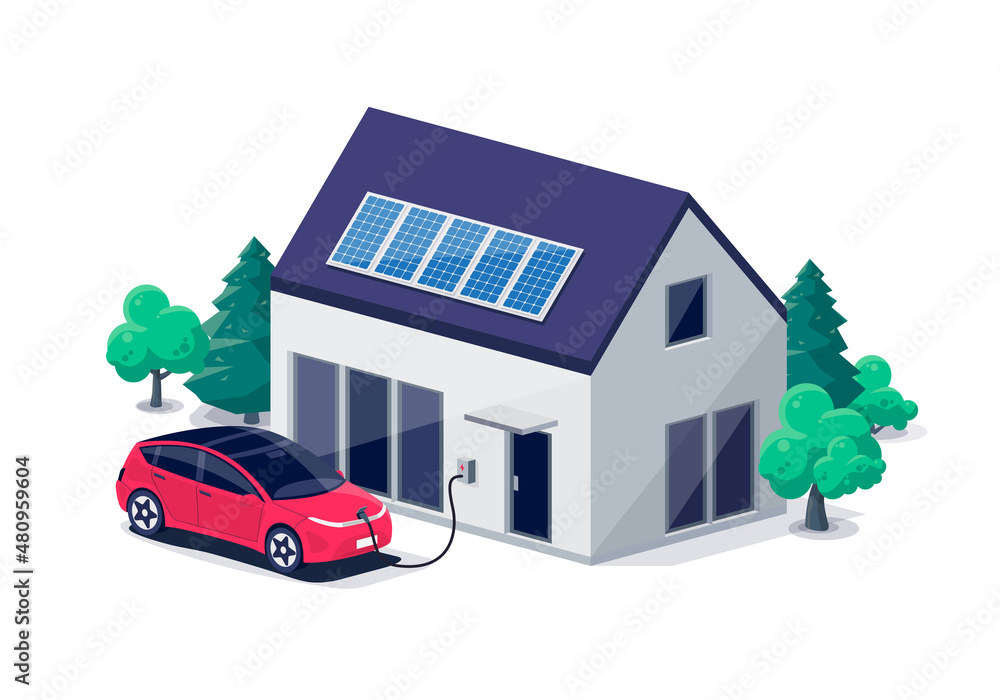
Image: Home EV charger installation in a typical Bengaluru residential setup. (Alt text: home EV charger installation Bengaluru India residential)
What Are Basic Chargers?
Basic chargers (often called “dumb” or portable Level 1/2 units) deliver power without smart connectivity. Many EVs in India come bundled with a 3.3 kW portable charger that plugs into a standard 15A socket, or simple wall-mounted AC units from brands like Okaya or generic options.
Pros:
- Lower cost: ₹10,000–₹30,000 for the unit.
- Easy setup: No app or WiFi required; plug-and-charge simplicity.
- Reliable for basic needs: Fewer components reduce potential issues.
Cons:
- No scheduling: Can’t shift to off-peak hours automatically.
- Limited insights: No usage tracking or solar priority.
- Higher potential bills: Charges during peak rates in variable tariff areas.
Best for low-mileage users or those without time-of-day (ToD) tariffs.
Image: Portable basic EV charger commonly used in Indian homes. (Alt text: portable basic EV charger India home use affordable)
What Are Smart Chargers?
Smart chargers are WiFi-enabled Level 2 units (typically 7.4 kW) with app integration. Leading Indian brands include Tata Power EZ Charge, Bolt.Earth, Exicom, Statiq, and ABB Terra—many solar-ready and OCPP-compliant.
Key Features:
- App control for remote start/stop and scheduling.
- Real-time energy monitoring and reports.
- Solar integration to prioritize rooftop power.
- Load balancing for apartments/societies.
- Off-peak optimization aligning with ToD tariffs.
These suit Bengaluru’s ecosystem, where BESCOM tariffs and solar adoption are rising.
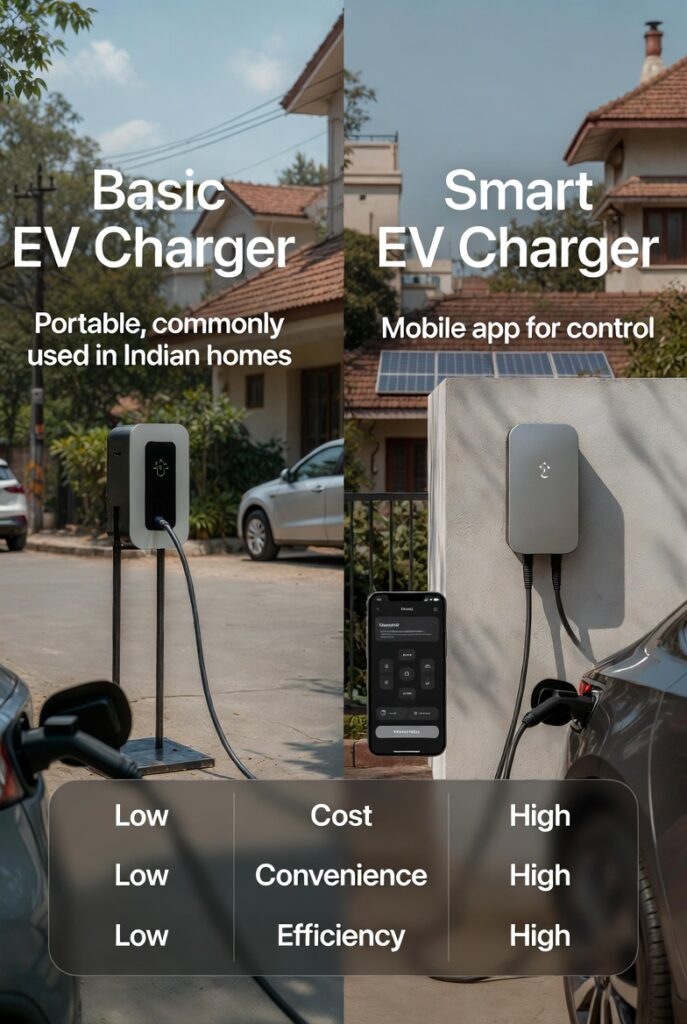
Image: Mobile app for smart EV charger control in India. (Alt text: smart EV charger app India scheduling monitoring Bengaluru)
Key Differences: Smart vs Basic Chargers in India (2026)
| Feature | Basic Chargers | Smart Chargers |
|---|---|---|
| Connectivity | None | WiFi/App (Tata Power, Bolt.Earth, Exicom) |
| Scheduling | Manual/vehicle-based | Automated off-peak/ToD optimization |
| Energy Monitoring | None | Real-time tracking & solar priority |
| Solar Integration | Limited | Yes, automatic clean energy use |
| Load Balancing | No | Yes, great for apartments in Bengaluru |
| Cost (Unit) | ₹10,000–₹30,000 | ₹40,000–₹1,00,000+ |
| Best For | Budget/low usage | Frequent drivers, solar homes, ToD areas |
Smart options lead due to efficiency gains in urban India.
Image: Comparison infographic of smart vs basic EV chargers in India. (Alt text: smart vs basic EV chargers India comparison infographic 2026)
Pros and Cons for Indian Users (Bengaluru Focus)
Pros of Smart Chargers
- Bill Savings: Schedule for off-peak/night rates (BESCOM domestic ~₹5.80/kWh average in 2026; lower at night). Save 20-40% on charging costs.
- Solar Benefits: Prioritize rooftop solar—common in Karnataka—reducing grid use by 30-50% and bills further.
- Convenience: Remote access ideal for apartment residents; load balancing prevents tripping.
- Incentives: Possible subsidies under PM E-DRIVE or state schemes; future-proof for V2G.
Cons of Smart Chargers
- Higher upfront cost.
- Requires stable internet/WiFi.
Pros of Basic Chargers
- Cheaper entry point.
- No tech setup needed.
Cons of Basic Chargers
- No ToD/solar optimization—higher long-term costs.
- Less aligned with clean energy goals.
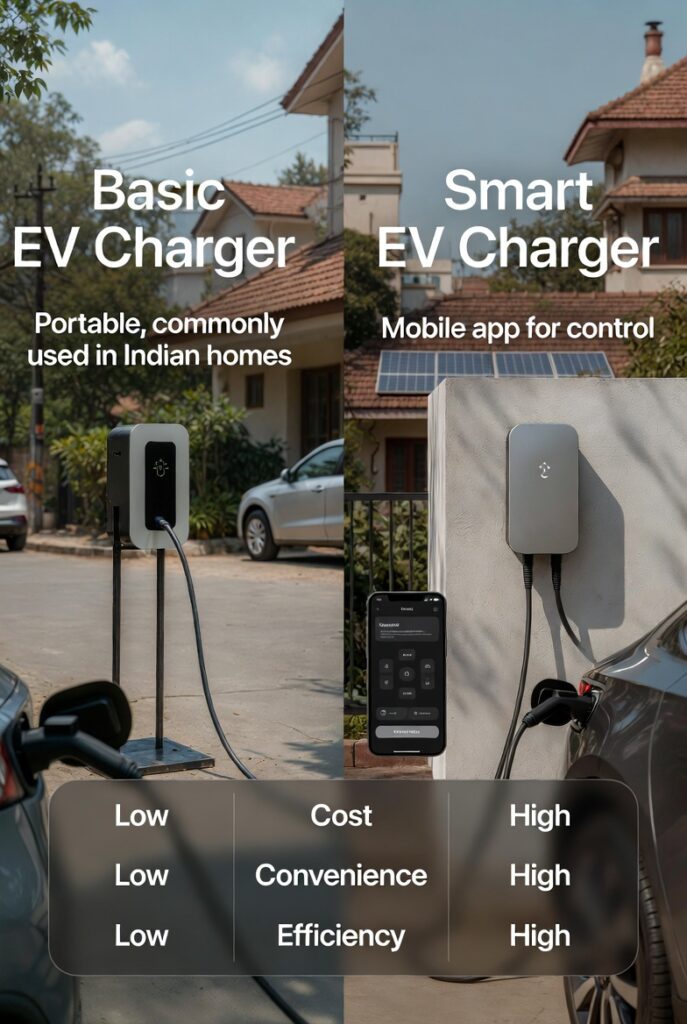
Image: Rooftop solar with EV charging in an Indian home. (Alt text: solar integrated EV charging home India Bengaluru clean energy)
Cost Comparison in India (2026, Bengaluru/Karnataka Focus)
Basic: ₹10,000–₹30,000 + installation ₹5,000–₹15,000.
Smart: ₹40,000–₹1,00,000 (e.g., Tata Power EZ Charge or Exicom 7.4 kW ~₹50,000–₹80,000).
BESCOM domestic tariff: ~₹5.80/kWh (2026 average); off-peak potentially lower. For a 40 kWh battery (e.g., Nexon EV):
- Full charge: ~₹230–₹300.
- Smart scheduling/solar: Save ₹50–₹150 per charge.
Annual savings for 10,000–15,000 km driver: ₹8,000–₹20,000+ via ToD and solar. Payback in 2–4 years, especially with any state incentives or PM E-DRIVE extensions.
Public charging: ₹15–₹25/kWh (or higher)—2–4x home rates—making smart home setup essential.
Clean Energy and Sustainability Benefits
Smart chargers boost India’s net-zero push by enabling solar-priority charging and grid support. In solar-rich Karnataka/Bengaluru, they maximize self-generated clean power, cut emissions, and reduce grid strain—aligning with PM E-DRIVE goals and rooftop solar incentives.
Are Advanced Features Worth It in India (Especially Bengaluru)?
Yes—for most users in 2026, particularly in Bengaluru with ToD potential, high solar adoption, and apartment constraints. Frequent drivers, solar owners, or those aiming for maximum savings see quick ROI. Basic chargers work for minimal usage, but smart ones deliver better value through efficiency, convenience, and green benefits.
As EV infrastructure expands under schemes like PM E-DRIVE, smart chargers future-proof your setup. Consider your driving, home setup, and tariff—many find the advanced features pay off fast in India’s evolving clean energy landscape. Ready to go electric smarter? Explore options from trusted brands today!