China’s petrol station network faces one of the most significant structural challenges in its history. As EV adoption has accelerated from approximately 15% of new vehicle sales in 2021 to well above 30% by 2026, the daily traffic volumes at traditional petrol stations have begun declining in ways that were entirely theoretical five years ago and are now measurable, documented, and — for station operators who have been paying attention to fuel volume trends rather than waiting for the quarterly report — personally felt.
The operational question this creates for Chinese petrol station operators is specific and practical: how to convert some or all of the station’s infrastructure to EV charging capability in a way that captures the growing EV driver market, maintains viable revenue as petrol volumes decline, and does so through equipment choices that survive the same great shakeout that has eliminated 80% of residential charger manufacturers — because the commercial DC fast charging equipment market has its own version of the same consolidation dynamic, with its own zombie risk and its own winners.
This guide on how to choose commercial DC fast chargers for your Chinese gas station conversion provides the complete commercial decision framework — the technical specifications that matter for public commercial charging contexts, the financial model that determines viable commercial configuration, the regulatory and approval process specific to petrol station conversion, the specific product comparison across commercial DC fast charging equipment, and the honest assessment of which conversion approaches succeed versus which generate equipment investment without viable commercial returns.
Understanding the Chinese Commercial DC Fast Charging Market
How Commercial DC Fast Charging Differs From Residential Charging
Every guide in this series has addressed residential home charging — this guide requires a fundamentally different frame.
The residential guidance that has dominated this content cluster — 7 kW single-phase AC charging, TOU scheduling, individual dedicated meters, 物业 permissions — is almost entirely irrelevant to commercial DC fast charging for petrol station conversion. The technical, regulatory, financial, and operational frameworks are different in virtually every dimension.
The core technical difference:
Residential charging uses the vehicle’s onboard charger (OBC) to convert AC grid electricity to DC for battery charging. This limits residential charging to the OBC’s maximum input (typically 6.6-11 kW) regardless of what the external charger can deliver.
Commercial DC fast charging bypasses the vehicle’s OBC entirely — the charging station itself converts AC grid electricity to DC and delivers it directly to the vehicle’s battery at voltages and currents that the vehicle’s Battery Management System (BMS) accepts. This allows charging rates far exceeding any OBC’s capacity, currently reaching 250 kW at standard commercial installations and 480-600 kW at premium ultra-fast installations.
The financial model difference:
Residential charging captures financial benefit through reduced electricity cost (TOU arbitrage). Commercial DC fast charging generates revenue through charging service fees — the per-kWh or per-minute fee charged to public users above the operator’s electricity cost. The entire ROI calculation differs fundamentally from residential analysis.
The infrastructure difference:
Residential charging requires a single dedicated circuit from the building’s existing distribution. Commercial DC fast charging requires transformer-level grid connection, often at medium-voltage (10 kV) rather than low-voltage (0.4 kV), with transformer procurement and installation representing a significant capital cost component.
The Regulatory Framework for Petrol Station EV Conversion in China
The Approvals That Must Precede Any Equipment Decision
Before selecting any specific equipment, petrol station operators must navigate a specific regulatory approval pathway that has no equivalent in residential charging — starting with this approval process is essential because its outcomes directly affect equipment specifications, site layout, and capital requirements.
Approval 1: National Energy Administration (NEA, 国家能源局) Charging Infrastructure Filing
Commercial EV charging stations above specified capacity thresholds must file with the NEA or its provincial/municipal equivalents. The filing establishes the charging station as a commercial energy infrastructure facility subject to ongoing regulatory oversight.
Filing requirements include: Site ownership or lease documentation, proposed charging infrastructure specification, grid connection capacity confirmation, safety system specification, operator business licence.
Timeline: Typically 15-30 working days for standard commercial filing.
Approval 2: Local Planning Authority Permission
For petrol station conversion specifically, local planning authorities (规划局 at district level) must confirm that the proposed EV charging land use is compatible with the existing site’s land use category — petrol station land use (加油站) and EV charging land use (充电站) may require specific planning permission for the change or addition.
The specific petrol station complication: Petrol stations operate under specific safety separation distance requirements from residential buildings, public roads, and other infrastructure. Some of these safety requirements continue to apply to the EV charging addition; others may be modified given EV charging’s different safety profile versus hydrocarbon fuel storage.
Timeline: Typically 20-40 working days, longer in cases requiring formal planning change.
Approval 3: Fire Safety Assessment
As covered extensively in our fire safety guide, EV charging creates specific fire safety considerations — particularly relevant in petrol station contexts where existing hydrocarbon fuel storage creates compound hazard scenarios.
Fire safety approval from the local fire safety bureau (消防救援局) specifically addressing the interaction between existing petrol storage infrastructure and proposed EV charging infrastructure is required before construction begins.
The specific petrol station fire safety consideration: Most fire safety authorities require physical separation between active hydrocarbon fuel storage/dispensing areas and EV charging areas — typically minimum 6-8 metre clear distance between fuel dispensing equipment and EV charging equipment, with specific requirements about fire suppression provisions in the charging area.
Approval 4: Power Grid Connection Agreement
As covered in our SGCC vs private networks guide, grid connection for commercial fast charging requires formal application and assessment. For petrol station conversion, this typically requires medium-voltage connection (10 kV) rather than the low-voltage residential connection that guide primarily addressed.
The specific capacity requirement: A petrol station conversion targeting 4-8 DC fast chargers at 120-250 kW each requires grid connection capacity of 480-2,000 kW — vastly beyond any residential connection and requiring transformer procurement and installation that is itself a significant capital line item.
Grid connection timeline for commercial medium-voltage: Typically 60-120 working days — the longest single approval process in the petrol station conversion pathway and the one that most frequently becomes the critical path.
The Petrol Station-Specific Regulatory Consideration
The simultaneous operation question:
Most Chinese petrol station operators considering EV charging conversion are not proposing complete immediate cessation of petrol sales — they are proposing to add EV charging capability alongside continuing petrol operations during the transition period. This “simultaneous operation” scenario has its own specific regulatory requirements:
Equipment placement must maintain petrol dispensing safety distances
The EV charging electrical infrastructure must be isolated from petrol storage and dispensing systems
Specific labelling and customer flow management may be required to prevent confusion between petrol and EV areas
The phased conversion approach:
Many Chinese petrol station operators are pursuing phased conversions — converting one or two bays to EV charging while maintaining petrol dispensing in remaining bays, then progressively converting additional bays as petrol volumes decline and EV charging revenues grow. This approach requires the regulatory framework to accommodate simultaneous operations during the transition period.
The Technical Specifications That Matter for Commercial DC Fast Charging
Power Level Selection — The Most Consequential Technical Decision
The power level decision determines customer experience, throughput capacity, equipment cost, and grid connection requirements simultaneously — it is the single most consequential technical decision in commercial DC fast charger selection.
120 kW DC Fast Charging:
The current mainstream standard for Chinese urban and peri-urban commercial DC fast charging installations:
Charge time for typical Chinese EVs (40-80 kWh batteries): 20-35 minutes for 20-80% charge
Compatible vehicles: All current Chinese EVs with DC fast charging capability
Typical daily throughput per charging point: 8-15 sessions/day at typical commercial locations
Grid capacity required per charging point: ~135 kVA (accounting for power factor)
Equipment cost: ¥35,000-¥65,000 per charging point
Best for: Standard petrol station conversions targeting typical residential and commuter EV drivers
180-250 kW DC Fast Charging:
The current premium standard, now mainstream at highway service areas and premium commercial installations:
Charge time for 800V architecture vehicles (BYD Seal LR, Zeekr 001 Performance, Xpeng G9 Ultra): 10-18 minutes for 20-80%
Charge time for 400V vehicles: Same as 120 kW installations (limited by vehicle OBC/battery acceptance, not charger output)
Typical daily throughput per charging point: 10-20 sessions/day due to faster turnaround for capable vehicles
Grid capacity required: ~200-280 kVA per charging point
Equipment cost: ¥65,000-¥120,000 per charging point
Best for: Highway corridor locations, premium commercial areas, locations expecting high proportion of 800V vehicles
480 kW+ Ultra-Fast Charging:
Currently deployed at flagship locations — SGCC’s “hypercharging” hubs, major charging network operators’ showcase sites:
Charge time for compatible 800V vehicles: 5-10 minutes for 20-80% (comparable to petrol refuelling time)
Compatible vehicles: Currently limited to highest-specification 800V vehicles with ultra-fast acceptance rates
Equipment cost: ¥150,000-¥300,000+ per charging point
Grid infrastructure cost: Very high — requires dedicated transformer and potentially substation-level connection
Best for: High-traffic highway nodes, premium brand showcase installations, locations serving specific fleet applications requiring maximum throughput
The honest recommendation for most petrol station conversions:
For the majority of Chinese petrol station operators evaluating conversion, 120-180 kW DC fast charging represents the optimal balance of customer experience, equipment cost, grid infrastructure requirement, and vehicle compatibility breadth. The 480 kW+ ultra-fast tier is not yet justified for most conversion scenarios given both equipment cost and limited vehicle compatibility.
The GB/T vs CCS2 vs NACS Connector Question for Commercial Equipment
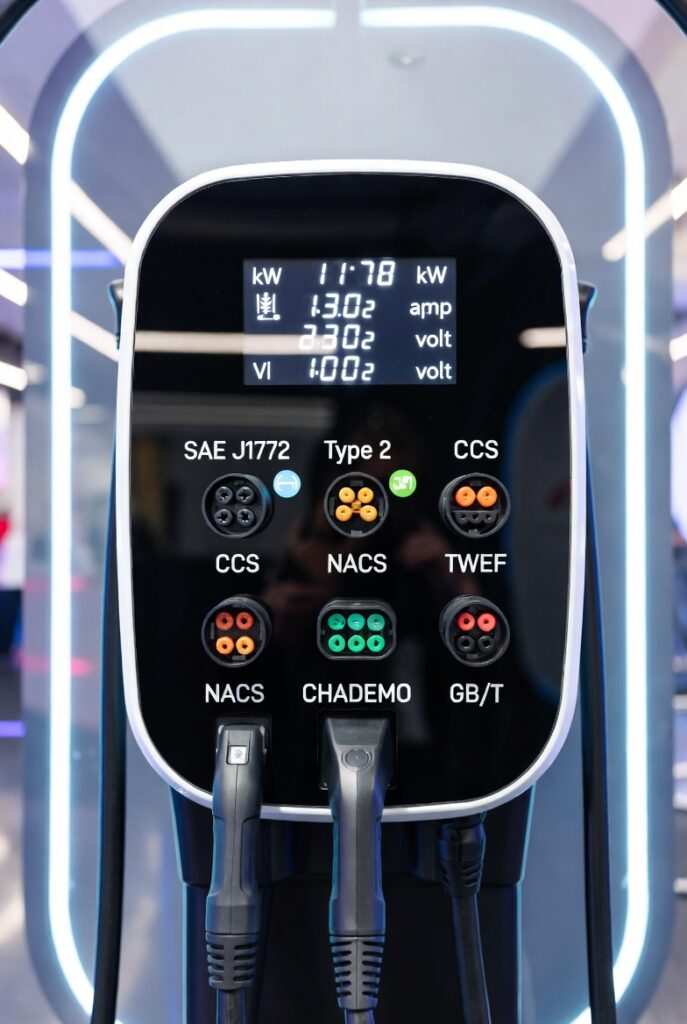
As covered in our GB/T vs NACS vs CCS guide, China’s domestic market uses GB/T connectors for DC fast charging (GB/T 20234.3) as the national standard.
For petrol station conversion targeting Chinese domestic market EV drivers:
GB/T 20234.3 DC connectors: Required for all domestic Chinese EVs — non-negotiable for any commercial DC fast charging installation targeting the domestic market.
CCS2 (Combined Charging System) connectors: Some imported European and American EVs (older BMW, Mercedes, Volkswagen models before complete China-localisation) use CCS2. However, by 2026, the proportion of China’s EV fleet using CCS2 rather than GB/T has declined significantly as domestic EV brands have dominated new vehicle sales and internationally-sold models have increasingly adopted GB/T for China domestic variants.
Practical recommendation: Specify GB/T 20234.3 as the primary connector standard for all DC fast charging points in a petrol station conversion targeting Chinese domestic market. If the specific location’s traffic profile includes meaningful numbers of imported pre-2023 EVs, add one or two CCS2 connector points rather than converting all points.
ChaoJi connectors: As covered in our standards guide, ChaoJi is the next-generation ultra-fast connector standard that provides backward compatibility with existing GB/T vehicles through adapter capability. Commercial installations considering 350 kW+ future capacity should investigate ChaoJi terminal availability, though full ChaoJi deployment remains limited in 2026.
The OCPP Specification for Commercial Charging
Unlike residential charging where OCPP is a “nice to have” for demand response income, OCPP compliance for commercial charging is operationally mandatory:
Payment processing through the national charging platform (SGCC’s national platform and the interconnected private network platforms) requires OCPP communication compliance.
Demand response participation — critical for managing the grid capacity costs that dominate commercial charging operating costs — requires OCPP 2.0 for the most sophisticated programmes.
Multi-network interoperability (allowing users of any charging network app to initiate sessions at your station) requires OCPP-based platform interconnection.
Regulatory reporting for NEA filing compliance requires OCPP session data logging.
Commercial DC fast charger specification minimum: OCPP 2.0 compliance as a baseline requirement, not an optional upgrade.
The Commercial DC Fast Charger Brand Landscape
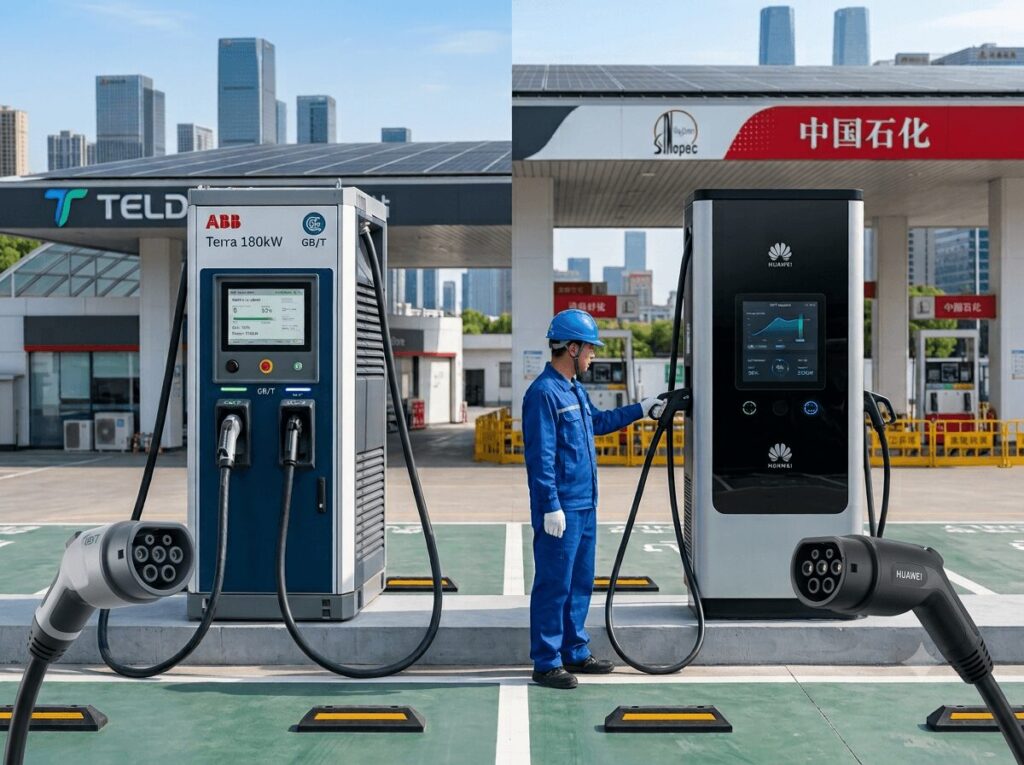
The Major Commercial DC Fast Charging Equipment Suppliers
TELD (特来电) — Commercial Equipment:
TELD’s commercial DC fast charging equipment, drawn from the company’s position as one of China’s largest public charging network operators, benefits from extensive real-world deployment data that residential-only manufacturers lack. TELD’s commercial equipment is informed by the operational experience of managing hundreds of thousands of public charging points across China’s EV infrastructure.
Key specifications: 120-360 kW power range, GB/T and CCS2 connector options, OCPP 2.0, integrated active cooling for sustained output, five-year commercial warranty with TELD’s own service network.
Relevant consideration for petrol station operators: TELD offers not only equipment supply but charging network operation partnership — petrol station operators can choose between purchasing TELD equipment independently or entering a revenue-sharing network partnership where TELD manages the platform, payment processing, and some operational functions.
StarCharge Commercial (星星充电商用) — Commercial Equipment:
As covered throughout this guide series, StarCharge’s residential equipment has established market presence. Their commercial DC fast charging division offers significantly different products from their residential AC charger line, targeting commercial and public charging applications.
Key specifications: 60-240 kW range for standard commercial models, OCPP 2.0, modular design allowing power-sharing between adjacent charging points, integrated energy management for demand charge optimisation.
Relevant consideration: StarCharge’s modular “liquid cooling” units allow multiple charging points to share a common power module, reducing per-point capital cost when multiple points are installed simultaneously — relevant for petrol station conversions installing 4+ charging points.
ABB Terra DC Fast Charging — Commercial Equipment:
As covered in our luxury EV charging and warranty comparison guides, ABB’s commercial EV charging equipment extends from residential to commercial DC fast charging. ABB’s Terra DC range includes highway-class commercial chargers.
Key specifications: Up to 360 kW per unit, IEC 61851 compliance (international standard, including GB/T China market variants), IP54 enclosure (adequate for covered commercial locations), modular architecture.
Relevant consideration: ABB’s international certification and established presence in Chinese industrial infrastructure positions its equipment well for petrol station conversions where international brand assurance is valued by site owners or by the petrol brand franchise requirements.
Huawei Digital Power Commercial (华为数字能源商用):
Huawei’s commercial DC fast charging extends the AI energy management philosophy of their residential FusionCharge into commercial-scale equipment, with specific integration into broader energy management including solar and storage — particularly relevant for petrol station conversions incorporating solar canopy installation.
Key specifications: 120-480 kW range, AI-optimised power allocation across multiple charging points sharing a common grid connection, integration with Huawei’s commercial energy storage systems for demand charge management, OCPP 2.0.
Relevant consideration: For petrol station conversions considering integrated solar canopy + storage + EV charging (a natural evolution of the 光储充 concept covered in our BESS guide, scaled to commercial context), Huawei’s integrated commercial system provides the most sophisticated coordination available.
BYD Commercial Charging:
BYD’s commercial charging equipment division offers DC fast chargers that benefit from the company’s unmatched understanding of battery management requirements — their charging algorithms are specifically optimised for BYD vehicle acceptance, which is relevant given BYD’s dominant share of China’s EV market.
Key specifications: 120-360 kW, GB/T primary, integrated BMS communication optimisation for BYD vehicles (while maintaining standard compliance for other brands).
Relevant consideration: Petrol stations with significant BYD fleet operator relationships or in regions with particularly high BYD market share may find BYD’s optimised charging equipment particularly relevant.
The Commercial DC Fast Charger Comparison Table
| Brand | Power Range | Connector | OCPP | Cooling | Commercial Warranty | Price Range (per point) |
|---|---|---|---|---|---|---|
| TELD Commercial | 120-360 kW | GB/T, CCS2 | 2.0 | Active liquid | 5 years | ¥45,000-¥110,000 |
| StarCharge Commercial | 60-240 kW | GB/T, CCS2 | 2.0 | Active air/liquid | 3 years | ¥35,000-¥85,000 |
| ABB Terra DC | 60-360 kW | GB/T, CCS2 | 2.0 | Active liquid | 5 years (extended) | ¥65,000-¥130,000 |
| Huawei Digital Power | 120-480 kW | GB/T, CCS2 | 2.0 | Active liquid | 3-5 years | ¥55,000-¥150,000 |
| BYD Commercial | 120-360 kW | GB/T, CCS2 | 2.0 | Active liquid | 3 years | ¥40,000-¥100,000 |
The Financial Model for Petrol Station Conversion
The Revenue and Cost Framework
Revenue stream 1: Charging service fees
The primary revenue source for commercial EV charging — the per-kWh service fee above electricity cost:
Typical Chinese commercial DC fast charging service fee: ¥0.50-¥1.20/kWh above electricity cost
At mainstream highway and urban commercial locations, ¥0.70-¥0.90/kWh service fee is achievable
At premium ultra-fast locations with superior dwell amenities, ¥1.00-¥1.50/kWh is achievable
Revenue stream 2: Electricity arbitrage (demand response)
Commercial charging operators with OCPP 2.0 capability can participate in commercial demand response programmes, earning income for curtailing charging loads during grid stress events. At commercial scale, this income is meaningful — typically ¥50,000-¥200,000/year for a well-managed multi-point commercial installation actively participating in demand response.
Revenue stream 3: Ancillary commercial revenue
As covered in our rural charging guide’s discussion of dwell time monetisation, the waiting period during EV charging creates commercial opportunity for adjacent retail, food and beverage, and automotive services — directly analogous to traditional petrol station convenience store revenue but with potentially longer dwell times creating greater commercial opportunity.
For petrol station operators who already have convenience store or food service capability, EV charging dwell time can meaningfully increase per-visitor spend as charging session lengths (15-35 minutes versus 3-5 minutes for petrol refuelling) create genuine browsing and purchase opportunity.
Revenue stream 4: Network partnership revenue sharing
For petrol station operators who join major charging networks (SGCC national network, TELD, StarCharge) as network partners rather than operating independently, network affiliation provides:
- User traffic from the network’s registered user base (immediate demand without requiring independent customer acquisition)
- Revenue sharing arrangements typically providing 60-80% of service fee revenue to the station operator
- Network management of payment processing, customer service, and platform maintenance
The net revenue per charging point at typical utilisation:
Reference: 120 kW DC charging point at highway-adjacent petrol station
Sessions per day: 12 (reasonable for established location)
Average session energy: 25 kWh
Daily kWh throughput: 300 kWh
Service fee: ¥0.80/kWh
Daily service fee revenue: ¥240
Annual service fee revenue per point: ¥87,600
Operating costs per charging point (annual):
Electricity cost (operator pays): 300 kWh/day × ¥0.55/kWh × 365 = ¥60,225/year
But electricity recovered through service fee: ¥0.55/kWh × 300 × 365 = ¥60,225
(So electricity is a passthrough — the net margin is purely the service fee component)
Maintenance (commercial grade): ¥5,000-¥10,000/year
Equipment depreciation (10-year life, ¥65,000 equipment): ¥6,500/year
Platform fees (if using major network): 20% of service fee = ¥17,520/year
Site cost allocation: variable
Net annual income per charging point (before site cost):
Service fee: ¥87,600
Less maintenance: -¥7,500
Less depreciation: -¥6,500
Less platform fee: -¥17,520
Net: ¥56,080/year per charging point
Payback calculation:
Equipment cost: ¥65,000
Grid connection and installation (per point allocation): ¥30,000-¥80,000 (wide range depending on transformer requirement)
Total per-point capital: ¥95,000-¥145,000
At ¥56,080/year net: Payback 1.7-2.6 years — a compelling commercial return for well-located, well-utilised installations.
The honest utilisation caveat:
12 sessions/day is achievable at established highway-adjacent or high-traffic urban locations but represents an aspiration rather than a guarantee for new conversions in lower-traffic areas. At 6 sessions/day (lower-utilisation scenario), net income drops to approximately ¥28,040/year and payback extends to 3.4-5.2 years — still viable but more sensitive to cost variations.
The Site Configuration — Layout and Infrastructure
Optimal Layout for Petrol Station Conversion
The canopy utilisation opportunity:
Petrol stations’ existing canopy structures — designed to provide weather protection for refuelling — create an ideal mounting opportunity for solar photovoltaic panels, directly above the vehicle positions where EV charging will occur. Solar canopy integration (discussed in our BESS guide’s commercial context) provides:
- Reduced electricity cost through solar self-consumption during daytime charging
- Visual differentiation from competitor locations
- Potential additional renewable energy incentives
- Effective advertising of the station’s green energy commitment
The traffic flow design principle:
EV charging’s fundamentally different dwell time from petrol refuelling requires traffic flow redesign — petrol stations are designed for 3-5 minute visits with rapid throughput of vehicles through a small number of dispensing positions. EV charging requires parking positions designed for 15-35 minute stays, requiring more total parking positions to achieve equivalent throughput capacity.
For a petrol station replacing 4 petrol dispensers with EV charging:
4 petrol dispensers @ 3 minute average: 80 vehicles/hour throughput
4 × 120 kW EV chargers @ 25 minute average: 9.6 vehicles/hour throughput
This 8× throughput reduction is the fundamental business model challenge of petrol station EV conversion — it cannot be fully addressed by faster chargers alone (480 kW chargers might achieve 12 minutes average, raising throughput to 20 vehicles/hour — still 4× below petrol throughput) but must be addressed through a combination of faster charging equipment, more charging positions per square metre of site area, and fundamentally different revenue model expectations (higher revenue per vehicle visit through longer dwell time commercial opportunity versus higher throughput at lower per-vehicle commercial opportunity).
The Network Partnership vs Independent Operation Decision
The Most Consequential Business Model Decision
The specific decision that determines the commercial structure:
Petrol station operators converting to EV charging must decide whether to:
Option A: Join a major charging network as an affiliated station
Partner with SGCC national platform, TELD, StarCharge, or a regional network as an affiliated station, receiving their registered user traffic and platform support in exchange for revenue sharing (typically 20-30% of service fee revenue to the network)
Option B: Operate independently with platform interconnection
Install own management platform, process own payments, and achieve interoperability with major networks through OCPP-based interconnection without formal affiliation, retaining 100% of service fee revenue but bearing full platform and customer acquisition costs independently
Option C: Hybrid — network partnership for traffic plus independent platform
Formal network affiliation for user traffic and network app visibility while maintaining independent management platform for operational data, demand response management, and ancillary service optimisation
The honest assessment of each option:
For new petrol station conversions without established EV charging reputation: Option A (major network affiliation) provides immediate access to the network’s registered user base — critical for utilisation during the establishment period when the station has no charging reputation or history. The 20-30% revenue sharing cost is worthwhile for the user traffic it provides.
For established conversions with proven utilisation: Option B or C becomes more attractive as the station’s own reputation and repeat customer base reduces dependence on network affiliation for user acquisition.
The Investment Decision — When Conversion Makes Sense vs When It Doesn’t
The Honest Site Assessment Framework
Factors that make petrol station conversion financially compelling:
Highway corridor location with established traffic flow — the single most important factor. Highway-adjacent stations have demonstrable daily traffic that converts directly to charging demand as EV adoption increases.
Existing transformer capacity at or near the required level — grid connection costs escalate significantly when transformer procurement and installation are required from scratch. Petrol stations with recent electrical infrastructure upgrades may have closer to adequate transformer capacity than older stations.
Proximity to competing charging infrastructure — or lack thereof. A petrol station 50 kilometres from the nearest commercial DC fast charger has a structural advantage that a station 200 metres from an established TELD hub lacks.
Existing convenience store, food service, or automotive service capability — directly monetisable through EV charging’s extended dwell time.
Factors that make petrol station conversion financially challenging:
Low-traffic rural or suburban location without highway adjacency — insufficient session volume to support commercial DC fast charging’s capital cost and operating expense.
Extremely congested or restricted site layout that cannot accommodate EV charging bay parking positions with adequate length for modern EV vehicles plus charging equipment clearance.
Petrol franchise agreement restrictions — some petrol brand franchise agreements contain provisions that limit site modifications or require franchisor approval for fundamental site use changes, potentially creating legal complications for conversion.
Internal Links — Further Reading on Clean Energy Bazaar
The how to choose commercial DC fast chargers for your Chinese gas station conversion guide connects to the technical, financial, and industry analysis guidance throughout this content cluster.
For the GB/T vs CCS connector standard guide establishing the connector specification context for commercial equipment selection, our GB/T vs NACS vs CCS which EV charger plug do you need in China 2026 guide covers every connector standard. For the great shakeout guide contextualising commercial DC fast charger brand selection within the broader industry consolidation, our great shakeout why 80 percent of Chinese EV charger manufacturers face elimination in 2026 guide covers the complete industry analysis. For the government fleet charging guide that identifies one specific demand source for petrol station conversion charging infrastructure, our public sector opportunity guide to China’s 25 percent government fleet charging mandate guide covers the institutional demand landscape. For the BESS guide covering solar canopy integration relevant to petrol station conversion’s renewable energy opportunity, our battery energy storage systems BESS combining solar storage EV charging in China guide covers the commercial integrated system context. For the fire safety guide covering the specific fire safety considerations that apply to petrol station conversion’s compound hazard environment, our fire safety and EV charging what Chinese homeowners need to know about indoor parking risks guide covers the fire safety framework. And for the rural charging guide covering the rural pilot county market where smaller petrol station conversions may be most viable, our rural charging boom 2026 how to start a charging business in China’s 59 new pilot counties guide covers the rural business opportunity.
Final Thoughts
The how to choose commercial DC fast chargers for your Chinese gas station conversion decision is more complex than any single specification choice — it is a compound decision spanning regulatory approval pathway, power level selection, connector standard specification, brand and equipment selection, network partnership versus independent operation, and site layout reconfiguration, all of which interact to determine whether a specific petrol station conversion produces the 1.7-2.6 year payback that well-configured conversions achieve or the extended, uncertain payback of poorly-configured ones.
The equipment selection guidance that this guide has provided — 120-180 kW DC fast charging as the mainstream sweet spot for most conversions, OCPP 2.0 as a non-negotiable commercial requirement, GB/T 20234.3 as China’s domestic standard, major network affiliation for new conversions to access established user traffic — represents the configuration most likely to produce viable commercial returns for most Chinese petrol station operators.
But equipment selection, which is what the question “how to choose commercial DC fast chargers” most literally asks, is actually the later and more straightforward part of the conversion decision. The earlier and harder parts are: confirming the regulatory pathway is navigable for your specific site, confirming the grid connection cost is within your capital budget, confirming the traffic profile of your specific location supports the utilisation assumptions that make the financial model work, and confirming the physical site layout can accommodate EV charging operations without creating vehicle flow problems that undermine customer experience and repeat utilisation.
For petrol station operators for whom those earlier confirmations produce positive answers: the equipment choice that follows is genuinely well-supported by the commercial market, with multiple established, consolidation-surviving brands offering equipment that delivers the specifications, warranty coverage, and network integration that commercial success requires.
The conversion from selling petrol to selling electrons is happening across China’s fuel retail network. The operators who get there with the right equipment, the right configuration, and the right commercial structure will capture a meaningful share of China’s EV energy market in the decade ahead. The ones who get there with the wrong equipment, the wrong power level, or inadequate grid connection will find the same utilisation potential delivering much weaker financial returns than the headline numbers suggest.
This guide’s framework is designed to put operators in the first category rather than the second.