Chinese shopping malls are undergoing a transformation in their car park infrastructure that is simultaneously a response to customer demand, a competitive differentiation strategy, and — for the mall operators who get the configuration right — a genuine commercial opportunity in its own right. The question “how much does it cost to install EV chargers in our mall?” is being asked in real estate developer boardrooms, mall management offices, and anchor tenant sustainability committees across China in 2026, and it deserves a more honest, more specific, and more complete answer than the marketing materials from charging equipment suppliers typically provide.
This guide on cost of installing 10 chargers in a Chinese shopping mall permits power capacity and ROI addresses a specific, practical scenario: a Chinese shopping mall that currently has no EV charging infrastructure installing 10 charging points in its underground or surface car park. Ten charging points is a realistic first-phase deployment for a mid-size mall — large enough to create meaningful customer impact and generate commercial returns, small enough to represent a manageable initial capital commitment for operators who are uncertain about demand levels or who want to phase their charging infrastructure buildout.
The complete honest answer covers every cost component — from the permit applications that must be completed before any equipment is ordered through the transformer upgrade that is the most frequently-underestimated capital item, to the ongoing operating costs that determine whether the investment generates the net positive returns its advocates promise. It also covers the ROI calculation honestly, which means acknowledging that direct charging fee revenue is only one component — and often not the primary component — of the financial case for mall EV charging installation.
The Chinese Shopping Mall EV Charging Context in 2026
Why Malls Are Installing EV Charging Now
The customer demand imperative:
China’s EV adoption rate in tier-1 and tier-2 cities has reached the point where the proportion of car park visitors arriving in EVs is no longer a marginal consideration in car park design. In Shenzhen, where EV penetration in new vehicle registrations has exceeded 60%, a mall car park without EV charging visibly disadvantages the mall relative to EV-equipped competitors for the growing segment of EV-owning shoppers who have learned to plan their charging around their shopping patterns.
The dwell time advantage:
As covered in our gas station conversion guide’s discussion of dwell time monetisation, the EV charging session’s 30-90 minute duration creates an extended mall visit that is operationally distinct from the petrol refuelling model. An EV owner who charges during a shopping visit spends 45-90 minutes in the mall versus the 60-90 minutes that non-charging shoppers average — the charging session becomes an anchor for a complete shopping visit rather than a detached logistical task.
Chinese retail research has documented that EV-charging mall visitors spend approximately 20-35% more per visit than non-charging visitors at the same malls — a commercially significant differential that transforms EV charging from a customer service cost into a customer value capture mechanism.
The competitive differentiation window:
In 2026, many Chinese malls have installed some EV charging, but the range between well-configured, sufficient-capacity, properly-managed charging infrastructure and token installations of 2-3 chargers in inconvenient locations is enormous. Mall operators who move from token installations to genuine, well-publicised EV charging capability have a specific window to capture the EV-owner customer segment preference before competitors upgrade their own installations.
The Permit and Approval Process
The Complete Approval Pathway Before Any Equipment Can Be Installed
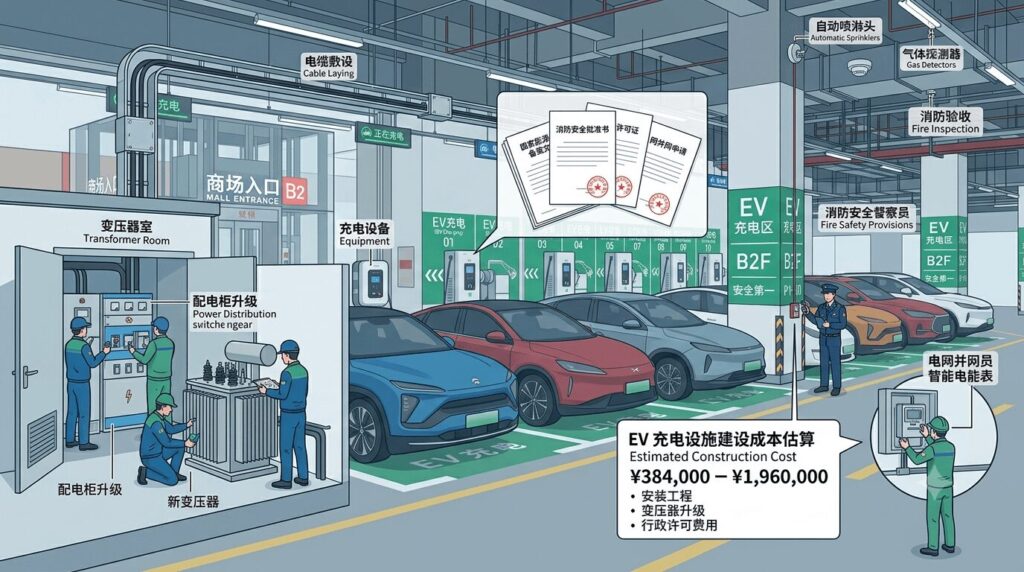
Unlike residential installation where the primary permission is 物业 approval, commercial mall installation involves a specific set of regulatory approvals that form a critical path — each approval gates the next, and the combined timeline typically runs 3-6 months before installation can begin.
Approval 1: Building Owner/Developer Consent and Lease Provision Review
For malls operating under developer-tenant lease structures (the majority of Chinese malls), the first approval is not regulatory but contractual:
The property developer or building owner must consent to infrastructure modifications to the car park — modifications that may affect the building’s structural assessment, electrical infrastructure, and the shared facility provisions that the lease agreement governs.
For malls where the car park is a shared facility rather than a dedicated tenant provision, the modification approval process may require consultation with major anchor tenants whose lease agreements include provisions about shared facility changes.
Timeline: 2-6 weeks depending on developer responsiveness and lease agreement complexity
Approval 2: Fire Safety Bureau Pre-Assessment
As covered in our fire safety guide’s commercial context, EV charging in underground car parks creates specific fire safety implications that the fire safety bureau (消防救援局) must assess before construction. For underground mall car parks specifically, where fire safety provisions are more complex than surface car parks, this assessment is particularly important.
The fire safety assessment for mall EV charging specifically considers:
Whether the proposed charging positions have adequate ventilation per the standards covered in our fire safety guide’s underground parking section
Whether the proposed charging positions maintain required separation distances from fire exits, fire suppression equipment, and occupied building areas above the car park
Whether the existing fire suppression system (sprinkler, foam, or dry powder) covers the proposed charging positions or whether supplementary suppression provisions are required
Whether the car park’s existing ventilation system is adequate for the gas dispersal requirements established in our fire safety guide, or requires upgrade to handle the potential off-gas from EV battery thermal events
What the fire safety bureau may require:
Additional automatic fire detection (potentially gas-sensitive detectors as recommended in our fire safety guide, not only standard smoke/heat detectors) in the EV charging zone
Specific fire suppression provisions for the charging area (in some cases requiring dedicated suppression beyond the general car park system)
Emergency power isolation provisions — automatic disconnection of charging equipment power when fire alarm is triggered
Physical separation or barriers between EV charging positions and conventional petrol vehicle parking in the same car park level
Timeline: 3-6 weeks for assessment; potential additional 4-8 weeks if remediation or additional provisions are required
Cost implication of fire safety requirements:
Base fire safety assessment: ¥0 (government service)
Additional detection system if required: ¥15,000-¥45,000
Additional suppression provisions if required: ¥20,000-¥80,000
Emergency isolation provisions: ¥8,000-¥25,000
Fire safety provision contingency budget: ¥43,000-¥150,000 (required for some installations, zero for others — assess before committing equipment capital)
Approval 3: Local Planning Authority Notification/Permission
For most mall EV charging installations, this is a notification rather than a permission — informing the planning authority of the proposed infrastructure addition rather than requesting approval. However, in cases where:
The installation requires significant external works (surface charging canopy visible from public roads)
The installation materially changes the car park’s classified capacity or operation
The mall’s existing planning permission has specific conditions that may interact with the proposed changes
A formal planning application rather than simple notification may be required, with associated additional timeline.
Timeline: 2-4 weeks for notification; 6-12 weeks for formal application if required
Approval 4: Grid Connection Application (中压/低压 Assessment)
As covered in our SGCC vs private networks guide and our commercial charger guide, the grid connection for 10 commercial charging points requires specific application and assessment:
The critical capacity assessment:
10 × 60 kW AC chargers: 600 kW required grid connection capacity
10 × 120 kW DC fast chargers: 1,200 kW required grid connection capacity
10 × mixed (60 kW AC + 120 kW DC): 900 kW required grid connection capacity
For comparison, a typical Chinese shopping mall’s existing electrical connection: 2,000-8,000 kVA depending on mall size, primarily serving HVAC, lighting, escalators, and tenant electricity.
The transformer capacity question:
Whether the proposed EV charging addition fits within the mall’s existing transformer capacity depends entirely on the specific mall’s current utilisation versus total capacity:
A mall with 4,000 kVA transformer capacity currently utilising 2,800 kVA has 1,200 kVA headroom — sufficient for 10 × 60 kW AC chargers without transformer upgrade, potentially insufficient for 10 × 120 kW DC fast chargers without smart load management
A mall with 2,000 kVA transformer capacity utilising 1,800 kVA has only 200 kVA headroom — insufficient for any significant EV charging installation without transformer upgrade
The transformer upgrade cost when required:
Transformer procurement (630 kVA additional capacity): ¥80,000-¥150,000
Transformer installation (civil works, connection): ¥40,000-¥100,000
SGCC connection modification: ¥30,000-¥80,000
Total transformer upgrade: ¥150,000-¥330,000
This is the single most frequently underestimated cost in Chinese mall EV charging installations — and the one whose omission from early financial modelling most frequently causes post-approval budget revisions.
Grid connection timeline (without transformer upgrade): 30-60 working days
Grid connection timeline (with transformer upgrade): 60-120 working days
Approval 5: NEA Commercial Charging Infrastructure Filing
As covered in our commercial charger guide, commercial charging infrastructure above specified thresholds must file with the NEA or provincial/municipal equivalent:
For 10 charging points above 60 kW each: NEA commercial filing required
Filing documentation: Approved site plan, equipment specifications, grid connection agreement
Timeline: 15-30 working days (typically parallel-processed with other approvals)
The Parallel Processing Strategy
The critical path management insight:
The approvals above have dependencies (grid connection cannot be finalised until fire safety assessment is complete for some aspects, NEA filing requires grid connection agreement) but also significant parallel processing opportunity. A well-managed approval process runs as many approvals concurrently as their dependencies allow, rather than completing each sequentially before beginning the next.
Practical parallel processing approach:
Start simultaneously: Building owner consent + Fire safety bureau pre-assessment application
After fire safety pre-assessment response: Begin grid connection application (incorporating fire safety requirements)
Parallel with grid connection: NEA commercial filing (using preliminary grid assessment)
After grid connection confirmation: Complete NEA filing with confirmed specifications
Total approval timeline with parallel processing: 3-5 months
Total approval timeline without parallel processing: 6-10 months
The Complete Cost Breakdown — 10 Chargers in a Chinese Shopping Mall
Scenario A: 10 × 60 kW AC Charging Points (No Transformer Upgrade Required)
The most accessible commercial deployment for malls with adequate existing transformer headroom:
Equipment costs:
10 × 60 kW AC commercial charging points (StarCharge, TELD, or equivalent commercial grade):
Unit cost: ¥18,000-¥28,000
10-unit total: ¥180,000-¥280,000
Fleet management software (Charge Now or equivalent commercial platform):
Setup cost: ¥20,000-¥50,000
Annual SaaS: ¥36,000-¥72,000/year
Payment terminal/QR equipment (if not integrated in charger): ¥1,000-¥3,000/unit × 10 = ¥10,000-¥30,000
Installation costs:
Civil works (trenching, conduit, concrete plinths for 10 units): ¥40,000-¥80,000
Cabling (from distribution board to 10 charging positions): ¥30,000-¥80,000 (highly variable based on car park size and positions relative to distribution board)
Distribution board modifications: ¥15,000-¥35,000
Protection devices (RCCB, MCBs per unit): ¥5,000-¥15,000
Licensed electrician installation labour: ¥25,000-¥50,000
Commissioning and testing: ¥5,000-¥15,000
Total civil and electrical installation: ¥120,000-¥275,000
Signage and marking costs:
EV parking space marking (10 spaces): ¥5,000-¥15,000
Directional signage within car park: ¥8,000-¥20,000
External mall EV charging facility signage: ¥5,000-¥15,000
Total signage: ¥18,000-¥50,000
Permitting and professional fees:
Fire safety assessment facilitation: ¥5,000-¥15,000
Planning notification/application: ¥3,000-¥10,000
NEA filing: ¥5,000-¥15,000
Design drawings (electrical, civil): ¥15,000-¥35,000
Project management: ¥20,000-¥50,000
Total permitting and professional: ¥48,000-¥125,000
Fire safety provisions (if required — scenario-dependent):
Additional detection: ¥0-¥45,000
Additional suppression: ¥0-¥80,000
Emergency isolation: ¥8,000-¥25,000
Total fire safety provisions: ¥8,000-¥150,000
Scenario A Total Capital Cost:
| Component | Low | High | Midpoint |
|---|---|---|---|
| Equipment | ¥190,000 | ¥310,000 | ¥250,000 |
| Installation | ¥120,000 | ¥275,000 | ¥197,500 |
| Signage | ¥18,000 | ¥50,000 | ¥34,000 |
| Permits/professional | ¥48,000 | ¥125,000 | ¥86,500 |
| Fire safety | ¥8,000 | ¥150,000 | ¥79,000 |
| Total | ¥384,000 | ¥910,000 | ¥647,000 |
The honest range explanation:
This ¥526,000 range between low and high is not unusual for commercial car park installations — the specific cost drivers that create the variance are:
Cabling distance (the most variable single cost — a 10-metre run from the distribution board versus a 100-metre run creates a ¥50,000+ cost difference)
Fire safety requirements (zero additional provisions versus full supplementary system: up to ¥150,000 additional)
Car park finish quality expectation (standard industrial finish versus mall-quality cosmetic finish for charging positions visible to customers: ¥20,000-¥50,000 premium)
Scenario B: 10 × 120 kW DC Fast Chargers With Transformer Upgrade
The premium commercial deployment for malls targeting the fastest EV charging experience:
Additional cost components versus Scenario A:
Equipment upgrade (120 kW DC vs 60 kW AC units):
Unit cost premium: ¥35,000-¥65,000 additional per unit
10-unit premium: ¥350,000-¥650,000
So equipment total: ¥530,000-¥960,000
Transformer upgrade (required for 1,200 kW DC total capacity):
Transformer and installation: ¥150,000-¥330,000
Higher-specification cabling (DC fast charging requires larger conductor cross-section):
Cabling premium: ¥20,000-¥50,000
Scenario B Total Capital Cost:
| Component | Low | High | Midpoint |
|---|---|---|---|
| Equipment | ¥530,000 | ¥960,000 | ¥745,000 |
| Transformer upgrade | ¥150,000 | ¥330,000 | ¥240,000 |
| Installation (enhanced) | ¥140,000 | ¥325,000 | ¥232,500 |
| Signage | ¥18,000 | ¥50,000 | ¥34,000 |
| Permits/professional | ¥55,000 | ¥145,000 | ¥100,000 |
| Fire safety | ¥8,000 | ¥150,000 | ¥79,000 |
| Total | ¥901,000 | ¥1,960,000 | ¥1,430,500 |
Scenario C: Mixed Configuration — 6 AC + 4 DC (The Practical Optimum for Most Malls)
The configuration that balances customer experience, capital cost, and commercial return:
Many Chinese mall operators are finding that a mixed configuration — AC charging for the majority of positions (serving shoppers who park for 1-3 hours and use AC charging’s slower rate to supplement their battery during a full shopping visit) plus a smaller number of DC fast chargers (serving shoppers who specifically want to add significant range quickly and will time their visit around a fast charging stop) — provides the best customer experience across different EV owner profiles at significantly lower capital cost than all-DC-fast configurations.
Scenario C estimated total capital:
6 × 60 kW AC: ¥108,000-¥168,000 equipment
4 × 120 kW DC: ¥212,000-¥384,000 equipment
Transformer (partial upgrade for 4 DC + 6 AC = 780 kW): ¥80,000-¥200,000
Installation, signage, permits: ¥200,000-¥450,000
Fire safety: ¥8,000-¥150,000
Scenario C Total: ¥608,000-¥1,352,000 (midpoint: ¥980,000)
The Revenue and ROI Analysis
Direct Charging Revenue — The Component Most Overestimated
The utilisation assumption that determines everything:
As established in our rural charging guide’s utilisation analysis, the charging station financial model is critically dependent on utilisation rate — sessions per day per charging point. For mall installations, the utilisation profile differs from both residential home charging and highway fast charging:
Mall EV charging utilisation characteristics:
Peak hours: Weekday evenings (6pm-9pm), weekend middays and evenings
Off-peak hours: Weekday mornings (9am-12pm), late evenings (9pm-10pm)
Seasonality: Higher utilisation in adverse weather (rain, cold), when EV owners particularly value the ability to charge while sheltered
Realistic utilisation ranges for Chinese mall charging:
High-traffic Tier-1 city mall (Shenzhen, Shanghai, Beijing): 6-12 sessions/day per AC point, 4-8 sessions/day per DC point
Mid-tier mall in Tier-2 city: 3-7 sessions/day per AC point, 2-5 sessions/day per DC point
Lower-traffic suburban or smaller city mall: 1-4 sessions/day per AC point, 1-3 sessions/day per DC point
The direct revenue calculation for Scenario C (mixed configuration) at mid-tier utilisation:
6 AC points × 5 sessions/day × 20 kWh/session × ¥0.70/kWh service fee × 365 days = ¥153,300/year
4 DC points × 3 sessions/day × 25 kWh/session × ¥0.90/kWh service fee × 365 days = ¥98,550/year
Total direct charging fee revenue: ¥251,850/year
Annual operating costs:
Electricity passthrough (included in pricing above as margin, so not an additional cost)
Platform SaaS: ¥36,000-¥72,000/year
Maintenance: ¥3,000-¥6,000/year per point × 10 = ¥30,000-¥60,000/year
Site cost allocation: ¥0-¥50,000/year (many malls allocate zero cost to charging as part of car park facilities)
Total annual operating cost: ¥66,000-¥182,000/year
Net direct charging revenue: ¥69,850-¥185,850/year
Direct ROI on midpoint capital (¥980,000):
At ¥127,850/year net revenue: Payback period: 7.7 years — not compelling as a standalone financial investment
This is where the honest analysis must extend beyond direct charging revenue to the full commercial case.
The Indirect Commercial Value — The Larger Financial Story
The direct charging fee revenue calculation above, while accurate, substantially understates the full commercial case for mall EV charging. The indirect commercial benefits are, for most Chinese malls, considerably larger than direct charging revenue.
Indirect benefit 1: Incremental tenant turnover from EV-charging visitors
Chinese retail research conducted across multiple Chinese malls has documented the premium spending behaviour of EV-charging visitors. If mall EV charging attracts an additional 50 EV-owning visitors per day who would not have visited the mall without charging availability:
50 additional visitors/day × ¥280 average spend (documented EV-charging visitor premium) × 365 days = ¥5,110,000/year in additional gross merchandise value
Assuming 15% retail margin contribution to mall rental income: ¥766,500/year incremental rental income attributable to EV charging attraction
This single indirect benefit is 3-6× the direct charging fee revenue — and it is this commercial reality that explains why the most commercially sophisticated Chinese mall operators treat EV charging as a customer acquisition investment rather than a direct revenue generation investment.
Indirect benefit 2: Reduced car park vacancy cost
EV charging designation of specific car park spaces creates reserved spaces that, while occupied by charging vehicles, are not randomly available to all parkers. This reduces car park congestion and may allow the mall to convert the EV charging area from standard parking revenue to value-added parking premium (EV charging premium parking at ¥5-¥15/hour above standard parking rate, capturing both parking revenue and charging service fee simultaneously).
10 EV spaces × ¥3/hour parking premium × 6 hours/day utilisation × 365 days = ¥65,700/year incremental parking revenue
Indirect benefit 3: Corporate tenant ESG compliance support
As Chinese corporate sustainability reporting requirements have strengthened, anchor tenants in Chinese malls — major retail brands, food and beverage chains, entertainment operators — increasingly value the mall’s sustainability credentials as part of their own supply chain ESG documentation. EV charging infrastructure is a specific, quantifiable sustainability facility that anchor tenants can reference in their own reports.
The commercial value of this ESG support is difficult to quantify precisely but is increasingly cited by anchor tenant leasing departments as a factor in lease renewal and expansion decisions — a retention value that translates to meaningful commercial benefit for mall operators competing for anchor tenant commitment.
Indirect benefit 4: Government subsidy income
As covered throughout our local rebates guide and rural charging guide, Chinese government subsidy programmes for commercial EV charging infrastructure provide both installation subsidies and ongoing per-kWh generation subsidies. For a 10-charger mall installation in a major Chinese city:
Installation subsidy (typical major city commercial programme): ¥1,500-¥3,000/point × 10 points = ¥15,000-¥30,000
Ongoing per-kWh operation subsidy (selected cities): ¥0.03-¥0.10/kWh × estimated 300,000 kWh/year = ¥9,000-¥30,000/year
The Complete Financial Case — Scenario C Midpoint
| Revenue/Benefit Stream | Annual Value |
|---|---|
| Direct charging fees (net) | ¥127,850 |
| Incremental tenant turnover contribution | ¥300,000-¥766,500 |
| Parking premium revenue | ¥65,700 |
| Government operation subsidy | ¥9,000-¥30,000 |
| Total annual value | ¥502,550-¥990,050 |
Revised payback on ¥980,000 capital (minus ¥22,500 installation subsidy = ¥957,500 net):
At midpoint ¥746,300/year total value: Payback 1.3 years
At conservative ¥502,550/year: Payback 1.9 years
The honest conclusion: The direct charging fee revenue alone produces a marginal financial case (7.7-year payback). The complete commercial case — accounting for the incremental visitor spending that EV charging attracts, the parking premium revenue, and the government subsidies — produces a compelling 1.3-1.9 year payback that justifies the capital investment for most mid-tier and above Chinese malls.
The Operational Management Framework
How Mall EV Charging Must Be Managed to Achieve the Financial Case
The customer experience factors that determine whether the indirect commercial benefits materialise:
The indirect commercial benefits calculated above depend on EV charging visitors having a consistently positive experience that builds repeat visit behaviour and word-of-mouth recommendation. The operational management decisions that determine this experience quality:
Factor 1: Charger availability and reliability
The single most damaging customer experience in mall EV charging is arriving at a designated EV charging space to find the charger non-functional or the space occupied by a non-charging vehicle. Both problems require specific management:
Non-functional chargers: Requires the maintenance schedule covered in our maintenance guide, adapted to the commercial context, with target first-response time of 4 hours maximum and repair completion within 48 hours to maintain operational availability.
ICE vehicle parking in EV charging spaces: Requires either physical enforcement (bollards that lower only when a charging session is active — technically possible but costly) or management enforcement (car park staff training to issue notices or arrange removal of non-EV vehicles in designated charging spaces).
Factor 2: Payment experience
Mall EV charging payment must match the seamless payment experience that Alipay, WeChat Pay, and digital yuan integration provides — requiring the payment terminal integration covered in our commercial charger guide to include all mainstream Chinese mobile payment methods. Charging points that require downloading a specific charging network app before initiating a session create friction that reduces both the direct charging revenue and the positive customer experience that drives indirect commercial benefit.
Factor 3: Charging status visibility
Mall EV owners benefit from real-time charging status visibility through the mall’s own customer app or mini-program — showing current SOC, estimated completion time, and whether the vehicle is due for disconnection before the shopper has finished their visit. This integration, while requiring development investment (¥50,000-¥150,000 typically for mall app integration), creates a distinctive customer experience that generic charging network apps don’t provide and that contributes directly to the premium perception that drives incremental spend.
The Network Partnership vs Independent Operation Decision
The Same Decision From Our Gas Station Guide, Applied to Mall Context
As covered in our commercial DC fast charger guide’s discussion of this decision, mall operators choosing between major network affiliation (SGCC national platform, TELD, StarCharge) and independent operation face the same fundamental trade-off:
Network affiliation for malls:
Provides registered user traffic from the network’s customer base (meaningful for filling off-peak hours with non-mall-visit charging)
Revenue sharing typically 20-25% of service fee revenue to the network
Simplifies payment processing and customer service management
Reduces the customer visibility advantage of independent operation
Independent operation for malls:
Retains 100% of service fee revenue
Allows charging to be bundled with mall loyalty programme (parking validation, loyalty point earning on charging spend, connection to mall member benefits)
Requires independent customer acquisition for off-peak fill
Requires independent payment processing and customer service
The mall-specific recommendation:
For malls with strong existing customer loyalty programme infrastructure and high inherent traffic, independent operation with major payment platform integration (Alipay, WeChat Pay, digital yuan) typically produces better commercial outcomes — the mall’s own traffic provides adequate utilisation without requiring network affiliation’s traffic support, and the loyalty programme integration creates stronger customer stickiness than a generic charging network app.
For malls with lower traffic or in markets where EV charging is still establishing customer habit, initial network affiliation provides the off-peak utilisation support that makes the financial case during the establishment period, with independent operation potentially justified as a later-stage transition once the charging facility has established its own customer following.
Internal Links — Further Reading on Clean Energy Bazaar
The cost of installing 10 chargers in a Chinese shopping mall permits power capacity and ROI guide connects to the commercial charging, fire safety, and business opportunity guidance throughout this content cluster.
For the commercial DC fast charger guide covering the hardware selection that this financial model builds upon, our how to choose commercial DC fast chargers for your Chinese gas station conversion guide covers every commercial hardware specification applicable to mall installations. For the fire safety guide covering the underground parking fire safety provisions that represent one of the most variable cost components in this analysis, our fire safety and EV charging what Chinese homeowners need to know about indoor parking risks guide covers the complete fire safety framework. For the SGCC vs private networks guide covering the grid connection process that is the critical path in mall EV charging installation timelines, our State Grid SGCC vs private networks who offers the best home connection rate guide covers the connection cost and process framework. For the local rebates guide covering the government subsidy programmes that reduce the net capital cost in this guide’s financial model, our local utility rebates for EV charging 2026 Shenzhen Shanghai Beijing guide covers every available programme. For the fleet charging management guide covering the software platforms used to manage commercial multi-point charging installations, our fleet charging management 2026 software for Chinese logistics companies JD.com SF Express guide covers the management software landscape. And for the great shakeout guide contextualising commercial charger brand selection within China’s consolidating manufacturer landscape, our great shakeout why 80 percent of Chinese EV charger manufacturers face elimination in 2026 guide covers the brand reliability framework.
Final Thoughts
The cost of installing 10 chargers in a Chinese shopping mall permits power capacity and ROI analysis produces conclusions that challenge both the overoptimistic projections of charging equipment suppliers and the underestimated cost assessments that catch first-time commercial installation clients by surprise.
The honest cost range — ¥384,000 to ¥1,960,000 for 10 charging points depending on configuration and site-specific factors — reflects genuine variation driven primarily by three variables: whether a transformer upgrade is required (¥150,000-¥330,000 additional capital), what fire safety provisions the fire safety bureau requires for the specific site (¥0-¥150,000 additional), and the distance of the proposed charging positions from the existing distribution board (¥30,000-¥130,000 additional cabling cost variation). Getting specific answers to these three questions before committing to a budget is the single most important financial risk management action available to mall operators evaluating this investment.
The honest ROI analysis reveals that the direct charging fee revenue alone — typically generating 6-9 year payback on the capital — is insufficient justification for most malls to make this investment purely as a revenue generation exercise. The commercial case that actually justifies the investment is the combination of direct revenue, incremental visitor spending that EV charging attracts, parking premium revenue, government subsidies, and the ESG and tenant retention value that increasingly sophisticated commercial leasing relationships demand.
For Chinese mall operators who capture all components of the commercial case — who integrate EV charging into their loyalty programme, who manage the charging facility to consistently high availability standards, who use charging status visibility to enhance the overall shopping experience, and who are located in markets with sufficient EV adoption to deliver the visitor frequency assumptions that make the financial model work — the investment in 10 charging points produces 1.3-1.9 year payback on the complete commercial value, not the 7.7 years that direct charging revenue alone suggests.
The technical recommendation that emerges for most mid-tier Chinese malls evaluating their first commercial EV charging installation: mixed AC/DC configuration (6 AC + 4 DC as the reference scenario), smart load management software to maximise existing transformer utilisation before committing to transformer upgrade capital, network affiliation for initial operation transitioning to independent operation as charging customer loyalty develops, and integration with the mall’s own customer platform as the differentiating feature that converts charging visitors into loyal mall customers.
The malls that do this well will capture a growing segment of Chinese consumers who are choosing where to shop partly based on where they can charge while they do so. In a retail environment where footfall differentiation is increasingly difficult and increasingly valuable, EV charging done right is one of the clearest remaining physical retail advantages available in 2026.