India’s electric vehicle industry has a battery problem that is difficult to overstate. The country sold approximately 2.27 million EVs in 2025, but only 1.4 GWh of domestic cell manufacturing capacity had been commissioned under the government’s ACC PLI scheme by October 2025. Nearly 75% of lithium-ion batteries used in Indian EVs are imported, predominantly from China. Battery cells alone account for 35 to 40% of an EV’s cost, and that cost is denominated in foreign currency and exposed to supply chain disruption .
Against that backdrop, the certification of a single cell might seem like a minor development. But the BIS certification of Ola Electric’s 46100 LFP cell in June 2026 represents something more significant than a product milestone. It is the first time an Indian company has secured BIS compliance for an in-house developed lithium iron phosphate cell in the 46100 format, qualified under the standards that govern electrical, mechanical, environmental, reliability, abuse, and transportation safety .
This is Ola Electric’s 46100 LFP cell: India’s push for domestic battery manufacturing, and the story of how one company is attempting to build the cell technology that India has spent years importing.
The Cell Itself: 170 Wh/kg and 4,000 Cycles
The technical specifications of the 46100 LFP cell are designed for the applications where cost and lifecycle matter more than maximum energy density.
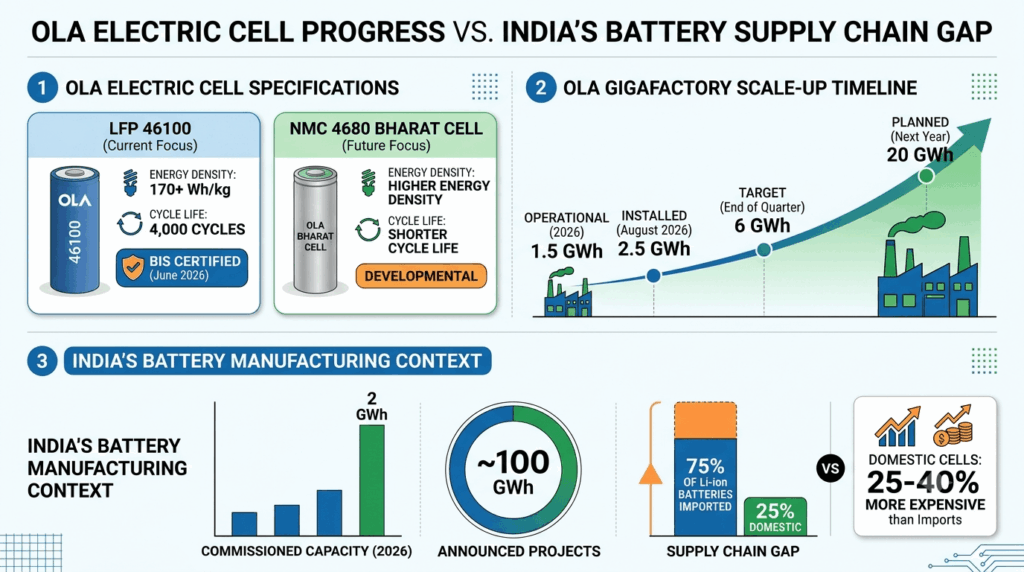
The cell features an energy density of over 170 Wh/kg and is designed to support up to 4,000 charge-discharge cycles . For context, the NMC 4680 Bharat Cell that Ola already produces offers higher energy density but at a higher cost and with shorter cycle life. The LFP cell is the volume play, the chemistry that can serve both Ola’s electric scooters and the stationary energy storage market where cycle life and cost per kilowatt-hour are the dominant considerations.
The 46100 format designation refers to the cell dimensions: 46 millimetres in diameter and 100 millimetres in height. It is larger than the 4680 format (46mm by 80mm) that Ola uses for its NMC Bharat Cell. The larger format reduces the number of cells required per pack, simplifying assembly and reducing cost. Ola has said the LFP cell will be integrated into its products starting the next quarter, and the company unveiled it in April 2026 as part of its push for vertical integration .
The BIS certification is not a formality. It confirms that the cell has passed the safety and performance tests required for commercial deployment in India, and it qualifies the cell under IS 16893 (Parts 2 and 3) and UN 38.3 standards . Without those certifications, the cell could not be sold in the Indian market or used in vehicles registered in the country.
The Gigafactory: From 2.5 GWh to 6 GWh and Beyond
The cell is only as meaningful as the factory that produces it. Ola’s gigafactory in Krishnagiri, Tamil Nadu, has been the subject of both ambition and scepticism since it was announced.
As of August 2026, Ola Electric had 2.5 GWh of installed cell manufacturing capacity, with another 3.5 GWh under installation. The company expects to reach 6 GWh by the end of the current quarter, ahead of the revised December 2026 timeline . The gigafactory project has seen an upfront investment of approximately ₹3,500 crore .
The capacity figures should be understood in context. Wood Mackenzie estimates that India has just 2 GWh of commissioned cell manufacturing capacity in 2026, against China’s cumulative capacity of 2,695 GWh. Domestic cells are expected to cost 25 to 40% more than imports, driven by limited scale, higher financing costs, and an underdeveloped supplier ecosystem. A 5 GWh facility operates at around negative 10% EBITDA. Breakeven is achieved only at 10 GWh, and positive margins require at least 20 GWh .
Ola’s 6 GWh target, therefore, is a milestone on the path to viability, not the destination. The company has said it plans to expand capacity to 20 GWh next year via a capital raise at the cell entity level . It has also explored raising up to ₹2,000 crore by selling a stake in Ola Cell Technologies, with investment banks Avendus and Motilal Oswal mandated to manage the process .
The PLI Window: ₹7,240 Crore and a Second Chance
The financial viability of Ola’s cell business depends heavily on the government’s Production Linked Incentive scheme, and the company’s relationship with that scheme has been complicated.
Ola Cell Technologies was awarded 20 GWh of domestic ACC manufacturing capacity under the PLI scheme in 2022. The scheme has a total outlay of ₹18,100 crore to establish 50 GWh of domestic manufacturing capacity, with beneficiaries required to invest ₹225 crore per GWh within two years. Ola missed the original investment milestone and subsequently sought additional time as well as a waiver of the penalty. Its auditor flagged the company’s decision to reverse a ₹57 crore provision for liquidated damages related to the missed milestone, noting that the provision had been reversed without formal approval from the Ministry of Heavy Industries .
In August 2026, the Ministry approved revised timelines. The revision effectively extends the original schedule by two years, securing a full five-year PLI window through calendar year 2031 for Ola’s 20 GWh allocation. The company said the revision could unlock cumulative incentives of up to ₹7,240 crore, disbursed quarterly beginning next quarter .
Bhavish Aggarwal, Ola Electric’s Chairman and Managing Director, framed the revision as transformative for the economics of the cell business: “The revised timeline is more than an extension. It transforms the economics of our cell business by converting an earlier milestone overhang into a five-year, quarterly PLI opportunity of up to ₹7,240 crore. We hadn’t factored any incentives into our business projections after overshooting the original timelines. Ola is now well ahead of the government’s revised schedule” .
The PLI revision is not a guarantee of success. It is a financial lifeline that gives Ola the time and the incentive structure to scale. Whether the company can convert that opportunity into commercially viable cell production depends on execution.
The Broader Context: India’s Battery Manufacturing Gap
Ola’s progress must be understood against the scale of India’s battery manufacturing challenge.
India has announced close to 100 GWh of domestic cell manufacturing capacity, according to Bernstein. Automotive traction battery demand is expected to reach 95 to 100 GWh by 2030. On paper, that suggests India could have enough cell capacity to meet its future EV demand .
But the nature and credibility of that capacity vary significantly. Bernstein notes that two PLI beneficiaries are trying to develop their own cell technology. One is doing this through acquisitions of smaller battery technology companies, the other through in-house research and development. Most of the other announced projects depend on partnerships, technology licensing, or technical support from Chinese cell manufacturers. The indigenous technology route has progressed more slowly than expected, and projects using Chinese technology have faced delays as well .
The deeper problem sits beyond the cell. Bernstein calls cell manufacturing the “largest value pool and the single biggest source of forex and geopolitical exposure.” But even a fully operational cell factory would not make India’s battery supply chain self-sufficient. India currently has little commercial-scale production of key battery materials such as cathodes, anodes, and electrolytes. A cell made in India using imported Chinese cathode and anode material would still leave the country dependent on China for a large part of the value chain .
The financial express reported that only 30 to 40% of the EV value chain is estimated to have been localised, with the highest-value technologies continuing to come from overseas. Nearly 75% of lithium-ion batteries used in EVs are imported, predominantly from China. Automotive-grade rare-earth permanent magnets are almost entirely imported, while more than 90% of automotive power semiconductors also come from overseas .
Ola’s 46100 LFP cell is a step toward closing that gap. It is not the whole solution.
What This Means for India’s EV Industry
The significance of Ola’s LFP cell lies in what it represents rather than what it immediately delivers.
For Ola Electric, the cell is a path to vertical integration. By producing its own cells, the company can reduce its dependence on imported cells, capture more of the value chain, and potentially lower the cost of its electric scooters. The LFP chemistry is particularly suited to the Indian market, where cost sensitivity is high and the daily driving distances of two-wheelers do not require the energy density of NMC.
For India’s battery manufacturing ambitions, Ola’s progress is one data point among many. The country’s announced capacity of nearly 100 GWh is impressive on paper, but operational capacity remains a fraction of that figure. Bernstein’s assessment is that domestic cell manufacturing will fall short of demand growth over the medium term, and India’s dependence on imported cells is likely to remain a defining feature of the EV market .
For policymakers, the Ola case illustrates both the potential and the fragility of the PLI approach. The scheme has attracted investment and created the framework for domestic manufacturing. But the execution challenges, from missed milestones to technology dependence, are substantial. The revised timeline for Ola is a recognition that building a cell industry from scratch takes longer than the original schedules anticipated.
The honest assessment is that Ola’s 46100 LFP cell is a genuine milestone. It is the first Indian-developed LFP cell in this format to receive BIS certification. It is being produced in a gigafactory that is scaling toward 6 GWh. And it is backed by a PLI window that could provide up to ₹7,240 crore in incentives.
But one certified cell does not make an industry. India’s battery manufacturing ambitions require dozens of such milestones, sustained investment across the upstream supply chain, and a realistic timeline measured in decades rather than years. Ola has taken a step. The path remains long.