Sodium-ion batteries have been discussed as a potential alternative to lithium-ion for years. In 2026, the discussion became irrelevant. The technology is now in production vehicles, in grid-scale energy storage contracts, and on factory floors. The question is no longer whether sodium-ion works. It is how quickly it scales.
Two developments define the year. The first is the Changan Nevo A06, the world’s first mass-production passenger vehicle equipped with sodium-ion batteries, which entered the market in 2026 with CATL’s Naxtra cells. The second is the 60 GWh supply agreement between CATL and HyperStrong, the largest sodium-ion battery order in history, covering three years of energy storage deployment.
Together, these developments mark the moment sodium-ion batteries reach commercial scale. This is how it happened.
The Naxtra Battery: 175 Wh/kg and the Cold-Weather Advantage
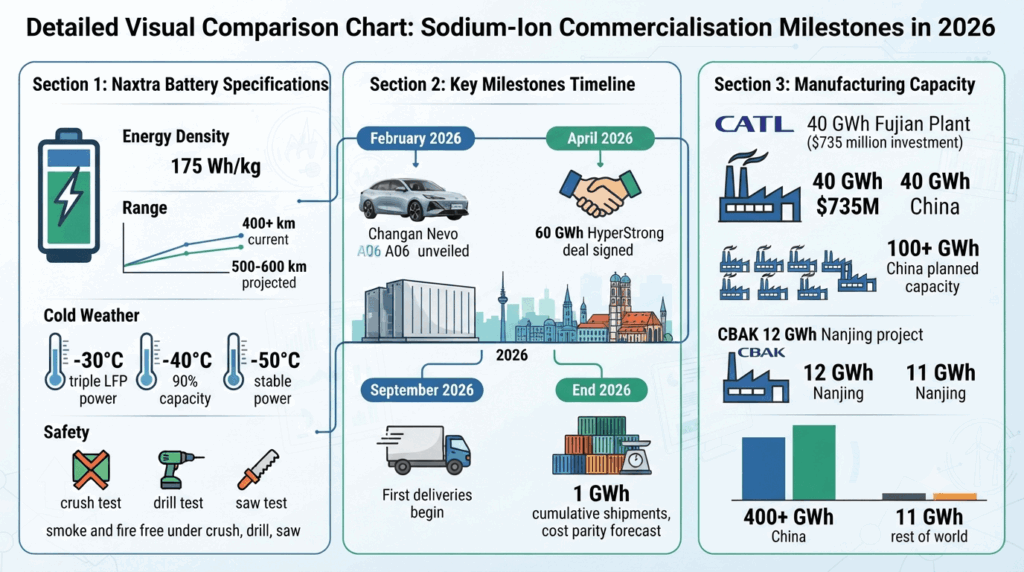
CATL’s Naxtra sodium-ion battery is the product at the centre of the commercialisation story. Unveiled as a dedicated sodium-ion brand in April 2025 and presented in its mass-production form in 2026, Naxtra achieves an energy density of up to 175 Wh/kg, setting the current benchmark for mass-produced sodium-ion cells.
That figure places Naxtra close to lithium iron phosphate (LFP) batteries, which typically deliver 160 to 180 Wh/kg. The gap that historically made sodium-ion uncompetitive in passenger vehicles has narrowed to the point where the chemistry is viable for the majority of mainstream applications.
The performance specifications are compelling:
- Pure-electric range: Over 400 kilometres with CATL’s Cell-to-Pack system and intelligent BMS. Future variants are projected to reach 500 to 600 kilometres for pure-electric configurations and 300 to 400 kilometres for range-extended and hybrid vehicles.
- Cold-weather performance: Nearly triple the discharge power of equivalent LFP batteries at minus 30°C, over 90% capacity retention at minus 40°C, and stable power delivery at temperatures as low as minus 50°C.
- Safety: Under crush, drill, and saw testing, the battery stays smoke and fire free and continues to provide power.
The cold-weather advantage is not a marginal improvement. For drivers in northern China, Scandinavia, Canada, and the northern United States, conventional lithium-ion batteries suffer significant range reduction and slower charging in winter. Naxtra addresses this directly. The Scientific American noted that “for anyone who’s watched their car’s range drop on a frigid morning, this claim is hard to ignore”.
The chemistry behind the advantage is straightforward. Sodium ions are larger than lithium ions, but they form weaker bonds with the liquid electrolyte. This allows them to detach and move more easily, even when cold temperatures thicken the electrolyte. As battery researcher Liu Chenguang of Xi’an Jiaotong-Liverpool University explained: “Cold weather makes all ions move slower, but sodium-based systems are often less affected, so they can keep more power and capacity in winter”.
The Changan Nevo A06: The First Mass-Production Sodium-Ion Passenger Vehicle
On February 5, 2026, Changan Automobile and CATL unveiled the Changan Nevo A06 at an event in Yakeshi, Inner Mongolia. The vehicle is the world’s first mass-production passenger car equipped with sodium-ion batteries, and it represents a genuine milestone in the commercialisation of the chemistry.
The A06 uses a 45 kWh sodium-ion pack, delivering a range exceeding 400 kilometres under the Chinese CLTC standard. CATL will supply Naxtra batteries across Changan’s full brand portfolio, including AVATR, Deepal, Qiyuan, and UNI.
CATL expects between 10,000 and 20,000 electric vehicles to carry its sodium-ion batteries in 2026. That is a fraction of the millions of EVs CATL supplies with lithium-ion cells each year, but it establishes the manufacturing base and supply chain that will support larger volumes in 2027 and beyond.
Gao Huan, CTO of CATL’s China E-car Business, framed the launch in strategic terms: “The arrival of sodium-ion technology marks the beginning of a dual-chemistry era. CHANGAN’s vision shows both its responsibility for energy security and its strategic foresight. Much as it embraced electric vehicles years ago, CHANGAN is once again taking the lead with its sodium-ion roadmap”.
The “dual-chemistry era” framing is important. Neither CATL nor Changan is positioning sodium-ion as a replacement for lithium-ion. They are positioning it as a complement. Lithium-ion remains the chemistry of choice for premium long-range vehicles and applications where maximum energy density matters. Sodium-ion serves entry-level and mid-range vehicles, cold climates, and stationary energy storage.
The 60 GWh Deal: CATL and HyperStrong
If the Changan Nevo A06 proves sodium-ion works in vehicles, the HyperStrong deal proves it works at scale.
On April 27, 2026, CATL and HyperStrong signed a strategic cooperation agreement on sodium-ion batteries for energy storage in Ningde, Fujian. The three-year partnership covers 60 GWh of sodium-ion battery supply, marking the largest sodium-ion battery supply agreement in the world to date.
HyperStrong becomes CATL’s first strategic partner for sodium-ion energy storage. The two companies will collaborate across research and development, product deployment, and project implementation.
The strategic significance extends beyond the volume. The agreement signals that CATL has overcome the manufacturing bottlenecks that previously limited sodium-ion production. As the joint statement noted, the partnership “signals that CATL has overcome key bottlenecks across the sodium-ion battery production chain, enabling large-scale manufacturing and delivery”.
CATL has systematically addressed the process challenges that held back sodium-ion mass production. These include foaming in hard carbon production lines and moisture control, which the company resolved through core technologies including angstrom-level pore size regulation, surface molecular water-locking, and adaptive dynamic formation.
The platform-based design of CATL’s sodium-ion energy storage batteries uses the same form factor as its lithium-ion batteries, ensuring high compatibility with the existing industrial chain. This reduces adaptation costs and significantly shortens the timeline from product readiness to power station deployment.
The energy storage application plays to sodium-ion’s strengths. In long-duration energy storage, system integration can be simplified, auxiliary energy losses reduced, and overall plant efficiency improved. Sodium-ion batteries offer excellent adaptability across a wide temperature range, generate less heat during operation, and experience lower cell expansion stress, resulting in superior safety and stability.
CATL’s Tener Sodium Energy Storage System, unveiled in Munich in June 2026, is the world’s first field-validated sodium-ion energy storage platform for grid applications. It offers a rated capacity of more than 30 MWh and is designed so that building a 1 GWh storage site requires placing only 34 modules weighing about 42 tonnes each.
CATL plans to begin first deliveries to customers in China in September 2026 and to ship a cumulative 1 GWh by the end of the year. Global supply is scheduled to start in June 2027.
William Wu, Director of CATL’s Energy Storage Technology Centre, articulated the strategic vision: “We have been developing a new battery chemistry system based on resources that can be abundantly secured on every continent. Lithium and sodium will become the two pillars of the energy storage market”.
The Cost Question: Where Sodium-Ion Stands
Sodium is 1,000 times more abundant than lithium in the Earth’s crust and 99% cheaper. But raw material abundance does not automatically translate into a cheaper finished battery.
CATL forecasts that sodium-ion batteries will reach cost parity with LFP batteries by the end of 2026. The company projects sodium-ion cells will cost approximately 30% less than LFP cells at scale.
The current cost picture is more nuanced. According to Mysteel’s sodium-ion battery cost model, NFPP-based sodium-ion cells for energy storage cost approximately Yuan 0.45 per Wh, compared with Yuan 0.342 per Wh for LFP cells, leaving a cost gap of around Yuan 0.11 per Wh.
The breakdown reveals where the gap lies. On the cathode side, sodium-ion already has a cost advantage. NFPP cathode costs stand at around Yuan 0.09 per Wh, below LFP cathode costs of approximately Yuan 0.12 per Wh, representing a cost advantage of about Yuan 0.03 per Wh for sodium systems.
The problem is manufacturing. Manufacturing costs for the NFPP route stand at approximately Yuan 0.15 per Wh, compared with around Yuan 0.03 per Wh for LFP, a differential of roughly Yuan 0.12 per Wh that already exceeds the cost advantage on the cathode side.
The higher manufacturing cost reflects that sodium-ion batteries are still in the early stages of large-scale manufacturing. Production line utilisation rates, production continuity, and manufacturing experience have not yet reached the levels of the mature lithium-ion industry.
The path to cost parity depends on scale. Once sodium-ion market output reaches 100 GWh and leading producers approach full capacity, manufacturing costs could fall by 30% to 40%, from approximately Yuan 0.15 per Wh to around Yuan 0.09 per Wh.
Independent analysis from Thunder Said Energy suggests that lithium prices would need to rise above $40 per kilogram on a sustained basis before it makes economic sense to scale up sodium-ion production. That is a more cautious assessment than CATL’s forecast of parity by end-2026.
The honest assessment is that sodium-ion’s cost trajectory is improving rapidly but parity with LFP is not yet achieved. The direction of travel is clear. The timing is less certain.
The Manufacturing Ramp: From Pilot to Gigafactory
The commercialisation of sodium-ion batteries depends on manufacturing capacity. In 2026, that capacity is being built at an unprecedented pace.
CATL announced plans to invest RMB 5 billion ($735 million) in a new 40 GWh sodium-ion battery production facility in Fujian province. The investment follows the HyperStrong supply agreement and demonstrates CATL’s confidence that sodium-ion production can be scaled economically.
China’s sodium-ion battery industry has already planned over 100 GWh of capacity, with a relatively complete upstream and downstream industrial chain taking shape. Operating rates at leading producers exceed 90%, though the industry-wide average stands at around 30%, with much of the already-built capacity not yet in stable production.
The gap between leading producers and the industry average is significant. It reflects the challenges of scaling a new chemistry, including product fragmentation and immature standards. Two main technology routes have emerged, layered oxide and polyanion, but companies still differ significantly in material systems, cell structures, and target applications.
Beyond CATL, other Chinese manufacturers are advancing sodium-ion capacity. CBAK Energy signed a deal for a 12 GWh cylindrical sodium-ion cell project in Nanjing and plans to add 6 GWh of annual cell capacity at its existing facility by the end of 2026.
The global picture is more concentrated. According to CRU data cited by the Financial Times, China has over 400 GWh of sodium-ion superfactory capacity either operational or planned, compared with only about 11 GWh outside China. That is a 36-fold gap, representing not a gradual difference but a generational divide.
The Material Supply Chain: Hard Carbon and Cathode
The sodium-ion supply chain is developing alongside manufacturing capacity. The two critical materials are hard carbon anodes and cathode active materials.
Hard carbon is the primary anode material for sodium-ion batteries. Bio-based hard carbon derived from coconut shells and resins has faced challenges including supply instability, inconsistent product quality, and high raw material costs.
The industry is shifting toward scalable industrial routes. Coal-based and petroleum coke-based hard carbon could help move production from a bio-based pathway to a scalable chemical feedstock system. Companies including Shaanxi Coal Group have already begun sample verification for coal-based hard carbon.
On the cathode side, polyanion materials have emerged as the dominant route for energy storage applications. Rongbai Technology has achieved large-scale production of composite sodium iron phosphate cathodes, reducing processing costs by 30% to 50% through proprietary processes and equipment.
Wanhua Chemical has developed two engineering routes for hard carbon, coal-based and resin-based, addressing the supply limitations and performance variability of early bio-based materials.
The material-level cost reduction has been significant. Hard carbon anode costs fell from RMB 60,000 to 70,000 per tonne in 2024 to RMB 35,000 to 40,000 per tonne in 2026, with long-term targets below RMB 25,000 per tonne.
What Sodium-Ion Means for the EV Industry
The commercialisation of sodium-ion batteries has implications that extend beyond a single chemistry.
For automakers: Sodium-ion offers a path to lower-cost entry-level and mid-range electric vehicles without compromising on cold-weather performance. The Changan Nevo A06 demonstrates that sodium-ion vehicles can deliver 400 kilometres of range at competitive price points. As the supply chain scales, sodium-ion vehicles will become a standard offering across the industry.
For consumers: Sodium-ion batteries address two of the most persistent concerns about electric vehicles: cost and cold-weather performance. For buyers in northern climates, a sodium-ion EV that retains over 90% capacity at minus 40°C is a practical alternative to lithium-ion vehicles that lose range in winter. For budget-conscious buyers, sodium-ion’s cost trajectory points to more affordable EVs.
For the energy storage market: The HyperStrong deal demonstrates that sodium-ion is viable for grid-scale storage. The chemistry’s long cycle life, thermal stability, and cost trajectory make it well-suited for stationary applications where weight is not a constraint. CATL’s Tener Sodium system, with its 30 MWh capacity and modular design, is positioned for utility-scale deployment.
For the global battery industry: Sodium-ion creates a second pillar for battery manufacturing. It diversifies supply chains away from lithium, which is geographically concentrated and subject to price volatility. Sodium is available everywhere, which means sodium-ion production can be distributed globally rather than concentrated in a handful of countries. For Western manufacturers seeking to reduce dependence on Chinese lithium processing, sodium-ion offers a strategic alternative.
For the competitive landscape: Morgan Stanley projects sodium-ion batteries could eventually capture more than one-third of the global battery market. CATL projects even more aggressively, stating sodium-ion will eventually displace 30% to 40% of the entire existing battery market. If those projections prove accurate, sodium-ion will not be a niche chemistry. It will be a mainstream one.
The Dual-Chemistry Future
The most accurate way to understand the sodium-ion commercialisation story is not as a competition where one chemistry wins and the other loses. It is the emergence of a dual-chemistry ecosystem where each technology serves the applications it is best suited to.
CATL’s Gao Huan framed it precisely: “The arrival of sodium-ion technology marks the beginning of a dual-chemistry era”.
In this future, lithium-ion batteries continue to power the majority of premium electric vehicles, particularly those that require maximum range and energy density. Sodium-ion batteries power entry-level and mid-range vehicles where cost and cold-weather performance matter more than maximum range. Sodium-ion batteries also power stationary energy storage, heavy-duty commercial vehicles operating in extreme conditions, and two- and three-wheelers where cycle life and cost are the dominant considerations.
Robin Zeng, CATL’s Chairman and CEO, has suggested that sodium-ion could eventually displace 30% to 40% of the current battery market. That implies 60% to 70% remains lithium-ion. The question is not which chemistry wins. It is how the market splits.
What 2026 Actually Proved
The commercialisation of sodium-ion batteries reached an inflection point in 2026. The Changan Nevo A06 entered the market as the world’s first mass-production sodium-ion passenger vehicle. CATL confirmed that all manufacturing bottlenecks had been resolved. The 60 GWh HyperStrong agreement demonstrated that sodium-ion can be supplied at scale. CATL announced a 40 GWh production facility in Fujian. The Tener Sodium energy storage system became the world’s first field-validated sodium-ion grid solution.
The cost question remains unresolved. CATL forecasts parity with LFP by the end of 2026. Independent analysis is more cautious. The manufacturing ramp is underway, and the trajectory is clear, but the timing of cost parity is less certain.
The most important development of 2026 is not a single product or a single announcement. It is the establishment of a manufacturing base. CATL’s 40 GWh facility, the HyperStrong supply agreement, and the network of cathode and anode material suppliers expanding sodium-ion capacity are the infrastructure that will determine how quickly the dual-chemistry future arrives.
Sodium-ion batteries have reached commercial scale. The question is no longer whether they will succeed. It is how large a share of the battery market they will capture.