India’s electric vehicle market has crossed a decisive threshold. In May 2026, for the first time ever, electric vehicles accounted for more than 11% of all vehicle retail sales in India. Total EV retail sales during the month stood at 2,71,682 units, marking a robust 45% year-on-year growth.
The numbers tell a story of a market that has moved decisively beyond early adopters. Electric passenger vehicle sales rose 79% year-on-year to 1,48,023 units in the first half of 2026, up from 82,535 units during the same period last year. Across all segments, total EV sales reached 1.54 million units in H1 2026, a 43% year-on-year increase.
This guide on India’s EV sales boom: crossing 11% market share and 79% growth in H1 2026 provides the complete, honest analysis. It covers the record retail sales data, the performance of top players (Tata Motors, Mahindra, JSW MG Motor), the entry of new brands like Maruti Suzuki, VinFast, and Tesla, and what this means for India’s evolving EV landscape.
The Big Picture: 11% Market Share and 79% Growth
How India’s EV Market Reached a Tipping Point
The 11% milestone:
In May 2026, India’s EV market achieved a significant milestone. EVs crossed the 11% retail market share mark for the first time, meaning more than 11 out of every 100 vehicles sold in India were electric. The Federation of Automobile Dealers Associations (FADA) President C S Vigneshwar described the achievement as an important step towards the country’s broader electrification goals.
The 79% growth:
Electric passenger vehicle sales in India rose 79% year-on-year to 1,48,023 units in the first half of 2026. Sales accelerated during the second quarter, with EV registrations rising 93% year-on-year to 85,845 units in April-June, compared to 64% growth in the first quarter.
The June record:
June 2026 was a standout month. Monthly e-PV retail sales crossed the 30,000 mark for the first time, reaching 32,259 units — more than double the 15,203 units recorded in June 2025. Total EV sales across all four segments surpassed the 300,000 milestone for the first time in a single month.
The growth drivers:
FADA attributed the strong performance to multiple factors: rising fuel prices, increasing consumer awareness, and a growing range of electric vehicle options across segments. The recent increase in fuel costs has sharpened buyers’ focus on running costs, making the lower cost of ownership offered by EVs an increasingly compelling proposition.
The 2026 outlook:
With 1,48,023 units sold in the first half, India’s electric passenger vehicle market is on track for the highest-ever annual sales of 300,000 units in CY2026. Combined domestic sales across all vehicle segments reached nearly 28.3 million units in the financial year ending March 2026, with electric passenger vehicle registrations rising by more than 80% in FY26.
The Top Players: Tata Leads, Mahindra Surges, MG Holds Strong
How the Big Three Performed in H1 2026
Tata Motors — The Market Leader
Tata Motors retained its leadership position in the electric passenger vehicle segment with consistent monthly performance and nearly two-fifths of the market.
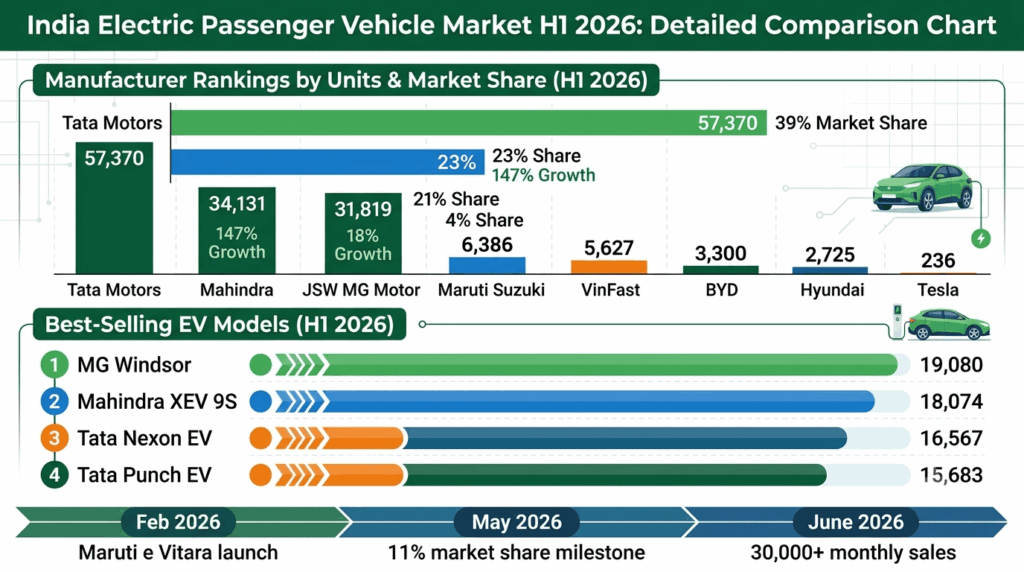
In H1 2026, Tata Motors sold 57,370 electric vehicles, an 82% increase from 31,556 units a year ago. Its market share increased marginally from 38% to 39%. The carmaker crossed 10,000 monthly EV sales in both May and June, selling 10,894 units and a record 12,384 units, respectively.
The Nexon EV remains Tata’s main volume driver, while the new Punch EV and updated Tiago EV have expanded its line-up. Tata also recently launched the Sierra EV, joining the Harrier EV, Curvv EV, and Tigor EV in its electric portfolio.
Tata’s first-mover advantage, widespread service network, and strong product portfolio continue to translate into customer confidence. The company’s total e-PV wholesales in the first seven months of CY2026 reached 76,715 units, up 95% year-on-year.
Mahindra & Mahindra — The Biggest Gainer
Mahindra recorded the highest growth among India’s three largest EV manufacturers, with sales rising 147% to 34,131 units from 13,801 units in H1 2025. Its market share increased from 17% to 23%.
Registrations increased 146% to 33,982 units, lifting its market share to 22.5% from 16.6%, a gain of 5.9 percentage points. Mahindra moved ahead of JSW MG Motor in March and retained second place through the first half of the year.
Mahindra’s five-seater XEV 9e maintained a steady sales run, having sold 11,149 units during H1 CY2026. Coupled with the BE 6, the company has emerged as a strong challenger with an expanding EV portfolio.
JSW MG Motor — Holding Third Place
JSW MG Motor recorded H1 2026 sales of 31,819 units, an 18% increase year-on-year. While registrations increased 18% to 31,741 units, growth lagged the overall market, causing its share to fall to 21% from 32.3%.
The MG Windsor led H1 2026 model sales with 19,080 units. More than 19,000 Windsors were sold during the first half of 2026, and cumulative Windsor sales crossed 75,000 units.
Combined market share:
Together, Tata Motors, Mahindra, and JSW MG Motor account for over 82% of total EV passenger vehicle registrations, leaving less than 18% for all other manufacturers combined. However, the combined market share of the three largest manufacturers declined to 81.7% in H1 2026 from 87% a year earlier, indicating a broadening competitive landscape.
The New Entrants: Maruti Suzuki, VinFast, and Tesla
How New Players Are Reshaping India’s EV Landscape
Maruti Suzuki — India’s Largest Carmaker Enters the EV Race
Maruti Suzuki, India’s largest carmaker, launched its first electric vehicle, the e Vitara, on February 17, 2026. The e Vitara is available with 49 kWh and 61 kWh battery options, offering up to 543 km of range. The base variant is priced at an introductory ₹10.99 lakh (ex-showroom) with a battery-as-a-service (BaaS) option.
In H1 2026, Maruti Suzuki registered 6,386 electric vehicles, giving it a 4.2% market share. The company’s e-PV registrations rose from 1,460 units in the first quarter to 4,926 units in the second quarter, showing accelerating momentum.
Maruti has started gaining traction with gradual month-on-month growth. Its nationwide dealer network and brand trust make it a company to watch closely. With the strength of its dealership network and the trust it commands, Maruti is positioned to become a significant EV player.
VinFast — The Vietnamese Challenger
VinFast, the Vietnamese electric vehicle maker, entered the Indian market with the VF6 and VF7 models. The company has launched three new products in 2026 and doubled its network to 75 dealerships.
In H1 2026, VinFast registered 5,627 electric vehicles, capturing a 4% market share. Volumes increased from 1,630 units in the first quarter to 3,992 units in the second quarter, showing strong momentum.
VinFast has also announced plans to enter India’s electric two-wheeler market in the second half of 2026 with India-specific electric scooters.
Tesla — A Slow Start
Tesla entered India on July 15, 2025, and began customer deliveries of the Model Y from September 2025. The company’s much-awaited entry has delivered a subdued first year, with Tesla retailing just 450 Model Y SUVs between September 2025 and June 2026, averaging fewer than 50 vehicles a month.
In July 2026, Tesla finally crossed the 100-unit monthly sales mark. Following a price cut, the company registered 115 EVs, a 203% surge from its previous best of 69 units. Against an internal annual target of 2,500 units, this represents a slow start. However, the July surge may indicate that price adjustments are beginning to attract buyers.
The new entrant impact:
Maruti Suzuki, VinFast, and Tesla together registered 12,244 vehicles in H1 2026, capturing an 8.1% share of the segment and accounting for 18% of incremental registrations. The data suggests new entrants are expanding the electric passenger-vehicle market rather than merely taking volumes from incumbents. The newcomers only gathered momentum in the second quarter of 2026, suggesting their impact will grow.
The Model Leaders: Best-Selling Electric Cars in H1 2026
Which EVs Are Flying Off Showroom Floors
The top-selling models:
| Rank | Model | Sales (H1 2026) |
|---|---|---|
| 1 | MG Windsor | 19,080 |
| 2 | Mahindra XEV 9S | 18,074 |
| 3 | Tata Nexon EV | 16,567 |
| 4 | Tata Punch EV | 15,683 |
The MG Windsor led H1 2026 with 19,080 units, followed closely by the Mahindra XEV 9S at 18,074 units. Tata Nexon EV recorded 16,567 units, and Punch EV recorded 15,683 units. Tata Harrier EV was the sixth-best-selling electric car in H1 2026, recording sales of 10,499 units. The newly introduced Tata Sierra EV also began contributing sales.
This model-level data confirms that the EV market is no longer dominated by a single model. A wide range of products across price points and body styles is helping expand the addressable market.
The Broader Segments: E-2W, E-3W, and Commercial EVs
The Full Picture of India’s EV Adoption
Electric two-wheelers:
Electric two-wheelers continued to dominate EV volumes, registering sales of 1,70,733 units in May 2026, up 63% year-on-year. EV penetration in the two-wheeler segment rose to 9.25%, up from approximately 6% the previous year.
Electric three-wheelers:
Electric three-wheelers retained their position as the most electrified vehicle category, with nearly two-thirds of all three-wheelers sold in India now powered by electricity.
Electric passenger vehicles:
Electric passenger vehicles delivered one of the strongest performances in May. Retail sales surged 81.2% year-on-year to 26,682 units, compared to 14,725 units in May 2025. EV penetration in the passenger vehicle segment rose to 6.6% from 4.5% a year earlier.
Total EV sales:
Across all segments, total EV sales in India rose 43% year-on-year to 1.54 million units in H1 2026. The growth reflects a broadening of the electric vehicle market beyond passenger cars to include two-wheelers, three-wheelers, and commercial vehicles.
What This Means for Today’s Buyers
The Practical Implications
More choices than ever:
Buyers today have access to everything from affordable city-focused EVs to premium electric SUVs and luxury offerings. Maruti’s e Vitara at ₹10.99 lakh (BaaS), the XUV 3XO EV at ₹13.89 lakh, Tata’s Sierra EV at ₹18.79 lakh, and Mahindra’s XEV 9S at ₹19.95 lakh represent a wide spectrum of options.
Competition is driving innovation:
The entry of Maruti Suzuki, VinFast, and Tesla is intensifying competition. India’s largest carmaker entering the EV space is a significant vote of confidence in the segment. VinFast’s aggressive expansion and Tesla’s eventual scale-up will push incumbents to improve products and pricing.
New entrants are expanding the market:
The data suggests new entrants are expanding the electric passenger-vehicle market rather than merely taking volumes from incumbents. A wider product range and the entry of manufacturers with established brands and distribution networks are drawing more mainstream buyers into the segment.
Fuel prices are accelerating adoption:
Rising fuel costs have sharpened buyers’ focus on running costs, making the lower cost of ownership offered by EVs an increasingly compelling proposition. Starting May 15, 2026, oil marketing companies implemented four petrol price hikes in 10 days, making petrol in Mumbai costlier by Rs 7 per litre.
Internal Links: Further Reading on Clean Energy Bazaar
The India’s EV sales boom: crossing 11% market share and 79% growth in H1 2026 guide connects to the EV market and policy guides on cleanenergybazaar.com.
For the MG Hector Tomahawk EV and PHEV launch guide covering India’s first mainstream plug-in hybrid SUV, our MG Hector Tomahawk EV and PHEV launch: India’s first mainstream plug-in hybrid SUV guide covers the dual launch in detail. For the Tata Motors’ EV offensive guide covering the Sierra EV and Safari EV, our Tata Motors’ EV offensive: Sierra EV launch and Safari EV coming soon guide covers Tata’s electric SUV lineup. For the Mahindra electric SUV lineup guide covering XEV 9S, BE 07, and XUV 3XO EV, our Mahindra’s expanding electric SUV lineup: XEV 4e, XEV 9S, BE 07, and XUV 3XO EV guide covers Mahindra’s comprehensive portfolio. For the PHEV vs EV analysis covering whether plug-in hybrids are a bridge or a competitor, our PHEV vs EV: why India’s first mass-market plug-in hybrid could reshape the market guide covers the broader market implications.
Final Thoughts
India’s EV sales boom: crossing 11% market share and 79% growth in H1 2026 — and the data confirms that India’s electric vehicle market has crossed a decisive threshold.
The numbers are compelling. Total EV sales across all segments reached 1.54 million units in H1 2026, a 43% year-on-year increase. Electric passenger vehicle sales rose 79% to 1,48,023 units. In May 2026, EVs crossed the 11% retail market share mark for the first time. June 2026 saw monthly e-PV sales cross 30,000 units for the first time.
The established players are delivering. Tata Motors retained its leadership with 57,370 units and a 39% market share. Mahindra recorded the highest growth at 147%, moving to second place with 34,131 units and a 23% share. JSW MG Motor held third with 31,819 units.
The new entrants are making their mark. Maruti Suzuki launched its first EV, the e Vitara, and sold 6,386 units in its first half-year. VinFast sold 5,627 units with just two models. Tesla had a slow start with 450 units in its first year, but a July price cut drove a 203% surge.
The honest verdict: India’s EV market is no longer a niche. It is a mainstream growth story, driven by rising fuel prices, new model launches, improving charging infrastructure, and a widening range of options. For buyers, the choices have never been better. For manufacturers, the competition has never been fiercer.