The commercial transport sector crossed a structural threshold in 2025 that industry analysts had long anticipated but few expected to arrive this decisively. For an asset class that diesel dominated for a century, this is no incremental adjustment. It is the early architecture of a structural realignment in global freight.
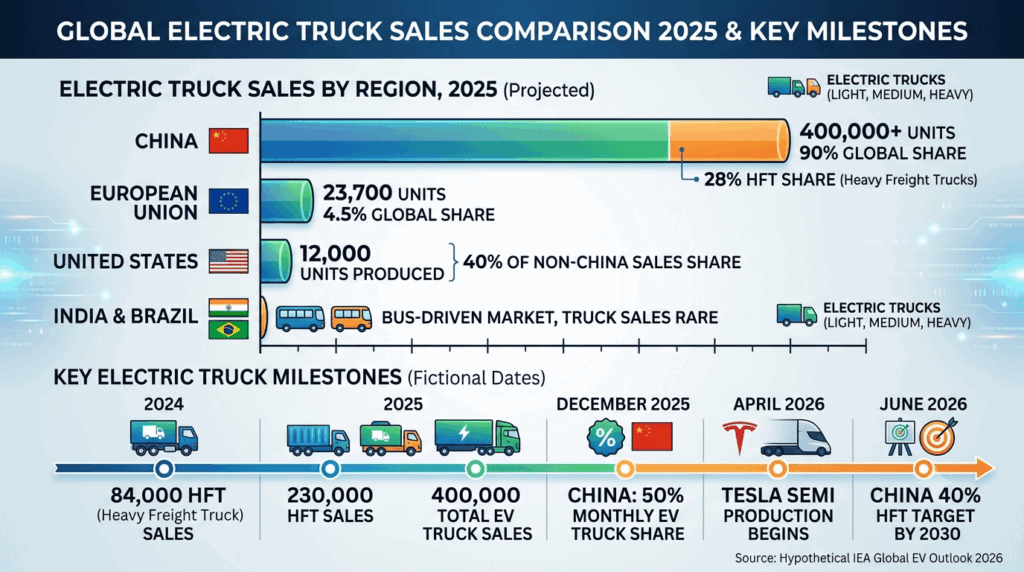
According to the International Energy Agency’s Global EV Outlook 2026, sales of electric trucks exceeded 400,000 units globally for the first time in 2025, doubling year-on-year and reaching 9% of all truck sales worldwide. Within this broader surge, the electric heavy freight truck segment delivered the most dramatic acceleration: sales almost tripled year-on-year, from approximately 84,000 units in 2024 to a record 230,000 in 2025. The electric medium freight truck segment grew more moderately but still posted a 65% year-on-year increase, reaching 210,000 units.
This guide on electric heavy-duty truck sales triple: the 200,000-unit logistics revolution provides the complete, honest analysis. It covers the IEA and ICCT data behind the surge, China’s dominant role, the regional breakdown, the policy and economic drivers, the challenges that remain, and what this means for the future of global freight.
The Global Surge: Electric Trucks Hit 9% of Global Sales
The IEA’s 2026 Assessment
The 400,000-unit milestone:
Sales of electric trucks continued to grow for the fifth consecutive year in 2025, exceeding 400,000 for the first time and doubling compared to the previous year. Globally, electric trucks reached 9% of all truck sales in 2025, surpassing the EV sales share for buses and light commercial vehicles. This is a remarkable acceleration from just a few years ago, when electric trucks were a niche segment with minimal market penetration.
The heavy freight segment:
The electric heavy freight truck (HFT) segment, which includes vehicles with a gross weight exceeding 15 tonnes, recorded the most dramatic acceleration. Sales of electric HFTs almost tripled year-on-year, from around 84,000 in 2024 to a record high of 230,000 in 2025. The share of electric trucks within total HFT sales reached 9%, having accelerated from just over 3% in 2024.
The medium freight segment:
Sales of electric medium freight trucks (MFTs), vehicles between 3.5 and 15 tonnes, grew more slowly but still increased 65% year-on-year to reach 210,000 in 2025. Electric MFT sales reached 9% of the total MFT market, increasing from 6% of sales in 2024.
Battery electric dominance:
Battery electric trucks accounted for nearly all, 97%, of electric truck sales globally in 2025. This is partly because battery electric truck models far outnumber plug-in hybrid electric truck models, and because battery electric trucks tend to be more cost-competitive.
The broader context:
The International Organization of Motor Vehicle Manufacturers (OICA) confirmed that global vehicle production rose from 92.7 million units in 2024 to 96.4 million in 2025, a 3.9% increase, while global sales climbed from 95.3 million to 99.8 million units, a 4.7% gain. OICA Secretary General François Roudier described the 2025 data as “a map of industrial repositioning”.
The ICCT data:
The International Council on Clean Transportation (ICCT) provides additional perspective. Across the 34 countries analysed, which account for approximately 80% of global truck and bus sales and 99% of zero-emission truck and bus sales, sales of electric trucks and buses nearly doubled for the second consecutive year in 2025, rising by 86% year-on-year. Total sales reached 520,000 electric units, corresponding to a global market share of around 14%.
China: The Engine of the Revolution
One in Four Trucks Sold in China Was Electric in 2025
China’s dominant role:
The majority of global electric truck sales growth in 2025 came from China, where sales more than doubled in 2025, just as in 2024. In 2025, sales of electric trucks in China surpassed 400,000, meaning China accounted for over 90% of global sales. One in four trucks sold in China in 2025 was electric.
The heavy freight segment in China:
Sales of electric HFTs in China reached an impressive 28% of total HFT sales in 2025, up from 13% in 2024. In December 2025, the EV sales share for trucks reached approximately 50% for the first time, reflecting an end-of-year surge in sales as fleet purchasers anticipated that the scrappage scheme may come to an end. Electric MFT sales also benefited from the same support schemes and reached a 24% sales share in 2025, up from 16% in 2024.
The policy drivers:
China’s success is not accidental. The renewed scrappage scheme offered owners up to approximately USD 20,000 to replace older trucks (trucks compliant with China IV emissions standards or earlier) with cleaner trucks, either new energy vehicles or conventional trucks that meet China VI emissions standards. The subsidy is sufficient to cover around 20-50% of the average electric truck price premium in China. Decarbonisation targets for heavy industry have also strongly supported the switch to electric trucks, especially in the steel and cement sectors. In addition, Stage 4 heavy-duty vehicle fuel consumption standards came into effect in July 2025, requiring a 12-16% improvement compared to Stage 3.
The ICCT perspective:
The ICCT’s study confirms China’s dominance. Of the approximately 520,000 electric units sold globally in 2025, 457,300 were registered in China. China accounted for 88% of global sales of medium- and heavy-duty zero-emission vehicles. However, the analysts note that China’s relative market share has begun to decline slightly as sales in other markets accelerate.
Total cost of ownership parity:
Battery electric HFTs in China have already reached total cost of ownership (TCO) parity with diesel trucks in certain cases after 5 years of ownership. In specific high-utilization applications such as ports, mining, and steel production, the economic case is already compelling.
The 2026 policy acceleration:
On June 15, 2026, China’s Ministry of Transport rolled out the nation’s first detailed electrification target for heavy trucks, mandating that battery electric trucks constitute 40% of new heavy truck sales and 20% of the total fleet, approximately 1.6 million vehicles, by 2030. On short-haul routes around Beijing, the target rises to 80%, accompanied by a build-out of 3,000 charging and battery-swap stations under a “zero-carbon highway” initiative.
The 2026 momentum:
Sales have continued to grow across the first quarter of 2026, with electric truck sales up more than 20% year-on-year. In China, industry data shows that 2025 new energy heavy-duty truck cumulative sales reached 233,206 units, a year-on-year increase of 181.91%. In December 2025, monthly terminal sales exceeded 45,000 units, a 198% year-on-year increase, with domestic monthly penetration exceeding 50%. Entering 2026, the market’s high-growth momentum continued, with January to May cumulative sales reaching 103,800 units.
Regional Breakdown: The Rest of the World
Europe, the United States, and Emerging Markets
The global picture excluding China:
Excluding China, global sales of medium- and heavy-duty zero-emission vehicles in 2025 amounted to around 63,000 units, led by the United States, the European Union, and India. This represents less than 15% of the global total, highlighting just how concentrated the electric truck market currently is.
The United States:
In the United States, around 12,000 electric trucks were produced in 2025. The medium freight segment accounted for the majority of domestic production and almost all exports. The US accounted for about 40% of sales outside China, which the ICCT study attributes primarily to medium-duty battery-electric trucks. Over 90% of electric vehicle sales in the US segment were medium-duty trucks, with heavy trucks making up only about 3% to 4%.
Tesla Semi enters production:
A defining Western milestone occurred on April 29, 2026, when Tesla rolled the first Semi off its high-volume production line at Gigafactory Nevada, a facility engineered for 50,000 units of annual capacity. Priced at roughly $290,000 for the 500-mile Long Range variant, the Semi is the lowest-priced Class 8 battery electric tractor on the market. In California’s Clean Truck & Bus Voucher program, the Semi accounted for 965 of 1,067 applications between January 2025 and February 2026, with Daimler, PACCAR, and Volvo combined receiving fewer than 100.
The European Union:
In the European Union, both battery-electric buses and trucks are growing. In 2025, the ICCT recorded over 23,700 new medium- and heavy-duty zero-emission vehicles in Europe. Zero-emission trucks over 3.5 tonnes achieved a sales share of 4.5%, while battery-electric buses already accounted for 24.8% of the total market.
Challenges outside China:
Market entry has proved difficult for a handful of new manufacturers in the United States and Europe. In the past 3 years, several start-ups focused on electric trucks filed for bankruptcy, including Nikola, Bollinger Motors, Proterra, Arrival and Volta, and were subsequently acquired by larger truck makers and industrial players.
India and Brazil:
In India and Brazil, the zero-emission vehicle market was predominantly driven by buses and coaches, which represented over half of EV sales in these regions. Battery-electric trucks remain rare there.
Emerging markets:
Despite the dominance of China, other markets are beginning to accelerate. The ICCT notes that China’s relative market share has begun to decline slightly as sales in other markets accelerate. This suggests that the electric truck revolution, while currently China-centric, is beginning to spread.
The Drivers: Why Electric Trucks Are Taking Off
Policy, Economics, and Technology Converge
Total cost of ownership parity:
The most important driver of electric truck adoption is total cost of ownership parity. Battery electric HFTs in China have already reached TCO parity with diesel trucks in certain cases after 5 years of ownership. In specific high-utilization applications such as ports, mining, and steel production, the economic case is already compelling. As battery costs continue to decline, this economic advantage will only grow.
Government policy:
Government policy has been a critical driver. China’s scrappage scheme offered owners up to approximately USD 20,000 to replace older trucks with cleaner alternatives. The subsidy is sufficient to cover around 20-50% of the average electric truck price premium in China. Decarbonisation targets for heavy industry have also strongly supported the switch to electric trucks, especially in the steel and cement sectors. Stage 4 heavy-duty vehicle fuel consumption standards came into effect in July 2025. China’s 2030 electrification target mandating 40% of new heavy truck sales and 20% of the total fleet by 2030 provides long-term policy certainty.
Declining battery costs:
Global average EV battery prices declined by 8% in 2025. As battery costs continue to fall, the upfront price premium for electric trucks shrinks, making them accessible to a broader range of fleet operators.
Operational advantages:
Electric trucks offer lower maintenance costs, fewer moving parts, and the potential for lower total cost of ownership over the vehicle’s lifetime. For fleet operators, these operational advantages translate directly to improved profitability.
Industrial demand:
Decarbonisation targets for heavy industry have strongly supported the switch to electric trucks, especially in the steel and cement sectors. Companies in these sectors face pressure to reduce their carbon footprint, and electric trucks offer a pathway to achieving those targets.
The Challenges: What Could Slow the Revolution
The Honest Assessment of the Barriers
China’s dominance:
The concentration of electric truck sales in China is both a strength and a vulnerability. China accounted for over 90% of global electric truck sales in 2025. Outside China, the market is still nascent. This geographic concentration means that the global electric truck market is heavily dependent on Chinese policy and economic conditions.
Start-up failures:
In the past 3 years, several start-ups focused on electric trucks filed for bankruptcy, including Nikola, Bollinger Motors, Proterra, Arrival and Volta. These failures highlight the challenges of bringing electric trucks to market in the competitive and capital-intensive commercial vehicle sector.
Charging infrastructure:
For electric trucks to achieve widespread adoption, a robust charging infrastructure for heavy-duty vehicles is essential. China is building out 3,000 charging and battery-swap stations under a “zero-carbon highway” initiative. In other regions, charging infrastructure for trucks remains limited.
Supply chain concentration:
China has the most integrated and geographically concentrated electric truck ecosystem. Electric truck sales in China are almost exclusively from Chinese OEMs using Chinese batteries, with CATL supplying 80% of the total. Outside China, battery supply chains remain heavily dependent on Chinese, Japanese and Korean companies. Around 70% of trucks sold in the European Union in 2025 were equipped with battery cells produced by manufacturers headquartered in these countries. In the United States, nearly 90% of the electric trucks sold in 2025 had batteries made by Korean and Japanese companies.
The 2026 outlook:
Global heavy-duty truck sales are forecast to slightly decline to 1.99 million units in 2026. Heavy-duty truck electrification will remain muted globally, except in China, where battery electric vehicle penetration is set to exceed 20% in 2026. However, analysts predict that 2026 electric heavy-duty truck penetration could approach 37% in China, with sales increasing approximately 28% year-on-year, entering an acceleration period.
What This Means for the Future of Freight
The Strategic Implications
The logistics revolution is here:
The data is clear. Electric heavy-duty truck sales tripled from 84,000 in 2024 to 230,000 in 2025. Electric truck sales exceeded 400,000 units for the first time, reaching 9% of all truck sales worldwide. This is not a pilot project. This is a structural shift in the global freight industry.
China is leading, but others are following:
China accounted for over 90% of global electric truck sales in 2025. But its relative market share is beginning to decline as sales in other markets accelerate. The Tesla Semi entering production, Europe’s 4.5% zero-emission truck share, and the US’s 12,000 electric truck production all signal that the revolution is spreading.
TCO parity is the key:
Battery electric heavy freight trucks have already achieved total cost of ownership parity with diesel in specific applications. As battery costs continue to decline, this economic advantage will expand to more applications and regions. The question is no longer whether electric trucks are viable. It is how quickly the transition will compress diesel’s competitive advantage.
The infrastructure challenge:
The competitive battleground over the next 36 months will not be technology validation, which is largely settled, but rather charging infrastructure density, residual-value certainty, and supply-chain control. Stakeholders who treat fleet electrification as a financing and infrastructure challenge, rather than a vehicle procurement decision, will capture disproportionate value.
Internal Links: Further Reading on Clean Energy Bazaar
The electric heavy-duty truck sales triple: the 200,000-unit logistics revolution guide connects to the EV market and policy guides on cleanenergybazaar.com.
For the IEA Global EV Outlook 2026 summary covering the full global picture, our IEA Global EV Outlook 2026: 2025 sales hit 20M, capturing 25% of global car sales guide covers the flagship report in full. For the Europe’s EV sales surge guide covering the European market context, our Europe’s EV sales surge 30% – how Germany, Spain, and Italy are leading the comeback guide covers the regional EV adoption surge. For the EV vs. ICE cost guide covering the operating cost advantages that drive TCO parity, our EV vs. ICE: 5-year cost of ownership post-Middle-East oil price spikes guide covers the fuel savings that make electric trucks compelling. For the nation-by-nation BEV penetration ranking covering where China stands globally, our nation-by-nation BEV penetration ranking: Norway at 97.9%, Denmark at 80%, US at 5.9% guide covers the global EV adoption landscape.
Final Thoughts
Electric heavy-duty truck sales triple: the 200,000-unit logistics revolution — and the data confirms that the commercial transport sector has crossed a decisive threshold.
The numbers are staggering. Electric truck sales exceeded 400,000 units for the first time in 2025, doubling year-on-year and reaching 9% of all truck sales worldwide. The electric heavy freight truck segment almost tripled, from 84,000 in 2024 to 230,000 in 2025. China accounted for over 90% of global sales, with one in four trucks sold in China being electric. In December 2025, the EV sales share for trucks reached approximately 50% for the first time.
The drivers are clear. Total cost of ownership parity with diesel has been achieved in specific applications. Government policy, including China’s scrappage scheme and 2030 electrification targets, has provided powerful incentives. Battery costs are declining. Industrial demand for decarbonisation is growing.
The challenges are equally real. China’s dominance means the global market is heavily concentrated. Start-ups have failed. Charging infrastructure outside China is limited. Supply chains remain dependent on Asian battery manufacturers.
The honest verdict: the electric truck revolution is real, and it is accelerating. China is leading the charge, but the revolution is spreading. The Tesla Semi is in production. Europe is at 4.5%. The US is producing 12,000 electric trucks. The question is no longer whether electric trucks will transform global freight. It is how quickly.