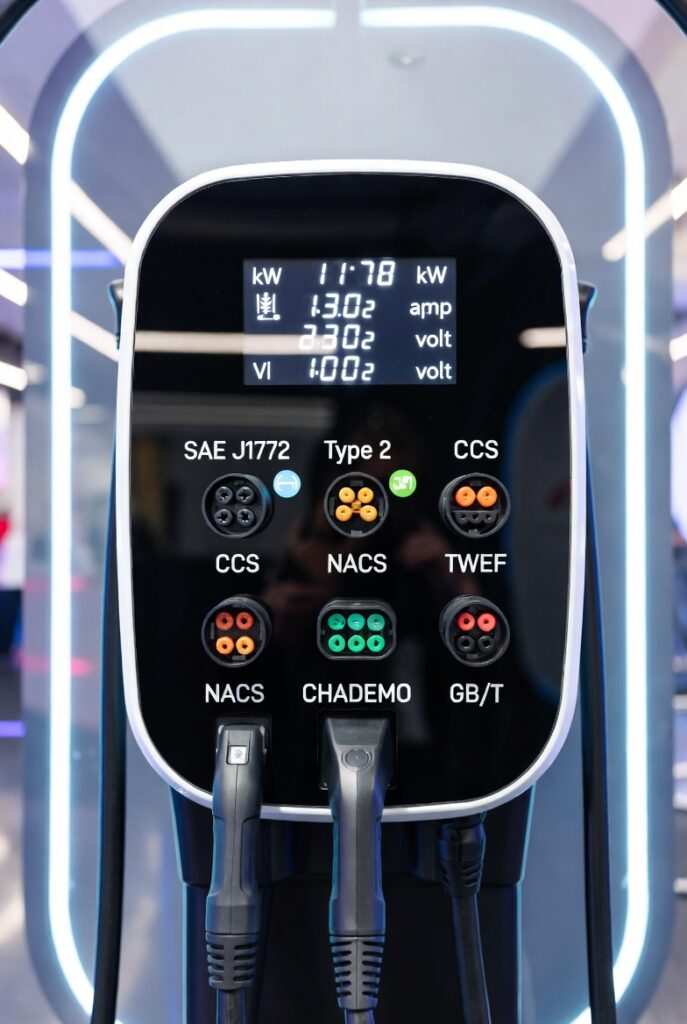
For the better part of a decade, EV charging in North America has been defined by chaos. Three competing connector standards, each with its own backers, have created a fragmented experience that has frustrated drivers and slowed adoption. The bulky CCS plug. The aging CHAdeMO standard, gradually fading from relevance. And Tesla’s sleek, proprietary connector that worked beautifully but only for Teslas.
That period is finally coming to an end. The solution is a new standard called SAE J3400 — the industry-stamped version of Tesla’s North American Charging Standard (NACS), formalised by SAE International in September 2024. In December 2024, the Federal Highway Administration confirmed that the J3400 connector and port would become the official federal standard.
This guide on NACS vs. CCS: what does the standardization (SAE J3400) mean for US drivers? provides the complete, honest analysis — what NACS and CCS actually are, how the SAE J3400 standardisation changes the landscape, why NACS won the connector war, what the transition means for current and future EV owners, and the honest assessment of how long this transition will really take.
What Is NACS and What Is CCS?
The Two Standards That Define North American EV Charging
NACS (North American Charging Standard):
The NACS connector and corresponding charge port, now formalised as part of SAE J3400, represent the future of US-market electric vehicle charging. Informally called the Tesla connector, this plug and port layout combines AC and DC charging with five pins, allowing the same two pins to carry power in each mode.
Originally developed for the Tesla Model S and Tesla’s first Supercharger stations delivered in 2012, the connector was opened to the public in November 2022 when Tesla adopted the communication standard of CCS and renamed it NACS. By the end of 2023, nearly every major automaker had announced plans to adopt it.
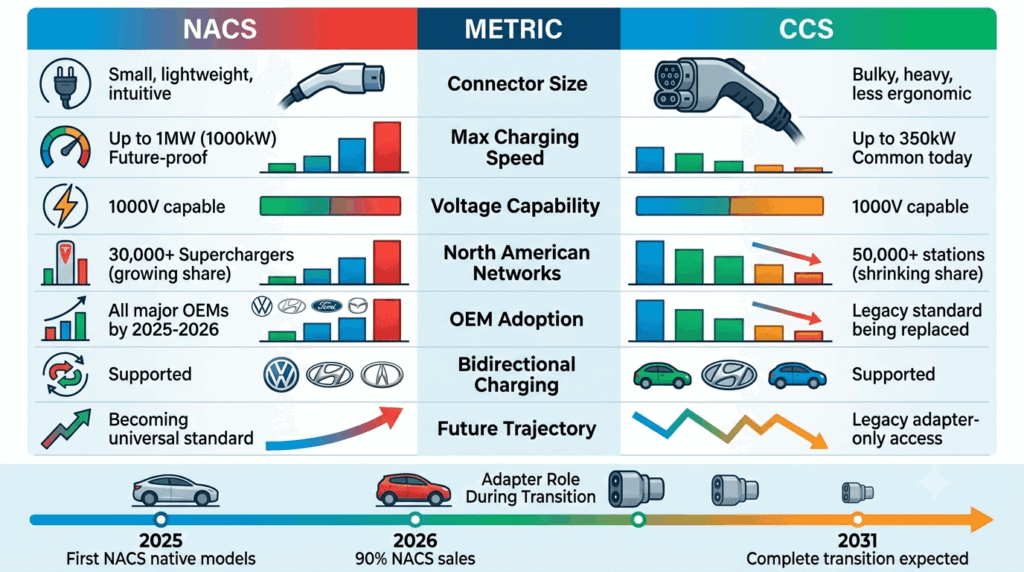
The NACS connector is fundamentally smaller and lighter than the CCS connector. According to EV suppliers, the height of a CCS inlet is more than 6 inches, whereas the height of a NACS inlet can be less than 3 inches. This reduced design makes the connector about half the size of its predecessor, significantly lighter, and easier to handle with improved power delivery.
CCS (Combined Charging System):
CCS is a charging standard developed primarily in Europe by a group of German automakers, plus GM and Ford. In its North American form, termed CCS1, the plug and port layout consists of the round J1772 five-pin layout used for AC charging, plus two stout DC charging pins added in a separate area underneath, amounting to a large albeit unified connector.
CCS has been able to charge up to 1,000 volts for more than a decade, and it arguably was one of the enabling factors spurring the development of 800-volt EVs like the Hyundai Ioniq 5 and Kia EV9. The key design difference is that CCS uses two giant pins on the bottom for high-speed DC fast charging and a separate five-pin connector on top for slower AC charging, while NACS uses the same two primary pins for both AC and DC power.
What Is SAE J3400?
The Official Standard That Ends the Connector War
The formalisation process:
In November 2022, Tesla opened its proprietary connector design to the world under the brand name NACS. In response, SAE International — the global association of engineers that defines automotive standards — began the process of reviewing, tweaking, and publishing it as an official standard. In September 2024, the SAE J3400 standard was finalised, effectively allowing other automakers and suppliers to develop NACS charging solutions without Tesla’s cooperation.
The distinction between NACS and J3400:
People often get confused about “NACS” versus “J3400,” but the distinction is simple. NACS was the brand name Tesla used for its connector when it opened the design to the world in 2022. SAE J3400 is the official, non-branded, industry-standard designation it received after SAE International formally reviewed and published it as a standard for all to use. Think of it like “Kleenex” versus “facial tissue” — one is the brand that started it all; the other is the generic, official term.
What the standard specifies:
The SAE J3400 is the entire technical specification for the connector, including the communication “language” the car and the charger use to talk to each other. The tightly scoped J3400 standard creates design frameworks for the mechanics and electrical signalling for the connector, which are key to a reliable, safe, and consistent EV charging experience. The standard defines the mechanical interface, not the cooling technology specifications.
The federal endorsement:
In December 2024, during a keynote address at Merge 2024, Kristin White, the Acting Administrator of the Federal Highway Administration, said that the J3400 connector and port would become the federal standard. The address followed the J3400 receiving SAE International certification. The Biden-Harris administration also took steps toward updating federal standards to incorporate J3400, with the Joint Office of Energy and Transportation working with SAE to develop a process and timeline for standardisation that advanced at unprecedented speed.
Why NACS Won
The Technical and Practical Advantages That Decided the Connector War
Form factor:
The most obvious advantage of NACS is its size and weight. The J3400 plug is barely half the size of the CCS1 behemoth and significantly lighter. Any EV owner who has wrestled a cold, stiff, and heavy CCS cable into their port during a rainstorm will tell you the user experience is far from ideal. The J3400 connector offers a simple, one-handed operation.
1000V capability:
The official SAE standard locks in a 1000V (1,000 volt) capability. This matters because high-performance EVs like the Porsche Taycan, Audi e-tron GT, and Lucid Air use 800V-plus architectures to charge at high speeds. The original NACS plug was limited to 500V, but the SAE J3400 standard ensures it is future-proof for these high-performance machines. The NACS standard has been modified to a high-voltage 1000V platform to meet the requirements of next-generation heavy trucks and premium long-range electric vehicles like the Lucid Air.
Higher maximum power:
NACS can support up to 1 MW (1,000 kW) under the V4 specification, compared to CCS which supports up to 350 kW. The V4 architecture is designed for heavy-duty applications.
Combined AC/DC design:
NACS is compatible with both AC and DC power, unlike CCS which has two distinct pins. The NACS connector uses the same two primary pins for both AC and DC power, which is precisely why the plug is so much smaller and lighter. This “all-in-one” design allows the connector to be half the size of its predecessor.
The Tesla Supercharger network:
Tesla operates more than 34,000 fast-charging ports in the US, many of which are now accessible to non-Tesla vehicles through adapters or direct vehicle integration. The Supercharger network has grown to more than 60,000 charging stalls worldwide. Tesla’s network has become a cornerstone of the public fast-charging experience in North America.
Native bidirectional support:
J3400 is natively bidirectional (V2L and V2H) and can transform electric vehicles into mobile energy sources.
Lower installation costs:
NACS allows for 277V AC charging which eliminates the need for a step-down transformer for commercial AC charging installations, resulting in significant cost savings often 10-20% of total installation cost.
The Transition — From CCS to NACS
How Long Will It Take and What Does It Mean for Drivers?
The current state of the charging network:
As of December 2025, CCS1 accounts for nearly 40 percent of all public DC fast-charging connectors in the US, while NACS holds just over 48 percent. CHAdeMO, by contrast, has effectively plateaued and is gradually exiting the market. In 2025, more new CCS1 DC fast chargers were installed in the US than NACS DC chargers, though the gap between the two standards narrowed over the course of the year.
Automaker adoption:
Every major automaker selling vehicles in North America has either adopted NACS natively or committed to transition timelines. Ford, General Motors, Rivian, Hyundai, BMW, Mercedes-Benz, and others have confirmed NACS port integration for 2025 and 2026 model years. Stellantis, the last major holdout, announced in November 2025 that it would begin introducing NACS to its models starting in 2026 with the Jeep Wagoneer S and Dodge Charger Daytona BEV.
By the end of 2026, it is estimated that approximately 90% of BEVs sold in the US will have native NACS ports. Approximately one in five non-Tesla EVs sold already include native NACS inlets, with manufacturers such as Hyundai, Kia, Genesis, and Rivian among early adopters.
The complete transition timeline:
Reviewing OEM announcements, vehicle production timelines, and software access rollouts suggests that a complete transition to NACS is unlikely before 2031. Millions of vehicles equipped with native NACS ports will still need access to existing CCS and J1772 infrastructure. Without adapters, approximately 45 percent of public DC fast charging and 96 percent of public AC charging infrastructure would be incompatible with many post-2026 EVs.
The adaptor solution:
Adapters are often framed as temporary accessories, but during a prolonged standards transition, they function more like system-level insurance. When designed, tested, and certified correctly, DC fast-charging adapters play a critical role in maintaining continuity across the charging ecosystem. From an access standpoint, adapters allow drivers to use the full public charging network regardless of vehicle inlet type, reducing range anxiety and supporting EV adoption.
The California Air Resources Board has indicated that CCS-to-NACS adapter inclusion should be a prerequisite for new NACS-equipped vehicle models sold in the state, a stance likely to influence other regulated markets.
The infrastructure cost:
Retrofitting infrastructure to eliminate the CCS-NACS mismatch is economically impractical. Estimates place the cost of replacing CCS and J1772 connectors nationwide at more than $660 million, with California alone accounting for nearly $190 million of that total. These figures do not include permitting delays, downtime, or the environmental impact of prematurely retiring functional equipment.
The NEVI dual-standard requirement:
Federal NEVI funding, totalling $7.5 billion allocated under the Infrastructure Investment and Jobs Act, requires all funded stations to include CCS connectors as a baseline. Updated minimum standards added a requirement that NEVI-funded stations must also accommodate NACS-equipped vehicles, either through dedicated NACS cables or through adapters. Texas, for example, has deployed 148 NEVI-funded charging stations across 52 corridor sites, with every site required to support both CCS1 and NACS connectors.
What This Means for Today’s EV Drivers
The Practical Implications of the NACS Standardisation
If you are buying a new EV in 2026:
Most new EVs sold in 2026 will have native NACS ports. By the end of 2026, approximately 90% of BEVs sold in the US will be NACS-equipped. This means you will have direct access to Tesla’s Supercharger network without an adapter, as well as growing NACS infrastructure from other providers.
However, CCS infrastructure remains a substantial portion of the public charging network. You may still need an adapter to access existing CCS chargers, particularly in areas where NACS deployment lags behind.
If you own a CCS-equipped EV:
You are not being left behind. Adapters will allow you to access the growing NACS network, and CCS infrastructure will continue to operate well into the 2030s. The US had approximately 4.2 million registered plug-in electric vehicles as of Q3 2025, of which roughly 2.8 million use CCS connectors. These vehicles will remain in the fleet for 10 to 15 years, meaning CCS infrastructure must continue operating.
CCS-to-NACS adapters are becoming available from multiple manufacturers, with UL 2252 certification ensuring safety and reliability.
The charging experience:
The NACS connector offers a superior user experience — smaller, lighter, and easier to handle. The standard also supports Plug and Charge functionality through the ISO 15118 communication protocol, enabling automatic billing and secure communication between the network and the car.
Resale value:
From a resale perspective, vehicles with SAE J3400 connectors are likely to hold value better as the standard spreads.
Should you wait for NACS before buying an EV?
The honest answer: no. The transition is already underway, and most new EVs shipping in 2026 will have NACS ports. If you are buying a CCS-equipped EV today, you will have adapter access to the NACS network. The charging experience will be slightly more complex during the transition, but you will not be stranded.
Internal Links — Further Reading on Clean Energy Bazaar
The NACS vs. CCS: what does the standardization (SAE J3400) mean for US drivers? guide connects to the EV infrastructure and policy guides on cleanenergybazaar.com.
For the NEVI’s new rules guide covering US charging reliability standards, our NEVI’s new rules: 97% uptime + 150kW – the US raises the bar for public chargers guide covers the federal standards for charging infrastructure. For the V2G goes commercial guide covering bidirectional charging, our V2G goes commercial in 2026: Enphase, GM, Ford, Hyundai, Kia, Tesla launch platforms guide covers bidirectional capability which both NACS and CCS support. For the US EV sales slump guide covering the broader US market context, our US EV sales slump 25% – policy uncertainty and the hybrid pivot guide covers the market conditions that NACS standardisation is designed to address. For the nation-by-nation BEV penetration ranking guide covering where the US stands globally, our nation-by-nation BEV penetration ranking: Norway at 97.9%, Denmark at 80%, US at 5.9% guide covers the global EV adoption landscape.
Final Thoughts
NACS vs. CCS: what does the standardization (SAE J3400) mean for US drivers? — and the honest answer is that it means the end of connector chaos in North America.
The SAE J3400 standardisation of Tesla’s NACS connector represents the most significant development in US EV charging infrastructure since the first Supercharger was installed. The connector war has been decided. NACS has won. Every major automaker has adopted it. The federal government has endorsed it. The technical specifications are locked in — 1000V capability, up to 1 MW power, native bidirectional support, and a connector half the size of its predecessor.
But the transition will take time. CCS infrastructure will remain a substantial portion of the public charging network for years. Retrofitting the existing network would cost more than $660 million. Adapters will be essential during the transition period, which is unlikely to be complete before 2031. Millions of CCS-equipped vehicles will remain on the road for 10 to 15 years.
The honest verdict: the standardisation of NACS as SAE J3400 is a victory for US EV drivers. It means a simpler, more reliable, and less frustrating charging future. But that future is not here yet. Today’s drivers — whether they own NACS or CCS vehicles — will need to navigate a transition period with adapters, dual-standard chargers, and continued infrastructure investment. The connector war is over. The integration has just begun.