For years, vehicle-to-grid technology has been the EV industry’s tantalising “next big thing” — the promise that your car could not only consume electricity but also earn you money by selling it back to the grid. The concept has been demonstrated in pilot projects, debated in academic papers, and promised by automakers for the better part of a decade.
In 2026, it is finally going commercial.
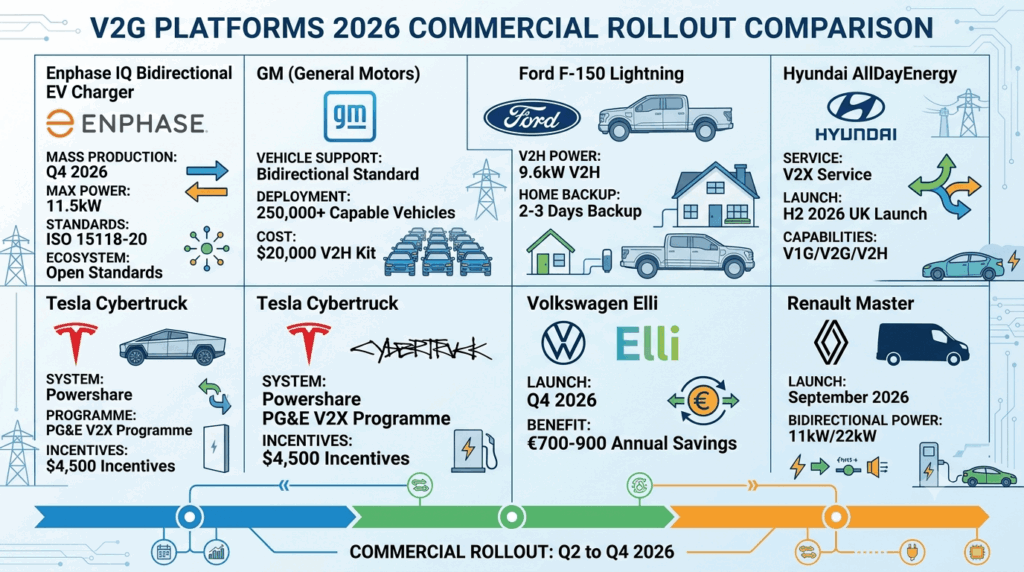
The second half of 2026 is shaping up to be the moment when bidirectional charging moves from pilot projects to mass-market deployment. Enphase Energy is targeting volume production of its IQ Bidirectional EV Charging Platform in Q4 2026. General Motors has launched a nationwide V2G push, integrating bidirectional capability as “a foundational standard” across its entire EV portfolio. Ford’s F-150 Lightning can already power homes during outages. Hyundai Motor Group has launched AllDayEnergy, its global V2X service, rolling out in the UK in H2 2026. Tesla has integrated the Cybertruck into PG&E’s residential V2X programme. Volkswagen and Elli are launching a V2G offering in Germany in Q4 2026. Renault is adding V2G support to the Master van from September 2026.
This guide on V2G goes commercial in 2026: Enphase, GM, Ford, Hyundai, Kia, Tesla launch platforms provides the complete, honest analysis — the platforms launching in 2026, the technology that makes bidirectional charging possible, the economics of selling power back to the grid, the challenges that remain, and what it all means for today’s EV buyers.
What Is V2G and Why Does It Matter?
The Technology Behind Bidirectional Charging
The concept:
V2G, or vehicle-to-grid, enables an electric vehicle to not only draw electricity from the grid to charge its battery but also to send electricity back to the grid when needed. The vehicle becomes a mobile energy storage asset, capable of supporting the grid during peak demand periods.
The spectrum of bidirectional use:
V1G (smart charging): The vehicle charges at times when electricity is cheapest and grid demand is lowest. Energy flows only one way, from grid to vehicle.
V2H (vehicle-to-home): The vehicle powers the home during outages or when electricity prices are high. Energy flows from vehicle to home. The Ford F-150 Lightning can send up to 9.6 kW of power from its onboard batteries back to the house, powering a home for two to three days.
V2G (vehicle-to-grid): The vehicle exports power to the public electricity grid, earning the owner financial compensation. This is the most advanced form of bidirectional charging and the one that is now going commercial.
V2X (vehicle-to-everything): An umbrella term covering all forms of bidirectional energy flow between vehicles and external systems.
The scale of the opportunity:
GM estimates that V2G-enabled GM EVs on the road today “have the energy capacity to help power 120,000 homes for up to one week”. The IEA projects in its Stated Policy Scenario that 250 million EVs will be on roads globally by 2030. If even a fraction of those vehicles are bidirectional-capable, the potential grid-stabilising capacity is enormous.
Enphase Energy — The Charger That Unlocks V2G
IQ Bidirectional EV Charging Platform: Q4 2026 Mass Production
The announcement:
In February 2026, Enphase Energy provided an update on the continued development of its IQ Bidirectional EV Charging Platform, following a series of successful product demonstrations. The company is targeting volume production beginning in Q4 2026, with limited pilot deployments expected ahead of broader commercialisation.
The technology:
The DC-based IQ Bidirectional EV Charger connects to the direct current (DC) port of an electric vehicle, enabling EV charging, home backup during outages, and future grid services. It is engineered to support 400V and 800V EVs and deliver up to 11.5 kW of bidirectional power, leveraging GaN-based grid-forming microinverters.
The charger enables a safe, reliable two-way power flow between the EV, home, and grid — sending power from the EV to the home during outages (V2H) and exporting from the EV to the grid when rates are high (V2G). It includes integrated black start technology, delivering uninterrupted backup even during full power outages.
The open standards commitment:
Enphase is building the IQ platform on open communication standards, including ISO 15118-20, to support vehicle interoperability and standards-based V2H and V2G functionality with compatible vehicles. The charger has been tested on U.S. and European EVs, with demonstrations at multiple CharIN interoperability events.
The compatibility:
From a hardware perspective, the EV will need to have Level 3 DC charging built in (NACS or CCS). Software compatibility is still in development, and there is no official list of compatible make/model EVs published yet.
General Motors — Bidirectional as a Foundational Standard
GM Empower 2026 and the V2G Push
The announcement:
At its GM Empower 2026 event in June, GM Chief Product Officer Sterling Anderson announced a broad initiative focused on vehicle-to-grid technology. The company is integrating bidirectional capability as “a foundational standard” across its entire EV portfolio, democratising access from high-volume platforms like the Chevy Equinox EV to flagship vehicles like the Cadillac Escalade IQ.
The scale:
GM alone has more than 250,000 bidirectional-capable vehicles on American roads today. The company pushed a firmware update to its vehicles and home energy management ecosystems to enable bidirectional charging, which its EVs already have the hardware to support.
The utility partnerships:
GM has already begun localised testing with major utility partners:
- Northern California: In collaboration with PG&E, GM projects that by 2030, a fleet of 130,000 GM EVs will be operational, with over 52,000 systematically participating in grid-balancing protocols.
- Michigan: GM is testing with DTE Energy under real-world conditions to refine the experience.
The customer experience:
GM is working toward a single mobile app interface to help people manage vehicle charging, home energy use, and, eventually, direct interaction with the grid. To participate, owners must install the GM Energy PowerShift Charger and GM Energy V2H Enablement Kit, coming at a cost of approximately $20,000. GM says homeowners can recover that upfront cost in about five years of use.
The broader strategy:
GM is also entering the grid-scale energy storage market, partnering with sodium-ion battery startup Peak Energy. The company sees “a future where electric vehicles, batteries that power them, and the country’s power grids work together”.
Ford — The Pioneer of Vehicle-to-Home
F-150 Lightning and Home Backup Power
The capability:
Ford made early headlines using its F-150 Lightning as a life-saving generator during winter ice storms and hurricanes. The best-selling electric truck in America can send up to 9.6 kW of power from its onboard batteries back to the house.
The Lightning can provide power for two to three days, depending on what home devices are being used. The F-150 PowerBoost Hybrid can provide up to five days on a single tank of gas.
The V2H demonstrations:
In Washington state, PSE and ChargeScape launched a V2H demonstration enabling participants with bidirectional-capable EVs — initially including the Ford F-150 Lightning and Kia EV9 — to use their vehicle batteries as backup power sources for their homes while simultaneously supporting grid reliability during peak demand periods.
The simplified setup:
Ford recently announced it is rolling out a simpler vehicle-to-home setup for certain F-150 Lightning and F-150 PowerBoost Hybrid owners, featuring a one-foot long adapter that plugs into a 240-volt outlet onboard the vehicle.
Hyundai and Kia — AllDayEnergy Goes Global
The Unified V2X Platform
The announcement:
Hyundai Motor Group has launched AllDayEnergy, its new global Vehicle-to-Everything (V2X) energy service. The service brings the Group’s existing V2X services together under a single global identity, providing customers with a consistent experience across different markets and service types.
The three service tiers:
AllDayEnergy will cover three types of energy services:
- V1G (smart charging): Adjusts the timing of vehicle charging in response to real-time electricity prices, grid conditions, and customer preferences.
- V2G (vehicle-to-grid): Enables an EV battery to return energy to the grid when required.
- V2H (vehicle-to-home): Allows energy stored in an EV battery to support household electricity needs, including backup power during outages.
The rollout:
The Group will begin rolling out AllDayEnergy in the UK via the Kia App in the second quarter of 2026, with planned expansion to Europe, the United States, and Korea. The official market launch is scheduled for the second half of 2026.
The pilot programmes:
Before the global announcement, the Group had already gained significant experience through pilot projects:
- In South Korea’s Jeju Special Self-Governing Province, a large-scale V2G test is currently underway.
- In the United States, it has deployed V2H services that provide emergency household backup power during events such as major wildfires.
- In the Netherlands, it has introduced V2G and smart charging services that optimise vehicle charging in response to dynamic electricity prices.
The model-specific pilots:
In May 2026, Hyundai selected 40 customers using Hyundai Motor’s Ioniq 9 and Kia’s EV9 models for a V2G service pilot on Jeju Island, providing bidirectional charging systems free of charge. In the Netherlands, Vattenfall launched a V2G pilot with Kia and Hyundai for up to 80 selected households with a Kia EV9 or Hyundai IONIQ 9.
Tesla — Cybertruck Leads the Way
Powershare Grid Support Program
The announcement:
Tesla has launched the Powershare Grid Support Program for Cybertruck owners. The Cybertruck, together with the Tesla Powershare Gateway and Universal Wall Connector, has been approved for participation in PG&E’s residential V2X programme.
The capability:
The system allows customers to install Tesla’s Powershare Home Backup and activate Powershare Grid Support, enabling energy to flow between vehicle, home, and grid. During periods of high demand, vehicles can export electricity to the grid in response to utility signals, including programmes such as PG&E’s Emergency Load Reduction Program.
The incentives:
Customers enrolled in the pilot programme can receive incentives of up to $4,500 towards bidirectional charging equipment and interconnection costs. Additional compensation is available for participation in grid events and continued enrolment.
Tesla’s competitive advantage:
Colby Hastings, Senior Director of Tesla’s Residential Energy business, noted: “Our unique integrated architecture makes vehicle-to-grid dramatically cheaper than alternatives, and PG&E’s V2X programme will accelerate customer adoption”.
The limitations:
Currently, only the Cybertruck supports Powershare functionality. Tesla confirmed in late 2025 that the new Model Y Performance would support bidirectional charging, but the feature has not been fully activated.
Volkswagen — V2G in Germany
Elli and the ID. Range
The announcement:
Volkswagen and its subsidiary Elli are planning to launch a vehicle-to-grid service for private customers in Germany at the end of 2026. The commercial launch will take place in the fourth quarter of 2026.
The offer:
The service is presented as a turnkey solution: dynamic electricity tariffs, a bidirectional DC charging station, a smart meter, and an energy management app are provided together. According to the manufacturer, the objective is to “reduce the total cost of mobility”.
The economics:
Volkswagen’s estimates suggest “potential of €700 to €900 in savings or revenue per year in the most favourable scenarios”. The remuneration paid to the customer initially remains fixed, calculated according to the degree of flexibility the user accepts in their charging behaviour. Volkswagen aims to eventually achieve domestic charging with a net cost that is almost nil.
The vehicle compatibility:
Approximately one million vehicles in Europe are already compatible with bidirectional charging. The entire ID. range has been compatible since 2023. The next software update, ID. Software 6, will extend this compatibility to other battery sizes. Volkswagen specifies that V2G usage will not significantly affect battery lifespan.
Renault — V2G Comes to Commercial Vans
Renault Master Adds V2G from September 2026
The announcement:
Renault Master has taken the top position in Europe’s large van segment in 2026, with the E-Tech electric range gaining bidirectional charging and vehicle-to-grid capability from September.
The specifications:
The updated E-Tech battery retains 87 kWh capacity with mid-nickel chemistry. Standard charging is 11 kW bidirectional, with an optional 22 kW bidirectional unit. V2G compatibility arrives in select markets from September 2026.
The significance:
Renault Master shifts from a vehicle that consumes grid power to one that can also supply it. This marks one of the first commercial V2G deployments in the commercial vehicle segment.
The Open Standards — Making V2G Work Across Vehicles
ISO 15118-20 and Interoperability
The standard:
ISO 15118-20 is the international standard for bidirectional charging communication between electric vehicles and charging stations. It defines how vehicles and chargers negotiate power flow, authentication, and grid services.
The commitment to interoperability:
Enphase is building the IQ platform on ISO 15118-20 to support vehicle interoperability and standards-based V2H and V2G functionality. The charger has been tested on U.S. and European EVs at multiple CharIN interoperability events.
The importance:
As Jayant Somani, senior VP of Enphase Energy’s digital business unit, noted: “Bidirectional charging only works at scale if it works across vehicles, homes and grids”. The success of V2G depends on automakers, charger manufacturers, and utilities adopting common standards.
The Economics — Can V2G Actually Make You Money?
The Financial Case for Bidirectional Charging
The potential savings:
Volkswagen estimates €700 to €900 in savings or revenue per year for V2G participants in the most favourable scenarios. GM estimates that homeowners can recover the $20,000 upfront cost of the PowerShift Charger and V2H Enablement Kit in about five years of use.
The cost structure:
The economics of V2G depend on several factors:
- Electricity price differentials: The gap between peak and off-peak electricity prices determines the arbitrage opportunity.
- Utility participation: The local utility must have engaged with the automaker to facilitate the programme.
- Incentives: PG&E offers up to $4,500 towards bidirectional charging equipment and interconnection costs.
- Compensation for grid events: Additional payments are available for participation in grid events.
The caveat:
The upfront costs remain substantial. GM’s V2H Enablement Kit costs approximately $20,000. While the payback period may be five years, the initial investment is a significant barrier for many consumers.
The Challenges — What Could Hold V2G Back
The Honest Assessment of the Barriers
The cost barrier:
The hardware required for V2G — bidirectional chargers, home energy management systems, enablement kits — remains expensive. GM’s V2H Enablement Kit costs $20,000. While costs will come down with scale, the initial investment is substantial.
The software layer:
The current focus of GM’s V2G work is on the software layer, including finalising utility partnerships and grid protocols. The software to make V2G frictionless for the end user is still being developed.
The closed systems:
Domestic V2G is currently only available through a ‘closed’ system (that isn’t technology neutral) because of the various technological and regulatory standards that have to align. This limits consumer choice and slows adoption.
The utility partnerships:
V2G requires active participation from utilities. GM is inviting utility companies across the country to understand the power and potential of the technology. But building these partnerships takes time.
Battery degradation concerns:
Volkswagen specifies that V2G usage will not significantly affect battery lifespan. However, this remains a concern for some consumers and will require ongoing validation.
What This Means for Today’s EV Buyers
The Practical Implications
Should you wait for V2G before buying an EV?
The honest answer: no. V2G is becoming available, but it is not yet a reason to delay an EV purchase. The technology is rolling out in 2026, but widespread adoption will take years.
The current state:
- Enphase’s IQ Bidirectional EV Charger is targeting Q4 2026 mass production.
- GM is rolling out V2G through firmware updates and utility partnerships.
- Hyundai and Kia are launching AllDayEnergy in H2 2026.
- Tesla’s Cybertruck V2G is available through PG&E’s pilot programme.
- Volkswagen’s V2G offering launches in Germany in Q4 2026.
The timeline for mainstream adoption:
- 2026: Initial commercial deployments, pilot programmes, and early adopter availability
- 2027-2028: Broader availability as more automakers enable V2G and more chargers come to market
- 2029-2030: Mainstream adoption as costs decline and utility partnerships expand
Internal Links — Further Reading on Clean Energy Bazaar
The V2G goes commercial in 2026: Enphase, GM, Ford, Hyundai, Kia, Tesla launch platforms guide connects to the EV infrastructure and policy guides on cleanenergybazaar.com.
For the NEVI’s new rules guide covering US charging reliability standards, our NEVI’s new rules: 97% uptime + 150kW – the US raises the bar for public chargers guide covers the federal standards for charging infrastructure. For the Europe hits 1.2M charging points guide covering the European charging experience, our Europe hits 1.2M charging points – but why is user satisfaction dropping? guide covers payment friction and rising costs. For the solid-state vs. lithium-ion comparison guide covering the battery technology that enables V2G, our solid-state vs. lithium-ion: safety, range, and cost compared guide covers the complete technology comparison. For the IEA Global EV Outlook 2026 summary covering the global EV transition, our IEA Global EV Outlook 2026: 2025 sales hit 20M, capturing 25% of global car sales guide covers the flagship report in full.
Final Thoughts
V2G goes commercial in 2026: Enphase, GM, Ford, Hyundai, Kia, Tesla launch platforms — and the second half of the year is shaping up to be the moment when bidirectional charging finally moves from promise to practice.
Enphase is targeting Q4 2026 mass production of its IQ Bidirectional EV Charging Platform, bringing open-standard V2G to US homes for the first time. GM has launched a nationwide V2G push, integrating bidirectional capability as a foundational standard across its entire EV portfolio. Ford’s F-150 Lightning can already power homes during outages. Hyundai Motor Group’s AllDayEnergy is rolling out in H2 2026. Tesla’s Cybertruck is participating in PG&E’s V2X programme. Volkswagen’s V2G offering launches in Germany in Q4 2026.
The technology is real. The platforms are launching. The standards are being established.
The challenges are equally real. The upfront costs remain substantial — GM’s V2H Enablement Kit costs $20,000. The software layer is still being developed. Utility partnerships are still being built. The systems are not yet technology-neutral.
The honest verdict: V2G is going commercial in 2026, but it is not yet for everyone. Early adopters with compatible vehicles, the right hardware, and supportive utilities can participate. For mainstream buyers, the economics and availability will improve over the next few years. Today’s EV buyers should purchase current vehicles with confidence, knowing that bidirectional capability is increasingly becoming a standard feature — and that the infrastructure to use it is finally arriving.