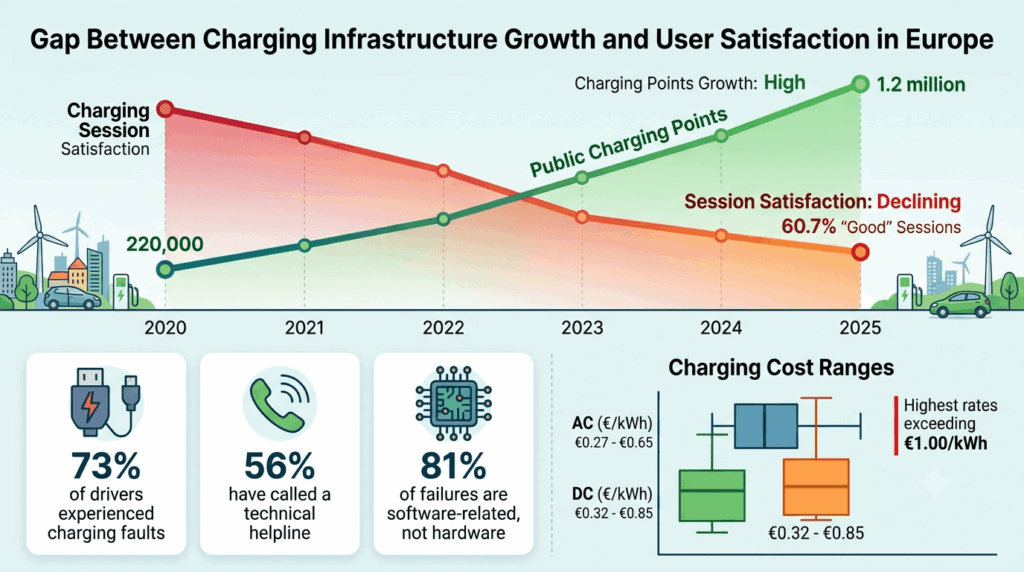
Europe’s public EV charging network has reached a historic milestone. By the end of 2025, the continent had surpassed 1.2 million publicly accessible charging points — a near five-fold increase from just 220,000 in 2020. The European Commission’s target of 1 million chargers by 2025 was exceeded. Charging infrastructure grew by more than 18% in a single year, outpacing most analysts’ expectations.
Yet something is wrong.
Despite this unprecedented expansion, EV driver satisfaction with the public charging experience is not improving — and in some critical areas, it is getting worse. Surveys show that while 88% of European EV drivers remain satisfied with their overall EV experience, the charging experience itself is increasingly a source of frustration. Nearly 40% of public charging sessions have some kind of problem. Seventy-three percent of drivers have experienced faults during charging. And charging costs are rising — Ionity raised prices by an average of 4% in July 2026, while some operators have increased rates by up to 14%, eroding the cost advantage that once made EVs so compelling.
This guide on Europe hits 1.2M charging points – but why is user satisfaction dropping? provides the complete, honest analysis — the infrastructure numbers that look impressive on paper, the satisfaction data that tells a different story, the payment friction and cost increases that are driving the discontent, and what it all means for European EV drivers.
The Infrastructure Milestone — 1.2 Million Chargers and Counting
The Numbers That Look Impressive
The 1.2 million milestone:
According to data aggregated by the European Alternative Fuels Observatory (EAFO), Europe finished 2025 with 1.23 million publicly accessible EV charging points. This represents an increase of roughly 190,000 chargers compared to the previous year. In October 2025, EAFO counted just over 1.1 million public chargers across the EU, the UK, Norway, and other European countries.
Other sources confirm the picture. Digital Charging Solutions reported that across its 31 markets in Europe and Japan, more than 1.2 million charge points are now accessible through its charging services. gridX’s 2026 Charging Report, covering 32 European markets, showed public charging infrastructure expanded to 1.22 million charge points in 2025, a 19.1% increase year-on-year.
The five-year transformation:
The scale of the transformation is remarkable. In 2020, the EU had approximately 220,000 public charging points. By the end of 2025, that number had increased nearly five-fold to 1.1 million in the EU alone.
The composition:
Alternating-current (AC) charging units continue to dominate total numbers, accounting for about 82% of all chargers installed in 2025. However, it is the growth in direct-current (DC) units that is particularly striking — they are increasing at more than double the rate of AC installations, driven by rising demand for rapid charging on long corridors and urban logistics routes. According to the International Council on Clean Transportation (ICCT), DC charging grew at nearly 41% year-on-year.
The market leaders:
The Netherlands remains Europe’s most densely equipped charging market, with 202,833 public charge points and a density of 11 per 1,000 residents. Germany and France follow closely in total installations, while the United Kingdom ranks fourth overall and third for ultra-fast charging deployment, with 12,246 high-power chargers installed.
The BEV-to-charger ratio:
As of December 2025, Europe had approximately 10.16 million battery electric vehicles (BEVs) and 1.23 million public charge points — approximately 8 BEVs per charge point.
The Satisfaction Paradox — More Chargers, Less Satisfaction
Why the Numbers Don’t Tell the Full Story
The overall satisfaction picture:
On the surface, EV driver satisfaction appears high. A large-scale survey conducted by Chargemap among nearly 20,000 drivers in nine European countries found that 88% of users declare themselves satisfied or very satisfied with their EV experience. This figure rises to 95% in Switzerland, 92% in the Netherlands, and 90% in Belgium.
The charging experience gap:
However, when you dig into the specifics of the charging experience, a different picture emerges. The USCALE EV Satisfaction Study 2025 found that 73% of European EV drivers have experienced faults during the charging process — unexpected interruptions or errors when starting a charge.
A real-world tracking study conducted between February and March 2026, in which 72 EV drivers logged 341 public charging sessions across Finland, Germany, and the UK, found that nearly 40% of public charging sessions had some kind of problem. Only 60.7% of sessions were rated “good”.
The paradox explained:
The gap between overall EV satisfaction and charging-specific satisfaction reflects a simple reality: drivers love their EVs but hate the charging experience. As one industry observer put it: “Range anxiety is largely in the past, the user experience at the charger is far from seamless”.
Declining satisfaction with specific metrics:
The USCALE study revealed that while 75% of drivers now support charging at 150 kW or above (up from 61% the previous year), the proportion who consider this power level “good” fell from 71% to 65%. This suggests that as technology improves, driver expectations are rising even faster.
Payment Friction — The New Anxiety
Why “Spayment Anxiety” Is Replacing Range Anxiety
The fragmentation problem:
The public charging experience in Europe is defined by fragmentation. Drivers face a patchwork of apps, QR codes, and cards, depending on which provider they use. Prices vary unpredictably. Behind the scenes, operators face chaos managing outdated billing systems, dozens of payment integrations, and conflicting price logic across multiple platforms.
This has given rise to a new phenomenon: “spayment anxiety” — the stress and uncertainty associated with paying at public charging points.
The real-world experience:
CharIN ambassador Agata Rzędowska described her experience after completing a journey of more than 1,000 kilometres from Berlin to Poland. Along the route, she used chargers operated by different Polish companies. While some were straightforward, others required restarting the charging process because the system forced her to make calculations “that not everyone is ready to do in the middle of a journey”.
At one station, the charging stopped when the car was turned off. “I came back an hour later and realised it hadn’t charged. We tried restarting it through the app, but it didn’t work,” she recalls. At another station, she discovered it was out of order — but had no way of knowing that when she started the process. At yet another, it was not possible to pay directly — she needed to register as a user.
The software problem:
A study by British charge point operator Techtron found that 81% of charging failures are not due to hardware defects but to “user-oriented” problems — authentication, communication between the car and the charger, and especially mobile apps. 75.7% of failed charging sessions come from application-related failures.
In France, 84% of users have encountered at least one charging fault in the past six months (up from 80% in 2022). More than half (56%) of users have had to call a technical helpline in 2024/2025 — up 6 percentage points from 2022.
The “app fatigue”:
Techtron’s white paper points to “app fatigue” — the cognitive overload created by multiplying digital steps. For a driver accustomed to the simplicity of a petrol pump, the obligation to navigate complex menus to initiate a charge generates counterproductive apprehension.
Rising Costs — The Economics of Public Charging
Why Charging Is Getting More Expensive
The Ionity price increase:
On July 1, 2026, Ionity — one of Europe’s largest ultra-rapid charging networks — raised its charging prices by an average of 4% across most of its European network. In Germany, ad-hoc charging now costs up to €0.76 per kilowatt-hour. Subscription kilowatt-hour prices now start at €0.41.
The company cited increased electricity procurement costs on European energy markets as one of the key reasons. Ionity explained that electricity for large charging networks is typically not procured at short notice — operators purchase required volumes over longer periods on wholesale markets. When market prices rise, these costs are eventually passed on to procurement and, consequently, to charging prices after a delay.
The wider trend:
Ionity is not alone. In Ireland, ESB raised its standard pay-as-you-go rates from 64-66 cents per kWh to 72-73 cents per kWh — a rise of between 10% and 14%. In Ireland, Circle K increased its public charge-point prices from 81.5c per kWh to 85c per kWh — a 4% jump — making its charging fees at least as expensive as petrol or diesel at the pump on a per-kilometre basis.
The cost range:
According to a study carried out for the European Parliament’s TRAN Committee, average AC charging prices through mobility service providers range from €0.27/kWh to €0.65/kWh. For DC charging, the range is even wider — from €0.32 to €0.85, with the highest prices exceeding €1.00/kWh in some markets. Even at the same charging station, the difference between the highest and lowest price usually ranges from €0.40 to €1.00 and in extreme cases can reach €1.40/kWh.
The cost of ad-hoc charging:
The ADAC has highlighted that ad-hoc charging is often non-transparent, not user-friendly, and up to 62% more expensive without a contract. Spontaneous charging can cost up to 87 cents per kWh. The ADAC also identifies the so-called pre-authorisation fee of up to €150 as another source of frustration.
The comparison with home charging:
Public charging is still significantly more expensive than charging at home or at work. This undermines the cost reasoning behind buying an EV, especially for citizens for whom home charging is not an option.
The Price Transparency Problem
Why Drivers Don’t Know What They’re Paying
The information gap:
Price information is often not displayed before charging starts. The price calculation method is difficult for consumers to understand. The final price depends to a large degree on whether the user pays ad hoc via a charge point operator or a mobility service provider (roaming), sometimes including hidden charges.
The same session, different prices:
The same charging session often leads to different final costs depending on the provider, app, card or payment method used by the consumer. In the Netherlands, only 50% of invoices matched the prices that were publicly available in advance.
The AFIR gap:
Although Article 5 of the AFIR (Alternative Fuels Infrastructure Regulation) stipulates that public charging prices must be reasonable, easily and clearly comparable, transparent and non-discriminatory, its implementation and enforcement remain incomplete, fragmented and uneven. European Parliament members have called for the Commission to propose minimum EU requirements to improve price transparency, including the mandatory display of the total charging price before charging begins.
The dynamic pricing challenge:
Dynamic pricing means costs can vary significantly throughout the day. For drivers who do not have the time or inclination to monitor prices in real-time, this creates unpredictability that undermines confidence in the charging experience.
What This Means for Today’s EV Drivers
The Practical Implications
The infrastructure is there — but the experience isn’t:
Europe has built the chargers. But it has not yet built a charging experience that matches the simplicity and reliability of filling a petrol tank. The hardware is expanding; the software and payment systems are lagging.
The cost advantage is eroding:
For drivers who rely on public charging, the cost advantage of EVs over petrol and diesel is shrinking — and in some cases disappearing entirely. When public charging costs exceed €0.80/kWh, the per-kilometre cost can match or exceed that of a fuel-efficient petrol car.
The subscription trap:
The wide gap between ad-hoc and subscription pricing (up to 62% higher for ad-hoc) means that drivers who do not sign up for subscriptions are effectively penalised. This creates a barrier for occasional users and tourists who do not want to commit to monthly fees.
The cross-border challenge:
For drivers travelling across borders, the fragmentation is even worse. Different networks, different apps, different payment systems, different pricing structures. The promise of seamless cross-border charging remains unfulfilled.
Internal Links — Further Reading on Clean Energy Bazaar
The Europe hits 1.2M charging points – but why is user satisfaction dropping? guide connects to the EV infrastructure and policy guides on cleanenergybazaar.com.
For the NEVI’s new rules guide covering the US approach to charging reliability, our NEVI’s new rules: 97% uptime + 150kW – the US raises the bar for public chargers guide covers the federal standards for reliability. For the IEA Global EV Outlook 2026 summary covering the global EV transition, our IEA Global EV Outlook 2026: 2025 sales hit 20M, capturing 25% of global car sales guide covers the flagship report in full. For the Europe’s EV sales surge guide covering the European market comeback, our Europe’s EV sales surge 30% – how Germany, Spain, and Italy are leading the comeback guide covers the country-level performance. For the upcoming EV charger trends guide covering the broader charging technology landscape, our upcoming EV charger trends 2026-2027 V2G solid-state batteries guide covers the global charging innovation landscape.
Final Thoughts
Europe hits 1.2M charging points – but why is user satisfaction dropping? — and the honest answer is that Europe has focused on quantity over quality.
The infrastructure numbers are impressive. 1.2 million public charging points. A near five-fold increase since 2020. DC charging growing at 41% year-on-year. The targets have been met and exceeded.
But the experience has not kept pace. Nearly 40% of public charging sessions have problems. Seventy-three percent of drivers have experienced faults. Payment is fragmented, confusing, and often unpredictable. Prices are rising — Ionity up 4%, ESB up to 14%, some rates exceeding €1.00/kWh. Public charging is often 62% more expensive without a contract. The cost advantage of EVs is eroding.
The policy framework exists — AFIR requires transparent, reasonable, non-discriminatory pricing. But implementation is incomplete, fragmented and uneven. Drivers still cannot reliably know what they will pay before they plug in.
The honest verdict: Europe has built the chargers. Now it must build the experience. That means standardising payment, enforcing price transparency, ensuring reliability, and preventing public charging costs from spiralling beyond the reach of ordinary drivers. The hardware is there. The software and the economics are not.