The question this guide addresses is one that Chinese EV owners who have followed this guide series have every reason to ask, given the emphasis throughout on brand survival risk, zombie pile concerns, and the great shakeout in China’s EV charging market. When the brand in question is Autel — a company that has featured positively throughout this guide series as a strong specification choice, particularly for IP65 weather protection and cold-weather reliability — and when the context is the significant and evolving US-China trade tensions that have characterised 2024-2026, the question deserves a careful, honest, and specifically-researched answer.
This guide on is Autel safe to buy the fate of US brands operating in China amidst trade tensions provides exactly that — a thorough, honest risk assessment that applies the same analytical framework developed in our zombie pile crisis guide to Autel specifically, examines Autel’s actual corporate structure and operational reality, assesses the specific ways trade tensions between the US and China can and cannot affect EV charger purchasing decisions for Chinese consumers, and provides the clear, honest guidance that readers need to make well-informed purchasing decisions.
First, the Essential Clarification — What Autel Actually Is
The Corporate Reality That Changes the Risk Assessment
The critical factual foundation that this guide must establish before any risk analysis:
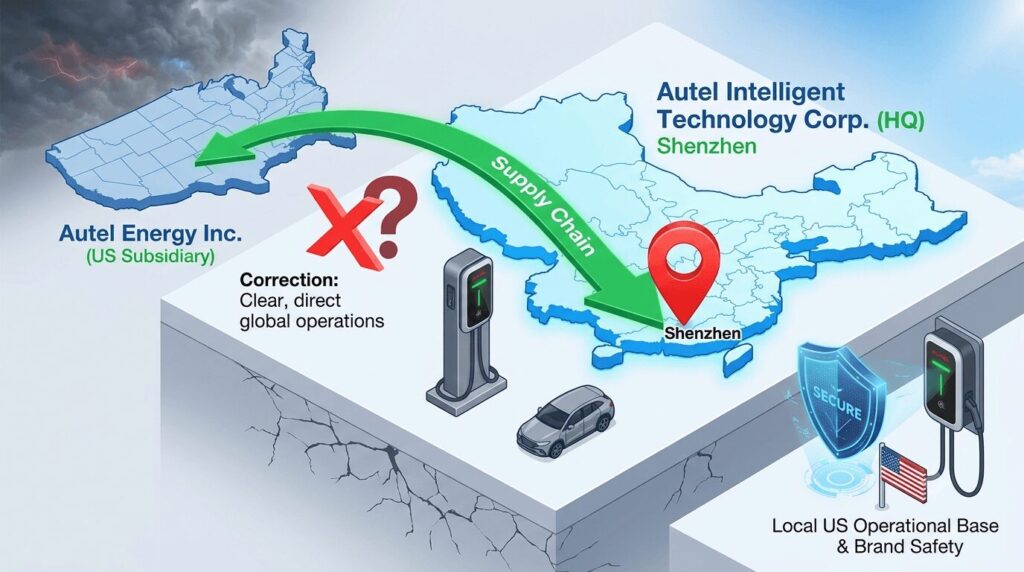
Autel is not a US company operating in China. Autel is a Chinese company — specifically, Autel Intelligent Technology Corp. Ltd. (道通智能), headquartered in Shenzhen, China, founded in 2004, with its primary operations, manufacturing, and R&D conducted in China.
The source of the “US brand” confusion:
Autel has established significant business presence in the United States through Autel Energy Inc. and related entities — selling automotive diagnostic equipment and EV chargers in the North American market with considerable commercial success. This US market presence, combined with English-language marketing, US-registered business entities, and Autel’s prominent position in US EV charging market coverage, has created a perception among some Chinese consumers that Autel is an American company.
The operational reality:
Autel’s global corporate structure has its origin and operational centre in Shenzhen, China. The US entities are market presence subsidiaries, not the parent company. Autel’s manufacturing, primary engineering, and corporate governance operate from China. Autel is listed on the Hong Kong Stock Exchange (Stock Code: 6718.HK) under the name Autel Intelligent Technology Corp., Ltd. — a Chinese company subject to Hong Kong securities regulation with its primary operational listing demonstrating its corporate domicile.
Why this corporate reality matters enormously for risk assessment:
The US-China trade tension risks that might affect a genuinely US-headquartered company operating in China — potential for US government restrictions on technology transfers to China, potential for Chinese government restrictions on US company operations in China, potential supply chain disruption from tariffs on US-origin goods — are either inverted or substantially modified when the company is actually Chinese-headquartered with US market presence.
The relevant risk for a Chinese-headquartered company with US market operations is essentially the inverse of what the question implies: potential US restrictions on Autel’s ability to operate in the US market, not potential restrictions on Autel’s ability to operate in China.
The Five-Factor Framework Applied to Autel
Applying Our Zombie Pile Crisis Guide’s Due Diligence Framework
As established in our zombie pile crisis guide, the five-factor framework for assessing brand survival probability:
Factor 1: Business Diversification
Assessment: High diversification — Strong positive indicator
Autel’s automotive diagnostic equipment business — the OBD scanners, professional-grade diagnostic tools, and TPMS systems that preceded their EV charger division — has been the company’s primary and longstanding revenue source since 2004. This diversified product portfolio means EV charger business performance, whether positive or negative, does not determine Autel’s overall corporate survival.
The automotive diagnostic equipment market is globally distributed and significantly less exposed to specific US-China trade tensions than semiconductor or advanced technology sectors. Autel’s diagnostic tools are used by professional automotive mechanics worldwide — a customer base and revenue stream that provides substantial insulation against any specific EV charger market challenges.
EV charger business as proportion of total revenue: Based on available Hong Kong Stock Exchange reporting and industry analysis, Autel’s EV charger division (Autel Energy) represents a meaningful but not dominant proportion of total group revenue — the automotive diagnostic business remains the larger contributor by most available measures. This diversification profile is precisely what the zombie pile crisis guide identified as the strongest indicator of brand survival durability.
Factor 2: Years in Operation and Market Position
Assessment: 20+ years in operation, established EV charger market position — Strong positive indicator
Autel (道通智能) was founded in 2004 — giving it over 20 years of operational history in automotive electronics, with the EV charger division established from a position of genuine industrial electronics manufacturing experience rather than as a pure-play startup.
In China’s domestic EV charger market, Autel’s MaxiCharger products have achieved meaningful market presence across residential, commercial, and fleet segments. In the North American EV charger market, Autel Energy has established a particularly strong commercial presence — one of the most visible third-party EV charger brands in North America alongside established players.
Factor 3: Financial Transparency and Backing
Assessment: Hong Kong Stock Exchange listed — High transparency, strong positive indicator
Autel Intelligent Technology Corp. is listed on the Hong Kong Stock Exchange (HKEX), subject to HKEX’s disclosure requirements including regular financial reporting, audit requirements, and continuous disclosure obligations. This listing status provides substantially more financial transparency than private companies whose financial health must be inferred from indirect signals.
HKEX financial disclosures allow investors, analysts, and consumers to assess Autel’s financial position through formally audited accounts — a level of transparency that private EV charger competitors cannot provide. While this guide does not provide specific financial analysis of Autel’s accounts (which would require investment analysis expertise and could become outdated), the existence of accessible audited financial statements means the “zombie pile” early warning signals covered in our crisis guide are assessable through formal disclosure rather than requiring the indirect monitoring approach needed for private companies.
The listing’s practical implication: HKEX-listed status significantly reduces the probability of the sudden, opaque operational wind-down pattern that characterises the zombie pile crisis scenario. Public company insolvency and wind-down involves formal processes, disclosure requirements, and creditor protections that provide warning well before the kind of silent operational cessation that has affected smaller private Chinese charger companies.
Factor 4: Software Architecture (Cloud-Optional vs Cloud-Dependent)
Assessment: Cloud-optional architecture confirmed — Strong positive indicator for worst-case protection
Autel’s MaxiCharger product line supports local operation — basic charging function initiable through the physical unit without requiring active internet connectivity. This is confirmed through:
Owner forum reports documenting continued basic charging function during WiFi outages
Autel’s own documentation indicating local control capability
The OCPP 1.6 compliance (and OCPP 2.0 in newer models) that enables third-party platform management independent of Autel’s own cloud — meaning even if Autel’s cloud services were disrupted, OCPP-enabled chargers could continue operating through alternative OCPP backend platforms
The cloud-optional architecture means that the worst-case zombie pile scenario — where cloud dependency renders a charger non-functional after company failure — specifically does not apply to Autel’s MaxiCharger. Basic charging would continue through local control even in that scenario, with loss limited to smart features that depend on Autel’s own cloud services.
Factor 5: Recent Operational Signals
Assessment: Active, expanding — Strong positive indicator
As of mid-2026, Autel demonstrates the operational vitality indicators that the zombie pile crisis guide identifies as positive signals:
Active product development: New MaxiCharger variants and commercial charging products continuing to be released, including ChaoJi-compatible and NACS variants for respective market segments — indicating ongoing R&D investment rather than maintenance-only operation.
App store activity: The Autel Charge app receives regular updates across iOS and Android platforms — a simple, verifiable indicator of ongoing software investment that distinguishes active companies from those entering decline.
Customer service responsiveness: Recent owner reviews (checking dates specifically, consistent with the zombie pile guide’s recommendation) do not show the pattern of declining responsiveness that precedes operational wind-down.
Expanding commercial partnerships: Autel’s commercial partnerships in multiple markets indicate ongoing business development activity inconsistent with a company approaching operational cessation.
The five-factor overall assessment:
Applying the zombie pile crisis guide’s framework, Autel scores positively on all five survival indicators — placing it clearly in the Tier 1-2 range of the brand survival assessment, consistent with this guide series’ consistent recommendation of Autel as a strong specification choice.
The Trade Tensions Analysis — What US-China Trade Friction Actually Means for Autel
Separating Real Risks From Misattributed Concerns
The nature of current US-China trade tensions in the EV sector:
US-China trade tensions in the EV and clean energy sector have been significant and escalating in 2024-2026, primarily manifesting through:
US tariffs on Chinese EV imports: The Biden administration’s escalation and Trump administration’s further escalation of tariffs on Chinese electric vehicles, reaching 100%+ on many categories in the US market. These tariffs affect Chinese EV manufacturers’ ability to export vehicles to the US — not their ability to manufacture and sell EV charging equipment in China.
US restrictions on specific Chinese technology companies: Export control measures and Entity List designations affecting specific Chinese semiconductor, telecommunications, and advanced technology companies — primarily targeting companies involved in areas deemed national security-relevant by the US government.
Chinese retaliatory measures: China has implemented various trade measures in response, primarily affecting agricultural products, specific US consumer goods, and some technology categories.
How these tensions do and don’t affect Autel:
What genuinely could affect Autel:
Autel’s North American operations — selling EV chargers in the US market — are subject to US trade policy developments. If the US were to impose tariffs on Chinese-manufactured EV charging equipment (which has been discussed in the context of broader EV supply chain policy), Autel’s US market competitiveness and US market revenue could be affected.
This would be a challenge for Autel’s US business, not its Chinese business. Autel manufacturing products in Shenzhen for sale in China to Chinese customers is entirely within China’s domestic regulatory environment and unaffected by US trade policy toward Chinese goods.
What does not affect Autel’s Chinese operations:
US tariffs on Chinese goods do not restrict Chinese companies from selling products in China. Chinese consumers’ ability to purchase an Autel MaxiCharger for their home in Shenzhen is not affected by US tariffs on Chinese EV goods exported to the United States.
US Entity List designations affect specific companies’ ability to receive US-origin technology — a consideration primarily relevant to companies dependent on US semiconductor components, US software, or US technical services. Autel’s EV charger products use components and technologies primarily from Asian supply chains; any US-origin component dependency would need to be specifically assessed rather than assumed.
Chinese government restrictions on foreign companies’ operations in China — the type of trade friction that could directly affect a US-headquartered company with Chinese operations — are not applicable in the same way to a Chinese-headquartered company like Autel, whose operations in China are conducted as a domestic Chinese company subject to standard Chinese business regulation.
The specific risk that is real but limited:
If US-China trade tensions escalate to the point where US technology export controls specifically target automotive electronics companies including diagnostic equipment manufacturers, Autel’s access to any US-origin components or software could be restricted. This is a theoretically possible but currently non-materialised risk that would require specific monitoring of technology export control designations, not a current operational threat.
The Honest Risk Comparison — Autel vs Genuinely Higher-Risk Chinese Charger Brands
Calibrating Autel’s Risk Against the Broader Market
The context that gives the risk assessment meaning:
The zombie pile crisis guide established that the primary survival risk in China’s EV charger market is concentrated among pure-play residential charger startups that entered 2019-2023 without industrial electronics heritage, without diversified revenue, without public financial transparency, and without the scale to survive the price compression and 3C certification cost pressure that the great shakeout guide documented.
Autel compared to the risk spectrum:
At the lower-risk end of the spectrum: Huawei Digital Power, Xiaomi (massive diversified parent companies with EV chargers as one product line among many) and established international industrial brands (ABB, Schneider, Siemens) with decades of China market presence.
Autel occupies a position in this spectrum that is meaningfully closer to the lower-risk end than to the higher-risk end — specifically because of the diversified automotive diagnostics business, the HKEX listing transparency, the 20+ year operational history, and the cloud-optional architecture. The trade tensions question, properly understood as relating to a Chinese company’s US market exposure rather than to a US company’s China operations, does not materially change this assessment.
The specific brands that warrant more concern than Autel:
As covered in our great shakeout guide, the brands warranting genuinely elevated zombie pile concern are the Category 1 and Category 2 companies — pure-play residential charger startups without the diversification, transparency, or heritage that Autel demonstrates. Concerns about Autel’s survival risk that are not directed at these genuinely higher-risk brands reflect a miscalibration of the risk landscape.
The Specific Scenarios That Chinese Buyers Should Actually Monitor
Genuine Monitoring Criteria Going Forward
For buyers who have already purchased Autel equipment:
Monitor the standard zombie pile crisis guide indicators — app update frequency, customer service responsiveness, new product releases — applied through Autel’s HKEX disclosure channel as an additional transparency resource not available for private competitors. If HKEX disclosures show material deterioration in Autel’s financial position, this provides earlier warning than indirect monitoring alone.
For buyers currently evaluating Autel:
Conduct the purchase-time due diligence recommended in our zombie pile crisis guide — verify current operational signals, confirm the specific MaxiCharger model’s cloud-optional architecture and OCPP compliance, and confirm current 3C certification status through the CQC database verification covered in our fake certification detection guide. These due diligence steps are appropriate for any charger purchase regardless of brand, and Autel’s positive indicators on each confirm the assessment rather than raising new concerns.
For buyers specifically concerned about trade tension escalation:
The specific monitoring item that is genuinely relevant: US government Entity List or export control designations affecting automotive electronics or EV charging companies. This information is publicly available through the US Bureau of Industry and Security (BIS) Entity List, which is updated regularly and searchable online. If Autel or any entity in its corporate group were to appear on the Entity List, this would signal potential supply chain impacts warranting reassessment. As of mid-2026, no such designation exists for Autel.
The Broader Question — When Should Trade Tensions Affect Chinese EV Charger Buying Decisions?
The Framework for Assessing Trade Tension Risk Across Different International Charger Brands
For genuine US-headquartered companies with China operations:
Companies that are actually headquartered and primarily owned in the United States but operating in China’s EV charger market face a different risk profile from Chinese companies with US market presence. Genuine US companies in China face:
- Potential Chinese government restrictions on foreign company operations (if retaliatory measures are introduced)
- Potential US government restrictions on technology transfer to Chinese subsidiaries
- Potential supply chain disruption if components or software from US parent to Chinese operations are restricted
In this guide series’ product coverage:
ABB (Swiss-headquartered), Schneider Electric (French-headquartered), and Siemens (German-headquartered) are the international industrial brands covered most extensively. None are US-headquartered, meaning their risk profile from US-China trade tensions is indirect rather than direct — they face exposure primarily through any US-origin component dependencies in their China-market products.
The genuinely US-headquartered EV charger brands with China market presence are fewer — and for those that exist, the trade tension risk assessment does warrant more attention than for Chinese-origin companies. However, the major international industrial brands covered in our luxury EV charging guide (ABB, Schneider, Siemens) are European, not US-headquartered, and their China market operations are conducted through long-established Chinese subsidiaries with deep local operational roots that are substantially insulated from US-China trade friction specifically.
The general principle:
Trade tension risk in EV charger purchasing decisions is most relevant when:
- The company is genuinely headquartered in a country with active trade friction with China
- The product line has significant US-origin component dependency
- The company’s China operations are structured in ways that make them specifically vulnerable to trade restriction
For the brands covered throughout this guide series, none of these conditions create acute trade tension risk for the Chinese residential EV charger market — including Autel, which as established above, is a Chinese company.
The Practical Guidance — What Chinese Buyers Should Actually Do About Autel
The Specific, Actionable Recommendation
Should Chinese EV owners buy Autel MaxiCharger products?
Based on the complete analysis in this guide:
The zombie pile crisis guide’s five-factor framework applies to Autel positively across all five factors — business diversification, years in operation, financial transparency, software architecture, and recent operational signals all point to a company with meaningfully better survival probability than the category of brands that genuinely warrant zombie pile concern.
The trade tensions concern that prompted this guide’s title question reflects a misattribution of company origin — Autel is a Chinese company whose operations in China are domestic operations, not a US company whose China operations are exposed to trade friction in the way the question implies.
The specific technical characteristics that led to Autel MaxiCharger’s recommendation throughout this guide series — IP65 weather protection, -30°C cold weather rating, OCPP compliance, strong connector specification — remain valid and independently supported regardless of the trade tensions context.
The recommendation:
Autel MaxiCharger remains a genuinely strong choice for Chinese residential EV charging applications, particularly for:
- Outdoor or semi-outdoor installations requiring IP65 protection
- Northern China installations requiring -30°C cold weather rating
- Owners prioritising OCPP compliance for demand response participation
- Owners in Shenzhen, Shanghai, Beijing, and other active demand response cities
The trade tensions question, properly investigated, does not change this recommendation. The zombie pile framework, properly applied, confirms it.
The one caveat worth maintaining:
All charger brand assessments should be re-verified at the time of purchase using the current operational signals covered in our zombie pile guide — not because Autel’s current assessment is uncertain, but because all brand assessments are point-in-time assessments that should be refreshed against current information before any significant hardware purchase. The five-factor framework is a tool to apply, not a permanent certification.
Internal Links — Further Reading on Clean Energy Bazaar
The is Autel safe to buy the fate of US brands operating in China amidst trade tensions guide is the brand-specific risk clarification companion to the broader brand survival and product guidance throughout this content cluster.
For the zombie pile crisis guide that established the five-factor framework applied throughout this Autel-specific assessment, our zombie pile crisis 2026 how to avoid dead chargers from liquidated Chinese brands guide covers the complete brand survival framework. For the great shakeout guide that contextualises Autel’s position within China’s broader EV charger market consolidation, our great shakeout why 80 percent of Chinese EV charger manufacturers face elimination in 2026 guide covers the complete industry analysis. For the warranty comparison guide that covers Autel’s warranty terms and service coverage within the international brand comparison, our EV charger warranty comparison 2026 best coverage from local brands vs US importers guide covers every warranty structure. For the best home EV charger comparison guide where Autel MaxiCharger specifications are evaluated alongside competitors, our best home EV chargers 2026 top 7 comparison for Chinese homeowners guide covers every major product. For the weatherproof charger guide that covers the IP65 and cold-weather specifications that make Autel particularly appropriate for specific Chinese climate installations, our weatherproof EV chargers 2026 IP ratings for humid southern China vs dusty northern China guide covers every climate specification. And for the 3C certification verification guide covering how to confirm any charger’s certification status regardless of brand, our spotting fake 3C logos how Chinese buyers can verify certification on Taobao JD chargers guide covers the complete verification process.
Final Thoughts
The is Autel safe to buy the fate of US brands operating in China amidst trade tensions question has a specific, honest, and ultimately reassuring answer for Chinese EV owners who have been considering Autel MaxiCharger products:
Autel is a Chinese company — Shenzhen-headquartered, Hong Kong Stock Exchange-listed, with 20+ years of automotive electronics manufacturing heritage and a diversified business spanning automotive diagnostics and EV charging. The “US brand” framing that the question implies reflects Autel’s significant and successful US market presence through Autel Energy, not its corporate origin or operational centre.
The trade tensions that have characterised US-China commercial relations in 2024-2026 create genuine exposure for Autel’s US market operations — a real business risk that Autel’s management must navigate — but they do not create meaningful exposure for Autel’s ability to manufacture, sell, service, and support EV charging products in China’s domestic market. A Chinese company selling to Chinese customers through Chinese operations is conducting domestic commerce that US trade policy does not restrict.
The zombie pile crisis guide’s five-factor framework, applied honestly to Autel, produces a positive assessment across every factor: business diversification through the automotive diagnostics heritage, 20+ years of operational history, HKEX-listed financial transparency, cloud-optional OCPP architecture, and active current operational signals. Autel occupies the moderate risk tier in the zombie pile framework — meaningfully safer than the pure-play residential startup category that has experienced the most dramatic failures, though not quite at the very lowest risk tier occupied by Huawei and Xiaomi with their vastly larger diversified parent company resources.
For Chinese EV owners who chose Autel based on this guide series’ consistent recommendation for its IP65 protection, cold weather specification, and OCPP compliance: that recommendation remains sound, and the trade tensions question, properly investigated, does not change it.
Buy with appropriate due diligence at time of purchase. Monitor through the standard zombie pile indicators. Trust the five-factor framework that was designed specifically to distinguish companies with Autel’s profile from the brands that genuinely warrant zombie pile concern.