When Chinese EV owners navigate the home charger installation process covered throughout this content cluster, the single most consistently confusing cost component is the connection rate — the fee charged to connect their new dedicated EV charging circuit to the electricity supply infrastructure. This confusion is compounded by the fact that, unlike the private electrician’s labour and materials costs that can be competitively quoted and compared, the connection to electricity supply infrastructure involves a specific party — either the State Grid Corporation of China (SGCC, 国家电网) or Southern Power Grid (南方电网) depending on geographic location, or increasingly, private charging network operators offering alternative connection arrangements — whose pricing, processes, and service levels are not always transparent to first-time applicants.
This guide on State Grid SGCC vs private networks who offers the best home connection rate covers the complete comparison — what SGCC and Southern Grid’s connection rates actually are and how they are determined, what private network operators offer as alternatives and under what circumstances, the specific scenarios where each option is genuinely superior, and the practical process for securing the most cost-effective connection for your specific installation situation.
Understanding What “Home Connection Rate” Actually Means
The Two Distinct Cost Components Within “Connection”
The confusion that drives most misunderstanding of this topic:
When Chinese EV owners and installation guides refer to “connection costs,” they are sometimes conflating two distinct cost components that involve different parties, different processes, and different pricing mechanisms:
Component 1: The utility connection fee (接入费 / 增容费)
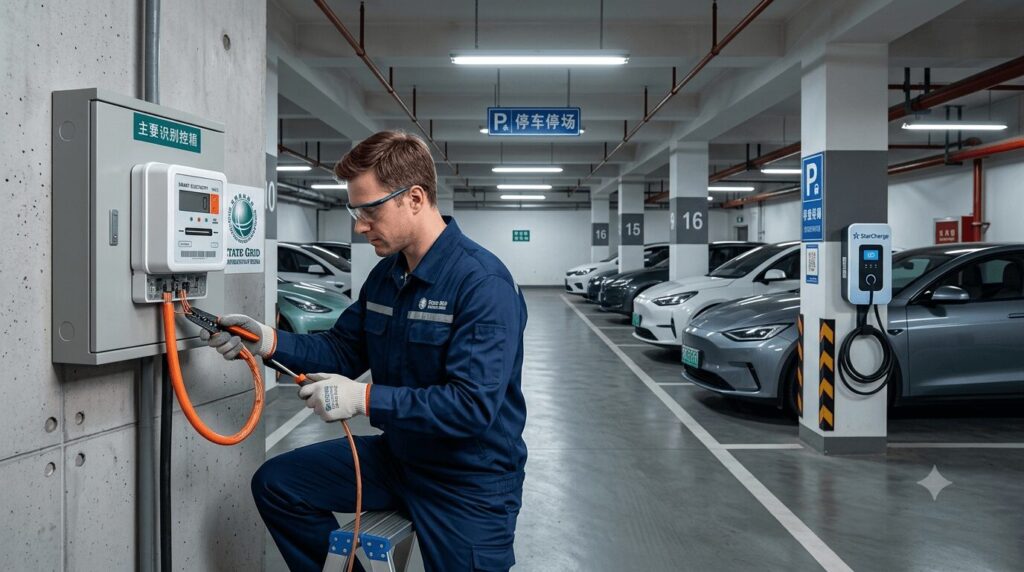
This is the fee charged by the electricity utility (SGCC or Southern Grid) specifically for the work of:
- Assessing the existing electrical supply infrastructure at your property and parking location
- Running supply cable from the existing distribution infrastructure to the new dedicated EV charging meter location
- Installing the dedicated electricity meter itself
- Connecting the new meter to the distribution board
- Issuing the connection certificate that makes the circuit live
This component involves the utility company exclusively — private electricians cannot perform utility-side connection work, regardless of their technical capability.
Component 2: The internal installation fee (内部布线安装费)
This is the fee charged by a licensed private electrician for:
- Running cable from the dedicated meter to the charger mounting point
- Installing protection devices (RCCB, circuit breakers)
- Mounting and wiring the charger unit
- Commissioning and testing
This component does not involve the utility and is competitively quotable from multiple licensed electricians — the professional installation costs guide covers this component extensively.
Why this distinction matters for the “connection rate” comparison:
The “best connection rate” comparison meaningfully applies only to Component 1 — the utility connection fee. Component 2 is always a private market transaction regardless of which utility serves your area. Conflating the two prevents accurate comparison and often leads to conclusions based on comparing unlike costs.
What SGCC and Southern Grid’s Connection Fee Actually Covers
The standardised but variable fee structure:
Both SGCC and Southern Grid operate under nationally-standardised pricing frameworks for residential electricity connection work, set by the National Development and Reform Commission and enforced through provincial-level regulatory oversight. However, within this standardised framework, specific charges vary based on:
Infrastructure distance: The primary driver of connection cost variation is the distance between the existing distribution infrastructure and the new meter location — a critical variable in underground car park installations where the distribution board may be 15-50 metres from the parking space.
Infrastructure availability: Whether connection requires only a new branch from existing distribution infrastructure (lower cost) versus requiring new supply cable from a higher-level point in the distribution network (higher cost) — a determination made by the SGCC/Southern Grid assessment engineer.
Meter specification: The specific meter type required for the installation, with smart meters (increasingly standard) having different cost structures from older meter types.
Provincial tariff schedules: While nationally standardised in framework, the specific labour rates and material costs that determine the connection fee vary by province within SGCC’s service territory (and between SGCC and Southern Grid’s respective territories).
State Grid (SGCC) Connection Rate Analysis
SGCC’s Service Territory and Structural Position
Geographic scope:
SGCC serves 26 provinces, autonomous regions, and municipalities across China — the northern, central, eastern, and western portions of mainland China. This includes Beijing, Shanghai (jointly with some municipal authority involvement), the northeastern provinces, and most of central and western China.
The five southern provinces (Guangdong, Guangxi, Yunnan, Guizhou, Hainan) are served by Southern Grid (南方电网) — a separate state-owned enterprise with different specific rate structures but the same general regulatory framework.
SGCC’s structural pricing position:
As a state-owned enterprise with monopoly provision status in its service territory, SGCC does not compete on connection pricing — it charges regulated rates that are the same regardless of whether any private alternative exists. The “competition” with private networks covered later in this guide doesn’t apply to connection fees in the traditional sense, because SGCC’s rates are regulatory-determined rather than market-determined.
SGCC’s Specific Connection Fee Components
Fee 1: The meter installation service fee
For residential EV charging meter installation in apartments and residential compounds, SGCC’s nationally-standardised service charges cover the meter unit hardware, its installation, and the basic distribution board connection:
Standard smart meter installation in existing distribution board: ¥0-¥300 (varies by province and specific installation complexity)
This component is often the lowest or zero-cost element in straightforward installations where the distribution board already has capacity for an additional circuit — the meter hardware cost is typically absorbed within SGCC’s regulated infrastructure funding rather than charged directly to the applicant.
Fee 2: Supply cable and conduit installation
This is the primary variable cost in SGCC’s connection work — and the component that creates the widest variation in total connection costs:
Short runs (under 5 metres, meter close to parking space or existing infrastructure nearby):
Cable and conduit material: ¥50-¥200
Installation labour: ¥100-¥300
Typical total: ¥150-¥500
Standard runs (5-20 metres, typical underground car park scenario):
Cable material (6mm² copper, 10-20m): ¥150-¥600
Conduit material: ¥50-¥200
Installation labour: ¥300-¥800
Typical total: ¥500-¥1,600
Long runs (20-50 metres, longer underground car park distances):
Cable material (6mm² copper, 20-50m): ¥300-¥1,500
Conduit and trunking: ¥100-¥500
Installation labour: ¥600-¥1,500
Typical total: ¥1,000-¥3,500
Infrastructure upgrade scenarios (new supply cable from higher distribution point):
These are the highest-cost scenarios, occurring when the local distribution board has insufficient capacity for additional EV charging circuits and new supply infrastructure must be run from a higher level in the distribution network:
Cable material and installation: ¥1,500-¥5,000+
Potential distribution board upgrade: ¥500-¥3,000+
Typical total: ¥2,000-¥8,000+ for infrastructure-limited scenarios
SGCC’s Free Services — What They Don’t Charge For
The specific SGCC services that are provided without additional fee:
SGCC’s site assessment visit (the engineer who comes to evaluate your installation requirements) is provided free — no assessment fee should be charged and any request for payment for the assessment itself should be queried.
The meter itself, as a piece of State Grid infrastructure that remains State Grid property even when installed at your dedicated circuit, is provided by SGCC as infrastructure asset rather than being charged to the applicant in most provincial implementations.
Basic meter programming and TOU tariff enrollment are provided without additional service fees in most provincial SGCC implementations.
The practical implication of these free services:
For straightforward installations (short cable runs, existing distribution board capacity), SGCC’s total connection fee can genuinely be very low or near-zero — limited primarily to the cable and installation labour for the supply run between the existing infrastructure and the meter location. Owners who receive SGCC quotations significantly higher than the ranges above should specifically query which cost components are generating the higher figure.
SGCC’s Process — The Timeline Reality
The connection process timeline as covered in our professional installation costs guide:
Application submission: Immediate upon having 物业 approval in hand
Site assessment visit: 5-15 working days after application
Quotation receipt: 3-5 working days after assessment
Work completion (standard installations): 15-30 working days after quotation acceptance
Exceptional cases (infrastructure upgrades required): 30-90 working days
The process variability that creates the widest owner experience differences:
SGCC’s timeline performance varies significantly by provincial grid company, by local service centre workload, and by the complexity of the specific installation. During peak periods (following major EV subsidy announcements that drive application surges, or during Chunyun when service centre resources are stretched), timelines can extend significantly beyond these typical ranges.
The specific strategies for accelerating SGCC processing — parallel application submission with 物业 approval process, pre-arranged electrician availability, correct initial documentation — are covered in the professional installation costs guide and remain the primary owner-controllable variables within the SGCC process.
Southern Grid (南方电网) Connection Rate Analysis
Southern Grid’s Differences From SGCC
The regulatory framework is the same, but specific implementations differ:
Southern Grid operates under the same national regulatory framework as SGCC, meaning its connection fee structures are similarly standardised in principle. However, several specific differences in Southern Grid’s provincial implementation are relevant:
Shenzhen’s electricity market reform advantage:
As covered extensively in our local rebates guide’s coverage of Shenzhen’s electricity market reform context, Shenzhen operates the most advanced electricity market reform environment in China — and this affects both the rate structures available to EV charging customers and the general service quality environment of Southern Grid’s Shenzhen operations.
Southern Grid’s Shenzhen operations have in some documented cases shown more proactive EV charging connection support than typical SGCC urban operations, partly reflecting Shenzhen’s status as a priority EV city and partly reflecting the broader service environment improvements that electricity market reform has driven in that specific market.
Guangdong provincial specifics:
Southern Grid’s Guangdong operations cover the largest EV market in Southern Grid’s territory, and the high EV adoption rate in Guangdong has driven both service process improvements (more efficient application handling due to high volume and process refinement) and infrastructure investment that has reduced the infrastructure limitation scenarios that drive the highest connection costs in other markets.
The basic rate comparison:
Southern Grid’s standardised connection rates are broadly comparable to SGCC’s ranges described above — both operate within the same national regulatory framework with similar provincial-level variation factors. Neither utility consistently offers materially lower rates than the other across the board; the differences lie in specific provincial implementations, process efficiency, and service quality rather than in structurally different rate levels.
Private Network Operators — What They Actually Offer
Understanding Private Network Operator Business Models
The context for private network “connection rates”:
When private EV charging network operators (TELD, StarCharge, CATL Ningle’s network arm, and others) are described as offering “connection rates” in competition with SGCC/Southern Grid, this requires careful definition because private operators cannot offer utility-side connection services — they cannot run supply cable from distribution infrastructure or install electricity meters. That remains exclusively a utility function.
What private operators can offer are fundamentally different value propositions that some EV charging guides conflate with “connection rates”:
Value proposition 1: Integrated installation packages
Private charging network operators often offer all-inclusive installation packages that combine:
- Equipment supply (their branded charger)
- Private electrician coordination (the internal installation work from meter to charger)
- Application assistance (helping navigate the SGCC/Southern Grid application process, not replacing it)
- Ongoing management platform access
The “rate” in these packages represents the total all-in cost for a complete installation, not an alternative to the utility connection fee — the utility fee is either embedded within the package or quoted separately as a passthrough.
Value proposition 2: Collective charging infrastructure
For residential compounds where individual dedicated circuits are being replaced or supplemented by collective charging infrastructure, private operators can offer a fundamentally different business model: they install, own, and operate the collective charging infrastructure themselves, charging users on a per-session or per-kWh basis rather than creating individual owner-owned dedicated circuits.
In this model, the “connection rate” for individual residents is zero — they pay per-session or per-kWh rather than upfront — because the operator is bearing the capital cost themselves, recovering it through ongoing charging fees.
Value proposition 3: Operator-subsidised installation
Some private operators — particularly those seeking to build network density in specific areas — offer subsidised or zero-cost installation for their branded equipment within certain programs, effectively cross-subsidising the installation cost from ongoing software platform fees, charging session revenue sharing, or broader strategic network development objectives.
When Private Operator Models Genuinely Offer Better Value
Scenario 1: No designated parking space
As covered extensively in our no-fixed-parking guide and urban parking guide, residents without designated parking cannot obtain individual SGCC dedicated circuit installations. In this scenario, private operators’ collective infrastructure model — installing shared charging points in common areas under their own operator agreement with 物业 — provides charging access that SGCC’s individual dedicated circuit model cannot.
Scenario 2: Buildings with insufficient individual circuit capacity
In older buildings covered in our load balancing guide where individual dedicated circuits are impractical due to distribution board capacity constraints, private operators’ collective infrastructure model (which handles its own electrical supply assessment and capacity provisioning independently of individual resident circuits) can be the only viable path to reliable charging access.
Scenario 3: Operator subsidy programmes in specific geographies
In areas where major charging operators are actively building network density — including some rural pilot county areas covered in our rural charging guide — operator-subsidised installation programmes can genuinely reduce the individual owner’s total installation cost below what the SGCC connection fee plus private electrician cost would produce without operator involvement.
Scenario 4: Commercial and fleet applications
As covered in our government fleet charging guide, commercial and fleet installations often find private operator partnerships more advantageous than individual SGCC applications because the operator handles the bulk connection negotiation, the management infrastructure, and the ongoing operational compliance — capabilities valuable at fleet scale that aren’t relevant for individual residential installations.
The Direct Cost Comparison — SGCC vs Private Networks for Standard Residential Scenarios
Scenario A: Standard Shanghai Apartment Underground Parking, Designated Space
The all-in cost comparison for a StarCharge S1 installation in standard conditions:
SGCC-connected individual dedicated circuit approach:
SGCC connection fee (15m cable run, typical Shanghai underground): ¥800-¥1,200
Private electrician (3.5m meter-to-charger run, standard components): ¥600-¥900
StarCharge S1 charger hardware: ¥999
Total: ¥2,399-¥3,099
Less Shanghai installation subsidy (¥1,500-¥2,100): Net: ¥299-¥1,599
Private operator collective charging approach (if available in compound):
Individual upfront cost: ¥0 (operator bears capital cost)
Ongoing per-session/kWh fee above electricity rate: ¥0.30-¥0.50/kWh service charge
Annual cost for 4,073 kWh consumption: ¥1,222-¥2,037 in service fees (above electricity)
5-year total ongoing service fees: ¥6,110-¥10,185
Compared to 5-year home TOU electricity cost with dedicated circuit: ¥6,925
Net difference at median service fee (¥0.40/kWh): ¥8,151 – ¥6,925 = ¥1,226 more expensive over 5 years
The honest comparison: For owners with designated parking who qualify for installation subsidies, the SGCC individual dedicated circuit approach is generally cheaper over 5 years than collective charging infrastructure at typical private operator service fee rates — because the subsidy-reduced upfront capital cost is recovered through the pure TOU electricity rate with no service fee markup, while collective operator models recover their capital from ongoing service fees that exceed the pure TOU electricity rate.
However, for owners who cannot access subsidies or who are in the high-SGCC-cost scenarios (long cable runs requiring ¥2,000+ in SGCC connection fees), the calculation shifts: higher upfront SGCC costs reduce the dedicated circuit’s financial advantage over collective operator charging.
Scenario B: Old Apartment Without Designated Parking
The comparison that has a clear answer:
SGCC individual dedicated circuit: Not available (no designated space for meter/charger installation)
Private operator collective infrastructure: The only viable option
In this scenario, the “comparison” is not between two pricing options for the same service — it is between an unavailable service and the only service that addresses the underlying need. The question isn’t which is cheaper; it’s whether the available collective operator infrastructure’s per-session pricing is acceptable relative to the alternatives (monthly subscription, portable EVSE, public charging) covered in our no-fixed-parking guide.
Scenario C: New Residential Development With Pre-Installed Infrastructure
An increasingly common scenario in Chinese residential development:
Many Chinese residential compound developers built since approximately 2020, responding to government requirements for EV charging infrastructure provision in new developments, have pre-installed conduit runs to parking spaces and/or pre-arranged with a charging network operator (often StarCharge or a local operator) to provide infrastructure ready for quick activation upon resident request.
In these compounds, the “connection” process is substantially simplified because the underlying infrastructure already exists — the resident typically pays an activation fee to the operator rather than a full installation cost, and the operator manages the SGCC/Southern Grid meter installation within the pre-arranged infrastructure arrangement.
The typical cost range for pre-infrastructure activation:
¥300-¥800 activation fee to the operator
Ongoing per-session charging fees or, in some arrangements, a flat monthly subscription
Versus standard SGCC new installation: ¥2,399-¥3,099 gross (before subsidies)
For residents in these pre-infrastructure compounds, the operator-provided activation approach is generally cheaper upfront and potentially comparable or cheaper over 5 years depending on the specific ongoing fee structure and usage intensity.
The Rate Comparison Across Connection Scenarios
| Scenario | SGCC Connection Fee | Private Operator | Subsidy Impact | Best Choice |
|---|---|---|---|---|
| Designated space, short run (<5m) | ¥150-¥500 | N/A (SGCC faster) | Reduces SGCC net to ¥0-¥500 | SGCC dedicated circuit |
| Designated space, standard run (5-20m) | ¥500-¥1,600 | Operator package ¥0-¥2,000 | Reduces SGCC net significantly | SGCC with subsidy |
| Designated space, long run (20-50m) | ¥1,000-¥3,500 | Operator package similar | Subsidies may equalise | Compare case by case |
| Infrastructure upgrade required | ¥2,000-¥8,000 | Collective infrastructure | Subsidies partial offset | Operator collective if available |
| No designated space | Not available | Only viable option | Subsidies N/A | Operator collective |
| Pre-infrastructure compound | Simplified (¥300-¥800 activation) | Operator activation | Generally lower | Operator activation |
| Rural pilot county | Variable (rural grid) | Operator programmes | Pilot subsidy offsets | SGCC with pilot subsidy |
The Non-Cost Factors — When Rate Isn’t the Only Consideration
Factor 1: Process Timeline
When SGCC’s timeline is a genuine constraint:
In specific scenarios — owners with urgent charging needs, owners navigating complex 物业 situations where timing matters, or owners in cities with currently high SGCC application backlogs — the timeline difference between SGCC’s application process (typically 6-12 weeks for complete installation) and private operator alternatives (sometimes faster, sometimes slower depending on operator capacity) may matter as much as or more than the cost comparison.
The timeline advantage private operators sometimes offer:
Private operators who have pre-existing relationships with 物业 management companies in specific compounds can sometimes navigate the installation approval process faster than individual owners applying through SGCC’s standard process — not because they bypass SGCC (they cannot) but because their established 物业 relationships reduce the administrative friction in the approval stage.
Factor 2: Single Point of Accountability
The service accountability difference:
SGCC and Southern Grid installations create a clear accountability structure: the utility is responsible for the utility-side work, the licensed electrician is responsible for the internal installation, and the charger manufacturer is responsible for the equipment. Any fault can be attributed to a specific party with specific accountability.
Some private operator package arrangements create potentially more complex accountability — if the operator-provided package combines equipment, installation, and platform service, determining responsibility for any given problem can involve navigating between the operator, their sub-contracted installer, and the equipment manufacturer. This complexity is manageable but worth considering in the comparison.
Factor 3: Platform Lock-In
The specific consideration for collective operator infrastructure:
Residents who access charging through a collective operator installation are dependent on that operator’s ongoing platform availability — exactly the zombie pile risk covered in our dedicated guide, but applied to a shared infrastructure rather than individually-owned equipment. If the operator managing your compound’s collective charging infrastructure ceases operations, the consequence is potentially loss of charging access for all residents served by that infrastructure simultaneously, rather than just the individual owner’s privately-owned charger.
This risk is mitigated for operators in our Tier 1 and Tier 2 survival categories from the zombie pile guide, but represents a meaningful consideration when evaluating smaller or less-established operators’ collective infrastructure proposals.
The Practical Guidance — What to Actually Do
For Owners With Designated Parking in Standard Conditions
The default recommendation:
Pursue the SGCC individual dedicated circuit application through the standard process covered in our professional installation costs guide, ensuring:
- Parallel application submission (apply to SGCC simultaneously with submitting the 物业 application, conditioning the SGCC application’s progress on 物业 approval)
- Full subsidy maximisation — applying for all available municipal, district, and demand response registration subsidies within the relevant deadline windows covered in our local rebates guide
- Subsidy-eligibility compliance — using approved installers who provide valid invoices, ensuring the installation meets all specification requirements for subsidy claim eligibility
This approach, for owners with designated parking in cities with meaningful subsidies, typically produces the lowest net cost.
For Owners in High-SGCC-Cost Scenarios or Without Designated Parking
The evaluation approach:
Request a private operator quote for collective infrastructure alongside the SGCC assessment, and compare on a 5-year total cost basis rather than upfront cost basis — the upfront cost advantage of collective infrastructure is often partially or fully offset by ongoing service fee costs over the ownership horizon.
If collective infrastructure genuinely offers better 5-year economics for your specific scenario (which it does in some infrastructure-limitation and no-designated-parking scenarios), proceed with the operator approach while confirming the operator’s zombie pile risk assessment from our dedicated guide and the contract terms covering what happens to your charging access if the operator ceases operations.
Internal Links — Further Reading on Clean Energy Bazaar
The State Grid SGCC vs private networks who offers the best home connection rate guide is the grid connection cost companion to the complete installation guidance throughout this content cluster.
For the professional installation costs guide that established the full installation cost framework this comparison builds upon, our professional EV charger installation costs 2026 what State Grid chargers vs private companies charge guide covers every cost component in full detail. For the local rebates guide covering the Shanghai, Beijing, and Shenzhen subsidies that transform the SGCC connection cost net calculation, our local utility rebates for EV charging 2026 Shenzhen Shanghai Beijing guide covers every available programme. For the no-fixed-parking guide covering the collective infrastructure scenarios where private operators genuinely offer superior value, our urban parking vs rural garages how Chinese homeowners install EV chargers without a fixed spot guide covers every alternative scenario. For the zombie pile crisis guide assessing the survival risk of private operators whose collective infrastructure EV owners become dependent on, our zombie pile crisis 2026 how to avoid dead chargers from liquidated Chinese brands guide covers the complete brand survival framework. For the ROI calculator that provides the 5-year total cost comparison methodology applied throughout this guide, our EV home charger ROI calculator 2026 when it pays off with local rebates included guide covers the complete financial analysis. And for the apartment rights guide covering how 物业 approval interacts with both SGCC and private operator connection processes, our apartment EV charging solutions 2026 China HOA rules property manager permissions and fixed parking rights guide covers every regulatory pathway.
Final Thoughts
The State Grid SGCC vs private networks who offers the best home connection rate comparison produces a nuanced conclusion that depends more on individual circumstances than on any single definitive answer applicable across all Chinese EV owners.
For the most common scenario — a Chinese EV owner with a designated parking space in a standard urban residential compound in a city with meaningful installation subsidies — the SGCC individual dedicated circuit approach, with full subsidy maximisation through the process covered in our local rebates guide, typically produces the lowest total 5-year cost. The utility connection fee, reduced by subsidies to often ¥500-¥1,500 net, combined with a one-time private electrician installation cost and then pure TOU electricity cost with no ongoing service fee markup, produces better 5-year economics than collective operator infrastructure’s service fee model at typical charging volumes.
For owners without designated parking, in buildings with severe infrastructure constraints, or in scenarios where operator subsidy programmes genuinely offset the capital cost in ways that subsidised SGCC installation doesn’t match — private operator collective infrastructure can be the superior option both practically (as the only viable option in no-designated-parking scenarios) and financially (in specific high-SGCC-cost situations where collective infrastructure’s upfront advantage isn’t fully eroded by ongoing fees).
The practical answer to “who offers the best home connection rate” is therefore: get both options quantified for your specific installation scenario, compare on a 5-year total cost basis rather than on upfront cost, apply the zombie pile risk assessment to any private operator whose collective infrastructure you’re considering depending on, and make the decision based on numbers specific to your situation rather than on general preferences for either state utility or private network approaches.
The state utility is not always cheaper. The private network is not always faster. The best home connection rate for your specific installation is the one that, accounting for your specific cable distance, your specific subsidy eligibility, your specific usage profile, and the specific operator’s survival probability if you’re considering collective infrastructure — produces the lowest total cost over the ownership horizon of a decision you’ll be living with for the next 7-10 years.