China’s government fleet electrification mandate represents one of the largest structured procurement opportunities in the global EV charging infrastructure market — and one of the least discussed in English-language EV industry coverage, which focuses predominantly on consumer residential markets rather than the institutional procurement channels that are, in many ways, the more predictable and more immediately impactful driver of charging infrastructure deployment.
The policy framework is specific: government agencies, public institutions, and state-owned enterprises at central, provincial, and municipal levels are required to ensure that a minimum percentage of their vehicle fleets — with the 25% threshold representing the current procurement requirement for new vehicle acquisitions in designated categories — consist of new energy vehicles. This mandate is not aspirational guidance; it is a procurement requirement backed by procurement verification processes and, increasingly, by post-procurement auditing of charging infrastructure deployment to support the mandated vehicles.
This guide on the public sector opportunity guide to China’s 25 percent government fleet charging mandate covers the complete landscape — what the mandate specifically requires, which institutional buyers are covered, the charging infrastructure implications that accompany vehicle procurement requirements, the specific business opportunities for charging equipment suppliers and installers, and the practical navigation guide for any Chinese EV charging industry participant seeking to position themselves for this structured demand.
The Policy Framework — What the 25% Mandate Actually Requires
The Regulatory Foundation
The core policy documents:
China’s government fleet new energy vehicle procurement mandate has been developed through a series of policy documents from multiple authorities, primarily:
The National Development and Reform Commission (NDRC, 国家发展和改革委员会) and the Ministry of Finance (财政部) have jointly issued guidance establishing NEV procurement requirements for government agencies (机关) and public institutions (事业单位).
The State-owned Assets Supervision and Administration Commission (SASAC, 国务院国有资产监督管理委员会) has issued specific requirements for state-owned enterprise (SOE) fleet procurement.
The Ministry of Industry and Information Technology (MIIT, 工业和信息化部) maintains and updates the catalogue of qualifying new energy vehicles eligible for government procurement under the mandate.
The 25% threshold:
The specific 25% procurement requirement — meaning that a minimum of 25% of newly procured vehicles in covered categories must be new energy vehicles — applies to central government agencies and public institutions as a minimum standard, with many local governments having established higher thresholds (some reaching 50-80% for specific vehicle categories in leading EV adoption cities like Shenzhen and Hainan).
The coverage categories:
Not all government vehicle procurement is subject to the same requirements. The mandate applies most stringently to:
- Official business vehicles (公务用车) — the standard fleet vehicles used for government operations
- Functional vehicles in categories where NEV alternatives are technically viable — shuttle buses, light-duty service vehicles, inspection vehicles
- Urban public transport (公共交通) — buses and some light rail feeder vehicles that fall within procurement mandates
Heavy-duty vehicles for specific operational requirements (certain construction, emergency, and military applications) have separate or modified requirements reflecting current NEV technology limitations in those specific use cases.
The Infrastructure Requirement That Accompanies Vehicle Procurement
The critical provision most frequently overlooked in discussions of the fleet mandate:
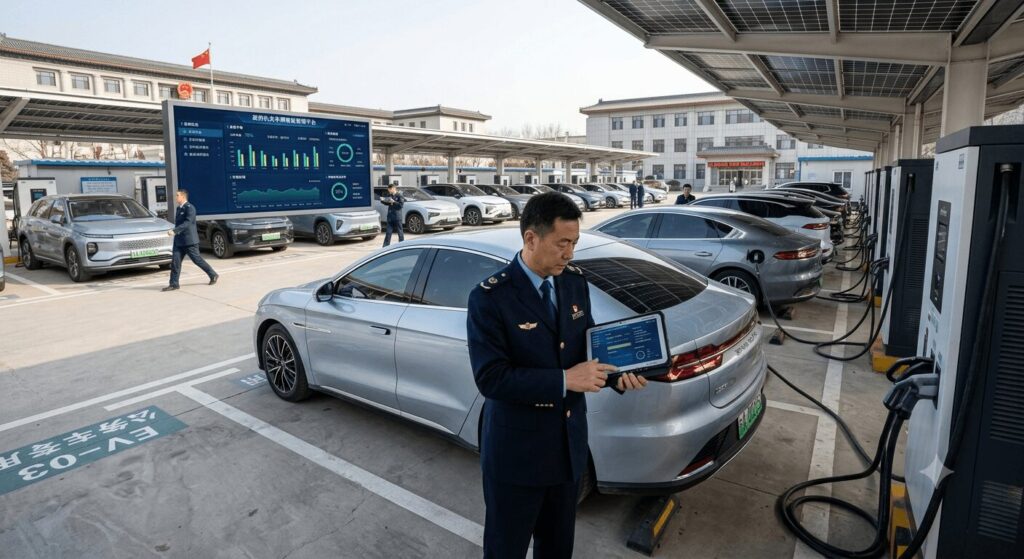
The fleet electrification mandate is not simply a vehicle procurement requirement — it is accompanied by explicit requirements for the charging infrastructure necessary to support the mandated vehicles. NDRC guidance specifically establishes that institutions procuring NEVs under the mandate must simultaneously ensure adequate charging infrastructure for those vehicles, with specific ratios between vehicle numbers and dedicated charging points that vary by institution type and location.
The infrastructure ratio requirements:
For standard government office locations: minimum 1 dedicated charging point per 5 fleet NEVs, with the expectation that shared charging infrastructure can supplement this ratio for less-used vehicles.
For institutions with high daily mileage requirements (inspection agencies, law enforcement agencies, regular field service departments): minimum 1 dedicated charging point per 3 fleet NEVs, reflecting the higher daily energy replenishment requirements of high-utilisation vehicles.
For institutions with overnight vehicle storage at a single location (many government compound-based agencies): the expectation that sufficient overnight charging capacity is available to replenish the full fleet between shifts, creating a requirement that scales directly with total fleet NEV count rather than just new procurement.
Why this infrastructure requirement is the primary business opportunity:
The vehicle procurement requirement creates a headline number — how many NEVs are being purchased. But the infrastructure deployment requirement creates the actual equipment and installation spending that flows to charging industry participants. A government agency procuring 50 NEVs under the mandate requires approximately 10-17 dedicated charging points, plus the electrical installation infrastructure to support them — a significant procurement in itself, representing ¥150,000-¥500,000 in equipment and installation depending on specification.
The Scale — How Much Infrastructure the 25% Mandate Implies
Fleet Size and Transition Trajectory
The total government and SOE fleet scale:
China’s government and public institution vehicle fleet is substantial — estimates of the total official government vehicle fleet (excluding SOEs and military) typically range from 4-6 million vehicles at all government levels combined. The SOE fleet adds a significantly larger number, with major SOEs in energy, infrastructure, banking, and telecommunications each operating fleets ranging from thousands to tens of thousands of vehicles.
The annual procurement volume:
Government fleet vehicle replacement cycles in China typically run 5-8 years for most standard categories. At a fleet size of approximately 5 million government vehicles and an 8-year average replacement cycle, annual government fleet procurement is approximately 600,000-700,000 vehicles per year. At the 25% NEV mandate threshold, this implies approximately 150,000-175,000 government fleet NEV procurements annually at the central mandate level, before accounting for local government top-ups that push requirements higher in many jurisdictions.
The charging infrastructure deployment implied:
At the minimum infrastructure ratio of 1 point per 5 vehicles for standard office locations, this implies approximately 30,000-35,000 dedicated charging point installations annually for central government mandate compliance alone — before accounting for SOE requirements, local government enhanced targets, and the backfilling of infrastructure for previously-procured NEVs whose charging requirements may have been addressed inadequately.
The total addressable market this represents:
At an average charging point cost of ¥5,000-¥15,000 per point including installation (based on the ranges covered in our professional installation costs guide, scaled to the higher-specification commercial-grade equipment appropriate for government fleet use), the annual government and SOE fleet charging infrastructure procurement market implies ¥150 million to ¥500 million in annual equipment and installation spending from mandate compliance alone — and this figure is likely conservative given that it applies only the minimum infrastructure ratios and doesn’t account for the preference among government procurement processes for more specification-complete, premium-positioned equipment than minimum-spec products.
The Charging Infrastructure Specification for Government Procurement
What Government Fleet Charging Actually Requires vs Residential Charging
The specification distinctions that matter for procurement positioning:
Government fleet charging infrastructure differs from residential home charging covered throughout this guide series in several specific, important ways that affect which products and suppliers are positioned to serve this market:
Power level requirements:
Unlike residential home charging, which predominantly uses 7 kW single-phase AC for overnight replenishment as covered throughout this guide series, government fleet charging often requires both:
AC charging (7-22 kW, potentially three-phase for faster daytime replenishment) for standard fleet vehicles with overnight or daytime parking at government compounds
DC fast charging (30-120 kW) for high-utilisation vehicles that need rapid replenishment within short operational windows — particularly relevant for law enforcement, emergency response, and inspection vehicles that may need multiple partial charges within a single operational day
Multi-point management requirements:
A government compound with 20-50 charging points requires management infrastructure fundamentally different from a residential home charger — specifically including:
OCPP-compliant smart management systems that allow centralised monitoring and management of all charging points (aligned with the OCPP guidance covered in our connectivity guide, but now in a mandatory commercial-grade context rather than a recommended residential feature)
Load management across the compound’s total electrical capacity, ensuring the aggregate charging demand doesn’t exceed the site’s power supply capacity (scaling up the same principles covered in our load balancing guide to a multi-point institutional context)
Integrated energy cost management, including TOU scheduling across the entire fleet’s charging programme and demand response programme participation at a scale that generates meaningful institutional income from grid services
User authentication and access control (relevant for accountability in government procurement contexts where vehicle use is subject to audit)
Charging records and reporting for procurement compliance documentation — government agencies must demonstrate compliance with the infrastructure ratio requirements to satisfy post-procurement auditing
Certification and approval requirements:
Government procurement in China operates through formal procurement procedures (政府采购法) with specific certification and approval requirements for equipment suppliers. The 3C certification covered in our dedicated guides is a necessary but not sufficient requirement — government procurement additionally typically requires:
Products listed in MIIT’s NEV charging equipment recommended catalogue or approved product lists (推荐目录)
Suppliers registered as approved government procurement suppliers (政府采购供应商) with appropriate business qualifications
In some cases, products certified to specific additional standards beyond standard 3C, particularly for DC fast charging equipment intended for government use
Installation contractor requirements:
Government procurement of charging installation services typically requires contractors to hold specific qualifications — including licensed electrical contractor status (电气施工资质) at appropriate grade, and increasingly, specific EV charging installation qualifications that go beyond the general licensed electrician (持证电工) standard applicable for residential installation.
The Procurement Process — How Government Fleet Charging Gets Purchased
Understanding Chinese Government Procurement Channels
Central government procurement:
Central government agencies procure through the Government Procurement Centre (政府采购中心) framework, with charging infrastructure typically procured through either:
Open tender (公开招标) for contracts above the tender threshold (generally ¥1 million for goods and services)
Competitive quotation (竞争性谈判 or 询价) for smaller contracts below the tender threshold
Framework agreements (协议供货) for commoditised products where pre-qualified suppliers can supply on standard terms without individual tender processes
Provincial and municipal government procurement:
Local government procurement follows similar channels but administered through local Government Procurement Centres or Finance Bureau procurement departments, with the specific procedures and thresholds varying somewhat by jurisdiction.
SOE procurement:
State-owned enterprise procurement operates under somewhat different frameworks than formal government procurement law, with larger SOEs typically having their own procurement departments and procedures, often more flexible than formal government procurement but still subject to SOE internal governance requirements and SASAC oversight.
The Tender Process Typical Cycle
For a typical government compound charging infrastructure tender:
Stage 1: Needs assessment and specification development (2-4 months before tender publication)
The procuring institution develops its charging infrastructure requirements based on its fleet NEV count, compound electrical capacity, daily utilisation patterns, and compliance with the infrastructure ratio requirement. This stage often involves consultation with qualified suppliers or technical consultants — a specific engagement opportunity for charging industry participants who position themselves as technical advisors rather than only as equipment suppliers.
Stage 2: Tender publication and response period (typically 30-45 days)
The procurement is published through the Chinese Government Procurement Network (中国政府采购网, ccgp.gov.cn) and typically through provincial/municipal equivalents. Tender documents specify technical requirements, qualification requirements for suppliers, evaluation criteria, and contract terms.
Stage 3: Evaluation and award (2-6 weeks after response deadline)
Submitted responses are evaluated against the criteria in the tender documents, with price and technical specification typically the primary weighted criteria. Awards are published on the procurement network, providing transparency about which suppliers and products are winning government fleet charging contracts.
Stage 4: Contract execution and installation
Following award, the contract execution and installation process typically spans 3-6 months for standard compound charging installations, longer for more complex or large-scale deployments.
The Business Opportunity Analysis — Where the Money Is
Opportunity Category 1: Equipment Supply
The product specification most demanded by government fleet procurement:
Based on procurement documentation analysis, government fleet charging procurement most commonly specifies:
For standard fleet vehicle AC charging: 7 kW or 11 kW AC charging points with OCPP 1.6 or 2.0 compliance, three-phase capability for sites with three-phase supply, integrated load management, and the certification qualifications described above. Products from established brands covered throughout this guide series — particularly Huawei FusionCharge, StarCharge’s commercial line, and the international brands’ commercial variants — are well-positioned for this requirement.
For high-utilisation vehicle DC fast charging: 30-120 kW DC charging points with OCPP 2.0, integrated energy management, and network connectivity. This segment involves different product categories from the residential-focused products primarily covered in this guide series, but many of the same brands’ commercial product lines are directly relevant.
For management systems: OCPP-compliant cloud management platforms that can aggregate charging data, manage load balancing, and provide the reporting functionality needed for compliance documentation. This software component often represents 10-20% of total procurement value and is a distinct opportunity from hardware supply.
Opportunity Category 2: Installation and Integration Services
The installation service characteristics required for government procurement:
As distinguished from the residential installation covered in our professional installation costs guide, government fleet compound installation typically involves:
More complex electrical infrastructure work — three-phase distribution, load management panel installation, integration with existing building management systems
More rigorous documentation and certification requirements — as-built drawings, inspection certificates, operational testing documentation required for the compliance audit trail
Higher contractor qualification requirements as noted above
The margin profile:
Government procurement installation services typically carry higher margins than competitive residential installation, reflecting both the more complex technical work and the administrative overhead of government procurement compliance — a trade-off of higher individual contract value and margin for higher administrative burden.
Opportunity Category 3: Operations and Maintenance Contracts
An often-overlooked but recurring revenue opportunity:
Many government fleet charging procurements include, or are followed by separate procurement of, operations and maintenance (O&M) contracts covering ongoing management, maintenance, and technical support for the installed infrastructure.
These O&M contracts represent recurring revenue streams that are specifically valued by charging industry participants seeking to reduce their dependence on lumpy capital procurement cycles — exactly the recurring revenue model that makes the most financially durable charging businesses distinct from pure hardware manufacturers.
Contract terms and value:
Government fleet O&M contracts typically run 2-5 years with options for renewal, covering preventive maintenance, fault response, software updates, and reporting obligations. Annual O&M contract values typically run 5-15% of the initial equipment and installation value — for a ¥500,000 initial procurement, ¥25,000-¥75,000 per year in recurring O&M revenue.
Opportunity Category 4: Technical Consulting and Specification Development
The upstream opportunity that positions suppliers for downstream procurement:
Government institutions developing their first fleet NEV charging infrastructure frequently lack the internal technical expertise to develop accurate specifications — particularly the electrical infrastructure assessment, the load management design, and the OCPP system specification that increasingly complex installations require.
Charging industry participants who invest in technical consulting capability — and position themselves as genuinely objective advisors during the specification development stage (before tender publication) — establish both a revenue stream from the consulting engagement itself and a positioning advantage in the subsequent tender, where they have deep familiarity with the specific institutional requirements they helped specify.
The important qualification:
The ability to provide objective technical advice while also being a potential equipment supplier requires careful management of the conflict of interest inherent in this positioning — institutions are increasingly aware of this dynamic and the most sophisticated procurement processes include explicit restrictions on specification consultants participating in the subsequent tender. This requires careful structuring of consulting versus supply business units within organisations seeking to participate in both roles.
The Geographic Concentration of Opportunity
Where Government Fleet Charging Procurement Concentrates
The institutional density factor:
Government fleet procurement opportunity concentrates where institutional density is highest — the same major cities and regional hubs covered throughout this guide series’ geographic analysis, but with a specifically institutional rather than residential concentration:
Beijing: The highest density of central government agencies and major SOE headquarters in China, producing proportionally the largest central government fleet procurement concentration. Beijing’s own municipal government has also established particularly aggressive NEV fleet targets beyond the national minimum.
Shanghai: Major regional government hub, financial sector SOE concentration (banking, insurance, infrastructure), and one of the leading cities in implementing higher-than-national-minimum fleet NEV targets.
Shenzhen: As China’s most advanced EV adoption city and a major hub for technology and infrastructure SOEs, Shenzhen’s government and SOE fleet procurement reflects the city’s broader EV leadership position — particularly in the infrastructure and operations SOE categories that have the largest vehicle fleets.
Provincial capitals and major tier-2 cities: The decentralised nature of provincial government procurement means significant opportunity exists across 31 provincial capitals and the major sub-provincial cities, where provincial government agencies, provincial SOEs, and well-resourced municipal governments represent aggregate procurement volumes comparable to significant central government procurement.
The rural and lower-tier opportunity:
County-level government procurement is smaller in individual scale but vastly larger in aggregate number of procurement entities — China has approximately 2,800 county-level administrative units, each with their own government fleet and many with county-owned enterprises. The aggregate procurement volume at this level is significant but more dispersed and more variable in procurement sophistication, requiring different market development approaches than city-level government procurement.
The Compliance Verification and Audit Framework
How Government Institutions Demonstrate Compliance
The post-procurement verification process:
The infrastructure ratio requirement isn’t simply a procurement specification — it’s a compliance obligation that institutions must demonstrate through post-procurement verification:
Annual fleet and charging infrastructure reporting to the relevant oversight authority (typically the local Finance Bureau or the agency’s supervisory authority)
Physical inspection capability — in principle, charging infrastructure provision should be verifiable through site inspection, creating an ongoing rather than one-time compliance obligation
Integration with broader institutional carbon footprint reporting requirements that are becoming increasingly formalised in China’s government sustainability framework
What this means for charging infrastructure suppliers:
The compliance verification requirement creates specific value for charging infrastructure that includes robust reporting capability — specifically OCPP-compliant management systems that can generate the session logs, energy consumption data, and fleet utilisation reports that compliance verification requires. Equipment and systems that can demonstrate compliance programmatically (through exportable reports directly compatible with government audit requirements) command meaningful premium over equipment that requires manual data compilation for compliance purposes.
The Connection to This Guide Series’ Residential Content
How Government Fleet Charging Informs Residential EV Charging Decisions
The technology transfer direction:
Many of the technologies and standards that began in commercial and government fleet applications have subsequently become available and relevant in the residential market covered throughout this guide series — OCPP compliance, smart load management, AI energy optimisation, and demand response programme participation all have origins in larger-scale commercial and government fleet applications that have subsequently been adapted for residential scale.
The specific residential connection:
For Chinese EV owners who are also employed at government agencies, public institutions, or SOEs that operate under the fleet mandate, understanding the infrastructure their employer is required to provide potentially creates workplace charging access that supplements or substitutes for residential home charging — exactly the workplace charging opportunity covered in our guide on charging solutions for owners without fixed parking spots.
The compatibility of residential and government fleet charging equipment around the GB/T standard means that vehicles charged at a government workplace charging facility are fully compatible with residential home chargers — the universal GB/T standard that this guide series has consistently identified as China’s domestic market universal connector standard.
Internal Links — Further Reading on Clean Energy Bazaar
The public sector opportunity guide to China’s 25 percent government fleet charging mandate guide connects to the product specification, certification, and market analysis guidance throughout this content cluster.
For the professional installation costs guide establishing the installation service costs and qualification requirements relevant to government fleet installation work, our professional EV charger installation costs 2026 what State Grid chargers vs private companies charge guide covers every cost component. For the OCPP and connectivity guide establishing the technical connectivity requirements specifically mandated in government fleet procurement specifications, our best smart connectivity WiFi 5G digital yuan payments in Chinese smart chargers guide covers every connectivity specification. For the load balancing guide establishing the multi-point load management principles that scale from residential to government fleet applications, our load balancing EV chargers 2026 avoid tripping breakers in old Chinese apartment blocks guide covers the fundamental principles. For the 3C certification guide covering the base certification requirements that government procurement additionally builds upon, our 3C certification and EV chargers 2026 why buying non-certified chargers is dangerous in China guide covers every safety standard. For the great shakeout guide that contextualises which charging companies are positioned to serve this institutional procurement market, our great shakeout why 80 percent of Chinese EV charger manufacturers face elimination in 2026 guide covers the complete industry landscape. And for the no-fixed-parking guide covering how government workplace charging can serve as the primary charging solution for employees, our urban parking vs rural garages how Chinese homeowners install EV chargers without a fixed spot guide covers workplace charging as a residential supplement.
Final Thoughts
The public sector opportunity guide to China’s 25 percent government fleet charging mandate reveals a market segment that the dominant English-language narrative of China’s EV charging industry — focused primarily on consumer residential adoption and the startup innovation ecosystem — has substantially underemphasised relative to its actual scale and commercial predictability.
Government and SOE fleet electrification mandate compliance is not optional, not contingent on consumer sentiment or vehicle range improvements, and not subject to the venture capital cycle volatility that has produced the great shakeout in the residential charging hardware market. It is a procurement obligation backed by specific verification requirements and specific post-procurement auditing — producing demand that is more predictable, more consistently funded, and more specification-stable than residential market demand.
The specific opportunities this mandate creates span equipment supply, installation services, O&M contracts, and technical consulting — a portfolio of revenue streams that, taken together, represent more financially durable business models than the pure residential hardware sales that characterised much of the eliminated Category 1 manufacturer group from our great shakeout analysis.
For charging industry participants seeking to navigate the post-shakeout landscape with the strongest possible business foundation: understanding and positioning for the government fleet mandate’s infrastructure requirements — with the product certifications, supplier qualifications, and technical capabilities that mandate compliance demands — represents exactly the kind of differentiated positioning that the residential market’s commodification and price compression makes increasingly unavailable for participants competing only in that segment.
The 25% mandate isn’t a ceiling. In leading EV adoption cities it’s already been exceeded. And as China’s broader fleet electrification targets for 2030 and beyond continue pushing the proportion upward, the charging infrastructure that enables each percentage point of that transition represents a structured, policy-backed demand stream that the right participants are already, systematically, building their businesses around.