The number that circulates in Chinese EV charging industry discussions in 2026 is stark: by some estimates, fewer than one in five of the companies that entered China’s residential and commercial EV charger manufacturing market between 2019 and 2023 will survive the current consolidation period in commercially meaningful form. The rest — a remarkable proportion of what was, just three years ago, a thriving, venture-capital-fuelled industry of hundreds of manufacturers — face some combination of bankruptcy, forced merger, quiet operational wind-down, or reduction to a rump operation surviving on legacy warranty servicing rather than active product development.
This is not a prediction. It is, in 2026, largely a description of something already substantially underway.
This guide on the great shakeout why 80 percent of Chinese EV charger manufacturers face elimination in 2026 provides the complete honest industry analysis: why this consolidation is happening, what specific structural forces are driving it, which categories of companies are most and least vulnerable, what the shakeout’s progression means for Chinese EV owners who have already purchased from affected brands, and how to position your hardware purchasing decisions for the post-shakeout market that will look meaningfully different from the fragmented, choice-abundant landscape of 2021-2023.
The Scale of the Entry — How China Got 300+ EV Charger Manufacturers
The Venture Capital Hypothesis That Drove Mass Entry
The investment thesis that seemed compelling in 2020-2021:
China’s EV adoption trajectory, confirmed by government targets and early sales momentum, suggested a straightforward infrastructure build-out opportunity: every EV sold creates demand for approximately one home charging unit and some fraction of a public charging unit. With tens of millions of EVs projected to sell annually by mid-decade, the charging hardware market appeared to be a classic “picks and shovels” opportunity — selling necessary infrastructure to a gold rush rather than betting on which specific EV brands would win.
The VC response:
Chinese venture capital, along with strategic investment from industrial conglomerates looking to participate in the EV ecosystem, flowed into EV charging hardware at scale from approximately 2019 through 2022. By 2022, the number of registered companies with EV charging as a stated primary or secondary business activity in China had grown to estimates ranging from several hundred to over a thousand, depending on how broadly “EV charging company” was defined.
The implicit assumption that proved wrong:
The investment thesis had an unstated assumption built into it: that the market would remain fragmented enough for multiple tiers of participants to capture value. History across virtually every infrastructure hardware market — from router manufacturers to solar inverter makers to industrial automation suppliers — suggests this assumption was wrong by definition. Infrastructure hardware markets consolidate aggressively once initial adoption accelerates, because the product’s intrinsic commodification (a charger that meets the standard is a charger that meets the standard) drives margin compression that eliminates all but the most cost-efficient producers and the most differentiated premium providers.
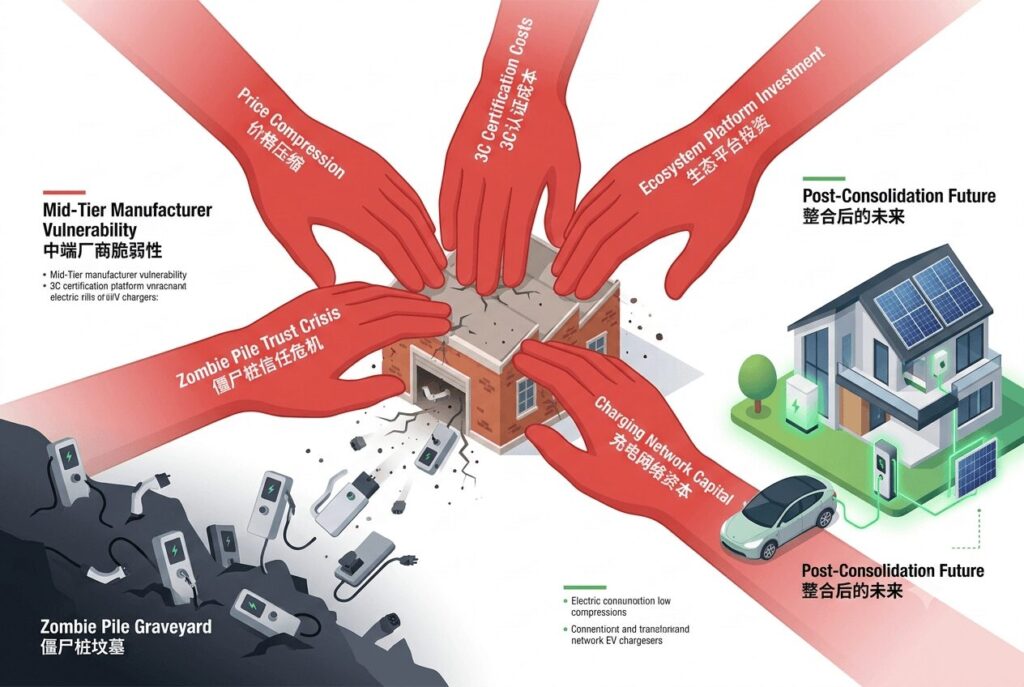
The Five Structural Forces Driving Elimination
Force 1: Price Compression Making Entry-Level Margins Unsustainable
The price trajectory of Chinese home EV chargers since 2019:
In 2019-2020, the entry price for a basic certified 7 kW smart home EV charger in China’s market was approximately ¥1,500-¥2,500. By 2023-2024, the same functional specification — 7 kW, GB/T certified, basic TOU scheduling — was available from multiple manufacturers at ¥699-¥999. By 2026, aggressive pricing from the survivors’ scaling efficiencies has pushed some offerings below ¥600.
Why this destroys smaller manufacturers’ economics:
A manufacturer producing 10,000-50,000 units annually cannot achieve the component cost and manufacturing efficiency of a manufacturer producing 500,000-2,000,000 units annually. As leading manufacturers’ production volumes have scaled, their per-unit costs have fallen through economies of scale, driving their retail prices down and simultaneously making it progressively more difficult for smaller manufacturers to compete on price while maintaining the margins necessary to fund ongoing product development, customer service infrastructure, and certification maintenance.
The specific margin compression numbers:
Industry estimates suggest that a 7 kW smart charger retailing at ¥899 carries approximately ¥200-¥280 in gross margin for a mid-scale manufacturer, before subtracting customer service costs, warranty provision costs (typically 3-7% of revenue provisioned for warranty claims), certification maintenance costs, distribution costs, and company overhead. At these margins, even a manufacturer with respectable volume cannot sustain meaningful R&D investment or the service infrastructure necessary to compete on quality rather than price — producing a squeeze between the large-scale cost competitors from below and the premium ecosystem players from above.
Force 2: 3C Certification Costs Falling Disproportionately on Smaller Manufacturers
As covered in our dedicated 3C certification guide and the August 2026 deadline guide, maintaining valid certification is not a one-time cost but an ongoing operational requirement.
The specific cost burden:
Initial 3C certification for a new charger model through an accredited testing laboratory costs approximately ¥50,000-¥150,000 depending on the product’s complexity and the specific laboratory used. For a manufacturer with multiple models, multiple variants, and the need to certify updated versions when either the product or the applicable standard changes, annual certification maintenance costs can reach ¥300,000-¥800,000.
How this distributes across manufacturer scales:
For a manufacturer like Huawei or StarCharge with annual revenue in the hundreds of millions to billions of yuan, certification costs represent a manageable, small percentage of revenue. For a manufacturer with annual revenue of ¥10-¥30 million — entirely plausible for a company with meaningful unit sales at compressed margins — certification costs can represent 3-8% of revenue, a genuinely burdensome overhead that constrains investment in every other business function.
The August 2026 deadline’s specific cost amplification effect:
As established in our August 2026 deadline guide, the updated standard’s recertification requirement represents a specific, time-concentrated additional cost burden that smaller manufacturers must absorb in a period when their financial resources are already constrained by the price compression force described above. This timing is not accidental from an industry dynamics perspective — regulatory tightening during a period of market stress accelerates consolidation by imposing fixed costs that fall more heavily on smaller players.
Force 3: Ecosystem Integration Requiring Platform Investment Beyond Hardware
The shifting value proposition in Chinese smart EV chargers:
As covered extensively throughout this guide series — in our smart charger comparison, our connectivity guide, our Xiaomi and Huawei ecosystem analyses — the competitive differentiation in China’s smart home EV charger market has progressively shifted from hardware specification (where commodification is most advanced) toward software ecosystem integration (where genuine differentiation remains possible).
The investment asymmetry this creates:
Developing and maintaining a meaningful smart home ecosystem — whether that means deep integration with Xiaomi’s HyperOS as covered in our Xiaomi charger guide, Huawei’s HarmonyOS as covered in our Huawei FusionCharge guide, or OCPP-based demand response programme participation as covered in our connectivity and technology trends guides — requires ongoing software development investment that standalone hardware manufacturers without existing platform presence cannot meaningfully sustain.
The specific platform barrier:
A manufacturer without an existing smart home ecosystem cannot create one from scratch against the established user bases of Xiaomi (with hundreds of millions of Mi Home active devices) or Huawei (with its own substantial HarmonyOS ecosystem). The charger manufacturer that isn’t already part of a major platform is therefore permanently competing in the commodifying hardware segment rather than the differentiating ecosystem integration segment — which, at compressed hardware margins, is an increasingly untenable position.
Force 4: The Zombie Pile Crisis Eliminating Trust in Smaller Brands
As covered in our dedicated zombie pile crisis guide, the documented failures of smaller EV charger manufacturers have created a specific trust dynamic that further accelerates consolidation.
The second-order market effect:
When a smaller manufacturer fails and their customers experience the zombie pile outcome — app failure, TOU scheduling cessation, warranty enforcement impossibility — the broader EV owner community learns about this through social media, owner forums, and the kind of informal knowledge transfer documented in our user stories guide. This learning effect makes prospective buyers progressively less willing to purchase from unestablished brands regardless of how competitive their price or specification may be, concentrating demand toward established, demonstrably operational brands.
The self-fulfilling dynamic:
Smaller manufacturers who haven’t yet failed but are experiencing financial pressure face a specific credibility problem: the zombie pile fear that prospective buyers have learned to apply makes it harder for financially-stressed smaller manufacturers to attract new customers, which reduces the revenue they need to resolve their financial stress — a classic self-fulfilling doom loop that accelerates the very consolidation it reflects.
Force 5: Charging Network Integration Requiring Capital That Pure Hardware Players Lack
The emerging competitive dynamic in the Chinese EV charging market:
As the Chinese market has developed, the most durable competitive positions in EV charging are increasingly being built not by pure hardware manufacturers but by companies that combine hardware supply with charging network operations — companies like StarCharge and TELD that operate extensive public charging networks alongside selling residential hardware, and companies like Huawei that integrate charging hardware into broader energy management infrastructure offerings.
Why network integration creates insurmountable advantage over pure hardware manufacturers:
Data from charging network operations provides insights into actual usage patterns, grid interaction opportunities, and demand response optimisation that pure hardware manufacturers without network operations simply don’t have. This data advantage compounds over time — a charging network operator with millions of daily charging sessions develops progressively better AI optimisation models, better demand response programme participation, and better product development insights than a hardware-only competitor can replicate.
The Elimination Categories — Who Goes and Who Stays
Category 1: Already Gone or Effectively Gone (Largest Group by Company Count)
The pure-play residential charger startups with no industrial heritage and no network operations:
Companies that entered the market specifically and only to manufacture residential smart chargers, funded by venture capital on the infrastructure thesis described above, without meaningful industrial electronics heritage, without a broader product ecosystem, and without network operations — this category represents the largest single group by company count among the approximately 300+ entrants, and the highest failure rate.
The specific characteristics that predicted failure in this category:
Companies in this category typically showed the warning sign constellation covered in our zombie pile crisis guide: app last-updated dates stretching to 2024 without subsequent updates, customer service response times measured in weeks rather than hours or days, e-commerce store listings showing increasingly aggressive discounting suggesting inventory liquidation rather than normal competitive pricing, and the absence of any new product announcements since the market’s 2022-2023 peak.
Category 2: Under Significant Stress, Outcome Uncertain (Meaningful Group)
Mid-tier manufacturers with some but insufficient differentiation:
Companies that achieved meaningful scale (hundreds of thousands of units sold) but without sufficient differentiation through either industrial heritage, ecosystem integration, or network operations to clearly occupy a defensible competitive position in the post-consolidation landscape. These companies are fighting the price compression force with volume efficiency gains that haven’t quite caught up to the leading manufacturers’ economies of scale.
The outcomes likely for this category:
Acquisition by larger industrial conglomerates (the most optimistic outcome, as it typically preserves product support for existing customers), strategic partnership with a major technology or energy company that provides the ecosystem integration they lack independently, or, failing either of the above, gradual revenue attrition toward the point of operational non-viability.
The specific customer implication:
Owners of 2-3 year old chargers from companies in this category should apply the zombie pile crisis guide’s framework actively and regularly — monitoring for the specific signals that distinguish “under stress but viable” from “entering the terminal phase” of the zombie pile pattern, and maintaining the car timer TOU backup practice this guide series consistently recommends as a hedge against cloud-dependent scheduling failure.
Category 3: Consolidating and Strengthening (Smaller Group, Mostly Already Identified in Guide Series)
The companies most likely to define the post-shakeout landscape:
This category maps closely to the Tier 1 and Tier 2 companies identified in our zombie pile crisis guide — companies with diversified business beyond EV charging specifically (Huawei, Xiaomi, Schneider, ABB, Siemens, Sungrow, Ginlong Solis, Delta Electronics), companies with established and scaling charging network operations alongside hardware (StarCharge, TELD), and EV manufacturer-integrated charger businesses tied to the most financially robust EV brands (primarily BYD).
How the shakeout benefits these companies:
Every company that exits the market at the Category 1 or Category 2 level is a potential customer base that the Category 3 survivors can potentially capture for replacement hardware, a potential distribution channel or service network they can absorb, and an element of the fragmented market structure that their consolidating dominance replaces.
The Investment That’s Flowing Into the Survivors
What “Market Consolidation” Actually Means in Investment Terms
The specific patterns of capital movement:
While the Chinese EV charger market’s overall venture capital enthusiasm has cooled dramatically from its 2020-2022 peak, capital hasn’t exited the sector entirely — it has concentrated into the companies already positioned in the surviving categories. This concentration takes several forms:
Strategic investment by ecosystem companies:
Technology companies with major platform presence — most obviously Xiaomi and Huawei but also Alibaba (through its energy subsidiary), Baidu, and others — have been making specific investments in charging infrastructure companies and technologies that extend their platform presence into the EV charging interaction, effectively acquiring the technological and operational capabilities they need to maintain competitive ecosystem integration rather than developing them organically.
Industrial conglomerate consolidation:
Major Chinese industrial groups with interests across energy equipment, automotive components, and electrical infrastructure — including Geely (parent of Zeekr), BYD’s energy division, CATL’s infrastructure investments, and various state-owned enterprise energy arms — have been making acquisitions and strategic partnerships within the charging hardware sector that bring struggling pure-play manufacturers under the umbrella of groups with the financial resources and market access to sustain the products.
International industrial company investment maintenance:
The major international industrial electronics companies covered throughout this guide series — ABB, Schneider, Siemens, Delta — have continued their China market investment specifically in EV charging as a strategic growth category within their broader electrification portfolios, providing the financial backstop that makes their warranty and long-term support commitments covered in our warranty comparison guide genuinely credible.
The Timeline — When Is This Over?
The Honest Assessment of Consolidation Trajectory
Where the shakeout stands in mid-2026:
The most dramatic phase of company failures — the pure-play startups that entered earliest and burned through venture funding fastest — has largely already occurred. The companies still operating in mid-2026 have generally demonstrated sufficient resilience to survive the initial triage, though a meaningful proportion remain in the Category 2 stress position described above.
The expected 2026-2028 continuation:
The consolidation is not finished. The Category 2 stress group’s resolution — either toward Category 3 survival or toward delayed Category 1 elimination — is the primary remaining dynamic. This resolution is likely to take 12-36 months more to play out fully, meaning the Chinese EV charger market will likely be significantly more consolidated by the end of 2027 or 2028 than it is today.
What the post-shakeout market looks like:
Industry analysts tracking China’s EV charging hardware sector generally anticipate a post-shakeout landscape dominated by a small number of clear categories: the major technology platform companies (Huawei, Xiaomi) dominating the smart home ecosystem segment; the established charging network operators (StarCharge, TELD) dominating the scale/value segment; the international industrial brands (ABB, Schneider, Siemens) maintaining the premium/industrial segment; and EV manufacturer-integrated charger businesses serving brand-specific ecosystem needs.
The approximate company count expectation:
From the 300+ companies that were meaningfully active in 2021-2022, the post-consolidation market is expected to sustain perhaps 20-30 companies with meaningful ongoing market presence, divided across these categories — a reduction of roughly 90% by company count but representing a far smaller reduction in actual market volume served, since the eliminated companies collectively served a declining share of actual market demand even before their individual failures.
What the Shakeout Means for Chinese EV Owners — The Practical Implications
Implication 1: The Buy List Gets Shorter and More Reliable
The paradox of reduced choice that benefits buyers:
The shakeout’s primary benefit for Chinese EV owners is counterintuitive — a market with fewer charger companies is actually better for buyers than a market with hundreds, because the surviving companies are specifically the ones that have demonstrated the operational durability that makes their warranty commitments credible and their long-term product support sustainable, per the framework established in our zombie pile crisis guide.
The practical buying guidance:
As the shakeout progresses, the buying guidance throughout this guide series — consistently recommending brands from the Tier 1 and Tier 2 survival categories rather than the broader market — becomes progressively less restrictive by necessity, since the eliminated companies remove themselves from consideration through their own operational cessation rather than requiring buyers to actively screen them out.
Implication 2: Service Quality Should Improve as Scale Concentrates
The quality improvement argument for consolidation:
As market share concentrates among a smaller number of surviving companies, the average company in the market has larger scale, better resources, and more financial stability to invest in customer service quality, warranty processing efficiency, and technical support capability — directly addressing the service quality concerns covered in our troubleshooting, maintenance, and warranty comparison guides.
The honest caveat: This improvement is an average expectation rather than a guarantee for any specific surviving company, and the timeline for the quality improvement to manifest in measurable customer experience is likely to lag the consolidation itself by 12-24 months as the survivors integrate and stabilise their expanded market positions.
Implication 3: Innovation May Temporarily Slow Before Accelerating
The innovation trajectory prediction:
In the short term (2026-2027), the shakeout’s absorption of smaller innovators into larger consolidated players may produce a temporary plateau in consumer-visible innovation — major product launches may be less frequent as the industry digests the consolidation — before the better-resourced surviving companies deploy their consolidated market position and improved margins toward accelerated development of the next-generation technologies covered in our technology trends guide (V2G, OCPP 2.0 mainstream deployment, AI energy management expansion).
Implication 4: The V2G and Smart Grid Opportunity Concentrates
Why consolidation specifically benefits V2G deployment:
As covered extensively in our technology trends guide, the deployment of V2G and advanced smart grid integration requires sustained, multi-year investment in both hardware development and network integration — exactly the kind of investment that fragmented, financially-stressed smaller manufacturers cannot make, but that well-capitalised surviving companies can and, given the commercial opportunity, are motivated to.
The specific beneficiaries: Huawei’s FusionCharge V2G OTA roadmap, Ginlong Solis’s OCPP 2.0 positioning, StarCharge’s network integration advantage, and the EV manufacturer-integrated systems covered throughout our vehicle-specific guides are specifically positioned to be the primary residential V2G deployment vehicles as this technology reaches commercial viability.
The Buying Strategy for the Shakeout Period
The Specific Recommendations for Chinese EV Owners Purchasing in 2026
Priority 1: Confirm current operational status before any purchase
Given that the shakeout is ongoing rather than complete, a company that was operational and apparently viable when this guide was written may have experienced material changes in financial position and operational status by the time any specific reader is making a purchase decision. The five-factor due diligence framework from our zombie pile crisis guide — applied at the time of actual purchase rather than relying on historical assessments — is the correct approach.
Priority 2: Weight the post-shakeout landscape categories
Purchase from companies clearly in the Category 3 survival group as this guide has defined it — diversified industrial or technology parent, established network operations, or clear EV manufacturer integration with a financially robust parent — with Tier 1 preference (Huawei, Xiaomi, Schneider, ABB, Siemens, Sungrow, Ginlong Solis) for owners specifically prioritising brand survival confidence.
Priority 3: The value case for the established mid-tier
StarCharge and TELD, while in the moderately higher zombie risk category than the Tier 1 companies, have demonstrated specific operational durability and EV-charging-specific scale that makes them substantially more robust than the eliminated Category 1 companies. For value-conscious buyers for whom Tier 1 premium pricing represents a genuine constraint, these established mid-tier options remain defensible choices with the monitoring practices our zombie pile guide recommends.
Priority 4: Never on price alone
The specific danger of the shakeout period is that eliminating companies typically generate their most attractive-appearing pricing in their final months of viable operation — liquidating inventory at margins that established competitors cannot match because those established competitors are factoring in long-term warranty provision and service infrastructure costs that the about-to-exit company is no longer accounting for. A significantly-below-market price from an unestablished brand should be treated as a warning signal rather than a buying trigger during a shakeout period.
Internal Links — Further Reading on Clean Energy Bazaar
The great shakeout why 80 percent of Chinese EV charger manufacturers face elimination in 2026 guide is the industry analysis companion to the brand-specific purchasing guidance covered throughout this content cluster.
For the zombie pile crisis guide that established the specific consumer-level framework for navigating manufacturer survival risk, our zombie pile crisis 2026 how to avoid dead chargers from liquidated Chinese brands guide covers the complete five-factor due diligence assessment. For the 3C certification and August 2026 deadline guide that covers the regulatory cost burden specifically forcing smaller manufacturers out, our China’s 3C deadline August 2026 is your current EV charger now illegal the 20 point checklist guide covers every compliance consideration. For the warranty comparison guide covering which surviving brands actually back their products with durable warranty commitments, our EV charger warranty comparison 2026 best coverage from local brands vs US importers guide covers every brand’s warranty structure. For the upgrade decision guide covering what to do when your current charger’s manufacturer is among the eliminated companies, our when to upgrade your EV charger signs your 2023 charger isn’t ready for 2026’s 800V cars guide covers the complete replacement decision framework. For the technology trends guide covering how the post-shakeout consolidated market will deploy V2G and smart grid technologies, our upcoming EV charger trends 2026-2027 V2G solid-state batteries and what to buy now in China guide covers every emerging technology. And for the full home charger comparison covering the surviving brands’ specific product specifications, our best home EV chargers 2026 top 7 comparison for Chinese homeowners Star Charge Autel guide covers every major product.
Final Thoughts
The great shakeout why 80 percent of Chinese EV charger manufacturers face elimination in 2026 is not a prediction of catastrophe for Chinese EV owners — it is a description of a market correction that, despite its dramatic human and financial cost for the companies that don’t survive, ultimately produces a better outcome for the owners who need reliable, long-term-supported charging hardware than the fragmented, survival-uncertain landscape of 2021-2023 provided.
The five structural forces driving this consolidation — price compression destroying smaller manufacturers’ margins, 3C certification costs falling disproportionately on smaller players, ecosystem integration requirements exceeding standalone hardware companies’ capabilities, zombie pile trust destruction concentrating demand toward established brands, and charging network integration creating insurmountable advantages for integrated players — are structural rather than cyclical. They don’t reverse when the venture capital cycle turns; they continue operating because they reflect fundamental economics of how infrastructure hardware markets mature.
The companies that survive this shakeout will be better businesses for having survived it: better capitalised, better scaled, better integrated into the ecosystem and network frameworks that define the market’s future, and better positioned to deploy the V2G and smart grid capabilities that the technology trends guide identified as the residential charging market’s next significant chapter.
For Chinese EV owners navigating the shakeout period: the five-factor framework from our zombie pile guide, applied at the time of purchase rather than on historical assessment, and the post-shakeout Category 3 survival group as this guide has defined it, provide the buying guidance that turns an uncertain market landscape into a navigable one. The great shakeout is happening. The right response is neither panic nor indifference — it is the informed, framework-guided purchase decision that this guide and the complete content cluster surrounding it has been built to support.