Every guide in this Chinese EV charging content cluster has addressed the buying decision — which charger to purchase, which specification matches your climate, which brand carries acceptable survival risk. This guide addresses what happens after the purchase decision is made and the charger has been installed: the ongoing maintenance reality that determines whether a correctly specified charger actually delivers its full 7-10 year service life, or fails prematurely despite having the right IP rating on paper.
This guide on EV charger maintenance 2026 dust protection vs humidity resistance brand comparison covers the complete maintenance picture — what dust protection and humidity resistance actually require in ongoing care beyond the initial IP rating specification, how the major Chinese charger brands compare specifically in real-world maintenance burden and long-term reliability, the specific maintenance tasks that matter for northern dust-exposed installations versus southern humidity-exposed installations, and the honest assessment of which brands genuinely require less maintenance attention over their service life.
Why IP Rating Alone Doesn’t Tell the Complete Maintenance Story
The Gap Between Specification and Real-World Performance
As established throughout our weatherproof charger guide, IP ratings provide a standardised, laboratory-tested measure of dust and water ingress protection at the moment of certification. What IP ratings don’t capture, and what this maintenance-focused guide specifically addresses, is how that protection degrades over years of real-world exposure, repeated thermal cycling, connector engagement cycles, and the accumulated effects of whatever specific climate stress a given installation experiences.
The seal degradation reality:
Every IP-rated enclosure achieves its rating through physical seals — gaskets, gland fittings, and enclosure joints — that are manufactured to a specification but that, like any physical material, experience gradual degradation through UV exposure, thermal expansion and contraction cycling, and simple material aging over a charger’s multi-year service life. A charger that tested as genuinely IP65 at manufacture may not maintain that exact protection level after five years of daily thermal cycling in a furnace city summer or five years of UV exposure in an unshaded outdoor installation.
Why this matters for the buying decision retrospectively:
This is not a reason to distrust IP ratings as a purchasing criterion — they remain the correct primary specification to evaluate before purchase, as covered extensively in our weatherproof guide. It is, however, the reason that ongoing maintenance matters even for a charger that was correctly specified for its installation climate at the time of purchase, and why some brands’ approach to seal design, material quality, and maintainability genuinely differs in ways that affect long-term real-world performance beyond the initial certified specification.
Dust Protection Maintenance — What Actually Requires Attention
Understanding Dust Ingress as a Progressive Rather Than Binary Failure
Why dust protection maintenance differs fundamentally from humidity maintenance:
As covered in our load balancing guide’s discussion of old apartment dust exposure, and our weatherproof guide’s coverage of northern Chinese dust storm conditions, dust ingress is typically a progressive accumulation problem rather than a sudden binary failure event — a charger doesn’t typically fail catastrophically from a single dust exposure event, but rather experiences gradually accumulating fine particle ingress through microscopic seal imperfections or gaps that compound over repeated exposure events (Beijing’s spring dust storm seasons, Xi’an and Lanzhou’s Loess Plateau exposure, Urumqi and Hohhot’s Gobi Desert proximity).
The specific maintenance implication:
Because dust accumulation is progressive, periodic proactive inspection and cleaning — rather than reactive response only after a problem manifests — provides genuinely meaningful protection extension, particularly for chargers in northern Chinese installations covered extensively in our weatherproof and tier 1 vs tier 2 city guides.
The Dust Protection Maintenance Schedule
Pre-dust-season inspection (February-March, before Beijing and northern China’s typical spring dust storm season):
Visual inspection of the charger enclosure’s external seals and joints, checking specifically for any visible gaps, cracking, or degradation in the gasket material around the enclosure’s access panels and cable entry points. This is the optimal timing because it allows identification and remediation of any seal degradation before the season’s most significant dust exposure events occur.
Post-dust-event cleaning (after any significant documented dust storm in your region):
External cleaning of the charger enclosure’s surface, paying particular attention to ventilation openings (for chargers with active ventilation rather than fully sealed enclosures) where accumulated dust can both reduce cooling effectiveness and potentially work its way deeper into the enclosure through ventilation pathways during subsequent thermal cycling.
Annual deep inspection (recommended timing: autumn, after the primary dust season has passed):
For chargers with any user-accessible internal inspection capability (some models permit limited access to connector terminals or internal components for authorised maintenance without voiding warranty, though this varies significantly by brand and model, and unauthorised access to sealed internal compartments should never be attempted without explicit manufacturer guidance), checking for any visible dust accumulation inside the primary enclosure that might indicate seal degradation requiring professional attention.
Why Connector Dust Exposure Specifically Matters
The connector-specific dust risk:
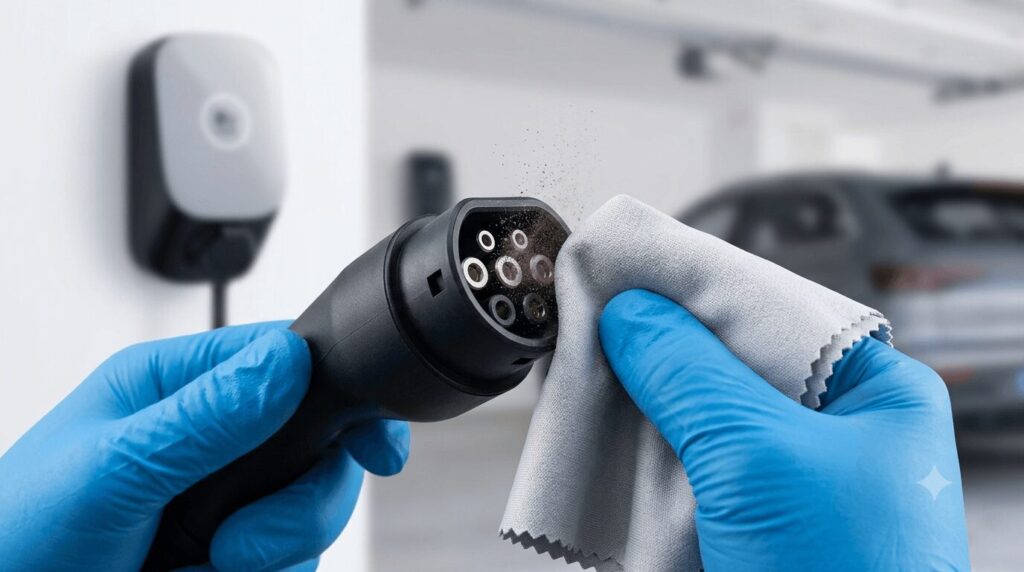
Beyond the charger’s main enclosure, the GB/T connector itself — repeatedly exposed to ambient air every time it’s disconnected from the vehicle and left exposed before the next charging session — experiences direct dust exposure that the sealed main enclosure doesn’t, making connector-specific maintenance a distinct consideration from main enclosure dust protection.
The connector maintenance practice:
Many experienced Chinese EV owners in northern dust-prone regions have adopted the practice of briefly wiping the connector’s contact pins with a clean, dry cloth before each connection during dust season specifically, removing any visible accumulated dust before it can be driven into the connection interface through the mechanical engagement process, which can otherwise gradually degrade contact quality over repeated dusty connections.
Humidity Resistance Maintenance — What Actually Requires Attention
Understanding Humidity-Related Degradation as a Different Failure Pattern
Why humidity maintenance requires a different approach than dust maintenance:
As covered extensively in our weatherproof guide’s discussion of South China monsoon conditions and our furnace city guide’s coverage of Wuhan and Chongqing’s sustained humidity, humidity-related degradation typically manifests through a combination of condensation cycling (the specific mechanism described in our weatherproof guide, where thermal cycling causes moisture to enter during warm humid periods and condense during cooler periods) and accelerated connector corrosion, rather than the more straightforward particle accumulation pattern of dust exposure.
The specific maintenance implication:
Humidity maintenance focuses more heavily on connector and contact point inspection for corrosion signs, combined with periodic functional testing to catch any early-stage intermittent connectivity or charging issues that often precede more complete humidity-related failures, compared to dust maintenance’s greater emphasis on physical cleaning and seal inspection.
The Humidity Resistance Maintenance Schedule
Pre-monsoon season inspection (March-April, before South China’s typical April-September monsoon period begins):
Visual inspection specifically focused on connector contact pins, checking for any early discolouration or surface oxidation that might indicate developing corrosion, combined with confirmation that the charger’s drainage provisions (where applicable — some IP65/66-rated designs include specific drainage channels to actively shed any water that does penetrate the primary enclosure seal) remain unobstructed.
Mid-monsoon functional check (July, during peak South China monsoon intensity):
Brief functional verification — confirming reliable WiFi connectivity, confirming the charger initiates and maintains charging sessions without any unusual interruption or error codes, and noting any subjective change in connector engagement feel (a connector that has begun experiencing corrosion sometimes engages with subtly different resistance or feedback than a fresh connector, though this is a somewhat informal check that experienced users develop through familiarity with their own equipment).
Post-monsoon thorough inspection (October, after the primary monsoon season has passed):
The most thorough annual humidity-related inspection, specifically checking connector contact pins under good lighting for any visible corrosion, confirming cable jacket integrity (humidity combined with UV exposure can accelerate cable jacket degradation distinct from the cold-weather brittleness mechanism covered in our winter guide), and testing charging function across a complete session to confirm no developing intermittent issues.
The Furnace City Specific Maintenance Addition
Connecting to our Wuhan and Chongqing guide’s maintenance recommendations:
As established in our furnace city thermal management guide, Wuhan and Chongqing’s specific combination of sustained heat and humidity warrants the additional pre-summer, mid-summer, and post-summer inspection schedule detailed in that guide, which functions as a more intensive version of the general humidity maintenance schedule above, reflecting these cities’ more severe and sustained humidity-heat combination compared to the more seasonally concentrated South China monsoon pattern.
The Brand Comparison — Maintenance Burden and Design Quality Differences
This section evaluates the major Chinese charger brands covered throughout this guide series specifically on maintenance-relevant design factors — seal quality and accessibility, connector material quality, drainage design, and documented real-world degradation patterns reported by owners over multi-year ownership periods.
Autel MaxiCharger — Maintenance Assessment
Seal and enclosure design quality:
Autel’s IP65 enclosure design, consistent with the industrial heritage discussed in our luxury EV charging and weatherproof guides, generally uses higher-grade gasket materials with documented better long-term UV and thermal cycling resistance compared to budget alternatives, based on owner-reported experience across multi-year installations in both northern dust-prone and southern humidity-prone regions.
Connector material quality:
Autel’s connector contact pins, as noted in our luxury EV charging guide’s discussion of premium connector specifications, generally use higher-quality plating that demonstrates better corrosion resistance in humid climate owner reports compared to some budget alternatives, though not quite matching the stainless steel or gold-plated options available in genuinely premium products like ABB’s offerings.
Maintenance burden assessment: Low — the combination of quality seal materials and connector plating generally requires less frequent intervention than budget alternatives, consistent with Autel’s positioning throughout this guide series as a strong all-around specification choice for challenging climate conditions.
StarCharge S Series — Maintenance Assessment
Seal and enclosure design quality:
StarCharge’s IP54 standard variant, as extensively discussed throughout this guide series’ coverage of covered/indoor installation appropriateness, uses adequate but not exceptional seal materials appropriate to its positioning as a value-oriented product for installations not facing severe weather exposure — appropriate maintenance expectations should be calibrated to this positioning rather than expecting premium-tier long-term seal performance.
Connector material quality:
Standard-grade connector plating, generally adequate for the covered installation scenarios this guide series has consistently recommended StarCharge for, but warranting more attentive humidity-season connector inspection if installed in any borderline exposure scenario beyond the fully covered parking this guide series generally recommends for this product.
Maintenance burden assessment: Moderate, appropriately calibrated to its covered-installation positioning — owners who have correctly matched StarCharge’s IP54 specification to genuinely covered parking, as this guide series consistently recommends, report generally low maintenance burden; owners who have installed StarCharge in marginal outdoor exposure scenarios beyond its design intent report correspondingly higher maintenance attention requirements.
Huawei FusionCharge — Maintenance Assessment
Seal and enclosure design quality:
Huawei’s IP65 design, drawing on the company’s broader industrial electronics manufacturing heritage discussed throughout our smart charger and luxury EV charging guides, demonstrates seal quality consistent with Huawei’s general reputation for component-level manufacturing precision, with owner reports generally indicating good long-term seal integrity across multi-year installations.
Connector material quality:
Generally high-quality connector materials consistent with Huawei’s premium positioning, though the AI-enhanced monitoring features discussed in our connectivity guide can provide an additional maintenance advantage specifically: Huawei’s system-level monitoring can sometimes detect early-stage connectivity degradation or unusual electrical patterns before they become visible physical symptoms, providing an early warning capability that purely passive hardware designs don’t offer.
Maintenance burden assessment: Low, with the additional benefit of proactive software-based anomaly detection providing earlier warning of developing issues than physical inspection alone would catch, for owners using the full Huawei ecosystem monitoring capability.
Xiaomi EV Charger — Maintenance Assessment
Seal and enclosure design quality:
Xiaomi’s IP55 standard specification, appropriate to the semi-outdoor and covered installation scenarios this guide series has generally recommended throughout the Xiaomi-specific content, uses adequate consumer-electronics-grade seal materials consistent with Xiaomi’s broader manufacturing approach across its product range.
Connector material quality:
Standard-grade materials appropriate to its positioning, with the HyperOS ecosystem integration discussed in our smart charger guide providing some software-level monitoring capability similar in concept to Huawei’s approach, though Xiaomi’s specific implementation and historical track record in this particular monitoring application remains less extensively documented than Huawei’s longer-established industrial electronics monitoring heritage.
Maintenance burden assessment: Moderate, appropriately calibrated to its semi-outdoor IP55 positioning — performs well within its intended use case but warrants the standard humidity and dust maintenance schedules covered above rather than offering the premium-tier seal quality that would reduce maintenance burden below this baseline.
ABB Terra AC W7 — Maintenance Assessment
Seal and enclosure design quality:
As extensively detailed in our luxury EV charging guide, ABB’s industrial-grade design philosophy and 5-year extended warranty option reflect genuinely premium seal material specification, with the company’s broader global industrial electronics manufacturing standards generally producing the most robust long-term seal performance among the brands covered in this comparison.
Connector material quality:
Among the highest-quality connector materials covered in this guide series, with the stainless steel and enhanced plating options discussed in our luxury EV charging guide providing genuinely superior corrosion resistance compared to standard consumer-grade alternatives.
Maintenance burden assessment: Lowest among the brands compared here — the combination of premium seal materials, superior connector plating, and the company’s broader industrial service infrastructure (relevant if professional maintenance inspection is ever required) produces the lowest expected maintenance burden, consistent with its premium positioning and pricing throughout this guide series.
Ginlong Solis Smart — Maintenance Assessment
Seal and enclosure design quality:
As noted throughout our weatherproof and load balancing guides, Ginlong Solis’s IP66 specification — the highest among mainstream products covered in this guide series — reflects genuinely robust seal design appropriate to its positioning for the most severe weather exposure scenarios, including direct South China monsoon coastal exposure.
Connector material quality:
Strong connector specification consistent with its positioning as a technical specification leader throughout this guide series’ coverage, with the OCPP 2.0 compliance discussed in our connectivity and technology trends guides also potentially supporting more sophisticated remote monitoring capability for early issue detection.
Maintenance burden assessment: Low — the combination of IP66’s superior water protection margin and generally robust component specification produces low expected maintenance burden, particularly valuable for the most severe exposure scenarios (direct coastal South China monsoon exposure, the most extreme furnace city conditions) where this guide series has specifically recommended Ginlong Solis over alternatives with lower IP ratings.
The Maintenance Comparison Table — All Brands Side by Side
| Brand | IP Rating | Connector Quality | Dust Maintenance Burden | Humidity Maintenance Burden | Overall Assessment |
|---|---|---|---|---|---|
| Autel MaxiCharger | IP65 | High-grade plating | Low | Low | Strong all-round, low maintenance |
| StarCharge S1 | IP54 | Standard | Moderate (covered use) | Moderate (covered use) | Good for intended covered use |
| Huawei FusionCharge | IP65 | High-grade + AI monitoring | Low | Low (early warning advantage) | Low burden, proactive detection |
| Xiaomi EV Charger | IP55 | Standard + app monitoring | Moderate | Moderate | Adequate for semi-outdoor use |
| ABB Terra AC W7 | IP65 | Premium (stainless/gold options) | Lowest | Lowest | Best-in-class, premium pricing |
| Ginlong Solis Smart | IP66 | Strong, OCPP 2.0 | Low | Lowest (best water margin) | Best for severe exposure |
| BYD Smart Charger | IP55 | Standard | Moderate | Moderate | Adequate, tied to BYD ecosystem |
| NIO Home Charger | IP55 | Standard | Moderate | Moderate | Adequate, NIO Power service support |
The Climate-Specific Brand Recommendation Matrix for Maintenance Minimisation
For Northern China Dust-Prone Installations (Beijing, Xi’an, Lanzhou, Hohhot)
Lowest maintenance burden choice: Autel MaxiCharger or Huawei FusionCharge, both offering IP65 dust-tight protection with quality seal materials that minimise the progressive dust accumulation risk covered extensively in our weatherproof guide’s North China section.
Acceptable with appropriate covered installation: StarCharge S1, provided installation is genuinely covered/indoor as this guide series consistently recommends, with correspondingly attentive adherence to the dust maintenance schedule covered above to compensate for the IP54 specification’s lower inherent dust-tight margin.
For South China Monsoon-Exposed Installations (Guangdong, Fujian, Hainan)
Lowest maintenance burden choice: Ginlong Solis Smart with its IP66 specification, providing the strongest available water ingress margin for direct monsoon and typhoon exposure scenarios covered in our weatherproof guide’s South China section.
Strong alternative: ABB Terra AC W7, offering comparable premium seal quality with the added benefit of the 5-year extended warranty option discussed in our luxury EV charging guide, relevant for owners specifically prioritising minimised long-term maintenance intervention.
For Furnace City Sustained Heat-Humidity Installations (Wuhan, Chongqing)
Lowest maintenance burden choice: Autel MaxiCharger or Ginlong Solis Smart, both offering the combination of IP65/66 humidity protection and the 50°C+ upper operating temperature rating specifically emphasised in our furnace city thermal management guide as essential for these cities’ sustained summer heat exposure.
For Extreme Cold Northeast Installations (Harbin, Changchun, Shenyang)
Lowest maintenance burden choice: Autel MaxiCharger, combining the -30°C cold weather specification covered extensively in our winter EV charging guide with IP65 protection against the combined snow, ice, and occasional summer humidity this region experiences across its full annual cycle.
For Standard Covered Underground Parking in Moderate Climates (Most of Shanghai, Tier-2 Cities)
Lowest maintenance burden choice: StarCharge S1 remains entirely appropriate for genuinely covered installations in moderate climates, with the understanding that its maintenance burden, while moderate rather than minimal, is appropriately calibrated to its value positioning and the protected installation environment this guide series consistently recommends for this product category.
The Practical Annual Maintenance Calendar — Combining Dust and Humidity Schedules
For owners in regions experiencing both dust exposure (even modest, non-extreme dust exposure common to most Chinese urban environments) and humidity-related concerns (relevant to the majority of China’s more populous eastern and southern regions), this combined calendar provides a practical annual structure.
February-March: Pre-season inspection
Check seals, gaskets, and connector condition before both the northern spring dust season and the southern pre-monsoon period.
April-June: Active monitoring period begins
Increased attentiveness to connector condition and functional performance as both dust storm activity (north) and monsoon onset (south) begin.
July-August: Mid-season functional verification
Brief functional check confirming reliable operation during peak summer humidity and heat stress, particularly relevant for furnace city installations following the more intensive schedule covered in our dedicated furnace city guide.
September-October: Post-season thorough inspection
The most comprehensive annual inspection, conducted after the primary seasonal stress periods (northern dust season, southern monsoon season) have passed, checking for any accumulated wear, corrosion, or seal degradation that occurred during the year’s most demanding months.
November-January: Winter preparation (relevant regions)
For owners in regions experiencing genuine winter cold as covered in our winter EV charging guide, confirming cable flexibility and connector mechanism function before the coldest months, alongside the general annual inspection cycle.
When to Escalate Beyond Owner-Level Maintenance to Professional Service
Signs That Warrant Professional Attention Rather Than Continued Self-Monitoring
Visible corrosion on connector contact pins: While minor surface discolouration sometimes occurs without functional impact, any corrosion that affects the visual quality of the actual contact surface (rather than just surrounding metal) warrants professional assessment before continued use, given the safety implications covered throughout our 3C certification and safety guides.
Any intermittent connectivity or charging interruption that develops a pattern: A single isolated incident may reflect a temporary WiFi issue covered in our connectivity guide rather than a hardware problem, but a developing pattern of repeated issues, particularly if correlating with specific weather conditions (worse during heavy rain, worse during extreme heat), suggests a developing hardware issue warranting professional inspection.
Any visible physical damage to the enclosure, cable, or connector: Beyond routine wear, any cracking, deformation, or damage that compromises the physical integrity relevant to the IP rating’s protective function should prompt professional assessment rather than continued use, given the safety mechanisms covered extensively in our flywire charging safety guide.
Warranty period considerations: As covered in our zombie pile crisis guide, utilising manufacturer warranty service while the warranty remains valid and the manufacturer remains operational provides access to professional assessment and potential remediation at no direct cost, making proactive warranty utilisation for any developing concern more valuable than delaying until the issue becomes severe enough to potentially exceed warranty coverage scope.
Internal Links — Further Reading on Clean Energy Bazaar
The EV charger maintenance 2026 dust protection vs humidity resistance brand comparison guide is the ongoing care companion to the buying decision guidance covered throughout this content cluster.
For the weatherproof charger specification guide that establishes the IP rating foundations this maintenance guide builds upon, our weatherproof EV chargers 2026 IP ratings for humid southern China vs dusty northern China guide covers every Chinese climate zone’s specification requirements. For the furnace city guide that details the more intensive maintenance schedule appropriate to Wuhan and Chongqing’s sustained heat-humidity combination, our hot weather EV charger tips thermal management for furnace cities like Wuhan and Chongqing guide covers every summer-specific consideration. For the winter charging guide relevant to the cold-weather maintenance considerations referenced throughout this guide, our winter EV charging guide 2026 cold weather performance for Harbin -30C vs wet Shanghai guide covers every cold-climate specification and care consideration. For the luxury EV charging guide that details the premium connector materials and ABB’s extended warranty option discussed in this brand comparison, our luxury EV charging 2026 Porsche Taycan BMW i5 Mercedes EQE best home solutions for China’s 1 percent guide covers every premium hardware option. For the zombie pile crisis guide relevant to warranty utilisation timing and brand reliability considerations affecting long-term maintenance support, our zombie pile crisis 2026 how to avoid dead chargers from liquidated Chinese brands guide covers the complete brand survival framework. And for the 3C certification guide establishing the safety standards relevant to recognising when developing maintenance issues warrant professional escalation, our 3C certification and EV chargers 2026 why buying non-certified chargers is dangerous in China guide covers every safety verification standard.
Final Thoughts
The EV charger maintenance 2026 dust protection vs humidity resistance brand comparison reveals that the IP rating purchasing decision, while genuinely the correct primary specification to evaluate before purchase as this entire guide series has consistently emphasised, represents only the starting point of a charger’s actual multi-year service life rather than a complete guarantee of trouble-free performance regardless of subsequent care.
Dust protection maintenance centres on progressive accumulation management — periodic seal inspection, post-dust-event cleaning, and connector contact maintenance specifically relevant to northern Chinese installations facing Beijing’s spring storms, Xi’an and Lanzhou’s Loess Plateau exposure, or Hohhot and Urumqi’s Gobi Desert proximity. Humidity resistance maintenance centres on corrosion monitoring and condensation-cycle awareness — connector inspection, functional verification during peak monsoon or furnace city summer intensity, and thorough post-season assessment specifically relevant to South China’s monsoon exposure and the sustained heat-humidity combination Wuhan and Chongqing experience for months at a time.
Among the brands compared throughout this guide, ABB Terra AC W7 and Ginlong Solis Smart demonstrate the lowest expected maintenance burden through superior seal materials and connector quality, appropriate for owners specifically prioritising minimal ongoing intervention even at premium pricing. Autel MaxiCharger and Huawei FusionCharge provide strong maintenance characteristics at more moderate pricing, with Huawei’s ecosystem monitoring offering a distinctive early-warning advantage. StarCharge, Xiaomi, and the EV manufacturer-branded chargers (BYD, NIO) provide adequate maintenance characteristics appropriately calibrated to their value positioning and the covered or semi-outdoor installation scenarios this guide series has consistently recommended for them.
The universal conclusion across every brand and every climate: a correctly specified charger that receives appropriate seasonal attention — the modest, periodic inspection and cleaning routines detailed throughout this guide rather than any complex or burdensome maintenance regime — genuinely achieves its full intended service life. The charger that fails prematurely is rarely the charger with an inadequate IP rating from the start; it is far more often the correctly specified charger that received zero ongoing attention through years of accumulated dust, humidity cycling, and connector wear that a few hours of annual inspection across this guide’s recommended calendar would have caught and addressed before minor degradation became charger failure.