Every year, in the weeks surrounding Chinese New Year, an estimated several billion individual trips take place across China as hundreds of millions of people travel home to family, then travel back again — a movement of humanity so vast it has its own dedicated name, 春运 (Chunyun), and its own dedicated planning apparatus within Chinese government transportation agencies that operates essentially as a standalone annual logistics operation.
For the growing population of Chinese EV owners, Chunyun presents a charging challenge unlike anything else in the annual calendar. The expressway service area queuing that occasionally surfaces during other Chinese holidays becomes, during Spring Festival specifically, a genuinely intense, widely documented, sometimes multi-hour ordeal at the most heavily travelled corridors — videos and photos of dozens of EVs queuing for charging at popular service areas circulate every single year on Chinese social media, often becoming minor viral moments that briefly dominate EV-focused discussion forums.
This guide on Spring Festival rush how to handle EV charging demand during China’s largest holiday migration addresses the specific, predictable, and manageable challenge that Chunyun presents to EV owners — not through vague reassurance that “it’s not that bad,” but through honest acknowledgment of exactly how bad it can genuinely get on the worst routes at the worst times, combined with the specific, practical strategies that experienced Chinese EV road trippers have developed to navigate this annual challenge successfully.
Understanding Why Spring Festival Creates a Uniquely Severe Charging Challenge
The Scale Problem
Chunyun’s actual scale:
Chinese Ministry of Transport data has documented Chunyun travel volumes that dwarf any other transportation event globally — the 40-day Chunyun period surrounding Spring Festival (typically beginning roughly two weeks before the holiday and extending roughly three weeks after) sees passenger trips across all transportation modes reaching into the billions, with road travel — both private vehicle and long-distance coach — representing the largest single mode by trip volume.
The specific EV-relevant subset:
As China’s EV adoption has scaled dramatically since approximately 2021-2022, the proportion of Chunyun’s private vehicle travel conducted in EVs has grown correspondingly — meaning the charging infrastructure that was adequate for a smaller EV population during earlier Chunyun periods faces proportionally greater demand each subsequent year, even as that same infrastructure has also been expanding to meet growing demand.
Why this creates a specific timing concentration problem:
Unlike regular daily commuting, which distributes charging demand relatively evenly across a 24-hour cycle, Chunyun travel concentrates an enormous volume of long-distance trips into specific, predictable windows — primarily the days immediately before and immediately after the Spring Festival holiday itself, with secondary concentration around the specific dates when most employers’ holiday periods begin and end.
The Geographic Concentration Problem
Why certain routes experience disproportionate severity:
Chunyun’s travel pattern is not evenly distributed across China’s road network — it concentrates heavily on specific corridors connecting China’s major coastal and inland economic centres (where enormous numbers of migrant workers and young professionals are based for employment) with the often more rural, less economically developed provinces and counties that remain many Chinese families’ ancestral home regions.
The specific corridors that experience the most severe charging demand:
Routes connecting Guangdong’s manufacturing and commercial centres (Shenzhen, Guangzhou, Dongguan) with Hunan, Hubei, Jiangxi, Guangxi, and Sichuan-Chongqing region origin points; routes connecting the Yangtze River Delta (Shanghai, Hangzhou, Suzhou) with Anhui, Henan, and other central Chinese provinces; and routes connecting Beijing-Tianjin-Hebei with northeastern and northern Chinese provinces all experience the most severe documented charging demand concentration during peak Chunyun travel days.
The Compounding Cold Weather Factor
Why Spring Festival’s timing creates an additional layer of difficulty:
Spring Festival falls during China’s winter (typically late January to mid-February, varying by the lunar calendar), meaning the charging challenges covered extensively in our winter EV charging guide — reduced range, slower charging rates, extended charging session duration — compound directly with the queuing and demand concentration challenges specific to Chunyun timing.
The specific compounding mechanism:
A driver travelling through Hubei or Hunan during Chunyun in winter conditions experiences both reduced range (requiring more frequent charging stops than the same route would require during milder seasons) and the queuing pressure from Chunyun’s concentrated demand simultaneously — meaning more charging stops are needed precisely during the period when each stop takes longer both to access (queuing) and to complete (cold-weather charging rate reduction).
The Documented Queuing Reality — What Has Actually Happened
The Pattern Chinese Media and Social Platforms Have Documented
The recurring annual story:
Chinese state and commercial media outlets have covered EV charging queue situations during Chunyun with increasing frequency as EV adoption has grown, documenting specific instances of multi-hour waits at popular service area charging stations along the most heavily travelled corridors, particularly during the 1-2 days immediately surrounding the holiday’s peak travel dates.
The social media amplification pattern:
Beyond formal media coverage, individual EV owners’ own social media posts — photos and videos of long queues, sometimes humorous, sometimes frustrated commentary about wait times — have become a recurring feature of Chinese Spring Festival social media discourse, contributing to broader public awareness of the issue even among non-EV owners.
What this pattern actually represents:
It is important to contextualise this documented queuing reality accurately: it represents a genuine, real, and worth-planning-for phenomenon at specific high-traffic corridors during specific peak hours of specific peak travel days — not a universal condition affecting every charging stop throughout the entire Chunyun period across the entire country. Understanding this distinction is essential for proportionate planning rather than either dismissive complacency or excessive anxiety.
Why the Situation Has Genuinely Improved Year Over Year, Even as Absolute Demand Has Grown
The infrastructure response:
State Grid, TELD, StarCharge, and other major charging network operators have specifically invested in expanding capacity at documented historical bottleneck locations, often adding additional charging points at the specific service areas that experienced the most severe queuing in previous years’ Chunyun periods.
The temporary/mobile charging deployment:
Some charging network operators and local governments have begun deploying temporary or mobile charging capacity specifically during Chunyun peak periods at locations expected to experience the highest demand — a response pattern that has expanded year over year as the scale of the underlying challenge has become better understood and documented.
The vehicle-side improvement:
As covered throughout this guide series’ vehicle-specific content, newer Chinese EV models increasingly feature faster DC charging capability and more sophisticated cold-weather battery management — meaning even as the EV population grows, the average charging session duration per vehicle has, for many models, decreased somewhat, partially offsetting the pure volume growth’s impact on aggregate charging demand.
The Pre-Trip Planning Strategy — What Experienced Chinese EV Owners Actually Do
Strategy 1: Departure Timing Optimisation
The core principle:
Because Chunyun’s charging demand concentrates heavily around specific peak travel windows — primarily the 1-3 days immediately before the holiday and the 1-3 days immediately after — shifting your own departure timing even modestly away from these absolute peak windows can produce meaningfully reduced charging queue exposure.
The practical application:
If your work and family circumstances provide any flexibility, departing 2-3 days before the absolute peak departure rush (rather than on the single most popular departure day, which is typically very close to the holiday’s official start) or delaying your return trip by a similar margin after the holiday’s official end can substantially reduce the queuing severity you personally experience, even though overall Chunyun travel volume remains high throughout the broader period.
The specific data-informed timing approach:
Chinese transportation authorities and major navigation app providers (高德地图 in particular) publish predictive traffic and travel volume forecasts in the weeks before Chunyun begins, based on historical patterns and current-year travel booking data. Reviewing these forecasts specifically for your planned route and adjusting your departure date within whatever flexibility your circumstances allow represents one of the most effective single strategies available.
Strategy 2: Time-of-Day Departure Optimisation
Why departing at unusual hours genuinely helps:
Beyond which specific day you travel, the specific hour of day you depart and consequently when you arrive at popular charging stops along your route significantly affects your queuing exposure — Chunyun charging demand, like regular daily charging demand but amplified, concentrates heavily around typical meal times and typical “comfortable” daytime travel hours, meaning charging stops at unusual hours (very early morning, or genuinely overnight) experience meaningfully reduced demand even during otherwise peak Chunyun days.
The practical overnight or pre-dawn departure strategy:
Many experienced Chinese EV road trippers specifically plan Chunyun departures for very early morning (departing from home at 3-4am) or, for longer journeys, plan to drive through the night specifically to access charging stops during their lowest-demand hours, accepting some personal inconvenience and fatigue management considerations in exchange for meaningfully reduced charging queue exposure.
Strategy 3: Route Selection With Charging Density as a Primary Factor
Beyond simply the fastest route:
While navigation apps default to optimising for travel time or distance, Chunyun planning specifically benefits from weighting charging infrastructure density and historical queue reporting as an explicit factor in route selection, sometimes favouring a marginally longer route that passes through better-served charging corridors over a shorter route that relies on a smaller number of charging stops with less redundancy if any individual stop experiences problems.
The redundancy principle:
Specifically planning routes that pass near multiple viable charging options at each leg of the journey — rather than a route where each charging stop represents the only viable option within a meaningful distance — provides the flexibility to bypass a specific congested or malfunctioning station in favour of an alternative without significant detour, a planning approach that becomes considerably more valuable during Chunyun’s elevated demand than during regular travel.
Strategy 4: The Buffer Time Allocation
The core planning adjustment:
As emphasised throughout our portable charger road trip guide, Chunyun planning specifically warrants building meaningfully more time buffer into your schedule than equivalent off-peak travel would require — experienced Chinese EV road trippers commonly suggest budgeting at least double the normal expected charging stop duration during peak Chunyun windows, and treating any arrival time calculation as inherently uncertain rather than precisely predictable.
Why this matters psychologically as much as practically:
Beyond the practical value of having genuine schedule flexibility, mentally pre-committing to the expectation that charging stops may take considerably longer than usual during Chunyun peak periods meaningfully reduces the frustration and stress of actually experiencing a queue, compared to approaching the same queue with an expectation of normal, off-peak charging speed and convenience.
The Real-Time Navigation and App Strategy During Travel
Using Multiple Apps in Combination
The core habit, building on our portable charger guide’s general guidance:
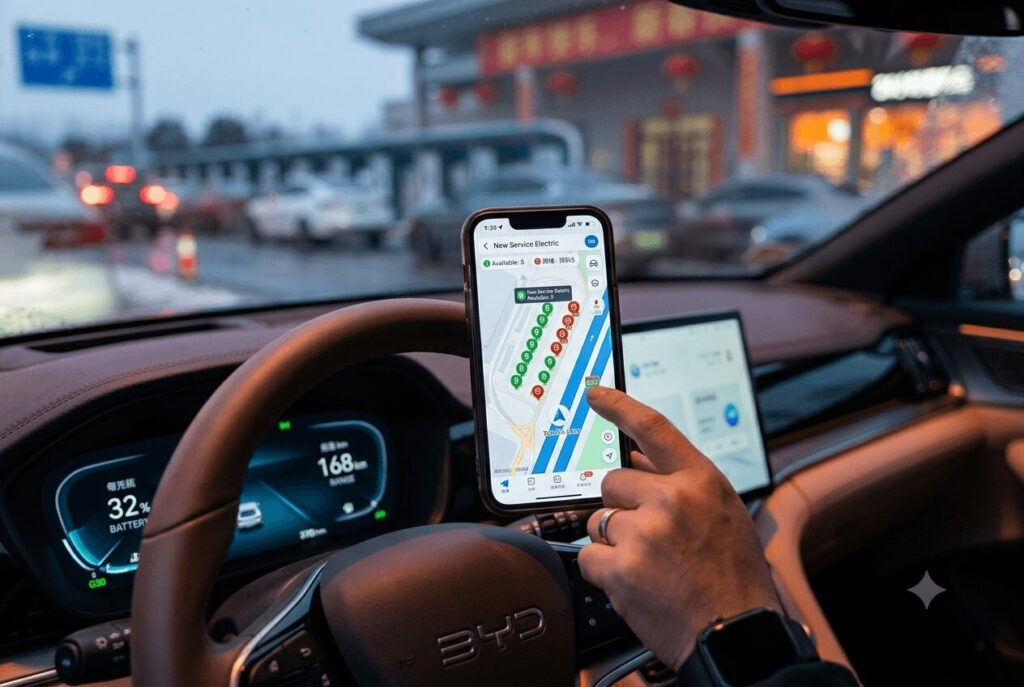
As covered in our road trip essentials guide, checking real-time charger availability through 高德地图’s EV charging layer alongside network-specific apps (国家电网, 特来电, 星星充电, and your vehicle manufacturer’s specific app) before committing to any particular charging stop is valuable during any road trip — but becomes considerably more essential during Chunyun specifically, where the gap between a charging stop’s “normal” expected availability and its actual Chunyun-peak-period reality can be dramatic.
The specific Chunyun-relevant app feature:
Many of these apps have, in recent years, begun displaying specific queue length indicators or estimated wait times at individual charging stations, sometimes crowd-sourced from other users currently at or recently departed from the location — checking these specific indicators, where available, before committing travel time to reaching a particular station provides considerably more actionable information than simply checking whether a station exists at all.
The Social Media and Group Chat Intelligence Network
An informal but genuinely valuable information source:
Beyond formal apps, Chinese EV owner communities — vehicle-brand-specific WeChat groups, regional road tripper communities, and broader EV enthusiast forums — frequently share genuinely useful real-time intelligence during Chunyun specifically, with travellers currently on the road posting updates about specific stations’ current queue status, alternative routing suggestions, and warnings about stations experiencing technical problems.
How to access this intelligence:
Joining relevant WeChat groups before your trip — searching for your specific vehicle brand combined with terms like “自驾” (self-driving/road trip) or “春节” (Spring Festival), or searching for region-specific road tripper communities relevant to your planned route — provides access to this informal but often more current and locally specific information than formal apps alone provide.
The Vehicle-Specific Considerations for Chunyun Travel
Connecting to This Guide Series’ Brand-Specific Charging Content
Why your specific vehicle’s charging speed and network access matters more during Chunyun:
As covered throughout our vehicle-specific guides — the NIO, Xpeng, and Li Auto charging guide, the BYD Seal and Han guide, the Zeekr and Xiaomi SU7 guide — different Chinese EV models have meaningfully different DC fast charging capabilities and, in some cases, access to manufacturer-specific charging networks that can provide a genuine advantage during Chunyun’s general public infrastructure congestion.
The NIO battery swap advantage during Chunyun specifically:
As covered in our NIO-specific guide, NIO’s battery swap network — offering a 3-5 minute full battery replacement rather than a 20-40+ minute charging session — provides a genuinely distinctive advantage during Chunyun’s queue-prone period, since swap stations, while also experiencing elevated demand, process each vehicle considerably faster than a charging session, meaning queue wait translates to proportionally less total time delay even when swap stations themselves experience some queuing.
The Xpeng S4 network consideration:
Similarly, Xpeng owners with access to the manufacturer’s S4 ultra-fast charging network, as covered in our Xiaomi SU7 and Zeekr guide’s broader discussion of premium charging network access, may find these manufacturer-specific networks experience somewhat less severe Chunyun congestion than the broader public State Grid and third-party network infrastructure, simply by virtue of being accessible only to a specific vehicle brand’s owners rather than the entire Chinese EV population.
The EREV and PHEV Advantage During Chunyun Specifically
Connecting to our Li Auto and broader EREV coverage:
As established throughout this guide series’ coverage of Li Auto and other extended-range electric vehicles, the petrol generator backup that defines this vehicle category provides a genuinely distinctive advantage during Chunyun specifically — EREV and PHEV owners facing severe charging queue situations at a specific service area retain the option to simply continue driving on petrol power, bypassing the charging queue entirely, in a way that pure battery electric vehicle owners cannot.
The practical Chunyun implication for EREV/PHEV owners:
While this guide series has generally emphasised maximising electric-only driving for cost and environmental reasons during normal use, Chunyun specifically represents a scenario where EREV and PHEV owners might rationally choose to rely more heavily on petrol range extension during the most severely congested travel days specifically to avoid charging queue delays, reverting to their normal electric-charging-optimised pattern once past the most acute Chunyun congestion period.
The Specific Strategies for the Worst-Case Scenario
What to Do When You Arrive at a Severely Congested Station
Step 1: Assess realistic wait time before committing
Rather than simply joining a queue without information, check whether the specific station’s app or any visible signage provides queue position or estimated wait information, and cross-reference against your remaining battery range and the availability of alternative stations within reach given your current charge level.
Step 2: Calculate whether continuing to an alternative station is viable
If your remaining range comfortably allows reaching an alternative charging location — information your navigation app should be tracking continuously — and that alternative shows better availability, continuing past a severely congested station is often the better choice than committing to an extended wait, provided your range margin genuinely supports this without creating a new, more acute range anxiety situation.
Step 3: If queuing is unavoidable, use the wait productively
If your range situation genuinely requires charging at your current location regardless of queue length, using the wait time for the practical purposes the stop would have served anyway — rest, food, restroom access, brief sleep if you’ve been driving through unusual hours as part of your Chunyun timing strategy — converts otherwise pure waiting time into at least partially useful time.
Step 4: Consider your portable charging kit as a genuine alternative
As covered extensively in our road trip essentials guide, your portable EVSE kit’s value specifically increases during Chunyun congestion scenarios — if your remaining range and timeline allow it, locating any standard socket access point (a restaurant willing to allow temporary charging access in exchange for a meal purchase, a petrol station with an available exterior socket, any willing local business) and using your portable kit for a partial top-up, even at slower AC charging speeds, can sometimes prove more time-efficient than an extended DC fast charging queue, particularly for shorter remaining-distance scenarios where a partial AC charge provides sufficient range to reach your next planned stop.
The Realistic Expectation-Setting Framework
What Chunyun EV Travel Genuinely Requires Versus What It Doesn’t
What it genuinely requires:
Meaningfully more advance planning than off-peak travel, genuine schedule flexibility and buffer time, active real-time monitoring of charging availability throughout your journey rather than passive reliance on a pre-planned static route, and psychological preparation for the possibility of experiencing at least some queuing at some point during your journey if you’re travelling on a heavily-trafficked corridor during peak dates.
What it doesn’t require:
Abandoning EV road trip plans entirely in favour of other transportation modes, panic-level anxiety about being permanently stranded, or assuming that every single charging stop throughout your entire journey will experience severe queuing — the documented severe queuing situations, while real and worth planning for, represent specific peak-hour, peak-date, peak-corridor concentrations rather than a universal condition.
The Year-Over-Year Improvement Trajectory Worth Keeping in Mind
Why this year’s Chunyun is likely somewhat better than previous years’, even with growing EV population:
As detailed earlier in this guide, the combination of expanding charging infrastructure specifically targeting documented historical bottlenecks, improving vehicle-side charging speed and cold-weather management across newer model years, and growing collective experience among both charging network operators and individual EV owners about how to navigate this specific annual challenge has produced a genuine, if gradual, improvement trajectory — meaning the most severe historical queue stories, while still possible at extreme outlier moments, represent a less universal experience for a well-prepared traveller in 2026 than they may have for less-prepared travellers in earlier years of China’s EV adoption curve.
Internal Links — Further Reading on Clean Energy Bazaar
The Spring Festival rush how to handle EV charging demand during China’s largest holiday migration guide is the seasonal peak-demand companion to the broader travel and climate guidance covered throughout this content cluster.
For the portable charger road trip essentials guide that establishes the core equipment and app-based strategies this Chunyun-specific guide builds directly upon, our best portable EV chargers for travel 2026 China national highway road trip essentials guide covers every essential travel charging consideration. For the winter EV charging guide that explains the cold-weather factors compounding with Chunyun’s timing, our winter EV charging guide 2026 cold weather performance for Harbin -30C vs wet Shanghai guide covers every cold-weather consideration relevant to Spring Festival’s winter timing. For the NIO, Xpeng, and Li Auto guide that details the battery swap and EREV advantages specifically relevant to Chunyun congestion avoidance, our best EV charger for NIO Xpeng and Li Auto home solutions for battery swap vs charging guide covers every relevant vehicle ecosystem advantage. For the charge time calculator that helps you precisely estimate how long your specific vehicle will need at any given charging stop, our EV charge time calculator 2026 how long to full for your Chinese EV BYD to NIO guide covers every major Chinese EV model. For the real user stories guide featuring genuine Chinese EV owner experiences with travel logistics and timing strategies, our user stories real EV charger setups from Chinese drivers from Shenzhen taxis to Hainan tourists guide covers eight genuine first-person accounts. And for the zombie pile crisis guide relevant to ensuring your portable charging backup equipment remains reliable specifically when you need it most during high-stakes Chunyun travel, our zombie pile crisis 2026 how to avoid dead chargers from liquidated Chinese brands guide covers the complete brand reliability framework.
Final Thoughts
The Spring Festival rush how to handle EV charging demand during China’s largest holiday migration challenge is real, well-documented, and worth taking seriously in your planning — but it is also a fundamentally manageable, predictable, and increasingly well-understood annual phenomenon rather than an insurmountable obstacle to EV road trip travel during China’s most important holiday period.
The strategies that genuinely work are not complicated: shift your departure timing away from the absolute peak windows where your circumstances allow, consider unusual departure hours specifically to access charging infrastructure during lower-demand periods, weight charging density and route redundancy alongside simple travel time when planning your specific route, build genuinely generous time buffers into your schedule rather than assuming off-peak charging speeds, actively monitor real-time availability through the combination of formal apps and informal community intelligence throughout your journey rather than relying on a static pre-planned route, and understand your specific vehicle’s particular advantages — whether NIO’s battery swap speed, an EREV’s petrol backup flexibility, or simply carrying the portable charging kit covered in our road trip essentials guide as a genuine backup option.
Millions of Chinese EV owners successfully navigate Chunyun’s charging challenges every single year, and the infrastructure, vehicle technology, and collective owner knowledge supporting this annual migration continues to improve year over year even as the underlying EV population and travel demand both continue growing. Approaching this year’s Spring Festival travel with proportionate preparation — neither dismissive complacency nor excessive anxiety — based on the realistic, documented patterns this guide has covered, gives you the best possible foundation for a Chunyun journey that, while perhaps requiring more patience at certain specific moments than your everyday driving does, ultimately gets you home to your family and back again successfully, exactly as it does for the enormous majority of Chinese EV owners who make this same journey every year.