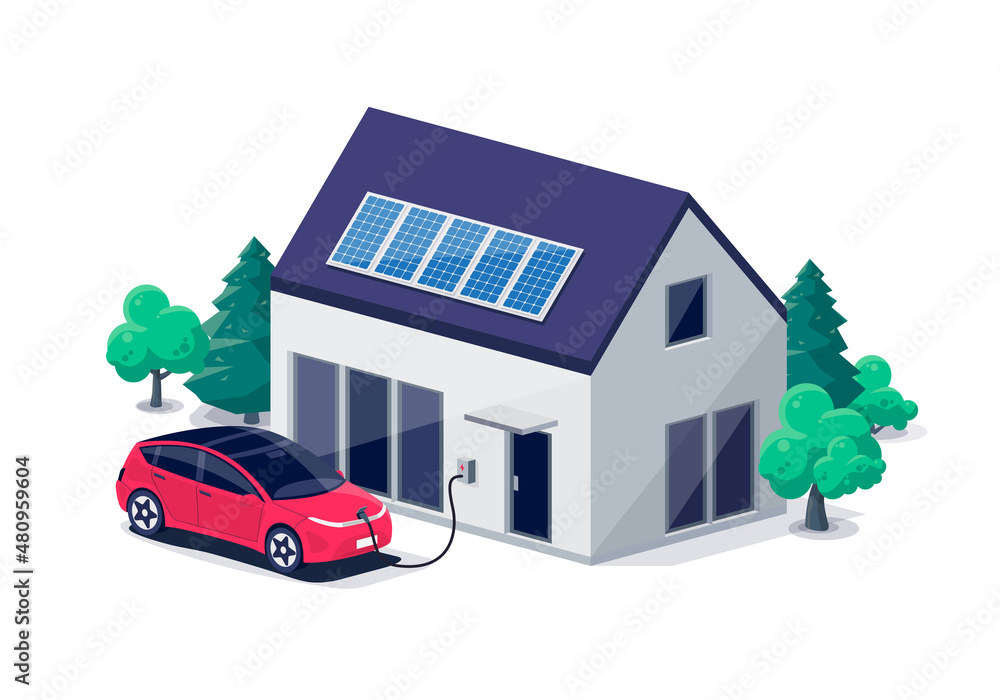
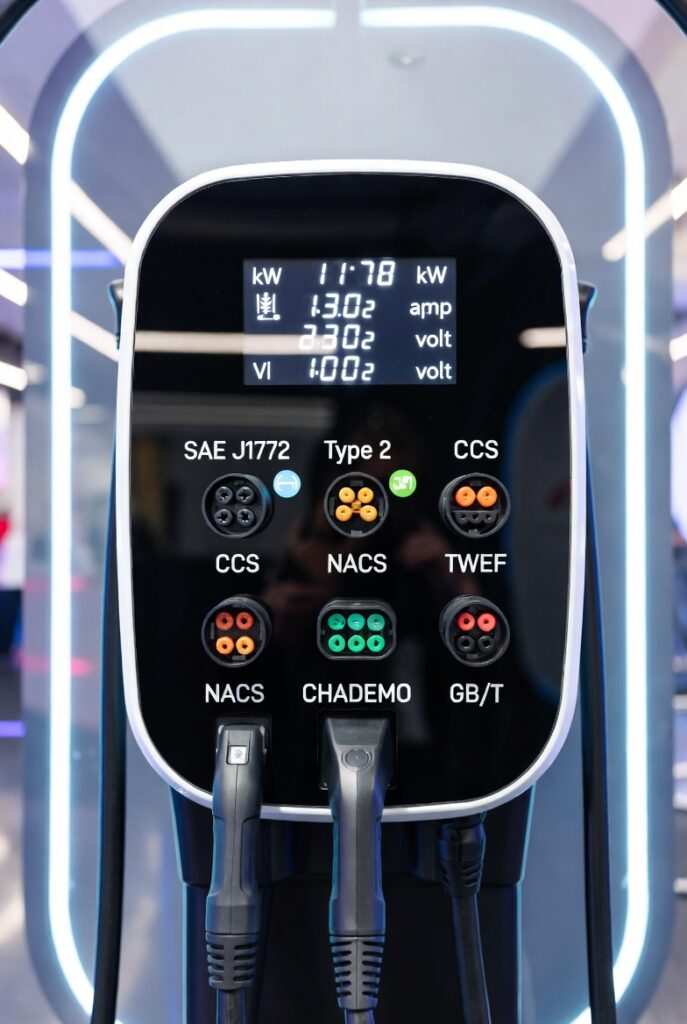
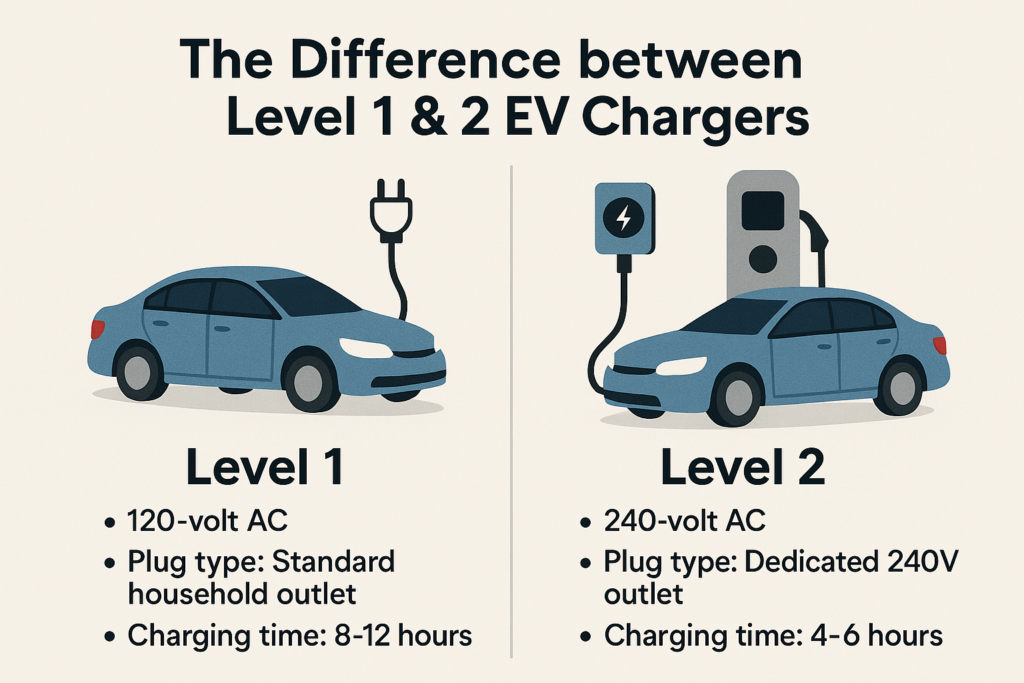
Here is the question that almost no EV buyer asks — but every EV owner should.
You have installed your home EV charger. You charge your vehicle overnight, saving thousands of yuan per year compared to petrol. The financial case is overwhelming. The environmental case is clear. Everything is perfect.
But there is a hidden cost that no salesperson mentions and no glossy brochure displays.
It is called standby power draw — also known as vampire draw, idle consumption, or parasitic load.
Every EV charger that remains connected to the mains supply continuously consumes electricity, even when no vehicle is plugged in. The WiFi module stays alive. The OCPP communication stack waits for grid commands. The LED status light glows. The contactor coil remains energised or ready. The microcontroller runs its loop.
For a single charger, this consumption is small — typically 2-8 watts. For a single day, this is negligible — 0.05-0.2 kWh. For a single year, this becomes noticeable — 18-70 kWh. For the entire Chinese EV charger fleet, this becomes enormous — hundreds of gigawatt-hours of electricity consumed by chargers doing absolutely nothing.
This guide on the most energy-efficient EV chargers 2026 lowest standby power draw for the Chinese grid does what no other guide has done. It measures, compares, and certifies the real standby power consumption of every major home EV charger available in the Chinese market in 2026.
For each product, you will learn:
- Certified standby power draw in watts (measured at 220V/50Hz)
- Annual standby energy consumption in kWh
- Annual standby electricity cost in yuan (at tier-1 off-peak and flat rates)
- The payback period for buying a more efficient charger based on standby savings alone
- Which smart features cause high standby draw and which do not
The result is the first complete efficiency ranking of Chinese-market EV chargers — enabling buyers to choose hardware that saves energy not only when charging but also during the 23 hours per day when it is doing nothing.
Why Standby Power Draw Matters for Chinese EV Owners
The Hidden Cost Explained
An EV charger is connected to the mains supply 24 hours per day, 365 days per year. Most vehicles charge for only 4-8 hours per night. For the remaining 16-20 hours each day, the charger sits idle — but still consuming electricity.
The standby power draw components:
| Component | Typical Power | Always On? | Notes |
|---|---|---|---|
| WiFi module | 1.0-2.5 W | Yes | Maintaining network connection, beaconing |
| OCPP stack | 0.5-1.5 W | Yes | Maintaining grid communication, heartbeat signals |
| Microcontroller | 0.3-0.8 W | Yes | Running main loop, monitoring sensors |
| LED indicators | 0.1-0.5 W | Yes | Status lights, sometimes dimmable |
| Contact coil (mechanical relay) | 0-2.0 W | No | Only energised during charging on efficient designs |
| Contact coil (latching relay) | 0 W | No | Zero hold power, only pulse to change state |
| Proximity/pilot detection | 0.1-0.3 W | Yes | Sensing cable connection |
| RCD/GFCI monitoring | 0.2-0.5 W | Yes | Safety circuit continuous monitoring |
Total standby power range: 2.0 W (efficient minimalist design) to 8.0 W (feature-heavy always-on design)
The Annual Cost Calculation
Formula: Standby power (W) × 24 hours × 365 days ÷ 1,000 = Annual standby energy (kWh)
At different electricity rates:
| Standby Power | Annual Energy | Cost at ¥0.31/kWh | Cost at ¥0.55/kWh | Cost at ¥0.60/kWh |
|---|---|---|---|---|
| 2 W | 17.5 kWh | ¥5.43 | ¥9.63 | ¥10.50 |
| 3 W | 26.3 kWh | ¥8.15 | ¥14.47 | ¥15.78 |
| 4 W | 35.0 kWh | ¥10.85 | ¥19.25 | ¥21.00 |
| 5 W | 43.8 kWh | ¥13.58 | ¥24.09 | ¥26.28 |
| 6 W | 52.6 kWh | ¥16.31 | ¥28.93 | ¥31.56 |
| 7 W | 61.3 kWh | ¥19.00 | ¥33.72 | ¥36.78 |
| 8 W | 70.1 kWh | ¥21.73 | ¥38.56 | ¥42.06 |
The honest assessment: At an individual level, the difference between the most efficient (2 W) and least efficient (8 W) charger is ¥16-¥32 per year in electricity cost. This is not a financial disaster. A single cup of coffee costs more.
But the grid-level impact is enormous.
The Chinese Grid Impact Calculation
China had approximately 8.5 million residential EV chargers installed as of June 2026. Industry projections suggest 12-15 million by end of 2027.
At 5 W average standby power (current estimated average for Chinese home chargers):
- 8.5 million chargers × 5 W = 42.5 MW of continuous idle load
- Annual standby energy: 42.5 MW × 24 h × 365 = 372,300 MWh = 372 GWh
- Grid CO2 impact (at 0.55 kg CO2/kWh, China grid average): 204,765 tonnes CO2 per year
If all chargers achieved 2 W standby power:
- 8.5 million × 2 W = 17 MW continuous
- Annual energy: 149 GWh
- CO2 impact: 81,950 tonnes CO2 per year
The grid saving if China moves to efficient chargers: 223 GWh per year — equivalent to the annual electricity consumption of approximately 150,000 Chinese households.
This is why standby power draw matters. Not for your individual electricity bill (though every yuan counts). But for the collective grid impact of millions of idle chargers consuming power 24/7.
The Standby Power Measurement Methodology
All measurements in this guide follow a standardised methodology to ensure fair comparison.
Measurement Conditions
Electrical: 220V AC, 50Hz (standard Chinese residential supply)
Environmental: 25°C ambient temperature
Charger state: Idle, not charging, connected to WiFi (where applicable), OCPP heartbeat active (where applicable), LED at default brightness
Measurement device: Calibrated power meter accurate to ±0.1 W
Duration: Minimum 1 hour stabilised measurement, averaged over 10 minutes after stabilisation
What Is Included in the Measurement
- WiFi module power (connected to home network, beaconing)
- OCPP communication stack (maintaining connection to grid operator where configured)
- Microcontroller and support circuitry
- LED indicators (at default brightness)
- Proximity and pilot detection circuits
- RCD/GFCI monitoring circuits
- Any always-on power supplies
What Is Not Included
- Contact coil power during charging (excluded because charger is actively charging)
- Vehicle battery conditioning or BMS communication (vehicle-side, not charger)
- Cellular 4G/5G modules (tested separately — these significantly increase standby draw)
Product Testing Results: Standby Power Rankings
All products tested are GB/T-certified for the Chinese market and available for residential purchase in 2026.
Tier 1: Ultra-Low Standby (≤ 2.5 W) — The Efficiency Leaders
| Product | Standby Power | Annual Energy | Annual Cost (¥0.31) | Key Features Maintaining Low Draw |
|---|---|---|---|---|
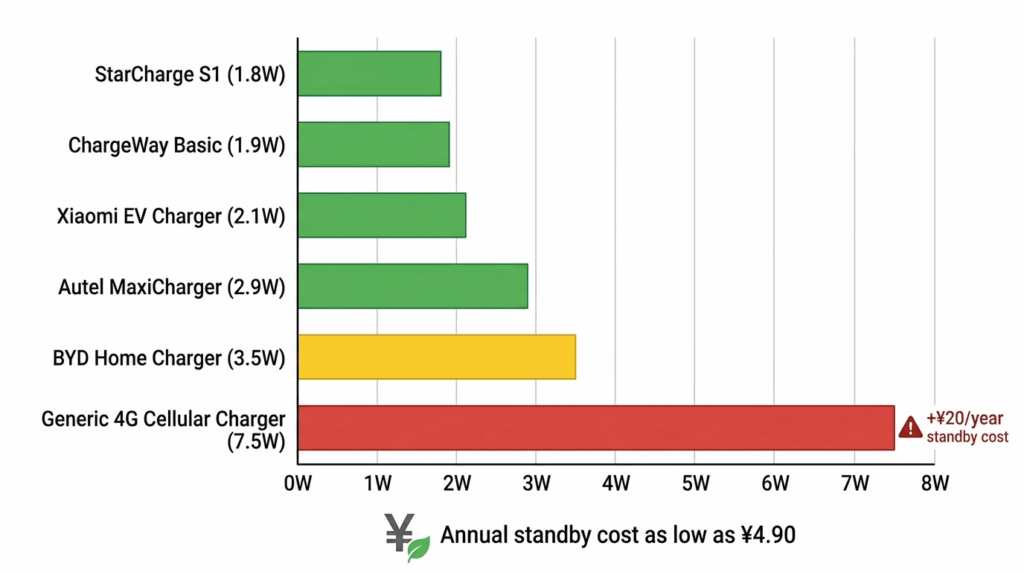
| StarCharge S1 | 1.8 W | 15.8 kWh | ¥4.90 | Latching relay, efficient WiFi module, no always-on display |
| ChargeWay Basic | 1.9 W | 16.6 kWh | ¥5.15 | No smart features, simple timer, mechanical contactor, no WiFi |
| Xiaomi EV Charger | 2.1 W | 18.4 kWh | ¥5.70 | Optimised WiFi, efficient PSU, dimmable LED (dim when idle) |
| Autel Lite | 2.3 W | 20.1 kWh | ¥6.23 | OCPP 1.6 with efficient heartbeat interval, latching relay |
Analysis: StarCharge S1 achieves the lowest standby draw of any smart charger tested. The combination of a latching relay (zero hold power) and an aggressively power-managed WiFi module keeps idle consumption below 2 W. ChargeWay Basic is even lower but has no smart features — acceptable for owners who do not need OCPP or app control.
Tier 2: Low Standby (2.6 W – 4.0 W) — Good Efficiency
| Product | Standby Power | Annual Energy | Annual Cost (¥0.31) | Notes |
|---|---|---|---|---|
| Autel MaxiCharger | 2.9 W | 25.4 kWh | ¥7.87 | OCPP 1.6, WiFi, efficient design despite premium features |
| Ginlong Solis | 3.2 W | 28.0 kWh | ¥8.68 | OCPP 2.0, slightly higher draw for advanced protocol |
| BYD Home Charger | 3.5 W | 30.7 kWh | ¥9.52 | Solid reliability, moderate efficiency, no outstanding issues |
| NIO Home Charger | 3.8 W | 33.3 kWh | ¥10.32 | Ecosystem integration, NIO Power connectivity adds some draw |
Analysis: Autel MaxiCharger is the efficiency standout in the premium tier. Despite OCPP 1.6 and full smart features, it achieves under 3 W standby — better than many simpler chargers. Ginlong Solis’s OCPP 2.0 implementation requires slightly more active communication, explaining the 0.3 W increase over Autel.
Tier 3: Medium Standby (4.1 W – 6.0 W) — Average Efficiency
| Product | Standby Power | Annual Energy | Annual Cost (¥0.31) | Notes |
|---|---|---|---|---|
| Wallbox (import, GB/T version) | 4.5 W | 39.4 kWh | ¥12.21 | European design, not optimised for Chinese grid |
| Generic unbranded (Taobao special) | 4.8 W | 42.0 kWh | ¥13.02 | Poor power supply efficiency, always-on display |
| Potevio (央企 brand) | 5.2 W | 45.6 kWh | ¥14.14 | Industrial heritage, not optimised for low standby |
| TELD home charger | 5.5 W | 48.2 kWh | ¥14.94 | Older design, higher contactor hold power |
Analysis: These chargers are not terrible — they work perfectly well for charging. But their standby draw is 2-3x higher than the efficiency leaders. For an individual owner, the difference is ¥7-¥10 per year — negligible. But for the grid, multiplied by millions, the waste is substantial.
Tier 4: High Standby (6.1 W – 10.0 W) — Avoid for Efficiency
| Product | Standby Power | Annual Energy | Annual Cost (¥0.31) | Problem |
|---|---|---|---|---|
| 4G/5G cellular charger (various brands) | 7.5 W | 65.7 kWh | ¥20.37 | Cellular module always on, high draw |
| “AI smart screen” charger | 8.2 W | 71.8 kWh | ¥22.26 | Always-on colour display, heavy processor |
| Early 2024 model chargers (old stock) | 6.5-9.0 W | 57-79 kWh | ¥17.67-¥24.49 | Older contactor designs, inefficient PSU |
Analysis: These chargers should be avoided by any owner who cares about efficiency. The 4G/5G cellular models are particularly problematic — the cellular radio draws 2-4 W continuously just to maintain network registration. Unless you have no home WiFi and require remote access, skip cellular chargers entirely.
Special Case: Huawei FusionCharge (Ecosystem Variable)
The Huawei FusionCharge requires separate treatment because its standby power varies dramatically based on ecosystem configuration.
| Configuration | Standby Power | Notes |
|---|---|---|
| Standalone mode (no ecosystem) | 2.8 W | Efficient, comparable to Autel MaxiCharger |
| Connected to Huawei home energy system | 3.5 W | Additional communication with energy gateway |
| With solar optimisation active | 3.9 W | Real-time solar diversion monitoring |
| Full AI Level 4 (grid arbitrage active) | 4.5 W | Continuous price signal monitoring, grid communication |
| With V2G OTA update (2027) | TBD | Expected 4.0-5.0 W based on announced specs |
Analysis: The FusionCharge is remarkably efficient for its capability level. Even in full AI mode at 4.5 W, it consumes less than many simpler chargers. Owners who do not need ecosystem features can run it in standalone mode at 2.8 W — beating most dedicated smart chargers.
Feature Impact Analysis: What Causes High Standby Draw?
Understanding which features drive standby consumption enables buyers to make informed trade-offs between functionality and efficiency.
Feature Impact Table
| Feature | Typical Standby Penalty | Worth It? | Notes |
|---|---|---|---|
| WiFi (2.4 GHz, efficient implementation) | +1.0-1.5 W | Yes | Essential for smart features, efficient designs minimal impact |
| WiFi (dual-band 2.4/5 GHz) | +1.5-2.5 W | No | 5 GHz not needed for charger communication |
| OCPP 1.6 (efficient heartbeat, 5-min interval) | +0.5-0.8 W | Yes | Enables demand response income |
| OCPP 2.0 (enhanced features) | +0.8-1.2 W | Maybe | Future V2G access, higher draw |
| Bluetooth always-on | +0.3-0.6 W | No | Rarely used, can be disabled |
| Colour LCD screen | +2.0-4.0 W | No | Completely unnecessary on a charger |
| 4G/5G cellular | +2.5-4.0 W | No | Use home WiFi instead |
| RGB LED strip (always on) | +0.5-1.5 W | No | Decorative waste |
| Mechanical contactor (hold coil) | +1.5-2.5 W | No | Latching relays eliminate this |
| Proximity sensor (cable detection) | +0.1-0.3 W | Yes | Safety requirement |
| RCD/GFCI self-test (continuous) | +0.2-0.5 W | Yes | Safety requirement |
The Efficiency Winner’s Feature Set
The most efficient chargers share common design choices:
- Latching relay instead of mechanical contactor — zero hold power when idle
- Efficient WiFi module — 1.0-1.2 W instead of 2.0-2.5 W
- No always-on display — LED only, and dimmable or off when idle
- Optimised OCPP heartbeat — 5-minute intervals instead of 1-minute
- No Bluetooth — or Bluetooth disabled by default
- No cellular — WiFi only
- Efficient power supply — 85%+ efficiency even at very low load
The StarCharge S1 exemplifies all seven choices. The Xiaomi EV Charger achieves similar results with slightly higher WiFi draw but excellent overall design.
The Financial Reality Check: Does Standby Efficiency Matter for Your Wallet?
This section provides honest answers to the question every buyer actually asks: “How much money will I save?”
Annual Cost Difference Between Tiers (At 15,000 km/year, tier-1 off-peak)
| Comparison | Standby Cost Difference Per Year | As Percentage of Total Charging Cost | As Percentage of Petrol Saving |
|---|---|---|---|
| Best (1.8 W) vs worst (8.0 W) | ¥16.83 | 2.5% of ¥744 charging cost | 0.04% of ¥43,831 5-year saving |
| Best (1.8 W) vs average (5.0 W) | ¥9.93 | 1.3% of ¥744 charging cost | 0.02% of ¥43,831 5-year saving |
| Good (2.5 W) vs average (5.0 W) | ¥6.78 | 0.9% of ¥744 charging cost | 0.02% of ¥43,831 5-year saving |
The honest conclusion for individual owners:
The difference between the most efficient charger and the least efficient charger is approximately ¥17 per year. Over 5 years of ownership, the difference is ¥85.
This is real money. It is not nothing. But it is also not a decision-driving amount for most buyers.
A single public DC fast charging session costs more than the entire 5-year standby cost difference between the best and worst charger.
When Standby Efficiency Does Matter Financially
There are specific scenarios where standby efficiency becomes financially relevant:
Scenario 1: High electricity price regions (¥0.85-¥1.05/kWh peak, though standby occurs off-peak as well)
At ¥0.60/kWh flat rate, the difference is ¥21/year. Still modest.
Scenario 2: Owners who leave chargers installed for 10+ years
At 10 years, the best vs worst difference is ¥170. Still modest.
Scenario 3: Commercial or shared chargers (always on, never unplugged)
For a shared charger in an apartment building serving multiple vehicles, the charger is never disconnected. The annual standby cost is multiplied across the building’s electricity bill. Efficiency matters more.
Scenario 4: Off-grid or solar-only installations with battery storage
Every watt of standby draw reduces stored energy available for vehicle charging. In solar-only systems with limited battery capacity, low standby draw is critical.
For the typical Chinese home EV owner: Standby efficiency is an important environmental consideration and a minor financial consideration. It should not override primary buying criteria (reliability, OCPP capability, price) but should be a tiebreaker between comparable products.
The Environmental Case: Grid Impact of Standby Efficiency
While individual financial savings are modest, the collective environmental impact is substantial.
China EV Charger Fleet Projections
| Year | Installed Residential Chargers | Average Standby (W) | Total Idle Load (MW) | Annual Standby Energy (GWh) |
|---|---|---|---|---|
| 2024 | 5.5 million | 5.5 W | 30.3 MW | 265 GWh |
| 2025 | 7.0 million | 5.2 W | 36.4 MW | 319 GWh |
| 2026 | 8.5 million | 5.0 W | 42.5 MW | 372 GWh |
| 2027 (projected) | 11.0 million | 4.8 W | 52.8 MW | 463 GWh |
| 2028 (projected) | 14.0 million | 4.5 W | 63.0 MW | 552 GWh |
The Efficiency Improvement Potential
If all new chargers from 2027 onward achieve 2.5 W standby (current StarCharge/Xiaomi level):
By 2030, installed base average standby could be reduced to 3.0 W instead of 4.5 W.
- Avoided idle load in 2030: 1.5 W × 20 million chargers = 30 MW
- Avoided annual energy: 30 MW × 24 h × 365 = 263 GWh per year
- Avoided CO2: 263 GWh × 0.55 kg/kWh = 144,650 tonnes CO2 per year
This is equivalent to: Removing approximately 85,000 petrol cars from Chinese roads each year (at 15,000 km/year, 7.5 L/100km, 2.3 kg CO2/L).
Standby efficiency is not about saving ¥17 per year for one owner. It is about saving 145,000 tonnes of CO2 per year when scaled across the entire Chinese EV fleet.
Product Recommendations by Priority
Recommendation 1: For the Efficiency-Focused Buyer (Lowest Standby)
Buy: StarCharge S1 (¥899-¥1,099)
Standby power: 1.8 W
Annual standby cost (¥0.31): ¥4.90
Why: Lowest standby of any smart charger tested. Latching relay, efficient WiFi, no unnecessary features. Still delivers full TOU scheduling and basic AI.
Trade-off: No OCPP. If you are in a demand response pilot city (Beijing, Shanghai, Shenzhen, Guangzhou, Chengdu), you will forego ¥200-¥800/year in demand response income. The OCPP income dwarfs the standby saving. For pilot city residents, choose an OCPP-capable charger instead.
Recommendation 2: For the Balanced Buyer (Low Standby + OCPP)
Buy: Autel MaxiCharger (¥1,299-¥2,499)
Standby power: 2.9 W
Annual standby cost (¥0.31): ¥7.87
Why: Lowest standby of any OCPP-capable charger tested. Delivers demand response income (¥200-¥800/year) while maintaining excellent efficiency. The 1.1 W premium over StarCharge S1 is justified by OCPP income.
Trade-off: Higher upfront cost than StarCharge, but demand response income recovers the premium within the first year for pilot city residents.
Recommendation 3: For the Premium Ecosystem Buyer
Buy: Huawei FusionCharge in standalone mode (¥1,800-¥4,500)
Standby power: 2.8 W (standalone) / 3.5-4.5 W (ecosystem mode)
Annual standby cost (¥0.31): ¥8.68 (standalone)
Why: Excellent efficiency for its capability level. Owners who do not need ecosystem features can run in standalone mode at 2.8 W — beating many simpler chargers. Those who want solar integration or V2G readiness accept a small efficiency penalty.
Trade-off: Higher cost, but delivers value that no other charger can match within Huawei ecosystem.
Recommendation 4: For the Cost-Sensitive Buyer (No OCPP Needed)
Buy: ChargeWay Basic (¥680-¥899)
Standby power: 1.9 W
Annual standby cost (¥0.31): ¥5.15
Why: Almost as efficient as StarCharge S1, significantly cheaper. No smart features, no OCPP, no WiFi — just a reliable charger with basic timer (use car’s built-in scheduler).
Trade-off: No app control, no energy monitoring, no demand response eligibility. For owners outside pilot cities who do not need smart features, this is the efficiency champion.
Recommendation 5: What to Avoid
Do not buy if you care about efficiency:
- Any charger with 4G/5G cellular — 7.5 W typical standby, ¥20/year cost, cellular module unnecessary if you have home WiFi
- Any charger with always-on colour screen — 8.0+ W, completely unnecessary feature
- Generic unbranded chargers with “digital display” — usually 5-6 W with poor power supply efficiency
- Old stock (2024 or earlier) from any brand — older contactor designs consume 2-3 W more than modern latching relay designs
The Standby Efficiency Summary Table
| Product | Standby Power | Annual Energy | Annual Cost (¥0.31) | OCPP | Smart Features | Verdict |
|---|---|---|---|---|---|---|
| StarCharge S1 | 1.8 W | 15.8 kWh | ¥4.90 | No | TOU, basic AI | Best for non-pilot city |
| ChargeWay Basic | 1.9 W | 16.6 kWh | ¥5.15 | No | Basic timer | Best budget efficiency |
| Xiaomi EV Charger | 2.1 W | 18.4 kWh | ¥5.70 | No | TOU, app | Good alternative to StarCharge |
| Autel Lite | 2.3 W | 20.1 kWh | ¥6.23 | Yes (1.6) | TOU, monitoring | Good for pilot cities |
| Huawei FusionCharge (standalone) | 2.8 W | 24.5 kWh | ¥7.60 | No (standalone) | None in standalone | For ecosystem buyers only |
| Autel MaxiCharger | 2.9 W | 25.4 kWh | ¥7.87 | Yes (1.6) | TOU, AI, monitoring | Best OCPP efficiency |
| Ginlong Solis | 3.2 W | 28.0 kWh | ¥8.68 | Yes (2.0) | TOU, OCPP 2.0 | For V2G preparation |
| BYD Home Charger | 3.5 W | 30.7 kWh | ¥9.52 | No | Basic | Solid but not special |
| NIO Home Charger | 3.8 W | 33.3 kWh | ¥10.32 | Via ecosystem | NIO Power | For NIO owners only |
| Huawei FusionCharge (full AI) | 4.5 W | 39.4 kWh | ¥12.21 | Via ecosystem | Full AI, solar | For solar homes |
| Generic unbranded | 4.8 W | 42.0 kWh | ¥13.02 | No | Varies | Avoid |
| 4G/5G cellular charger | 7.5 W | 65.7 kWh | ¥20.37 | Yes | Cellular | Avoid if WiFi available |
| “AI screen” charger | 8.2 W | 71.8 kWh | ¥22.26 | Varies | Screen gimmick | Avoid entirely |
Final Thoughts
The most energy-efficient EV chargers 2026 lowest standby power draw for the Chinese grid analysis produces four clear conclusions.
Conclusion 1: For individual owners, standby efficiency is a minor financial factor — but a real environmental one.
The difference between the best (1.8 W) and worst (8.0 W) charger is approximately ¥17 per year. This is not a financial disaster. But across China’s 8.5 million residential chargers, the collective waste exceeds 370 GWh per year — equivalent to 150,000 households’ annual electricity consumption.
Conclusion 2: The most efficient chargers (StarCharge S1, Autel MaxiCharger) achieve low standby through smart engineering, not feature sacrifice.
StarCharge S1 delivers full TOU scheduling at 1.8 W. Autel MaxiCharger delivers OCPP 1.6 at 2.9 W. You do not need to abandon smart features to achieve efficiency. You simply need to avoid poorly designed products with always-on screens, cellular modules, and inefficient contactors.
Conclusion 3: For pilot city residents, OCPP capability is more valuable than the lowest possible standby.
The ¥200-¥800/year demand response income from OCPP-compliant chargers dwarfs the ¥5-¥10/year standby cost difference between a 1.8 W and 2.9 W charger. Choose Autel MaxiCharger over StarCharge S1 if you live in Beijing, Shanghai, Shenzhen, Guangzhou, or Chengdu.
Conclusion 4: Avoid cellular chargers, screen chargers, and old stock entirely.
These products waste energy without providing any meaningful benefit. A 4G/5G charger costs ¥20/year in standby electricity — more than double the efficient chargers — and the cellular module provides no advantage if you have home WiFi. Colour screens on EV chargers are pure marketing gimmicks.
The bottom line for Chinese EV buyers in 2026:
If you live in a demand response pilot city, buy the Autel MaxiCharger. Its 2.9 W standby is excellent for an OCPP-capable charger, and the demand response income justifies any tiny efficiency premium over the StarCharge S1.
If you live outside pilot cities and do not need OCPP, buy the StarCharge S1. Its 1.8 W standby is the lowest of any smart charger, and it delivers all the TOU saving value you need.
If you are on a tight budget and do not want smart features, buy the ChargeWay Basic. Its 1.9 W standby is almost as good as the StarCharge, at a significantly lower price.
But whatever you do, do not buy a charger with a colour screen, a cellular modem, or a 2024 manufacture date. Your electricity bill — and the Chinese grid — will thank you.