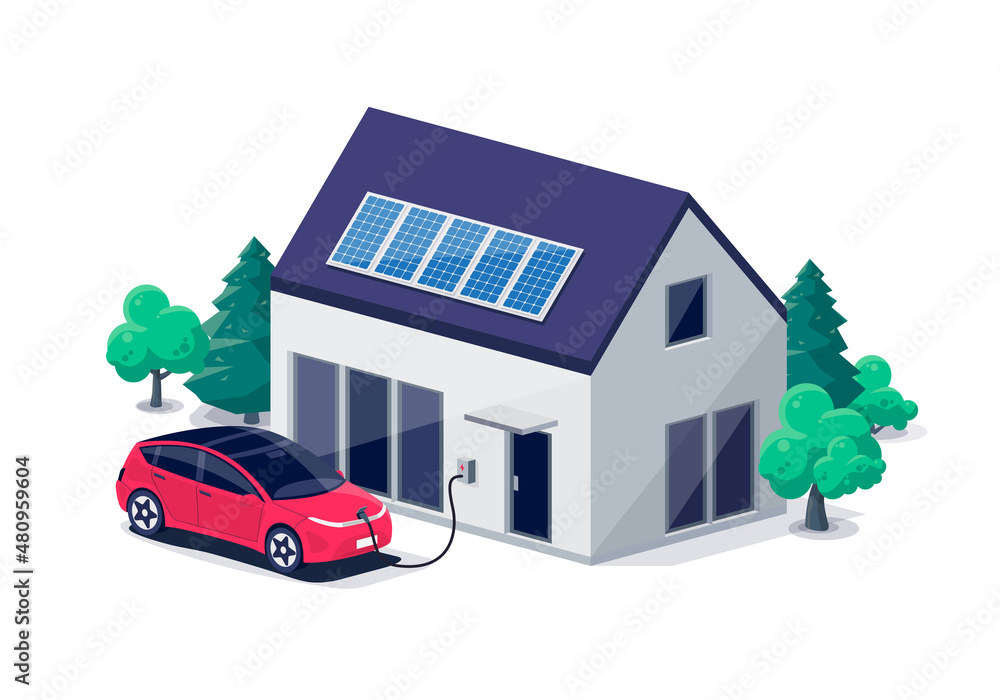
Here is the moment that happens to almost every new EV owner within the first week of ownership.
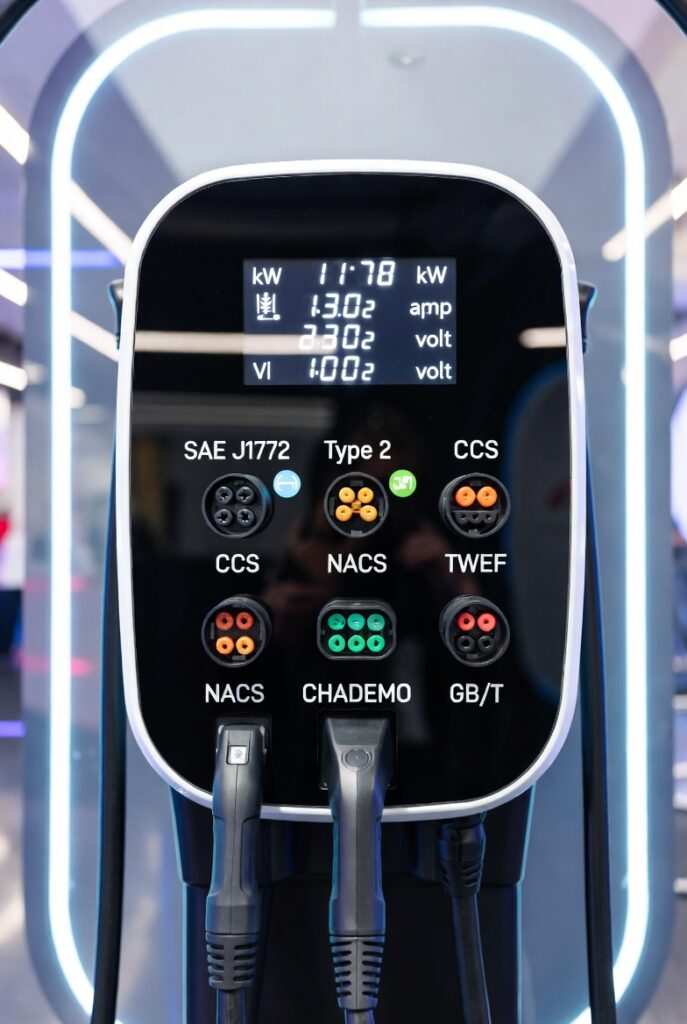
You open the specification sheet for your home charging unit. Or you look at the charging station screen. Or you read the description on your car manufacturer’s website. And you see a list of numbers — 7 kW, 32A, 400V, 11 kW three-phase, GB/T 20234.3, 250 kW DC, 800V architecture — with no explanation of what any of them mean, how they relate to each other, or which ones actually matter for your daily charging decisions.
Most people close the tab and just plug in the car.
This works fine — until it doesn’t. Until you arrive at a public charging station and don’t understand why your 120 kW-capable car is only charging at 50 kW. Until you buy a home charger rated at 22 kW and discover it charges your car at exactly the same speed as your neighbour’s 7 kW charger. Until you read about 800V architecture in a new Chinese EV and don’t know whether that changes what charger you need at home.
This guide on understanding EV charger specs 2026 kW amps 800V architecture and the new GB standards translates every relevant specification into plain language — covering both the international EV charging specifications that appear across US and European charging guides, and the GB/T and ChaoJi standards specific to the Chinese market. It is written for English-reading Chinese EV owners, Chinese expats navigating both Chinese and international charging infrastructure, and any reader who wants to understand the technical specifications well enough to make genuinely informed decisions rather than guessing.
Why EV Charger Specifications Are Confusing — The Root Cause
Before explaining individual specifications, identifying why EV charger specs are confusing prevents the same misunderstandings from recurring after you finish reading.
The Ceiling Problem
EV charging speed is always determined by the lowest ceiling in the chain — not the highest number on any individual component’s specification sheet.
The chain has three components:
- The electrical supply (grid connection to your home or charging station)
- The charging unit (home charger or public station)
- The vehicle’s onboard charger (internal component converting incoming electricity for the battery)
Whichever of these three has the lowest power ceiling determines your actual charging speed. Every other component’s higher rating is irrelevant above that ceiling.
Example:
- Your home’s electrical supply: single-phase 220V, 32A maximum = 7 kW ceiling
- Your home charging unit: rated for 22 kW
- Your vehicle’s AC onboard charger: accepts up to 11 kW
Actual charging speed: 7 kW — determined by the electrical supply, which is the lowest ceiling.
The 22 kW charger rating is entirely irrelevant. The 11 kW vehicle rating is partially irrelevant (relevant only if supply could be upgraded). Understanding this ceiling principle resolves approximately 60% of all EV charging specification confusion.
The AC vs DC Distinction
The second major source of confusion is the conflation of AC charging specifications and DC fast charging specifications. They are fundamentally different processes with different relevant numbers.
AC charging:
- Electricity comes from the grid as AC (alternating current)
- Enters the vehicle through the AC charging connector (GB/T AC, Type 2, J1772, NACS AC)
- The vehicle’s onboard AC-to-DC converter (onboard charger) converts it to DC for the battery
- The onboard charger’s capacity is the ceiling for AC charging speed
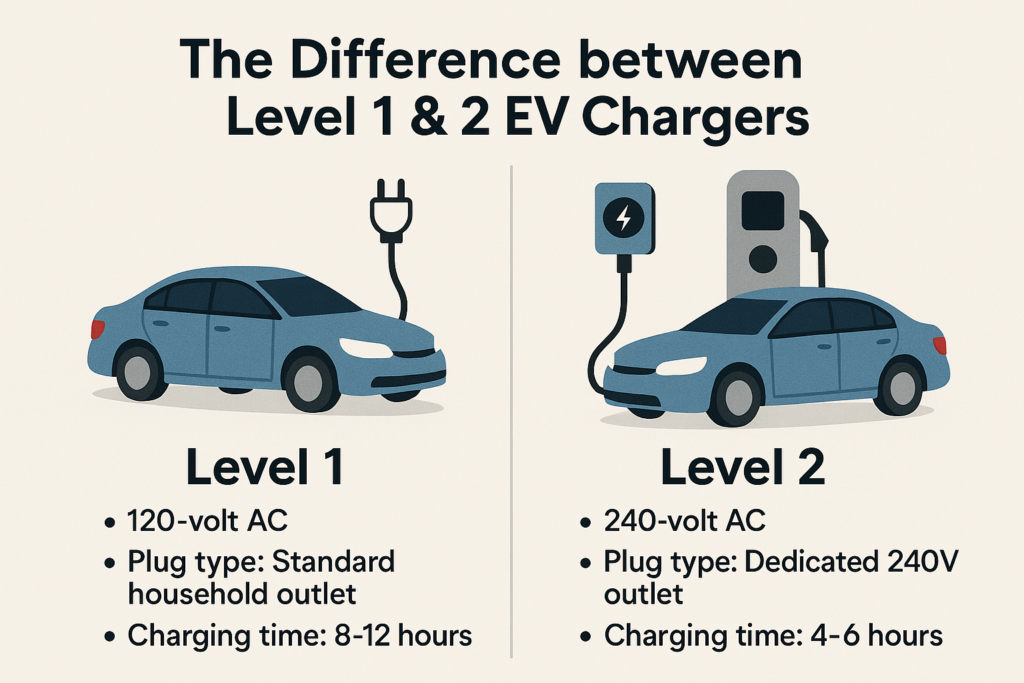
- Home charging is always AC
DC fast charging:
- A DC fast charger at a public station does the AC-to-DC conversion outside the vehicle
- Delivers DC (direct current) directly to the battery through the DC fast charging connector (GB/T DC, CCS2, CCS1, NACS DC)
- Bypasses the onboard AC-to-DC converter entirely
- The vehicle’s battery management system (BMS) and maximum DC acceptance rate are the ceiling
- Public fast charging is usually DC
The practical implication: Your vehicle has two separate charging specifications — one for AC (home/slow charging) and one for DC (fast/public charging). They are independent of each other. A vehicle with a modest AC charging rate (7 kW) can have a very high DC charging rate (250 kW), and vice versa.
The Core Electrical Specifications — Explained
Watts (W) and Kilowatts (kW) — The Power Specification
What it is: Watts measure power — the rate at which energy is transferred. Kilowatts are simply thousands of watts. 7 kW = 7,000 watts.
Why it matters for EV charging: The kW rating of a charger tells you how quickly it adds energy to your battery. More kW = faster charging.
The relationship between kW and charging time:
Charging time (hours) = kWh to add ÷ kW charging rate
A 60 kWh battery charging from 20% to 80% (adding 36 kWh) at 7 kW: 36 ÷ 7 = 5.14 hours (approximately 5 hours 8 minutes)
The same battery at 120 kW DC: 36 ÷ 120 = 0.3 hours (approximately 18 minutes)
kW in the Chinese context: Chinese home charging units are typically 7 kW (single-phase 220V, 32A). Public AC stations range from 7 kW to 22 kW. DC fast charging stations range from 30 kW to 480 kW and beyond with ChaoJi.
What “maximum power” means on a charger spec sheet: The maximum power a charger can output — not necessarily what it will output with your vehicle. Your vehicle’s onboard charger ceiling applies.
Amperes (A) — The Current Specification
What it is: Amperes (amps) measure electrical current — the flow of electrons through the circuit. More amps = more electrons flowing = more power delivered (at the same voltage).
The relationship between amps, volts, and watts:
Power (W) = Voltage (V) × Current (A) × Power Factor
For a simple single-phase calculation: 7,000 W = 220 V × 32 A × 1.0 (power factor approximately 1 for resistive loads)
Why amps matter for EV charging:
The amperage of a charging circuit determines the circuit breaker size, the cable gauge required, and the maximum power deliverable at a given voltage. When you see “32A circuit” on a charger specification, it means:
- UK/China single-phase: 32A × 230V (UK) or 220V (China) = approximately 7.4 kW or 7.0 kW
- European three-phase: 32A × 400V × √3 = approximately 22 kW (per three-phase connection)
Chinese residential amperage context: Standard Chinese residential electrical supply is single-phase 220V with a main circuit breaker typically rated 40-60A for the whole apartment. A dedicated EV charging circuit is typically 32A — requiring a 32A breaker and appropriately sized cable (typically 6mm² copper for 32A at Chinese residential supply distances).
Amps in the Chinese charging standard context:
- GB/T AC standard: up to 32A single-phase or 32A per phase three-phase
- GB/T DC standard: up to 400A (for 250 kW at 625V)
- ChaoJi: up to 600A (for 900 kW at 1,500V)
Volts (V) — The Voltage Specification
What it is: Volts measure electrical potential — the “pressure” driving electrons through the circuit. Higher voltage at the same current means more power.
Voltage in AC charging context:
| Market | Standard AC Voltage | Notes |
|---|---|---|
| China | 220V single-phase / 380V three-phase | Standard residential and commercial supply |
| UK | 230V single-phase / 400V three-phase | Single-phase standard for most homes |
| Continental Europe | 230V single-phase / 400V three-phase | Three-phase more common in residential than UK |
| United States | 120V single-phase / 240V split-phase | Different from all other markets |
Why voltage matters for home charging: The voltage of your electrical supply determines the maximum power achievable at a given amperage. Chinese single-phase 220V at 32A gives 7.04 kW. European 230V at 32A gives 7.36 kW. The difference is minor in practice — both are referred to as “7 kW” charging.
800V architecture — the most important voltage specification in 2026: This is covered in detail below as its own major section, because 800V architecture is the most significant voltage-related development in current EV technology.
kWh — The Energy Specification
What it is: Kilowatt-hours measure energy — not power, but the total amount of energy stored or transferred. kW × hours = kWh.
Why it matters for EV charging: Your EV battery’s capacity is measured in kWh. This determines:
- Total range available (kWh ÷ vehicle efficiency in kWh/km = km range)
- How much energy needs to be added to charge from X% to Y%
- How long any given charging rate will take
The kWh calculation:
Energy to add = Battery usable capacity (kWh) × (Target SOC% – Current SOC%) ÷ 100
For a BYD Han EV with 76.9 kWh usable battery, charging from 20% to 80%: 76.9 × (80-20) ÷ 100 = 76.9 × 0.6 = 46.14 kWh to add
At 7 kW home charging: 46.14 ÷ 7 = 6.6 hours (6 hours 36 minutes) At 120 kW DC fast charging: 46.14 ÷ 120 = 0.38 hours (approximately 23 minutes)
kWh in Chinese EV context: Major Chinese EV battery capacities in 2026:
| Vehicle | Usable Battery | CLTC Range |
|---|---|---|
| BYD Seagull (small) | 30.1 kWh | 405 km |
| BYD Dolphin | 44.9 kWh | 427 km |
| BYD Atto 3 | 60.5 kWh | 480 km |
| BYD Han EV | 76.9 kWh | 605 km |
| BYD Seal | 82.5 kWh | 700 km |
| NIO ET5 | 75 kWh / 100 kWh / 150 kWh | 550/700/1000 km |
| Xpeng G9 | 98 kWh | 702 km |
| Li Auto L9 (PHEV) | 42.8 kWh electric | 215 km electric |
| Tesla Model 3 (China) | 60 kWh | 556 km |
Power Factor — The Efficiency Specification
What it is: Power factor measures how effectively the charger converts apparent power (VA — volt-amperes) drawn from the grid into real power (W — watts) delivered to the vehicle.
Why it matters: A charger with power factor of 0.95 delivers 95% of the apparent power drawn from the supply as real power. A charger with power factor of 0.80 wastes 20% as reactive power — you’re paying for electricity that doesn’t charge your car.
In practice: Modern home EV chargers include Power Factor Correction (PFC) circuitry that maintains power factor above 0.95 — meaning less than 5% reactive power loss. EU Ecodesign regulations and GB/T standards both require minimum power factor compliance.
For Chinese EV owners: Power factor is a specification to verify is above 0.95 when evaluating home charging units. Below 0.95 represents avoidable electricity waste. Most certified GB/T home charging units meet this requirement.
Charging Efficiency — The Conversion Loss Specification
What it is: The percentage of electricity drawn from the charger that actually reaches the battery. The remainder is lost as heat during conversion.
Typical values:
- AC home charging (onboard charger conversion): 88-97% efficiency
- DC fast charging: 92-98% efficiency
The practical implication: At 95% charging efficiency, a 7 kW charger draws 7 kW from the supply but delivers approximately 6.65 kW to the battery. Over a 6.6-hour charging session (BYD Han EV, 20-80%), approximately 1.5 kWh is lost as heat — at Chinese residential rates of ¥0.50/kWh, this represents approximately ¥0.75 of wasted electricity per charging session.
Over a year of daily charging: 365 × ¥0.75 = ¥274 in annual charging losses at 95% efficiency vs 100% (theoretical perfect) efficiency
At 90% efficiency (lower-quality charger), annual losses are approximately ¥548. The difference between a well-designed 95% efficient charger and a poorly-designed 90% efficient charger: approximately ¥274/year.
This explains why efficiency specifications matter for chargers used daily — and why EU Ecodesign and GB/T standards mandate minimum efficiency thresholds.
SOC (State of Charge) — The Battery Level Specification
What it is: SOC is the battery’s current charge level expressed as a percentage of full capacity. 80% SOC means the battery contains 80% of its maximum charge.
Why it matters for charging: EV batteries don’t charge at a constant rate from 0% to 100% SOC. Charging slows progressively above approximately 80% SOC — a deliberate design choice to protect battery longevity.
The charging curve:
- 10% to 80% SOC: maximum charging rate (or close to it)
- 80% to 90% SOC: approximately 60-70% of maximum rate
- 90% to 100% SOC: approximately 20-40% of maximum rate
The practical implication: When manufacturers quote DC fast charging time (e.g. “BYD Han EV charges to 80% in 35 minutes at 120 kW”), they’re quoting the 10-80% segment which charges at maximum speed. Adding the final 20% (80-100%) takes as long as the first 70% in some cases.
For daily charging: Target 80% SOC for daily use. This is faster to reach, easier on battery longevity, and adequate for most daily commuting. Reserve 100% charges for days when maximum range is needed.
C-Rate — The Charging Speed Relative to Battery Size
What it is: C-rate expresses charging power relative to battery capacity. 1C means charging at a rate that would fill the battery in 1 hour. 4C means charging at 4× the battery capacity per hour.
Why it matters: C-rate is how battery manufacturers specify safe charging speeds regardless of actual battery size. A “4C capable” battery with 100 kWh capacity can safely accept 400 kW charging (100 kWh × 4 = 400 kW). The same 4C rating on a 50 kWh battery means 200 kW maximum.
CATL Shenxing’s 4C significance: CATL’s Shenxing (神行) battery technology, announced as the world’s first mass-production 4C battery, can be charged at 4× its capacity per hour. A 100 kWh Shenxing battery can safely accept 400 kW — enabling 10-80% in approximately 10 minutes on compatible ultra-fast infrastructure.
C-rate examples in Chinese EVs (2026):
| Vehicle/Battery | C-Rate | Battery Size | Max DC Charge Rate |
|---|---|---|---|
| Standard Li-ion (most EVs) | 1-2C | Various | 1-2× battery kWh |
| BYD Blade Battery | 2C | Various | 2× battery kWh |
| CATL Shenxing | 4C | Various | 4× battery kWh |
| BYD Yangwang U9 | 5C+ | 83 kWh | 415+ kW |
| Xpeng G9 Ultra | 4.8C | 98 kWh | 480 kW |
The 800V Architecture Deep Dive — The Most Important Technical Development of 2026
800V battery architecture is the single most significant technical specification difference between conventional EVs and the most advanced current Chinese and international EVs — and it is the most commonly misunderstood specification in 2026.
What 400V Architecture Means (The Conventional Baseline)
Most EVs sold between 2010 and 2022 — including most current mainstream EVs globally — use 400V battery architecture. This means:
- The battery pack operates at approximately 300-420V nominal voltage
- DC fast charging uses 400V DC
- Maximum practical DC charging rate: approximately 50-150 kW (higher than this at 400V requires very high current, which creates heat management challenges)
400V Chinese EVs:
- BYD Han EV: 400V architecture
- BYD Seal Standard: 400V architecture
- NIO ET5 (Standard battery): 400V architecture
- Most current mainstream Chinese EVs
What 800V Architecture Means
800V architecture means the battery pack operates at approximately 600-900V nominal voltage — approximately double the 400V baseline.
The physics of why this matters:
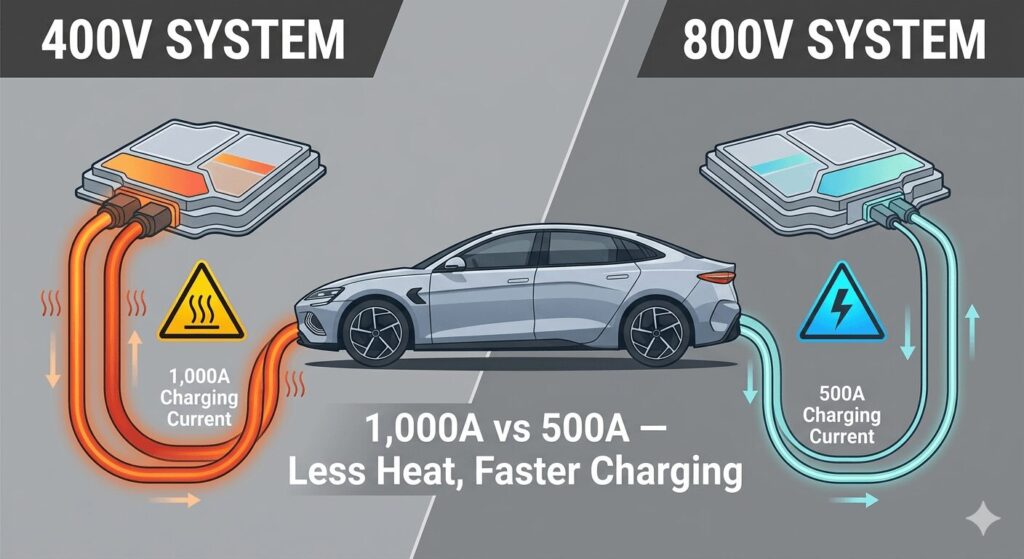
Power = Voltage × Current (P = V × I)
To deliver 400 kW at 400V requires: 400,000 ÷ 400 = 1,000A of current To deliver 400 kW at 800V requires: 400,000 ÷ 800 = 500A of current
High current creates heat — in cables, connectors, and battery cells. 500A is significantly more manageable than 1,000A from a thermal engineering perspective. This means:
- Thinner, lighter charging cables (important for 400+ kW charging)
- Less heat generation in the battery during ultra-fast charging
- Faster charging without thermal throttling
- Better long-term battery longevity at high charging rates
800V Chinese EVs (2026):
| Vehicle | Architecture | Max DC Rate |
|---|---|---|
| BYD Yangwang U9 | 800V+ | 500 kW |
| BYD Seal (Long Range) | 800V | 150 kW |
| Xpeng G9 Ultra | 800V | 480 kW |
| ZEEKR 001 | 800V | 400 kW |
| Huawei Aito M9 Performance | 800V | 400 kW |
| GAC Aion Hyper GT | 800V | 480 kW |
| NIO ET7 (150 kWh battery) | 800V | 400 kW |
| Li Auto MEGA | 800V | 520 kW |
International 800V EVs for comparison:
- Hyundai Ioniq 5 / Kia EV6: 800V (Europe and US) — up to 235 kW
- Porsche Taycan: 800V — up to 270 kW
- Lucid Air: 900V — up to 350 kW
Does 800V Architecture Affect Your Home Charging Setup?
This is the question that causes the most confusion and the answer is important:
800V architecture has NO effect on AC home charging speed.
Home charging is AC. The AC charging process goes through the vehicle’s onboard AC-to-DC converter regardless of battery voltage architecture. The onboard charger’s capacity — typically 7 kW or 11 kW for Chinese EVs — is the ceiling for home charging, completely independently of whether the battery is 400V or 800V architecture.
A BYD Yangwang U9 (800V, 500 kW DC capable) charges from a 7 kW home charger at exactly 7 kW — identical to a BYD Dolphin (400V, 60 kW DC capable) on the same charger.
What 800V architecture does affect:
- DC fast charging speed at compatible high-power stations
- DC fast charging efficiency (less heat at high speeds)
- Long-term battery health during repeated fast charging
- The ultra-fast charging time that makes 800V architectures desirable
The buying decision implication: If you primarily home charge your EV and occasionally use public DC fast charging at standard stations (below 150 kW), 800V architecture provides minimal practical benefit over 400V. If you frequently use ultra-fast charging (150 kW+), or plan to use ChaoJi stations as they proliferate, 800V architecture delivers meaningfully faster charging and better longevity.
The 800V Charging Infrastructure Requirement
800V vehicles charge fastest on 800V-compatible high-power DC stations. But:
At 400V DC stations (below 150 kW): Most current Chinese DC fast charging stations operate at 400V DC output. An 800V vehicle can use these stations — but only at reduced speed. The station’s 400V output needs to be boosted to 800V for the battery through the vehicle’s internal DC-DC boost converter. This typically limits charging to approximately 100-150 kW regardless of the station’s rated maximum.
At 800V DC stations (150 kW+): Stations specifically designed for 800V output (Xpeng S4, premium State Grid stations, ChaoJi stations) deliver full 800V DC directly — enabling the vehicle’s maximum DC charging rate.
The practical home charging takeaway: Your 800V EV charges at home at 7 kW from your GB/T AC home charger. This is normal. The 800V architecture is irrelevant for home charging. On public infrastructure, you charge at whatever power the station offers up to your vehicle’s maximum — constrained by whether the station is 400V or 800V output.
The Chinese GB Standards — Explained in Detail
This section specifically covers the GB (Guobiao — National Standard, 国家标准) specifications that define Chinese EV charging standards — the technical backbone of everything in the Chinese charging ecosystem.
GB/T 20234.1 — General Requirements
What it covers: The general requirements for EV charging connector systems in China — safety requirements, environmental resistance, mechanical strength, electrical insulation.
What it means for users: This is the foundational safety standard. Any GB/T-certified charger or connector has met these safety requirements. Look for GB/T 20234 certification marking on charging equipment.
The 2015 revision: GB/T 20234.1-2015 is the current edition — updated from the 2011 original to increase safety requirements and align with the expanded Chinese EV market. Most current Chinese EV charging equipment complies with the 2015 edition.
GB/T 20234.2 — AC Charging Interface
What it covers: The specific technical requirements for AC charging connectors and vehicle inlets — the GB/T AC connector used for home and slow public charging.
Key specifications defined:
| Parameter | Specification |
|---|---|
| Rated voltage | AC 250V (single-phase) / AC 440V (three-phase) |
| Rated current | 16A / 32A (single-phase) or 16A / 32A per phase (three-phase) |
| Maximum AC charging power | 7 kW (single-phase, 32A) / 22 kW (three-phase, 32A per phase) |
| Number of contacts | 7 (single-phase) |
| Protection rating | IP55 minimum for vehicle inlet |
| Temperature range | -30°C to +50°C |
| Locking mechanism | Mechanical locking required |
| Communication | CP (Control Pilot) signal |
2015 revision key changes: The 2015 edition added the three-phase AC charging specification (not in the 2011 original) and tightened safety and reliability requirements for connector contacts.
What this means for buying a home charger: Your home GB/T AC charger should be certified to GB/T 20234.2-2015. The certification number appears on the charger unit and in the product documentation. Non-certified chargers may work but have not passed official safety testing.
GB/T 20234.3 — DC Charging Interface
What it covers: The specific technical requirements for DC fast charging connectors and vehicle inlets — the GB/T DC connector used at public fast charging stations.
Key specifications defined:
| Parameter | Specification |
|---|---|
| Rated voltage | DC 750V (original) / DC 1000V (updated) |
| Rated current | Up to 400A |
| Maximum DC charging power | 250 kW (standard) |
| Number of contacts | 9 |
| Protection rating | IP55 minimum |
| Temperature range | -30°C to +50°C |
| Communication | CAN bus |
| Locking mechanism | Electronic locking required |
The 250 kW vs higher power gap: GB/T 20234.3 as published specifies up to 250 kW — but current premium Chinese charging stations operate at 480 kW. This works through upgraded physical hardware and the emerging ChaoJi standard rather than through a revision of GB/T 20234.3 itself.
GB/T 27930 — Communication Protocol Standard
What it covers: The communication protocol between the EV and the DC fast charger — how they negotiate charging parameters, exchange safety information, and manage the charging session.
What this means practically: GB/T 27930 uses CAN (Controller Area Network) bus communication — a protocol also used extensively in automotive systems. When a Chinese EV connects to a GB/T DC fast charger:
- Charger and vehicle establish CAN communication
- Vehicle BMS communicates battery voltage, temperature, SOC, and maximum charging parameters
- Charger negotiates output voltage and current based on vehicle requirements
- Charging proceeds with continuous monitoring and adjustment
Why this matters for cross-market compatibility: CCS2 (European standard) uses PLC (Power Line Communication) rather than CAN bus. This protocol difference is one reason why GB/T DC and CCS2 adapters require complex electronics rather than simple physical connector translation.
GB/T 34657 — Smart Charging Communication
What it covers: Smart charging communication standards for Chinese EVs — enabling scheduled charging, load management, and V2G (vehicle-to-grid) communication.
The smart charging context: As Chinese residential charging scales, grid management becomes critical. GB/T 34657 enables:
- Scheduled off-peak charging (谷电充电) — charging during low-price overnight periods
- Demand response — utilities can request charging reduction during peak demand
- V2G capability — bidirectional power flow for future vehicle-to-grid services
What this means for home charger buyers: GB/T 34657-compliant chargers support smart charging scheduling — important for taking advantage of China’s residential TOU (time-of-use) electricity pricing and off-peak 谷电 rates (typically ¥0.35-0.45/kWh vs ¥0.85-1.00/kWh peak rates in some Chinese cities).
ChaoJi — The New Standard That Changes Everything
Full name: 超级充电接口 (Super Charging Interface) Development: Joint development by State Grid Corporation of China and China Electricity Council IEC/ISO alignment: Being submitted to IEC for international standardisation as IEC 62196-6 (under development)
ChaoJi technical specifications:
| Parameter | ChaoJi Specification | GB/T DC (for comparison) |
|---|---|---|
| Maximum voltage | 1,500V DC | 1,000V DC |
| Maximum current | 600A | 400A |
| Maximum power | 900 kW | 250 kW (standard) |
| Communication | PLC (ISO 15118) | CAN (GB/T 27930) |
| Connector | New design | GB/T 20234.3 |
| Backward compatibility | Yes (via adapter mode) | N/A |
The communication protocol shift: ChaoJi’s adoption of PLC (Power Line Communication) and ISO 15118 — the same protocol used by CCS2 in Europe — is technically significant. It creates potential future interoperability pathways between ChaoJi and CCS2 that don’t exist between GB/T DC and CCS2. Whether this leads to practical consumer-level cross-standard compatibility remains to be seen, but the technical foundation is more compatible than the previous GB/T DC vs CCS2 situation.
ChaoJi deployment timeline:
- 2023-2024: Pilot installations at premium motorway service areas
- 2025-2026: Commercial deployment at State Grid premium charging hubs and brand-specific super-fast charging locations
- 2027-2029: Widespread deployment as new EVs with ChaoJi capability launch in volume
ChaoJi backward compatibility: This is crucial for Chinese EV owners. ChaoJi charging stations include a built-in adapter mode that allows them to charge current GB/T DC vehicles — the ChaoJi cable provides a GB/T DC interface through the ChaoJi station. Current GB/T vehicles don’t need to be replaced when ChaoJi deploys — they just won’t benefit from 900 kW charging speeds.
The Updated GB/T Standards — What Changed in 2024-2025
Several GB/T charging standards were updated or newly published in 2024-2025. The key changes relevant to EV charging:
GB/T 20234.3 update (2024):
- Increased rated voltage to 1,000V DC (from 750V original)
- Increased rated current specification to support higher power operations
- Enhanced safety requirements for ultra-high-power charging scenarios
- Improved electromagnetic compatibility (EMC) requirements
GB/T 34658 (2024 new standard): Wireless charging communication standard for Chinese EVs — a forward-looking standard addressing the emerging inductive/wireless home charging market as wireless EV charging technology approaches commercial readiness in China.
GB/T 18487 series update: EV charging system general requirements — updated to reflect current market reality including:
- Higher power specifications
- Smart charging mandatory requirements (not just optional)
- Stronger cybersecurity requirements for networked chargers
- More rigorous reliability testing standards
The Key Specifications for Every Buying Decision
For Buying a Home Charger in China
The specs that matter:
Power (kW): 7 kW is the correct specification for Chinese residential single-phase 220V supply. Buying a higher-rated charger doesn’t increase charging speed if your supply and vehicle are both limited to 7 kW.
Current (A): 32A for 7 kW charging on 220V single-phase. Your dedicated circuit must be rated for at least 32A — typically requiring a 40A breaker (125% of continuous load per Chinese electrical code).
GB/T certification: GB/T 20234.2-2015 certification is mandatory. Look for the certification number on the product. Uncertified chargers are not legally compliant.
Smart charging (GB/T 34657): Smart charger compliance enables TOU scheduling and off-peak charging — saves ¥200-¥500/year on electricity depending on local tariff structure and usage.
IP rating: IP55 minimum for any outdoor-adjacent installation. IP65 for fully exposed outdoor positions. The rating system is: first digit (1-6) = dust protection, second digit (1-8) = water protection. IP55 = dust protected, water jet resistant. IP65 = dust tight, water jet resistant.
Operating temperature: -20°C to +50°C at minimum. For northern Chinese cities (Harbin, Changchun, Shenyang) experiencing sustained -20°C winters, confirm the lower operating temperature is adequate.
For Understanding Your Vehicle’s Charging Specifications
When reading your vehicle’s charging spec sheet, these are the numbers that determine your real-world charging experience:
AC charging power (交流充电功率): The maximum AC power your vehicle’s onboard charger accepts. This is your home charging speed ceiling. For most current Chinese EVs: 7 kW (32A, 220V single-phase). For three-phase capable vehicles: 11 kW or 22 kW.
DC fast charging power (直流快充功率): The maximum DC power your vehicle’s battery can accept. This determines your maximum public fast charging speed. Current range: 60 kW (budget vehicles) to 500 kW (performance vehicles).
Battery capacity (电池容量): Total kWh. The usable capacity (可用容量) is typically 90-95% of total. Charging times are based on usable capacity.
Range (续航里程): Chinese manufacturers use CLTC (China Light-duty vehicle Test Cycle) range — typically 10-20% more optimistic than real-world range in mixed urban driving. European manufacturers use WLTP. When comparing Chinese and European EV range claims, CLTC to WLTP conversion is approximately: CLTC × 0.85 ≈ WLTP equivalent.
For Understanding Public Charging Station Specifications
When you approach a public charging station in China, these specifications determine what you’ll experience:
Station power output (输出功率): The maximum DC or AC power the station can deliver. A “120 kW DC” station can deliver up to 120 kW — but only if your vehicle can accept that rate. If your vehicle’s maximum is 100 kW, you charge at 100 kW.
Number of connectors / simultaneous sessions: Many DC fast charging stations share power between multiple connectors. A “240 kW dual-gun” station delivers 240 kW total — but if both guns are in use, each session gets approximately 120 kW. If only one gun is in use, that session gets the full 240 kW.
Output voltage range: The station’s output voltage range must be compatible with your vehicle’s charging voltage. A station rated for 200V-1000V DC covers both 400V architecture vehicles (typically charging at 350-500V DC) and 800V architecture vehicles (typically charging at 700-900V DC). A station limited to 200V-500V DC cannot charge 800V vehicles at appropriate voltage.
OCPP compliance: OCPP (Open Charge Point Protocol) is the international standard for communication between charging stations and management systems. Chinese stations increasingly include OCPP compliance alongside GB/T protocols — relevant for fleet management and smart grid integration.
Specifications in Context — Real-World Examples
Example 1: Decoding the BYD Han EV Spec Sheet
Published specification:
- Battery: 76.9 kWh (usable)
- AC charging: 6.6 kW / 11 kW (depending on variant)
- DC fast charging: 120 kW maximum
- Architecture: 400V
What this means in practice:
Home charging at 7 kW (7 kW × 0.88 efficiency factor):
- Effective delivery to battery: 6.16 kW
- 20-80% charge time: 46.14 kWh ÷ 6.16 kW = 7.5 hours
Public DC fast charging at 120 kW (station matched to vehicle):
- 20-80% charge time: 46.14 kWh ÷ 120 kW = 23 minutes (plus charging curve taper above 80%)
Public DC fast at a 50 kW station (common at older installations):
- 20-80%: 46.14 ÷ 50 = 55 minutes (station is the ceiling, not the vehicle)
The Han EV at a 250 kW station:
- Still charges at 120 kW maximum — the vehicle’s DC acceptance ceiling applies regardless of the station’s higher capability
The lesson: The vehicle’s DC acceptance rate (120 kW) is more important than the station’s rated power for determining fast charging speed once the station exceeds the vehicle’s ceiling.
Example 2: Decoding the Xpeng G9 Ultra Spec Sheet
Published specification:
- Battery: 98 kWh (usable)
- AC charging: 11 kW (three-phase)
- DC fast charging: 480 kW maximum (S4 compatible)
- Architecture: 800V
What this means in practice:
Home charging at 7 kW (single-phase 220V Chinese residential):
- Same as the BYD Han EV — 7 kW regardless of 800V architecture
- 20-80% charge time: 58.8 kWh ÷ 6.16 kW (effective) = 9.5 hours
On three-phase 380V supply (if available at workplace or commercial building):
- 11 kW charging
- 20-80% charge time: 58.8 kWh ÷ 9.68 kW (effective at 11 kW, 88% efficiency) = 6.1 hours
On Xpeng S4 ultra-fast station at 480 kW:
- 20-80% charge time: 58.8 kWh ÷ 480 kW = 7.3 minutes (approximately 7-8 minutes in practice with thermal management)
On a standard 120 kW public DC station:
- 20-80% charge time: 58.8 kWh ÷ 120 kW = 29.4 minutes (station is the ceiling)
The 800V lesson: The G9 Ultra’s 800V architecture and 480 kW DC capability is only usable at Xpeng S4 stations and similarly capable 800V DC infrastructure. On standard Chinese DC fast chargers (up to 120-150 kW), the G9 Ultra charges similarly to a 400V vehicle — faster only at stations specifically designed for its capability.
Example 3: Understanding a Home Charger Specification Label
Sample product label: “StarCharge GB/T Home Charger — 7 kW / 32A / 220V / GB/T 20234.2-2015 / IP55 / -20°C to +50°C / Smart charging / WiFi / GB/T 34657”
Translation:
| Specification | Value | What It Means |
|---|---|---|
| 7 kW | Power output | Maximum 7 kW charging — correct for Chinese residential supply |
| 32A | Current | 32A continuous — requires 40A dedicated circuit breaker |
| 220V | Voltage | Single-phase 220V — standard Chinese residential AC supply |
| GB/T 20234.2-2015 | AC connector standard | Certified Chinese AC charging connector — fits all Chinese EVs |
| IP55 | Weather protection | Dust protected, water jet resistant — adequate for covered parking |
| -20°C to +50°C | Operating temperature | Suitable for most Chinese mainland locations including most northern cities |
| Smart charging | Feature | Supports scheduled charging through app |
| WiFi | Connectivity | App control and monitoring via WiFi |
| GB/T 34657 | Smart charging standard | TOU scheduling and demand response compatible |
Is this a good home charger? Yes — it hits every specification you need for Chinese residential EV charging: correct power for supply, certified connector, adequate IP rating, smart scheduling capability, and standard compliance.
The Specifications That Don’t Matter as Much as Marketing Suggests
Not all specifications on EV charger spec sheets deserve equal attention. These are often emphasised in marketing but matter less in practice:
Maximum Charger Power Above Your Vehicle’s AC Ceiling
A 22 kW home charger delivers exactly the same speed as a 7 kW charger if your vehicle’s onboard charger accepts only 7 kW. The higher-rated charger is wasted expenditure for AC home charging.
Exception: Future vehicles with higher AC acceptance rates. If you plan to own a vehicle with 22 kW AC capability in the next few years, buying the 22 kW charger now has forward-looking value.
Charger Brand Origin (Beyond Certification)
Chinese brands (StarCharge, TELD, State Grid certified chargers) produce GB/T certified home chargers that meet the same safety and performance standards as premium international brands. Certification compliance matters more than brand country of origin.
Theoretical Maximum DC Station Power Beyond Your Vehicle’s Ceiling
Arriving at a 500 kW ChaoJi station with a 120 kW vehicle doesn’t make your car charge faster. You charge at 120 kW regardless. The station’s higher capability benefits future vehicles, not yours.
The Number of App Features
A home charger with 15 app features you never use is less valuable than one with 3 features you use daily. TOU scheduling and energy monitoring are the two features that deliver ongoing financial value for most Chinese EV owners. Everything beyond these is optional.
Internal Links — Further Reading on Clean Energy Bazaar
Understanding EV charger specs 2026 kW amps 800V architecture and the new GB standards is the technical reference guide within the Chinese market content cluster.
For the complete Chinese charging speed guide covering slow vs fast vs ultra-fast in real-world context, our EV charging guide 2026 slow vs fast vs ultra-fast differences in the Chinese market covers every charging scenario. For the connector compatibility guide covering which plug works where across GB/T, NACS, and CCS standards, our GB/T vs NACS vs CCS which EV charger plug do you actually need in China in 2026 guide covers every compatibility scenario. For the European equivalent of this specifications guide — covering Type 2, CCS2, and NACS specs in the European context, our understanding EV charger specs 2026 kW amps voltage NACS CCS three-phase charging guide translates European specifications into plain language. For the future technology context including V2G and bidirectional charging that builds on the smart charging standards covered here, our upcoming EV charger trends 2026-2027 V2G bidirectional guide covers the global direction. And for the EV charge time calculator covering Chinese vehicles including BYD, NIO, and Xpeng across all charging scenarios, our EV charge time calculator 2026 provides the calculation framework applicable to Chinese market vehicles.
Final Thoughts
Understanding EV charger specs 2026 kW amps 800V architecture and the new GB standards comes down to five principles that resolve the majority of specification confusion:
Principle 1: The lowest ceiling determines actual charging speed. Your supply, your charger, and your vehicle all have ceilings — the lowest one is all that matters. Higher numbers on other components don’t help.
Principle 2: AC charging and DC charging are separate. AC charging at home uses your onboard charger as the ceiling. DC fast charging at public stations bypasses the onboard charger and uses your battery’s DC acceptance rate as the ceiling. These are independent specifications.
Principle 3: 800V architecture only helps with DC fast charging. Home AC charging speed is identical for 400V and 800V architecture vehicles on the same home charger. 800V benefits appear only at high-power DC fast charging stations.
Principle 4: GB/T certification is mandatory, not optional. A GB/T 20234.2-2015 certified home charger has met Chinese safety and performance standards. Uncertified equipment presents genuine safety risk and legal compliance issues.
Principle 5: ChaoJi is the Chinese future but GB/T is the Chinese present. Existing GB/T vehicles work with ChaoJi stations through built-in adapter modes. The transition is designed to be backward compatible. No current GB/T vehicle owner needs to panic about being left behind.
Understand these five principles and the specification sheet that once looked confusing becomes a straightforward checklist — matching your vehicle’s ceilings to your home supply and your public charging access, and buying or using the hardware that serves your specific combination.