Introduction: Why a Portable EV Charger Belongs in Every EV Owner’s Boot
The wall-mounted home charger gets all the attention. The DC fast charging network gets all the headlines. But experienced EV owners — whether in Texas, Bavaria, or Bengaluru — will tell you the same thing: a quality portable EV charger sitting quietly in the boot of your car is the single most confidence-building accessory you can own.
It is your safety net when a public charger is offline. Your solution when staying at a relative’s house with no wallbox. Your answer when a charging app fails mid-journey. And for millions of EV owners travelling across regions with inconsistent infrastructure, it is often the difference between a relaxing road trip and an anxious one.
But portable EV chargers are not one-size-fits-all. The outlet standard you plug into determines everything — from your charge speed to which cable you carry. In the US, it means navigating NEMA adapters (14-50, 6-20, 5-15, and others). In Europe, it means working with Schuko household sockets and CEE industrial connectors. And in India, it means understanding how both systems inform what is emerging domestically, and which portable charger actually makes sense for Indian roads in 2026.
This guide covers the best portable EV chargers for travel 2026: US NEMA adapters vs Europe Schuko — and draws out the lessons that matter most for Indian EV buyers.
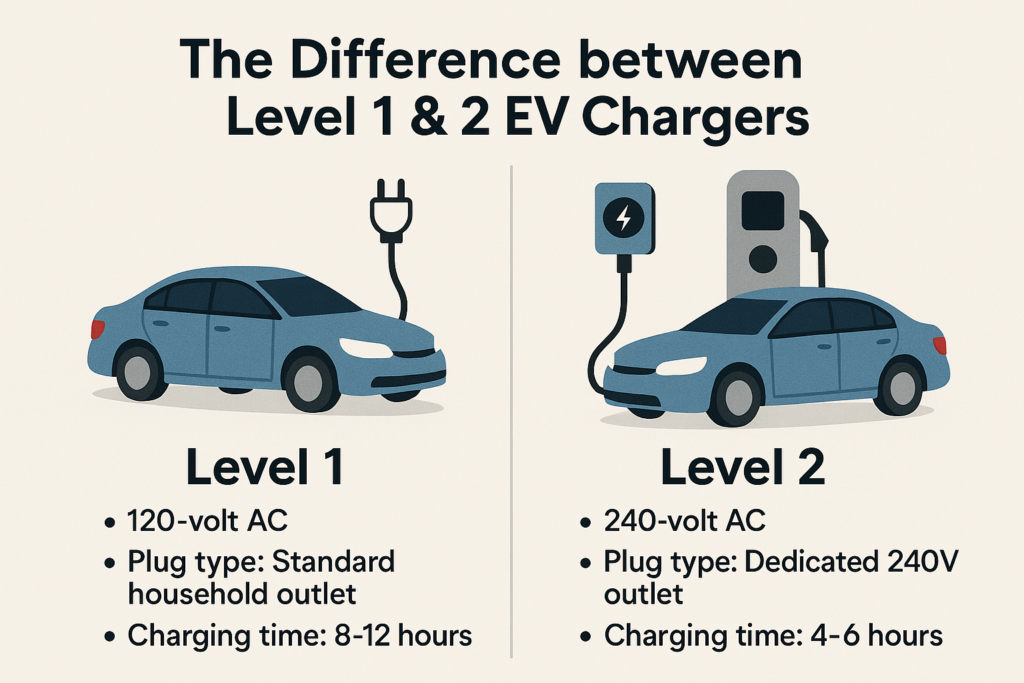
Just getting started with EV charging? Read our foundation guide first: EV Charger Types Explained: AC vs DC, Level 1 vs Level 2 vs Level 3
Understanding the Basics: What Is a Portable EV Charger?
Before comparing NEMA and Schuko systems, a quick clarification that trips up many first-time buyers: portable EV chargers are technically EVSEs — Electric Vehicle Supply Equipment. They do not charge your car directly. They safely deliver AC power from the wall to your car’s onboard charger, which then converts it to DC for the battery. Your car’s onboard charger, not the portable unit, determines the maximum charging speed you can achieve.
This distinction matters practically because:
A car with a 3.3 kW onboard charger will charge at 3.3 kW regardless of whether you plug into a 7.2 kW portable unit or a 22 kW wallbox. You are always limited by the smaller number.
A car with an 11 kW onboard charger will charge at 7.2 kW from a 32A Level 2 portable unit — close to the maximum most portable chargers can deliver anyway.
The point: before buying any portable charger, check your car’s onboard AC charging capacity. It is usually listed in your vehicle’s spec sheet as “maximum AC charging rate” or “onboard charger capacity.”
📌 Check your specific EV model’s onboard charger capacity in our comparison tool: Compare All Home EV Chargers Available in India — Side-by-Side
Part 1: US NEMA Adapters — The American Portable Charging Ecosystem
How the US System Works
The United States runs on a 120V/240V split-phase electrical system. For EV charging, this means two distinct charging levels accessed through different outlet types, all standardised under the NEMA (National Electrical Manufacturers Association) plug system.
Level 1 (120V): Plug into any standard US wall socket (NEMA 5-15) and you get roughly 1.2–1.9 kW of charging power — enough to add 6–12 km of range per hour. Painfully slow for daily use, but universally available.
Level 2 (240V): Plug into a 240V outlet — most commonly a NEMA 14-50 (the same socket used for RV hookups and large appliances) — and you get up to 9.6 kW at 40 amps, adding 30–40 km of range per hour. This is where portable Level 2 chargers become genuinely useful.
The genius of the US portable charging ecosystem is the multi-adapter approach: the best portable chargers ship with a collection of NEMA adapters, allowing you to use the same unit across a NEMA 14-50 at an RV park, a NEMA 14-30 at a laundromat’s dryer socket, a NEMA 6-50 at a welding shop, and a standard NEMA 5-15 at any household outlet — all from a single charger.
The Best US Portable EV Chargers for Travel in 2026
Zencar Level 2 Portable — Best for Multi-Location Travellers
The Zencar Level 2 Portable is widely regarded as the Swiss Army knife of portable EV chargers — it ships with adapters for NEMA 14-50, 14-30, 10-30, and standard 5-15, meaning it works with virtually any outlet you will encounter in North America. At 240V, it delivers 32 amps (7.68 kW) and adds roughly 25 miles of range per hour. At 120V, it drops to Level 1 trickle speed — but having that fallback means you are never stranded. Charged EVs
The IP66 weather resistance is a standout feature in the portable category — most portable chargers are not rated for rain or outdoor use, but the Zencar handles it confidently. The trade-off is bulk: carrying four adapters adds weight compared to single-plug units. No carrying case is included, which feels like an oversight given the multi-adapter design. Charged EVs
Best for: Road trippers who cannot predict what outlet they will find at their destination.
Grizzl-E Duo — Best for Maximum Speed + Dual-Voltage
The Grizzl-E Duo is the premium pick among portable US chargers. At 40 amps on 240V, it is the fastest portable charger in its class — adding about 30 miles of range per hour, which is 20% faster than the 32A portables that dominate this category. Charged EVs
Its signature feature is auto-voltage detection: plug it into a NEMA 14-50 and it charges at 40A; plug it into a standard household outlet and it seamlessly switches to 16A Level 1 mode. No adapters to swap, no buttons to press. Charged EVs
The Grizzl-E’s tough aluminum body, UL-rated safety, built-in GFCI, and 24-foot cable make it genuinely road-trip friendly, with multiple plug adapters included. It also doubles as a wall-mounted charger with the included bracket — a rare dual-purpose capability. EV Connect
Best for: Power users who want the fastest portable charging available without committing to a permanent installation.
Lectron 40A — Best Value Overall
The Lectron 40A delivers fast, ETL and FCC certified charging at Level 2 (240V, 40A, up to 9.6 kW) with IP65 weatherproofing and built-in safety protections, all for around $300 — making it the best value in the US portable charger category. EV Connect
A 16-foot cable with LED status lights keeps the design clean and practical. The trade-off versus the Zencar is fewer adapter options out of the box — but for travellers who primarily use NEMA 14-50 outlets (the most common 240V socket at RV parks and rental properties), the Lectron is a cost-efficient, no-fuss choice.
Best for: Budget-conscious buyers who primarily use NEMA 14-50 outlets.
AIMILER Level 2 with WiFi — Best Smart Features
For buyers who want smart features, adjustable amperage, and delay charging without paying premium prices for WiFi connectivity, the AIMILER Level 2 EV Charger hits a notable sweet spot — with over 1,250 positive reviews and consistent performance across extended testing. Blink Charging
The unit includes both NEMA 6-20P and NEMA 5-15 adapters, giving you flexibility to charge from standard household outlets or 240V dryer-style outlets, while an AI Smart Chip communicates with the vehicle to deliver exactly what it can safely handle — maximising charging speed without risking electrical issues. Blink Charging
Best for: Tech-forward EV owners who want scheduling, app monitoring, and smart current adjustment in a portable unit.
The US NEMA Adapter Hierarchy: Which Outlet Gives You What
| Outlet Type | Voltage | Max Amps | Typical Power | Range/Hour |
|---|---|---|---|---|
| NEMA 5-15 (standard) | 120V | 12A | 1.4 kW | 6–10 km |
| NEMA 6-20 | 240V | 16A | 3.8 kW | 18–24 km |
| NEMA 14-30 (dryer) | 240V | 24A | 5.8 kW | 25–32 km |
| NEMA 14-50 (RV/range) | 240V | 32–40A | 7.7–9.6 kW | 35–45 km |
| NEMA 6-50 (welder) | 240V | 40A | 9.6 kW | 35–45 km |
The golden rule in the US: Always size your amperage to your circuit per the NEC 80% rule — a 50A circuit safely supports a 40A charger; a 30A circuit safely supports 24A. Drawing more than 80% of a circuit’s rated capacity on a continuous load is a fire hazard and a code violation. PG&E
Part 2: Europe Schuko — The Continental Portable Charging Ecosystem
How the European System Works
Europe operates on a unified 230V/50Hz system, but the variety of socket types encountered across 27+ countries is considerably more complex than the US’s NEMA standardisation. For EV owners, three outlet types matter most:
Schuko (Type F): The standard European household socket found in Germany, France, Italy, Spain, the Netherlands, and most of continental Europe. It delivers single-phase 230V at up to 16A — giving a maximum of 3.68 kW from a Schuko-to-Type 2 portable charger. This adds roughly 20–25 km of range per hour.
CEE Blue (IEC 60309, 16A single-phase): The blue industrial socket common at campsites, marinas, and some holiday parks across Europe. More robust than Schuko and rated for continuous 16A loads, it safely delivers the same 3.68 kW but with better thermal endurance.
CEE Red (IEC 60309, three-phase): The red 32A three-phase industrial socket found in some workshops, larger campsites, and commercial properties. With a three-phase CEE-to-Type 2 portable charger, this delivers up to 11 kW — making it the most powerful portable charging option available in Europe without a fixed wallbox.
The universal vehicle connector across Europe is Type 2 (IEC 62196, also called Mennekes) — a seven-pin plug that handles both single-phase and three-phase AC charging and is fitted to virtually every European EV as standard.
The Best European Portable EV Chargers for Travel in 2026
go-e Charger Gemini flex 2.0 — Overall Best for European Travellers
The go-e Charger Gemini flex 2.0 was named Price Champion 2025 in a major comparison test by electricar magazine, with 45,000 readers voting it the best portable wallbox in its category. It combines smart features typically found in fixed wallboxes — app control, scheduling, flexible energy tariffs, load balancing, and PV surplus charging — in a genuinely portable design. FeedSpot
With an IP65 rating, it is protected against dust and water, making it suitable for outdoor use. It also works safely at rental properties when equipped with proper safety features, including DC and AC fault protection, voltage monitoring, and current sensors. FeedSpot
The Gemini flex 2.0 charges at up to 3.68 kW from Schuko and up to 7.4 kW from a CEE blue outlet with the appropriate adapter — making it genuinely versatile across the range of sockets you encounter travelling across Europe.
Best for: European EV travellers who want smart charging features and multiple adapter compatibility in one compact unit.
Juice Booster 2 — Premium Pick for Frequent European Travellers
The Juice Booster 2 is one of the most famous premium mobile EV chargers in Europe. In the German Traveller Set, you get a robust 22 kW mobile charging station with adapters for CEE, camping, and Schuko sockets — making it perfect for frequent travellers and company cars. Franklinfueling
The Juice Booster 2’s headline capability is 22 kW from a three-phase CEE red socket — a level of portable charging power that puts it firmly in “mobile wallbox” territory. It is the charger of choice among professional EV road trippers who cross multiple countries and need to handle any socket they encounter, from a French gîte’s Schuko to a German Autobahn rest stop’s three-phase CEE.
Its price (typically €500–€700 with the full adapter set) reflects this premium positioning. For most occasional travellers, it is overkill. For EV fleet operators and frequent cross-border drivers, it is the most capable portable charger available in Europe.
Best for: Serious EV road trippers and company fleet drivers who need maximum flexibility and the fastest possible portable charging across Europe.
Morec 11 kW Three-Phase CEE Portable Charger — Best Mid-Range Mobile Wallbox
The Morec 11 kW portable EV charger is one of the best options for European drivers who want a “mobile wallbox.” It plugs into a three-phase CEE socket and delivers up to 11 kW to your Type 2 electric car, with adjustable current and a clear LCD display. Franklinfueling
At roughly half the price of the Juice Booster 2 while delivering 11 kW from a three-phase CEE socket, the Morec hits a compelling mid-range sweet spot for drivers who regularly visit campsites, workshops, or industrial premises with three-phase outlets.
Best for: Campers and rural travellers who regularly access three-phase CEE sockets and want near-wallbox charging speed in a portable form.
EVDANCE Schuko-to-Type 2 — Best Budget European Travel Charger
The EVDANCE Type 2 Schuko Charging Cable charges faster than standard Type 2 Schuko cables with adjustable options from 6A to 16A, delivering a maximum charging power of 3.68 kW — providing approximately 22 km of range per hour in testing on a Tesla Model 3/Y. InsideEVs
Its ABS case is tested to support 1.5 tonnes and withstand a 10-tonne drop test, while the TPU cable is rated to last up to 15 years and tested for over 10,000 bends. The IP66 splash and dust-proof rating, combined with multiple protections including overcurrent, over-voltage, overheating, and short circuit, makes it one of the most robustly built budget options in the European market. InsideEVs
For EV travellers who primarily use Schuko outlets and want a lightweight, affordable backup charger with genuine build quality, the EVDANCE is hard to beat.
Best for: Budget-conscious European EV travellers who primarily charge from Schuko sockets at home or at holiday destinations.
Loady Adjustable Mobile Charger — Best for Long-Cable Applications
One of the few mobile chargers available in 5, 10, 12, and 15-metre cable lengths, the Loady Type 2-Schuko mobile EV charger features the highest possible water resistance and a colour LCD screen for real-time monitoring. An optional app allows scheduling and real-time insight into charging sessions, including setting charging start time to a 15-hour delay. Statiq
For apartment dwellers who need to run a cable from a balcony socket to a car in a courtyard below — a common scenario in Spanish, Italian, and French residential buildings — the 10-metre or 15-metre Loady is often the only practical portable option.
Best for: Apartment and villa travellers who need an unusually long cable to bridge the distance between socket and car.
The European Socket Hierarchy: Schuko vs CEE vs Three-Phase
| Socket Type | Phase | Voltage | Max Amps | Typical Power | Range/Hour |
|---|---|---|---|---|---|
| Schuko (Type F) | Single | 230V | 16A | 3.68 kW | 18–25 km |
| CEE Blue (16A) | Single | 230V | 16A | 3.68 kW | 18–25 km |
| CEE Blue (32A) | Single | 230V | 32A | 7.4 kW | 30–38 km |
| CEE Red (16A) | Three | 400V | 16A | 11 kW | 50–60 km |
| CEE Red (32A) | Three | 400V | 32A | 22 kW | 80–100 km |
The European golden rule: Schuko sockets were not originally designed for continuous high loads over many hours. For daily charging, an 11 kW CEE-based portable charger or a fixed wallbox is safer and more efficient. Keep Schuko-based portable EV chargers mainly for backup and occasional use. Franklinfueling
Part 3: How This Maps to India’s Portable Charging Landscape
Understanding the US and European portable charging ecosystems is directly useful to Indian EV owners — because India’s own system draws from both, while also developing its own standards.
India’s Outlet and Connector Reality in 2026
For AC charging at home, most Indian EV owners use either:
- A standard 15A Indian socket (230V, similar voltage to Europe, but with a different BS 546 plug) giving roughly 2.5–3.3 kW — comparable to a European Schuko setup in power output
- A dedicated 15A or 32A circuit with a Type 2 or proprietary socket installed by the manufacturer alongside a home wallbox
For the vehicle connector, for anyone buying or charging a four-wheeler EV in India in 2026, the connector picture is straightforward: Type 2 for AC (home and slow public charging) and CCS2 for DC fast public charging. PlugShare
This is excellent news for portable charger compatibility: the Type 2 connector that all major Indian EVs use for AC charging is the same connector standard used across all European portable chargers. A European Schuko-to-Type 2 cable, with the Schuko plug replaced or adapted to an Indian BS 546 plug, is functionally the same as what Indian manufacturers are producing domestically.
📌 For a complete breakdown of Indian EV connector standards: CCS2 vs CHAdeMO vs Bharat DC: EV Connector Types in India Explained
The Indian Equivalent of NEMA and Schuko
| Global Standard | Indian Equivalent | Power | Use Case |
|---|---|---|---|
| NEMA 5-15 (120V, 15A US) | BS 546 15A (230V) | ~2.5–3.3 kW | Standard household socket |
| Schuko (230V, 16A) | BS 546 15A or 6A socket | ~2.5–3.3 kW | Backup / overnight home charging |
| NEMA 14-50 (240V, 40A) | 32A industrial socket | ~7.2–7.4 kW | Dedicated home EV circuit |
| CEE Red 32A (three-phase) | Three-phase commercial supply | ~11–22 kW | Commercial / industrial |
The practical takeaway: India’s standard household 15A socket delivers approximately the same power as a European Schuko outlet — roughly 3.3 kW maximum. The portable charging experience from a standard home socket in Bengaluru, Madrid, or Berlin is essentially the same: a slow but universally available overnight charge.
Where India differs is that dedicated 32A home circuits for EV charging are becoming increasingly standard with new home charger installations, enabling the same 7.2 kW portable charging speed that US NEMA 14-50 users enjoy. If your building supports it, this is the upgrade worth prioritising.
Best Portable EV Charger Options Available in India in 2026
Tata Power Portable EV Charger — Best Brand-Backed Option
The Tata Power Portable EV Charger is considered the top Indian market choice for its fast 7.4 kW charging, smart app integration via Tata Power EZ Charge, and compatibility with popular Indian EVs like the Tata Nexon EV Max. Its IP66 rating ensures durability in India’s diverse weather conditions, including monsoon humidity. Pulse Energy
For Tata EV owners in particular, the ecosystem integration — with charging history, session monitoring, and scheduled charging available through the EZ Charge app — makes this the most seamless portable option available domestically.
BougeRV Portable Charger — Best Budget Import Option
Budget options like BougeRV are available in India at approximately ₹14,000, making them the most accessible entry point for EV owners who want a travel portable charger without a significant upfront investment. Pulse Energy
The trade-off at this price point is typically fewer smart features and shorter cables — but for the core use case of “I need a backup charger that works from a standard socket when I’m travelling,” budget-tier chargers deliver the core function reliably.
What to Look For in Any Indian Portable EV Charger:
Drawing from the lessons of both the US and European portable charger markets, here is the specification checklist every Indian buyer should run through:
IP Rating: Minimum IP65 for the Indian market — essential for monsoon conditions, humid coastal areas, and dusty environments in North and Central India. IP66 or higher is better.
BIS or ARAI Certification: The Indian equivalent of UL (US) or CE (Europe) safety certification. Portable EV chargers meeting BIS, ARAI, or CPRI certifications are considered safe. Look for features like overvoltage protection, thermal sensors, and IP65+ ratings to ensure safe operation in India’s humid and dusty conditions. Pulse Energy
Adjustable Current: A charger with adjustable amperage (6A/10A/13A/16A settings) lets you safely use older circuits in guest houses and rural properties without tripping breakers — mirroring the advice given to European Schuko users.
Cable Length: 6–7 metres minimum for travel use. The US standard of 20–25 feet (6–7.5 m) and the European preference for 7–10 m options are both longer than the 3–5 m cables that often come with Indian OEM portable units.
Type 2 Connector: Confirm the car-end connector matches your vehicle. For virtually all modern Indian four-wheeler EVs in 2026, this is Type 2.
📌 See our full portable charger comparison for Indian buyers: Best Home EV Chargers in India 2025: Tata, Exicom, and More Compared
Part 4: Head-to-Head — US NEMA vs Europe Schuko for Travel
Maximum Power from a Standard Socket
US NEMA 5-15 (standard outlet): 1.4–1.9 kW. Universally available but painfully slow — adds roughly 6–10 km per hour.
European Schuko: 3.68 kW maximum. Also universally available across continental Europe, adding 18–25 km per hour — meaningfully faster than a US Level 1 socket for the same “plug into a normal wall outlet” scenario.
Winner for standard socket charging: European Schuko. The 230V system delivers more than double the power from a household outlet compared to the US 120V Level 1 baseline.
Maximum Portable Speed
US NEMA 14-50 at 40A: 9.6 kW — the highest portable charging power widely available in North America. Adds 35–45 km per hour.
European CEE Red 32A three-phase: 22 kW — the highest portable charging power available anywhere, delivering near-wallbox speeds from an industrial socket. Adds 80–100 km per hour.
Winner for maximum portable speed: European CEE three-phase, decisively. However, three-phase CEE sockets are not as universally available as NEMA 14-50s at US RV parks — the practical access advantage narrows the real-world gap.
Adapter Ecosystem Versatility
US NEMA system: Excellent variety of socket types accessible via adapters (14-50, 6-50, 14-30, 10-30, 5-15). A single multi-adapter charger like the Zencar genuinely covers almost every scenario encountered across the US.
European Schuko/CEE system: Similarly strong adapter ecosystem, with the Juice Booster 2 Traveller Set covering Schuko, CEE blue (camping), CEE red (industrial), and more.
Winner: Essentially tied — both systems have mature adapter ecosystems for their respective geographies.
Ease of Use for a First-Time EV Traveller
The US system is arguably simpler to navigate for a newcomer — NEMA 14-50 is a single standard found consistently at RV parks, rental properties, and many hotels across the country, with consistent behaviour. The European system requires understanding the difference between Schuko, CEE blue, and CEE red sockets before you travel — and knowing which adapter you need for each.
Winner for simplicity: US NEMA 14-50 ecosystem, marginally.
The Universal Rules for Portable EV Charger Travel
Regardless of whether you are in the US, Europe, or India, experienced EV travellers follow the same set of rules for portable charger use on the road.
Always carry the charger, even if you don’t expect to need it. The one time you leave it at home is the one time a public charger is broken and you wish you had it.
Check your destination’s outlet type before you arrive. A quick message or phone call to confirm whether a holiday rental has a 15A socket, a 32A dedicated outlet, or nothing at all is worth the 30 seconds it takes — and shapes which adapter you pack.
Never exceed 80% of a circuit’s rated capacity. This rule applies equally in the US, Europe, and India. A 16A Schuko socket can safely support a 13A charger setting, not 16A. A 15A Indian socket can safely support a 12A charger setting. Respecting this rule prevents tripped breakers, overheated sockets, and fire risk.
Carry a short extension lead for awkward parking situations. A simple cable bag keeps your trunk clean and makes charging faster at each stop. It also prevents dirt from getting into connectors. A 3-metre heavy-gauge extension (rated for continuous 16A loads) solves the majority of “the socket is around the corner from where I parked” problems. Pulse Energy
Prefer your onboard charging limit as your portable charger’s output limit. If your car’s onboard charger accepts a maximum of 3.3 kW, there is no benefit — and some BMS stress — from supplying 7.2 kW from a higher-spec charger. Match the portable charger’s output setting to your car’s acceptance rate.
📌 Thinking about upgrading from a portable to a fixed home charger? EV Charger Installation Cost in India: What to Expect in 2025
Frequently Asked Questions (FAQ)
Q: Can I use a US NEMA portable charger in India? Not directly. US chargers are designed for 120V/240V at 60Hz; India runs on 230V/50Hz. Voltage is compatible with NEMA 240V adapters (14-50 etc.) but the plugs are physically different. More importantly, US chargers output a J1772 connector — not the Type 2 used by Indian EVs. You would need both a plug adapter and a connector adapter, which introduces compatibility and safety risks. Indian buyers are better served by India-specific or European-standard (Type 2) portable chargers.
Q: Can I use a European Schuko portable charger in India? Much closer to viable — India and Europe share the same 230V voltage and similar socket physical designs (both derived from IEC standards). However, the Schuko plug shape is different from the Indian BS 546 plug, and a simple adapter is needed. The car-end Type 2 connector is identical to what Indian EVs use. European Schuko portable chargers with an Indian socket adapter are a practical option, and several EV owners in India already use this approach.
Q: What is the fastest portable EV charger for travel in 2026? In the US, the Grizzl-E Duo and Megear 40A both deliver 9.6 kW from a NEMA 14-50 — the fastest widely accessible portable option in North America. In Europe, the Juice Booster 2 with a 32A three-phase CEE adapter delivers 22 kW — the fastest portable charging available anywhere without a fixed installation.
Q: How much range does a portable EV charger add per hour in India? From a standard Indian 15A socket at 3.3 kW, expect approximately 18–22 km of range per hour depending on your EV’s efficiency. From a dedicated 32A circuit at 7.2 kW, expect 35–45 km per hour. These figures are for passenger EVs like the Tata Nexon EV or Hyundai Ioniq 5.
Q: Is it safe to charge from a standard socket at a guest house or hotel in India? Yes, with precautions. Set your portable charger to 10A or lower (not 16A) when using unknown circuits to stay well within the NEC-equivalent 80% rule. Avoid using extension leads not rated for continuous high loads. Charge overnight rather than during peak demand hours. Most importantly — use a portable charger with GFCI/RCD (residual current device) protection, which cuts power instantly in case of a fault.
Q: What does IP rating mean for a portable EV charger? IP (Ingress Protection) rating indicates how well the charger housing is sealed against dust and water. For Indian travel use, IP65 is the minimum — it protects against dust ingress and low-pressure water jets (monsoon rain). IP66 and IP67 offer stronger water protection. Avoid chargers with IP54 or lower for outdoor travel use in India’s climate.
Conclusion: Choose for Your Road, Not Someone Else’s
The best portable EV charger for travel in 2026 is not the most powerful one, or the most feature-rich one, or the one with the most adapters. It is the one that matches the sockets you actually encounter on your journeys, carries a cable long enough for the parking situations you actually face, and meets the safety certifications relevant to your country.
US travellers plugging into NEMA 14-50 hookups at Airbnbs and RV parks need a different tool from European travellers relying on Schuko sockets at Spanish villas and Dutch campsites. And Indian EV owners navigating a mix of standard 15A sockets, dedicated EV circuits, and a charging infrastructure that is rapidly maturing need a solution calibrated for Indian realities — drawing the best from both global systems.
What the US and European markets have proven, after years of portable charger evolution, is that versatility and safety certifications always matter more than raw power output. A 3.68 kW Schuko charger that works reliably from any socket you encounter beats a 9.6 kW charger that needs a specific 40A circuit that may not exist at your destination.
At Clean Energy Bazaar, we help Indian EV buyers cut through the noise and find the charger that actually fits their life.
📌 Ready to compare portable and home EV chargers for Indian conditions? Compare All Home EV Chargers Available in India — Side-by-Side
Have a portable charger that’s saved you on a road trip — or one that let you down? Share your experience in the comments below. The best buyer advice comes from real owners.