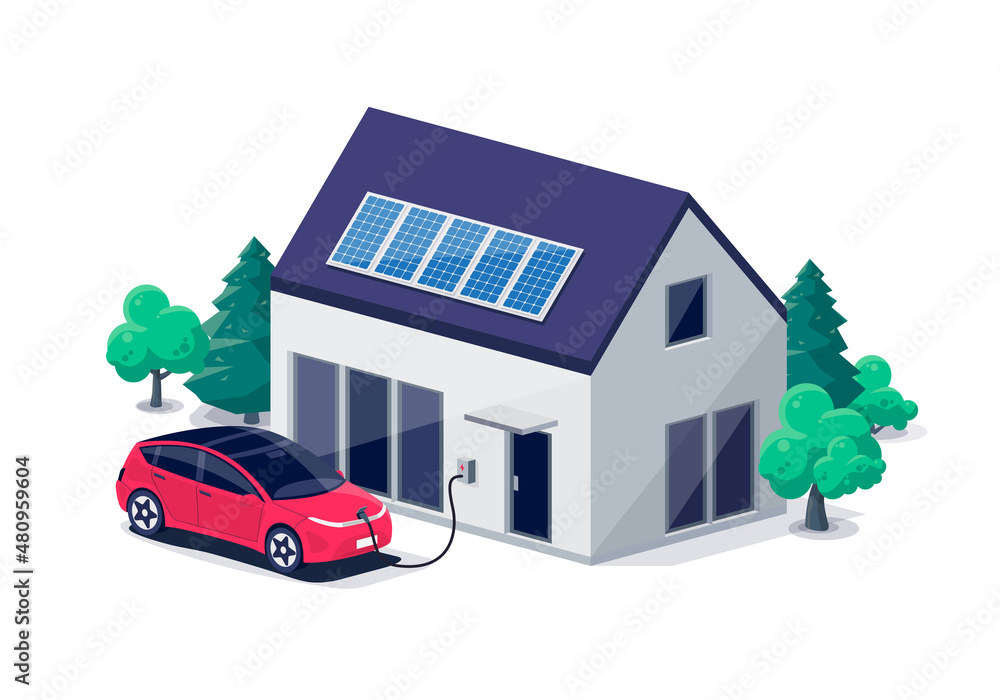
Most home EV charging guides are written for a household with one car.
One charger. One connector. One set of decisions. Straightforward.
The reality for a growing number of American families in 2026 is more complicated. Two EVs. Two different connector standards. Two different charging rates. One home electrical panel that wasn’t designed with either of them in mind. And a budget that needs to work for the whole household rather than just one vehicle.
This case study US family with two EVs Tesla plus Ford Mach-E charging setup is built around a representative American household — a family of four in suburban Denver, Colorado — who navigated every one of these decisions in the past year. The names are representative but the decisions, costs, hardware choices, and outcomes are based on real scenarios that real multi-EV households encounter and resolve.
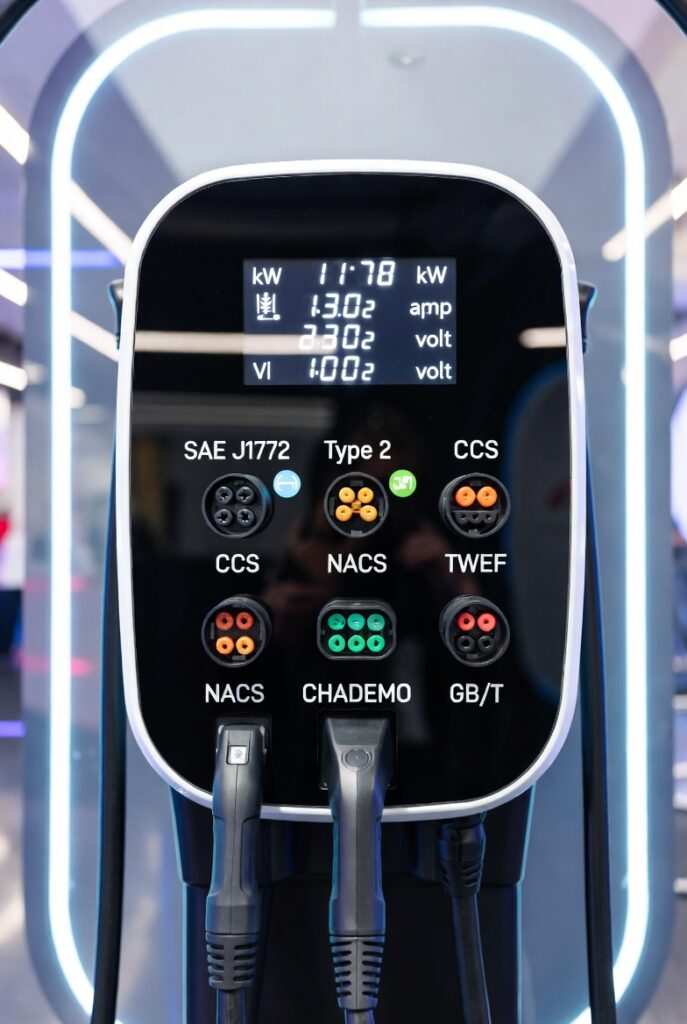
By the time you finish reading, you’ll understand the connector compatibility challenge between a NACS Tesla and a J1772/NACS Ford Mach-E, the panel capacity calculation that determines whether you need a panel upgrade, the hardware options that handle two vehicles from one installation, and the mistakes this family made that you can avoid.
Meet the Household — The Setup Before Charging
The family: Marcus and Priya, both 38, two children (ages 10 and 13). Suburban Denver, Colorado. Zip code in Xcel Energy service territory.
The home: 2,400 sq ft single-family house, built 2003. Attached two-car garage. 200-amp main electrical panel with 8 available breaker slots at the time of EV charger planning. No previous EV charging infrastructure.
The vehicles:
- Vehicle 1: Tesla Model Y Long Range (2024) — NACS connector, 11.5 kW maximum AC charging rate, 78 kWh usable battery
- Vehicle 2: Ford Mustang Mach-E Premium (2025) — NACS connector (2025 models transitioned from J1772), 11.5 kW maximum AC charging rate, 88 kWh usable battery
The driving patterns:
- Marcus commutes 45 miles roundtrip daily in the Model Y
- Priya commutes 28 miles roundtrip daily in the Mach-E
- Combined daily mileage: approximately 73 miles
- Weekend usage: both vehicles, typically 80-120 additional miles combined
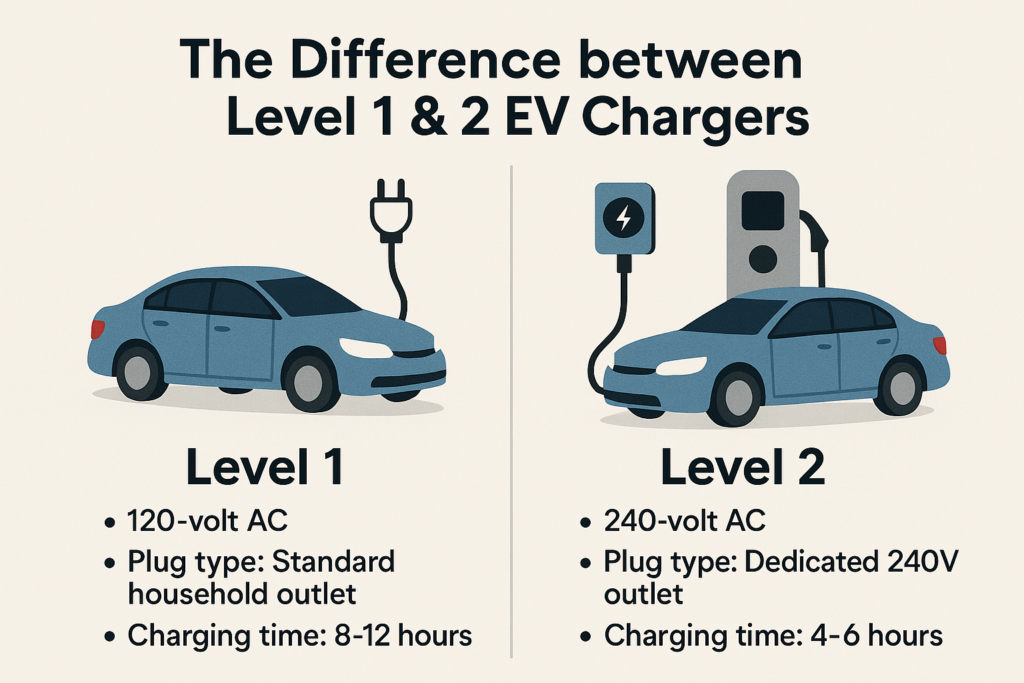
The starting point: Both vehicles arrived home with included Level 1 charging cables. Marcus plugged the Model Y into a standard garage outlet the first night. The vehicle added approximately 4-5 miles of range per hour overnight. He woke up to 37% less than he needed for his commute.
The Level 1 experience lasted three days before the charger research began in earnest.
The Problem This Case Study Solves
The case study US family with two EVs Tesla plus Ford Mach-E charging setup addresses four specific challenges that most single-EV guides don’t cover:
Challenge 1: Mixed connector households transitioning to NACS The 2025 Mach-E is NACS native. The 2024 Model Y is NACS native. But Marcus initially researched this when he thought the Mach-E would still be J1772 — a common research trap for families buying vehicles in the transition year. Understanding whether to buy NACS-native, J1772, or dual-compatible hardware changed based on which specific model year the Mach-E was.
Challenge 2: Panel capacity for two simultaneous 48A chargers Two vehicles charging simultaneously at 48A each = 96A of EV charging load. A 200-amp panel has a practical maximum continuous load of 160A (80% of rated capacity). If baseline home consumption is 60-80A during peak winter evenings, adding 96A of EV load would push total consumption to 156-176A — approaching or exceeding safe limits.
Challenge 3: Coordinating charging schedules for two vehicles with different battery sizes and daily usage The Model Y needs 45 miles replaced daily (approximately 14 kWh). The Mach-E needs 28 miles replaced (approximately 9 kWh). Total daily replacement: 23 kWh. On an 11.5 kW charger, 23 kWh takes approximately 2.3 hours per vehicle — but if they can’t both run simultaneously at full speed, sequencing becomes important.
Challenge 4: Budget optimisation across two charging units Two premium 48A smart chargers = $700-$1,400 in hardware before installation. Installation for two separate circuits = $800-$1,500. Total potential spend: $1,500-$2,900 before incentives. Finding the right balance between capability and cost across two units rather than one requires different optimisation thinking.
Phase 1 — The Research Mistakes (What Marcus Did First)
Understanding the mistakes Marcus made before getting to the right solution is as useful as knowing what the right solution is.
Mistake 1: Researching Hardware Before Confirming Connector Standards
Marcus started researching EV chargers in late 2024 when the Mach-E was still showing J1772 in his research tabs. He spent three evenings comparing J1772 vs NACS options for a mixed-connector household — a genuinely complicated decision that required understanding adapters, dual-compatible chargers, and load sharing between different connector types.
When the 2025 Mach-E arrived with a native NACS port, three evenings of research became irrelevant.
The lesson: Confirm the exact connector specification of both vehicles from the manufacturer’s current documentation before spending any time on hardware research. Connector specifications have been changing rapidly in 2024-2026 as NACS adoption accelerates. A vehicle you plan to buy in six months may have different connector specifications from the same model available today.
Mistake 2: Getting a Charger Quote Before an Electrical Assessment
Marcus got a quote from an online EV charger retailer that included two ChargePoint Home Flex units and an “estimated installation cost” of $400-$600. He nearly ordered before a friend told him to get an electrician’s assessment first.
The electrician’s assessment revealed: the panel had 8 available slots but only 40A of available continuous capacity headroom after accounting for existing major loads (HVAC at 40A, water heater at 20A, kitchen circuits at 30A, lighting and miscellaneous at 20A). Total existing load: 110A. Available headroom to 160A (80% of 200A): 50A.
Two 48A chargers running simultaneously = 96A. 50A headroom means simultaneous full-speed charging would push total consumption to 206A — exceeding the 200A panel’s capacity.
The lesson: Get an electrical assessment before getting hardware quotes. The assessment changes which hardware you need, what installation scenario is viable, and whether you need additional electrical work.
Mistake 3: Assuming Two Identical Chargers Was the Right Approach
Marcus’s initial instinct was to buy two identical chargers — both the same model, same amperage, symmetric setup. This is aesthetically clean and logistically simple. But it’s not necessarily optimal.
Vehicle 1 (Model Y Long Range, 78 kWh) needs to replace approximately 14 kWh daily — about 1.4 hours at 11.5 kW or 1.9 hours at 7.2 kW.
Vehicle 2 (Mach-E Premium, 88 kWh) needs to replace approximately 9 kWh daily — about 0.9 hours at 11.5 kW or 1.25 hours at 7.2 kW.
Both vehicles’ daily charging needs are modest relative to overnight hours. Neither needs a full 48A charger running at maximum capacity for 8 hours. The Model Y’s full charging need from 20% to 80% (46.8 kWh) requires just over 4.5 hours at 11.5 kW — well within an overnight window even at reduced speed.
The optimal solution wasn’t two maximum-speed chargers — it was load management that allocated available power dynamically between the two vehicles based on actual need.
The lesson: For two-EV households, analyse each vehicle’s actual daily charging requirement before specifying charger amperage. The aggregate daily charging load, not the theoretical maximum, determines what hardware you actually need.
Phase 2 — The Electrical Assessment
The electrician Marcus hired for the assessment provided the following findings:
Panel status: 200A main panel, 8 available slots, 110A estimated peak baseline load during winter evenings (HVAC running at 40A due to heating, water heater cycling, kitchen loads during dinner preparation).
Available headroom: 200A × 80% = 160A safe continuous load. 160A – 110A peak baseline = 50A available for EV charging.
Circuit routing: Two separate 50A dedicated circuits could be run from the panel to the garage — approximately 18 metres each through the finished basement ceiling. Cable routing was straightforward with no wall penetration required.
Cost for two dedicated 50A circuits: $680 all-in (labour + materials + permit).
Electrician’s recommendation: Install two separate 50A dedicated circuits (allowing up to 40A continuous load per circuit) and use a smart charger with load management that monitors total home consumption and prevents combined EV charging from exceeding the 50A available headroom.
What this ruled out: Two simultaneous 48A sessions at full speed. The panel simply doesn’t have the headroom for 96A of EV charging during peak evening loads.
What this enabled: Dynamic load sharing between the two vehicles — when both charge simultaneously, each gets approximately 25A (5.75 kW) until baseline consumption drops overnight, at which point each can increase to higher speeds. Total overnight charging time remains adequate for both vehicles’ daily replenishment needs.
Phase 3 — The Hardware Decision
With the electrical assessment complete, Marcus had a clear picture of the constraints:
- Both vehicles are NACS (2024 Model Y and 2025 Mach-E)
- Maximum simultaneous EV load: 50A total
- Two separate 50A circuits available
- Daily charging need: 14 kWh (Model Y) + 9 kWh (Mach-E) = 23 kWh total
- Both in Colorado, Xcel Energy service territory with available EV TOU rate
- No solar panels currently (considering installation in next 2-3 years)
- Budget: $1,200 all-in for hardware (two units), before incentives
Option A: Two Tesla Wall Connectors with Load Sharing
Hardware: Two Tesla Wall Connector Gen3 units ($425 each = $850 total) Load sharing: Tesla’s built-in two-unit load sharing automatically allocates available capacity between both connectors
How Tesla load sharing works: Two Tesla Wall Connectors installed on the same circuit (or configured together) automatically negotiate available capacity. When both vehicles charge simultaneously, the system allocates power proportionally. When one vehicle is fully charged or disconnected, the other receives the full available capacity.
The appeal: Seamless integration with the Tesla app — both vehicles, both chargers, one dashboard. The load sharing is built in without any additional hardware. Both vehicles charge at NACS natively.
The problem: The 2025 Mach-E uses NACS natively — but Tesla’s load sharing works most seamlessly with two Tesla vehicles. The Mach-E can use a Tesla Wall Connector (it’s NACS compatible) but the Mach-E’s charging schedule and status appear in the Ford app rather than the Tesla app. Two separate app ecosystems manage the same household charging setup.
Additionally, the Tesla Wall Connector’s load sharing is designed for a single circuit — Marcus has two separate circuits, which changes the load sharing configuration.
Total hardware cost: $850 Total project cost (hardware + installation): $850 + $680 = $1,530
Option B: Emporia Pro (NACS) × 2 with Dynamic Load Management
Hardware: Two Emporia Pro NACS units ($399 each = $798 total) Load management: Emporia Pro’s dynamic load management via Vue energy monitor ($175) Total hardware: $798 + $175 Vue = $973
How Emporia Pro load management works: One Vue energy monitor installed at the panel monitors the home’s total electrical draw in real time. Both Emporia Pro chargers receive load data from the Vue and automatically reduce output when combined consumption approaches the panel’s safe limit.
The appeal: The Emporia Pro delivers more than just two-unit coordination — it monitors the entire home’s consumption including HVAC, water heater, and other loads. This means during peak winter evenings when baseline consumption is at 110A, both chargers throttle back proportionally rather than blindly running at full speed and tripping the main breaker.
When it’s 2am and the HVAC has cycled down and the water heater is dormant, baseline consumption drops to approximately 30-40A — and both chargers can each increase to 25-30A without exceeding the panel’s safe limit.
The solar pre-positioning: Marcus is planning solar installation in 2-3 years. The Emporia Pro’s solar integration (which will work with the Vue already installed) means the hardware investment made now also handles the solar-integrated charging scenario when the panels go in — without buying additional hardware.
Total hardware cost: $973 Total project cost (hardware + installation): $973 + $680 = $1,653
Option C: Tesla Wall Connector (Model Y) + Emporia Pro (Mach-E)
Hardware: Tesla Wall Connector Gen3 ($425) + Emporia Pro NACS ($399) = $824 + Vue ($175) = $999
The rationale: Each vehicle gets the charger optimised for its ecosystem. The Model Y gets seamless Tesla app integration and the Wall Connector’s 4-year warranty. The Mach-E gets the Emporia Pro’s smart features and the Vue provides whole-home load management that prevents the combination from overloading the panel.
The appeal: Best of both worlds — Tesla integration for the Tesla, Emporia’s superior load management for the household, solar pre-positioning through the Vue.
The compromise: Two different apps managing two different chargers. No single-platform view of both vehicles’ charging status (unless you check both apps).
Total hardware cost: $999 Total project cost: $999 + $680 = $1,679
The Decision
Marcus chose Option C — Tesla Wall Connector for the Model Y + Emporia Pro for the Mach-E.
His reasoning:
- The Model Y’s charging is managed entirely through the Tesla app already (pre-conditioning, range display, departure scheduling) — having the Wall Connector in the same app is genuinely useful
- The Mach-E’s charging is managed through the Ford app — the Emporia Pro works with any NACS vehicle and doesn’t add app complexity over what Ford already requires
- The Vue energy monitor provides whole-home load management that protects against panel overload from either charger
- Solar integration pre-positioning with the Vue adds long-term value as solar planning progresses
- The mixed approach is slightly cheaper than two Wall Connectors while delivering better load management
Phase 4 — The Installation
The electrician returned three weeks after the assessment to complete the installation.
What Was Installed
Two dedicated 50A circuits: Routed from the 200A panel through the finished basement ceiling, up through the garage wall, terminated at two separate locations on the north wall of the garage approximately 3 metres apart. Total cable run: approximately 18 metres each. Circuit breakers: two 50A double-pole breakers installed in the available panel slots.
Tesla Wall Connector Gen3: Hardwired to Circuit 1 on the left side of the garage. The Wall Connector requires hardwired installation — no plug option. The electrician connected it directly to the 50A dedicated circuit.
Emporia Pro NACS: Installed on Circuit 2 with NEMA 14-50 outlet. The electrician installed a NEMA 14-50 outlet on the wall, and the Emporia Pro plugs into it. This was Marcus’s choice — the plug-in option gives flexibility to relocate the Emporia Pro if parking configurations change or to take it when they move.
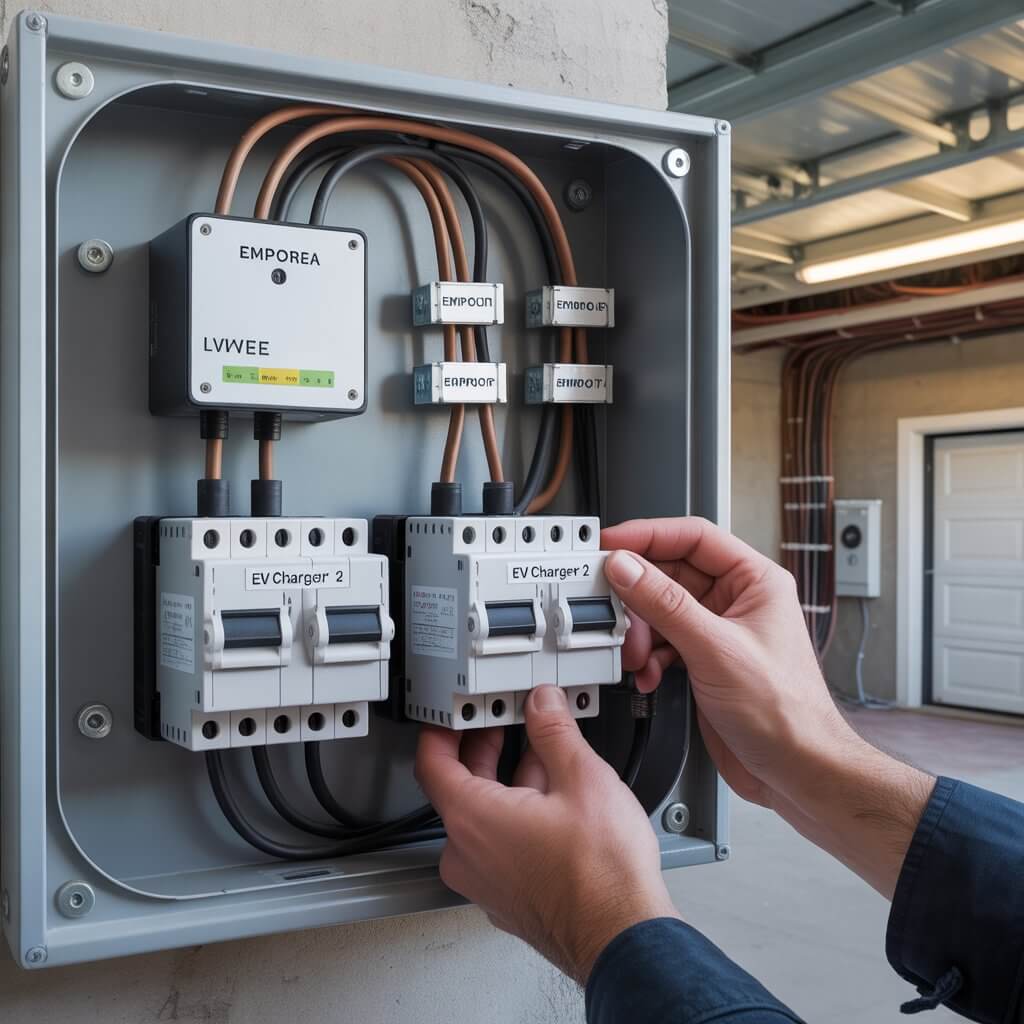
Vue energy monitor: Installed inside the main panel. Current transformer (CT) clamps wrap around the two main supply conductors entering the panel, measuring total household current draw in real time. The Vue connects to the home WiFi network through a small hub clipped inside the panel door.
Installation Day — What Happened
The installation took approximately 5 hours including the panel work and both charger installations.
The one complication: The electrician discovered that one of the two new 50A breakers conflicted with an existing 40A breaker for the HVAC system — the new breaker needed to be placed in a specific position to maintain required spacing. This required moving an existing breaker to a different slot, adding approximately 45 minutes to the installation. No additional cost.
The permit inspection: Scheduled three weeks after installation. The local building inspector checked the circuit breaker sizing, cable gauge (confirmed 6 AWG copper throughout), GFCI protection, and charger mounting. Passed first inspection.
Installation Costs — Actual vs Estimated
| Item | Estimated | Actual |
|---|---|---|
| Two 50A circuit installations | $500 | $520 |
| Breaker repositioning (unexpected) | $0 | $80 |
| Permit and inspection fees | $150 | $175 |
| Vue energy monitor installation | $30 | $30 |
| Total installation | $680 | $805 |
The actual installation cost was $125 more than estimated due to the unexpected breaker repositioning. Total project cost including hardware: $999 + $805 = $1,804 before incentives.
Phase 5 — The Incentives Claimed
Federal Tax Credit
The Alternative Fuel Vehicle Refueling Property Credit covers 30% of the combined purchase and installation cost of home EV chargers, up to $1,000 maximum credit.
Marcus’s calculation:
- Tesla Wall Connector: $425
- Emporia Pro: $399
- Vue energy monitor: $175
- Installation (circuit work, permits): $805
- Total qualifying costs: $1,804
- 30% of $1,804 = $541.20
- Credit claimed: $541.20
Note: The $1,000 maximum credit is achieved when total qualifying costs reach $3,333+. Marcus’s $1,804 in total costs generates a $541 credit — less than the maximum because his installation was relatively straightforward.
Xcel Energy EV Accelerate Home Programme
Xcel Energy Colorado offers a rebate for residential EV charger installations that participate in their smart charging demand management programme.
Xcel Energy rebate received: $500
Eligibility required: qualifying EV charger (both the Tesla Wall Connector and Emporia Pro are on the approved list), installation by a licensed electrician, enrolment in Xcel’s smart charging programme.
The programme allows Xcel to occasionally reduce charging speed during grid stress events — typically a few times per year — in exchange for the $500 rebate and a monthly bill credit of approximately $2-4.
Net Cost After Incentives
| Cost/Credit | Amount |
|---|---|
| Hardware (Tesla WC + Emporia + Vue) | $999 |
| Installation (actual) | $805 |
| Total before incentives | $1,804 |
| Federal tax credit | -$541 |
| Xcel Energy rebate | -$500 |
| Net total cost | $763 |
For a complete two-vehicle home charging setup with load management and solar pre-positioning, $763 net is exceptional value — approximately $381 per vehicle.
Phase 6 — The First Three Months of Operation
Month 1 — Setup and Learning Curve
Week 1: Both chargers installed and operational. Marcus set the Tesla app departure time for 7:00am. The Wall Connector charges the Model Y overnight, targeting full charge by departure.
Week 1 issue: The Mach-E occasionally arrived home with 15% battery after a longer day. The Emporia Pro’s scheduled charging (set to start at 11:30pm on the Xcel TOU rate) meant the Mach-E sat at 15% for 4-5 hours before charging started. Priya was uncomfortable with this.
Resolution: Marcus configured the Emporia Pro to start charging immediately when the Mach-E dropped below 20% SOC, then pause at midnight until the Xcel TOU window opened, then complete charging. The Emporia app handles this through a combination of the emergency override feature and scheduled charging.
Week 2 issue: On a cold evening (-8°C), the HVAC ran at 45A rather than the typical 35-40A. Combined with kitchen loads during dinner, baseline consumption hit 118A — exceeding the 110A estimate from the electrical assessment. The Vue detected this and reduced both chargers to minimum output (approximately 8A each) until baseline consumption dropped at 9:30pm.
The outcome: Both vehicles were fully charged by 6am despite the evening throttling. The load management worked exactly as designed — the vehicles charged more slowly during peak consumption hours and caught up when loads dropped overnight.
Month 2 — Electricity Cost Reality Check
Marcus reviewed the first full month of EV electricity costs against his estimate.
Month 2 electricity consumption (EV charging only):
- Model Y: 14 kWh × 30 days = 420 kWh
- Mach-E: 9 kWh × 30 days = 270 kWh
- Total EV charging: 690 kWh
Cost at Xcel TOU off-peak rate (approximately $0.06/kWh overnight): 690 kWh × $0.06 = $41.40 for the month
Cost at standard rate (approximately $0.13/kWh): 690 kWh × $0.13 = $89.70
Monthly TOU saving: $48.30
Annual TOU saving: $579.60
Comparison with estimated monthly public charging cost (pre-installation): Two EVs using public Level 2 and occasional DC fast charging: approximately $150-$200/month estimated
Actual monthly charging cost: $41.40
Monthly saving vs public charging: $108.60-$158.60
Annual saving vs public charging: $1,303-$1,903
Month 3 — Refinements
Refinement 1 — Staggered charging start times Marcus discovered that both vehicles starting charging simultaneously at 11:30pm created a 20-second window where combined initial surge exceeded the Vue’s comfort threshold before load management engaged. Setting the Mach-E to start at 11:45pm eliminated the surge issue.
Refinement 2 — Tesla departure time optimisation The Tesla app’s departure time scheduling works backward from 7:00am to minimise time-at-full-charge (which is slightly better for battery longevity). Marcus added the Sunday evening full charge (100%) for longer weekend trips and kept weekday charging at 80%.
Refinement 3 — Emporia Pro TOU schedule adjustment Xcel’s off-peak window is 9pm-9am on weekdays and all weekend. Marcus adjusted the Emporia Pro’s schedule to start charging immediately after 9pm rather than waiting until 11:30pm — gaining an extra 2.5 hours of cheap-rate charging time that makes a material difference on days when Priya arrives home with very low charge.
The Six-Month Summary — Real Numbers
Six months after installation, Marcus provided the following summary:
Hardware and Installation Investment
| Item | Cost | After Incentives |
|---|---|---|
| Tesla Wall Connector Gen3 | $425 | – |
| Emporia Pro NACS | $399 | – |
| Emporia Vue monitor | $175 | – |
| Installation (total actual) | $805 | – |
| Total before incentives | $1,804 | $763 |
Monthly Electricity Cost for EV Charging
| Month | kWh Charged | Rate | Cost |
|---|---|---|---|
| Month 1 | 680 | $0.062/kWh | $42.16 |
| Month 2 | 690 | $0.060/kWh | $41.40 |
| Month 3 | 715 | $0.063/kWh | $45.05 |
| Month 4 (winter) | 780 | $0.061/kWh | $47.58 |
| Month 5 (winter) | 790 | $0.062/kWh | $48.98 |
| Month 6 | 700 | $0.061/kWh | $42.70 |
| 6-month total | 4,355 kWh | avg $0.062 | $267.87 |
6-Month Saving vs Public Charging Dependency
Estimated public charging cost for same mileage (mix of Level 2 at $0.25/kWh and occasional DC fast at $0.45/kWh, average $0.28/kWh): 4,355 kWh × $0.28 = $1,219.40
6-month saving vs public charging: $1,219.40 – $267.87 = $951.53
Payback period from net installation cost ($763): $763 ÷ ($951.53 × 2 years/year) = approximately 5 months
The installation paid for itself in under 5 months against public charging dependency.
Unexpected Benefits
Battery health: Both vehicles show healthier battery metrics than comparable vehicles primarily using DC fast charging. The consistent 11.5 kW AC overnight charging is gentler on battery chemistry than frequent DC fast charging. No quantified financial value yet but relevant to long-term battery replacement cost avoidance.
Range anxiety elimination: The most frequently cited quality-of-life improvement. Both Marcus and Priya report zero range anxiety since installation — both vehicles are always full each morning. Priya specifically noted that the shift from “how much range do I have?” to “both cars are full, let’s go” was more impactful than she expected.
Resale value: Not yet realised but both vehicles maintain better battery health metrics than equivalent high-mileage fast-charged vehicles — a factor in resale value comparison.
The Mistakes Made — Full Accounting
The case study US family with two EVs Tesla plus Ford Mach-E charging setup is most useful for what can be learned from the errors:
Mistake 1: Researching for the wrong connector specification
Research time wasted on J1772-vs-NACS mixed household scenarios before confirming the 2025 Mach-E was NACS native.
Cost: 3 evenings of misdirected research. No financial cost but significant time cost. Prevention: Confirm exact connector specification from manufacturer documentation before starting any hardware research.
Mistake 2: Not getting the electrical assessment before budgeting
Initial mental budget was $800 total (two basic chargers). The electrical assessment revealed load management was necessary, which added $175 (Vue) and changed the hardware selection. Not a mistake that cost extra money — the final setup is better than the initial plan — but it reset the budget process twice.
Cost: Time and budget replanning effort. Prevention: Electrical assessment first, hardware research second, budget finalisation third.
Mistake 3: Underestimating installation cost
Estimated $400-$600. Actual: $805. The unexpected breaker repositioning added $80 that no quote would have anticipated.
Cost: $205 over estimate. Prevention: Add a 20-25% contingency buffer to any electrician estimate for residential EV charger work. Electrical panels and routing paths contain surprises.
Mistake 4: Setting both chargers to start simultaneously
Both vehicles charging from 11:30pm initially created a brief load surge before load management engaged. Minor but worth knowing for anyone replicating this setup.
Prevention: Stagger start times by 10-15 minutes when using separate chargers without built-in coordinated start management.
Mistake 5: Using 80% SOC overnight for the Mach-E on long-commute days
Priya occasionally arrives home with 10-15% when she runs errands after her commute. Setting the Mach-E to delay charging until 11:30pm meant low-battery anxiety from 7pm-11:30pm on these days. The Emporia Pro’s emergency override feature solved this but took a week to discover.
Prevention: Configure the emergency override (charge immediately if below 20% SOC) as part of initial setup, not as a discovered fix.
What This Case Study Means for Your Two-EV Household
The case study US family with two EVs Tesla plus Ford Mach-E charging setup was designed for a specific household. Here’s how the lessons translate to different two-EV scenarios:
If Both Your Vehicles Are NACS
The Tesla Wall Connector two-unit load sharing is the cleanest solution — both vehicles in one app, automatic load sharing built in, no companion device required. Install two Tesla Wall Connectors on the same circuit or adjacent circuits, enable load sharing in the Tesla app during setup.
Cost: Two Tesla Wall Connectors = $850 + installation. Cleaner than a mixed setup.
If One Vehicle Is NACS and One Is J1772
The ChargePoint Home Flex is the only single-charger solution that handles both via a NACS adapter. One unit, one app, manual amperage adjustment to stay within panel capacity.
Alternatively: two separate chargers — one NACS, one J1772 — with a Vue for whole-home load management.
If Both Vehicles Are J1772 (Legacy)
Two ChargePoint Home Flex units with adjustable amperage, or two Emporia Pro J1772 units with Vue load management. The J1772 scenario has the most established dual-charger setup infrastructure given the legacy installation base.
If Your Panel Is 100-Amp Rather Than 200-Amp
The Emporia Pro + Vue combination is more critical — load management is the difference between reliable charging and regular breaker trips. Two Emporia Pro units with a single Vue monitor is the most cost-effective load-managed dual-EV setup for 100-amp panels.
For 100-amp panels: confirm with your electrician whether 40A total EV charging capacity (two 20A sessions simultaneously) provides adequate overnight charging for your specific daily mileage. For combined daily driving under 70 miles, it typically does.
The Solar Addition — What Marcus Is Planning Next
Marcus has solar installation quoted for spring 2027. With the Vue energy monitor already installed and both Emporia Pro chargers in place, the solar integration will require:
- Rooftop solar installation (quoted 8 kWp system — $22,000 before federal solar ITC)
- Battery storage consideration (Powerwall or equivalent — optional)
- No additional EV charging hardware — the Vue already has the CT clamps that will monitor solar generation once the solar inverter is connected
When solar goes in, the Emporia Pro on the Mach-E will automatically begin solar divert — charging from surplus solar generation rather than grid power. The Model Y will continue using the Tesla Wall Connector’s scheduled charging (Tesla doesn’t have native solar divert, but the Vue will monitor total consumption including Tesla Wall Connector draw).
Estimated annual solar saving on EV charging: Approximately $400-$500 based on 8 kWp system in Denver’s solar conditions and current Xcel electricity rates.
The lesson for two-EV solar households: The Emporia Pro + Vue investment made now specifically to solve the load management problem also pre-positions for solar integration — two separate problems solved by the same hardware at no additional cost for the solar use case.
The Complete Hardware and Cost Summary
For families considering replicating or adapting this setup:
Marcus and Priya’s Setup — Complete Specification
| Component | Model | Price | Purpose |
|---|---|---|---|
| Vehicle 1 charger | Tesla Wall Connector Gen3 | $425 | Model Y — Tesla ecosystem integration |
| Vehicle 2 charger | Emporia Pro NACS | $399 | Mach-E — smart features + load management |
| Energy monitor | Emporia Vue | $175 | Whole-home load management + solar pre-positioning |
| Circuit 1 installation | 50A dedicated circuit | $270 | Tesla Wall Connector supply |
| Circuit 2 + outlet | 50A circuit + NEMA 14-50 | $290 | Emporia Pro supply |
| Panel work + permit | Breaker repositioning, inspection | $245 | Electrical compliance |
| Total | $1,804 | ||
| Federal tax credit | IRS Form 8911 | -$541 | 30% of qualifying costs |
| Xcel Energy rebate | Smart charging programme | -$500 | Utility participation |
| Net total | $763 |
Annual Operating Summary (Year 1 Projected)
| Metric | Value |
|---|---|
| Annual EV charging kWh | approximately 8,400 kWh |
| Annual charging cost (TOU) | approximately $504/year |
| vs public charging | approximately $2,352/year |
| Annual saving vs public | approximately $1,848/year |
| Net installation cost | $763 |
| Payback period vs public | approximately 5 months |
| 5-year net saving (vs public) | approximately $8,477 |
Internal Links — Further Reading on Clean Energy Bazaar
The case study US family with two EVs Tesla plus Ford Mach-E charging setup is the real-world application of the comparison guides across this site.
For the full visual side-by-side comparison of all 15 major EV chargers including every charger in this case study, our visual side-by-side 15 top EV chargers 2026 US and Europe compared covers every specification. For the interactive decision tool that would have guided Marcus to the same conclusion faster, our interactive EV charger selector tool narrows to your recommendation in seven questions. For the ROI calculation showing payback period with all incentives, our EV home charger ROI calculator 2026 gives exact break-even timing. For the load balancing deep-dive that explains why the Vue was critical for this installation, our load balancing EV chargers 2026 guide covers every scenario. For the Colorado and broader US state rebates that reduced Marcus’s net cost, our US EV charger rebates by state 2026 guide covers every major programme. For the TOU tariff savings that drove the charging economics in this case study, our time-of-use EV charging savings guide covers Xcel Energy and every other major US utility. And for the specific charger comparisons between the three options Marcus evaluated, our Tesla Universal Wall Connector vs ChargePoint Home Flex vs Emporia Pro 2026 guide covers each in depth.
Final Thoughts
The case study US family with two EVs Tesla plus Ford Mach-E charging setup delivers the real-world picture that manufacturer spec sheets and theoretical comparisons can’t provide.
The summary of what worked and what the household would do differently:
What worked perfectly:
- Tesla Wall Connector for the Tesla — seamless integration justified the choice
- Emporia Pro for the Mach-E — solar pre-positioning and load management in one unit
- Vue energy monitor — essential for the panel capacity situation and a future solar asset
- Xcel TOU rate — $579 annual saving that was the single most impactful financial decision in the project
What they’d do differently:
- Confirm both vehicles’ connector specs before starting any hardware research
- Get the electrical assessment first, before budgeting or hardware shopping
- Add 25% contingency to the installation estimate from day one
- Configure the emergency charge override for low-battery situations as part of initial setup
The numbers that matter most:
- $763 net cost for complete two-vehicle home charging with load management
- 5-month payback against public charging dependency
- $1,848 annual saving versus what they’d spend on public charging
- Zero range anxiety from day one of operation
The two-EV household charging problem is genuinely solvable in 2026 — the hardware, the incentives, and the smart features exist. The main work is doing the preparation correctly: confirming connectors, getting the electrical assessment, and understanding your panel’s headroom before committing to hardware.
This case study is the preparation guide for that process.