Here’s a situation that plays out thousands of times across the US and Europe every winter.
Someone installs a home EV charger. The installation goes smoothly. The charger works perfectly for two weeks. Then one evening in January — the heating is running, the electric oven is on, someone’s using the tumble dryer, and the EV charger is pulling 32A — the main circuit breaker trips. The house goes dark. The EV stops charging.
The electrician who installed the charger explained nothing about load balancing. The charger manufacturer’s spec sheet mentioned it in passing. Nobody explained that the problem wasn’t the charger — it was the combined load of the charger alongside everything else the house was already drawing.
Load balancing EV chargers 2026 US homes European apartments is one of the most practically important topics in home EV charging and one of the least clearly explained. This guide fixes that — covering exactly what load balancing is, why it matters for your specific electrical setup, which chargers handle it properly, and the specific scenarios where it makes the difference between a reliable charging experience and a frustrating one.
What Load Balancing Actually Is — The Plain Language Version
Load balancing in the context of home EV charging means dynamically adjusting the power drawn by the EV charger based on the total electrical consumption of the home at any given moment — preventing the combined load from exceeding the capacity of the electrical supply.
Think of your home’s electrical supply as a pipe with a fixed diameter. Every appliance running in your home draws from that pipe simultaneously. The EV charger is a large-draw appliance — potentially drawing 32A (7.2 kW) or 48A (11.5 kW) continuously for several hours. When other large appliances are also running, the total draw can exceed the pipe’s capacity.
Without load balancing, the result is a tripped circuit breaker. With load balancing, the EV charger automatically reduces its output when it detects that total home consumption is approaching the supply limit — and increases again when other loads reduce.
The Technical Distinction — Load Balancing vs Load Management vs Dynamic Load Balancing
These terms are often used interchangeably but they have specific meanings worth distinguishing:
Load management (basic): A static approach — the charger is set to a fixed maximum amperage lower than the circuit’s rated capacity, leaving headroom for other appliances. Simple but inflexible — you’re always charging at reduced speed even when headroom is available.
Load balancing (dynamic): The charger monitors actual total home consumption in real time and adjusts its output continuously. When home consumption is low, the charger runs at maximum speed. When home consumption rises, the charger throttles back. When home consumption drops again, the charger speeds back up. This is the approach that maximises charging speed while preventing overloads.
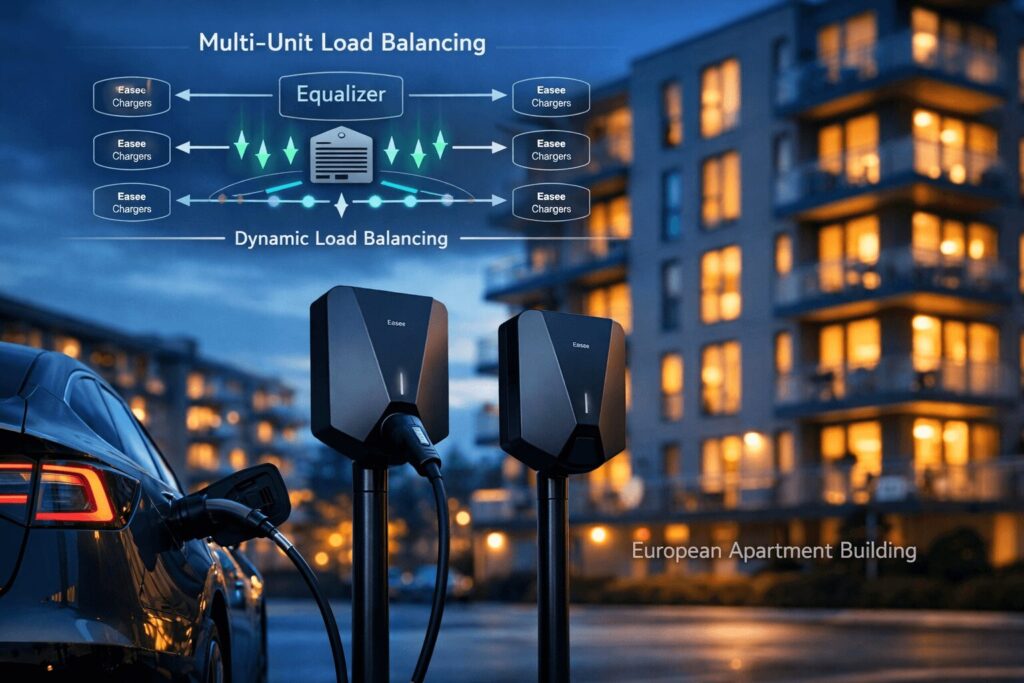
Multi-unit load balancing: Multiple EV chargers in the same installation (apartment building, two-EV household) share available capacity dynamically — each charger gets more when others are idle and less when multiple charge simultaneously.
Why Load Balancing Matters More Than Most People Expect
The situations where load balancing prevents problems are more common than buyers anticipate:
US 100-amp panel homes: The majority of US residential properties still have 100-amp main panels. Adding a 48A EV charger to a home where the panel is already serving HVAC, electric water heater, washer/dryer, and kitchen appliances creates real overload risk during peak usage.
UK and European older properties: Many older European homes — particularly UK pre-1980 properties, older French houses, and older Spanish and Italian apartments — have limited consumer unit capacity. A 32A EV charger alongside electric heating, cooking, and water heating can push total consumption beyond what the supply handles comfortably.
Apartment buildings: Multi-unit buildings share electrical infrastructure in ways that create specific load balancing challenges. A building where three residents simultaneously charge at 32A, while cooking and running heating, creates compound load management requirements that individual charger load balancing alone doesn’t solve.
Seasonal variation: Winter is when load balancing matters most. The same house that comfortably charges an EV in summer can experience breaker trips in winter when heating loads add significantly to baseline consumption.
The US Load Balancing Challenge — 100-Amp Panels and High-Draw Homes
Understanding the US 100-Amp Panel Reality
The US has a specific structural challenge with EV charging that differs from most European markets: a large percentage of US homes have 100-amp main electrical panels rather than the 200-amp panels that are standard in newer construction.
Why this matters for EV charging:
A 100-amp panel can supply a maximum of 100A continuously — but practical maximum load is typically 80A (80% of rated capacity under NEC continuous load rules). This 80A practical ceiling must cover:
- HVAC system: 20-40A depending on size and type
- Electric water heater: 15-25A
- Electric range/oven: 30-50A
- Washer/dryer: 10-30A
- Lighting and miscellaneous: 5-15A
- Other appliances: variable
When HVAC, water heater, oven, and dryer all run simultaneously — which happens regularly in cold weather — baseline consumption can reach 70-80A before the EV charger is even connected.
Adding a 48A EV charger to this situation would push total draw to 118-128A — far beyond the 100A panel’s capacity and a guaranteed breaker trip.
The traditional solutions and their limitations:
Panel upgrade (100A to 200A): The definitive solution. Typically costs $1,500-$4,000. Eliminates all panel capacity constraints. But it’s expensive, requires significant electrical work, and may involve utility coordination for larger services.
Reduce charger amperage: Install a 24A or 32A charger rather than 48A. Reduces charging speed but reduces panel stress. Doesn’t dynamically respond to changing home loads — still trips if baseline consumption is high when the charger is running.
Time-based scheduling: Schedule EV charging for overnight hours when HVAC, oven, and dryer are less likely to run simultaneously. Reduces risk but doesn’t eliminate it — overnight heating can still create high loads.
Dynamic load balancing: The most technically elegant solution. Monitors real-time home consumption and adjusts charger output continuously. Effectively makes 48A charging possible on a 100-amp panel by ensuring the charger never pushes total consumption above safe limits.
How Dynamic Load Balancing Works in US Homes
A dynamic load balancing system for a US home consists of:
1. A whole-home energy monitor that clamps onto the main conductors in the panel and measures real-time current draw across all circuits. The Emporia Vue, Sense Home Energy Monitor, or similar devices serve this function.
2. A compatible smart EV charger that receives signals from the energy monitor and adjusts its output accordingly.
3. The control algorithm that determines how the charger responds — when to reduce speed, how quickly to respond to load changes, what minimum charging speed to maintain.
The Emporia Pro implementation: The Emporia Pro with the Vue energy monitor is currently the most accessible and cost-effective dynamic load balancing solution for US homeowners. The Vue monitors all home circuits in real time, the Emporia Pro reads this data, and the charger continuously adjusts its output to ensure total home draw stays within safe limits.
Real-world example:
Home has 100-amp panel. It’s 7pm. The HVAC is running (30A draw), dishwasher has just started (12A), and lighting/electronics draw 8A — total baseline: 50A. The Emporia Pro starts charging at 48A — total would be 98A, within the 100A panel capacity.
30 minutes later, someone starts the electric oven (30A more) — total would now be 128A. The Emporia Pro detects the rising load and reduces charging to 18A — total becomes 98A, back within safe limits.
Oven finishes an hour later. Load drops to 50A. Emporia Pro increases charging back to 48A. All of this happens automatically, without any manual intervention, without a tripped breaker, and with EV charging running as fast as the available headroom allows throughout.
US Chargers With Load Balancing Capability
Emporia Pro + Vue ($399 + $150-$200): The most cost-effective dynamic load balancing solution in the US market. The Vue’s per-circuit monitoring provides the data the Emporia Pro needs for precise load management. Total investment: $549-$599. Alternative to a $1,500-$4,000 panel upgrade in many cases.
ChargePoint Home Flex (manual load management): The ChargePoint Home Flex’s adjustable amperage (16-48A) allows manual load management — you set the maximum amperage based on your panel’s available headroom. This is static rather than dynamic — the charger runs at the set maximum regardless of what else is drawing at any moment. Less sophisticated than dynamic load balancing but simpler and without a companion device requirement.
Practical approach: assess your typical peak home consumption, subtract from 80% of panel capacity, set ChargePoint to the difference. For a 100-amp panel with typical 50A peak baseline: 80A (safe maximum) – 50A (baseline) = 30A maximum EV charging. Set the Flex to 30A. Not dynamic but prevents trips.
Tesla Wall Connector (two-unit load sharing): The Tesla Wall Connector’s multi-unit load sharing — where two Wall Connectors share a single circuit’s capacity automatically — is a form of load balancing for two-EV households. Not whole-home load management but relevant for households where two EVs charging simultaneously is the primary load concern.
JuiceBox with utility demand response: Enel X Way’s JuiceBox can participate in utility demand response programmes — the utility temporarily reduces charging speed during grid stress events in exchange for bill credits. This is load balancing at a grid level rather than a home level.
The European Apartment Load Balancing Challenge
Why Apartment Load Balancing Is Different From House Load Balancing
European apartment load balancing involves challenges that don’t apply to single-family homes — and these challenges require different solutions.
Shared building electrical infrastructure: In most European apartment buildings, the electrical supply to individual flats comes through a shared building electrical system. The building has a main supply from the grid — rated for the building’s total expected load — with individual flat connections branching from it.
Adding EV charging across multiple flats in a building doesn’t just stress individual flat supplies — it stresses the shared building supply. A building where 10 residents simultaneously charge at 7.4 kW is drawing 74 kW of EV charging load alone — potentially overwhelming shared infrastructure that wasn’t designed for this.
Individual flat supply limits: European flat supplies are typically rated at lower capacities than US residential supplies:
- UK flats: Commonly 60-80A single-phase (13.8-18.4 kW total supply)
- French apartments: Commonly 9-12 kVA single-phase (39-52A)
- German apartments: Varies — typically 25-40A per flat in older buildings
- Dutch apartments: Commonly 25-40A single-phase
A 7.4 kW (32A) EV charger on a French apartment with a 9 kVA (39A) supply, alongside electric cooking, water heating, and other appliances, creates a genuine overload risk without load management.
The building supply upgrade requirement: When multiple apartments in a building want EV charging, the individual flat supply management is only part of the solution. The building’s main supply connection to the grid may also need upgrading — a process that involves the local DNO/network operator and can be expensive and slow.
Multi-unit load balancing is the European apartment solution: Rather than each flat installing independent load balancing, apartment building EV charging is increasingly handled through networked multi-unit load balancing systems — where a central controller manages total building EV charging load across all charging points simultaneously.
European Chargers With Multi-Unit Load Balancing
Easee (One, Home, Charge): Easee’s dynamic load balancing across multiple units is the most mature and widely deployed multi-unit load balancing solution in the European apartment market. Multiple Easee chargers in the same building communicate with each other and share available capacity dynamically.
How Easee multi-unit load balancing works: A master Easee charger (or a separate Easee Equalizer device) monitors the building’s main electrical supply. When multiple EVs charge simultaneously, the available load is distributed proportionally across active charging sessions. When some sessions end, the remaining sessions automatically receive more power. The building never draws more than the configured maximum load.
Real-world example in a European apartment building:
Building has 80A of available EV charging capacity from a shared supply. Six Easee chargers installed across parking spaces.
Monday evening: three residents plugging in simultaneously. Each gets approximately 26A (80A ÷ 3).
Two finish charging at 11pm. The remaining session automatically increases to 80A — full available capacity.
Tuesday morning: five residents plug in for overnight charging. Each gets 16A (80A ÷ 5). All five cars charge — slowly — but consistently throughout the night.
This dynamic distribution is exactly what apartment buildings need — no single session gets blocked, no building supply limit is exceeded, and the available capacity is always maximised across active sessions.
Easee pricing and installation: The Easee Equalizer (building-level current monitor): approximately €200-€300 Individual Easee One chargers: €499-€649 per unit For a 10-unit apartment installation: €5,000-€7,000 hardware, plus installation labour
Zaptec: Zaptec’s multi-unit load management system is specifically designed for apartment buildings and offers similar functionality to Easee with strong Scandinavian and UK deployments.
Zaptec Pro (building management unit): Approximately €300-€400 Individual Zaptec Go chargers: €499-€599 per unit
Zaptec’s billing system is a specific differentiator — individual residents can be billed separately for their charging consumption even in a shared infrastructure setup, which makes the economics of collective installation cleaner for building management.
Wallbox Business: Wallbox’s business line includes multi-unit load management through the Wallbox Commander 2 and associated management software. More commonly deployed in commercial parking than residential, but relevant for larger apartment buildings.
ABB Terra AC (OCPP 2.0.1): ABB’s OCPP 2.0.1 compliance enables integration with third-party building energy management systems for load balancing. More relevant for commercial and high-end residential installations where OCPP compliance is required.
UK-Specific Apartment Load Balancing
The UK flat supply challenge: UK flats typically have 60-80A single-phase supply, giving a practical maximum of approximately 48-64A under safe continuous load rules. A 32A EV charger alongside electric cooking (30A), water heating (15-20A), and other loads creates a very tight margin.
Hypervolt Home 3 Pro dynamic load balancing: The Hypervolt Home 3 Pro includes dynamic load balancing as a standard feature — monitoring total flat consumption via a CT clamp on the consumer unit and adjusting EV charging output to prevent overloads. For UK flat owners with limited supply, this is the most straightforward single-unit load balancing solution.
Ohme Home Pro: The Ohme Home Pro’s integration with smart tariffs also includes basic load management — scheduling charging for periods when other home loads are minimal (overnight). Not dynamic load balancing in the real-time sense but a practical approach to avoiding daytime overloads.
Myenergi Zappi: The Zappi’s Eco mode acts as a form of load management for solar households — by prioritising solar surplus for EV charging, it reduces grid draw during solar generation hours. Not traditional load balancing but has load management benefits for solar flat owners.
The Panel Upgrade vs Load Balancing Decision — Honest Financial Comparison
This is the decision most US homeowners on 100-amp panels face and most guides avoid answering directly.
When Load Balancing Is the Right Choice
Load balancing is the right choice when:
Your baseline home consumption during EV charging hours typically leaves 20-30A of headroom on your 100-amp panel. Load balancing smooths the peaks — preventing the occasional high-consumption moments from tripping the breaker while allowing full-speed charging the majority of the time.
You want to install EV charging quickly and at minimum cost. A panel upgrade takes weeks (utility coordination, permit, inspection) and costs $1,500-$4,000. The Emporia Pro + Vue takes a day to install and costs $549-$599.
You’re uncertain whether your panel’s capacity is genuinely insufficient or just marginal. Load balancing is a reversible, low-cost way to test whether 48A charging is viable on your panel before committing to an upgrade.
Load balancing is NOT sufficient when:
Your baseline home consumption leaves less than 15-20A of headroom. If your home routinely draws 80-85A and you’re adding a 32-48A EV charger, load balancing will result in very slow EV charging (10-15A) during peak hours because there’s simply not enough headroom to charge at meaningful speed.
You have an older 60-amp panel or a genuinely undersized service. 60-amp panels are inadequate for modern homes with EV charging regardless of load management. Upgrade is necessary.
You need consistent, predictable fast charging. Load balancing means your car sometimes charges at 48A and sometimes at 15A depending on what else is running. If consistent speed matters (you always need a full charge by 7am), load balancing introduces unpredictability that a panel upgrade eliminates.
The Honest Financial Comparison
| Approach | Cost | Charging Speed | Predictability | Time to Install |
|---|---|---|---|---|
| Emporia Pro + Vue (load balancing) | $549-$599 | Variable (15-48A) | Moderate | 1-2 days |
| ChargePoint Home Flex at 32A (static) | $699 | Fixed 32A | High | 1-2 days |
| Panel upgrade + standard 48A charger | $2,100-$5,000 | Fixed 48A | High | 2-6 weeks |
| No load balancing, 48A on 100A panel | $229-$699 | 48A until trip | Low | 1-2 days |
The load balancing approach saves $1,500-$4,400 compared to a panel upgrade. Over 5-7 years, the electricity savings from optimal charging speed (sometimes 48A rather than the constant 32A of the static approach) partially offset the difference. For most US homeowners on 100-amp panels, Emporia Pro + Vue is the right starting point — with a panel upgrade reconsidered if load management results in consistently slow charging.
How to Assess Whether Your Home Needs Load Balancing
Most homeowners don’t know their home’s typical electrical consumption profile before their EV charger is installed. Here’s how to assess it:
Step 1: Check Your Main Panel’s Rating
The panel’s rated capacity is printed on the main breaker — typically 100A, 150A, or 200A in US homes. UK consumer units are typically rated at 100A overall with individual circuits much lower. European consumer units vary widely.
Step 2: Calculate Your Baseline Consumption
Add up the amperage of your largest electrical loads that might run simultaneously with EV charging:
US example:
- Central HVAC (electric heat pump, 3-ton): 25A
- Electric water heater: 20A
- Refrigerator and freezer: 5A
- Lighting and electronics: 10A
- Typical evening baseline: 60A
Available headroom at safe 80% of 100A panel: 80A – 60A = 20A
At 20A headroom, a load-balanced charger would charge at 20A (4.8 kW) during peak evening hours. This adds approximately 30-35 km of range per hour — sufficient for most daily commuting patterns if charging for 3-4 hours.
Step 3: Identify Your Peak Load Scenarios
The concern isn’t average consumption — it’s peak consumption. When does your home draw its maximum load?
Typical peak scenarios:
- Winter evening: HVAC running at maximum heat + cooking dinner + running dryer
- Summer afternoon: Air conditioning at maximum + multiple appliances
- Weekend: Washing machine + dryer + dishwasher + cooking simultaneously
Your EV charging load management needs to handle your specific peak scenarios — not just average evenings.
Step 4: Model the EV Charging Impact
Add your chosen EV charger’s maximum amperage to your peak baseline consumption. If the total exceeds 80% of your panel’s rated capacity, load balancing is necessary.
US example continued: Peak baseline: 60A (HVAC) + 20A (water heater) + 30A (oven) + 5A (miscellaneous) = 115A
This exceeds the 100A panel capacity significantly. Adding any EV charger without load balancing will trip the main breaker during this peak scenario.
With load balancing (Emporia Pro + Vue): The charger detects the 115A peak load and reduces to 0A during that period — the total stays at 115A which still exceeds panel capacity momentarily. This reveals that load balancing alone doesn’t prevent all overload scenarios when baseline consumption already exceeds panel capacity. In this case, a panel upgrade is genuinely necessary.
Important realisation: Load balancing works when peak baseline consumption is below panel capacity but occasional peaks push it over with EV charging added. If baseline consumption already exceeds panel capacity regularly, load balancing EV chargers are not the solution — the electrical supply is fundamentally inadequate.
Practical Load Balancing Tips for US and European Owners
Tips for US Homeowners
Install a whole-home energy monitor before your EV charger. An Emporia Vue or Sense Home Energy Monitor installed a week before your charger gives you a real consumption profile — actual data rather than estimates. This tells you whether load balancing will be sufficient or whether a panel upgrade is necessary before you spend money on either.
Consider overnight charging as partial load management. Setting your charger to charge between 11pm and 6am reduces load conflict with HVAC, cooking, and laundry. Load balancing plus overnight scheduling is more effective than either alone.
Discuss load balancing with your electrician before finalising hardware. Some electricians quote for a standard charger installation without considering load management. Asking specifically about load balancing during the quote process gets you a more complete solution.
Don’t ignore the load calculation when comparing chargers. A $229 Grizzl-E Classic at 40A on a 100-amp panel with a heavy electrical load is a recipe for breaker trips. The $549-$599 Emporia Pro + Vue combination prevents those trips and is the genuinely better value for panels with limited headroom.
Tips for European Apartment Owners
Discuss multi-unit load balancing with your building management before individual installation. Individual charger load management handles your flat’s supply constraint but doesn’t address building supply limitations. If multiple residents want EV charging, a coordinated building-wide installation with multi-unit load balancing (Easee, Zaptec) is more effective than individual ad-hoc installations.
Check your flat’s supply rating before specifying charger power. A 32A EV charger on a French apartment with a 9 kVA (39A) supply and electric cooking creates a supply that’s essentially fully saturated. Reducing charger power to 16A or 20A with dynamic load management is the pragmatic solution.
Prioritise chargers with built-in load balancing for apartment use. The Easee One’s dynamic load balancing, Zaptec Go’s multi-unit management, and Hypervolt Home 3 Pro’s CT clamp load management are all specifically appropriate for apartment use. Chargers without load balancing — Wallbox Pulsar Plus without a separate CT clamp, Rolec WallPod — are better suited to house installations with adequate supply headroom.
Factor in the building supply upgrade timeline. In some European countries, requesting a building supply upgrade involves the local DNO with multi-month lead times. Load balancing within the existing supply is often the faster route to operational EV charging while supply upgrades are planned for the longer term.
Internal Links — Further Reading on Clean Energy Bazaar
Load balancing EV chargers 2026 US homes European apartments connects to every other dimension of smart home EV charging on this site.
For the full smart connectivity comparison between the Emporia Pro and Myenergi Zappi — including load management as a featured dimension, our best smart connectivity Wi-Fi app solar integration US Emporia vs Europe Zappi guide covers every relevant feature. For the smart EV charger features that pay for themselves financially — with load management payback specifically calculated, our smart EV chargers 2026 features worth the cost guide gives specific timelines. For the full US home charger market including the Emporia Pro and ChargePoint Home Flex covered in detail, our best home EV chargers 2026 US comparison covers ten options. For European apartment charging permissions and rights alongside the technical load balancing challenge, our apartment EV charging solutions 2026 guide covers both dimensions. For the full UK and European charger comparison including Easee, Zaptec, and Hypervolt covered in detail, our best Level 2 EV chargers UK Europe 2026 guide covers every major option. And for installation costs that include panel upgrade vs load balancing trade-off considerations, our professional EV charger installation costs 2026 guide covers the full financial picture.
Final Thoughts
Load balancing EV chargers 2026 US homes European apartments is not a niche technical topic — it’s the practical reality facing a large proportion of EV owners who install home chargers without understanding the electrical constraints of their specific home or building.
The honest summary:
For US homeowners on 100-amp panels: Dynamic load balancing through the Emporia Pro + Vue combination is the most cost-effective solution for homes where baseline consumption leaves some headroom. At $549-$599, it’s the alternative to a $1,500-$4,000 panel upgrade for homes where load peaks rather than baseline consumption is the problem. For homes where baseline consumption already approaches panel capacity, a panel upgrade is necessary regardless.
For European flat owners with limited supply: The Easee One or Hypervolt Home 3 Pro with built-in dynamic load balancing handles individual flat supply constraints effectively. For buildings where multiple residents want EV charging, coordinated multi-unit load balancing through Easee or Zaptec is the building-level solution.
For apartment building managers and management companies: Multi-unit load balancing (Easee, Zaptec, ABB with OCPP) is the right infrastructure approach — it enables multiple simultaneous charging sessions within a fixed building supply capacity, with automatic distribution and individual billing.
The worst outcome is installing a 48A charger on a 100-amp panel without load balancing, discovering the breaker trips on cold winter evenings, and either living with the frustration or paying for a panel upgrade that load balancing would have made unnecessary. Understanding the load balancing question before installation is the single most useful thing this guide can do for anyone who reads it.