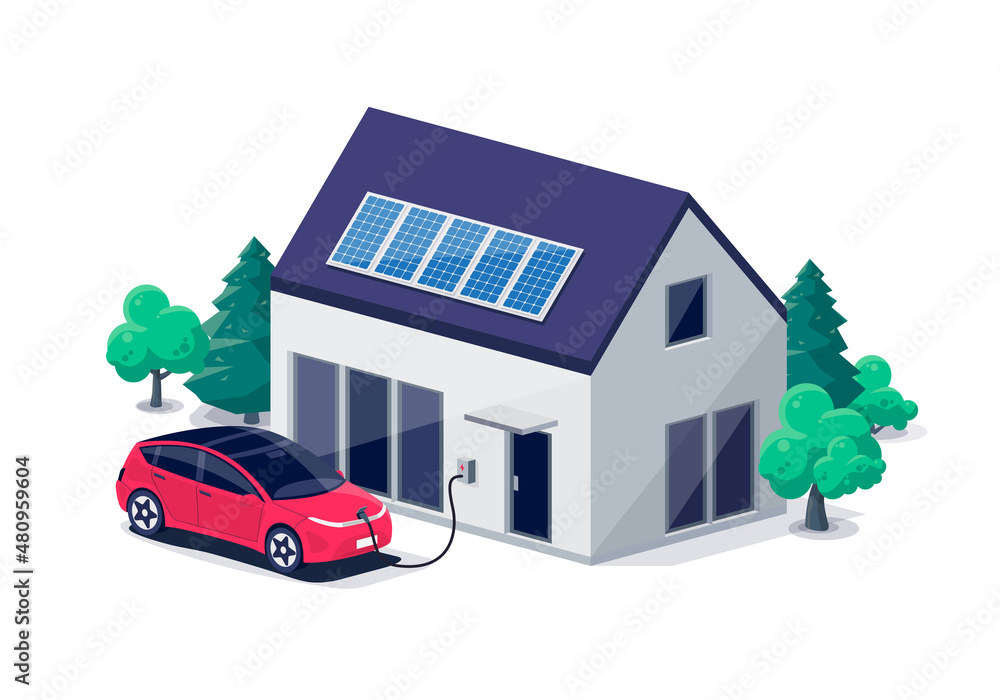
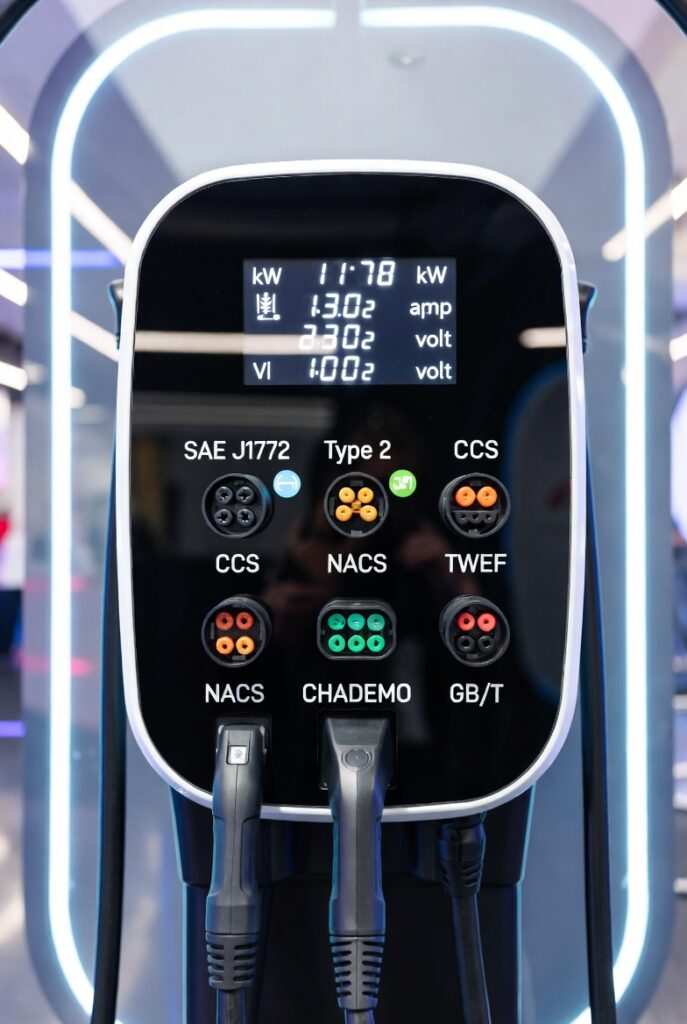
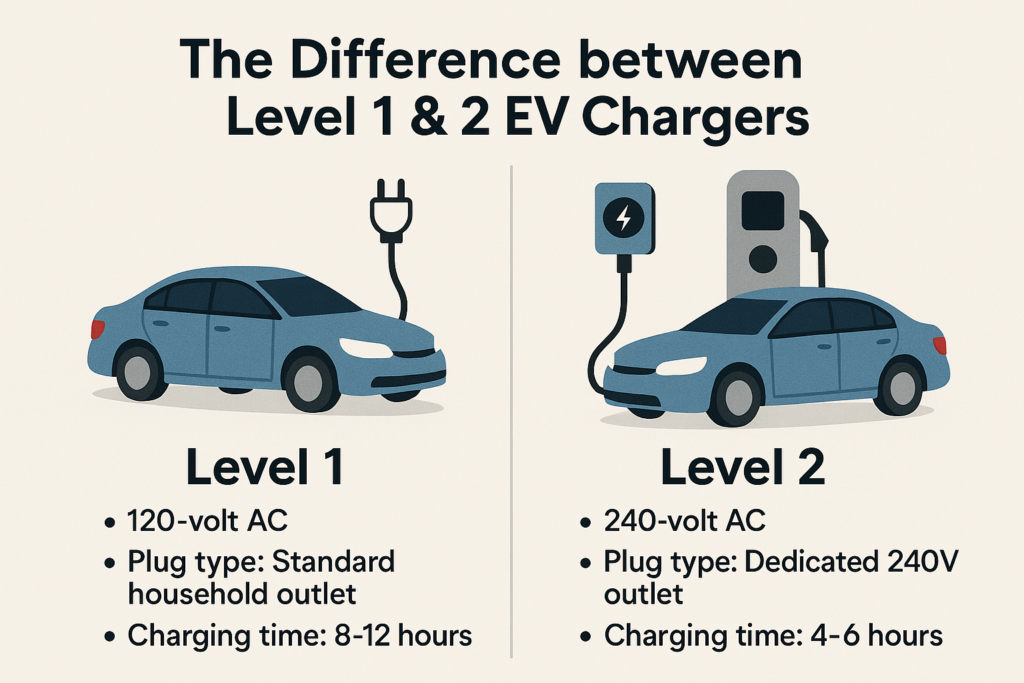
Here’s a scenario that happens thousands of times a week across the US, UK, and Europe.
Someone buys a home EV charger. They budget for the unit itself — $399, $699, £649, whatever it is. They call an electrician to install it. The quote comes back significantly higher than expected. Sometimes double what they assumed. Sometimes more.
The charger was £649. The installation quote was £850. Nobody told them it would cost that much.
Or the reverse — they get a suspiciously cheap quote from someone who turns out not to be a licensed electrician, installs the charger without a permit, and three years later when they try to sell the house, the unpermitted electrical work becomes a problem.
Professional EV charger installation costs 2026 US UK Europe vary enormously — by country, by region, by the complexity of the specific installation, and by how well the buyer understands what they’re paying for. This guide puts the complete, honest picture in one place.
What licensed electricians actually charge in different markets. What drives the variation between a simple $200 installation and a complex $3,000 one. The hidden costs that quotes often exclude. How to get a fair price without getting ripped off. And the specific installation scenarios — panel upgrades, long cable runs, apartment buildings — that change the cost calculation significantly.
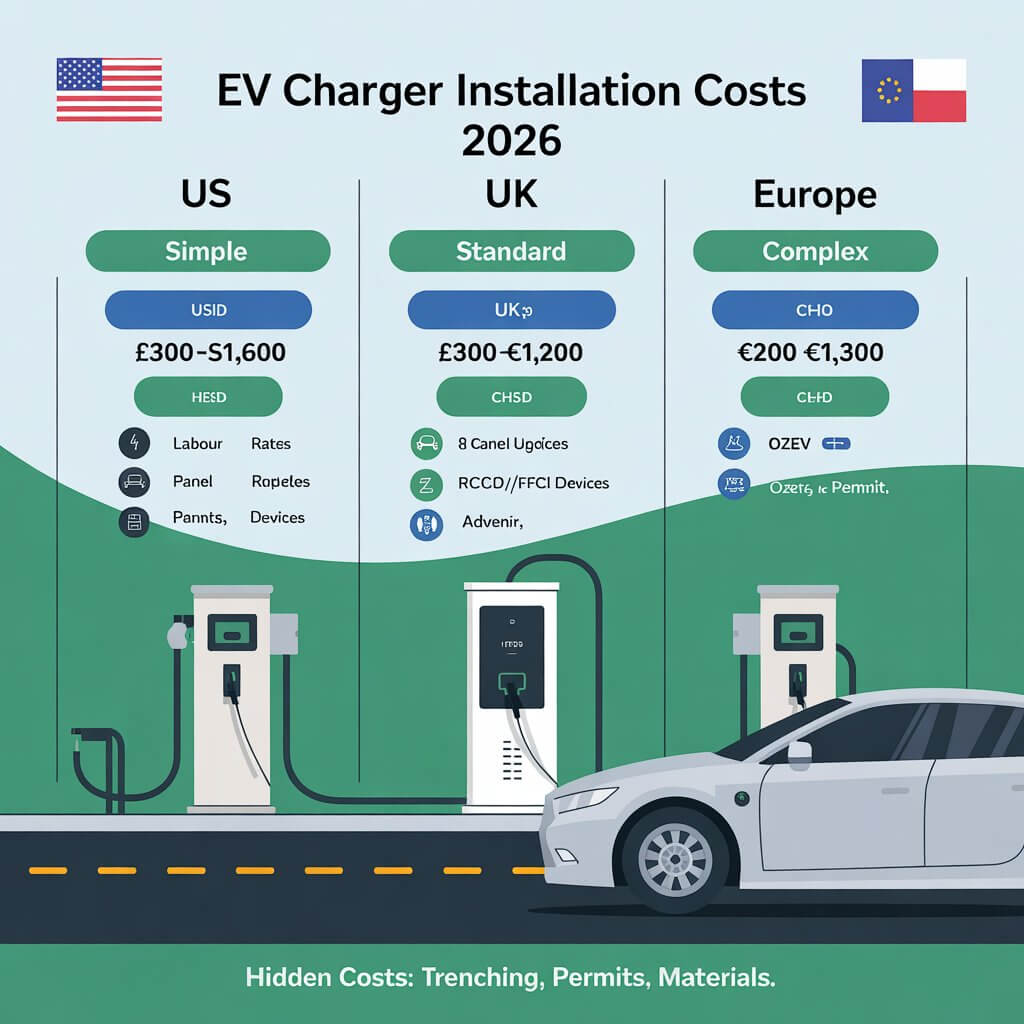
Why EV Charger Installation Costs Vary So Much
Before getting into specific numbers, understanding why the variation exists makes the numbers more useful.
Factor 1: Labour Rates by Region
Licensed electrician labour rates vary significantly across and within markets:
United States: $75-$175 per hour for a licensed electrician depending on region. New York City and San Francisco are at the high end ($130-$175/hour). Rural Midwest and Southeast states are at the lower end ($75-$100/hour). The same installation job costs twice as much in Manhattan as in rural Ohio.
United Kingdom: £50-£100 per hour for an OZEV-registered electrician. London and southeast England at the high end. Northern England, Scotland, Wales at the lower end. Specialist EV charger installers may charge a fixed rate per installation rather than hourly.
Germany: €60-€100 per hour. Higher in Munich and Frankfurt, lower in rural eastern Germany.
France: €50-€90 per hour. Paris significantly higher than provincial France.
Netherlands: €65-€95 per hour. Amsterdam higher than rural Netherlands.
Scandinavia (Norway, Sweden, Denmark): €80-€130 per hour — among the highest in Europe, reflecting overall Scandinavian labour costs.
Spain, Italy, Portugal: €40-€70 per hour — lower than Northern Europe but rising.
Factor 2: Installation Complexity
Labour time is driven by complexity more than anything else. The same charger unit might take one electrician 45 minutes to install (existing dedicated circuit, charger mounted near the panel) and another electrician 4 hours (no existing circuit, long cable run through finished walls, panel work required).
Simple installation (1-2 hours): Existing dedicated circuit or NEMA 14-50/CEE outlet close to parking, charger mounted on adjacent wall, minimal cable routing, no panel work required.
Standard installation (2-4 hours): New 240V/230V dedicated circuit required, panel has available slot, moderate cable run (10-20 metres), some cable routing through walls or conduit.
Complex installation (4-8 hours): Long cable run (20-50 metres), cable routing through multiple rooms or floors, panel work required (new breaker, load assessment), outdoor conduit installation, trenching for underground cable.
Very complex installation (full day or more): Panel upgrade required, underground cable runs, three-phase supply upgrade, apartment building common area work, multiple charger installation with load management hardware.
Factor 3: Materials
The electrician’s labour quote often excludes materials — or includes them at significant markup. Key material costs:
Cable (per metre):
- 6 AWG copper cable (US, for 50A circuit): $3-$6 per metre
- 8 AWG copper cable (US, for 40A circuit): $2-$4 per metre
- 6mm² twin and earth (UK, for 32A circuit): £3-£6 per metre
- 10mm² (UK, for higher current): £5-£8 per metre
- 6mm² three-core (Europe, for three-phase): €4-€7 per metre
A 20-metre cable run adds $60-$120 in cable alone in the US, £60-£120 in the UK, €80-€140 in Europe — before any conduit, trunking, or junction boxes.
Conduit: $1-$3 per metre in the US, £1-£3 in the UK. Required in many jurisdictions for outdoor runs and some indoor runs depending on local code.
Circuit breaker: $20-$80 in the US (50A double-pole breaker). £15-£50 in the UK (32A MCB). €20-€60 in Europe.
Permit fees: $50-$200 in the US. No permit required in the UK (but Electrical Installation Certificate required). Varies by country in Europe.
RCD/GFCI protection: Required for EV charging in many jurisdictions. $30-$80 in the US (GFCI breaker). £50-£100 in the UK (Type B RCD, required for most EV chargers). €60-€120 in Europe.
Factor 4: Panel Work
The most significant cost variable in EV charger installation is whether any electrical panel work is required:
Available panel slot (no panel work): Add a breaker, connect the circuit. 30-60 minutes additional. $50-$150 additional cost.
Full panel with tandem breakers possible: Tandem breaker installation to free up space. $100-$300 additional.
Full panel requiring upgrade: Panel upgrade from 100A to 200A (US) or equivalent upgrade (UK/Europe). This is a major additional cost covered in detail below.
US EV Charger Installation Costs 2026 — The Complete Breakdown
Simple US Installation — Existing Circuit or Adjacent Panel
Scenario: You have an existing NEMA 14-50 outlet at your parking location, or the charger is being mounted immediately adjacent to the panel on a short cable run.
Labour: 1-2 hours at $75-$175/hour = $75-$350 Materials: Minimal — breaker if needed ($20-$80), short cable run ($20-$60), mounting hardware ($10-$20) Permit: $50-$150 in most jurisdictions Total range: $175-$660
Realistic median for a simple US installation: $300-$450 all-in
This is the scenario most people imagine when they budget for EV charger installation. It’s the best-case scenario — and it’s genuinely achievable if you have an existing dedicated circuit or are mounting the charger in your garage adjacent to your panel.
Standard US Installation — New Dedicated Circuit, Moderate Cable Run
Scenario: New 240V dedicated circuit from the panel to the charger location. The panel has an available slot. The cable run is 10-25 metres through a garage or unfinished basement.
Labour: 2-4 hours at $75-$175/hour = $150-$700 Materials:
- 40-50A double-pole breaker: $30-$80
- 6-8 AWG copper cable (15-25 metres): $45-$150
- Conduit if required: $15-$75
- GFCI protection if required: $30-$80
- Mounting hardware: $10-$20
- Permit: $50-$150 Total range: $330-$1,255
Realistic median for a standard US installation: $500-$800 all-in
This is the most common US EV charger installation scenario. Most homeowners with a garage and a reasonably positioned panel fall into this category. Getting three quotes is important at this price level — the range is wide and contractor pricing varies significantly.
Complex US Installation — Long Cable Run, Finished Walls, or Difficult Routing
Scenario: The charger needs to be installed at a location requiring a long cable run (25-50 metres), routing through finished living spaces, underground conduit to a detached garage, or other complexity.
Labour: 4-8 hours at $75-$175/hour = $300-$1,400 Materials:
- Cable (30-50 metres of 6 AWG): $90-$300
- Conduit (30-50 metres): $30-$150
- Junction boxes, fittings: $30-$100
- Breaker and protection: $60-$160
- Permit: $50-$200 Total range: $560-$2,310
Realistic median for a complex US installation: $1,000-$1,600 all-in
Underground cable runs to detached garages are the most common complex scenario — trenching alone adds $200-$500 to the cost depending on length and soil conditions.
US Panel Upgrade — The Big Unknown Cost
This is where EV charger installation costs can escalate dramatically and unexpectedly. A homeowner with a 100-amp panel who needs a 200-amp upgrade to support 48A EV charging is looking at a separate and significant project.
100A to 200A panel upgrade (US):
- Labour: 4-8 hours (utility coordination required in some cases)
- Panel and breakers: $500-$1,500 (panel hardware alone)
- Utility meter upgrade (if required): $200-$500 (utility company charge)
- Permit: $100-$300
- Total panel upgrade cost: $1,500-$4,000
Important context: A panel upgrade is not always necessary for EV charging. A 100-amp panel can support a 32A (7.2 kW) EV charger if there’s available panel capacity. The upgrade is only necessary when:
- The panel is genuinely full with no available breaker slots
- The existing total load leaves insufficient headroom for EV charging
- You specifically need 48A (11.5 kW) charging capacity
The Emporia Pro’s load management feature is specifically designed to make 48A charging viable on 100-amp panels without a panel upgrade — by monitoring total home consumption and throttling EV charging when other loads are high. For many homeowners, buying the Emporia Pro ($399) is a better option than a $2,000-$4,000 panel upgrade.
US Commercial and Multi-Unit Installation Costs
For apartment buildings, offices, and commercial properties, EV charger installation costs are structured differently:
Apartment building (5-20 parking spaces):
- Shared electrical infrastructure: $5,000-$20,000
- Per-space hardware and connection: $500-$1,500 per space
- Load management system: $1,000-$3,000
- Total for 10-space installation: $15,000-$38,000
Office parking (10-50 spaces):
- Infrastructure and load management: $10,000-$50,000
- Per-space hardware: $500-$2,000
- Networked charging management software: $1,000-$5,000 annually
For commercial installations, the ChargePoint, Blink, and EVgo business programmes offer alternative financing models where the network operator shares installation costs in exchange for revenue sharing or network branding.
UK EV Charger Installation Costs 2026 — The Complete Breakdown
Simple UK Installation — Adjacent Panel, Short Cable Run
Scenario: Charger mounted on a garage wall adjacent to the consumer unit, short cable run (under 5 metres), no significant routing challenges.
Labour: 2-3 hours at £50-£100/hour = £100-£300 Materials:
- 32A MCB: £15-£30
- 6mm² cable (5 metres): £15-£30
- RCD Type B (required for most EV chargers): £50-£100
- Electrical Installation Certificate: included
- Mounting hardware: £10-£20 OZEV Grant (eligible flat owners): -£350 Total before grant: £190-£480 Total after grant (eligible): £0-£130
Realistic median for simple UK installation before grant: £300-£400 Realistic median after OZEV grant (eligible flat owners): £0-£50
Standard UK Installation — New Circuit, Moderate Cable Run
Scenario: New 32A dedicated circuit from the consumer unit to a parking space or garage, 10-20 metre cable run, some routing through walls or ceiling void.
Labour: 3-5 hours at £50-£100/hour = £150-£500 Materials:
- 32A MCB: £15-£30
- 6mm² cable (15-20 metres): £45-£120
- Conduit/trunking: £20-£60
- Type B RCD: £50-£100
- Weatherproof enclosure (if outdoor): £20-£40
- Permit and certificate: included in OZEV registration Total before grant: £300-£850 After OZEV grant (eligible): £0-£500
Realistic median for standard UK installation before grant: £500-£650 Realistic median after grant: £150-£300
This is the most common UK home EV charger installation scenario. The OZEV grant significantly changes the net cost for eligible flat owners. House-owning homeowners pay full price without the grant.
Complex UK Installation — Long Cable Run, Apartment Building, or Consumer Unit Work
Scenario: Long cable run (20-50 metres), routing through multiple rooms or between floors, significant consumer unit work, or apartment building installation requiring work in common areas.
Labour: 5-8 hours at £50-£100/hour = £250-£800 Materials:
- Cable (25-50 metres of 6-10mm²): £75-£300
- Conduit/trunking: £40-£150
- Consumer unit work: £50-£200
- Type B RCD: £50-£100
- Additional protection devices: £30-£80 Total before grant: £495-£1,630 After OZEV grant (eligible flat owners): £145-£1,280
Realistic median for complex UK installation before grant: £800-£1,200 After grant: £450-£850
UK Consumer Unit (Fuse Box) Upgrade
Unlike the US where 100A-to-200A upgrades are relatively common, UK consumer unit upgrades for EV charging are less frequently required. Most UK homes have adequate supply for a 7.4 kW single-phase EV charger.
However, older UK properties — particularly pre-1980 construction with older fuse boards — may need a consumer unit upgrade to accommodate EV charging safely:
Consumer unit replacement (UK):
- Labour: 4-6 hours
- New consumer unit (with RCD protection): £150-£400
- Labour cost: £200-£600
- Total: £350-£1,000
This is less common than US panel upgrades but worth knowing if your home has an older fuse board.
UK Three-Phase Supply Upgrade
For UK homeowners who want to upgrade from single-phase to three-phase supply (to access 11 kW charging on capable vehicles):
Three-phase supply upgrade cost:
- DNO (distribution network operator) application: £500-£1,500 for the connection upgrade
- Internal wiring upgrade: £300-£800
- New three-phase consumer unit: £300-£600
- Total: £1,100-£2,900
This is a significant investment that’s only financially justified for vehicles with 11 kW+ AC capability (Porsche Taycan with upgrade, Lucid Air, some BMW iX variants) and owners who frequently need rapid overnight charging.
European EV Charger Installation Costs 2026 — By Country
Germany
Simple installation (existing circuit):
- Labour: 1-2 hours at €60-€100/hour = €60-€200
- Materials: €80-€200
- Total: €140-€400
Standard installation (new dedicated circuit):
- Labour: 3-5 hours = €180-€500
- Materials: €150-€350
- Total: €330-€850
Complex installation:
- Labour: 5-8 hours = €300-€800
- Materials: €200-€500
- Total: €500-€1,300
KfW financing: While Germany doesn’t have a direct grant equivalent to the UK OZEV scheme, KfW subsidised financing reduces the effective cost of installation for qualifying homeowners.
France
Simple installation:
- Labour: 2-3 hours at €50-€90/hour = €100-€270
- Materials: €80-€200
- Total: €180-€470
Standard installation:
- Labour: 3-5 hours = €150-€450
- Materials: €150-€350
- ADVENIR subsidy (apartment individual): up to €960
- Net cost after ADVENIR: €0-€240 for many installations
French TVA reduction: 5.5% rather than 20% VAT on EV charger installation — reduces total cost by approximately 14.5%.
The French context: France’s ADVENIR programme and TVA reduction make it one of the most financially supported EV charger installation markets in Europe. French homeowners who navigate both incentives can install a quality home charger for minimal net cost.
Netherlands
Simple installation:
- Labour: 2-3 hours at €65-€95/hour = €130-€285
- Materials: €80-€180
- Total: €210-€465
Standard installation:
- Labour: 3-5 hours = €195-€475
- Materials: €150-€300
- SEEH subsidy (30%, up to €1,500): reduces total significantly
- Net cost after SEEH: €50-€400 for most standard installations
The Dutch context: The SEEH subsidy makes the Netherlands one of the cheapest net-cost EV charger installation markets in Europe. Dutch homeowners who apply early in the year (before SEEH budget runs out) achieve excellent net costs.
Norway
Simple installation:
- Labour: 2-3 hours at €80-€130/hour = €160-€390
- Materials: €80-€200
- Enova grant: approximately €260
- Net cost: €0-€330
Standard installation:
- Labour: 3-5 hours = €240-€650
- Materials: €150-€300
- Net cost after Enova: €130-€690
The Norwegian context: Norway’s extremely high EV adoption rate means electricians are very experienced with EV charger installation and installation times are often shorter than other markets. The combination of experienced installers and Enova grants makes Norway a well-supported installation market.
Sweden
Simple installation:
- Labour: 2-3 hours at €70-€110/hour = €140-€330
- Materials: €80-€200
- Rotavdrag (30% labour deduction): reduces labour cost
- Net cost after deductions: €50-€220
Standard installation:
- Labour: 3-5 hours = €210-€550
- After Rotavdrag and Green Technology deduction: reduces total by 30-45%
- Net cost: €100-€350
Spain
Simple installation:
- Labour: 2-3 hours at €40-€70/hour = €80-€210
- Materials: €80-€180
- Total: €160-€390
- MOVES III subsidy: up to €500
- Net cost after MOVES III: €0 (in many cases)
Standard installation:
- Labour: 3-5 hours = €120-€350
- Materials: €150-€300
- Total: €270-€650
- Net cost after MOVES III: €0-€150
The Spanish context: Spain’s lower labour rates combined with the MOVES III subsidy make Spanish EV charger installation among the most affordable in Europe on a net cost basis. Application timing is important — MOVES III budgets are allocated by autonomous community and can run out.
Italy
Simple installation:
- Labour: 2-3 hours at €40-€70/hour = €80-€210
- Materials: €80-€180
- Total: €160-€390
Standard installation:
- Labour: 3-5 hours = €120-€350
- Materials: €150-€300
- Total: €270-€650
- Bonus Colonnine (80% of total, up to €1,500): covers most standard installations
- Net cost after bonus: €0-€130
The Italian context: Italy’s Bonus Colonnine is the most generous individual home EV charger subsidy in Europe — covering 80% of purchase and installation costs up to €1,500. Italian homeowners who successfully access an open application window (applications open periodically and fill within hours) pay virtually nothing for a standard installation.
The Total Cost Comparison — What You’re Actually Paying
Here’s the honest all-in cost picture for a typical installation — $699/£699/€699 ChargePoint Home Flex equivalent, standard installation (new dedicated circuit, 15-20 metre cable run):
| Market | Total Before Incentives | Main Incentive | Net Cost After Incentives |
|---|---|---|---|
| US (California, PG&E) | $1,200-$1,800 | Federal credit + utility rebate ($1,000-$1,860) | $0-$800 |
| US (Texas, Oncor) | $1,000-$1,600 | Federal credit + Oncor rebate ($610) | $390-$990 |
| US (no state programme) | $1,000-$1,600 | Federal credit only ($360) | $640-$1,240 |
| UK (flat owner) | £800-£1,200 | OZEV grant (£350) | £450-£850 |
| UK (homeowner) | £800-£1,200 | None | £800-£1,200 |
| France | €900-€1,300 | ADVENIR + TVA (up to €1,120) | €0-€400 |
| Netherlands | €800-€1,100 | SEEH 30% (up to €330) | €470-€770 |
| Germany | €900-€1,300 | KfW financing | €900-€1,300 (financed) |
| Norway | €900-€1,300 | Enova (€260) | €640-€1,040 |
| Italy | €800-€1,200 | Bonus Colonnine 80% (up to €960) | €0-€240 |
| Spain | €700-€1,000 | MOVES III (up to €500) | €200-€500 |
How to Get a Fair Quote — And Avoid Being Overcharged
This is the practical section most cost guides skip — not just what things cost, but how to navigate the quoting process to pay a fair price.
Always Get Three Quotes
The variation in EV charger installation quotes for identical work can be 2-3x between the cheapest and most expensive contractor. Three quotes from licensed electricians gives you a market reference — anything significantly above the median warrants detailed explanation from the contractor.
What a Good Quote Includes
A comprehensive, trustworthy EV charger installation quote should specify:
- Labour cost (clearly separated from materials)
- Materials list with approximate costs — cable, breaker, conduit, RCD, etc.
- Cable run route and method — surface trunking, in-wall, underground
- Permit fee (US) or certification cost (UK/Europe)
- Panel/consumer unit assessment — whether any panel work is included or whether it’s an additional quote
- Total cost with no hidden extras — or a clear statement of what could cause the price to increase
A quote that’s just a single number with no breakdown is a warning sign. Ask for itemisation.
Red Flags in EV Charger Installation Quotes
No mention of permit: In the US, EV charger installation requires a permit. A quote that doesn’t mention a permit is either including it without disclosing (ask) or planning to skip it (walk away).
No Type B RCD in UK quote: Most EV charger installations in the UK require a Type B RCD — a specific type of residual current device that handles the DC fault currents that EV chargers can produce. A UK quote that doesn’t mention RCD protection may be underspecifying the installation.
Unusually low quote: An installation quote that’s 40-50% below other quotes for identical work typically means something is being excluded — permit, materials, or using undersized cable.
No OZEV registration (UK): An electrician who can’t provide their OZEV registration number cannot legally certify an EV charger installation in the UK and cannot claim the OZEV grant on your behalf. Always verify OZEV registration.
No Electrical Installation Certificate offered: In the UK, every EV charger installation must be accompanied by an Electrical Installation Certificate. An electrician who doesn’t mention this is either not providing one (non-compliant) or doesn’t know it’s required (inexperienced).
How to Reduce Installation Costs Legitimately
Choose hardware with a NEMA 14-50/CEE plug option. Installing a NEMA 14-50 outlet rather than a hardwired charger typically costs $100-$200 less in labour because the final connection is a plug rather than terminal wiring. The outlet installation itself costs the same — but the charger connection is simpler.
Have the circuit installed separately from the charger mounting. Some electricians are more expensive for the whole-job price than for circuit installation alone. If you’re competent with basic mounting and wall work, having the electrician install the circuit and then mounting the charger yourself (where permitted) can save $50-$150 in labour.
Choose the charging location to minimise cable run. Every metre of cable run adds $3-$8 in materials and increases labour time. If you can position the charger within 5 metres of your panel rather than 20 metres, you save meaningful cost.
Bundle with other electrical work. If you have other electrical jobs — additional outlets, lighting circuits, consumer unit work — bundling them with the EV charger installation often reduces the per-job mobilisation cost that electricians charge for arriving at the property.
Apply for grants before installation begins. Some grant programmes (CAEVIP in California, NYSERDA in New York) require pre-approval before installation. Applying late disqualifies you from the grant. Getting grant approval first ensures you don’t lose incentives through timing mistakes.
The Hidden Costs Nobody Mentions
Beyond the quoted installation cost, these additional costs catch EV charger buyers off guard:
Trenching for Detached Garage Cable Runs
Running cable underground to a detached garage requires trenching — digging a trench, laying conduit, pulling cable, backfilling, and reinstating the surface. Trenching costs $10-$30 per linear metre depending on soil conditions, depth required, and surface material (lawn vs patio vs concrete).
A 15-metre underground run to a detached garage costs $150-$450 in trenching alone — before cable, conduit, or connection costs.
Asphalt or Concrete Cutting
If cable needs to pass under a driveway or patio surface, core drilling or saw cutting is required. Cost: $100-$400 depending on thickness and material.
Patching and Restoration
After cable runs through finished walls or ceilings, the holes need patching. Electricians typically don’t include plastering or decorating in their quotes. Budget $50-$200 for patching if cable runs through finished living spaces.
Smart Charger Setup and Configuration
Some electricians charge for smart charger WiFi setup and app configuration — typically $25-$75. Others include it. Check the quote. It’s not expensive but it’s worth knowing.
Extended Warranty Activation
Some charger brands (ChargePoint, Emporia) offer extended warranty terms that require activation within a specific window of installation. Missing this window loses the extended coverage. Not a cost but a time-sensitive action worth noting.
Internal Links — Further Reading on Clean Energy Bazaar
The professional EV charger installation costs 2026 US UK Europe breakdown is the practical companion to the hardware guides across this site.
For the full US home charger comparison — which hardware you’re installing and how much the unit itself costs — our best home EV chargers 2026 US comparison covers ten options honestly. For the UK and European market, our best Level 2 EV chargers UK Europe 2026 guide covers every major option. For the DIY vs professional installation decision and what’s genuinely DIY-accessible, our DIY EV charger installation 2026 guide covers every scenario. For the US state rebates that reduce net installation costs significantly, our US EV charger rebates by state 2026 guide covers every major programme. For European grants and incentives that interact with installation costs, our EV home charging incentives Europe 2026 guide covers every country. And for the portable vs hardwired decision that significantly affects installation complexity and cost, our portable vs hardwired home EV chargers guide covers the full comparison.
Final Thoughts
Professional EV charger installation costs 2026 US UK Europe range from effectively zero — after grants and incentives in the best cases in California, France, and Italy — to $3,000-$5,000+ for complex installations requiring panel upgrades and long underground cable runs.
The honest summary by scenario:
Lowest net cost scenarios:
- California PG&E customer: $0-$200 after federal credit + CAEVIP + utility rebate
- French apartment owner: €0-€200 after ADVENIR + TVA reduction
- Italian homeowner: €0-€200 after Bonus Colonnine
- Spanish homeowner (MOVES III available): €0-€200 after subsidy
- UK flat owner (simple installation): £0-£130 after OZEV grant
Median net cost scenarios:
- US homeowner (standard installation, federal credit only): $500-$900
- UK homeowner (standard installation, no grant): £500-£750
- Dutch homeowner (after SEEH): €200-€500
- Norwegian homeowner (after Enova): €400-€800
Highest cost scenarios:
- US homeowner requiring panel upgrade: $2,500-$5,000 total
- UK homeowner, complex apartment or long cable run: £1,000-£1,600
- European homeowner requiring three-phase supply upgrade: €2,000-€4,000
Three actions before you commission any installation: get three quotes with full itemisation, confirm all applicable grant pre-approval requirements, and check whether load management hardware (Emporia Pro, Myenergi Zappi) can avoid a panel upgrade before committing to one.
The installation cost is a one-time expense. The electricity tariff is a forever cost. And the charger hardware is what you use every day. Get all three right.