Here’s two conversations that happen every week in EV owner communities — on opposite ends of a very wide spectrum.
The first is from someone in Chicago, London, or Amsterdam. They live in a fourth-floor apartment. They park on the street or in a shared underground car park. They’ve just taken delivery of an EV and are realising that the home charging setup they assumed would be straightforward is anything but. The building management has said no to a charger installation. The street has no charging infrastructure. The nearest public charger is eight minutes’ walk away. They’re wondering whether they made a mistake buying an EV at all.
The second is from someone in rural Montana, rural Normandy, or a village in the Cotswolds. They have a garage. They have a driveway. They have plenty of wall space for a charger. But their electrical supply is on a rural single-phase circuit that struggles to maintain 220V under load. The nearest electrician who knows anything about EV charger installation is forty miles away. The nearest parts supplier if something breaks is further. And in winter, the temperature in their unheated garage drops to minus 20°C.
Both of these people are trying to solve the same problem — reliable home EV charging — but the solutions are entirely different. And almost no guide addresses both honestly in the same place.
This is that guide.
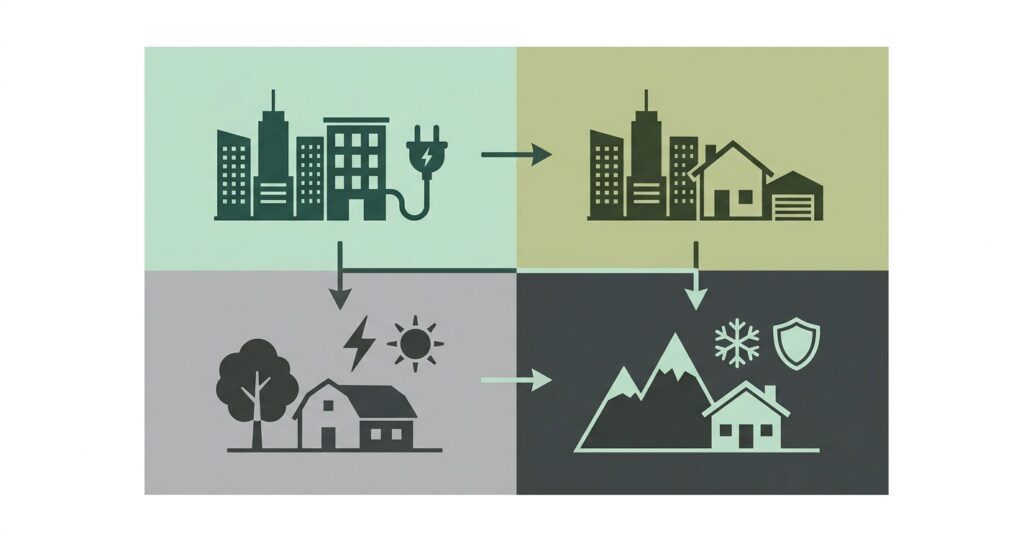
Urban vs rural home EV charging US cities European villages is one of the most practically important but least well-covered topics in the EV charging space. This guide covers both ends of the spectrum — and the significant middle ground — with honest solutions that work in the real conditions each setting creates.
Why Location Changes Everything About Home EV Charging
Before getting into specific solutions, it’s worth understanding why the urban/rural distinction matters so fundamentally for home EV charging — because it affects almost every aspect of the decision.
Parking Access and Ownership
Urban US: Street parking, shared garage, or purchased parking space. High likelihood of no direct electrical access at parking location. Parking and residence are often physically separated — charging at home may literally mean charging in a different building or several floors below your apartment.
Urban Europe: On-street parking is dominant in most European city centres. Many older European city flats have no parking at all. Underground car parks in newer buildings increasingly have electrical infrastructure but older buildings don’t. In some European cities — Amsterdam, central London, central Paris — car ownership rates are low enough that EV charging infrastructure for residents is politically low priority.
Rural US: Almost universal driveway or garage access. Parking is adjacent to the home. No shared parking complications. The challenge is electrical infrastructure quality rather than access.
Rural Europe: Similar to rural US for access — most European village homes have gardens, driveways, or garages. The challenge is the quality and capacity of rural electrical supply, which in parts of France, Italy, Spain, Portugal, and rural UK can be genuinely limited.
Electrical Infrastructure Quality
Urban US: Generally good electrical infrastructure. 200-amp panels are common in newer construction. The challenge is access to that panel from the parking location — running a cable from a fourth-floor apartment to an underground car park is a building management and cable routing problem, not an electrical capacity problem.
Urban Europe: Variable. Newer European apartment buildings increasingly have three-phase supply and good panel capacity. Older buildings — particularly pre-1980 construction in France, Italy, Spain, and the UK — often have limited supply capacity and single-phase only, with the additional complication that adding load requires coordination with the building’s shared electrical system.
Rural US: Variable and often problematic. Rural areas are served by overhead power lines that experience more voltage fluctuation than urban underground cables. Transformer capacity in rural areas is sometimes marginal — in areas with significant EV adoption, local transformers can be at or near capacity. Supply voltage during peak demand periods can drop meaningfully below the standard 240V.
Rural Europe: The most challenging scenario. Rural France, rural Italy, rural Spain, rural Portugal, and parts of rural UK can have genuinely limited electrical supply — sometimes as low as 6 kVA (kilowatt-ampere) single-phase for older village properties. Adding a 7.4 kW EV charger to a home with a 6 kVA supply that already runs electric heating, a water heater, and kitchen appliances requires careful management or a supply upgrade.
Charging Infrastructure Density
Urban US: Generally good public charging density in major cities — particularly on the coasts. Manhattan, San Francisco, Los Angeles, Seattle, Chicago, and Boston all have reasonably dense public charging networks. The challenge is reliability and peak demand, not availability.
Urban Europe: Variable by city but generally strong in city centres. Central London, Amsterdam, Oslo, Paris, and Berlin have dense public charging networks including on-street charging points funded by local authorities. However, secondary cities and suburban areas can be significantly less well served.
Rural US: Thin. The US rural charging network outside interstate highway corridors is genuinely sparse. A Montana homeowner may have the nearest DC fast charger 80-100 miles away. Day-to-day rural EV ownership in the US is fundamentally dependent on home charging in a way that urban ownership isn’t.
Rural Europe: Better than rural US in some respects — Europe’s motorway charging network is denser and the EU AFIR regulation is improving coverage. But village-level charging in rural France, rural Italy, or rural Spain is often dependent on a single municipal charging point that may or may not be working. Rural EV ownership in Europe is also fundamentally dependent on reliable home charging.
Urban Home EV Charging — US Cities
The Core Urban US Challenge: Parking Without Power
The fundamental problem for most urban US EV owners isn’t technical — it’s physical and legal. Getting electrical power to where you park is the challenge that makes urban home charging harder than it should be.
Scenario 1: Urban homeowner with garage or driveway access This is the simplest urban scenario. A San Francisco row house with a driveway, a Chicago bungalow with a garage, a Houston townhouse with an attached parking space — these owners have the same home charging options as suburban owners.
For single-family urban homeowners with parking access, standard Level 2 charger recommendations apply. The specific urban consideration is panel capacity — urban homes in older US cities often have 100-amp panels rather than 200-amp, which affects high-power (48A) charger feasibility.
Best options: ChargePoint Home Flex (adjustable amperage for older panels), Emporia Pro with load management, Grizzl-E Classic for budget installations.
Scenario 2: Urban condo or apartment owner with designated parking space The most common and most complicated urban US scenario. You own a condo parking space in an underground garage — but installing an EV charger requires building approval, electrical work in common areas, and coordination with the HOA.
For this scenario, see our dedicated apartment EV charging solutions 2026 guide for the complete legal and practical framework. The key points:
- Right to charge laws in California, Florida, New York, and other states limit HOA refusal rights
- A dedicated circuit from your unit’s electrical panel to your parking space is the gold standard solution
- A NEMA 14-50 outlet installation may be approvable even when a full charger installation isn’t — enabling a portable Level 2 EVSE
- Shared infrastructure proposals (building-wide charging) often get more traction with HOA boards than individual requests
Scenario 3: Urban renter with parking Renters have fewer legal protections than owners in most US states. Right to charge laws in California and some other states provide some protections for renters — but enforcement and landlord cooperation vary.
Practical options for urban renters with parking:
- Negotiate a NEMA 14-50 outlet installation with the landlord — frame it as an amenity upgrade that benefits future tenants
- A portable Level 2 EVSE with a NEMA 14-50 outlet delivers full Level 2 speed and can be taken when you move
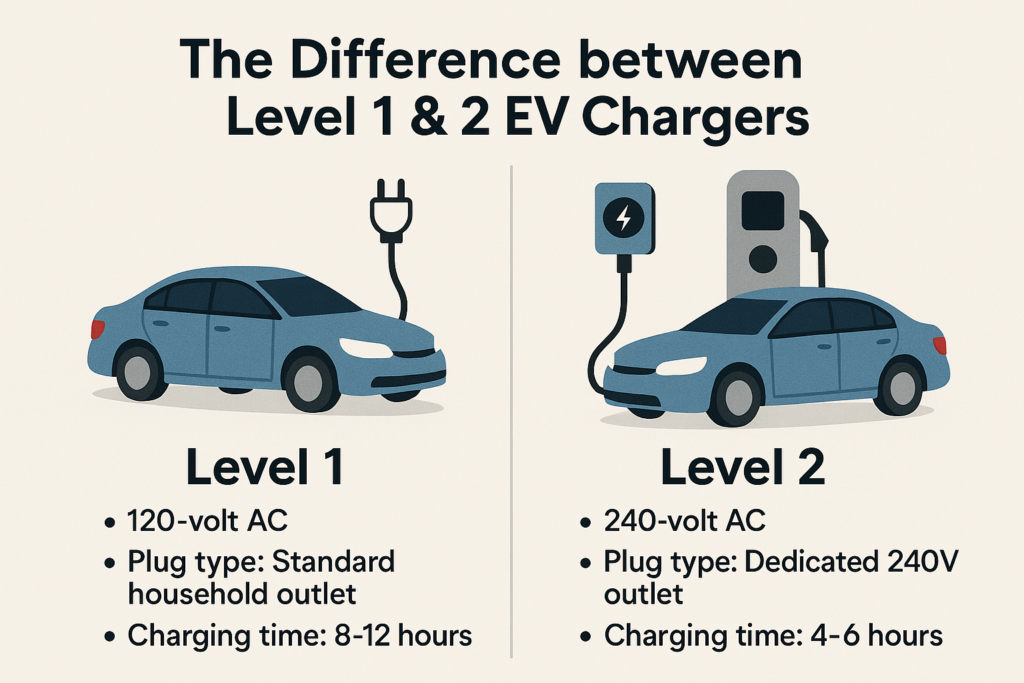
- Level 1 (120V standard outlet) — adequate for urban drivers with low daily mileage and consistent overnight parking
Scenario 4: Urban owner or renter without dedicated parking Street parking only, no garage, no assigned space — the hardest US urban EV charging scenario.
Honest options:
- Public charging as primary charging method — use DC fast charging weekly for major top-ups and opportunistic Level 2 charging at destinations (work, shopping, gym)
- On-street charging infrastructure advocacy — many US cities are installing on-street charging stations specifically for residents without off-street parking. New York City, Los Angeles, and San Francisco all have programmes. Contact your city councillor or district representative.
- Workplace charging — if your employer has or can be persuaded to install EV charging, workplace Level 2 charging during the workday replaces home charging for many urban patterns
- Destination charging — hotels, parking garages, shopping centres with free or low-cost Level 2 charging can provide regular top-up charging for low-mileage urban drivers
Urban US Charging Networks — What’s Actually Reliable
For urban US EV owners who rely significantly on public charging, network reliability matters more than raw station count. Here’s the honest assessment:
Tesla Supercharger (NACS-native vehicles): The most reliable urban charging network in the US. Consistent station availability, well-maintained hardware, predictable pricing. For NACS vehicle owners, Tesla Supercharger locations in urban areas are the most dependable public charging option.
ChargePoint (urban locations): The largest US charging network by station count. Urban ChargePoint stations at workplaces, hotels, and parking garages are generally reliable. Network-managed stations have better uptime than unmanaged alternatives.
EVgo (urban DC fast): Urban-focused DC fast charging network. Generally reliable but station density varies significantly by city.
Blink: Mixed reliability track record. Useful for destination charging where you have time to deal with occasional faults. Less suitable as a primary charging dependency.
PlugShare app: The essential tool for urban US EV owners without reliable home charging. Real-time user check-ins on station status are more reliable than any network’s own app for finding currently working chargers.
Urban Home EV Charging — European Cities
The European Urban Challenge: Old Buildings, On-Street Parking, and Strong Rights
European urban EV charging has a different character from US urban charging — different building stock, different legal frameworks, and in many cities a genuinely stronger municipal commitment to on-street charging infrastructure.
Scenario 1: European city flat with designated parking space (newer building) Newer European apartment buildings — particularly those built after 2010 — increasingly have underground parking with electrical infrastructure. The EU’s Energy Performance of Buildings Directive (EPBD) requires EV charging pre-installation in new buildings.
For flat owners in newer European buildings with designated parking, a Type 2 home charger installation is usually straightforward. Key considerations:
- Confirm building electrical supply to the parking area
- In the UK, the OZEV grant (£350) covers flat owners — see our EV home charging incentives Europe 2026 guide for the full grant picture
- A Wallbox Pulsar Plus or Easee One are the most appropriate hardware options for this scenario
Scenario 2: European city flat in an older building (pre-1990 construction) The most common European urban scenario — a flat in an older building with limited parking and limited electrical infrastructure at the parking level.
UK: The freeholder’s consent is required for electrical modifications affecting building fabric. The UK government’s ongoing leasehold reform is strengthening flat owners’ rights but as of 2026 freehold consent is still required in most cases. A dedicated circuit from the flat’s own consumer unit to the parking space — routed through approved cable channels — is the most commonly approved approach.
France: The droit à la prise (right to socket) since 2011 means flat owners cannot be refused permission to install a charging socket in their parking space. In practice, the building syndic may impose conditions — specific cable routes, specific hardware — but cannot simply refuse.
Germany: The WEG reform (2020) gives flat owners the right to demand permission for EV charger installation as a privileged construction measure. The syndicate cannot refuse — only the individual owner bears the costs.
Netherlands: Strong right to charge framework with government support for collective building installations.
Italy, Spain: Improving framework but implementation varies. In practice, getting collective building approval for shared charging infrastructure is often faster than pursuing individual rights.
Scenario 3: European city flat without parking A very common scenario in dense European city centres — central Paris, central London, central Amsterdam, central Rome. Many residents of these areas simply don’t have parking and rely entirely on public charging.
For European urban EV owners without parking, the public charging infrastructure is genuinely better than in equivalent US cities — particularly in Amsterdam, Oslo, London, and Paris where on-street charging is a municipal priority.
Amsterdam: Extensive on-street charging network with over 3,500 public charging points city-wide. Amsterdam has specifically designed its charging network for residents without off-street parking.
London: Growing on-street charging network through programmes like the On-Street Residential ChargePoint Scheme (ORCS). Coverage is uneven — central London and some inner boroughs are well served, outer boroughs less so. Lamppost charging (using existing street lighting infrastructure) is expanding rapidly.
Paris: Belib’ and other operator networks provide on-street charging across Paris. The city has committed to significant expansion of residential on-street charging as part of its urban mobility plan.
Oslo: Best public charging density of any European city. Norway’s universal EV culture means charging infrastructure in Oslo matches or exceeds private car parking infrastructure in density.
European Urban Charging Networks
Ionity: Best for motorway and intercity charging. Less relevant for urban daily charging.
Allego: Strong in Netherlands, Belgium, Germany. Urban fast charging in major city centres.
Osprey (UK): Growing UK urban charging network. Generally reliable.
Pod Point (UK): Significant UK urban charging presence, particularly at supermarkets and destination charging. Variable reliability.
Zunder (Spain/Portugal): Growing Iberian network with urban presence.
ChargeNow (BMW/ChargePoint Europe): Good European urban coverage through ChargePoint’s European network.
Rural Home EV Charging — US
The Core Rural US Challenge: Electrical Infrastructure Quality
Rural US EV owners face a fundamentally different challenge from their urban counterparts. They almost universally have parking access and wall space for a charger. The challenge is the quality and capacity of rural electrical supply — and the isolation that makes installation, service, and repairs more difficult and expensive.
Rural US Electrical Infrastructure Realities
Overhead line voltage drop: Rural US electrical supply is predominantly delivered via overhead power lines rather than the underground cables typical in urban areas. Overhead lines have higher resistance and are more susceptible to voltage drop under load. In rural areas where the local transformer serves few customers, adding a 40A EV charger can cause noticeable voltage drop that affects both the charger’s performance and other appliances.
Transformer capacity: Rural distribution transformers serve fewer customers than urban transformers. In areas with significant EV adoption or other high-load equipment (agricultural machinery, well pumps, electric heating), the local transformer may be at or near capacity. Adding EV charging load can cause transformer overload issues that the utility may take weeks to resolve.
Voltage fluctuation: Rural supply voltage fluctuates more than urban supply — dropping during peak demand periods (summer air conditioning, winter heating) and recovering overnight. EV chargers with voltage protection will throttle output during low-voltage periods — a 7.2 kW charger may deliver 5-6 kW during periods of supply voltage depression.
What this means for rural US charger selection:
- Voltage tolerance specification: Look for chargers with wide input voltage tolerance — 208-240V rather than 220-240V. The ChargePoint Home Flex and Emporia Pro both have wider voltage tolerance than some budget alternatives.
- Load management: The Emporia Pro’s load management is particularly valuable in rural homes where the EV charger competes with well pumps, electric heating, and agricultural equipment for a limited supply capacity. Preventing breaker trips is more important in rural settings than urban ones.
- Surge protection: Rural supply experiences more voltage spikes and surges from lightning strikes, switching events, and line faults. A surge protector on the EV charger circuit is more important in rural than urban installations.
- IP67 weather resistance: Rural charger installations are more likely to be in exposed, unheated outbuildings rather than climate-controlled garages. IP67 and cold weather ratings matter more.
Rural US Charging Recommendations
Best overall for rural US: Grizzl-E Ultimate — IP67, -40°C, internal heating, aluminium enclosure, wide voltage tolerance. Built specifically for the conditions that catch out urban-designed chargers in rural settings.
Best with solar for rural US: Emporia Pro with Emporia Vue — solar divert is more financially significant in rural areas where grid electricity rates can be higher than urban rates and solar self-consumption more achievable on rural properties.
Best budget for rural US: Grizzl-E Classic — IP67, -40°C, robust hardware at minimum cost. No smart features but durable enough to handle rural conditions long-term.
Rural US Solar and EV Charging
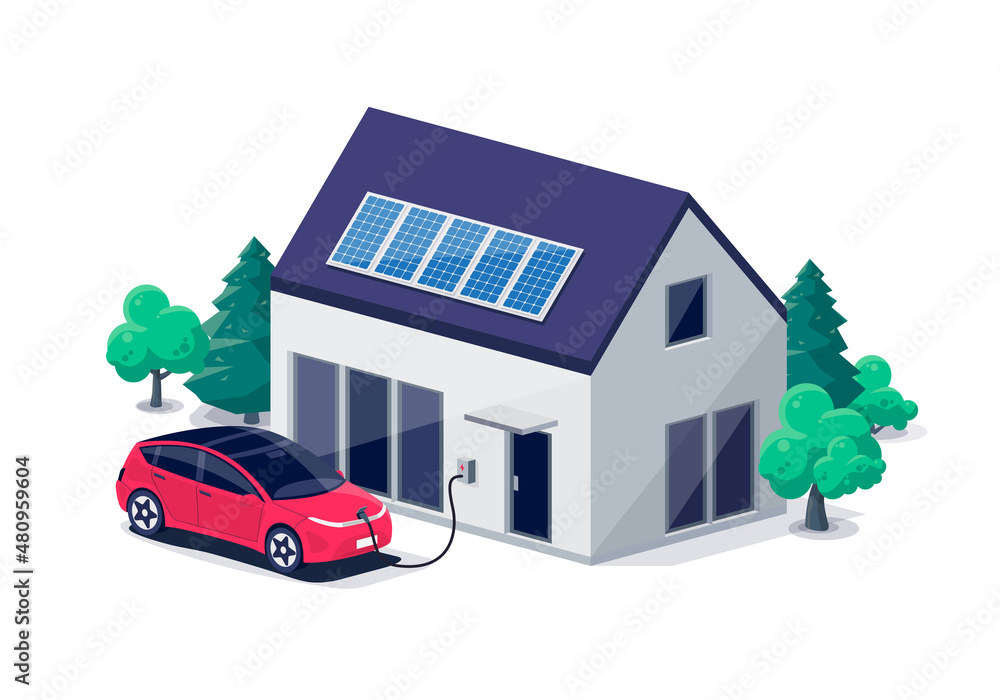
Rural US properties have a significant advantage over urban properties for solar + EV charging integration: roof space, ground mount potential, and minimal shading in many rural areas makes larger solar arrays practical.
For rural US EV owners who can install solar, the combination of:
- Rooftop or ground-mount solar (10+ kWp on many rural properties)
- Battery storage (Powerwall, Enphase, LG Chem)
- Solar-integrated EV charger (Emporia Pro)
creates an essentially grid-independent daily charging setup where the EV charges from solar during the day, battery storage covers overnight charging demand, and the grid is a backup rather than a primary source.
This is the most financially optimised rural US EV charging scenario — and it’s more accessible in rural areas than urban ones simply because the space and shading conditions that make solar practical are available.
Rural US Public Charging — The Honest Reality
Outside interstate highway corridors, rural US public charging is genuinely sparse. For rural US EV owners, home charging is not supplementary to public charging — it is the primary charging method, full stop.
Practical implications:
- Size your charger to your car’s maximum AC acceptance rate — no reason to restrict yourself to 32A when 48A is available
- Always maintain a buffer of 30-40% battery charge to handle unexpected journeys beyond normal range
- Plan longer trips meticulously — use ABRP (A Better Route Planner) or PlugShare for comprehensive route planning that accounts for rural charging gaps
- Keep a Level 1 cable in the car as genuine emergency equipment — a standard 120V outlet at a rural motel or friend’s house can add 30-40 miles overnight when needed
Rural Home EV Charging — European Villages
The European Village Challenge: Limited Supply, Distant Support, Winter Conditions
Rural European EV charging presents a unique combination of challenges that differ from both rural US and urban European scenarios.
Limited electrical supply in rural European properties:
The most significant challenge for rural French, Italian, Spanish, Portuguese, and parts of rural UK properties is the electrical supply capacity itself.
In rural France, many older village houses have a 9 kVA (kilowatt-ampere) single-phase supply — equivalent to approximately 9 kW of total available load. A 7.4 kW EV charger alone would consume 82% of the total supply capacity, leaving insufficient headroom for other appliances running simultaneously. Cooking, heating, water heating, and EV charging cannot all run simultaneously on a 9 kVA supply.
In rural Italy, rural Spain, and rural Portugal, similar supply limitations apply — often 3-6 kVA for older rural properties that haven’t been updated.
In rural UK, the majority of rural homes have adequate supply for EV charging, but voltage can be at the lower end of the acceptable range (216-220V rather than 230V) on long rural distribution lines.
Solutions for limited rural European supply:
Supply upgrade: Contact your local distribution network operator (DNO in the UK, ERDF in France, Enel in Italy) to request a supply capacity increase. In the UK, small supply upgrades (to accommodate EV charging) are often available at no or minimal cost. In France, EDF supply upgrades are available but may involve connection charges.
Load management charger: A smart charger with load management — Myenergi Zappi, Wallbox Pulsar Plus, Hypervolt Home 3 Pro — can monitor total home consumption and reduce EV charging speed when other appliances are running. On a limited rural supply, this enables EV charging without a supply upgrade by automatically throttling the charger when the kettle boils, the oven runs, or the heating system activates.
Reduced power charging: Installing a 3.7 kW or 3.3 kW charger rather than 7.4 kW — slower but compatible with more limited rural supply capacities. For a rural European driver covering 60 km daily, a 3.7 kW charger adds sufficient range overnight (approximately 22 km per hour of charging, giving 176 km in 8 hours) even from a limited supply.
Scheduled charging: Setting the charger to run only during night-time hours when other appliance loads are minimal. Combined with a load manager, this maximises available overnight charging capacity without supply conflicts.
Rural European Solar and EV Charging
Like rural US, rural European properties often have significant solar installation potential. The financial case for solar + EV charging integration is particularly strong in rural France, rural Spain, and rural Italy where:
- Electricity grid prices are significant and rising
- Solar generation is high (particularly southern France, Spain, and Italy)
- Rural properties have roof space and minimal shading
- The Myenergi Zappi’s solar divert performs most effectively with consistent surplus generation
For rural French Renault 5 owners, rural Spanish VW ID.4 owners, or rural Italian EV owners with rooftop solar, the Myenergi Zappi + solar combination is the most financially optimised home charging setup available.
Rural European Installation Challenges
Installer availability: In rural areas of France, Italy, Spain, and parts of the UK, finding an EV charger-qualified installer is genuinely more difficult than in urban areas. OZEV-registered installers in rural UK can be 40-60 miles away. Certified installers for specific charger brands in rural France or Italy may require several weeks’ wait.
Parts and service availability: If your rural charger develops a fault, replacement parts and qualified service may take longer to arrive than in urban areas. This makes brand reliability and warranty terms more important — a charger that rarely needs service is better than one with a long warranty but frequent faults requiring service visits.
Hardware recommendations for rural European reliability:
- Best overall rural European charger: Wallbox Pulsar Plus — wide installer network across Europe, strong brand support, reliable hardware with low fault rates
- Best for rural European solar homes: Myenergi Zappi — solar divert is the highest-value feature for rural properties with significant solar generation
- Best value rural European option: Easee One — Norwegian engineering built for Northern European rural conditions, 3-year warranty, good load balancing
- Best for very limited rural supply: Myenergi Zappi with load management enabled — automatically reduces charging speed when other loads are high, making it compatible with limited rural supply without manual management
Rural European Winter Charging
Rural European winters create specific challenges that urban European charger guides don’t address:
Unheated outbuilding installations: Many rural European properties have stone outbuildings, barns, or open-fronted car ports rather than heated garages. Winter temperatures in rural France, rural UK highlands, and rural Scandinavia can reach -10°C to -20°C for extended periods.
At -10°C, standard PVC cable jackets stiffen noticeably. At -15°C to -20°C, some charger electronics begin to operate outside their rated temperature range. For rural European installations in unheated buildings, IP65 minimum and a -25°C operating temperature rating are the appropriate specifications.
Rural UK: The Hypervolt Home 3 Pro’s -25°C operating temperature rating and IP65 protection is appropriate for Scottish rural installations. The Wallbox Pulsar Plus’s -25°C rating covers most of rural England and Wales.
Rural Scandinavia: The Easee One’s -25°C rating covers most of Norway, Sweden, and Finland. For the coldest Norwegian, Swedish, and Finnish rural locations reaching -30°C to -35°C, the Grizzl-E Ultimate (import only) or a professional industrial outdoor installation with a heater is the more appropriate solution.
The Middle Ground — Suburban and Semi-Rural
Most EV owners don’t live at either extreme — they live in suburban or semi-rural settings that share characteristics of both urban and rural scenarios without the most extreme challenges of either.
US Suburban: Generally good electrical infrastructure (200-amp panels common), driveway or garage parking, no apartment building permissions challenge, reasonable public charging access. The mainstream US home charger recommendations apply without the limitations of extreme urban or rural scenarios. The ChargePoint Home Flex, Tesla Wall Connector, and Emporia Pro are all straightforward recommendations.
European Suburban and Commuter Belt: Single-family homes with driveways, mostly single-phase supply in the UK and much of France and Spain, three-phase more common in Northern European suburbs. Standard European home charger recommendations — Wallbox Pulsar Plus, Myenergi Zappi for solar, Easee One for value — apply with fewer complications than either urban apartment or rural village scenarios.
US Semi-Rural: Properties outside city limits with rural electrical supply but access to a nearby town’s charging infrastructure. Home charging is primary but occasional public charging is accessible. The rural US charger recommendations apply (weather resistance, voltage tolerance, surge protection) but without the extreme isolation of Montana or rural Wyoming.
European Village with Good Infrastructure: Many European villages — particularly in Northern France, Southern England, the Netherlands, and Germany — have good electrical infrastructure despite their rural character. A village house in the Cotswolds or rural Norfolk with a 200-amp panel and a garage is more similar to a suburban scenario than a rural scenario.
Decision Matrix — Urban vs Rural Home EV Charging US Cities European Villages
| Scenario | Primary Challenge | Best Solution | Hardware |
|---|---|---|---|
| US city apartment, no parking | No charging access | Public charging + destination charging | None (public network) |
| US city condo, designated parking | HOA approval, cable routing | Individual circuit with portable EVSE | Lectron or Grizzl-E Duo (J1772) |
| US city homeowner, garage | Panel capacity (often 100A) | Load-managed smart charger | Emporia Pro |
| US suburban homeowner | None — standard scenario | Standard Level 2 recommendations | ChargePoint Flex / Tesla WC |
| US rural homeowner | Supply quality, weather, isolation | IP67, cold-rated, surge protected | Grizzl-E Ultimate |
| US rural + solar | Supply limits + solar | Solar-integrated with load management | Emporia Pro + Vue |
| European city flat, no parking | No charging access | Public charging (Amsterdam/Oslo model) | None (public network) |
| European city flat, parking | Permission, cable routing | Individual circuit from flat’s supply | Wallbox Pulsar Plus |
| European suburban homeowner | Standard single-phase | Standard Level 2 recommendations | Wallbox / Easee One |
| European village, good supply | Installer availability | Reliable brand, good warranty | Wallbox Pulsar Plus |
| European village, limited supply | Supply capacity | Load management essential | Myenergi Zappi |
| European village + solar | Supply limits + solar potential | Solar divert + load management | Myenergi Zappi |
| Rural Europe, unheated outbuilding | Cold, weather, IP requirements | IP65+, -25°C rating | Easee One / Hypervolt Pro |
| Rural Scandinavia extreme cold | -30°C+ temperatures | IP67, -40°C, internal heating | Grizzl-E Ultimate (import) |
Five Mistakes Both Urban and Rural EV Owners Make
Mistake 1: Urban owners assuming public charging can fully replace home charging It can — but it requires planning, flexibility, and tolerance for occasional inconvenience that many EV owners underestimate until they’re living it. Urban EV owners without home charging access should honestly assess whether their usage pattern and tolerance for charging logistics matches public-charging-dependent ownership before buying.
Mistake 2: Rural owners underestimating electrical supply limitations Installing a 7.4 kW charger on a rural property with a 6-9 kVA total supply without load management is a recipe for tripped breakers and frustrating charging sessions. Always assess total supply capacity before specifying charger power.
Mistake 3: Urban owners not exploring the full apartment permission toolkit Many urban flat and condo owners give up after the first HOA or building management refusal without understanding their legal rights (right to charge laws, EU EPBD provisions, German WEG reform, French droit à la prise). The legal framework is stronger than most people know.
Mistake 4: Rural owners buying urban-designed chargers The IP55-rated, polycarbonate-housed, standard-temperature charger that works perfectly in a Brighton garage doesn’t necessarily handle three years of winters in rural Scotland or rural Montana. Match the hardware to the actual conditions of your installation.
Mistake 5: Both groups ignoring the ongoing electricity cost question The charger purchase and installation is a one-time cost. The electricity tariff is a forever cost. Switching to an appropriate EV tariff — PG&E’s EV2-A in California, Octopus Go in the UK, CPS Energy’s EV plan in San Antonio — can save more over five years than any hardware rebate. Urban and rural owners both should prioritise tariff optimisation alongside hardware selection.
Internal Links — Further Reading on Clean Energy Bazaar
The urban vs rural home EV charging US cities European villages comparison connects to a wide set of guides that cover specific dimensions of the decision.
For apartment and condo owners navigating building permissions in both the US and Europe, our apartment EV charging solutions 2026 guide covers every legal framework and practical solution. For the cold weather hardware specifications that matter most for rural US and Northern European installations, our Grizzl-E Ultimate vs Hypervolt Home 3 Pro cold weather comparison and our weatherproof EV chargers 2026 IP ratings guide cover every relevant specification. For the full US home charger market, our best home EV chargers 2026 US comparison covers ten options. For the UK and European market, our best Level 2 EV chargers UK Europe 2026 guide is the reference. For US state rebates that apply to both urban and rural installations, our US EV charger rebates by state 2026 guide covers every major programme. And for European incentives and grants, our EV home charging incentives Europe 2026 guide covers every country.
Final Thoughts
The urban vs rural home EV charging US cities European villages question doesn’t have a single answer — it has a different answer for every combination of location, parking access, electrical infrastructure, and climate that EV owners actually live with.
The honest summary:
Urban US owners with parking access need to navigate HOA approvals and cable routing — the technology and hardware are standard, the people and legal challenges are the work. Urban US owners without parking access are dependent on public infrastructure that’s improving but isn’t yet universally adequate.
Rural US owners need hardware built for their conditions — IP67, cold weather ratings, surge protection, wide voltage tolerance. The Grizzl-E Ultimate is the most appropriate hardware for genuine rural US installation conditions. Solar integration through the Emporia Pro is the most financially compelling long-term strategy.
Urban European owners in older buildings need to understand their legal rights — which are stronger and more consistent than most people know — and pursue the individual circuit or shared infrastructure approach that building conditions make practical.
Rural European owners need to confront their electrical supply capacity honestly before specifying hardware — a load-managed charger like the Myenergi Zappi is the right foundation for limited-supply rural European properties, with a supply upgrade worth pursuing for the long term.
The worst outcome in both urban and rural scenarios is the same: buying hardware that doesn’t match the actual conditions and discovering the mismatch after installation. The solutions exist for every scenario. Matching the right solution to your specific scenario is the work this guide is designed to do.