Most EV charger guides skip the portable vs hardwired question entirely. They jump straight to comparing brand names and spec sheets, assuming you’ve already decided you want a permanently installed unit on your garage wall.
But a significant number of EV owners — renters, frequent movers, people with awkward parking situations, people who charge at multiple locations — have a genuinely legitimate case for choosing a portable charger over a hardwired one. And an equally significant number of people buy a portable charger thinking it’ll do everything a hardwired unit does, and discover the limitations the hard way.
This guide on portable vs hardwired home EV chargers US Europe gives you the honest comparison nobody else writes — not just the specs but the real-world trade-offs, the hidden costs on both sides, the situations where portable is clearly the right answer and the situations where it clearly isn’t. By the end you’ll know exactly which type fits your life, not just which type looks better on a comparison table.
What’s Actually Different Between Portable and Hardwired EV Chargers
Before comparing options, it’s worth being precise about what these terms actually mean — because the marketing around EV charging uses them loosely.
Portable EV Chargers (EVSE)
A portable EV charger — technically called an EVSE (Electric Vehicle Supply Equipment) — is a charging unit that isn’t permanently fixed to a wall. It typically has a plug on one end that connects to a standard electrical outlet or a specific socket type, and a charging connector on the other end that plugs into your car.
Portable chargers come in two main types:
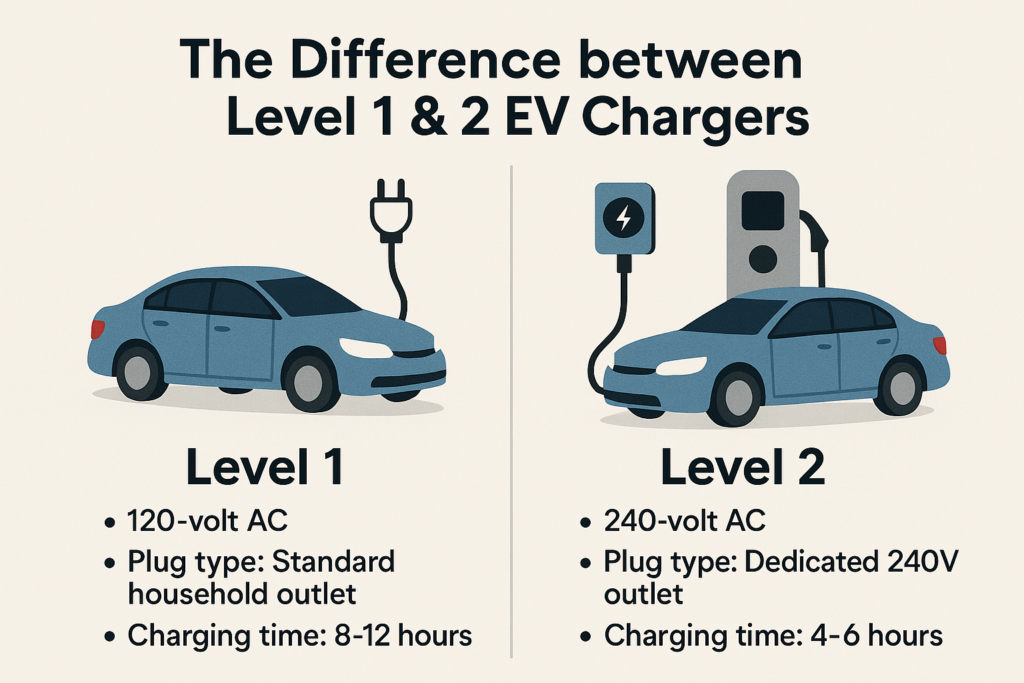
Level 1 portable chargers (trickle chargers): These plug into a standard 120V US household outlet or 230V European outlet. They typically deliver 1.2-2.3 kW. Slow, but genuinely useful as an emergency backup or for low-mileage drivers.
Level 2 portable chargers: These plug into a dedicated 240V outlet (NEMA 14-50 or NEMA 6-50 in the US, CEE socket or Schuko socket in Europe) and deliver 7.2-11 kW — the same speed as most hardwired Level 2 chargers. This is where the portable vs hardwired home EV chargers US Europe comparison gets genuinely interesting.
Hardwired EV Chargers
A hardwired charger is permanently connected to your home’s electrical system — wired directly into a dedicated circuit breaker on your distribution panel without a plug or socket in between. The charger unit is fixed to a wall and the cable either hangs permanently from it (tethered) or you plug your car’s own cable into a socket on the unit (untethered).
Hardwired chargers in the US typically run at 32A-48A on 240V, delivering 7.2-11.5 kW. In Europe, single-phase hardwired chargers deliver 7.4 kW on 230V and three-phase units deliver up to 22 kW on 400V.
The critical distinction: hardwired chargers generally deliver power more consistently and at higher sustained amperages than portable units, partly because the direct wiring eliminates connection resistance that builds up over time at plug-and-socket interfaces.
The Real Cost Comparison — Portable vs Hardwired Home EV Chargers US Europe
This is where most guides mislead you. They compare unit prices without including installation costs for hardwired chargers or the electrical outlet upgrade costs for Level 2 portable chargers. Here’s the complete picture:
True Cost of a Portable Level 2 EV Charger
Unit cost (US): $150-$400 for a quality portable Level 2 EVSE Outlet installation (if you don’t have a NEMA 14-50 already): $150-$400 for an electrician to install a dedicated NEMA 14-50 outlet Total realistic cost: $300-$800
Unit cost (Europe): €200-€500 for a quality portable Type 2 EVSE CEE socket installation (if needed): €100-€300 Total realistic cost: €300-€800
Unit cost (UK): £150-£400 Dedicated outlet installation: £100-£300 Total realistic cost: £250-£700
True Cost of a Hardwired Level 2 EV Charger
Unit cost (US): $229-$699 depending on brand and features Installation by licensed electrician (US): $200-$800 depending on cable run length, panel work required, and local labour rates Panel upgrade if needed (US): $1,500-$3,000 — not always required but worth checking Total realistic cost without panel upgrade: $429-$1,499
Unit cost (Europe): €300-€1,200 Installation (Europe): €150-€600 Total realistic cost: €450-€1,800
Unit cost (UK): £300-£900 Installation (UK): £150-£500 OZEV grant deduction: -£350 Total realistic cost after grant: £100-£1,050
What This Actually Means
The cost gap between portable and hardwired is smaller than most people assume — particularly in the US where a NEMA 14-50 outlet installation brings a portable Level 2 charger to a similar total cost as a budget hardwired unit. The decision isn’t really about cost for most buyers. It’s about flexibility versus performance.
Charging Speed — Where Hardwired Wins More Clearly Than You’d Think
On paper, a portable Level 2 charger at 32A and a hardwired charger at 32A should deliver identical speed. In practice, hardwired chargers have a consistent edge that shows up over time.
Why Portable Chargers Lose Speed Over Time
Portable Level 2 chargers connect to their power source via a plug and socket interface. Every plug and socket connection has resistance — a small but real electrical impedance that increases with:
- Normal wear and oxidation of the plug contacts
- Frequent insertion and removal cycles
- Heat cycling from repeated high-current charging sessions
- Dust, moisture, and contamination in outdoor or garage environments
A worn NEMA 14-50 socket on a heavily used home charging setup can reduce delivered current by 5-15% compared to a new connection. Over 3-5 years of daily use, a portable charger that started at 32A may be delivering 28-30A in practice.
Hardwired connections have no plug interface to wear — the wiring is direct and maintains consistent resistance over the charger’s lifetime.
This matters more at higher amperages. A 40A portable charger with 10% resistance degradation delivers 36A — a meaningful reduction. A 40A hardwired charger delivers 40A consistently for the unit’s entire lifespan.
The Three-Phase Speed Ceiling
In Europe, three-phase 22 kW charging is only practical with a hardwired charger. Portable three-phase Level 2 chargers exist — they use industrial CEE 32A three-phase sockets — but these require a specific industrial socket installation that costs similar to hardwiring anyway, and the charger units themselves aren’t meaningfully more portable than a compact hardwired unit.
For European homeowners with three-phase supply who want more than 7.4 kW, hardwired is the only practical answer.
Portability — What It Actually Gives You and What It Doesn’t
The portability argument for portable chargers is real but narrower than most buyers assume.
Where Portability Genuinely Helps
Renters who move frequently. A hardwired charger installed at a rented property is left behind when you move — or requires professional de-installation that may or may not be reimbursed by a landlord. A portable Level 2 charger goes with you. Over 5-7 years of renting and moving, this is a genuine financial advantage.
Charging at multiple locations. If you regularly charge at a second property — a holiday home, a parent’s house, a workplace with a NEMA 14-50 outlet — a portable charger adds real flexibility. A hardwired charger at your primary home doesn’t help you at those other locations.
Pre-installation fallback. If you’re waiting for a hardwired installation but want to start charging faster than Level 1 allows, a portable Level 2 charger is a practical bridge. Buy the NEMA 14-50 outlet first, use the portable EVSE, upgrade to hardwired when timing and budget allow.
Unusual parking configurations. If your parking is on a driveway without a garage, or in a location where a permanent wall mount is impractical, a portable charger stored indoors and deployed when needed avoids the weatherproofing and vandalism concerns of a permanently installed outdoor unit.
Where Portability Doesn’t Help as Much as You’d Think
You still need a dedicated outlet. Level 2 portable charging requires a NEMA 14-50 (US), CEE 32A (Europe), or similar dedicated outlet — not a standard household socket. Installing this outlet costs nearly as much as installing a hardwired charger. At that point you’ve done 70% of the hardwired installation work for 80% of the cost, and ended up with a less reliable long-term charging solution.
It’s not actually that portable day-to-day. A Level 2 portable EVSE is bulky — typically 1-2 kg with a 5-7 metre cable. Most owners keep it in the boot of their car or hung in the garage and use it in exactly one location, exactly like a hardwired charger. The “portable” benefit is mostly theoretical for daily charging.
Public charging is faster anyway. If you’re away from home and need to charge, a DC fast charger at a public station is far faster and more convenient than carrying a portable Level 2 EVSE and hoping wherever you’re staying has a compatible outlet.
Best Portable EV Chargers for US Drivers in 2026
Lectron 240V Level 2 Portable EVSE — Best Value US Portable
Price: $189-$229 Connector: J1772 or NACS versions available Max Power: 9.6 kW (40A, 240V) Plug: NEMA 14-50 Cable Length: 20 feet IP Rating: IP44 Warranty: 1 year
The Lectron is the portable Level 2 EVSE that makes the strongest case for the portable vs hardwired home EV chargers US Europe comparison. At $189-$229 it delivers 40A (9.6 kW) — enough to fully charge a 75 kWh battery in about 8 hours — at a price that’s significantly below most hardwired units before installation costs.
Both J1772 and NACS versions are available, which reflects a level of market awareness that many competing portable EVSE brands haven’t caught up with. The 20-foot cable is long enough for most driveway and garage configurations without an extension. IP44 rating is adequate for sheltered outdoor use — not ideal for fully exposed outdoor installation.
Where it falls short: The 1-year warranty is short for a daily-use product. No smart features — no scheduling, no app, no energy monitoring. The IP44 rating means it shouldn’t be left permanently outdoors in exposed conditions.
Best for: US renters or frequent movers who want a genuinely affordable Level 2 charging solution they can take when they leave.
Grizzl-E Duo — Best US Portable for Reliability Focused Buyers
Price: $299-$349 Connector: J1772 (NACS adapter available) Max Power: 9.6 kW (40A, 240V) Plug: NEMA 14-50 or NEMA 6-50 Cable Length: 24 feet IP Rating: IP67 Warranty: 3 years
The Grizzl-E Duo is the portable version of the Grizzl-E brand — the same rugged metal build and IP67 rating that makes the Classic hardwired version one of the best budget hardwired chargers in the US market, in a portable form factor.
The IP67 rating is the standout spec for a portable unit — fully dustproof and waterproof, meaning this unit genuinely tolerates outdoor conditions rather than just technically meeting a minimum indoor rating. The 24-foot cable is the longest on any portable EVSE at this price point. The 3-year warranty matches most hardwired competitors.
Where it falls short: No smart features, no app, no scheduling. J1772 only natively — NACS users need an adapter. At $299-$349 it’s priced closer to budget hardwired options which makes the portability-vs-hardwired cost case tighter.
Best for: US homeowners or renters who want the reliability and weather resistance of the Grizzl-E brand in a portable unit — particularly for outdoor or exposed driveway charging scenarios.
Splitvolt Level 2 Portable EV Charger — Best for Sharing an Existing Dryer Outlet
Price: $229-$279 Connector: J1772 Max Power: 7.2 kW (30A, 240V) Plug: NEMA 14-30 (dryer outlet) Cable Length: 18 feet IP Rating: IP44 Warranty: 2 years
The Splitvolt solves a specific and genuinely common US problem: you have a dryer on a NEMA 14-30 outlet and you want to charge your EV without installing a dedicated new circuit.
The Splitvolt’s smart load sharing switches automatically between dryer use and EV charging — when the dryer runs, charging pauses; when the dryer stops, charging resumes. For renters or homeowners who can’t justify the cost of a new dedicated circuit, this makes Level 2 charging possible using an outlet that already exists.
At 30A (7.2 kW) it’s slightly slower than 40A portable alternatives but still adds roughly 40-45 km of range per hour — more than sufficient for overnight home charging on most driving patterns.
Where it falls short: The NEMA 14-30 dryer outlet workaround means you’re sharing a circuit that was designed for a single high-draw appliance — confirm with an electrician that your dryer circuit can handle the occasional load sharing safely. 18-foot cable is shorter than competing portables.
Best for: US renters or apartment dwellers who have access to a NEMA 14-30 dryer outlet and want Level 2 charging without a new circuit installation.
Best Portable EV Chargers for European and UK Drivers in 2026
Juice Booster 2 — Best Premium Portable for European Drivers
Price: €499-€699 Connector: Type 2 Max Power: 22 kW (three-phase CEE 32A) or 7.4 kW (single-phase) Adapters: Multiple socket adapters included (Schuko, CEE 16A, CEE 32A, Type 2 socket) Cable Length: 5 metres IP Rating: IP67 Warranty: 2 years
The Juice Booster 2 is the most capable portable EV charger available in the European market and it’s genuinely impressive hardware for the portable vs hardwired home EV chargers US Europe comparison at the premium end.
The key differentiator is the adapter system. The Juice Booster 2 comes with a set of adapters for different European socket types — Schuko (standard household), CEE 16A (blue camping/outdoor socket), CEE 32A (industrial three-phase socket), and Type 2 charging socket. This means the same unit charges at 2.3 kW from a standard German household socket, at 7.4 kW from a CEE 16A socket, and at up to 22 kW from a three-phase CEE 32A industrial socket.
For European drivers who travel extensively — to holiday homes, campsites, Airbnbs, or work locations with varied socket availability — this versatility is genuinely valuable. No other portable charger matches this range of compatibility.
The IP67 rating means genuine weatherproofing. The build quality matches the premium price.
Where it falls short: At €499-€699 it’s expensive — approaching the cost of a hardwired charger plus installation in some European markets. The 5-metre cable is shorter than US portable alternatives. Not available in the US market.
Best for: European drivers who travel extensively between different charging locations with varied socket availability, or those who want a single portable charger that works everywhere from a standard household socket to a three-phase industrial outlet.
Keba KeContact P30 Portable — Best Mid-Range European Portable
Price: €299-€449 Connector: Type 2 Max Power: 7.4 kW (single-phase 32A) Plug: CEE 16A or Schuko adapter Cable Length: 6 metres IP Rating: IP54 Warranty: 3 years
Keba is an Austrian brand with a strong reputation in the European EV charging market — their hardwired chargers are widely installed across commercial and residential properties in Germany, Austria, and Switzerland. The KeContact P30 Portable brings that engineering heritage to a portable form factor.
At 7.4 kW on single-phase CEE 16A it delivers the standard European home charging speed in a portable unit. The 6-metre cable is more generous than most European portable options. The 3-year warranty matches premium hardwired alternatives. IP54 is adequate for sheltered outdoor use.
Where it falls short: No three-phase capability — capped at 7.4 kW regardless of supply. IP54 rather than IP67 means it shouldn’t be left in permanently exposed outdoor conditions. No smart features.
Best for: European homeowners or renters who want a reliable, mid-range portable Type 2 charger with a strong brand warranty for everyday single-phase home charging.
Masterplug EVPOD2UK — Best Budget UK Portable
Price: £149-£199 Connector: Type 2 Max Power: 7.2 kW (32A, 230V) Plug: 13A standard UK plug (Level 1) and 32A commando socket adapter Cable Length: 5 metres IP Rating: IP44 Warranty: 2 years
The Masterplug EVPOD2UK earns its place as the most accessible entry point for UK portable EV charging. At £149-£199 it’s the lowest-cost Type 2 portable EVSE from a recognisable UK brand, and the dual-plug design — standard 13A for slow emergency charging, 32A commando for full 7.2 kW Level 2 — means one unit covers both use cases.
For UK renters who want a portable option without committing to a dedicated socket installation, the 13A standard plug capability means this unit works from day one with zero installation cost — albeit at the slow 2.3-3 kW rate of a standard UK plug. When ready to install a commando socket (£100-£200 typically), the same unit upgrades to full 7.2 kW Level 2.
Where it falls short: IP44 means indoor or sheltered use only. No smart features. The 13A Level 1 mode is very slow — 2.3 kW adds roughly 12-15 km of range per hour. Not OZEV grant eligible for a portable unit.
Best for: UK renters at the very beginning of their EV ownership who want the cheapest possible entry to home Level 2 charging without any installation cost upfront.
Best Hardwired EV Chargers — US and Europe Quick Reference
Since this guide covers both sides of the portable vs hardwired home EV chargers US Europe comparison, here’s a quick reference to the best hardwired options covered in detail across our other guides:
US hardwired:
- Best overall: Tesla Wall Connector (NACS, $425, 4-year warranty)
- Best value smart: Emporia EV Charger ($349, NACS/J1772, solar integration)
- Best budget: Grizzl-E Classic ($229, IP67, 3-year warranty)
- Full US comparison: Best Home EV Chargers 2026 US — Top 10 Honest Comparison
UK and Europe hardwired:
- Best overall: Wallbox Pulsar Plus (£649-£799, bidirectional ready)
- Best for solar: Myenergi Zappi (£699-£849, best solar divert)
- Best budget after OZEV grant: Rolec WallPod (£449-£549, £99-£199 after grant)
- Full UK/Europe comparison: Best Level 2 EV Chargers UK Europe 2026
The Decision Framework — Portable vs Hardwired Home EV Chargers US Europe
Here’s the honest framework for making this decision. Answer these five questions:
Question 1: Do you own your home or rent?
If you rent, portable is worth serious consideration — particularly if you move every 1-3 years. A hardwired charger left behind at a rental property is money lost. A portable charger moves with you.
If you own, hardwired is almost always the better long-term choice unless questions 2-5 change the calculus.
Question 2: Do you have a dedicated parking space with access to electrical supply?
If yes — whether a garage, driveway, or dedicated parking bay with power — hardwired is straightforward and the better long-term investment.
If no — street parking, shared parking without a dedicated space, or no electrical access near parking — portable may be your only practical option for home charging, combined with public charging for speed.
Question 3: How many kilometres or miles do you drive daily?
Under 50 km / 30 miles daily: A portable Level 1 charger from a standard household socket might genuinely be sufficient. Many low-mileage EV owners never install a dedicated charger at all.
50-150 km / 30-90 miles daily: Level 2 is important — either portable Level 2 with a dedicated outlet, or hardwired.
Over 150 km / 90 miles daily: Hardwired, maximum amperage, no compromise. You need the most reliable and fastest home charging available.
Question 4: Do you charge at multiple locations regularly?
If you regularly charge at a second location with compatible outlets, a portable Level 2 EVSE adds genuine value. A Juice Booster 2 in the boot that works at your holiday home’s CEE 16A socket and your parent’s house and a motorway services Type 2 socket is a genuinely useful tool.
If you charge at home and at public stations only, portability adds little real-world value for your daily life.
Question 5: Are you on or planning to switch to a smart electricity tariff?
If yes, a hardwired smart charger with TOU scheduling will save you meaningful money over time. Portable chargers are almost universally “dumb” — no scheduling, no tariff integration. Over 5-7 years on a time-of-use tariff, the smart scheduling savings from a hardwired smart charger can outweigh its installation cost premium over a portable unit.
If no, this advantage disappears and the cost equation tilts more toward portable.
The Honest Verdict — Who Should Buy What
Buy a portable Level 2 charger if:
- You rent and move every 1-3 years
- You regularly charge at multiple locations with varied socket types
- You need a bridge solution while waiting for hardwired installation
- Your daily driving is under 50 km and Level 1 speed is acceptable
- You have an unusual parking configuration that makes wall mounting impractical
- You’re in Europe and want the Juice Booster 2’s adapter versatility for travel
Buy a hardwired charger if:
- You own your home
- You drive more than 80 km / 50 miles daily
- You’re on or planning to switch to a smart electricity tariff
- You have or plan to install solar panels
- You want the maximum charging speed and long-term reliability
- You’re in Europe and want three-phase 22 kW charging
- You want smart features — load management, solar divert, TOU scheduling
Buy both if: This sounds extravagant but it’s a legitimate strategy for some owners. A hardwired smart charger at home for daily overnight charging, plus a portable Level 1 EVSE kept in the car for emergency slow charging at any standard outlet — covers every scenario without compromise.
The total cost of a hardwired Grizzl-E Classic ($229) plus a Level 1 portable EVSE ($50-$100) is less than most standalone smart chargers. For US owners who want maximum flexibility at minimum cost, this combination is worth considering seriously.
Common Mistakes in the Portable vs Hardwired Decision
Mistake 1: Buying a portable charger and plugging it into a standard household outlet expecting Level 2 speed A standard 120V US outlet or 230V UK outlet delivers Level 1 speed regardless of what charger you plug into it. Level 2 portable charging requires a dedicated outlet — NEMA 14-50 in the US, CEE 32A or similar in Europe. If you haven’t installed that outlet, you’re getting Level 1.
Mistake 2: Installing a NEMA 14-50 for a portable charger without realising you’re halfway to a hardwired installation A NEMA 14-50 outlet installation costs $150-$400 in the US. A hardwired charger installation on the same circuit costs $200-$500. The marginal cost of going hardwired over portable — once you’ve decided to install a dedicated circuit — is surprisingly small. Get quotes for both before deciding.
Mistake 3: Assuming portability means you can charge anywhere A Level 2 portable charger requires a specific socket type that most homes, hotels, and workplaces don’t have. True charging flexibility requires either a multi-adapter unit like the Juice Booster 2 or acceptance that most away-from-home Level 2 charging will be at public stations rather than from a portable unit.
Mistake 4: Ignoring IP rating for a unit that will live in a garage or driveway Even “indoor” garages in the UK and northern Europe experience significant temperature variation, condensation, and dust. IP44 is the minimum for any EV charger that isn’t in a climate-controlled indoor environment. IP55 or IP67 is better. A charger that corrodes or fails in year two because it was rated for conditions better than its actual environment is a false economy regardless of its original price.
Mistake 5: Not checking smart tariff compatibility before buying portable If you’re planning to switch to Octopus Agile, Octopus Go, or any other smart EV tariff in the UK — or a TOU tariff in the US — a portable dumb charger cannot schedule around cheap rate windows. You’ll be on a smart tariff but manually plugging in at 11pm every night to catch the off-peak window. A hardwired smart charger does this automatically. The convenience difference compounds daily.
Internal Links — Further Reading on Clean Energy Bazaar
The portable vs hardwired home EV chargers US Europe question is one piece of a bigger picture.
If you’re leaning toward hardwired and want the full US comparison, our best home EV chargers 2026 US guide covers ten options honestly including budget, smart and premium picks. For UK and European hardwired options, our best Level 2 EV chargers UK Europe 2026 comparison covers Wallbox, Easee, Hypervolt, Zappi and more. If you’re still on the fence about whether smart features justify the premium, our smart EV chargers 2026 features worth the cost comparison breaks down exactly what pays for itself and what doesn’t. For spec sheet clarity before any purchase, our guide to understanding EV charger specs 2026 translates kW, amps, IP ratings and OCPP into plain language. And if something goes wrong with either type of charger after installation, our EV charger troubleshooting guide covers every common fault across charger types.
Final Thoughts
The portable vs hardwired home EV chargers US Europe debate doesn’t have a universal winner. It has a right answer for each individual situation — and getting that answer right saves you money, frustration, and the post-purchase regret that comes from buying the wrong type for your life.
Renters who move frequently, multi-location chargers, and low-mileage drivers have a genuine case for portable. Homeowners, high-mileage drivers, solar owners, and smart tariff users have a genuine case for hardwired.
The mistake most buyers make isn’t choosing the wrong brand — it’s choosing the wrong type without thinking through the five questions in the decision framework above. Answer those honestly and the right choice becomes obvious.