Planning a winter road trip to Manali, Leh, or the hills of Uttarakhand in your electric vehicle? Or simply wondering why your EV’s charging speed dropped overnight during a cold Delhi winter? You’re not alone. Cold weather and EV charging performance are closely linked — and for Indian EV owners, understanding this relationship can mean the difference between a smooth journey and a stressful roadside wait.
In this comprehensive winter EV charging guide for India, we compare how popular EVs sold in India — from the Tata Nexon EV and MG ZS EV to the Ather 450X and Ola S1 Pro — perform in cold weather conditions. We also share practical tips on how to charge an electric vehicle in winter and what to expect from public chargers in hilly regions.
Why EV Charging in Cold Weather India Performs Differently Than You Expect
The core reason electric vehicles charge slower in cold weather comes down to battery chemistry. Most EVs — including every major EV sold in India — use lithium-ion (Li-ion) batteries. At low temperatures, the chemical reactions inside the battery slow down significantly, which has two important effects:
- Reduced charging acceptance rate: The battery management system (BMS) deliberately limits how fast it allows the battery to accept charge in cold weather to prevent damage to the cells. This is why your DC fast charging session may take 40–60% longer on a cold morning in Shimla compared to a warm afternoon in Mumbai.
- Reduced usable range: Cold batteries also deliver power less efficiently, meaning your real-world EV range in winter will be noticeably lower than what you see on the instrument cluster under normal conditions.
Additionally, running the cabin heater in cold weather draws significant power from the same battery pack — further reducing your driving range. This is a critical factor that EV owners in North India, Himachal Pradesh, Uttarakhand, Jammu & Kashmir, and Ladakh must factor into trip planning.
At What Temperature Does EV Charging Performance Drop?
EV battery performance begins dropping below 10°C and degrades sharply below 5°C — a common reality for North Indian winters.
Research across multiple lithium-ion battery platforms shows that charging and range performance begins to noticeably degrade below 10°C, with significant impacts below 5°C. In regions like Leh (Ladakh), where temperatures regularly drop to -15°C to -25°C in winter, EV usage becomes genuinely challenging without proper planning and thermal management.
For reference, here are typical winter temperatures in key Indian cold-weather destinations:
| Location | Typical Winter Low (°C) | EV Range Impact (Approximate) |
|---|---|---|
| Delhi (plains) | 3°C – 8°C | 10–20% range reduction |
| Shimla, HP | -2°C – 4°C | 20–30% range reduction |
| Manali, HP | -7°C – 0°C | 25–35% range reduction |
| Srinagar, J&K | -5°C – 2°C | 25–35% range reduction |
| Leh, Ladakh | -15°C – -5°C | 35–50%+ range reduction |
| Dehradun / Mussoorie | 2°C – 8°C | 15–25% range reduction |
Note: Range reductions are indicative and vary by vehicle, driving style, and cabin heating usage.
Indian Regions Where Cold-Weather EV Charging Matters Most
Routes like Rohtang Pass near Manali present extreme challenges for EV travel in winter — planning for cold-weather range loss is essential.
While cold weather may seem irrelevant to EV owners in Chennai or Bengaluru (where winters are mild), a large and growing number of Indian EV owners either live in or travel to cold regions. If you fall into any of these categories, this guide is especially relevant for you:
- Residents of North India plains (Delhi-NCR, Punjab, Haryana, UP) where temperatures dip below 5°C in December–January
- Travellers driving to hill stations — Manali, Kasauli, Nainital, Mussoorie, Coorg, Ooty
- EV owners in Himalayan states — Himachal Pradesh, Uttarakhand, Jammu & Kashmir, Sikkim, Arunachal Pradesh
- Adventure tourists attempting Leh-Ladakh by EV — a growing trend that demands extreme caution and planning
- High-altitude plateau regions where cold + altitude together reduce battery efficiency
Cold Weather Charging Performance Comparison: Popular EVs in India
India’s best-selling EV — the Tata Nexon EV — can see range drop 35–45% in cold weather below 5°C. Here’s how it compares to rivals.
Not all EVs handle cold weather equally. The key differentiator is thermal management system (TMS) quality. EVs with active liquid-cooled battery thermal management systems handle cold weather significantly better than those with passive (air-cooled) systems.
1. Tata Nexon EV (Max / Long Range)
The Tata Nexon EV is India’s best-selling electric car, and its performance in cold weather is a common concern for owners in North India. The Nexon EV uses a liquid-cooled battery thermal management system in its Long Range and later variants, which helps manage cold-weather performance better than older models with passive cooling.
- Real-world range in cold weather (below 5°C): Approximately 180–220 km vs. claimed ~346 km — a reduction of ~35–45%
- DC Fast Charging speed in cold: May drop from the rated 50 kW to 20–30 kW until the battery warms up
- Battery pre-conditioning: Not available as a dedicated feature; battery warms up during use
- Best practice: Start a charging session before driving to warm the battery; avoid parking in open spaces overnight in sub-zero conditions
2. MG ZS EV (2022 Facelift / Excite & Exclusive)
The MG ZS EV comes with a liquid thermal management system and has a larger battery pack (50.3 kWh), giving it more headroom to absorb cold-weather losses.
- Real-world range in cold weather: ~250–300 km (vs. claimed 461 km MIDC) — roughly 35–45% reduction in extreme cold
- DC Fast Charging in cold: Accepts up to 76 kW under ideal conditions; may throttle to 30–40 kW in very cold weather until pack warms up
- Advantage: Larger battery means even with range loss, it can comfortably cover hill routes like Delhi–Shimla on a full charge with one stop
3. Hyundai Ioniq 5 / Kia EV6 (Premium Segment)
If you’re asking which EV handles Indian cold weather best in the premium segment, the Ioniq 5 and EV6 are class-leaders. Both use the Hyundai-Kia 800V architecture with active battery pre-conditioning that automatically prepares the battery when navigation is set to a fast charger.
- Real-world range in cold weather: ~350–400 km (from a ~72 kWh usable pack) — about 20–30% reduction, significantly better than most competitors
- DC Fast Charging in cold: Up to 220–350 kW on compatible chargers; battery pre-conditioning means less cold throttling
- Standout feature: Dedicated battery pre-conditioning activated via navigation or app
- Limitation: High price; very limited ultra-fast charging infrastructure in Indian hill regions
4. BYD Atto 3
The BYD Atto 3 uses BYD’s proprietary Blade Battery (LFP chemistry), which behaves differently from NMC batteries in cold weather.
- Real-world range in cold weather: Expect 30–40% range reduction below 5°C
- DC Fast Charging in cold: May need 15–20 minutes of driving before fast charging at full speed
- Advantage: LFP cells are more durable long-term and can charge to 100% regularly without degradation concerns
5. Ather 450X (Electric Scooter)
The Ather 450X is one of India’s most sophisticated electric scooters. Its battery is IP67 water and dust resistant but does not feature an active thermal management system.
- Real-world range in cold weather: From a claimed 85 km (IDC), expect 55–65 km in cold conditions below 5°C
- Charging speed in cold: Ather Grid fast charger may deliver 80% in ~60–70 minutes vs. 50 minutes in warm weather
- Best suited for: Daily urban commuting in mild winter cities; not recommended for extended hill rides in sub-zero temperatures
6. Ola S1 Pro (Electric Scooter)
The Ola S1 Pro has had mixed reviews regarding cold weather performance, with some users in North India reporting more significant range drops than competitor scooters during winter months.
- Real-world range in cold weather: From a claimed 181 km, expect 100–120 km in moderate cold; significantly less in sub-5°C conditions
- Charging in cold: Standard home charger (750W) remains largely unaffected; Hypercharger speeds may reduce marginally
- Note: Software updates have progressively improved cold-weather performance; check firmware version before winter trips
Quick Comparison Table: Cold Weather EV Performance in India
| EV Model | Battery Type | Thermal Mgmt | Est. Cold Weather Range Loss | Pre-conditioning | Cold Weather Rating |
|---|---|---|---|---|---|
| Hyundai Ioniq 5 | NMC | Active Liquid | 20–30% | ✅ Yes | ⭐⭐⭐⭐⭐ |
| Kia EV6 | NMC | Active Liquid | 20–30% | ✅ Yes | ⭐⭐⭐⭐⭐ |
| MG ZS EV | NMC | Active Liquid | 30–40% | ❌ No | ⭐⭐⭐⭐ |
| Tata Nexon EV LR | NMC | Active Liquid | 35–45% | ❌ No | ⭐⭐⭐ |
| BYD Atto 3 | LFP (Blade) | Active Liquid | 30–40% | ❌ No | ⭐⭐⭐ |
| Ather 450X | NMC | Passive | 25–35% | ❌ No | ⭐⭐⭐ |
| Ola S1 Pro | NMC | Passive | 35–45% | ❌ No | ⭐⭐ |
How Much Does Charging Speed Drop in Winter? (India-Specific Data)
One of the most frequent questions from Indian EV owners is: “Why is my EV charging so slowly in winter?” Here’s what typically happens at a DC fast charger in cold conditions:
Phase 1: Cold Soak (Battery Below 10°C)
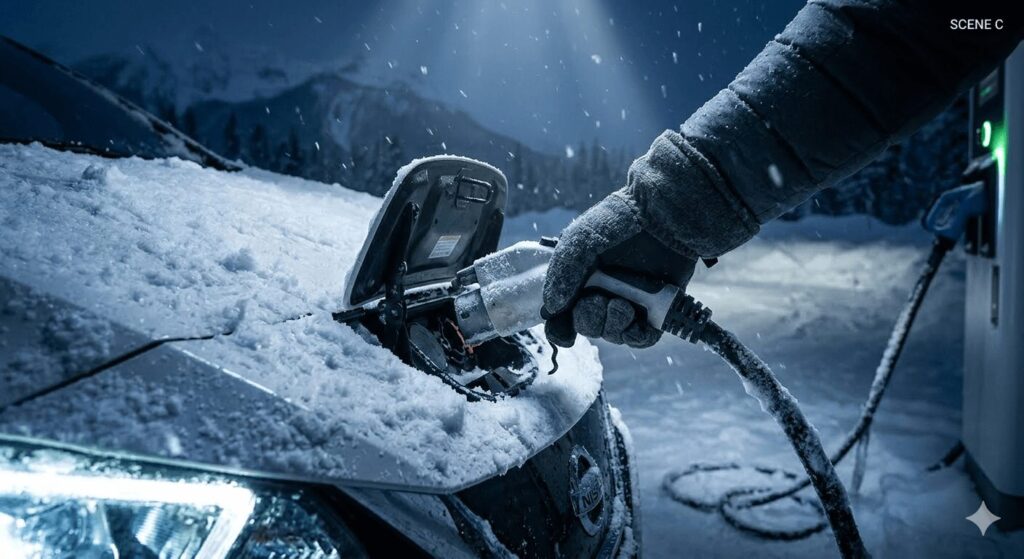
When you plug in after parking overnight in the cold, the BMS will initially limit incoming power to protect the cells. You may see charging rates of 10–25 kW even on a 50 kW or 100 kW charger. This phase can last 10–20 minutes.
Phase 2: Warm-Up Phase (Battery 10°C–20°C)
As the battery warms from the charging process itself, charging power ramps up. You’ll see the rate climb toward the vehicle’s rated maximum. At a 50 kW charger, this may look like 30 kW → 40 kW → 45 kW over 20–30 minutes.
Phase 3: Normal Fast Charging (Battery Above 20°C)
Once the battery reaches its optimal temperature window, charging proceeds at near-normal speeds. Practical implication for Indian hill-station travellers: At Bhuntar (near Kullu-Manali) or Ramban (Jammu–Srinagar highway) charging stations, plan for 30–50% longer charging sessions in December–February compared to summer months.
Practical Tips to Maximise EV Charging Speed and Range in Indian Winter
1. Pre-condition Your Battery Before Charging
EVs like the Hyundai Ioniq 5 and Kia EV6 automatically pre-condition the battery when you set a DC fast charger as a navigation destination. If your EV doesn’t have this feature, drive for 10–15 minutes before arriving at a charger to warm the battery manually.
2. Use Scheduled Charging the Night Before a Trip
Set charging to complete close to your planned departure time. A full, recently charged battery is slightly warmer and will perform better immediately after charging completes.
3. Park Indoors or in a Covered Area Overnight
The difference between -5°C outdoor parking and 5°C indoor parking can translate to a 10–15% better initial range when you start your day.
4. Pre-heat the Cabin While Still Plugged In
Use your EV’s remote climate control app to pre-heat the cabin while still connected to the charger. This means the energy for cabin heating comes from the grid, not your battery — preserving range.
5. Use Seat Heaters Instead of Cabin Blowers
Seat heaters consume significantly less energy than the main HVAC system. Use them as the primary warmth source in mild cold to preserve range.
6. Drive at Moderate Speeds on Cold Mornings
Drive moderately for the first 10–15 minutes until the battery warms up through use — you’ll get better efficiency and subsequent charging sessions will also be faster.
7. Top Up at Every Available Opportunity in Hill Regions
Adopt the “top-up mentality” rather than waiting for a low battery. Plug in at hotels, dhabas with charging points, and public stations whenever you stop.
8. Account for Reduced Regenerative Braking
In very cold weather, regenerative braking is often reduced or disabled by the BMS. Be aware of reduced braking assistance, especially on mountain descents.
Public EV Chargers Available in Cold-Weather Regions of India
India’s public EV charging network is expanding on highways — but coverage in cold Himalayan regions like Ladakh and upper Himachal remains limited.
Himachal Pradesh
HPSEBL has partnered with multiple charging operators. Key charging points exist at Shimla, Mandi, Kullu, and Manali. Tata Power and ChargeZone have also deployed chargers at select locations. However, the Rohtang area and beyond Manali remain largely without public charging infrastructure.
Uttarakhand
The Haridwar–Rishikesh corridor has decent charging coverage. Mussoorie, Nainital, and Corbett-area hotels are increasingly installing EV chargers. The higher Kedarnath and Badrinath routes are not recommended for EV travel currently.
Jammu & Kashmir / Ladakh
Srinagar has a growing number of public chargers. The Jammu–Srinagar national highway has select charging points at Ramban and Banihal. Ladakh (Leh) has very limited charging infrastructure — covering the Manali–Leh or Srinagar–Leh highway by EV remains an extreme challenge requiring meticulous planning.
Pro tip: Use the ChargeZone, Tata Power EZ Charge, Statiq, and EVRE apps to locate and pre-verify charger availability. Always call ahead to confirm operational status before long trips in hilly areas.
Frequently Asked Questions: EV Charging in Cold Weather India
Does cold weather damage EV batteries permanently?
Occasional cold weather exposure does not cause permanent battery damage if you follow best practices — avoid charging to 100% or discharging to 0% in extreme cold, and don’t use DC fast charging immediately on a deeply cold battery.
Why is my Tata Nexon EV charging slowly in winter?
The Nexon EV’s Battery Management System deliberately limits charging speed when the battery is cold to prevent cell damage. Drive for 10–15 minutes before arriving at a DC fast charger to warm the battery, or use home AC charging overnight.
Can I drive my Ather 450X or Ola S1 Pro to Manali in winter?
This is not recommended. The range reduction in sub-zero Manali temperatures combined with very limited public charging infrastructure makes this a high-risk journey for current two-wheeler EVs.
What is battery pre-conditioning and which Indian EVs have it?
Battery pre-conditioning heats the battery to an optimal temperature before charging using energy from the charger, not the battery. Among Indian market EVs, the Hyundai Ioniq 5 and Kia EV6 offer the most sophisticated automatic pre-conditioning.
How do I find EV charging stations in Himachal Pradesh or Uttarakhand?
Use apps like Tata Power EZ Charge, ChargeZone, Statiq, EVRE, and PlugShare. The government’s e-Amrit portal also lists registered public chargers. Always verify operational status before starting long trips.
Is AC charging or DC fast charging better in cold weather?
AC charging overnight is gentler on cold batteries and ensures a full, warm battery by morning. DC fast charging is faster in theory but the BMS will throttle it heavily on a cold battery — so the real-world speed advantage over AC is smaller in winter than in summer.
Does regenerative braking work in cold weather?
Regenerative braking is often reduced in cold weather as the BMS limits how quickly a cold battery can accept charge current. You may notice less one-pedal driving capability on cold mornings — this improves as the battery warms up during your drive.
Conclusion: Planning Smart EV Travel in India’s Cold Regions
Cold weather and EV charging performance are inextricably linked — but with the right vehicle, preparation, and route planning, EV travel in winter India is absolutely achievable for most routes. Key takeaways:
- Choose an EV with active liquid thermal management if you live in or frequently visit cold regions
- Battery pre-conditioning is the single biggest differentiator for fast charging in cold weather
- Plan for 25–45% range reduction in temperatures below 5°C
- Use the “top-up whenever possible” strategy in hill regions
- Two-wheeler EVs are suitable for mild winter routes but should be avoided for extreme cold or high-altitude travel
Have you driven your EV in a cold Indian winter or on a hill-station road trip? Share your experience in the comments below!