
For millions of urban Indians living in high-rise apartments, especially in Mumbai where over 60% of residents rely on shared parking in gated societies, home EV charging remains one of the biggest barriers to electric vehicle adoption. Searching for EV charging solutions for apartment residents Mumbai 2026 or how to install home EV charger in apartment parking India, many face hurdles like RWA approvals, shared electrical load concerns, fire safety objections, and lack of dedicated parking slots. Yet, real-world adaptations show it’s achievable—and often cost-effective—with the right approach.
This case study follows a typical Mumbai apartment dweller (let’s call him Kartikey, a 35-year-old IT professional in Andheri East) who switched to a Tata Nexon EV in late 2025. Through persistence, policy leverage, and smart provider choices, he built a reliable, affordable charging setup. If you’re querying apartment EV charging setup case study India 2026 or best home charger for Mumbai society parking, here’s how it works in practice.
The Challenges: Why Apartment Charging Feels Impossible in Mumbai
In dense areas like Mumbai, Pune, or Bengaluru, common roadblocks include:
- RWA/Society Permissions: Many Resident Welfare Associations (RWAs) hesitate due to fire safety fears, transformer overload risks, or “no precedent” policies. Older societies often lack provisions for individual wiring from flats to parking.
- Shared Parking & Load Issues: First-come-first-served bays make dedicated spots rare; electrical panels may not support extra 3–7 kW draw without upgrades.
- Safety & Regulatory Gaps: Concerns over short circuits, basement flooding, or uneven billing lead to denials.
- Cost & Complexity: Wiring from upper floors, electrician fees, and charger installation can add ₹15,000–40,000 upfront.
Kartikey’s society (a 15-year-old 20-floor complex with 300+ flats) initially denied permission, citing “no policy” and load concerns—mirroring widespread issues in Maharashtra housing societies.
The Turning Point: Leveraging Rules, Policies, and Communication
Kartikey turned things around by:
- Citing Maharashtra Guidelines & Bombay High Court Precedent
Maharashtra’s EV Policy 2025 mandates 20% of parking slots reserved for EV charging in new/existing societies. A 2025 Bombay High Court ruling (Amit Dholakia vs. Society) directed societies to grant NOCs within 7 days if safety norms are met, per the Chief Electrical Inspector’s advisory. Kartikey presented these to the managing committee, along with the Maharashtra Cooperative Housing Circular (2022), emphasizing that arbitrary denials hinder state EV goals. - Building Consensus
He rallied 4–5 other EV owners via WhatsApp group, shared safety data (modern chargers have auto cut-off, overload protection, and fire-retardant cables), and proposed a pilot: individual smart meters for fair billing. - Engaging the Society Electrician & DISCOM
A certified electrician assessed the society’s transformer capacity (found sufficient with 1.25 safety factor). Tata Power (as local DISCOM partner) confirmed residential tariff eligibility (₹6–9/kWh vs. commercial ₹15+).
Result: Society approved individual installations in dedicated bays, with a simple NOC process and guidelines (charger within 5m of parking, no extension cords, monthly sub-meter reading).
Kartikey’s Final Setup: Practical, Affordable, and Scalable
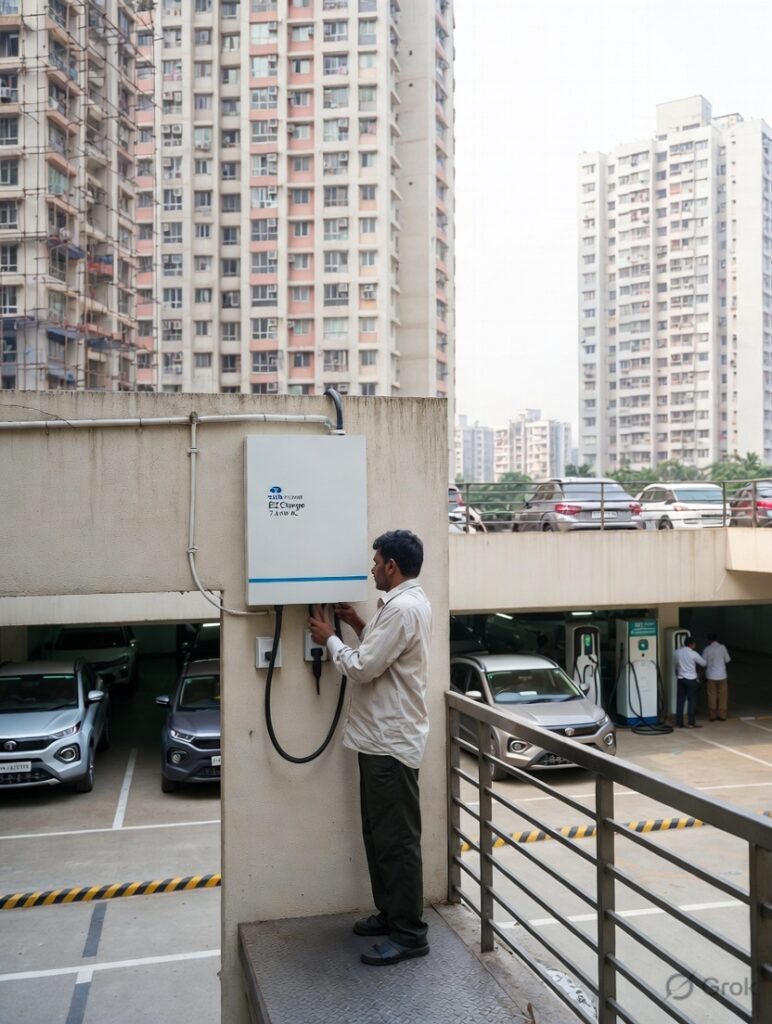
- Charger Chosen: Tata Power EZ Charge 7.4 kW AC wallbox (Type-2 connector, app-controlled, ₹35,000–45,000 installed).
Why? Reliable, compatible with Tata Nexon EV, smart scheduling for off-peak rates, and easy RWA approval due to Tata’s reputation. Alternatives considered: Statiq Nectar (7.4/11 kW, app-integrated) or Zeon home units (strong in South but available in Mumbai). - Installation Details
- Wiring: Dedicated 4 sq mm copper cable from flat meter to basement bay (~₹8,000–12,000).
- Mounting: Wall-mounted near pillar in allocated slot.
- Metering: Individual sub-meter for accurate billing (₹2,000–4,000).
- Total Cost: ₹50,000–65,000 (including charger, wiring, electrician, and minor society fees).
- Daily Routine & Savings
Kartikey charges overnight (10 PM–6 AM) at home, adding ~250–300 km range (₹80–120 per full charge at residential rates).
Vs. public fast chargers (₹18–25/kWh): Saves ₹400–600/month on 1,000 km commute.
Running cost: ₹0.18–0.25/km vs. ₹7–9/km on petrol.
Key Lessons & Tips for Mumbai Apartment Dwellers
- Start with Documentation: Gather Maharashtra EV Policy 2025 excerpts, Bombay HC ruling, and CEI safety advisory—present to RWA.
- Propose Shared Solutions: Suggest society-level Statiq or Tata Power community chargers (split costs, app-based billing) if individual denied.
- Choose Smart, Approved Chargers: Prioritize Tata Power EZ Charge, Statiq, or Zeon for reliability and easier society buy-in.
- Battery Swapping Backup: For two-wheelers, use networks like Battery Smart (650+ stations) during delays.
- Future-Proof: Newer Mumbai projects (post-2025) include EV-ready wiring—factor this when buying/renting.
Kartikey’s setup proves apartment charging is feasible in 2026 Mumbai—with persistence, policy knowledge, and the right partner. Curious about your society’s feasibility? Use our free comparison tool: input your pincode, building type, and EV model (Tata Nexon EV, Ola S1 Pro, etc.) to see compatible chargers, costs, and providers like Tata Power or Statiq in your area.
Compare EV Chargers for Your Apartment Now
Updated March 8, 2026. Subscribe for more Mumbai-specific EV tips and apartment charging updates.
I love how your posts are both informative and entertaining You have a talent for making even the most mundane topics interesting
Thank you for your kind words